Standing in front of the Last Supper is not like standing in front of any other painting in the world.
You don’t walk into a gallery and stumble upon it between two smaller works. You move through three sealed climate chambers, the humidity drops, a guard counts you in, and then — for exactly fifteen minutes — you are inside a refectory where a mural has survived five centuries of war, flooding, and near-destruction.
That is the strange, disciplined ritual surrounding the most carefully guarded fresco in Europe. And it begins, long before you arrive in Italy, with a single question: how far in advance should you lock in your entry?
If you’re searching for The Last Supper Milan tickets, the short answer is this: earlier than you think, and earlier than almost any other attraction in Europe. Only about 1,300 visitors are admitted per day. On peak weekends, slots disappear within hours of release.
This guide walks you through why access is so restricted, how booking actually works, what you’ll experience inside Santa Maria delle Grazie, and how to secure your spot without the stress of refreshing a sold-out calendar.
Why The Last Supper Isn’t Like Any Other Painting You’ll Ever See
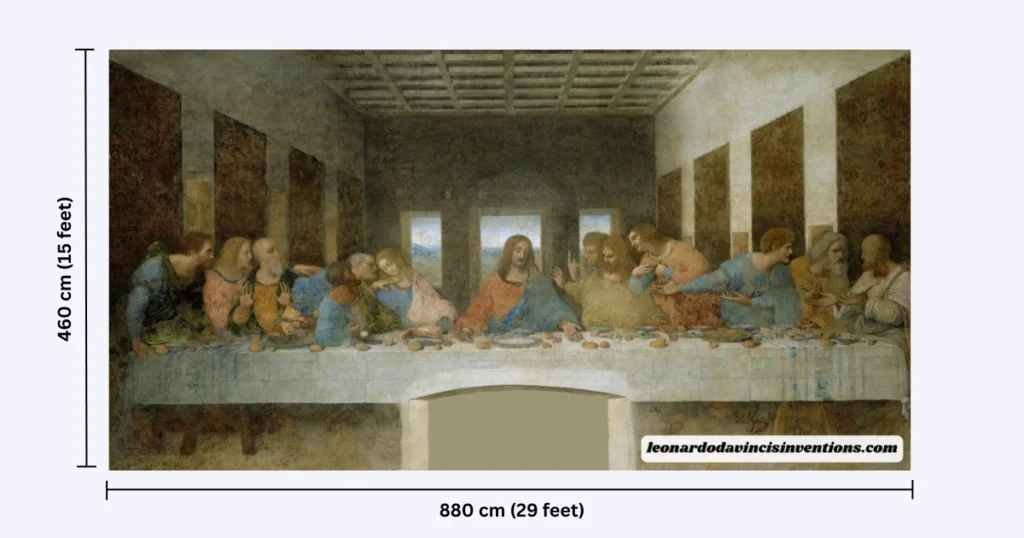
Leonardo da Vinci finished The Last Supper (known in Italy as Il Cenacolo) around 1498, painted directly onto the northern wall of the dining hall belonging to the Dominican friars at Santa Maria delle Grazie. It measures roughly 15 feet tall by 29 feet wide. And here is where the trouble — and the mystique — begins.
Leonardo refused to use the traditional buon fresco technique, in which pigment is applied to wet plaster and chemically bonds with the wall as it dries. Fresco is fast, unforgiving, and permanent — three qualities Leonardo, an obsessive reviser, despised.
Instead, he experimented with tempera and oil on dry plaster, which let him rework details for months at a time. It also meant the paint began to flake during his lifetime. By the mid-1500s, biographer Giorgio Vasari described the mural as already ruined.
What you see today is the result of a two-decade restoration completed in 1999 that stripped away centuries of overpainting and grime. It is fragile, faded in places, and protected by one of the strictest visitor protocols on earth.
That’s why tickets to the Last Supper in Milan are not sold like museum tickets elsewhere — they are rationed.
Why Availability Runs Out So Fast
Here is what almost no first-time visitor understands until they try to book: the limit isn’t commercial. It’s conservational.
Groups of a maximum of 35 people are allowed into the refectory at a time, for exactly 15 minutes, every 15 minutes. That math is brutal. The room operates roughly 8 hours a day, closed on Mondays.
At full capacity, that caps the daily total at around 1,300 people — worldwide demand, squeezed through a doorway the size of a small chapel. For comparison, the Uffizi in Florence admits roughly 10,000 visitors daily. On a busy day, the Louvre admits 45,000.
This is why the question isn’t really “where do I buy official Last Supper tickets?” — it’s “how early can I buy them?”
Tickets are typically released in three-month blocks, and for peak season (April through October, plus the Christmas holidays), the most desirable morning and late-afternoon slots are claimed within the first 48 hours of release.
If you’re traveling in summer and searching the official Last Supper tickets website two weeks before your trip, you will almost certainly find nothing. This isn’t a booking failure. It’s the system working exactly as designed.
The practical rule: for any visit between May and September, start planning at least 3 months in advance. For October through April (excluding Christmas week), six to eight weeks is usually workable. For Easter, Christmas, and Milan Design Week in April, treat four months out as your floor, not your ceiling.
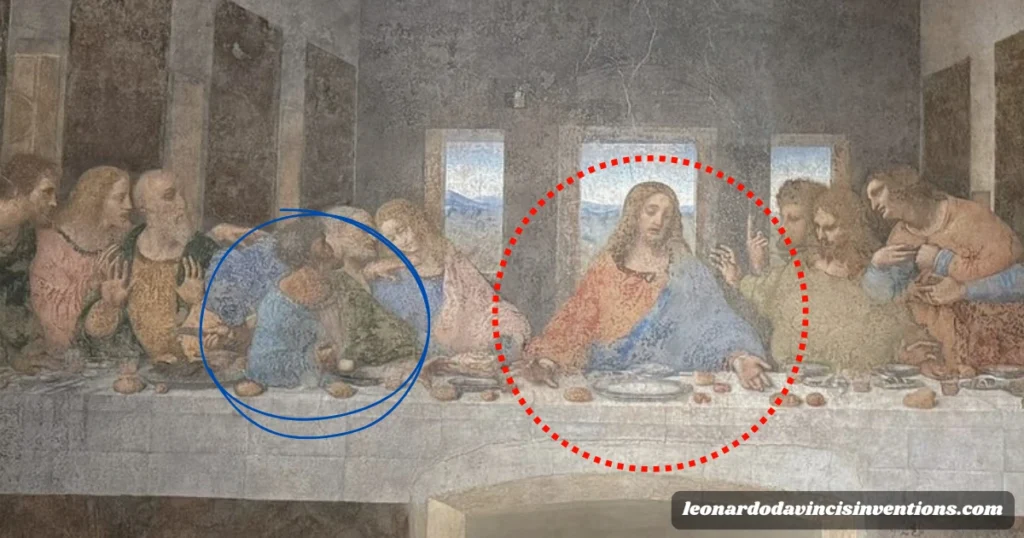
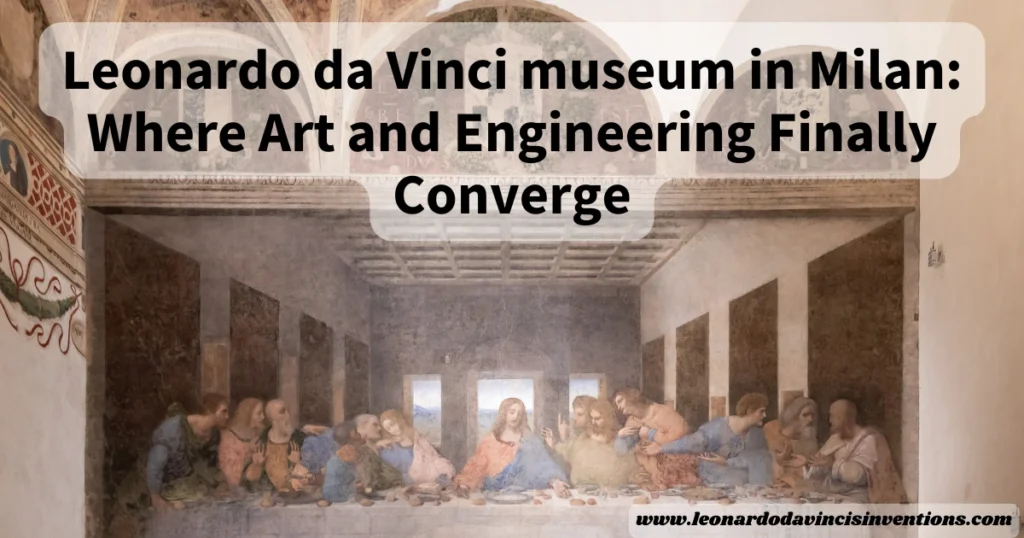
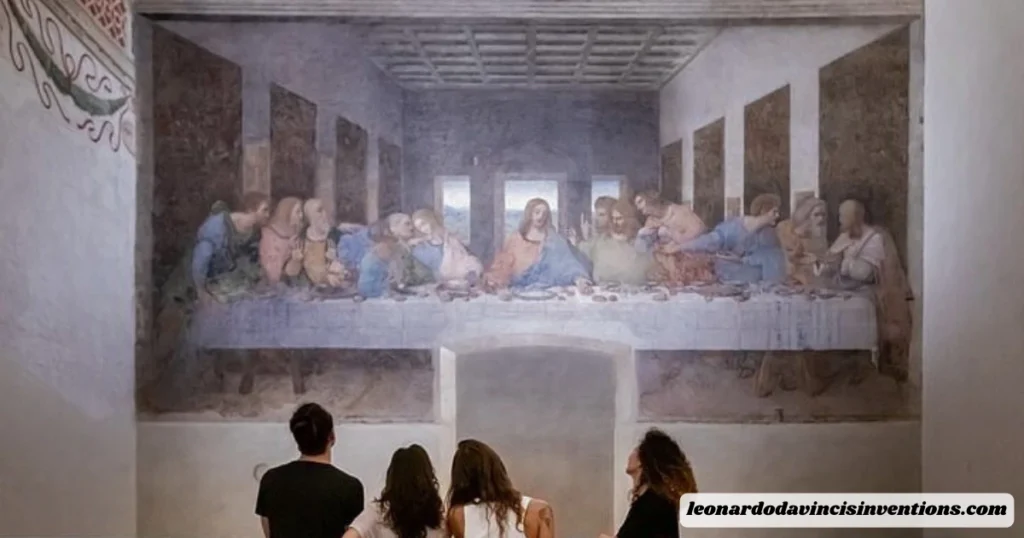
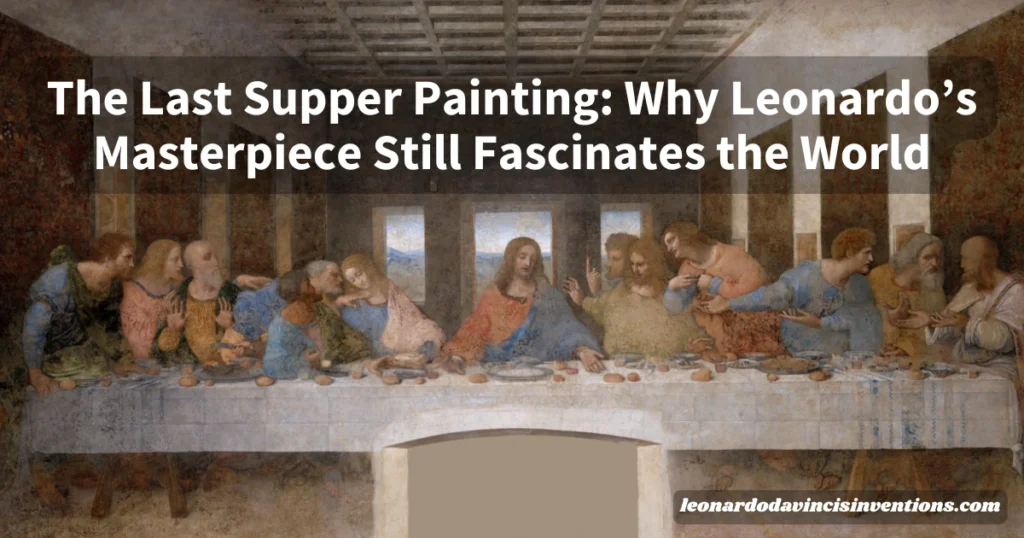
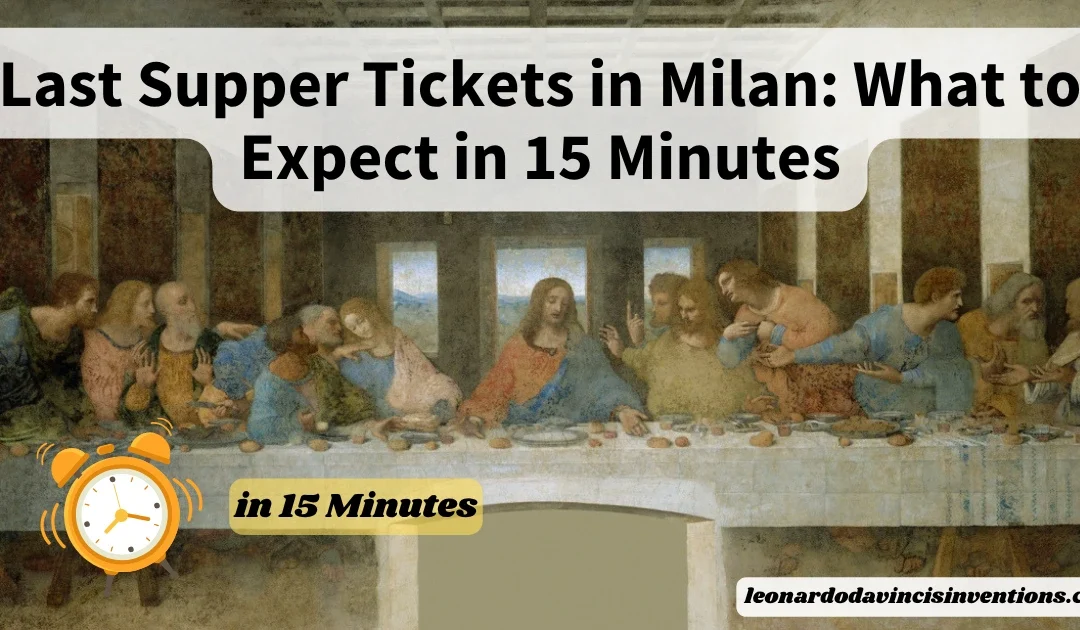
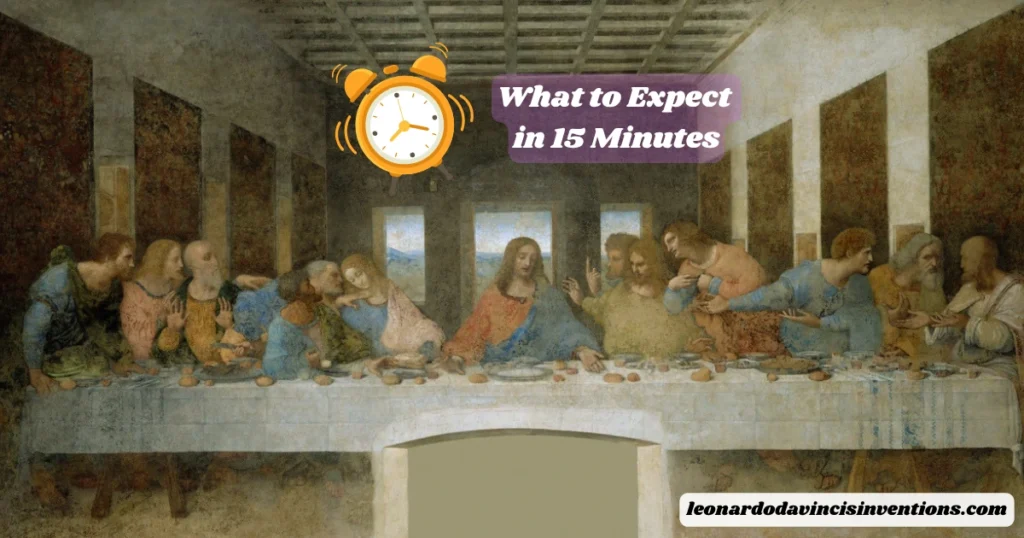
The Last Supper painting shows Christ at the center of the composition, with Judas seated in shadow among the apostles in the refectory of Santa Maria delle Grazie.
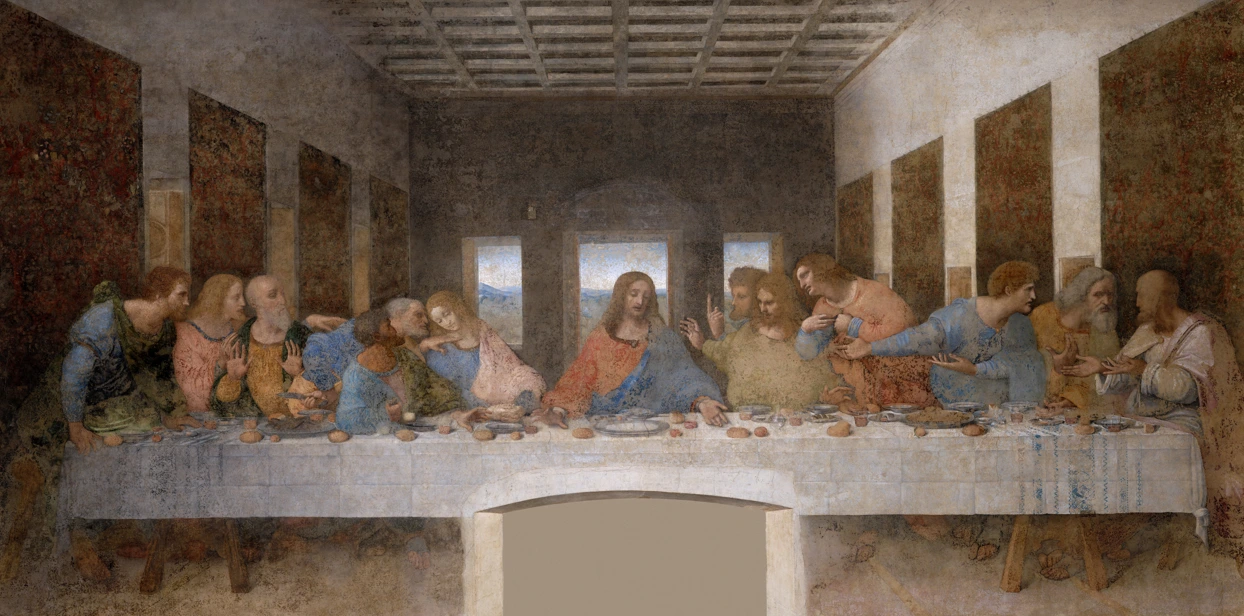
Most visitors know the painting depicts the moment Christ announces that one of the twelve apostles will betray him. What they often miss is that Leonardo chose the exact second the words land — not the betrayal itself, but the reaction. Every gesture in the room is a response, frozen mid-flinch.
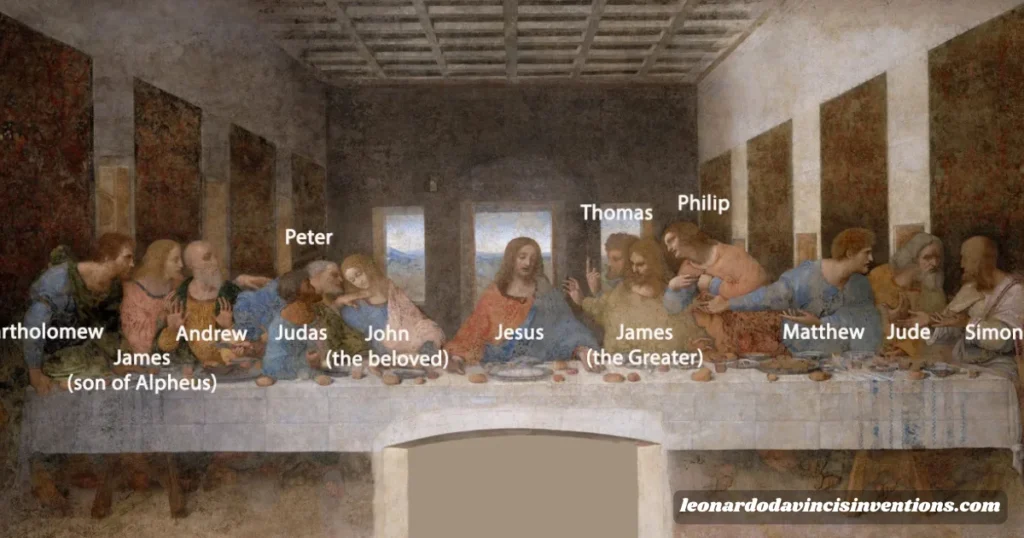
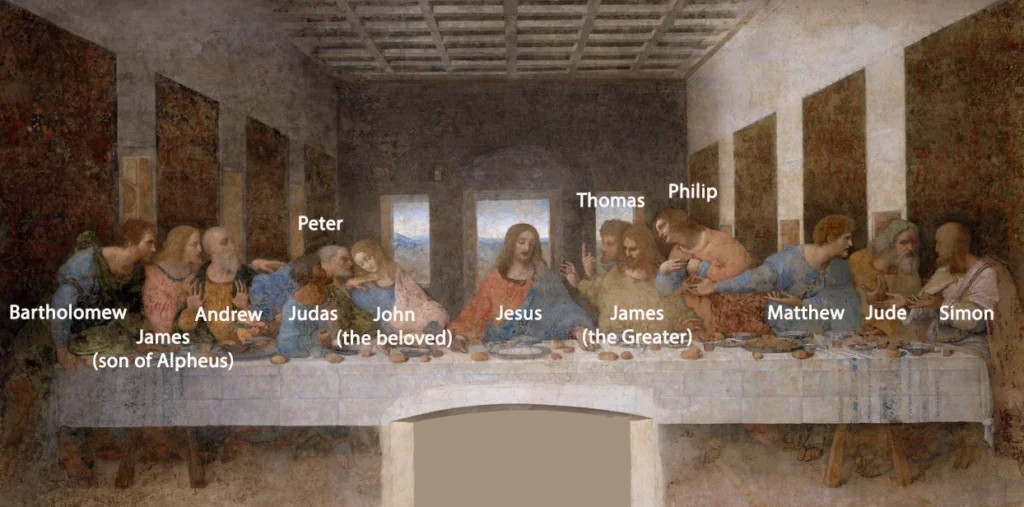
The apostles are arranged in four groups of three, a compositional rhythm that echoes the Trinity's theology. Judas is the only figure leaning back into shadow, his right hand clutching a small bag — traditionally read as the thirty pieces of silver.
He has just knocked over a salt cellar, a detail so subtle you can miss it in the faded pigment, but one Leonardo placed deliberately: spilled salt was a medieval emblem of broken trust. Peter grips a knife behind Judas’s back. Thomas raises a single finger, the same finger that will later probe Christ’s wounds.
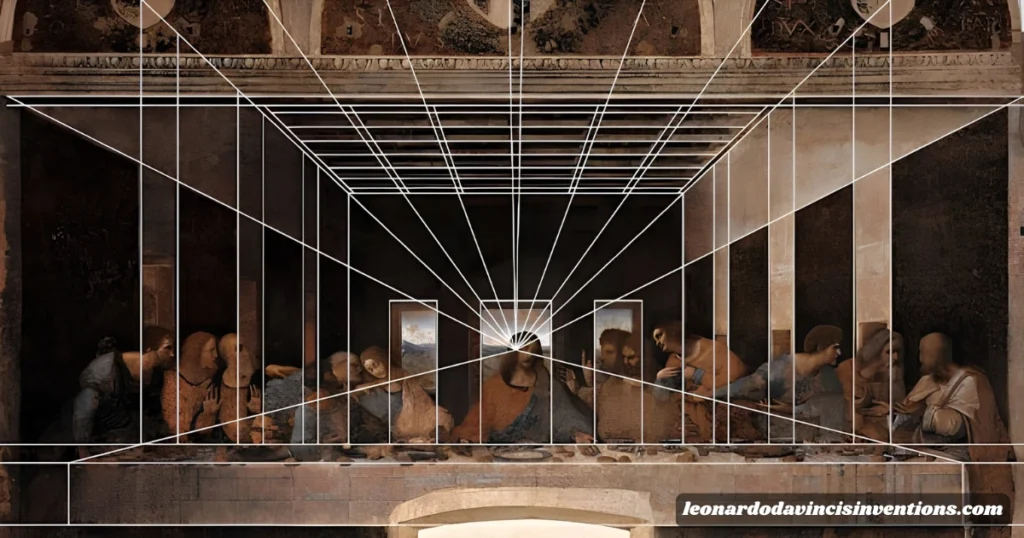
And then there is the vanishing point. Every line of linear perspective in the room — the beams of the ceiling, the edges of the tapestries, the sides of the table — converges behind Christ’s right temple.
Leonardo didn’t just paint a scene; he built an optical machine that forces your eye to land on one specific point no matter where you stand. This is the detail that guides tend to save for last, because once you see it, you can’t unsee it.
Where to See It: Santa Maria delle Grazie
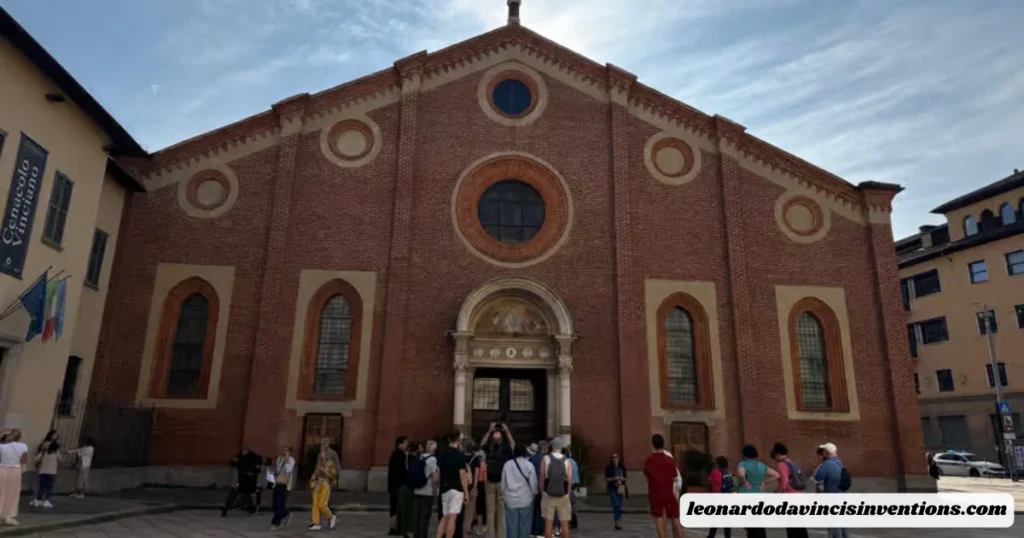
The mural lives where Leonardo painted it — on the north wall of the refectory of the Dominican convent of Santa Maria delle Grazie, a UNESCO World Heritage site on the western edge of central Milan. The address is Piazza di Santa Maria delle Grazie 2, about 15 minutes on foot from the Duomo or a five-minute walk from the Cadorna and Conciliazione metro stops.
The church itself, designed in part by Bramante, is worth arriving early for — especially its luminous tribune and small cloister that almost nobody visits. The refectory is a separate structure accessed through a modest modern doorway to the left of the church facade, marked Cenacolo Vinciano. That’s where your Last Supper in Milan, Italy, experience actually begins.
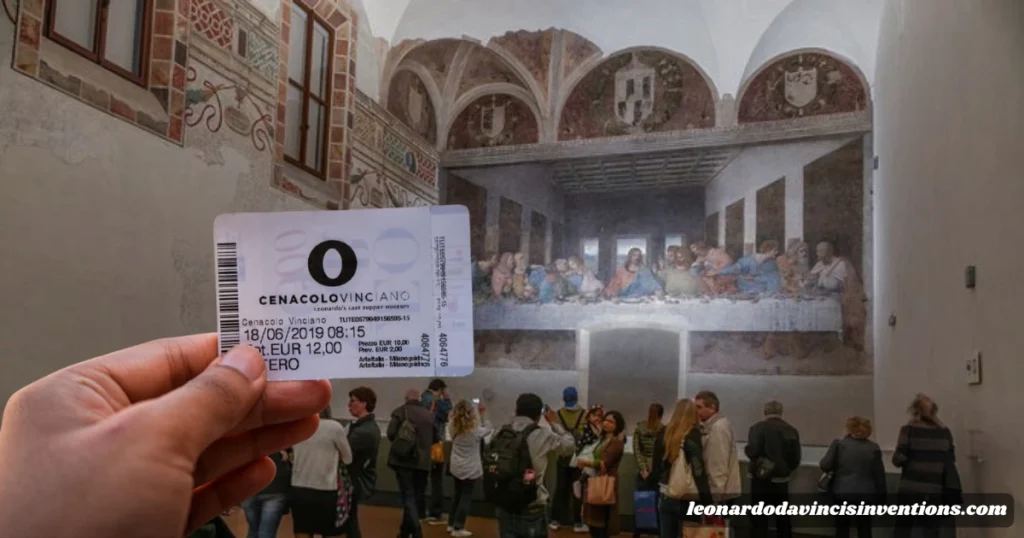
Arrive at least 20 minutes before your assigned slot — it’s enforced. If you miss your entry time, you forfeit the ticket entirely. No refunds, no rescheduling.
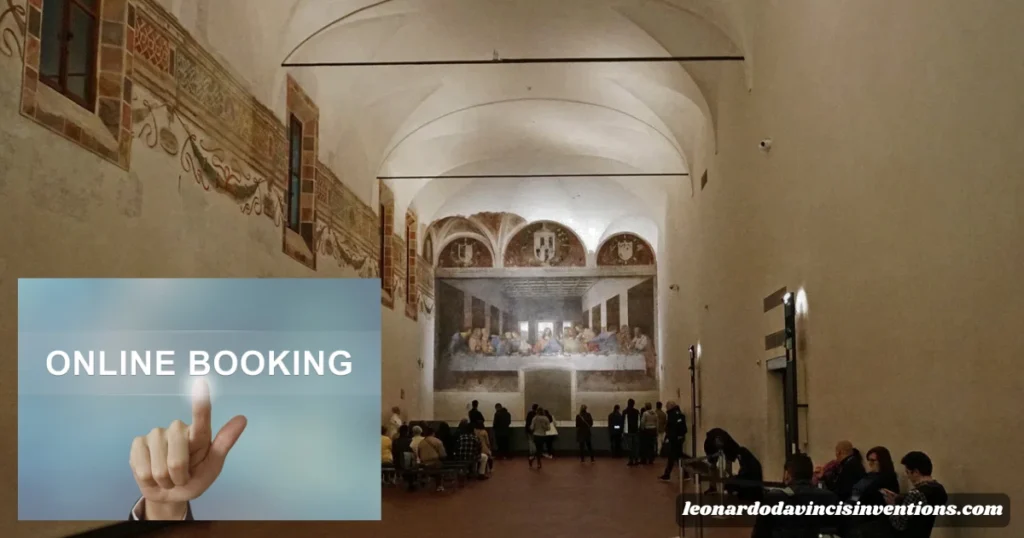
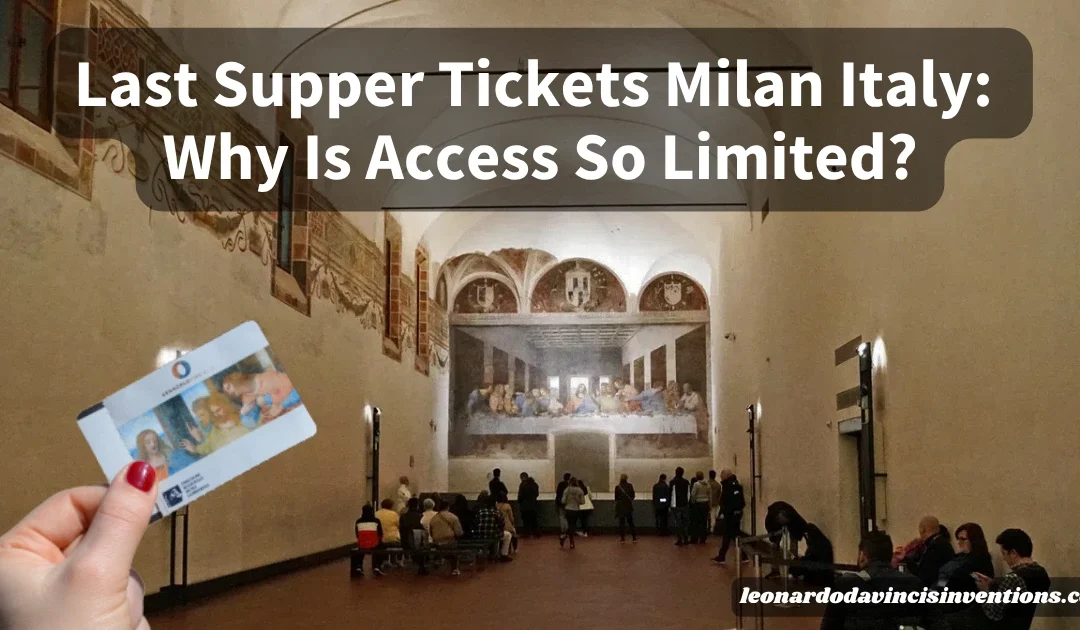
Security checks your ID against the name on the reservation, large bags go into a cloakroom, and then you move through climate-controlled dehumidification chambers that protect the mural from the moisture human bodies bring into the room. By the time the last door opens, you’re ready.
Experience This in Milan
This isn’t just something you read about — it’s something you feel standing inside that room. Knowing what to look for before you arrive transforms 15 minutes into something that stays with you.
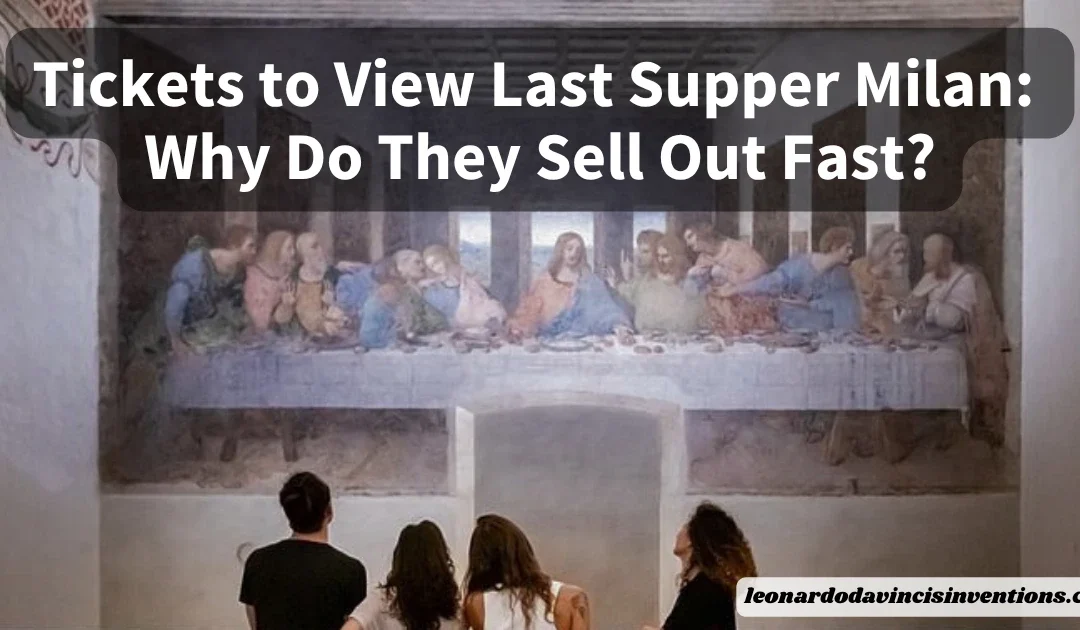
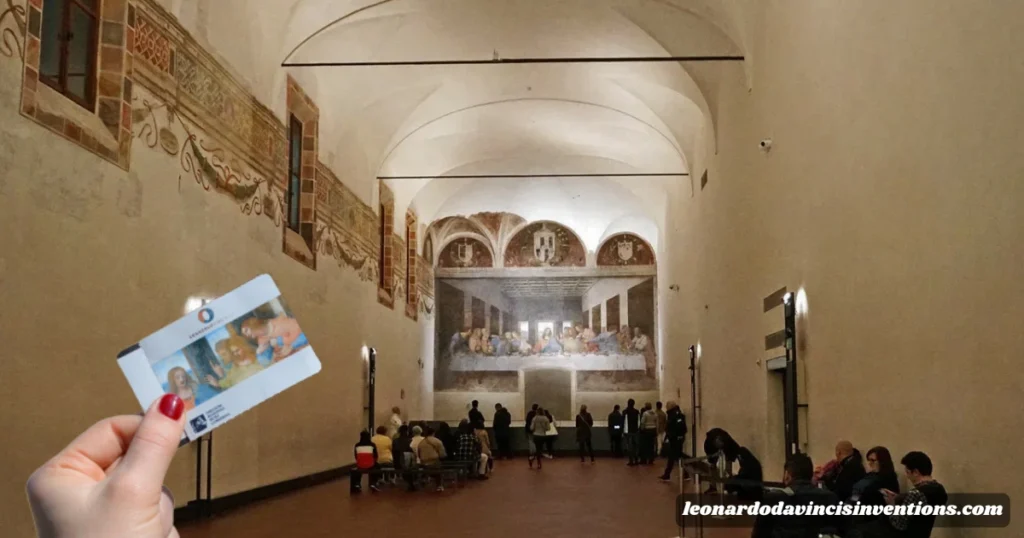
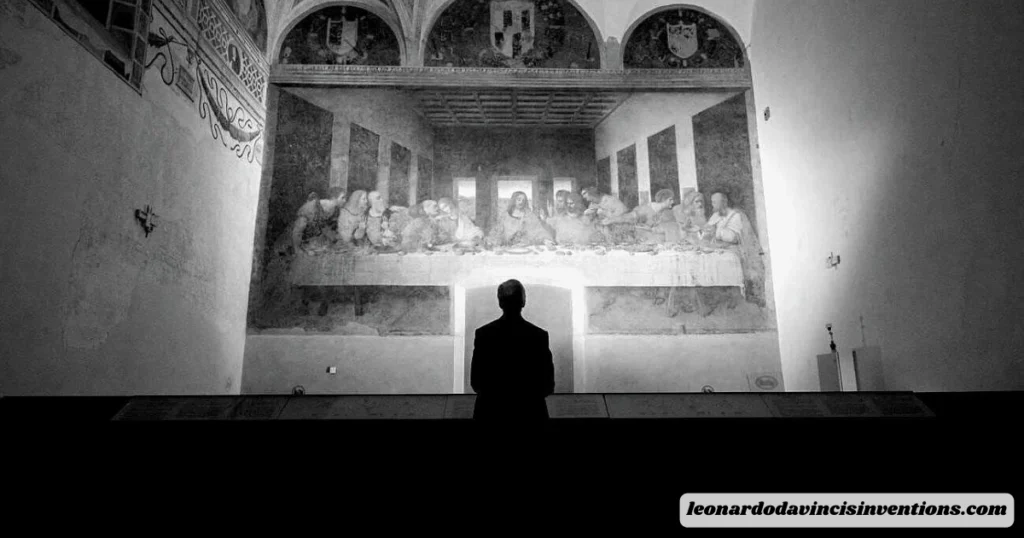
The first thing that surprises almost everyone is the size. Photographs never communicate how much wall this painting covers. When the final door slides open, the mural fills your entire field of vision — the table stretches across the room at roughly eye level, as if you’ve walked into the meal itself.
This was Leonardo’s intention. The refectory was where the friars ate their daily meals in silence. The painted table and the real tables of the Dominicans were meant to mirror each other, so that every dinner the community shared was, in a sense, sitting across from Christ.
The second surprise is the silence. The ventilation system hums faintly. Visitors speak in whispers, if at all. There is no velvet rope, no jostling crowd. You can walk the length of the room or sit on the low bench along the opposite wall.
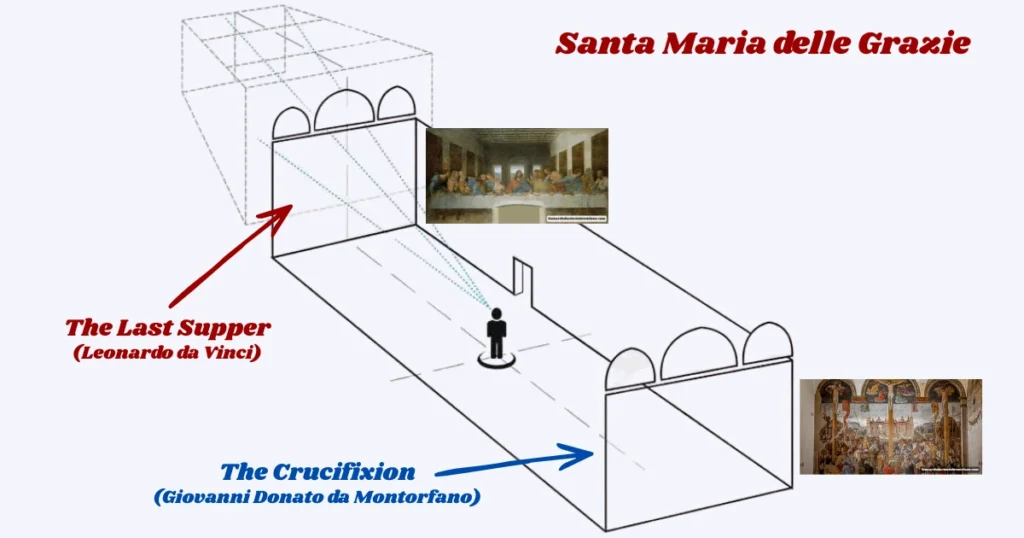
On the far side of the refectory, almost always overlooked, is a Crucifixion by Giovanni Donato da Montorfano, painted in 1495. It’s worth turning around — Leonardo himself added the kneeling donor figures to that wall, though time has faded his contributions beyond recognition.
Fifteen minutes sounds short until you’re in the room. Then it feels exactly right — long enough to slow your breathing, short enough that you leave still hungry for it. When the far door opens to release you, there is always a pause. Most people don’t want to go.
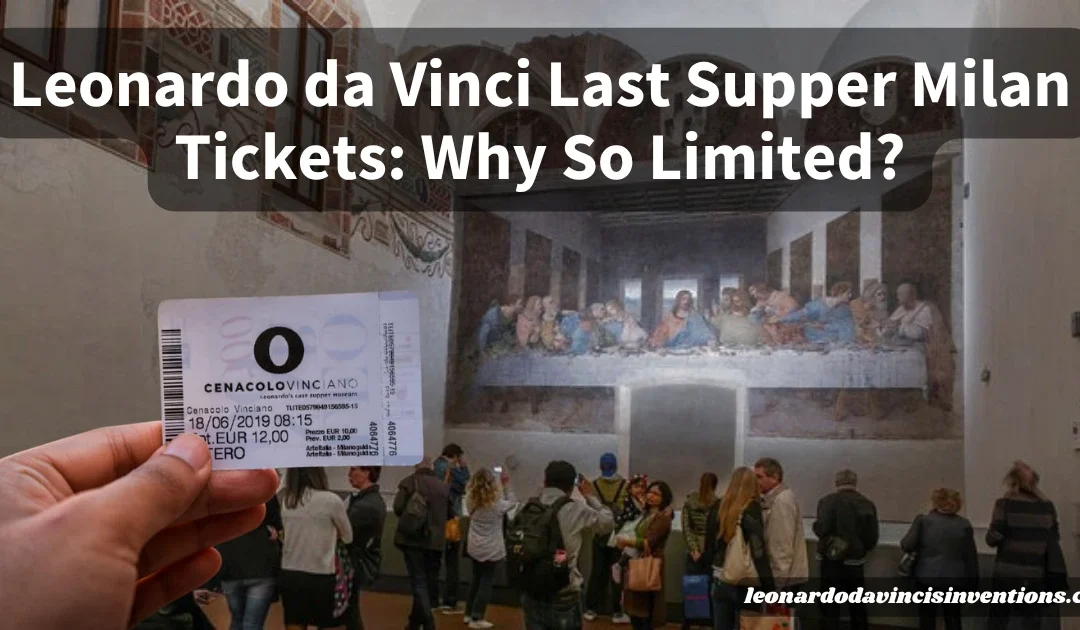
There are two basic ways to see Milan’s Last Supper. The first is to buy a direct-entry ticket through the official ministry site, cenacolovinciano.vivaticket.it, which releases slots roughly three months in advance and sells them as bare entry: no audio guide, no explanation, 15 minutes on your own.
This option costs less, but you’re on your own to interpret what you’re looking at — and most visitors, staring at a 500-year-old mural for the first and only time in their life, wish afterward they had known more.
The second option is a small-group guided visit, typically booked through experience platforms that hold reserved ticket allocations. These are especially useful when the official website shows sold out, because tour operators often purchase time-slot inventory months in advance.
A guide spends 20 to 30 minutes outside the refectory explaining the commission, the Sforza dynasty that paid for it, Leonardo’s strange working habits, and the iconography — so when your fifteen minutes inside begin, your eyes already know where to go. Many guided options also bundle the nearby Sforza Castle or the Duomo.
For most first-time visitors, the guided option is worth the difference in cost. You’re not paying for a ticket you could have found yourself — you’re paying for the context that turns the visit into something you’ll actually remember five years from now.
How to Experience the Last Supper Without Missing the Details
Access is limited, and most visitors only get a few minutes inside.
The difference is having the right context before you walk in.
If you’re still deciding how early is early enough, here is a realistic rhythm. For a summer visit — say, a week in June — you should be looking at availability in early March, the moment the next trimester opens.
Official releases happen quarterly: January opens April through June, April opens July through September, July opens October through December, and October opens the following January through March.
Midweek mornings (Tuesday through Thursday, 8:15 to 10:30 AM) disappear first because tour operators buy them in bulk. Late afternoons on weekends are the second wave.
The slots that linger longest are early weekday afternoons in November and February — shoulder-season gold, if your dates are flexible. For trade fairs like Salone del Mobile in April or Milan Fashion Weeks in February and September, assume all inventory evaporates six weeks before the event.
One more thing worth knowing: the official platform does release small batches of last-minute inventory, sometimes just a few days before, when group reservations are returned to the pool. These appear unpredictably.
If you’re already in Milan and missed your window, check the official Last Supper tickets website at 9 AM local time — and also look at guided experience platforms, which sometimes have same-week slots that the direct channel doesn’t.
What to Pair With Your Visit
Because the Last Supper visit is so brief, it’s worth building a half-day around it. Within a ten-minute walk of Santa Maria delle Grazie, you’ll find the Museo Nazionale Scienza e Tecnologia Leonardo da Vinci, which houses the world’s largest collection of models built from Leonardo’s engineering drawings.
The Vigna di Leonardo — the small vineyard gifted to him by Ludovico Sforza in 1499, restored in 2015 and replanted with the original Malvasia grape — sits directly across the street from the church.
For a meal after, the neighborhood around Corso Magenta has unfussy trattorias serving Milanese classics: risotto alla milanese, cotoletta, ossobuco. Avoid the restaurants immediately fronting the piazza — they charge tourist rates — and walk two blocks in any direction.
Leonardo worked on this mural for three years, revising, scraping, and starting over. Visitors get fifteen minutes.
The asymmetry is part of what makes the experience so charged — you are handed a narrow, guarded window into something that has survived bombs, floods, and Napoleon’s troops stabling horses in the room. Booking early isn’t a tourist hack. It’s the only way to be in the room at all.
For summer, book three to four months ahead. For shoulder season, six to eight weeks. For holiday periods, treat four months as your minimum.
Choose a guided experience if you want the mural to come alive beyond what a wall label can tell you; choose a direct ticket if you want fifteen uninterrupted minutes alone with it. Either way, don’t wait until you land in Milan. By then, the room is already full.
Travel Essentials for Visiting Milan for the First Time
Preparing for a visit to Milan often comes down to a few small details that can make long museum days, historic walking routes, and city exploration significantly more comfortable.
Comfortable Walking Shoes
Milan’s major landmarks are often best experienced on foot, with visitors covering long distances between museums, churches, and historic streets. Supportive shoes can make a full day of exploration far more comfortable →
explore comfortable walking shoes for long city days
Portable Power Bank
Navigation, photography, and digital tickets can quickly drain battery life during a full day in the city. A compact power bank helps avoid interruptions, with many visitors choosing lightweight options →
view reliable portable chargers
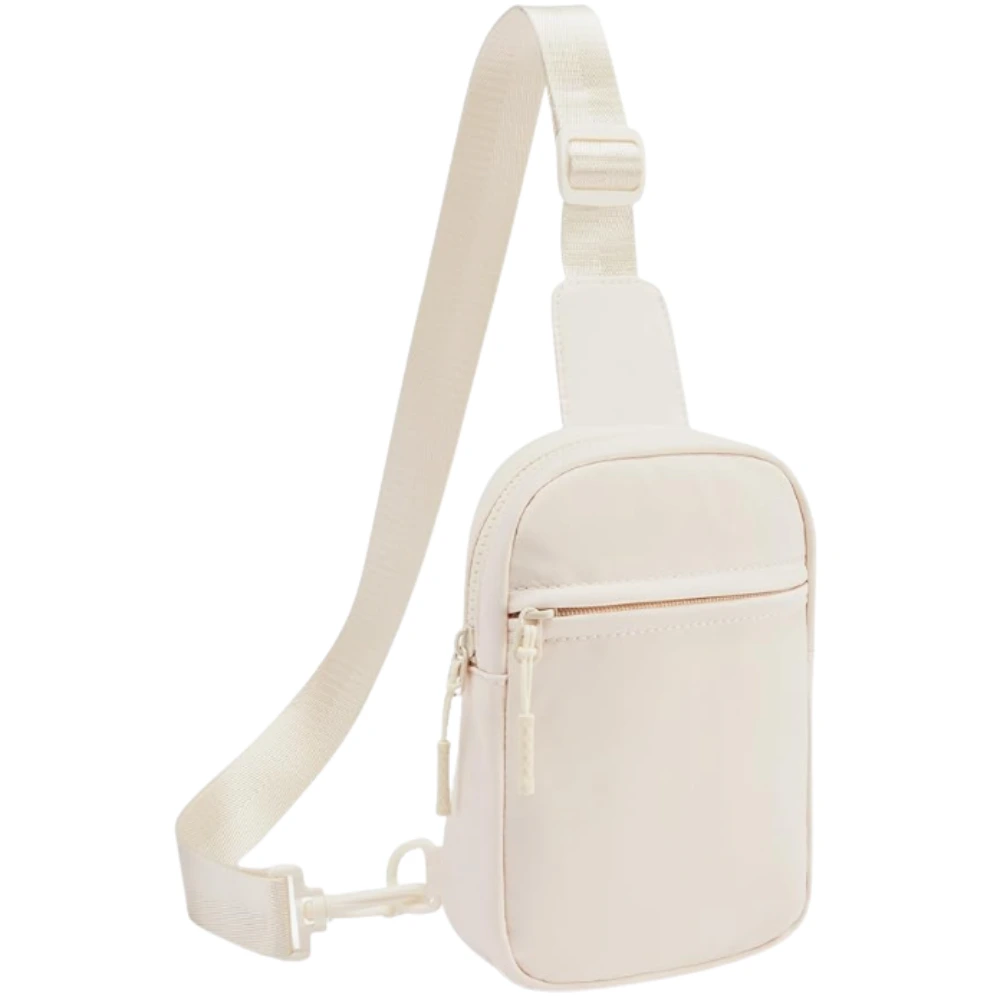
Secure Crossbody Bag
Busy areas near major attractions can require extra awareness. Many travelers prefer a compact crossbody bag worn in front to keep essentials accessible and secure →
A compact option often preferred for full-day city travel.
FAQs about The Last Supper Milan Tickets
Do you need tickets to see the Last Supper in Milan?
Yes, you need tickets to see The Last Supper in Milan, and advance reservations are mandatory. Entry is strictly controlled, with timed slots, and tickets are released in limited batches that often sell out months in advance.
Why is it so hard to get tickets for the Last Supper?
It is difficult to get tickets because access is tightly limited to protect the fragile mural. Only small groups are allowed inside for short time slots, while global demand remains extremely high, leading to tickets selling out quickly.
Is Milan's Last Supper worth it?
Yes, seeing The Last Supper in Milan is widely considered worth it, as it is one of the most important artworks of the Renaissance and a unique, immersive experience. Despite the effort required to book, many visitors rank it as a must-see highlight of Milan.
How far in advance should I book the Last Supper?
You should book The Last Supper tickets as early as possible—ideally 2–4 months in advance. Tickets are released in advance blocks and often sell out within days, especially during peak travel seasons.
Is there a dress code to see the Last Supper in Milan?
There is no strict formal dress code, but visitors are expected to dress respectfully since the site is part of a religious complex. Avoid overly casual or revealing clothing to ensure entry without issues.
Can you just turn up to see the Last Supper?
No, you generally cannot just turn up to see The Last Supper without a reservation. Same-day tickets are rarely available, and most visitors must book in advance or join a guided tour with pre-reserved access.
Every single day, thousands of travelers search for a way inside a small, climate-controlled room in Milan — and most of them leave disappointed. Not because the painting fails to impress, but because they never made it through the door.
Securing tickets to view the Last Supper in Milan has become one of the most competitive reservations in European travel, often booked out weeks or even months in advance.
So what makes this 15-minute viewing experience so ferociously sought-after, and why does Leonardo da Vinci’s masterpiece vanish from availability calendars faster than almost any other cultural site in Italy?
The answer isn’t just fame. It’s a collision of scarcity, fragility, and one of the most psychologically charged images ever painted — a work that continues to reveal new layers the longer you stand before it.
The Story Behind the Most Guarded Painting in Milan
Leonardo painted The Last Supper between 1495 and 1498 on the refectory wall of the Dominican convent of Santa Maria delle Grazie. Duke Ludovico Sforza commissioned it as a meditative aid for the monks who ate beneath it every day.
Unlike traditional fresco, which demands speed and permanence, Leonardo chose an experimental technique: tempera and oil applied directly to dry plaster. This let him work slowly, revise obsessively, and capture expressions no fresco painter had ever attempted. But it came at a devastating cost: the paint began to flake off within 20 years of completion.
What you see today is the result of more than 500 years of deterioration, botched restorations, Napoleonic vandalism, and — most astonishingly — a 1943 Allied bombing that destroyed the refectory’s roof and three walls.
The Last Supper survived behind sandbags. That survival alone is part of why access is so tightly controlled. The painting isn’t just priceless; it’s medically fragile. Humidity, breath, and body heat all accelerate its decay, which is why only 30 visitors are permitted inside the viewing room at a time, for exactly 15 minutes.
The Key Insight: Why This Painting Changed Art Forever
The Last Supper painting depicts the apostles reacting to the betrayal in the refectory of Santa Maria delle Grazie in Milan.
Most visitors arrive expecting to see a religious painting. What they actually encounter is more like a freeze-frame from a psychological thriller.
Leonardo didn’t paint the moment of the Eucharist, as virtually every artist before him had. He painted the exact second after Christ says, “One of you will betray me.”
That single decision redefined Western art. Look closely at the twelve apostles, and you’ll see them grouped in four clusters of three — not by chance, but as a study in human reaction.
Philip presses a hand to his chest in disbelief. Peter lurches forward, knife already in hand. Thomas raises a finger, the same gesture he’ll later use to doubt the Resurrection.
And Judas — unlike every earlier depiction — sits among the apostles rather than isolated across the table. He clutches a small bag of silver and knocks over the salt cellar, a detail so subtle that many visitors miss it entirely until a guide points it out.
Leonardo wasn’t painting a scene. He was painting twelve individual emotional responses to the same devastating sentence. No one had ever done that before.
Once you know where to look, the painting stops being a frozen tableau and becomes more like a puzzle Leonardo left for anyone patient enough to decode.
The vanishing point of the entire composition — every architectural line, every beam in the ceiling — converges directly behind Christ’s right temple. Your eye is forced to land on him whether you notice it or not.
The window behind him frames his head like a halo, but Leonardo refused to paint an actual one. He wanted the divinity to come from composition, not convention.
The hands on the table form a rhythm: open, closed, pointing, grasping — each one telling you something about the apostle attached to it. And the bread and wine glasses are arranged in a pattern some scholars have argued mimics a musical score, though that interpretation remains contested.
What’s not contested is this: every inch of the painting rewards slow looking. And slow looking is exactly what 15 minutes doesn’t give you — unless you walk in already knowing what to search for.
Where Is the Last Supper Painting Located?
The Last Supper remains exactly where Leonardo painted it: on the north wall of the refectory at Santa Maria delle Grazie, a Dominican convent in central Milan. The church itself is a UNESCO World Heritage Site and a masterpiece of Renaissance architecture by Donato Bramante.
The refectory is a separate building adjacent to the church, now climate-controlled and accessed through a series of airlock-style chambers designed to stabilize humidity before visitors enter the viewing room.
The address is Piazza di Santa Maria delle Grazie 2, in the Magenta district — a quiet, elegant neighborhood about a 15-minute walk from the Duomo or a short metro ride (Line 1 or 2, Cadorna stop).
Unlike the Vatican or the Uffizi, this isn’t a museum you wander through. You arrive at a specific time, present your reservation, pass through the dehumidification chambers, and enter the refectory for exactly 15 minutes before being ushered out so the next group can enter.
Because capacity is capped at roughly 1,300 visitors per day — in a city that receives more than 8 million tourists annually — reservations for the Last Supper in Milan routinely disappear months before anyone steps onto a plane. This is why Last Supper tickets at the last minute are famously difficult to find through the official channel, and why guided-access options often remain the only realistic way in.
Experience This in Milan
This isn’t just something you read about — it’s something you feel standing inside that room. Knowing what to look for before you arrive transforms 15 minutes into something that stays with you.
No photograph prepares you for it. The painting is enormous — roughly 15 feet tall and 29 feet wide — and it occupies the entire end wall of a long, narrow hall. The moment you walk in, the proportions shift.
You’re not looking at a picture; you’re looking through a window into a second room that seems to extend the refectory itself. Leonardo designed it that way. The perspective was calculated so that monks eating at the long tables below would feel as if Christ and the apostles were dining alongside them.
The colors are softer than reproductions suggest — more faded, more ghostly. That fragility is part of the emotional weight. You’re looking at something that shouldn’t still exist.
Visitors often describe an involuntary quiet that settles over the room. People lower their voices without being asked. Some cry. Others simply stand motionless for the full 15 minutes, tracking one apostle’s expression at a time.
On the opposite wall is the Crucifixion by Giovanni Donato da Montorfano, painted just before Leonardo began his work. Almost no one looks at it. That’s how completely Leonardo’s painting dominates the space — it pulls every eye in the room toward itself the instant the door opens.
Three forces collide to make this one of Europe’s hardest cultural reservations. First, there’s the hard capacity ceiling — fewer than 1,300 people per day, compared to roughly 25,000 at the Vatican Museums or 15,000 at the Uffizi.
Second, the painting’s cultural profile has exploded since The Da Vinci Code introduced it to readers who’d never otherwise have sought it out.
Third, release schedules favor planners: slots on the Last Supper tickets official website open in blocks, typically three to four months in advance, and the most desirable times — mid-morning and early afternoon — often sell out within hours of release.
The result is a booking market where demand perpetually outpaces supply. Travelers who arrive in Milan without a reservation are almost never able to walk in. Even trying to get Last Supper tickets last-minute through the official system is usually a dead end — though a small number of cancellation slots do occasionally appear the day before, if you’re willing to refresh the page compulsively.
This is why authorized guided operators have become the practical solution for most international visitors. They hold pre-allocated blocks of entry times released specifically for tour access, and they pair the visit with expert commentary that transforms those 15 minutes from a blur into something coherent.
How to Experience the Last Supper Without Missing the Details
The difference between a memorable visit and a forgettable one almost always comes down to preparation. Fifteen minutes is not much time to absorb a painting that took Leonardo three years to complete.
Visitors who arrive cold — without knowing who’s who, where to look, or what the symbolic details mean — tend to remember the experience as rushed. Visitors who arrive with context often describe it as one of the single most powerful cultural moments of their lives.
How to Experience the Last Supper Without Missing the Details
Access is limited, and most visitors only get a few minutes inside.
The difference is having the right context before you walk in.
A few practical notes worth knowing before you go. Arrive at least 20 minutes before your entry slot — the dehumidification chambers require timed sequencing, and latecomers are not admitted.
Large bags must be checked at the entrance. Photography inside the refectory is strictly prohibited, which actually turns out to be a gift: everyone in the room is present, not staring through a phone screen.
Try to combine the visit with a walk through Santa Maria delle Grazie itself, especially Bramante’s apse, which is one of the finest examples of early High Renaissance architecture anywhere in Italy.
The neighborhood also contains the Museo Nazionale Leonardo da Vinci, a ten-minute walk away, which houses working models of Leonardo’s inventions and makes an excellent complement to the refectory visit. Together, these sites let you spend half a day tracing Leonardo’s creative footprint across Milan.
If you’re traveling during high season — April through October, plus the Christmas and New Year period — assume tickets will be gone the moment you start searching casually. Milan Last Supper tickets released for these windows often vanish the same week they open.
Winter weekdays offer better odds, and the refectory is noticeably less crowded in January and February, though even then, last-minute availability is rare.
It would be fair to ask whether any painting justifies this much logistical effort. The honest answer, from almost everyone who has actually stood in that room, is yes. The Last Supper is not simply a famous image reproduced on postcards and dormitory posters.
It is a living survivor of five centuries, a psychological portrait gallery disguised as a biblical scene, and the single work that arguably separates medieval painting from everything that followed.
The difficulty of getting in is, in a strange way, part of the experience. You arrive knowing you’ve earned the 15 minutes. You prepare. You anticipate. You pass through the chambers, the door opens, and there it is — softer and stranger and more human than you imagined.
You look at Judas first because you can’t help it. Then Christ. Then you start tracking outward, apostle by apostle, until a guide or a timer pulls you back into the present.
That’s why tickets to see the Last Supper in Milan sell out the way they do. Not because scarcity manufactures desire, but because the painting actually delivers on the promise. And for anyone willing to plan ahead—or to secure a guided slot after direct access has already closed—Milan offers one of the most concentrated, unforgettable cultural experiences available anywhere in Europe.
Travel Essentials for Visiting Milan for the First Time
Preparing for a visit to Milan often comes down to a few small details that can make long museum days, historic walking routes, and city exploration significantly more comfortable.
Comfortable Walking Shoes
Milan’s major landmarks are often best experienced on foot, with visitors covering long distances between museums, churches, and historic streets. Supportive shoes can make a full day of exploration far more comfortable →
explore comfortable walking shoes for long city days
Portable Power Bank
Navigation, photography, and digital tickets can quickly drain battery life during a full day in the city. A compact power bank helps avoid interruptions, with many visitors choosing lightweight options →
view reliable portable chargers
Secure Crossbody Bag
Busy areas near major attractions can require extra awareness. Many travelers prefer a compact crossbody bag worn in front to keep essentials accessible and secure →
A compact option often preferred for full-day city travel.
FAQs about Tickets to View the Last Supper in Milan
Do you need tickets to see the Last Supper painting in Milan?
Yes, tickets are required to see The Last Supper in Milan. Entry is strictly controlled with timed reservations, and all visitors must book in advance to access the refectory at Santa Maria delle Grazie.
Can you just turn up to see the Last Supper?
No, you cannot simply show up to see the painting. Walk-in access is not available, and tickets must be reserved in advance through official channels or authorized providers due to limited capacity and timed entry slots.
How to see the Last Supper if tickets are sold out?
If official tickets are sold out, visitors can still access the painting by booking guided tours through authorized operators or checking for last-minute cancellations on official platforms. These options often provide reserved time slots not available to the general public.
What is the official website for Last Supper tickets?
The official website to book tickets is Museo del Cenacolo Vinciano (cenacolovinciano.org), with ticket sales handled through its authorized platform. Reservations open in scheduled release blocks throughout the year.
Why is it so hard to get tickets for the Last Supper?
Tickets are difficult to obtain because visitor numbers are strictly limited to small groups for short viewing times, helping preserve the fragile artwork. Combined with global demand, this creates intense competition for a very limited number of daily tickets.
Is it better to book the Last Supper in advance?
Yes, booking in advance is essential. Tickets are typically released months ahead and often sell out quickly, so early planning is the most reliable way to secure a time slot and avoid missing the experience entirely.
You can walk into the Louvre and stand in front of the Mona Lisa any day of the year. You can stroll into the Sistine Chapel with a general Vatican ticket.
But to stand in front of Leonardo da Vinci's Last Supper in Milan, you need something very different: a timed slot, booked weeks (sometimes months) in advance, inside a climate-controlled room that holds barely 30 people at a time. Fifteen minutes. Then you're politely ushered out.
Why is access to this single painting more tightly controlled than almost any other masterpiece on earth? The answer is part chemistry, part history, part accidental genius — and understanding it is the difference between seeing a faded fresco on a wall and witnessing what many art historians consider the most psychologically complex painting ever produced in the Western tradition.
If you're planning a trip to Milan, figuring out how to see the Last Supper in Milan is usually the first — and most frustrating — item on the list. Let's unpack why, what you're actually looking at, and how to make those fifteen minutes count.
A Painting That Was Dying the Moment Leonardo Finished It
To understand why tickets to see the Last Supper in Milan, Italy, are so scarce, you have to understand what Leonardo did wrong — magnificently, stubbornly wrong.
In 1495, when Duke Ludovico Sforza commissioned Leonardo to paint the refectory wall of the Dominican convent of Santa Maria delle Grazie, the accepted technique for a mural this size was buon fresco — pigment applied directly into wet plaster.
Fresco is brutal, unforgiving, and fast. You get one chance. Once the plaster dries, the color is locked in for centuries.
Leonardo hated that. He was a notorious perfectionist, a man who could spend a full morning painting a single eyelash and then scrape it off by lunch. Fresco didn't allow for second thoughts, and Leonardo was made of second thoughts.
So he invented his own technique. He sealed the dry wall with a ground of pitch, gesso, and mastic, and painted on top of it in tempera and oil — a method that let him layer, revise, and finesse his expressions for years.
The results were breathtaking. The faces had a luminosity no fresco had ever achieved. Judas's shadowed panic, John's gentle sorrow, Thomas's accusatory finger already raised toward the sky — all rendered in painterly subtlety impossible in traditional fresco.
It also began to flake off the wall within 20 years.
By 1517, contemporaries were already reporting deterioration. Over the next five centuries, things got worse: Napoleon's troops stabled horses in the refectory, an 1800 flood soaked the lower third, a door was cut through Christ's feet in 1652, and in 1943 an Allied bomb destroyed the roof — the Last Supper survived only because monks had sandbagged it before the raid.
The Room That Keeps It Alive
This is the key insight most visitors miss: the strict access rules aren't a bureaucratic inconvenience. They're life support.
After the final, painstaking twenty-two-year restoration completed in 1999, the painting was placed under a tightly regulated microclimate. Humans are walking humidity machines. Every visitor exhales water vapor, sheds skin cells, and carries dust.
In a normal gallery, those contributions are negligible. In front of a 15th-century oil-and-tempera experiment clinging to a wall, they're catastrophic.
So the room operates as a filter. Visitors enter through a series of airlocks that dehumidify the air and strip particulates before anyone gets close to the painting.
Groups are capped at around 30 people. Viewing is capped at 15 minutes. Only about 1,300 people per day can enter. That's fewer than the Louvre admits in a single hour.
Multiply that by 365 days and subtract Mondays (when the site closes), and you get why Last Supper tickets last minute is a phrase that usually ends in disappointment. Demand dwarfs supply by roughly ten to one during high season.
The Last Supper painting depicts the apostles in groups of three in Santa Maria delle Grazie’s refectory in Milan.
Every other Last Supper in Western art — and there are hundreds — depicts the institution of the Eucharist. Christ blesses the bread. Apostles look pious. It's a sacrament made visible.
Leonardo ignored that tradition entirely. He painted the moment immediately after Christ says, “One of you will betray me.”
This is not a religious scene. It is a psychological shockwave, frozen mid-ripple. The apostles cluster into four groups of three — a deliberate trinitarian composition — and each group reacts differently.
Philip rises, hand to chest, pleading his innocence. James throws his arms wide in disbelief, nearly knocking Thomas backward. Peter leans forward with a knife, already hunting for the traitor. Judas recoils into the shadows, clutching a bag of silver, spilling the salt.
Christ sits at the exact center, hands open, calm — the only still point in a room full of motion. The perspective lines of the coffered ceiling, the tapestries, and the windows behind him all converge on his right temple. Your eye has nowhere else to go.
Leonardo didn't paint a dinner. He painted twelve different answers to a single unbearable sentence.
Where to See It: Santa Maria delle Grazie
The painting hangs where it has always hung — on the north wall of the refectory (the dining hall) of the Dominican convent attached to the church of Santa Maria delle Grazie. This is a Renaissance church in the Corso Magenta district of central Milan, roughly a ten-minute walk from the Duomo.
A small note for visitors who ask about the largest church in Milan, Italy: that title belongs to the Duomo di Milano, the colossal Gothic cathedral in the city center, not to Santa Maria delle Grazie.
The two are often confused because both appear on Milan itineraries, but they're different sites with different ticketing systems. The Duomo is a cathedral open to the public; Santa Maria delle Grazie is a working parish church that also houses one wall of the most protected painting in Italy.
Entry to the refectory itself is managed by the Italian Ministry of Culture. The authorized retailer that handles most direct ticket sales is Vivaticket — often searched as Vivaticket Last Supper — which releases slots in batches, typically about three months in advance.
The Last Supper tickets' official website releases sell out for weekends and holidays within minutes of going live, and for summer months within hours.
Three practical routes exist for securing access:
Direct ministry slots via the official channel — cheapest, but requires calendar vigilance and flexibility on date and time.
Combined museum passes that bundle entry with other Milan sites. These sometimes release when direct slots are gone.
Guided small-group tours that hold pre-allocated slots for their groups. Typically, the most reliable for short-notice visitors.
Travelers looking specifically for Last Supper tickets without the guide option should know it exists, but it almost always sells out first because it's the cheapest tier. If direct entry isn't available when you check, a guided slot is usually the only remaining door into the room.
Experience This in Milan
This isn’t just something you read about — it’s something you feel standing inside that room. Knowing what to look for before you arrive transforms 15 minutes into something that stays with you.
No reproduction prepares you for the scale. The painting is enormous — about fifteen feet tall, nearly thirty feet wide — and it occupies an entire end of a long rectangular hall that was once a working dining room.
The Last Supper painting measures 460 cm tall and 880 cm wide, filling the refectory wall at Santa Maria delle Grazie.
Monks ate their silent meals here for three centuries, facing a wall that made their own table look like a muted echo of the one Leonardo painted.
When you step in, the first thing you notice is the silence. The airlock completely cuts off street noise. The lighting is deliberately low to protect the pigment, so your eyes take a moment to adjust.
Then the painting emerges — ghostly in places where centuries of damage have left it more suggestion than image, startlingly vivid in others where the 1999 restoration recovered passages thought lost forever.
Look at the tablecloth — the folds are rendered with such care you can almost feel the linen. Look at the glasses of wine, each casting its own tiny, accurate shadow.
Look at the hands: Leonardo painted twenty-six of them, and every single one is doing something different, saying something different, confessing or accusing or recoiling or reaching.
Then look at what isn't there. The feet of Christ, famously, are gone — destroyed when that doorway was cut through the wall in 1652. The lower edge of the painting is a scar. You are looking at an object that has survived what it shouldn't have.
Here's the honest tradeoff most travel guides don't spell out: a quarter of an hour is not a lot of time to absorb a painting that took Leonardo four years to make and took restorers twenty-two years to stabilize.
Visitors who walk in cold — without knowing the story of the grouping, the perspective trick, the Judas-Peter dynamic, the symbolism of the spilled salt — typically spend the first five minutes just figuring out what they're looking at. That's a third of your time gone.
The travelers who came away most moved did one of two things: either they read deeply before arriving, or they went with a guide who could walk them straight to the details that matter.
A good guide points at the knife in Peter's hand and explains why it foreshadows the Garden of Gethsemane. A good guide notes the way the window behind Christ forms a halo without painting one. A good guide shows you Judas's face and lets you decide for yourself whether Leonardo made him a villain or a tragic figure.
How to Experience the Last Supper Without Missing the Details
Access is limited, and most visitors only get a few minutes inside.
The difference is having the right context before you walk in.
Arrive twenty minutes early. Latecomers are not admitted; the slot runs whether you're in the room or not. The airlock sequence takes about ten minutes.
Bring photo ID. Names on the booking are checked against a document. If the ticket is in someone else's name, you will be turned away.
No large bags. Anything bigger than a small purse has to go in the adjacent locker area, which adds time.
Photos are technically allowed without flash, but rules tighten periodically. Assume no flash, no tripod, no video.
The church itself is free to enter — worth ten minutes before or after, both for Bramante's tribune and for its own sake.
Mondays andmajor Italian holidays are closed. Build your itinerary around that.
If you're flexible, the quietest slots tend to be the first of the morning (8:15 AM) and the last of the afternoon. Midday slots in summer are warm and crowded.
Why This Painting, Specifically, Keeps Pulling People to Milan
There is no shortage of Renaissance masterpieces in Italy. Florence alone could fill a month. So why does this one, half-ruined and rationed by the quarter-hour, draw a million visitors a year to a quiet convent in Milan?
Part of it is fame. Part of it is the Dan Brown effect. But the real pull, once you're standing in front of it, is that the painting does something no reproduction can.
It shows you a moment of human reaction — twelve different flavors of shock, grief, denial, anger, and fear — rendered by a man who spent his nights dissecting corpses to understand how muscles moved under skin. You are looking at Leonardo's understanding of what a face does when the ground gives way under it.
And because the painting is fading, you're also looking at something finite. It will not be here forever. The restoration took decades, not centuries.
That combination — psychological depth plus ticking clock — is why tickets to see the Last Supper in Milan behave the way they do. Supply is engineered scarcity in service of preservation, but demand is driven by the knowledge that this is a thing you have to go see now, because the version your grandchildren visit will be further gone than the one you walk into.
The limits around the Last Supper aren't a bug in the visitor experience — they're the whole reason there's still a visitor experience to have. Every rule, every sealed door, every fifteen-minute kitchen timer, exists so that one more generation gets to stand inside that silent refectory and watch twelve men react, forever, to one sentence.
Plan ahead. Book early. Know what you're looking at before you arrive. And when you walk out, blinking, back onto Corso Magenta, you'll understand why Milan built an entire ticketing infrastructure around a painting on a dying wall — and why it was worth it.
Travel Essentials for Visiting Milan for the First Time
Preparing for a visit to Milan often comes down to a few small details that can make long museum days, historic walking routes, and city exploration significantly more comfortable.
Comfortable Walking Shoes
Milan’s major landmarks are often best experienced on foot, with visitors covering long distances between museums, churches, and historic streets. Supportive shoes can make a full day of exploration far more comfortable →
explore comfortable walking shoes for long city days
Portable Power Bank
Navigation, photography, and digital tickets can quickly drain battery life during a full day in the city. A compact power bank helps avoid interruptions, with many visitors choosing lightweight options →
view reliable portable chargers
Secure Crossbody Bag
Busy areas near major attractions can require extra awareness. Many travelers prefer a compact crossbody bag worn in front to keep essentials accessible and secure →
A compact option often preferred for full-day city travel.
FAQs about Last Supper Tickets in Milan, Italy
What’s the best way to see the Last Supper in Milan?
The best way to see The Last Supper in Milan is to book a timed-entry ticket in advance or join a small-group guided tour that guarantees access. Entry is strictly limited to short, scheduled visits, and guided tours help you understand key artistic details within the 15-minute viewing window.
Can you just turn up to see the Last Supper?
No, you cannot simply turn up to see The Last Supper in Milan. All visitors must reserve a timed ticket in advance, as on-site availability is extremely limited and most slots sell out weeks or months ahead.
How to get last-minute tickets to the Last Supper in Milan?
To get last-minute tickets for The Last Supper, your best option is to book a guided tour or a combo ticket, as these often include pre-reserved slots. Checking for cancellations on official platforms can also help, but availability is rare close to your visit date.
How far in advance should I book the Last Supper?
You should book The Last Supper tickets at least 2–3 months in advance, especially for peak travel seasons. Tickets are released in batches roughly every three months and often sell out within hours or days.
Why is it so hard to get tickets for the Last Supper?
Tickets are hard to get because access is strictly limited to small groups for short visits to protect the fragile painting. Only a limited number of visitors can enter each day, and high global demand far exceeds available slots.
Is there a dress code to see the Last Supper in Milan?
There is no strict formal dress code, but visitors should dress respectfully as the site is part of a historic religious complex. Modest clothing is recommended, and visitors must follow rules such as no large bags and compliance with security checks.
There's a strange moment when travelers pull up the official booking page for the Last Supper in Milan and realize something unexpected: the tickets are already sold out. Not for today. Not for this week. For months.
It feels absurd for one of the most famous paintings in the world. But once you understand why Leonardo da Vinci Last Supper Milan tickets are so tightly controlled, the whole experience starts to make sense — and you start to see why the people who actually get inside describe it the way they do.
This isn't a gallery hang. It isn't a painting on canvas that can be moved, rotated, or lent to another museum. The Cenacolo Vinciano — the Last Supper — is a wall. A specific wall, in a specific refectory, inside a specific Dominican convent in Milan.
You cannot bring it to the crowds. The crowds have to come to it, in small groups, for a measured number of minutes, through a carefully sealed chamber. And that scarcity isn't a marketing trick. It's the only reason the painting still exists at all.
To understand the ticket system, you have to understand what Leonardo actually did in the 1490s — and what he refused to do.
Fresco, the standard wall-painting technique of the Italian Renaissance, requires speed. Pigment is applied to wet plaster, the artist commits to every brushstroke before it dries, and the result bonds chemically with the wall for centuries. Michelangelo painted the Sistine Chapel in fresco. So did nearly every major master of the era.
Leonardo hated fresco. He was a tinkerer, a reviser, a man who could spend an entire morning adjusting a single lip. Fresco gave him no room to change his mind.
So for his commission in the refectory of Santa Maria delle Grazie, he experimented — he painted in tempera and oil directly onto a dry, sealed wall. The technique allowed him the freedom he wanted. It also meant the paint had no real bond with the surface beneath it.
Within twenty years of its completion, the painting was already flaking. By the 17th century, monks casually cut a doorway through the bottom center of it, amputating Jesus's feet.
Napoleonic troops used the refectory as a stable. During World War II, an Allied bomb destroyed the roof of the building — the Last Supper survived only because it had been sandbagged. Every century has tried to kill this painting. It is, in a real sense, a ghost.
Why the Tickets Are So Limited
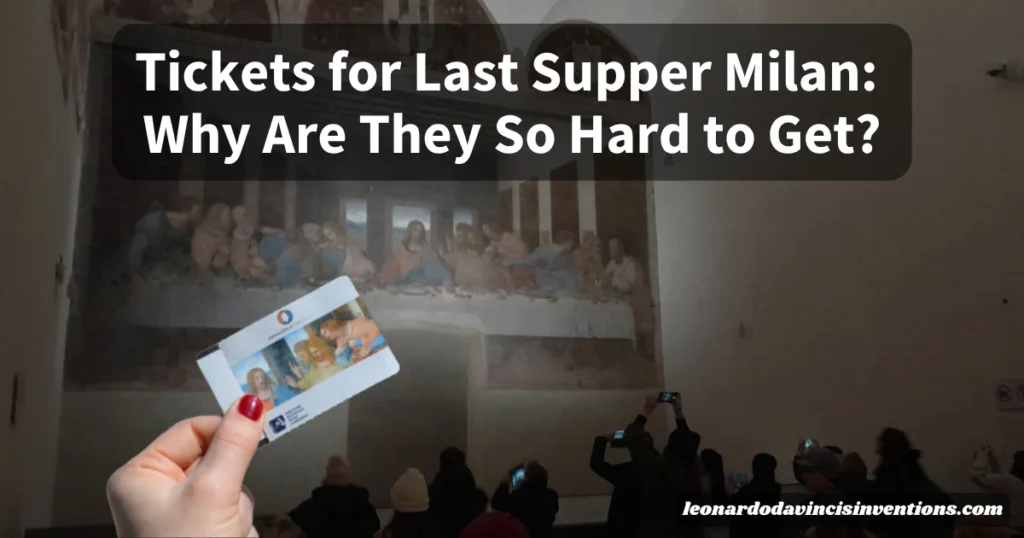
The Last Supper painting is accessed through Santa Maria delle Grazie’s entrance, where visitors gather before entering controlled viewing chambers.
Here is the part that most visitors don't fully grasp until they're standing outside the entrance. The Last Supper lives behind a climate-controlled airlock. Groups of roughly 30 people enter a sealed chamber, the door closes behind them, humidity and temperature stabilize, and only then does a second door open into the refectory itself.
The moisture, breath, and body heat of human visitors are literally dissolving the painting — slower now, but still measurable. Every single person inside that room is, in a tiny way, accelerating its decay.
So the tickets to the Last Supper in Milan, Italy, are rationed by time, not by demand. Italy's Ministry of Culture has capped visits at a strict number of people per day, in 15-minute windows.
Do the math: roughly 1,300 visitors a day, in a city that receives millions of tourists a year, for a painting that appears on every postcard and in every guidebook. There is no scenario in which supply meets demand. There can't be. The painting won't allow it.
This is why booking windows open months in advance and disappear within minutes of release. It's why scalpers and resellers have built entire businesses around this one refectory wall. And it's why "just showing up" — the classic traveler's fallback — simply doesn't work here.
The Last Supper painting tickets aren't scarce because of hype. They're scarce because the artwork is, biologically and physically, a dying thing being kept alive one breath at a time.
What Leonardo Actually Painted (and Why It Still Shocks People)
Before Leonardo, almost every depiction of the Last Supper followed the same template. The twelve apostles line up politely on one side of the table.
Judas sits alone on the opposite side, sometimes halo-less, sometimes with a small black figure hovering over him, always visually quarantined from the others so the viewer knows exactly who the traitor is. The image is didactic. It tells you the answer before you ask the question.
The Last Supper by Leonardo da Vinci depicts the apostles gathered around Christ, with Judas among them, in Santa Maria delle Grazie.
Leonardo threw that template out. He put Judas in the middle of the group, indistinguishable at first glance, clutching a small bag of silver — thirty pieces, the price of his betrayal — and knocking over a salt cellar with his elbow, a gesture that Renaissance viewers would have instantly read as a sign of broken trust.
Judas is hiding in plain sight. You have to look to find him. Leonardo made the viewer do the work.
And then there's the moment he chose to paint. Not the institution of the Eucharist. Not the prayer. Not the calm, symbolic supper of every previous version. Leonardo painted the exact second after Jesus says, "One of you will betray me."
Every apostle reacts — recoil, confusion, denial, anger, grief — each emotion mapped onto a specific face, a specific pair of hands. It's the most psychologically alive painting of the 15th century. You are not looking at a religious scene. You are looking at the instant a group of friends realizes their world is ending.
Where Is the Da Vinci Last Supper in Milan?
The painting lives in the refectory — the old monks' dining hall — of the Santa Maria delle Grazie convent, a short walk from the Cadorna metro station in central Milan. The address is Piazza Santa Maria delle Grazie, 2.
The church itself is a gem of Lombard Renaissance architecture, with a Bramante-designed apse that would be the pride of almost any other city on earth. In Milan, it's the building next door to the wall with the painting.
That location matters. Leonardo didn't paint the Last Supper for a museum; he painted it for the Dominican friars who ate their meals in this room. The idea was that when the monks sat down to their own silent suppers, Christ and the apostles would appear to be eating with them on a kind of painted extension of the hall.
The vanishing-point perspective — everything in the painting converges on Jesus's head — is calibrated to work from a specific standing position in the real room. This is site-specific art in the most literal sense.
You cannot understand the Last Supper anywhere else, because it was designed to exist only here.
Experience This in Milan
This isn’t just something you read about — it’s something you feel standing inside that room. Knowing what to look for before you arrive transforms 15 minutes into something that stays with you.
What It Actually Feels Like to Stand in Front of It
People who have seen the Last Supper in Milan almost always describe the same sequence of feelings. The first is mild disorientation — the painting is much larger than expected, nearly 15 feet tall and 29 feet wide, and it covers an entire end wall.
The second is a kind of hush. Voices drop automatically. Even in a group of 30, there's an unspoken understanding that this is not a place for selfies and chatter, even though both are technically allowed. Something about the room makes people behave as if they've walked into a cathedral.
The third feeling is harder to name. The painting is damaged — visibly so. Centuries of restorations, many of them well-intentioned disasters, have left the surface patchy and ghostly. In some places, you can see almost nothing but a faint outline. In others, the color is eerily vivid.
And yet this fragility is exactly what makes the experience so different from seeing a reproduction. You are not looking at "the" Last Supper. You are looking at what is left of it. You are looking at survival.
The Last Supper painting fills the refectory wall at Santa Maria delle Grazie, where visitors stand quietly observing its fragile surface.
Then the 15 minutes end. A soft chime, a gesture from the guard, and you move through the second airlock into a small gift shop that feels, in the moment, almost comically ordinary.
People walk out dazed. Some step back out into the Milan sunshine and just stand there for a minute, recalibrating. It's a very short visit. It does not feel short.
How to See the Last Supper in Milan Without Losing Your Mind
The practical question almost every traveler asks is the same: how to see the Last Supper in Milan when the official site is perpetually sold out?
There are really only three paths, and understanding the trade-offs between them is what separates travelers who actually get inside from travelers who leave disappointed.
The first path is to book directly through the official Vinciano. vivaticket portal the moment tickets release — typically three to four months in advance, on a set release day, at a set hour.
If you are flexible with dates, fast with a credit card, and willing to camp out on the website when the window opens, this is the cheapest option. It is also the most brutal; tickets for prime weekend slots evaporate in seconds.
The second path is to go with a licensed guided tour operator that holds pre-allocated blocks of tickets. These small-group visits bundle the entry slot with an expert guide who walks you through the painting's history, the symbolism, Leonardo's technique, and the details you would otherwise completely miss — the hand with the knife, the reflected window, the argument in the faces on the far left.
The cost is higher than a bare ticket, but you are paying for access and context, and both matter in a room you'll only stand in for 15 minutes.
The third path, the one most travelers end up on by accident, is to wait until the last minute and hope. This occasionally works — cancellations happen, and third-party resellers sometimes have leftover inventory — but it is by far the highest-stress option, and many visitors who try it end up writing rueful blog posts about the day they didn't get in.
How to Experience the Last Supper Without Missing the Details
Access is limited, and most visitors only get a few minutes inside.
The difference is having the right context before you walk in.
A few details can make or break your visit. The refectory is closed on Mondays — a detail that catches a surprising number of tourists off guard. Arrival time is non-negotiable; if you are late for your 15-minute slot, you simply lose it, and there is no "next available" group. Plan to arrive at least 20 minutes early.
Bags larger than a small purse must be stored in a locker. Large camera gear and tripods are not permitted, though phone photography without flash is generally fine.
The adjacent church of Santa Maria delle Grazie is free to enter and worth 20 minutes of your time. Bramante's apse and cloister are among the finest Renaissance architecture in Lombardy, and the atmosphere is an excellent cool-down from the intensity of the refectory visit.
One last note on expectations. You will not have the room to yourself. You will not get to stand two inches from the painting with a magnifying glass. You will not be allowed to linger past your slot.
What you get, instead, is 15 minutes in the same space Leonardo stood in while he worked, looking at the same wall the Dominicans looked at while they ate their soup in 1498. For most people, that is more than enough.
The Painting Everyone Has Seen and No One Has Really Seen
The Last Supper is the most reproduced religious painting in history — on mugs, posters, dorm-room walls, tattoo flash sheets, and the cover of a novel that sold 80 million copies.
And yet almost no one has really seen it, because reproductions cannot show you the scale, the damage, the light in the refectory, or the quiet strangeness of standing in front of something that has been dying slowly for more than five hundred years and is still, somehow, there.
That is why the tickets are so limited. And that is why, for the travelers who do manage to get inside, those 15 minutes tend to become one of the memories they come home with — not the Duomo, not the Galleria, not the aperitivo.
The room with the fading wall. The hush. The moment they finally understood why the world has been trying to keep this painting alive for half a millennium.
Travel Essentials for Visiting Milan for the First Time
Preparing for a visit to Milan often comes down to a few small details that can make long museum days, historic walking routes, and city exploration significantly more comfortable.
Comfortable Walking Shoes
Milan’s major landmarks are often best experienced on foot, with visitors covering long distances between museums, churches, and historic streets. Supportive shoes can make a full day of exploration far more comfortable →
explore comfortable walking shoes for long city days
Portable Power Bank
Navigation, photography, and digital tickets can quickly drain battery life during a full day in the city. A compact power bank helps avoid interruptions, with many visitors choosing lightweight options →
view reliable portable chargers
Secure Crossbody Bag
Busy areas near major attractions can require extra awareness. Many travelers prefer a compact crossbody bag worn in front to keep essentials accessible and secure →
A compact option often preferred for full-day city travel.
FAQs about Leonardo da Vinci Last Supper Milan Tickets
Do I need a ticket to see the Last Supper in Milan?
Yes, you need a ticket to see the Last Supper in Milan, and advance reservations are mandatory. Entry is strictly controlled with timed slots, and visitors are only admitted in small groups for about 15 minutes to protect the painting.
How much does it cost to go to the Last Supper in Milan?
The standard ticket to see the Last Supper costs about €15 for adults, with reduced tickets around €2 for ages 18–25 and free entry for some visitors under 18. Guided tours cost more but often include guaranteed access.
How far in advance should I book the Last Supper?
You should book the Last Supper tickets at least 2–4 months in advance, as official tickets are released in limited batches and sell out quickly. Waiting too long often means relying on guided tours or cancellations.
Is it worth going to see the Last Supper in Milan?
Yes, seeing the Last Supper in Milan is widely considered worth it because it is one of the most important Renaissance artworks, viewed in its original setting at Santa Maria delle Grazie, offering a unique historical and emotional experience.
Why is it so hard to get tickets for the Last Supper?
Tickets are hard to get because access is strictly limited to small groups and short viewing times to preserve the fragile painting. High global demand combined with restricted daily capacity causes tickets to sell out months in advance.
Is there a dress code to see the Last Supper in Milan?
Yes, there is a dress code because the painting is located in a former religious site. Visitors must wear modest clothing, covering shoulders and knees, and avoid sleeveless tops or short garments.
You walk into a quiet refectory in Milan. The room is cool, almost hushed. The doors seal behind you. And there, stretched across a wall that has stood for more than 500 years, is Leonardo da Vinci’s Il Cenacolo — The Last Supper. You have exactly 15 minutes. Then the next group enters, and your window closes.
That is the strange, beautiful reality of securing Last Supper tickets in Milan. Unlike most masterpieces, you cannot linger in front of it. You cannot return after lunch for a second look.
Access is controlled down to the minute because the painting is still fading. Every breath, every degree of humidity, every particle of dust matters. So the 15 minutes you get are rationed, rare, and — if you know what to look for — completely unforgettable.
This guide walks you through what those 15 minutes actually feel like, what Leonardo hid inside the composition, and what most visitors miss in front of one of the most analyzed paintings in history.
Leonardo painted the Last Supper between 1495 and 1498 on the north wall of the dining hall of the Dominican convent of Santa Maria delle Grazie. Duke Ludovico Sforza commissioned it, and Leonardo — restless, experimental — refused to use traditional fresco technique.
Fresco required speed: pigment applied to wet plaster and completed within hours. Leonardo wanted time to revise, to layer, to perfect individual faces over the course of weeks.
So he invented his own method, mixing tempera and oil on dry plaster. It gave him the freedom he craved. It also meant that within 20 years of completion, the painting had already begun to deteriorate.
By the 1600s, monks had cut a doorway through Jesus’s feet. Napoleonic troops used the room as a stable. In 1943, an Allied bomb collapsed the roof and an adjacent wall — the painting survived only because sandbags had been stacked against it. What you see today is the result of a 21-year restoration that ended in 1999.
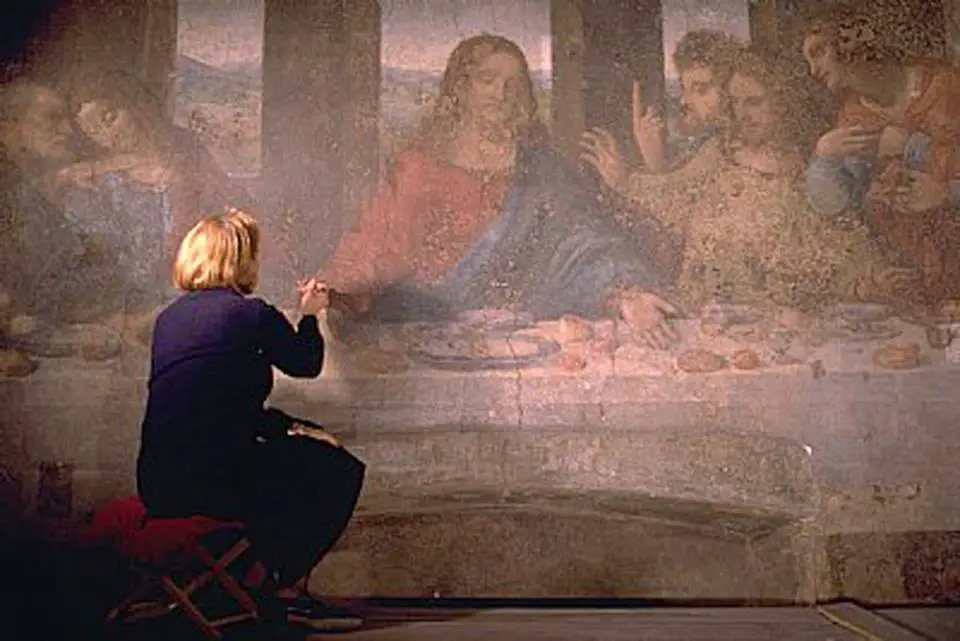
The Last Supper in Milan shows a conservator working on Leonardo’s mural during its restoration, completed in 1999.
Knowing this changes everything about the visit. You are not looking at a painting. You are looking at a ghost of one — a fragile, breathing, barely-held-together survivor.
That is why tickets to view the Last Supper in Milan are capped at around 35 people every 15 minutes, and why the climate-controlled anteroom strips humidity and dust from your clothes before you enter.
What Leonardo Actually Painted
Most visitors arrive expecting to see a religious scene. They are not — or at least, not only. Leonardo painted the precise instant after Jesus had said, “One of you will betray me.” The painting is not about the meal. It is about the reaction.
Every apostle is mid-gesture, mid-emotion. Leonardo clustered them into four groups of three, each a different psychological response — shock, denial, outrage, anxious questioning.
Philip presses both hands to his chest, pleading. Thomas raises a finger, already doubting. James the Greater throws his arms wide in disbelief.
And Judas — crucially — is the only figure leaning back, clutching a small bag of silver, his face shadowed. Leonardo integrated him into the group rather than isolating him on the opposite side of the table, as earlier painters always had. It was a radical choice.
The Last Supper reveals linear perspective lines converging on Christ’s head, forming a natural halo in the refectory.
Then there is the geometry. Jesus sits at the exact vanishing point of the entire composition. Every line of the room — the ceiling beams, the wall tapestries, the tiled floor — converges directly behind his head, as if the architecture itself bends toward him.
The window behind him forms a natural halo without any gold leaf. Photographs flatten this effect. You have to stand in the room.
Once you know what to look for, the painting opens up in layers. Leonardo placed exactly 13 figures at a table designed to echo the dimensions of the real refectory — the illusion was meant to feel as though Christ and the apostles were dining alongside the monks. The figures are life-sized. The table linen matches the tablecloths the Dominicans actually used.
There are subtler clues, too. A knife floats unnervingly in the hand of Peter, pointed toward Bartholomew — a visual foreshadowing of violence to come. A spilled salt cellar sits near Judas, an old symbol of betrayal.
Three windows behind the figures echo the Trinity. The bread and wine are arranged in a way Renaissance viewers would have read as Eucharistic, tying the scene directly to the liturgy performed in the adjacent church.
None of this is accidental. Leonardo was not decorating a wall. He was translating a sacred story into the language of human psychology, geometry, and architectural illusion.
The answer to what makes this painting special is not that it is beautiful, although it is. It is a piece of theatre frozen at its most volatile moment.
Finding Santa Maria delle Grazie
The question of where the Last Supper painting is has a precise answer: the refectory of the Convent of Santa Maria delle Grazie, at Piazza di Santa Maria delle Grazie 2, in Milan’s Magenta district.
It is about a 15-minute walk west of the Duomo, or two stops on Metro Line 1 to Conciliazione or Cadorna. The church itself is a Bramante masterpiece — cool and luminous —, but the painting is housed separately, in the old dining hall attached to the cloister.
Tickets must be reserved in advance. There is no walk-up option. The official website for The Last Supper tickets, cenacolovinciano.vivaticket.it, is managed by the Italian Ministry of Culture, and tickets are released in quarterly batches.
They sell out within hours for peak season. During spring and summer, slots often fill up weeks in advance. Winter is slightly easier, but never casual.
If the official site is fully booked — which is common — licensed tour operators hold a separate allocation of slots bundled with guided experiences. These tend to be the most reliable way to secure tickets for the Last Supper by Leonardo da Vinci when the state portal has sold out, and they come with the added benefit of a professional art historian walking you through the details during your 15 minutes inside.
Experience This in Milan
This isn’t just something you read about — it’s something you feel standing inside that room. Knowing what to look for before you arrive transforms 15 minutes into something that stays with you.
The entry process is the first surprise. You do not walk straight in. After scanning your ticket at a small side entrance, you pass through a series of climate-controlled vestibules — glass doors that seal behind you before the next opens.
The air is drier than outside. You are being prepared, in a sense, like the painting itself.
When the final door opens, you step into the refectory, and the scale catches you immediately. The room is much larger than photographs suggest — over 130 feet long, with a vaulted ceiling.
The Last Supper fills one entire end wall. On the opposite wall is Donato Montorfano’s Crucifixion, a fully intact fresco painted just two years earlier. Most people don’t glance at it. They walk directly to Leonardo and stop.
The Last Supper fills one refectory wall, opposite Montorfano’s intact Crucifixion, often overlooked by visitors.
Here is what no reproduction prepares you for: the softness. The colors are muted now, ghost-pale in places, but the faces still hold their expressions with astonishing precision.
John leans toward Peter. Judas recoils. Christ’s hands rest open on the table, palms turned outward — one toward the bread, one toward the wine. The restoration stripped away centuries of overpainting, so what you see is essentially what Leonardo himself painted.
The room stays hushed. People whisper, if they speak at all. A guide, if you have one, will move quickly — pointing out details you would otherwise miss: the landscape glimpsed through the back windows, the subtle gradations of light on each apostle’s robes. Fifteen minutes pass in what feels like four.
There is a rhythm to the visit that surprises first-timers. The first two or three minutes are orientation — you stand still, adjusting to the scale, letting your eyes travel across the composition.
The urge to photograph passes quickly. Flash is forbidden, and the painting’s faded palette doesn't translate well on phone cameras anyway. Most people put their phones down after a single attempt.
The next seven or eight minutes are where the painting opens up, especially with context. This is when you can trace the grouping of the apostles, find the vanishing point behind Christ’s temple, notice the spilled salt, and spot the knife.
If you are visiting alone without preparation, you are often left realizing how much you are missing. This is why the quality of your preparation matters more than the quality of the ticket itself.
The final few minutes tend to be quieter — reflective rather than analytical. You stop looking for symbols and just look. The expressions become less about theology and more about humanity: fear, loyalty, doubt, love. That emotional register is what lingers after you leave.
How to Experience It Without Missing the Details
If you are booking tickets to the Last Supper in Milan, Italy, for the first time, a few practical details will shape your experience more than anything else. Arrive 20 minutes early — late arrivals are not readmitted to a later slot.
Bring ID that matches the name on your reservation. Leave large bags at the coat check. Dress in layers because the climate control runs cool.
Above all, decide in advance whether you want to enter with context or without. A visit without a guide is quieter, more personal, and leaves more room for your own interpretation.
A visit with a guide is denser, richer in detail, and tends to deliver more lasting understanding — especially for first-time visitors to the Last Supper in Milan, Italy, who only get one shot at seeing it in person.
How to Experience the Last Supper Without Missing the Details
Access is limited, and most visitors only get a few minutes inside.
The difference is having the right context before you walk in.
There are paintings you visit and paintings that visit you. The Last Supper belongs to the second category. Long after you leave the refectory, details tend to resurface — the pale outline of a hand, the shadow across Judas’s face, the exact slope of Christ’s shoulders.
It is a painting designed to embed itself in memory precisely because it was designed to be seen, originally, every day, by monks at their meals. Leonardo built it to keep revealing itself over time.
That is ultimately why the strict ticketing, the short slots, and the climate controls are worth navigating. They are not obstacles to the experience. They are part of it.
The difficulty of securing tickets to see the Last Supper painting in Milan is what has kept the painting alive long enough for any of us to see it at all.
Milan has the Duomo, the Galleria, La Scala, and the Navigli canals — all extraordinary. But in a city full of monuments, there is only one room where a 500-year-old painting quietly fades into its own wall while 35 people at a time stand silent before it, watching history hold itself together for another quarter hour.
Those 15 minutes, properly prepared for, are among the most remarkable you can spend anywhere in Europe.
Travel Essentials for Visiting Milan for the First Time
Preparing for a visit to Milan often comes down to a few small details that can make long museum days, historic walking routes, and city exploration significantly more comfortable.
Comfortable Walking Shoes
Milan’s major landmarks are often best experienced on foot, with visitors covering long distances between museums, churches, and historic streets. Supportive shoes can make a full day of exploration far more comfortable →
explore comfortable walking shoes for long city days
Portable Power Bank
Navigation, photography, and digital tickets can quickly drain battery life during a full day in the city. A compact power bank helps avoid interruptions, with many visitors choosing lightweight options →
view reliable portable chargers
Secure Crossbody Bag
Busy areas near major attractions can require extra awareness. Many travelers prefer a compact crossbody bag worn in front to keep essentials accessible and secure →
A compact option often preferred for full-day city travel.
FAQs about Last Supper Tickets in Milan
How much does it cost to go to the Last Supper in Milan?
The official ticket to see the Last Supper in Milan costs about €15 for adults, with reduced tickets (€2) for young EU visitors and free entry for children under 18, although all visitors must still reserve a time slot.
Can you just turn up to see the Last Supper?
No, you cannot simply turn up to see the Last Supper; advance reservations are mandatory because entry is strictly controlled with timed slots and limited group sizes.
How to get last-minute tickets to the Last Supper in Milan?
If official tickets are sold out, last-minute access is usually only possible through guided tours or third-party providers that bundle reserved tickets with a guide.
How far in advance should I book the Last Supper?
You should book the Last Supper as early as possible—tickets are released in batches every few months and often sell out quickly due to limited daily capacity.
Why is it so hard to get tickets for the Last Supper?
Tickets are difficult to obtain because only about 35 visitors are allowed per 15-minute session to protect the fragile mural, creating extremely limited daily availability.
Is there a dress code to see the Last Supper in Milan?
Yes, visitors must wear modest clothing, as the painting is in a former religious site—shoulders and knees must be covered, and hats must be removed.
Leonardo Bianchi is the founder of Leonardo da Vinci Inventions & Experiences, a cultural travel guide helping visitors explore Leonardo da Vinci’s art, inventions, and legacy across Italy and Paris.
Planning Milan?
See The Last Supper Without Missing the Details
Tickets are limited and visits are short. Start with the Milan guide before choosing your Last Supper experience.
If you're visiting Milan for Leonardo da Vinci, these are the experiences most travelers prioritize first — especially when tickets are limited and time is short.
This site is built for travelers who want more than surface-level sightseeing — helping you plan smarter visits around Leonardo da Vinci’s art, museums, and cities across Italy and Europe.


 Leonardo Bianchi is the founder of Leonardo da Vinci Inventions & Experiences, a cultural travel guide helping visitors explore Leonardo da Vinci’s art, inventions, and legacy across Italy and Paris.