The Renaissance

(Last updated: May 2026)

The Renaissance was one of the most transformative periods in human history — a sweeping cultural rebirth that changed how people thought about art, science, architecture, and the human body itself.

It spanned roughly the 14th to the 17th centuries, beginning in the Italian city-states and gradually spreading across Europe. At its heart was a bold new idea: that human beings, through observation, reason, and creativity, could understand and reshape the world around them.

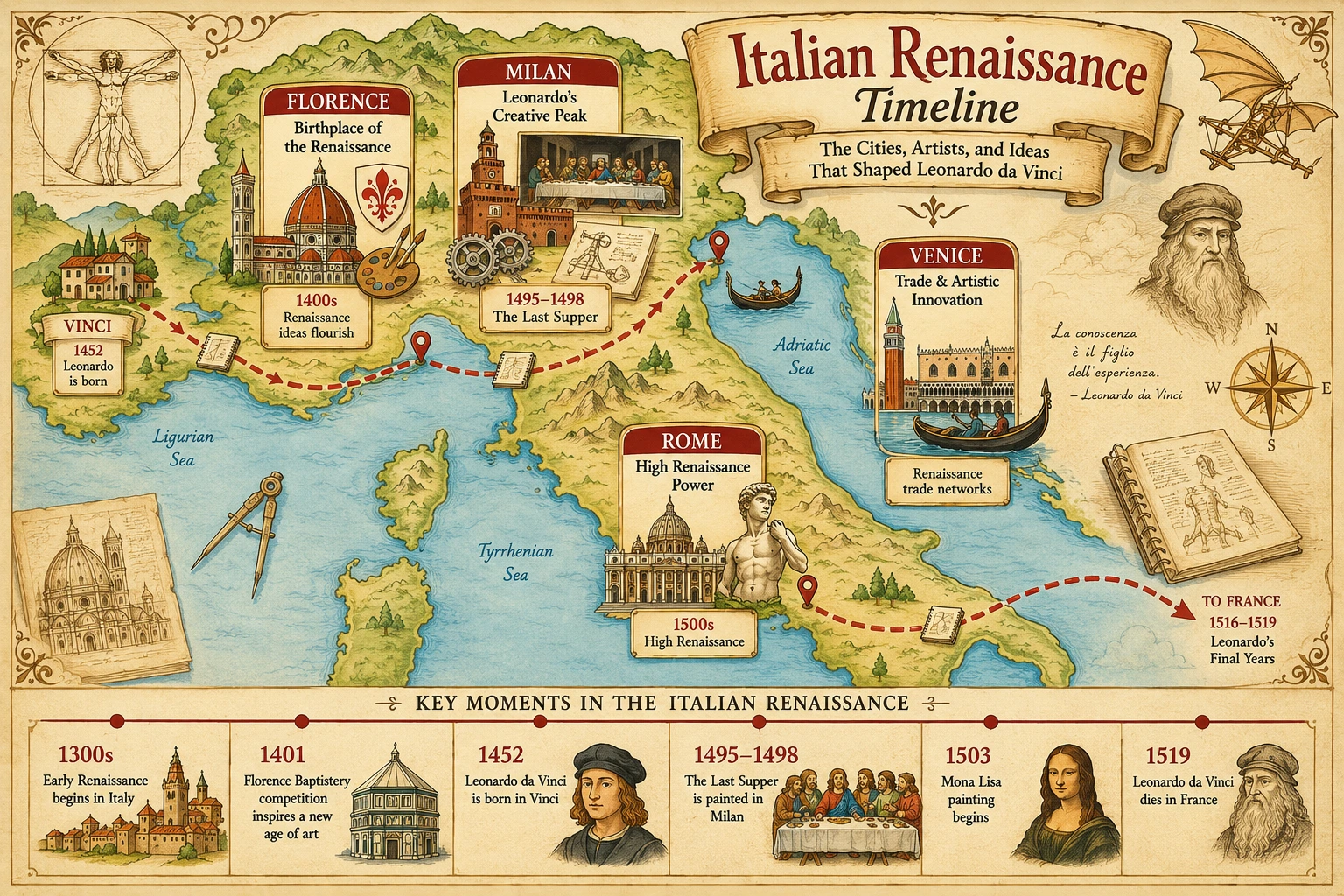
Leonardo da Vinci perfectly represents the spirit of the Renaissance. Born in Tuscany in 1452, he was both an artist and a scientist who studied nature, the human body, and machines, believing that art and science were closely connected.

Understanding the Renaissance helps us appreciate his work more deeply. Famous paintings like the Mona Lisa and The Last Supper were created in a time of powerful patrons, creative rivalry, and great cultural change in Italy.

This post is all about the Renaissance — its origins, art and architecture, remarkable patrons, spread across Europe, and the enduring legacy it left in the cities and museums where you can still encounter it today.

What Is the Renaissance?

Renaissance Art: A New Way of Seeing the World

Before the Renaissance, European painting followed the conventions of the medieval period. Figures were flat and symbolic. Backgrounds were often plain gold. The goal was to convey religious meaning, not to imitate the natural world.

Renaissance artists changed all of this. They looked at people, plants, light, and shadow with fresh eyes — and what they saw, they painted.

Famous Renaissance Paintings and Their Makers

The names of the great Renaissance artists are among the most recognized in all of human history. Leonardo da Vinci, Michelangelo, Raphael, Botticelli, and Titian each pushed painting in new directions.

Leonardo’s Mona Lisa introduced a sense of psychological depth that had never been achieved before. Michelangelo’s Sistine Chapel ceiling turned a room into a universe. Raphael’s School of Athens celebrated the very idea of human knowledge.

What unified these artists was a set of shared techniques.

These tools together produced a Renaissance art style that felt alive in a way medieval painting never had.

Renaissance Style: From the Workshop to the Wall

Renaissance artists did not work alone. They trained in workshops — botteghe — under master painters who taught them to grind pigments, stretch canvas, and eventually handle a brush.

Leonardo himself trained under Andrea del Verrocchio in Florence, a sculptor and painter of considerable reputation. This apprenticeship system ensured that the Renaissance style was carefully transmitted, from hand to hand, across generations.

By the High Renaissance of the late 15th and early 16th centuries, Italian workshops had become centers of innovation. Artists competed openly, traded ideas, and sometimes stole from each other. This healthy rivalry produced some of the most famous Renaissance art the world has ever seen.

Explore further: discover the great Renaissance artists, their masterpieces, and the techniques that transformed European painting.

Renaissance Architecture: Building a New Ideal

Architecture during the Renaissance was, like painting, a project of recovery and reinvention. Architects looked back at the temples and public buildings of ancient Rome and asked: What made those structures so beautiful? The answer, they decided, lay in proportion, symmetry, and the disciplined use of classical forms — columns, arches, domes, and pilasters.

Italian Renaissance Architecture and Its Principles

Filippo Brunelleschi is often credited with launching Renaissance architecture. His dome for the Florence Cathedral — completed in 1436 — was an engineering marvel that had not been attempted since antiquity. It still dominates the skyline of Florence today.

Leon Battista Alberti followed with theoretical writings that provided a philosophical foundation for the new architecture. He argued that a beautiful building, like a beautiful painting, was governed by mathematical ratios that mirrored the order of nature.

Examples of Italian Renaissance architecture can be found throughout the cities of Tuscany, Lombardy, and the Veneto. The Palazzo Rucellai in Florence, the Tempio Malatestiano in Rimini, and Palladio’s Villa Rotonda near Vicenza all demonstrate the principles of Renaissance-style architecture: clean lines, balanced facades, human scale, and the deliberate echoing of classical antiquity.

Explore further: discover the principles of Italian Renaissance architecture and the iconic buildings of Brunelleschi, Alberti, and Palladio across Italy.

Renaissance Masterpieces in Stone and Space

Leonardo contributed to architectural thinking as well, though few of his designs were ever built. His notebooks contain studies for centrally planned churches, ideal cities, and fortifications — ideas that were startlingly modern in their conception.

Working for Ludovico Sforza, the Duke of Milan, he also contributed to urban planning projects that reflected the Renaissance ideal of reason applied to the built environment.

Renaissance Patronage: The Power Behind the Art

The Renaissance
The Sistine Chapel ceiling by Michelangelo, commissioned by Pope Julius II

Great art requires more than great artists. It requires patrons — people with money, vision, and the ambition to be remembered. The Renaissance produced some of history’s most extraordinary patrons, and without them, most of what we admire today would never have been made.

The Medici Family and the Florentine Renaissance

No family shaped the Renaissance more profoundly than the Medici of Florence. Beginning with Cosimo de’ Medici in the early 15th century and reaching its height under Lorenzo the Magnificent in the late 15th century, the family used their banking fortune to commission art, support scholars, and turn Florence into the intellectual capital of Europe.

They funded Botticelli, supported the young Michelangelo, and created an environment in which artistic ambition was both expected and rewarded.

The relationship between the Medici and their artists was not purely philanthropic. Art was also power. A magnificent chapel, a portrait painted in oils, a bronze sculpture in the public square — all of these announced the donor’s wealth, taste, and divine favor. Renaissance art patronage was a form of politics as much as it was a form of love for beauty.

Explore further: discover how the Medici family used art patronage to shape Florence and fuel the Renaissance.

Ludovico Sforza and the Court of Milan

Leonardo spent nearly two decades at the court of Ludovico Sforza in Milan — the longest stretch he ever stayed in one place. Ludovico was a calculating ruler who understood that culture was a weapon. He wanted the finest musicians, engineers, and painters in Italy gathered around him.

Leonardo, hired as a court engineer and painter, thrived in this environment. It was here that he painted The Last Supper, completed his studies of anatomy and hydraulics, and developed ideas for weapons and flying machines that would fill his notebooks for years to come.

The Renaissance courts of Italy — Milan, Florence, Ferrara, Mantua, Urbino — were extraordinary incubators of talent. Each court competed for the best artists and scholars. Each ruler wanted to be remembered as a new Augustus, a patron of civilization. This competition raised the quality of Renaissance masterpieces to heights rarely equaled since.

The Northern Renaissance: A Different Kind of Rebirth

The Renaissance did not stay in Italy. By the late 15th century, it had crossed the Alps and taken root in the Netherlands, Germany, France, and England — and in the process, it changed.

Northern Renaissance art shared the Italian passion for observation and technique, but it had a different character: more detailed, more concerned with everyday life, and more influenced by the Protestant Reformation, which would soon reshape European religion.

Northern Renaissance Artists and Their Vision

The painters of the Northern Renaissance — Jan van Eyck, Albrecht Dürer, Hans Holbein, Pieter Bruegel the Elder — developed the Italian discoveries of oil painting into something uniquely their own. Van Eyck’s panels glow with a jewel-like intensity.

Every thread of fabric, every blade of grass, every reflection in a mirror is rendered with breathtaking precision. Dürer, who traveled to Italy and met with Venetian painters, brought Italian ideas of proportion and classical form back to Germany, fusing them with northern realism to produce some of the era’s most powerful prints and paintings.

Northern Renaissance artwork is not secondary to Italian achievement. It is a parallel tradition, equally inventive and equally important. The two streams fed each other through the movement of artists, printed books, and engraved reproductions of famous paintings that circulated across the continent.

Explore further: discover the Northern Renaissance artists and how their detailed realism transformed European painting.

Northern Renaissance vs Italian Renaissance

The key differences between Italian Renaissance and Northern Renaissance art lie in their focus, style, and techniques.

Renaissance Masterpieces: The World’s Greatest Renaissance Art

The Renaissance masterpieces created between the 14th and 17th centuries remain the most visited and studied works of art in the world. Each painting, sculpture, and fresco tells a story of an era when artists, scientists, and philosophers united in pursuit of truth and beauty.

Iconic Renaissance Paintings

Leonardo da Vinci’s Mona Lisa captivates with her elusive expression and atmospheric depth, while his Last Supper in Milan captures a charged moment of human drama with extraordinary compositional precision.

Botticelli‘s The Birth of Venus, now in Florence‘s Uffizi Gallery, marked a turning point — elevating mythological subjects to the same grandeur previously reserved for sacred art.

Legendary Renaissance Sculptures and Frescoes

Michelangelo‘s David stands as a defining symbol of Renaissance idealism, its marble surface conveying both physical perfection and inner resolve.

His Sistine Chapel ceiling — anchored by The Creation of Adam — and Raphael‘s The School of Athens in the Vatican represent Renaissance masterpieces of an entirely different scale, transforming architectural spaces into monuments of human thought.

Artistic Innovations of the Renaissance

Renaissance artists grounded their work in humanism, centering the individual human experience as worthy of artistic and philosophical attention.

They applied linear perspective to achieve spatial realism and studied anatomy directly from the human body to render figures with new authenticity.

Leonardo pushed these foundations further with sfumato, his technique of imperceptibly blending light into shadow, alongside the broader use of chiaroscuro — contrasts that give Renaissance masterpieces their enduring sense of life and dimension.

Explore further: Discover how Leonardo da Vinci, Michelangelo, and Raphael shaped Renaissance art by exploring the stories, techniques, and locations behind their most famous masterpieces.

Experience Leonardo’s World in Person

A great museum visit is not simply about looking at paintings. It is a matter of preparation. Knowing something about the Renaissance — its history, its patrons, its techniques — transforms every painting from a beautiful object into a conversation across five centuries.

Guided Tours and Cultural Itineraries

Many travelers find that guided tours of Florence or Milan, led by art historians or specialist guides, open up levels of meaning that are impossible to find on your own. A good guide can explain why a particular gesture in The Last Supper carries theological significance, or why the light in a Florentine painting falls from the left.

These details are not trivial. They are the language Leonardo and his contemporaries were speaking — a language well worth learning before you walk through the museum door.

Several cultural travel companies now offer immersive Renaissance itineraries that combine visits to Leonardo sites in Florence, Vinci, Milan, and beyond, often pairing them with smaller venues — the Castello Sforzesco in Milan, the Opificio delle Pietre Dure in Florence — that give a more complete picture of how Renaissance art was actually made and preserved.

What to Look for in Renaissance Museums

When visiting a Renaissance gallery, resist the instinct to rush from one famous name to the next. Spend time with the preparatory drawings, if the museum has them.

Leonardo’s sketches reveal his thinking process more clearly than his finished paintings. Look at the way he drew hands. Look at how he used shading to suggest three-dimensional form.

These drawings are a window into one of the most restlessly curious minds in human history, and they are often displayed with far fewer crowds than the masterpieces that hang nearby.

Also, pay attention to the context that the museum provides. Good Renaissance exhibitions place works within their historical setting — the patronage, the commission, the religious or political meaning that shaped every compositional choice. The more you understand that context, the richer your experience of the paintings themselves will be.

Final Thoughts

This post was all about the Renaissance as the essential framework for understanding Leonardo da Vinci — not just as a great painter, but as the product of a specific cultural moment that valued curiosity, observation, and the pursuit of knowledge across every discipline.

Leonardo da Vinci was shaped by Florence and enriched by Milan, in a time when art and science were closely connected. Understanding the Renaissance helps explain how he could be both an artist and a scientist, reflecting a belief that human curiosity and learning can achieve extraordinary things.

That spirit still lives on today. From Renaissance paintings and architecture to museums in Florence and Paris, this period continues to shape how we think about art, knowledge, and human potential—with Leonardo da Vinci at its heart.

FAQs about the Renaissance

What exactly is the Renaissance?

The Renaissance was a period in European history, roughly from the 14th to the 17th centuries, marked by a “rebirth” of interest in classical Greek and Roman art, science, and knowledge. It followed the Middle Ages and introduced major cultural, artistic, and scientific advancements that helped shape the modern world.

What was the Renaissance period, 1500 to 1600?

The years 1500 to 1600 represent the High and Late Renaissance, when artistic and intellectual achievements reached their peak, especially in Italy. This era produced masterpieces by figures such as Leonardo da Vinci and Michelangelo, while Renaissance ideas spread across Europe before giving rise to new styles and movements.

What are 5 facts about the Renaissance?

The Renaissance began in Italy in the 1300s, emphasized humanism (focus on human potential), revived ancient Greek and Roman knowledge, produced iconic artists like Leonardo da Vinci, and led to major innovations such as the printing press and scientific discoveries.

What caused the Renaissance to start?

The Renaissance began due to several key factors, including the rediscovery of ancient Greek and Roman texts, the rise of wealthy patrons in cities like Florence who funded art, the invention of the printing press, and the arrival of scholars after the fall of Constantinople in 1453. These events helped spread knowledge and encouraged new ways of thinking.

What ended the Renaissance?

The Renaissance gradually ended in the 16th century due to major historical changes, including the Protestant Reformation, political instability, and the Sack of Rome in 1527. These shifts, along with the rise of new artistic styles, marked the transition into a new era of European history.

How to explain the Renaissance to a kid?

The Renaissance can be described as a time when people in Europe began learning, creating, and discovering new ideas again—like a “big restart” in art and science. People became curious, made beautiful art, and explored how the world works in new ways.

Related Post You May Like

Disclosure: This page may contain affiliate links. If you choose an experience through them, it helps support the site at no extra cost to you.