
(Last updated: Aug 2026)
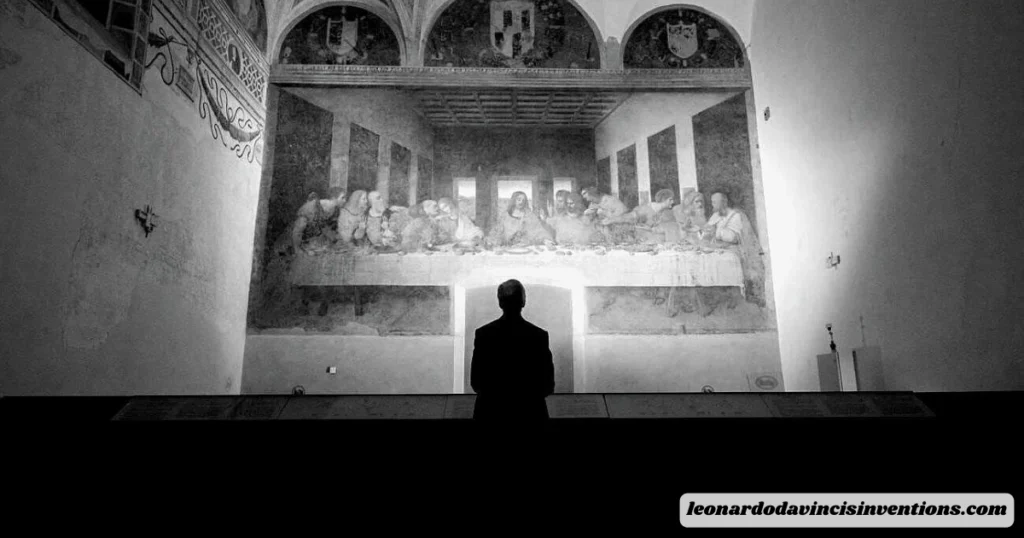
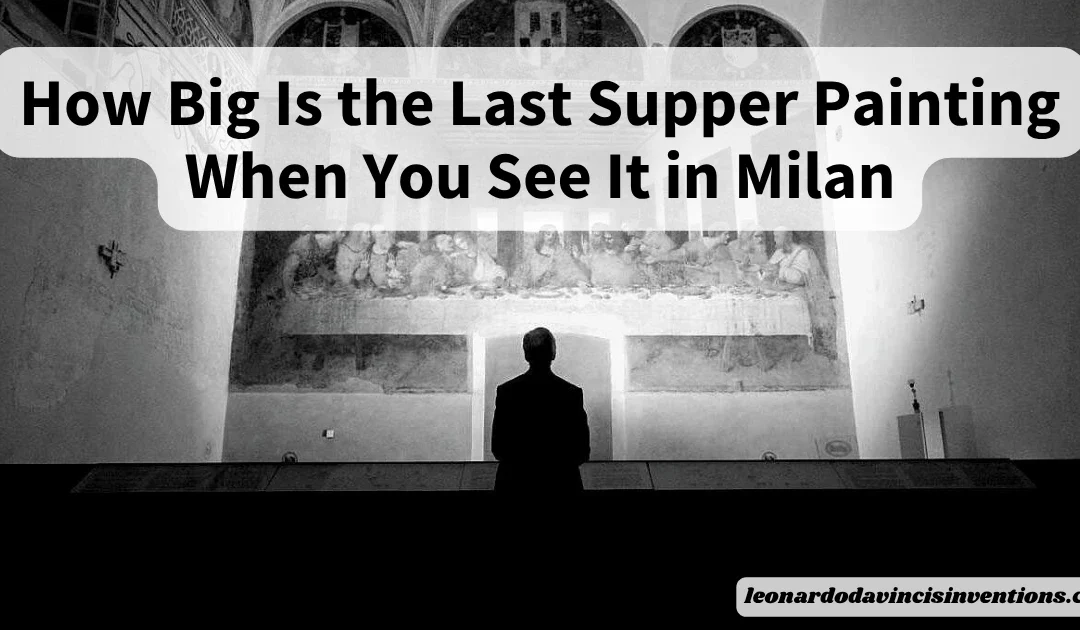
How big is the Last Supper painting is one of the first questions visitors ask when they stand before Leonardo da Vinci's legendary mural in Milan, and the answer is more impressive than most people expect. Measuring approximately 460 cm by 880 cm (roughly 15 feet tall and 29 feet wide), this is not a canvas you can hang in a living room. It fills an entire wall.
Painted between 1495 and 1498 in the refectory of Santa Maria delle Grazie, the Last Supper is not just a large artwork. It is one of the most studied, debated, and visited images in human history. Understanding its physical scale — and what Leonardo achieved within it — transforms how you experience the painting in person.
This post is all about how big the Last Supper painting is, the artistic choices behind its monumental scale, and why visiting it in Milan remains one of the most powerful cultural experiences in the world.
What Is the Size of the Last Supper Painting?
The Artistic Genius Behind the Last Supper Painting
Leonardo's Unusual Technique
Most Renaissance muralists used fresco — applying pigment to wet plaster so that the paint literally becomes part of the wall as it dries. Leonardo chose a different path. He worked on dry plaster using tempera and oil, which gave him greater control over detail and color blending.
This decision allowed him to revise, layer, and refine his work in ways that wet fresco never permits. It also, unfortunately, made the painting far more vulnerable to humidity and decay. Leonardo traded permanence for perfection.
The consequences became visible within decades. By the early 1500s, the paint was already beginning to flake. Today, after numerous restorations over the centuries, what we see is a work that has been stabilized rather than perfectly preserved — yet it still communicates Leonardo's original vision with remarkable power.
Composition and Perspective Mastery
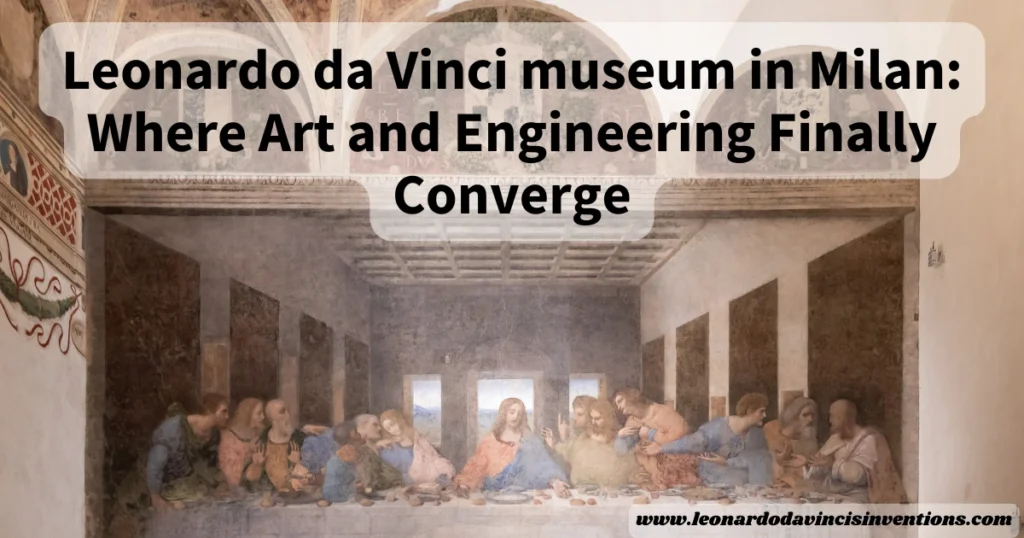
The scale of the Last Supper was never accidental. Leonardo designed the composition to interact directly with the architecture of the refectory — the long dining hall where Dominican monks took their meals.
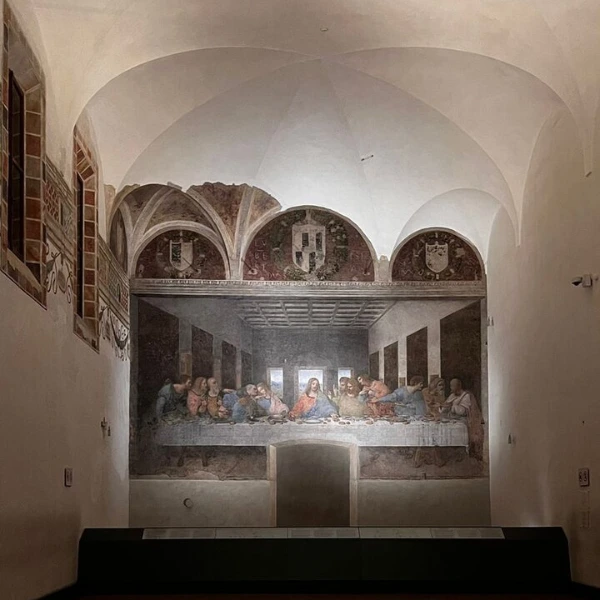
The painted ceiling beams and tapestries continue the lines of the actual room. The perspective lines all converge on a single vanishing point behind the head of Christ, drawing every eye to that exact center. When monks sat at their tables below, the mural appeared as a continuation of their own space — Christ dining at the far end of their room.
This spatial illusion required a canvas that matched the scale of the real room. A smaller work would have broken the effect entirely. The size of the Last Supper painting was, in this sense, architecturally necessary.
How Long Did It Take Leonardo to Paint the Last Supper?
Leonardo worked on the Last Supper for approximately three years, from around 1495 to 1498. But the word "worked" needs context. Leonardo was famous — or notorious — for long pauses and sudden bursts of activity.
Contemporary accounts describe him arriving at the refectory, studying the wall for hours without making a single brushstroke, then working furiously for extended sessions. He reportedly agonized most over the face of Judas, wandering the streets of Milan's criminal quarters in search of the right expression.
The patron, Ludovico Sforza, grew impatient. Leonardo responded, in a surviving letter, that he was searching for a face worthy of betrayal — and that if he could not find it in life, he might be forced to use the prior of the convent as his model.
Visitors who want to understand Leonardo's working process in depth often find that guided Last Supper tours in Milan help connect the artwork's physical scale with the historical context that shaped every decision Leonardo made.
Why the Last Supper Painting Became Famous
The Scene Leonardo Chose to Depict
Leonardo did not paint the moment of bread and wine — the traditional subject of Last Supper imagery in Renaissance art. Instead, he captured the instant Christ announces that one among them will betray him.
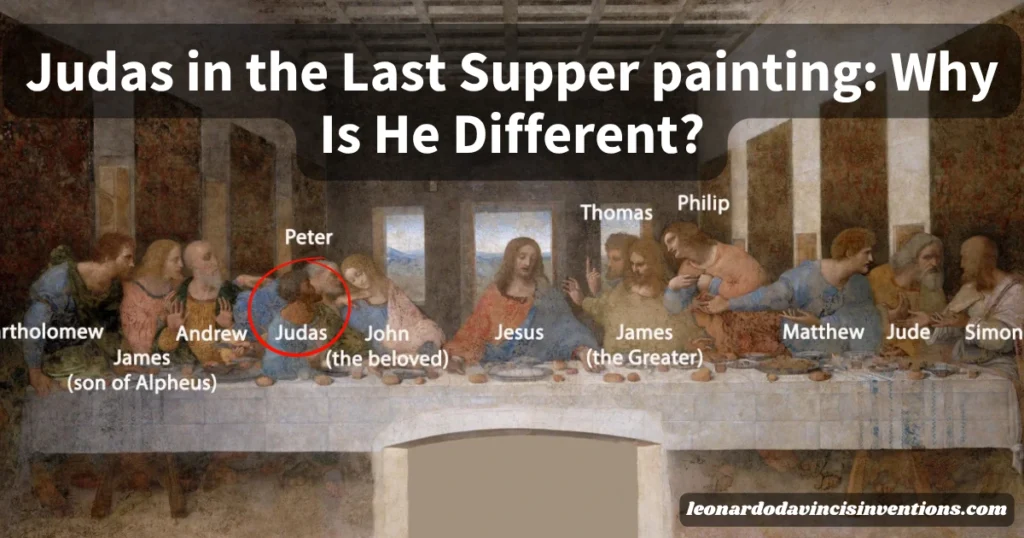
This decision turned a quiet theological symbol into a scene of psychological drama. Each of the twelve apostles reacts differently. Some lean in with disbelief. Some pull back in horror. Thomas raises a single finger toward heaven. Judas clutches a small bag of coins and leans away from the light.
Leonardo grouped the apostles into four clusters of three — each group forming its own emotional unit while the whole composition moves in waves away from the still center of Christ. It is a masterwork of narrative painting, and its scale is what makes the emotion land.
When Was the Last Supper Painted — and Why It Survived
The Last Supper was painted between 1495 and 1498, commissioned by Ludovico Sforza, Duke of Milan, for the refectory of Santa Maria delle Grazie, a church the duke intended as the mausoleum of his dynasty.
Its survival is, in many ways, extraordinary. French troops used the refectory as a stable in the early 1800s, soldiers reportedly throwing bricks at the painted figures for sport. Allied bombing in 1943 destroyed much of the building around it — yet the wall bearing the Last Supper somehow held.
Between 1978 and 1999, a meticulous restoration removed centuries of overpainting, grime, and damage. What emerged was not a pristine Leonardo — it was something more honest: a stabilized fragment of one of the greatest paintings ever made.
Why the Last Supper Original Painting Matters for Art History
The Last Supper is not just famous because of its subject. It redefined how Western artists depicted group scenes, psychological states, and narrative tension within a single frozen moment.
Raphael studied it. Rubens made copies of it. Every artist who came after Leonardo in the Western tradition encountered this work, directly or indirectly. It sits at the foundation of how narrative painting evolved for the next five centuries.
Understanding its scale helps explain its influence. The figures are near life-size. The emotion is large enough to read from a distance. It was designed to be overwhelming — and it still is.
Where to See the Last Supper Painting Today
Santa Maria delle Grazie, Milan
The Last Supper is housed in the refectory — technically a separate building from the church itself — at Santa Maria delle Grazie, on Piazza di Santa Maria delle Grazie in Milan. The church and refectory are a UNESCO World Heritage Site.
The entrance is through the refectory building, not the church. Visitors pass through a series of climate-controlled chambers before entering the viewing room. This decontamination process protects the fragile mural from fluctuations in humidity and temperature.
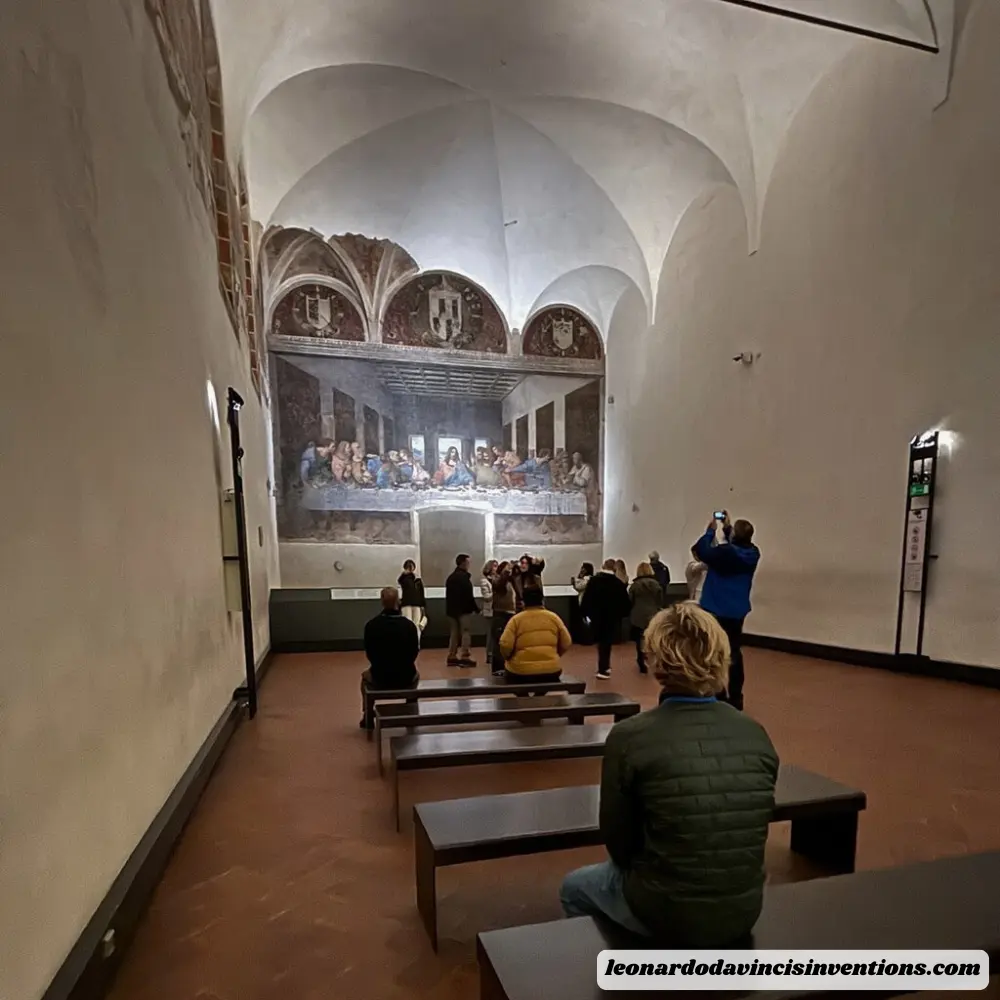
Inside, the room is dim. The wall-sized painting occupies the entire north end of the hall. The opposite wall holds a 16th-century Crucifixion by Giovanni Donato da Montorfano — often overlooked, but worth attention as a contrast to Leonardo's revolutionary approach.
Booking Access to the Last Supper
Tickets to see the Last Supper sell out weeks or months in advance. The experience is timed and strictly regulated. Walk-in access is rarely possible for the main timed viewing slots.
Several options exist: direct booking through the official Vivaticket system (Italian-language interface) or through licensed tour operators that include entrance and a guided experience. The latter often provides the clearest historical context — particularly useful for first-time visitors who want to understand what they are actually seeing.
For travelers who want guaranteed access alongside expert context on Leonardo's technique and the painting's restoration history, skip-the-line Last Supper experiences in Milan typically include both timed entrance and a guided walkthrough — a practical option given how quickly standard tickets sell out.
What You See When You Stand Before It
The 15-minute viewing window is brief. But the effect of standing before a 29-foot-wide painting of near-life-size figures — knowing you are standing in the actual room Leonardo designed his perspective around — is difficult to describe in advance.
The vanishing point behind Christ's head is exactly at eye level for a standing adult. This was deliberate. Leonardo placed it there so that every person in the room — monk, duke, or visitor — would feel personally centered in the scene.
Before your visit, it helps to study the apostle groupings and individual faces. The 15 minutes move quickly. Knowing what to look for — Judas's shadowed face, Thomas's upraised finger, the cascading emotional waves from Christ outward — makes every second count.
Ready to Plan Your Visit?
Because The Last Supper has limited daily access, tickets often sell out early. Explore available tickets and guided tours.
Plan Your Last Supper VisitExploring Leonardo da Vinci in Milan
Milan was where Leonardo spent the most productive decades of his life — nearly twenty years under the patronage of Ludovico Sforza. Beyond the Last Supper, the city holds deep layers of Leonardo's presence.
The Pinacoteca Ambrosiana houses his portrait of a musician and the codices he left behind. The Castello Sforzesco contains frescoes he designed for ducal chambers. Walking between these sites, the city begins to feel like an extended studio — one Leonardo never entirely left.
For those whose interest extends beyond Milan, Leonardo's trail runs through Florence, where he trained under Verrocchio and painted the Annunciation (now in the Uffizi). It continues to Venice, where his notebooks describe hydraulic engineering projects for the lagoon, and to Rome, where he worked briefly in the Vatican during his later years.
Paris holds the most famous of all his paintings — the Mona Lisa and The Virgin of the Rocks — at the Louvre. Each city offers a different chapter of the same extraordinary story.
Final Thoughts
This post was all about how big the Last Supper painting is — and as we have seen, the answer reaches well beyond a single set of measurements. At 460 by 880 centimeters, the work is physically large.
But its true scale is psychological. Leonardo designed every element — the composition, the perspective, the groupings, the expressions — to operate at a scale that made the viewer feel present at the moment of betrayal.
Seeing it in person, standing in the room, Leonardo shaped his perspective around, remains one of the few experiences in cultural travel that genuinely surprises people who thought they were prepared. No photograph, reproduction, or documentary fully anticipates the presence of the original wall.
That is the mark of a work that was made to be experienced in a specific place, at human scale, in real light. Leonardo built it that way on purpose. It still works.
Travel Essentials for Visiting Milan for the First Time
Preparing for a visit to Milan often comes down to a few small details that can make long museum days, historic walking routes, and city exploration significantly more comfortable.
Secure Crossbody Bag
Busy areas near major attractions can require extra awareness. Many travelers prefer a compact crossbody bag worn in front to keep essentials accessible and secure → explore practical crossbody bags for travel
Portable Power Bank
Navigation, photography, and digital tickets can quickly drain battery life during a full day in the city. A compact power bank helps avoid interruptions, with many visitors choosing lightweight options → view reliable portable chargers
Comfortable Walking Shoes
Milan’s major landmarks are often best experienced on foot, with visitors covering long distances between museums, churches, and historic streets. Supportive shoes can make a full day of exploration far more comfortable →
Explore comfortable walking shoes for long city days

FAQs about How Big Is the Last Supper Painting
The Last Supper measures about 4.6 meters high and 8.8 meters wide (roughly 15 × 29 feet). It spans an entire wall inside the refectory of Santa Maria delle Grazie, which is why its scale feels so immersive in person.
The $450 million painting, Salvator Mundi, was purchased in 2017 by Badr bin Abdullah bin Mohammed bin Farhan Al Saud, widely reported to be acting on behalf of Mohammed bin Salman. It remains the most expensive painting ever sold at auction.
A doorway installed in the refectory wall later cut away the lower central section of The Last Supper. This alteration removed Jesus’ feet, which were originally part of Leonardo’s composition but are now permanently lost.
There is no confirmed record of a single lover, but historians often point to Salaì, Leonardo’s longtime assistant, as a possible companion. Leonardo da Vinci kept his personal life private, leaving this subject open to interpretation.
The most expensive painting ever sold is Salvator Mundi by Leonardo da Vinci. It sold for about $450.3 million in 2017, setting a world record that still stands today.
The Last Supper is considered priceless because it is a wall painting that cannot be moved or sold. Located in Santa Maria delle Grazie, its value lies in its cultural and historical significance rather than its market price.
Related Post You May Like

Disclosure: This page may contain affiliate links. If you choose an experience through them, it helps support the site at no extra cost to you.
 Leonardo Bianchi is the founder of Leonardo da Vinci Inventions & Experiences, a cultural travel guide helping visitors explore Leonardo da Vinci’s art, inventions, and legacy across Italy and Paris.