
(Last updated: Aug 2026)
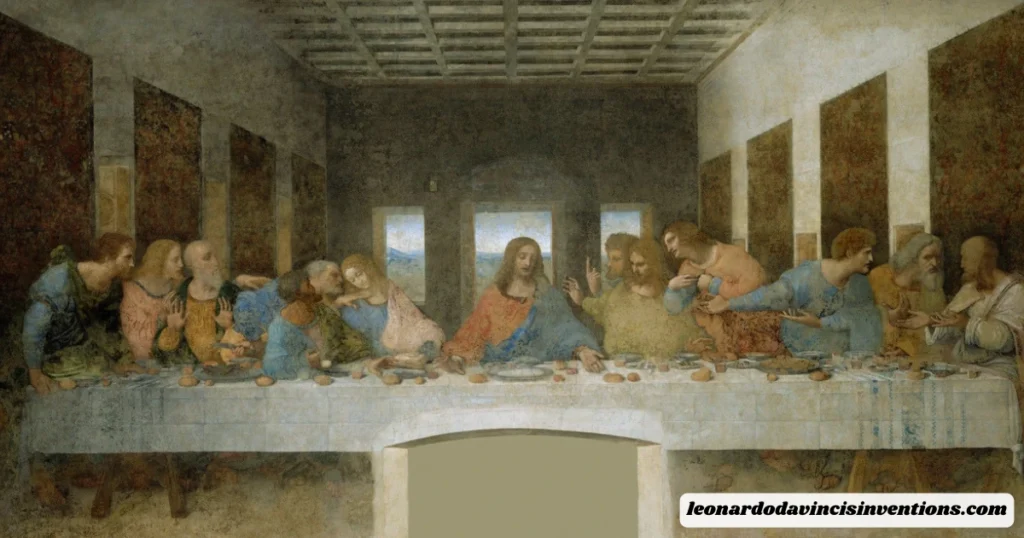
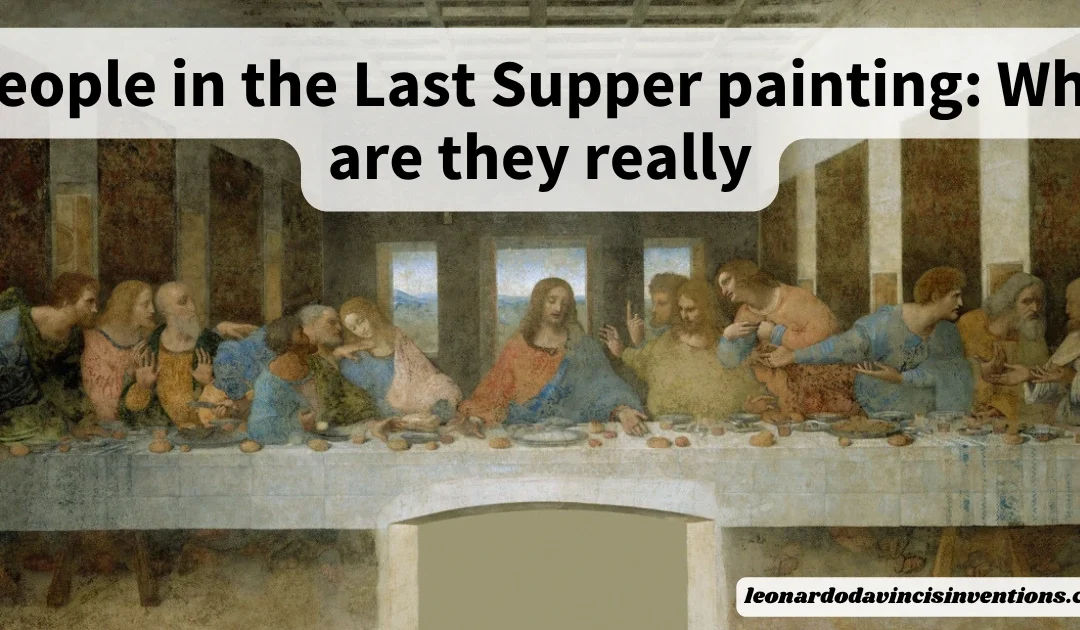
The figures in the Last Supper painting are among the most studied and debated in the history of Western art. Painted by Leonardo da Vinci between 1495 and 1498 on the refectory wall of Santa Maria delle Grazie in Milan, this monumental work captures a single electric moment — the instant Christ announces that one among the thirteen present will betray him.
Understanding who is who transforms the experience of looking at this image. Each of the twelve apostles reacts differently. Each posture, each gesture, each expression carries centuries of theological weight. For anyone planning to visit Milan, recognizing these figures in advance makes a brief encounter with a protected fresco genuinely moving.
This post is all about the people in the Last Supper painting — their identities, their stories, and what Leonardo encoded into every brushstroke.
What Are the People in the Last Supper Painting?
The Artistic Genius Behind the People in the Last Supper Painting
Leonardo's Radical Compositional Choice
Most painters before Leonardo depicted the Last Supper as a quiet, devotional scene. Judas was traditionally isolated on the opposite side of the table — visually marked as the villain. Leonardo discarded that convention entirely.
He placed all thirteen figures on the same side of a long table, facing the viewer. Judas sits among the other apostles without a special marker of guilt. What separates him is subtler: his posture, his shadow, the way he clutches his money bag. Leonardo trusted the viewer to look carefully.
This was a seismic shift in religious painting. Leonardo was no longer illustrating a story for people who already knew it. He was recreating a moment — capturing the psychology of thirteen individuals facing an unbearable revelation.
The Geometry of Emotion
Leonardo organized the apostles into four groups of three. Each group is a self-contained emotional unit. Within each group, figures lean toward or away from one another, creating visual tension and release. The entire composition flows outward from Christ, who remains perfectly still at the center — the calm at the eye of a storm.
Christ's head aligns with a vanishing point in the painted architecture behind him. Every perspectival line in the room converges on that single point. In a painting filled with motion and anguish, Christ is the anchor.
The Medium and Its Fragility
Leonardo painted this work in tempera and oil on a dry plaster wall — not the traditional wet-plaster fresco technique. He wanted the freedom to rework passages, to layer glazes, to achieve a luminosity that traditional fresco could not.
The consequence was devastating. Within decades, the paint had begun to flake. By the 17th century, visitors described a shadow of its former self. The painting we see today is a palimpsest: Leonardo's original vision filtered through centuries of deterioration and restoration.
Knowing this makes the work more poignant, not less. What survives still communicates across five hundred years.
Who Is in the Last Supper Painting? Every Figure Identified
Christ at the Center
Christ occupies the exact center of the composition. His arms are open and slightly extended, palms facing upward. He has just spoken the words that will fracture the room: 'Truly, I say to you, one of you will betray me.' His expression is one of settled sorrow rather than shock. He already knows. He is grieving, not accusing.
Leonardo gave Christ a luminosity no other figure possesses. The open window directly behind his head frames him in natural light — a painted halo that requires no gilding.
The Apostles: Left to Right
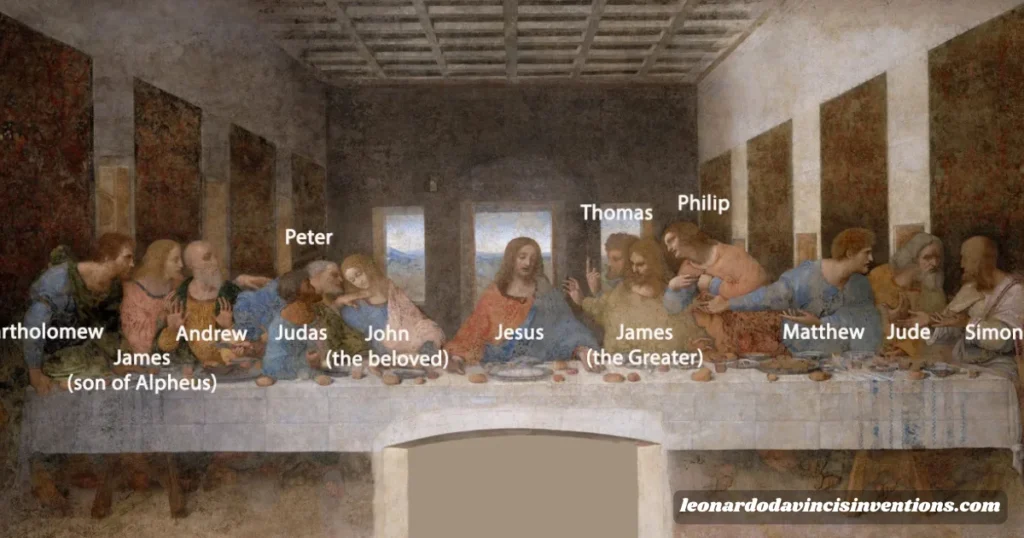
Reading from left to right as you face the painting, the apostles appear in the following groups.
The first group contains Bartholomew, James the Lesser, and Andrew. Bartholomew is the outermost figure on the far left, leaning forward with both hands flat on the table, disbelieving. James the Lesser leans inward. Andrew holds his hands up, palms outward — a gesture of open-handed shock.
The second group contains Judas, Peter, and John. This is the most studied cluster in the painting. Peter leans forward aggressively, clutching a knife in his right hand. John — the youngest apostle, often identified by his soft, almost feminine features — has slumped away to the right, eyes downcast. Between them sits Judas, hunched and pulling back, his left arm reaching toward the bread dish, his right hand tight around a small bag of coins.
Visitors who arrive in Milan with some context tend to experience the painting very differently from those who arrive cold. Guided tours that focus specifically on Leonardo's iconography, including the identity of each apostle, are available through specialist Milan experience providers, and many visitors note that even fifteen minutes of preparation transforms what they see.
The third group contains Thomas, James the Greater, and Philip. Thomas raises one finger — a gesture that would echo centuries later in his most famous moment of doubt after the Resurrection. James the Greater spreads his arms wide in disbelief. Philip presses his hands to his chest, as if asking: 'Surely not me, Lord?'
The fourth group, on the far right, contains Matthew, Jude, and Simon. Matthew has turned away from Christ entirely, gesturing back toward the center group as if asking Jude and Simon to confirm what he has just heard. Jude raises his hands in exasperation. Simon, the oldest apostle, sits with quiet gravity at the far edge of the composition.
Who Is the Woman in the Last Supper Painting?
One of the most persistent questions surrounding this painting concerns the figure to Christ's immediate right — the place of John, the Beloved Disciple.
This figure is notably young, with soft features and no beard. Dan Brown's novel The Da Vinci Code popularised the claim that this figure is Mary Magdalene, not John the Apostle, and that her presence indicates a secret marriage to Christ.
Art historians have consistently and firmly rejected this reading. Leonardo's preparatory drawings for the Last Supper include a study of this figure labeled 'Giovanni' — the Italian name for John.
The softness of the features is consistent with how the Beloved Disciple had been depicted in Italian Renaissance art for generations. Young men in 15th-century religious painting were routinely depicted with delicate, androgynous features to suggest their spiritual purity.
The woman in the Last Supper painting is, in short, not a woman. She is John. The mystery, while compelling as a cultural phenomenon, does not hold up to historical scrutiny.
Judas in the Last Supper Painting
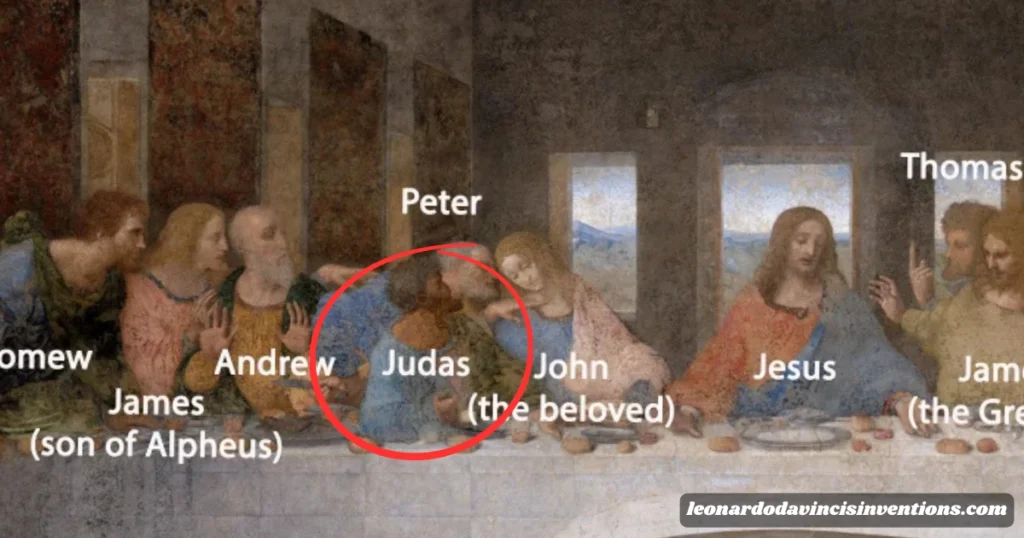
Judas Iscariot is one of the most psychologically complex figures Leonardo ever rendered. He does not look monstrous. He does not wear the pointed hat of caricature. He is simply a man who has already made a decision he cannot unmake — and Leonardo shows us what that looks like from the inside.
He leans back and away from Christ, putting physical distance between them. He clutches the bag of thirty pieces of silver. His elbow knocks a salt cellar — a traditional symbol of bad luck — off the edge of the table.
His face is partially in shadow, not because Leonardo painted it darker, but because his recoiling posture pulls him back from the window light illuminating the other figures.
Seeing how subtly Leonardo reveals Judas’s inner conflict becomes far more powerful in person, where the scale, light, and spatial tension of the refectory bring these details into sharper focus.
Where to See the Last Supper Painting Today
Santa Maria delle Grazie, Milan
The Last Supper has not moved from the wall where Leonardo painted it. It occupies the far wall of the refectory — the monks' dining hall — of the Dominican convent attached to Santa Maria delle Grazie in central Milan. The church itself is a UNESCO World Heritage Site.
The painting is preserved under strict environmental controls: temperature, humidity, and the number of visitors admitted at any one time are tightly regulated.
Entry is by timed ticket only, and slots sell out weeks or months in advance, especially in summer. Each group is given approximately fifteen minutes inside the room.
The painting fills the far wall at a scale that photographs cannot capture: it is nearly 9 meters wide and almost 5 meters tall. Standing in front of it is a genuinely different experience from studying it in reproduction.
How to Experience It Today
The practical reality of visiting the Last Supper is that preparation matters enormously. Fifteen minutes pass quickly. Visitors who know the composition — who can locate Judas, recognize Thomas's raised finger, understand why Christ's posture is so deliberately still — use that time very differently from those encountering the figures for the first time.
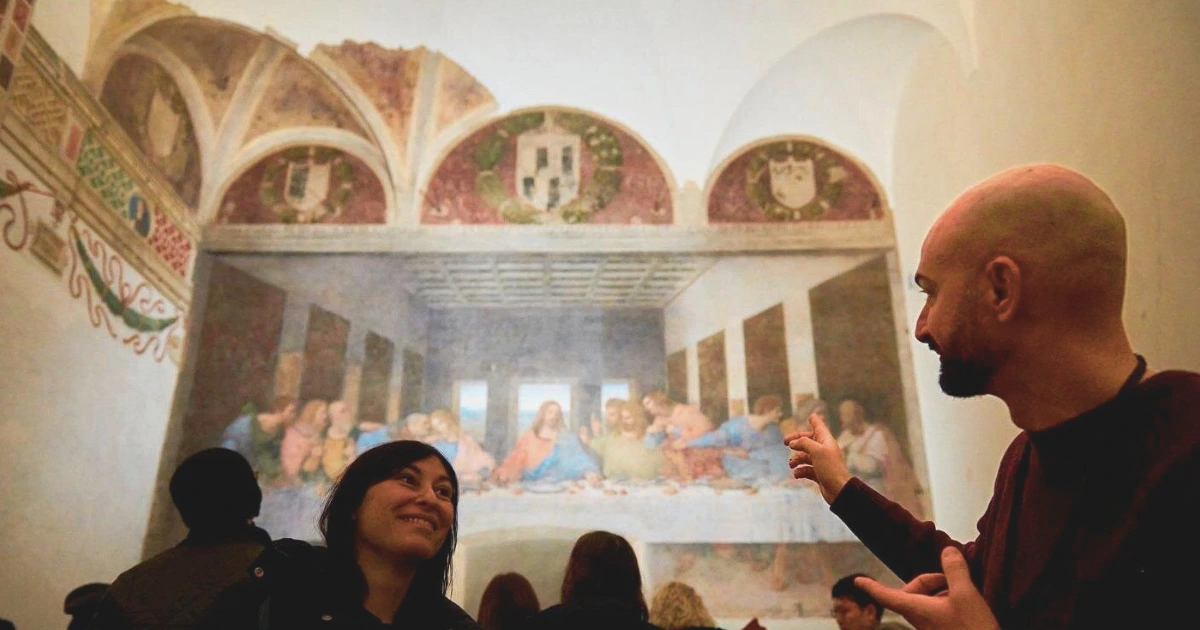
Ready to Plan Your Visit?
Timed entry and an expert guide reveal the deeper meaning of The Last Supper and its apostles.
Plan Your Last Supper VisitBeyond the Last Supper itself, the Castello Sforzesco holds a collection of Leonardo drawings, and the Museo Nazionale della Scienza e della Tecnologia 'Leonardo da Vinci' features full-scale reconstructions of his machines. Milan rewards visitors who treat it as a Leonardo city rather than simply a stop to see one famous wall.
Exploring Leonardo da Vinci in Milan and Beyond
Milan is the city most closely associated with Leonardo's mature working life. He lived and worked here for nearly two decades under the patronage of Ludovico Sforza, Duke of Milan. The Last Supper was painted here.
The equestrian monument that occupied years of his life — never cast — was designed here. The city still carries traces of his presence in its streets, its churches, and its collections.
But Leonardo's world extends well beyond Milan. Florence, where he trained in Verrocchio's workshop and painted the Annunciation, offers a different dimension of his genius.
Venice holds its notebooks on water and hydraulics. Rome granted him access to commissions in anatomy and engineering. And Paris is home to the Mona Lisa, the Virgin of the Rocks, and Saint John the Baptist. Each city is a chapter in the same extraordinary life.
FAQs about the people in The Last Supper painting
The 13 people in Leonardo da Vinci's The Last Supper painting are Jesus Christ and his twelve apostles: Bartholomew, James the Lesser, Andrew, Judas Iscariot, Peter, John, Jesus, Thomas, James the Greater, Philip, Matthew, Jude (Thaddeus), and Simon the Zealot. Leonardo arranged the apostles in four groups of three to emphasize their reactions to Jesus' announcement of his betrayal.
The people in The Last Supper painting are Jesus Christ and his twelve apostles, gathered for their final meal before Jesus' crucifixion. Leonardo captured the dramatic moment when Jesus announces that one of them will betray him, eliciting unique emotional reactions from each apostle.
Mary Magdalene is not in Leonardo's The Last Supper. The figure often mistaken for her is John the Apostle, traditionally depicted as a youthful, beardless man in Renaissance art. Art historians reject the claim that Mary Magdalene appears in the painting.
Leonardo da Vinci's The Last Supper features 13 figures: Jesus Christ and his twelve apostles. Leonardo arranged them to clearly show each apostle's reaction to Jesus' announcement that one of them would betray him.
Judas is not painted as Black in The Last Supper. His face appears partly in shadow to symbolize his betrayal, while Leonardo used light, posture, and expression—not skin color—to distinguish him from the other apostles.
The 13th guest at the Last Supper was Jesus Christ, accompanied by his 12 apostles. If the question refers to Judas Iscariot, the New Testament says he later regretted betraying Jesus and died afterward.
Final Thoughts
This post was all about the people in the Last Supper painting — who they are, where they sit, what their gestures mean, and why a 15th-century fresco continues to generate questions five centuries after it was made.
Leonardo did not paint a diagram of a theological event. He painted thirteen human beings in the grip of an impossible moment, and he made each one of them psychologically real.
The apostles react the way people actually do when faced with shocking news: with disbelief, questions, anger, and withdrawal. Judas recedes. Thomas demands certainty. John goes quiet. Christ holds still.
What Leonardo understood — and what still draws millions of people to a monastery refectory in Milan every year — is that the greatest religious subjects are also the most human ones. Seeing the painting in person is not a pilgrimage. It is a conversation with a mind that has never been equaled.
The fifteen minutes you spend in that room will stay with you far longer. Specialist-led experiences with timed entry and guided figure-by-figure explanations make those minutes count.
Related Post You May Like


Disclosure: This page may contain affiliate links. If you book through them, we may earn a small commission at no extra cost to you. Learn more.
 Leonardo Bianchi is the founder of Leonardo da Vinci Inventions & Experiences, a cultural travel guide helping visitors explore Leonardo da Vinci’s art, inventions, and legacy across Italy and Paris.