
(Last updated: Oct 2026)
Leonardo da Vinci mechanical engineering is the reason a 500-year-old notebook can still make an engineer's jaw drop.
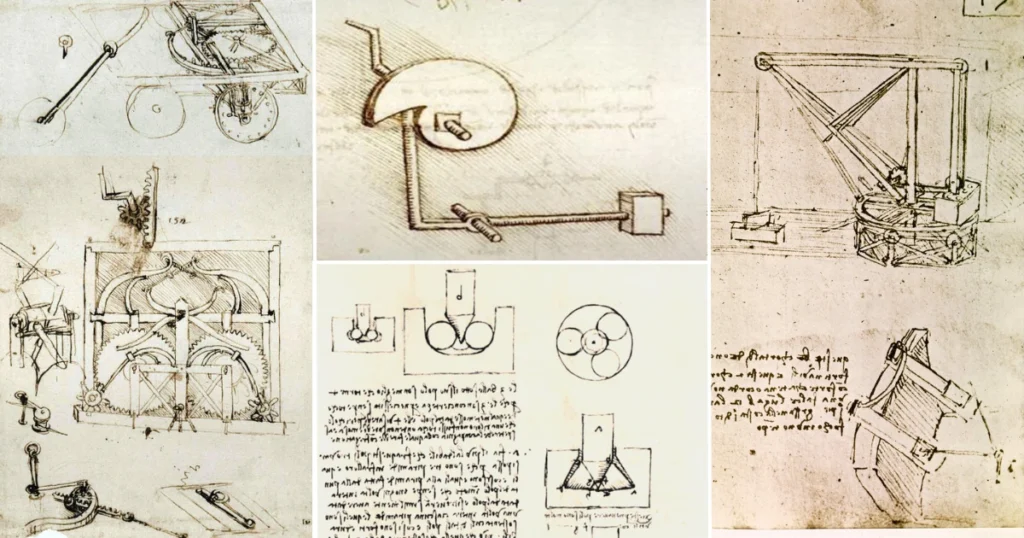
Long before machines were built to test an idea, Leonardo built them on paper, sketching gears, pulleys, and moving parts with a precision modern historians still study.
His notebooks reveal a mind that treated the human body, water, wind, and metal as parts of the same great machine.
This matters far beyond art history. Leonardo's mechanical thinking laid the groundwork that echoes into robotics, aerodynamics, and structural engineering.
Standing in front of one of his original drawings, or a model built from them, is not just a museum visit. It's a direct line to the first person who tried to draw the future before it existed.
This post is all about Leonardo da Vinci mechanical engineering, from the ideas behind it to the places where you can still see it up close.
What is Leonardo da Vinci Mechanical Engineering?
Leonardo da Vinci mechanical engineering refers to the scientific drawings and mechanical concepts Leonardo developed between the 1480s and 1519, covering gears, cams, ball bearings, self-propelled carts, and war machines. Recorded across thousands of manuscript pages, this body of work combined observation, mathematics, and imagination into functional mechanical systems, many of which anticipated devices built centuries later.
The Engineering Idea Behind Leonardo da Vinci Mechanical Engineering
A Mind Trained in Observation
Leonardo did not train as an engineer in any formal sense. He trained as an artist, apprenticed in Andrea del Verrocchio's workshop in Florence, where he learned to observe muscles, joints, and weight distribution with obsessive detail.
That same eye later turned toward machines. He watched water swirl in a canal the way he watched hair curl on a shoulder, and he asked the same question of both: what force is making this move this way?
This habit of visual reasoning became the foundation of his engineering work. Instead of starting from theory, Leonardo started from what he could see and measure, then built mechanical explanations around it.
It's a method modern engineers would recognize instantly, even though the term "mechanical engineering" did not exist in his lifetime.
From Sketch to System: The Codex Atlanticus
Much of what we know about Leonardo da Vinci mechanical engineering survives thanks to the Codex Atlanticus, the largest collection of his drawings and writings, containing over 1,100 pages produced across nearly four decades.
It moves between anatomy, hydraulics, fortification design, and pure mechanical invention, often on the same page. Reading it feels less like flipping through an old book and more like looking directly into a working mind mid-thought.
The related keyword "codex atlanticus" points to one of the richest engineering archives ever produced by a single person. Its pages include studies of gear ratios, lifting devices, and flight, each annotated in Leonardo's famous mirror-script handwriting, written right to left, possibly to keep his notes private, possibly simply because he was left-handed.
What makes the Codex Atlanticus so valuable to engineers today isn't just the individual sketches, but the way ideas repeat and evolve across the pages. A gear mechanism drawn in one decade reappears, refined, a decade later applied to a completely different machine.
That pattern shows Leonardo wasn't producing isolated flashes of genius. He was building a personal library of mechanical solutions he could reach for and adapt, much like an engineer today keeps a reference of proven components rather than reinventing every part from scratch.
How Leonardo da Vinci Mechanical Engineering Works
Gears, Cams, and Self-Propelled Machines
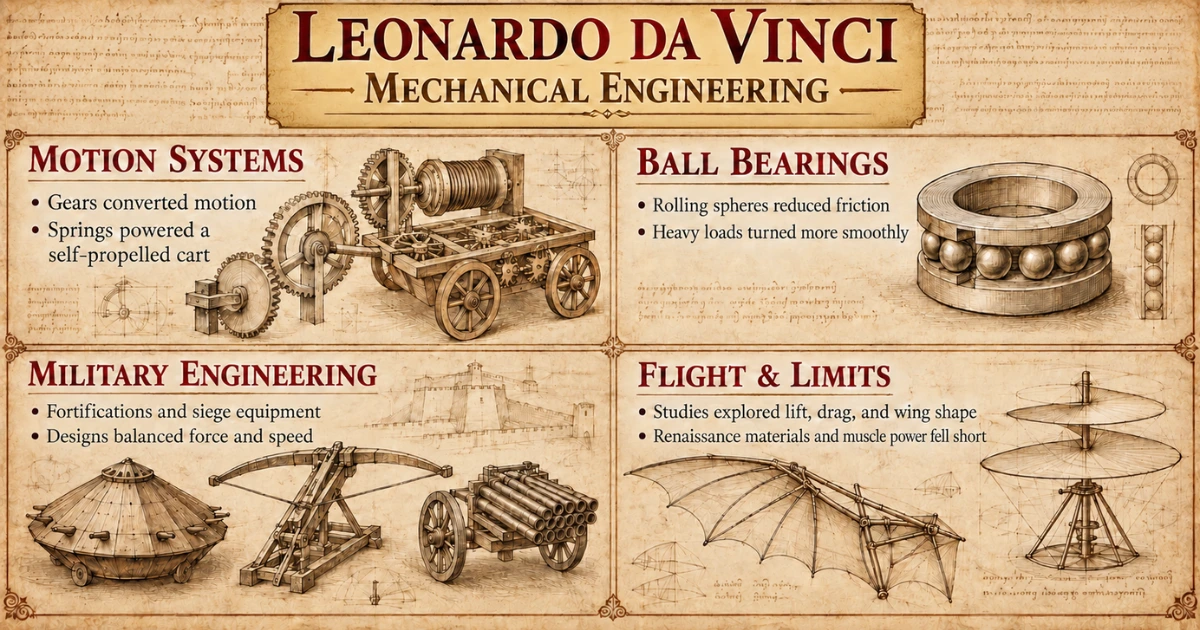
Da Vinci gears appear throughout his notebooks in astonishing variety: spur gears, worm gears, and ratchet mechanisms that convert one type of motion into another.
He used these systems to design devices most people assume are modern, including a Leonardo da Vinci self-propelled cart, a spring-powered vehicle capable of moving without being pushed or pulled.
Many historians now describe it as a conceptual ancestor of the automobile, not because it resembled a car, but because it solved the same fundamental problem: how do you store energy and release it as controlled movement?
His cam-and-lever systems also appear in one of his most famous creations, the Leonardo da Vinci mechanical knight, an armored figure designed to sit, stand, and move its arms using an internal system of pulleys and cables.
It was engineering theater as much as engineering theory, built to demonstrate that mechanical logic could imitate life.
Ball Bearings and the Physics of Motion
Long before industrial machinery relied on them, Leonardo da Vinci sketched ball bearings as a solution to a specific problem: friction.
Leonardo understood that reducing contact between moving parts made machines more efficient, so he designed housings with small spheres positioned to let heavy loads rotate smoothly. The concept would not become standard in engineering for another 300 years.
Bearings solve a problem every engineer eventually meets: two surfaces rubbing together lose energy as heat, and over time that heat wears the materials down. Leonardo's answer, small rolling spheres cradled between two rings, reduced that contact to a rolling motion instead of a sliding one.
It's the same basic principle used in bicycle wheels, skateboard trucks, and industrial machinery today, sketched centuries before anyone had the manufacturing tools to actually build it at scale.
This kind of thinking often gets lost in casual retellings of Leonardo's genius, which tend to focus on painting. But seeing these mechanical drawings displayed alongside working scale models, a common highlight for visitors exploring Leonardo-themed sites in Milan, makes the engineering far easier to grasp than reading about it alone. A drawing on a page is an idea. A bearing spinning smoothly in your hand is proof the idea worked.
War Machines and Military Engineering
Leonardo da Vinci military engineer credentials came from real employment, not just imagination. He worked for powerful patrons including Ludovico Sforza in Milan and, later, Cesare Borgia, designing fortifications, siege equipment, and defensive systems.
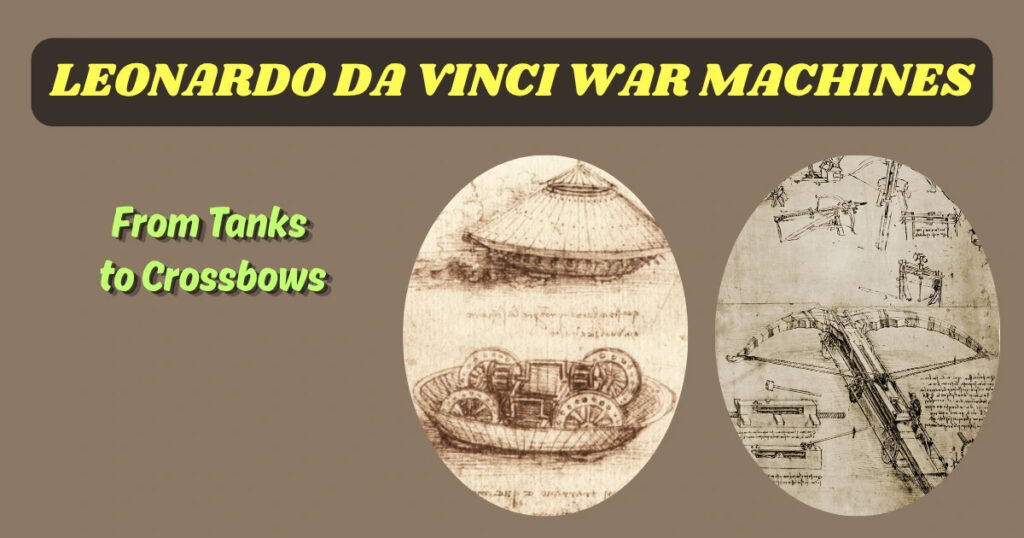
His da Vinci war machine sketches include an early armored vehicle resembling a tortoise shell on wheels, a giant crossbow requiring a team to operate, and rapid-fire cannon concepts meant to increase firing speed without increasing crew size.
He also studied wind and air movement seriously enough to design an anemometer, a device for measuring wind speed. The Leonardo da Vinci anemometer worked on a simple principle: a hinged panel would be pushed by wind, and its angle would indicate wind strength, a method still echoed in some modern instruments.
None of these designs existed in isolation. Leonardo treated his war machines the way he treated his anatomical studies, as a system of forces that had to balance. A crossbow that fires too fast tears itself apart. A cannon that reloads too slowly loses the battle.
His notebooks are full of these tradeoffs worked out in the margins, evidence that he understood engineering as much through failure and iteration as through inspiration.
Flight and the Limits of Renaissance Materials
No discussion of da Vinci's mechanical drawings is complete without his flying machine studies. He sketched ornithopters, devices meant to fly by flapping wings like a bird, along with a large screw-shaped device sometimes called an early helicopter concept.
Neither could have flown with the materials available in the 1480s and 1490s. Human muscle power was never going to be enough, and Leonardo likely suspected this. Yet the underlying aerodynamic questions he was asking, about lift, drag, and wing shape, remained relevant to engineers centuries later.
He also explored a Leonardo da Vinci perpetual-motion concept, though notably, his own notes eventually reject the idea as impossible. That intellectual honesty, chasing an idea and then proving to himself it couldn't work, is part of what separates true engineering thinking from wishful invention.
It's worth remembering that Leonardo rarely built full-scale versions of these machines himself. Most existed only as Leonardo da Vinci invention drawings, precise enough to guide a modern craftsman, but never tested against real wind, real friction, or real metal fatigue in his own lifetime.
That gap between the sketch and the object is exactly what makes the surviving mechanical da Vinci drawings so valuable to historians and engineers alike. They capture pure reasoning, untouched by the compromises of actually manufacturing something.
Where to See Leonardo da Vinci Mechanical Engineering Today
The Codex Atlanticus in Milan
The Biblioteca Ambrosiana in Milan holds the Codex Atlanticus, but because of its fragility, it displays pages in rotation rather than all at once. Visitors typically see a curated selection alongside historical context explaining each drawing's purpose, whether hydraulic, military, or purely theoretical.
Museo Nazionale della Scienza e della Tecnologia
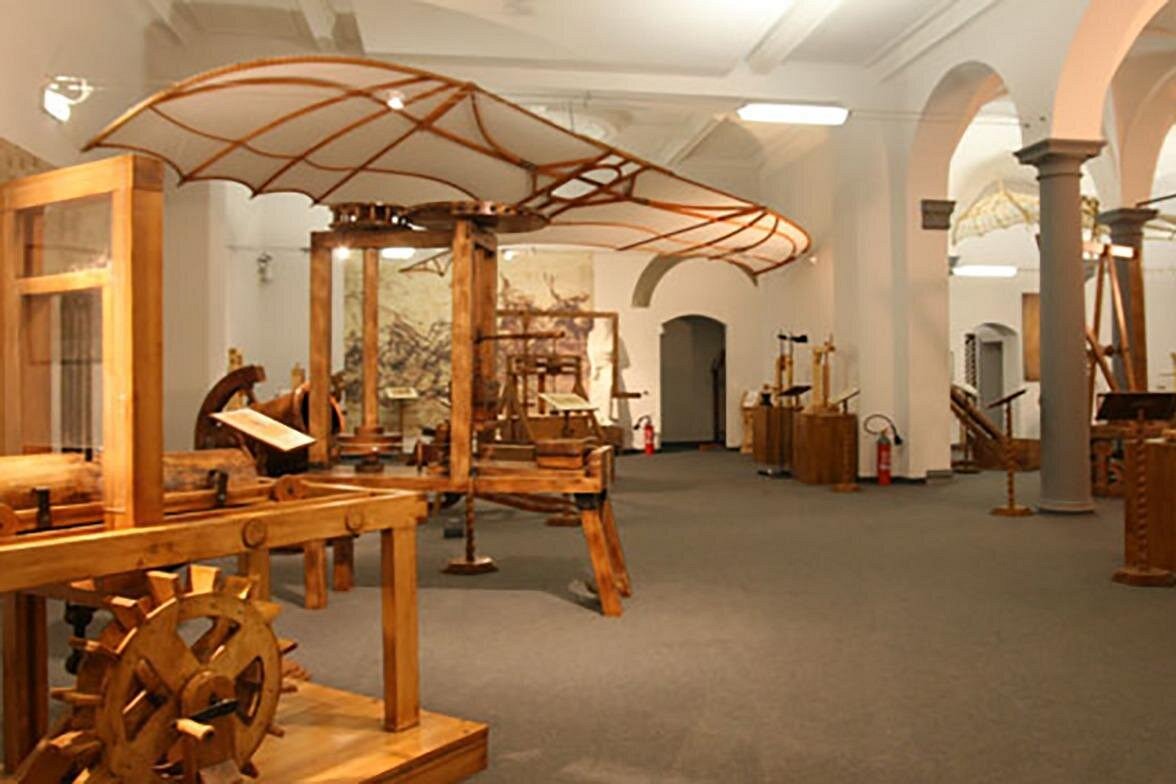
For anyone who wants to see Leonardo's ideas made physical, Milan's Museo Nazionale della Scienza e della Tecnologia Leonardo da Vinci houses one of the world's largest collections of working models built directly from his engineering drawings and inventions, including gear systems, the self-propelled cart, and flight studies rendered in wood and metal.
Craftsmen and engineers built these models by studying Leonardo's original measurements and proportions, translating five-century-old ink lines into functioning wood and brass.
Walking past a case of gear assemblies turning in slow motion, or a full-size reconstruction of the self-propelled cart, gives a much clearer sense of scale than any photograph of a manuscript page ever could.
It also raises a question worth sitting with: how much of what looks impossible today might simply be waiting for the right materials, the way Leonardo's flying machines were.
Discover Leonardo Machines in Milan
See full-scale reconstructions of Leonardo’s inventions and discover the engineering ideas behind his designs
Explore Leonardo Mechanical DesignsA Closer Look at Leonardo's Machines in Milan
A guided walk through Milan's Leonardo-related sites typically pairs the Codex Atlanticus pages with nearby working models, connecting the sketch to the object.
- Working scale models built from Leonardo's original drawings
- Context on how each invention was meant to function
- Time to view rotating manuscript pages when on display
Visitors often note that seeing the models beside the drawings makes the engineering logic click in a way reading alone doesn't. See current availability
Exploring Leonardo da Vinci in Milan
Milan was where Leonardo spent nearly two decades of his most productive engineering years, employed by the Sforza court to design canals, fortifications, and court spectacles alongside his painting commissions. Walking the city today, from the Ambrosiana to the Sforza Castle, traces the physical path of a mind that moved constantly between art and mechanics.
It was in Milan that Leonardo painted The Last Supper while simultaneously drafting canal systems and stage machinery for Sforza court festivals, a schedule that only makes sense once you understand he didn't separate art from engineering the way modern disciplines do.
Every fresco commission sat next to a page of gear ratios in the same notebook, and every court spectacle needed the same mechanical problem-solving as a war machine, just aimed at entertainment instead of defense.
Leonardo's engineering story doesn't end in Milan, though. His path also runs through Florence, where his apprenticeship began; Venice, where he consulted on naval defenses; Rome, where he studied under papal patronage; and finally Paris, near where he spent his final years and where some of his manuscripts eventually landed.
Experience Leonardo's Engineering Genius in Milan Today
Reading about gears and cams is one thing. Standing in front of a model built from Leonardo's actual drawings and watching a wooden gear system turn exactly as he intended is another experience entirely. Milan remains the best place to make that connection, since it holds both the original manuscript pages and the largest set of models built from them.
A well-organized visit typically moves from the historical drawings to the physical machines, letting the mechanical logic build step by step rather than all at once. This is where the engineering stops being abstract and starts being something you can watch move.
For travelers who want that progression handled for them, a small-group visit through Milan's Leonardo sites offers a way to see the manuscripts and models in the right order, guided by someone who can explain the mechanical reasoning behind each piece, such as this Leonardo da Vinci engineering tour of Milan, without needing to research the collection layout in advance.
Many visitors find that pairing the Ambrosiana's rotating manuscript pages with the Museo Nazionale's working models gives the clearest possible picture of how Leonardo's mind actually worked.
View Leonardo da Vinci Experiences in Milan
Final Thoughts
This post was all about Leonardo da Vinci mechanical engineering, and the deeper you look into his notebooks, the harder it becomes to separate the artist from the engineer.
His gears, war machines, flying studies, and ball bearing concepts weren't side projects to his painting career. They were the same restless curiosity applied to a different material.
The Renaissance gave Leonardo the freedom to move between disciplines without apology, and that freedom is exactly why his engineering work still resonates centuries later.
Seeing it in person, whether in a rotating manuscript page or a wooden model turning exactly as he sketched it, is the closest most of us will ever get to watching his mind actually think.
Related Post You May Like

Disclosure: This page may contain affiliate links. If you book through them, we may earn a small commission at no extra cost to you. Learn more.
Free Leonardo Milan Travel Guide
Plan Your Leonardo Trip in Milan
A premium mini guidebook for smarter Milan planning, including the best ticket strategy, Leonardo map, and practical visitor advice.
Get the Free Guide
Download the guide and receive practical Milan planning tips by email.
Download the Free Guide >> Leonardo Bianchi is the founder of Leonardo da Vinci Inventions & Experiences, a cultural travel guide helping visitors explore Leonardo da Vinci’s art, inventions, and legacy across Italy and Paris.