
(Last updated: Sep 2026)
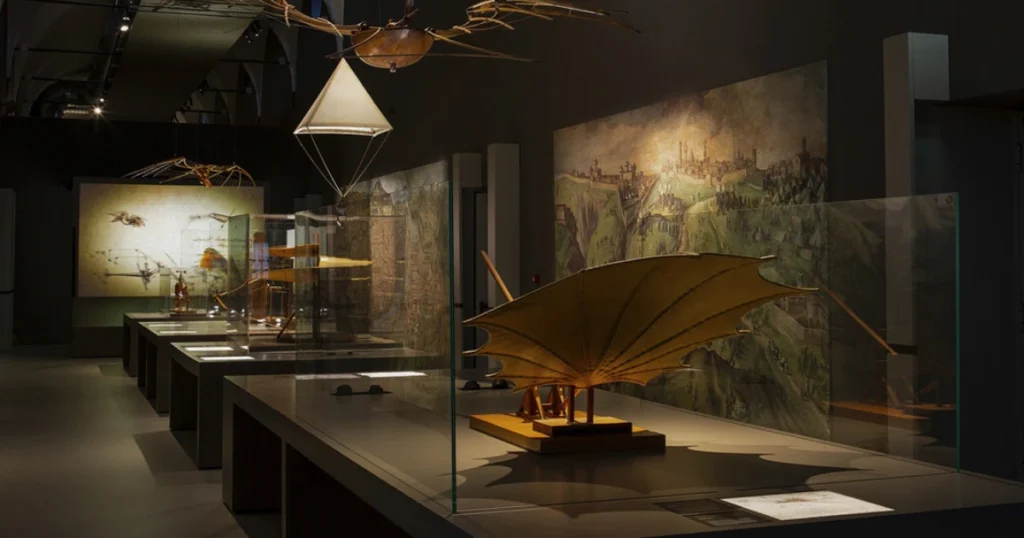
Did Leonardo da Vinci build his inventions, or did most of them stay locked inside his notebooks forever?
It's one of the most-searched questions about the Renaissance genius, and the honest answer is more interesting than a simple yes or no. Leonardo filled thousands of pages with mechanical sketches, but sketching a machine and building one are two very different things.
Some of his ideas connect directly to real engineering jobs he held in Milan. Others were likely thought experiments that never left the page. Understanding the difference changes how you see the man behind the drawings — and it changes what you look for the next time you stand in front of one of his notebooks in a museum.
This post is all about whether Leonardo da Vinci built his inventions, and what the historical evidence actually tells us.
Did Leonardo da Vinci build his inventions?
This question asks whether Leonardo physically constructed the machines shown in his famous sketches, such as the flying machine, the armored vehicle, and the giant crossbow. The short answer: some of his engineering work was practical and real, but there is no reliable evidence that most of his spectacular designs were built at full scale during his lifetime.
The Engineering Mind Behind Leonardo's Notebooks
Before judging what Leonardo built, it helps to understand why he was drawing in the first place. His notebooks weren't a portfolio of finished inventions. They were a working laboratory on paper.
Why Leonardo Drew So Many Machines
Leonardo's notebooks served many different purposes at once. Some pages record pure observation, like the movement of water or the flight of a bird. Others show mechanical experiments, calculations, and improvements to machines that already existed in his time.
Some sketches are proposals written to impress a patron, and some are speculative concepts he may never have intended to build at all. This mix matters.
A single drawing might represent a serious construction plan or a passing idea Leonardo was simply working through with a pen. That's why "Leonardo drew it" does not automatically mean "Leonardo built it."
Leonardo Was More Than a Theoretical Inventor
It's tempting to picture Leonardo as a dreamer sketching gadgets no one asked for, but that undersells him. He held real jobs. His most important position was as an engineer for Ludovico Sforza, the ruler of Milan.
In a now-famous letter written to secure that position, Leonardo listed his abilities in military engineering, bridge building, fortifications, weapons design, architecture, sculpture, and painting — almost as an afterthought.
He wanted Ludovico to see him as someone who could solve real engineering problems, not just an artist who doodled imaginary machines in his spare time.
This distinction matters more than it might seem. Renaissance courts didn't pay engineers to produce beautiful drawings; they paid them to solve immediate, expensive problems — defending a city wall, moving water efficiently, or designing a stage set that could impress visiting dignitaries.
Leonardo's notebooks show him operating in both worlds at once. On one page he might be calculating the load-bearing angle of a bridge truss for an actual commission. A few pages later, he might be sketching a mechanical lion or a device with no obvious client at all, simply because the mechanical problem interested him.
Reading his notebooks as a single, uniform "invention list" flattens this difference, making it harder to separate his working engineering career from his private intellectual play.
Which Leonardo Inventions Were Actually Built?
Rather than making a blanket claim, historians tend to classify each design individually, because the evidence varies enormously from sketch to sketch. Here's how the most famous designs stack up.
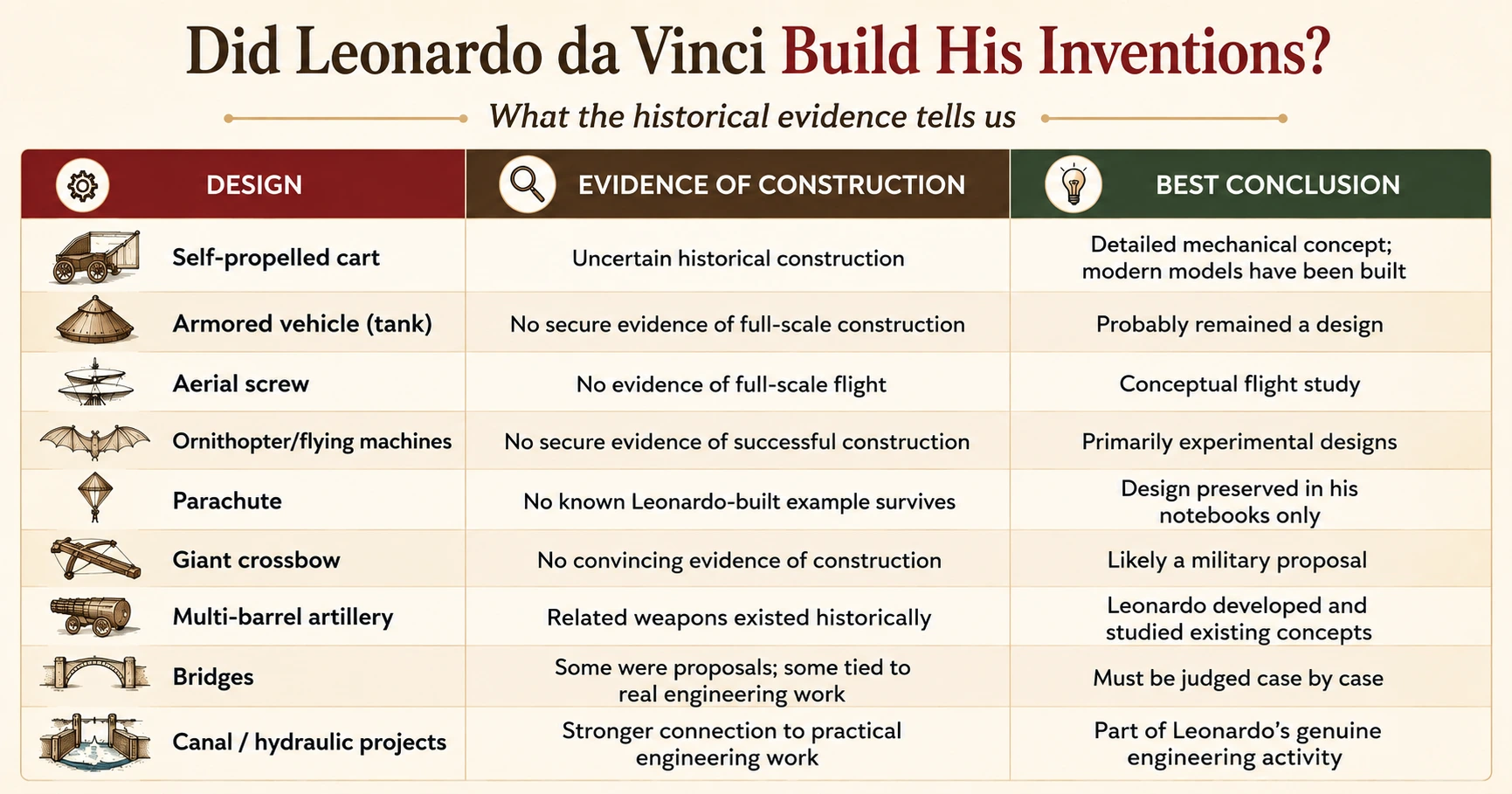
Leonardo's Real-World Engineering Projects
If the table above only listed the spectacular machines, you might walk away thinking Leonardo never built anything at all. That would be a mistake.
His genuine, hands-on engineering work centered on canals and water management, surveying, architecture, fortifications, and hydraulic systems. These weren't flashy inventions destined for museum posters, but they represent the practical backbone of his career as a working Renaissance engineer.
Water management, in particular, occupied a significant part of his working life. Milan's economy depended heavily on its canal network, both for transporting goods and for irrigating farmland, and Leonardo studied how locks, sluices, and channels could move water more efficiently through the city.
He also produced detailed surveys of the surrounding landscape, work that required precise measurement rather than imaginative flourish. Later in his career, he consulted on architectural and fortification projects, applying the same analytical eye he used for water systems to the problem of defending a besieged city.
None of this generates the same headlines as a flying machine, but it's arguably a more accurate picture of what "Leonardo the engineer" actually did with most of his working hours.
If you've ever wondered how much of this practical side survives to be seen in person, one of the clearest ways to connect the notebooks to physical reality is through a guided walking exploration of Leonardo's engineering sites in Milan, where fortification walls and canal routes he studied are still part of the city's layout today.
Did Leonardo Build His Most Famous Machines?
Two categories of invention dominate the public imagination more than any other: the armored vehicle and the flying machines. Both deserve a closer look, because both are frequently misunderstood.
The Armored Vehicle: Fact vs. Myth
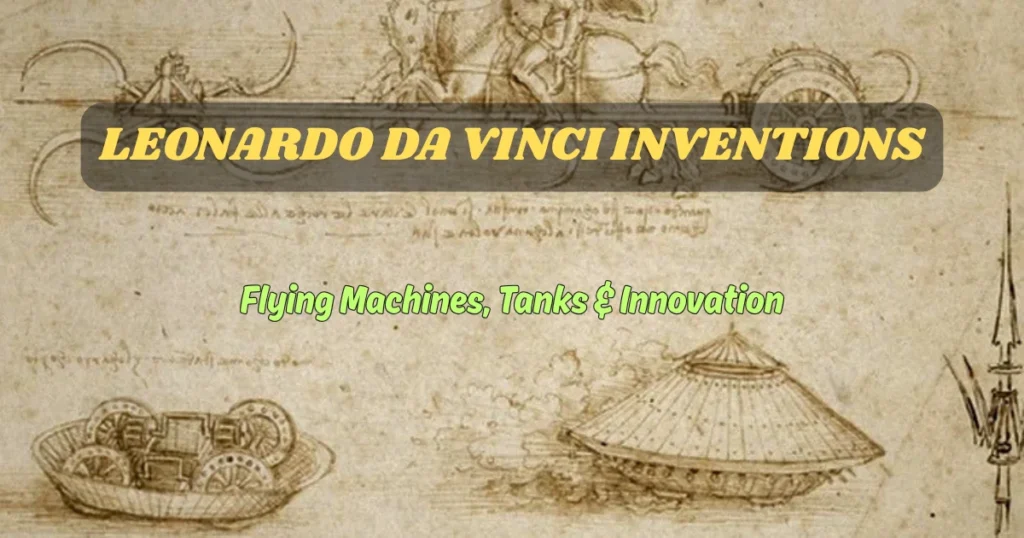
Leonardo's sketch of a covered, wheeled vehicle bristling with cannons is often described as the world's first tank. The drawing shows a low, cone-shaped shell mounted on wheels, designed to let soldiers fire in every direction while staying protected.
Its purpose was clearly military, meant to break enemy lines while shielding the crew inside. But no prototype from his lifetime has ever been documented, and historians generally draw a firm line between this sketch and any actual Renaissance-era battlefield vehicle.
Interestingly, some modern reconstructions have revealed a design quirk: as drawn, the gearing would have caused the wheels to work against each other. Whether that was an intentional safeguard against the plans falling into the wrong hands, or simply an error, remains debated.
The Flying Machines: Investigation, Not Construction
Leonardo studied flight more seriously than almost anyone of his era. His sketches include the aerial screw, ornithopter concepts, detailed wing studies, glider-related ideas, and the observations that make up his Codex on the Flight of Birds.
The key distinction is this: Leonardo investigated flight extensively, but the surviving drawings are not evidence that he successfully constructed and flew these machines. What they do show is a mind treating the sky as a solvable engineering problem centuries before powered flight became possible.
Much of this work reads less like a finished blueprint and more like a research notebook. Leonardo repeatedly observed how birds adjusted their wings mid-flight, how air resistance behaved, and how weight and wingspan related to lift.
The aerial screw, often nicknamed an early helicopter concept, is a striking design, but nothing in the historical record suggests he built one large enough to leave the ground, and the human muscle power required would have made flight physically impossible regardless of the design's cleverness.
The parachute sketch is often treated the same way. It shows a pyramid-shaped canopy meant to slow a falling person, and while no Leonardo-built example survives, modern enthusiasts have built working versions from his design centuries later — proof that the underlying physics held up, even if Leonardo himself never tested it in the air.
The Military Machines: Giant Crossbow and Multi-Barrel Artillery
Leonardo worked in a period when military engineering was both commercially valuable and politically essential, and several of his most dramatic sketches belong to this category.
The giant crossbow, drawn at a scale far larger than any practical siege weapon, was likely intended as a proposal meant to demonstrate ambition and skill rather than a device built for the battlefield.
His multi-barrel artillery designs fall into a slightly different category: similar multi-barrel weapons already existed in Renaissance warfare, so Leonardo was refining and studying known technology rather than inventing something from nothing.
This distinction — between machines Leonardo invented outright, machines he redesigned, and technologies that already existed before him — is one of the most useful lenses for evaluating any claim about what he "built."
Why Didn't Leonardo Build More of His Designs?
No single reason explains this.
It was likely a combination of factors working together: available materials and power sources simply couldn't achieve what some sketches proposed; large projects required patronage, money, and a practical justification that wasn't always available; some drawings appear to capture Leonardo thinking through a mechanical problem rather than finalizing a machine for production; his attention constantly shifted between painting, anatomy, engineering, and court duties; and the notebooks that survive represent only a fraction of everything he actually worked on.
A quick reality check on modern reconstructions.
- Museums and engineers have built working models from Leonardo's drawings
- These models reveal whether mechanisms can actually move and how components interact
- They also expose missing information and practical limitations in the original sketches
A working modern reconstruction does not prove Leonardo built the machine, or that it would have worked exactly as drawn using Renaissance-era materials.
Visitors often note that seeing a reconstruction in motion changes how they read the original sketch entirely.
Where to Experience Leonardo's Engineering Legacy Today
Reading about these machines is one thing. Standing in front of a full-scale reconstruction built from Leonardo's own measurements and notes is an entirely different experience. Museums in Milan hold some of the richest collections of these models anywhere in the world, including recreations of the self-propelled cart, the aerial screw, and several of his hydraulic and military designs. Seeing the gears, pulleys, and counterweights in physical form makes it much easier to understand what Leonardo was actually trying to solve — and where his ideas ran into the limits of Renaissance technology.
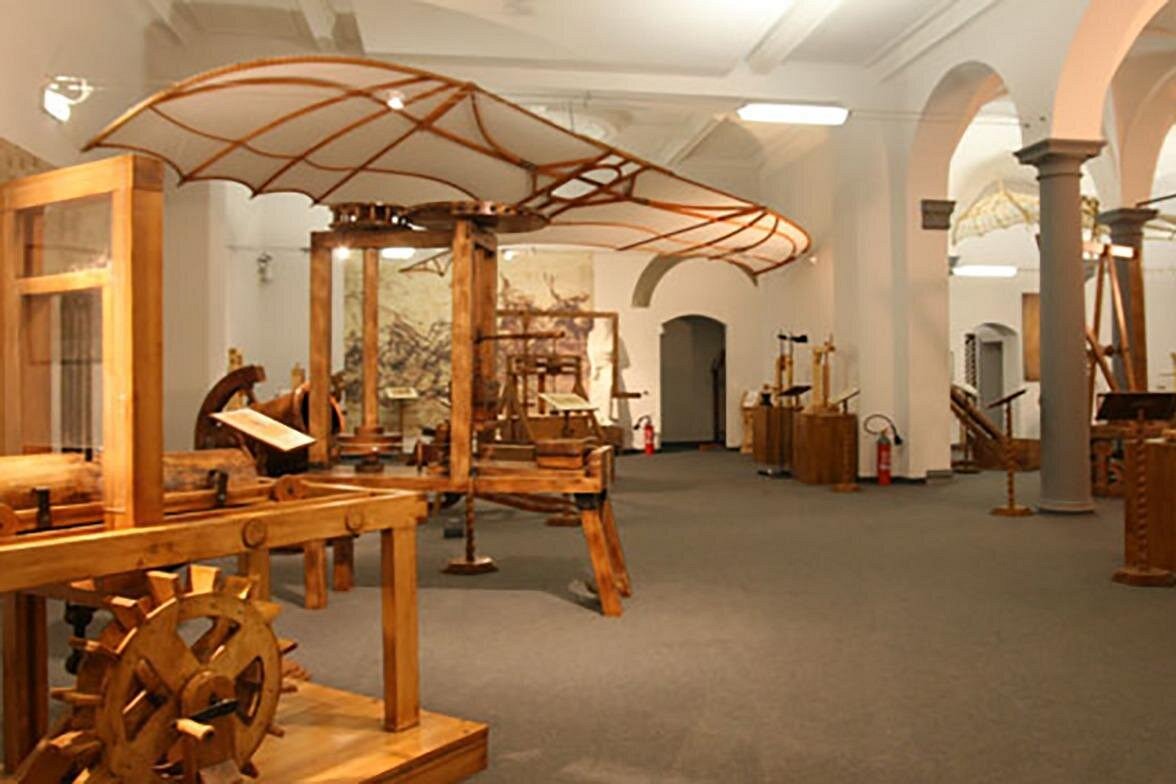
Explore Leonardo’s Machines in Milan
See full-scale reconstructions of Leonardo’s inventions and discover the engineering ideas behind his designs
Explore Leonardo Museum ToursLeonardo da Vinci Museum Experience, Milan
A guided visit through rooms of full-scale wooden models built from Leonardo's original sketches.
- Hands-on and interactive machine models
- Context on which designs were tested historically
- Small-group format with a knowledgeable guide
Visitors often mention that the guide's explanations make the engineering details click in a way the sketches alone don't. Check availability
Beyond the museum halls, several of the fortification walls and canal routes Leonardo actually surveyed still shape parts of Milan's layout, quietly connecting his notebook sketches to the ground beneath your feet.
Exploring Leonardo da Vinci in Milan
Milan is where Leonardo spent nearly two decades as a working engineer, and it remains the best starting point for tracing his practical projects on the ground.
From there, his footprint spreads across Italy and beyond: his artistic training took shape in Florence, his studies of water and canals connect to Venice, his architectural and scientific interests touched Rome, and his final years and legacy are preserved in Paris, where he died and where the Louvre now holds some of his most famous work.
Each city adds a different layer to the same story — the artist, the engineer, the observer of nature, and the court favorite whose notebooks still raise questions today.
Visiting more than one location turns Leonardo from a name in a textbook into a figure whose ideas quite literally shaped the map of Renaissance Europe.
Final Thoughts
This post was all about did Leonardo da Vinci build his inventions, and the answer resists a simple yes or no.
Some of his engineering ideas connected to practical work, real commissions, and documented projects, but there is no solid evidence that many of the spectacular machines now associated with him were ever constructed at full scale during his lifetime.
That doesn't make him less remarkable. If anything, his notebooks reveal something more historically interesting than a list of finished inventions: an engineer using drawing itself as a tool for thinking through how machines could work, long before he — or anyone else — could build them.
Seeing his sketches reproduced as working models in person is one of the few ways to genuinely test that idea for yourself, which raises one more question worth exploring: would these machines have actually worked as designed?
Related Post You May Like

Disclosure: This page may contain affiliate links. If you book through them, we may earn a small commission at no extra cost to you. Learn more.
Free Leonardo Milan Travel Guide
Plan Your Leonardo Trip in Milan
A premium mini guidebook for smarter Milan planning, including the best ticket strategy, Leonardo map, and practical visitor advice.
Get the Free Guide
Download the guide and receive practical Milan planning tips by email.
Download the Free Guide >> Leonardo Bianchi is the founder of Leonardo da Vinci Inventions & Experiences, a cultural travel guide helping visitors explore Leonardo da Vinci’s art, inventions, and legacy across Italy and Paris.