
(Last updated: Sep 2026)
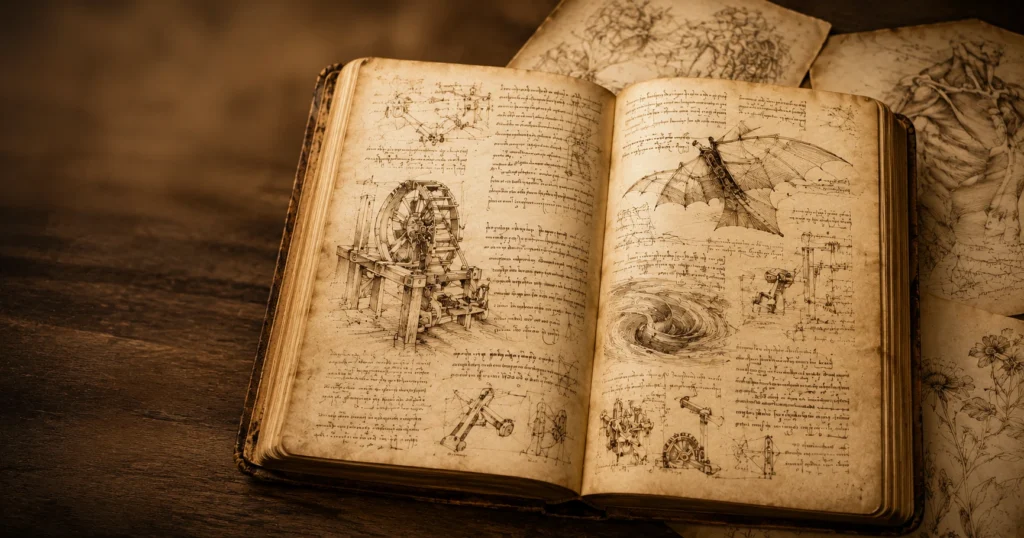
Leonardo da Vinci notebooks were never meant to be read the way we read a diary — they were a working laboratory, pressed onto paper and carried everywhere he went.
Across thousands of surviving pages, Leonardo filled the margins with flying machines, dissected muscles, swirling studies of water, and half-finished poems, often crammed onto the very same sheet.
These pages matter because they are the closest thing we have to watching Leonardo think in real time. No other artifact from the Renaissance offers this kind of unfiltered access to a single mind moving between anatomy, engineering, art, and nature within a single afternoon — which is exactly why standing in front of a real page, rather than a printed reproduction, changes how people experience his genius.
This post is all about the Leonardo da Vinci notebooks — what's actually inside them, why he wrote the way he did, how the pages scattered across Europe, and where you can still see the originals today.
What Are Leonardo Da Vinci Notebooks?
Leonardo da Vinci notebooks are a bound or loose collection of handwritten pages on which Leonardo recorded sketches, scientific observations, inventions, and personal notes between roughly 1478 and 1519. He carried these notebooks daily, filling them with mirror-written text beside detailed drawings on subjects from anatomy to hydraulics. Today, the surviving pages are grouped into separate bound collections known as codices.
Historical Background
Leonardo began keeping notebooks seriously in the early 1480s, around the time he moved to Milan to work for Duke Ludovico Sforza, and he kept writing in them almost until his death in France in 1519.
He never intended most of these pages for publication. They were personal tools — a place to think on paper, test half-formed ideas, and record whatever caught his attention that day.
Why Leonardo Kept a Notebook at All
Leonardo moved constantly between roles: painter, military engineer, court entertainer, anatomist, and self-taught mathematician.
He carried small notebooks strapped to his belt so he could sketch or write the moment something interested him, whether that was the flow of water around a bridge support, the structure of a bird's wing mid-flight, or the mechanics of a crossbow he was designing.
Historians estimate he produced somewhere around 13,000 pages of notes and drawings over his lifetime, of which roughly 7,200 survive today — meaning more than half of everything he wrote and drew has been lost to time, fire, and careless owners.
What He Actually Recorded on Each Page
A single page might combine a shopping list, a study of light and shadow on a hillside, a mechanical drawing for a pump, and a note reminding himself to "ask the master of arithmetic" about a calculation he couldn't finish.
This mixture is one of the reasons the notebooks feel so alive today: they show a mind that refused to separate art from science.
Anatomical studies sit beside hydraulic engineering; hydraulic engineering sits beside verses of poetry. Nothing was organized the way a modern textbook would be, because Leonardo wasn't writing a textbook — he was thinking out loud.
Leonardo da Vinci anatomical drawings appear throughout the notebooks in extraordinary detail, some based on dissections he performed himself on cadavers obtained through hospital connections in Florence and Milan.
Alongside them sit Leonardo da Vinci engineering drawings for pumps, gears, and war machines, plus recurring nature studies of moving water, plant growth patterns, and the flight paths of birds.
He also sketched maps for military and civic clients, including an unusually accurate Leonardo da Vinci map of the town of Imola, based on measurements he likely took on foot.
Many pages serve as preparatory drawings for a painting he was planning, allowing him to work out a hand, a drapery fold, or a facial expression before committing it to panel.
A small number of pages are even believed to include a Leonardo da Vinci self-portrait, sketched in red chalk late in his life, though scholars still debate exactly which drawings show his own face.
Leonardo's Role and Influence
The notebooks aren't just a curiosity from art history — they reshaped how later generations understood Leonardo entirely. For centuries after his death, he was known mainly as a painter with a handful of famous works.
It was only once scholars began seriously studying the surviving pages that the full scope of his engineering, anatomical, and scientific thinking came into focus.
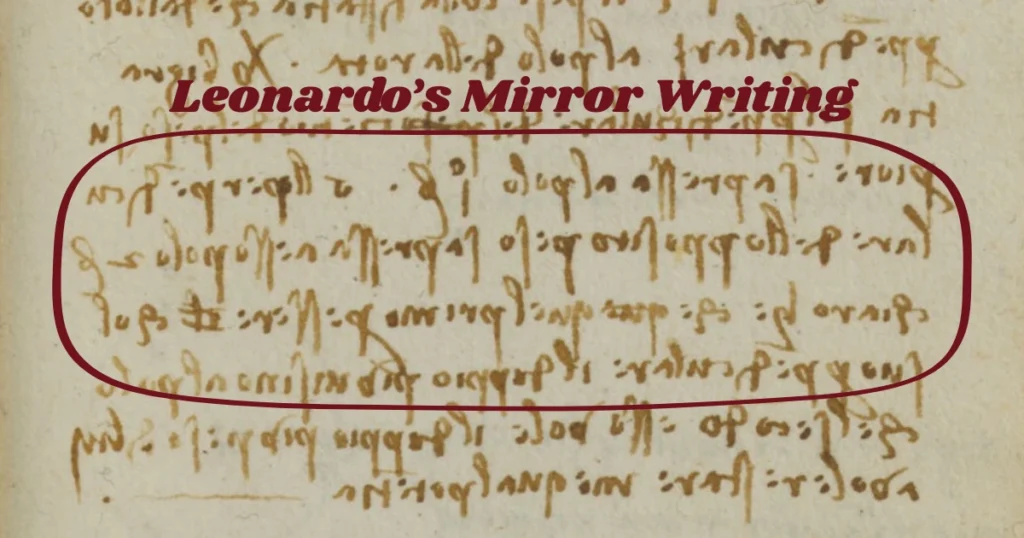
Why Did Leonardo da Vinci Write Backward?
Most of Leonardo's notebook pages are written in mirror script — right to left, legible only when held up to a mirror or read in reverse.
He was left-handed, and writing this way likely felt more natural for him while also keeping fresh ink from smudging under his moving hand, a real problem with the metal-nib pens of the period.
Some historians have suggested it may also have given his more unconventional ideas a degree of privacy from casual readers, though this theory remains debated rather than settled fact.
What's clear is that the backward writing wasn't a code meant to hide secrets from history — it was simply how Leonardo wrote every day, in shopping lists as much as in anatomical studies.
How a Lifetime of Pages Became Scattered Codices
After Leonardo died, his notebooks passed to his devoted student and heir, Francesco Melzi, who kept the collection largely intact for decades at his family villa near Milan.
Once Melzi died, however, the pages were broken apart, sold, and passed through the hands of sculptors, collectors, and even a spy.
Later owners cut the sheets apart, rearranged them by subject, and bound them into new volumes that bore no relation to Leonardo's original order.
That's the reason the notebooks survive today not as one continuous diary, but as separate bound collections called codices — each one shaped as much by its later owners as by Leonardo himself.
Anyone curious about how these fragmented pages ended up in a single archive can get a close, guided look at the Codex Atlanticus inside Milan's Biblioteca Ambrosiana, where a rotating selection of the original sheets is explained page by page in its historical context.
The Major Surviving Codices
Several da Vinci codices now anchor most of what scholars know about Leonardo's notebooks:
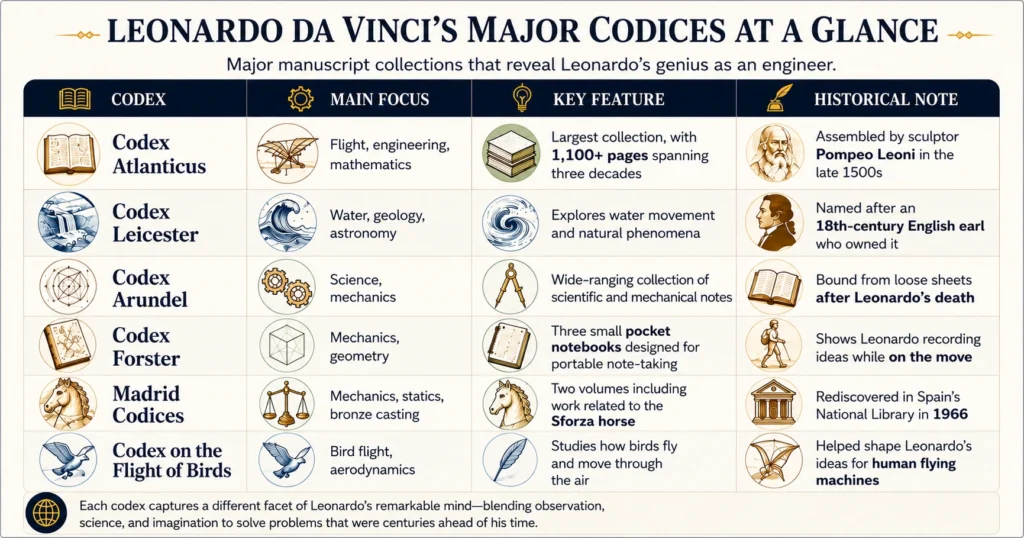
Each of these represents a different slice of how Leonardo used paper — some are formal working manuscripts assembled by later collectors, others are pocket-sized notebooks small enough to carry through the streets of Milan or Florence.
Taken together, the da Vinci codices are less a finished body of work than a lifetime of raw thinking that outlived the man who wrote it.
Where to Experience This Legacy Today
Reading about the notebooks is one thing; standing close enough to see Leonardo's actual handwriting is another experience entirely.
Knowing where each codex lives today — and how it's displayed — makes it possible to plan an itinerary around seeing the real pages rather than reproductions.
Major Collections and Where They Live
| Codex / Manuscripts | Current Location | City | Visitor / Display Notes |
|---|---|---|---|
| Codex Atlanticus | Biblioteca Ambrosiana | Milan, Italy | Rotating selections are displayed in the Sala Federiciana |
| Codex Leicester | Privately owned | — | Owned by Bill Gates and periodically shown in public exhibitions around the world |
| Codex Arundel | British Library | London, UK | Preserved as part of the British Library’s manuscript collections |
| Codex Forster | British Library | London, UK | Held alongside other important Leonardo manuscript material |
| Madrid Codices | Biblioteca Nacional de España | Madrid, Spain | Two important volumes preserved in Spain’s national collection |
| Codex on the Flight of Birds | Biblioteca Reale | Turin, Italy | Preserved in Turin’s Royal Library |
| Additional Leonardo Manuscripts | Institut de France | Paris, France | Holds 12 additional manuscripts, combining drawings with Leonardo’s reverse-script notes |
Seeing the Real Pages in Person
Original notebook pages are rarely on permanent public display — most institutions rotate only a handful of sheets at a time to protect fragile paper and centuries-old ink from light exposure.
That's exactly why timing and location matter so much for anyone hoping to see one of these pages in person, and why museums in Milan and London plan entire exhibits around whichever specific pages happen to be on loan that season.
This is also why so many visitors combine a look at the original manuscripts with a stop at a dedicated Leonardo museum, where full facsimiles of Leonardo da Vinci notebook pages are displayed alongside working models built from the sketches.
It's a practical way to see far more of his notebook sketches than any single rotating display could show at once, since a facsimile exhibit isn't limited by the conservation rules that keep the originals locked away most of the year.
For anyone specifically chasing the Vitruvian Man, it's worth knowing that the drawing itself is kept in storage at Venice's Gallerie dell'Accademia and shown only rarely, so a museum reproduction is often the more realistic way to study its proportions up close.
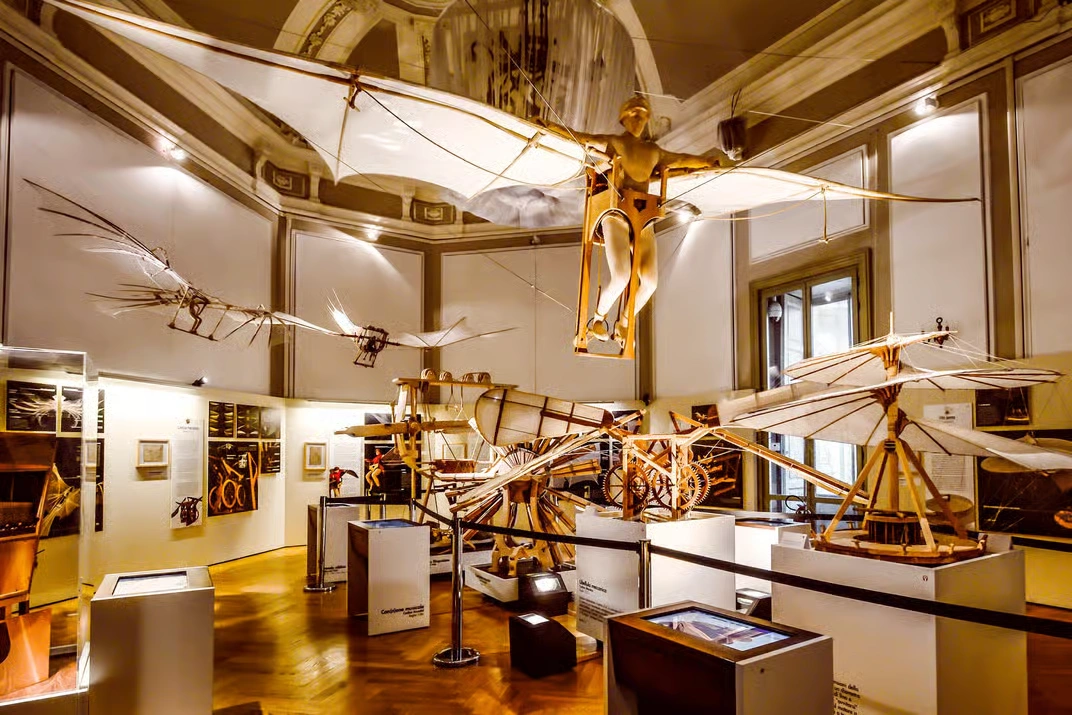
Leonardo’s Ideas Come to Life
See Leonardo’s notebook sketches come to life through interactive displays and full-scale models
Explore Leonardo3 TicketsAn interactive museum near the Duomo that rebuilds machines directly from notebook sketches, letting visitors see the drawings and the working models side by side.
- Full-scale reconstructions built from Codex Atlanticus pages
- Digital manuscript displays you can page through by hand
- Central location, easy to combine with a Duomo or Last Supper visit
Many visitors say the models here make Leonardo's engineering sketches click in a way the flat page alone doesn't. Check current entry times
Visitors often note that standing in front of a single handwritten page feels more revealing than an entire gallery of paintings — there's something about the cramped mirror script and the doodles in the margins that makes the five centuries in between briefly disappear.
Exploring Leonardo da Vinci in Milan
Milan holds a disproportionate share of Leonardo's story. It's where he spent nearly two decades at the Sforza court, painted The Last Supper, and filled a large portion of what later became the Codex Atlanticus.
Walking through the city today means passing many of the same streets where he studied the canal system's hydraulics and designed elaborate machines for Sforza court festivals — details that show up, sketched and annotated, throughout his notebook pages.
For a fuller picture of his life and work, it's worth pairing a Milan visit with time in Florence, where he trained under Verrocchio and painted his earliest works; Venice, where he consulted on the city's defenses and where the Vitruvian Man is kept today; Rome, where he spent his final years in Italy working under papal patronage; and Paris, where he died in 1519 and where several of his manuscripts eventually settled in French collections, including twelve held today at the Institut de France.
Each city adds a different layer to the same story the notebooks tell. Florence shows the training that gave Leonardo his technical foundation.
Milan shows the two decades during which his notebooks grew fastest, fueled by court commissions and canal engineering.
Rome and Paris show a slower, more reflective final decade, spent revisiting older notes and adding new observations right up until his death.
Following that arc across cities — rather than treating any single museum as the whole story — is what turns a Leonardo trip from a single afternoon into a genuine journey through his notebooks.
Final Thoughts
This post was all about the Leonardo da Vinci notebooks — why he wrote in mirror script, how his lifetime of pages scattered into separate codices after his death, and where those pages live today.
What makes the notebooks remarkable isn't just their content, but what they reveal about how Leonardo actually thought: restlessly, across every discipline at once, without ever drawing a hard line between curiosity and craft.
Seeing a real page in person, whether at the Ambrosiana in Milan or the British Library in London, offers something a printed reproduction never quite can — a direct, physical link to the hand that drew it five hundred years ago.
Related Post You May Like



Disclosure: This page may contain affiliate links. If you book through them, we may earn a small commission at no extra cost to you. Learn more.
Free Leonardo Milan Travel Guide
Plan Your Leonardo Trip in Milan
A premium mini guidebook for smarter Milan planning, including the best ticket strategy, Leonardo map, and practical visitor advice.
Get the Free Guide
Download the guide and receive practical Milan planning tips by email.
Download the Free Guide >> Leonardo Bianchi is the founder of Leonardo da Vinci Inventions & Experiences, a cultural travel guide helping visitors explore Leonardo da Vinci’s art, inventions, and legacy across Italy and Paris.