
(Last updated: Sep 2026)
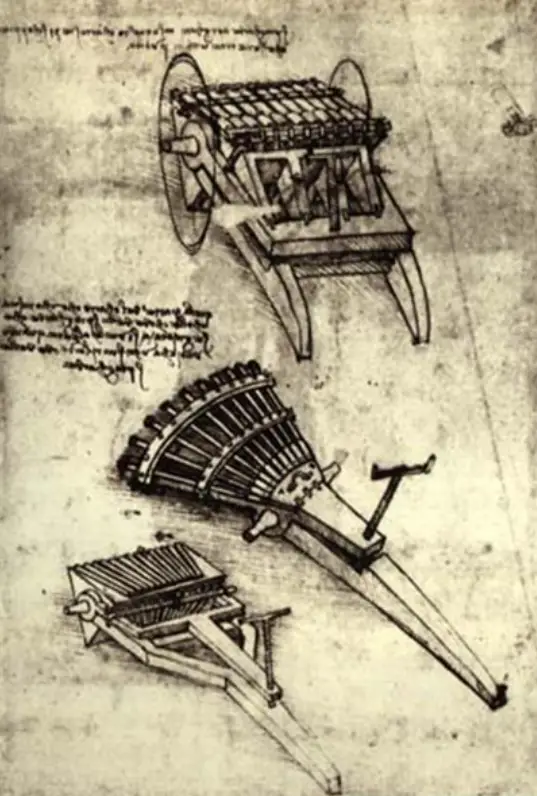
The Leonardo da Vinci machine gun is one of the most surprising entries in the inventor's private notebooks, a rapid-fire weapon concept sketched more than 400 years before automatic firearms became a reality.
Long before Milan knew him as a painter, Leonardo worked as a military engineer, and his notebooks reveal a mind constantly testing how war could be fought differently.
This idea matters because it reframes our understanding of the Renaissance itself. Leonardo's war machines, alongside his sketches of flying machines and armored vehicles, show a period defined not only by art but also by relentless technical experimentation, and seeing these original pages in person adds a layer of understanding that no textbook photograph can fully capture.
This post covers the Leonardo da Vinci machine gun, how it worked on paper, and where you can still see the drawings and reconstructions today.
What is the Leonardo da Vinci Machine Gun?
The Leonardo da Vinci machine gun refers to a multi-barrel firearm design Leonardo sketched in his notebooks, most notably a fan-shaped arrangement known as the "triple-barrel organ gun." It was never mass-produced, but it demonstrates an early attempt to solve the reload problem of early firearms by grouping many barrels together for faster, near-continuous fire.
The Engineering Idea Behind the Leonardo da Vinci Machine Gun
To understand why Leonardo sketched something resembling a machine gun, it helps to picture the battlefields he was designing for.
Renaissance armies relied on single-shot firearms called arquebuses, which were powerful but painfully slow to reload. A soldier might fire once, then spend a dangerous stretch of time repacking gunpowder and shot while exposed to the enemy.
A Renaissance Military Problem
Leonardo, working under patrons like Ludovico Sforza in Milan, was expected to propose solutions to exactly this kind of problem. In one of his best-known letters, addressed to Sforza while seeking employment, Leonardo listed his abilities as a military engineer well before he mentioned painting.
He described bridges that could be quickly built and dismantled, methods for draining moats, and designs for cannons and other unconventional weapons.
Firearms in the 1480s were still a relatively new battlefield technology, and commanders sought any advantage they could gain through engineering rather than sheer numbers.
His notebooks from this period are full of war machine sketches: catapults, armored vehicles, and fortification designs. The recurring theme is efficiency — how to make war faster, safer for the operator, and more devastating for the opponent.
Leonardo approached these problems the same way he studied water or anatomy: by breaking a system down into its individual moving parts and asking how to improve each one.
Leonardo's Innovative Solution
Rather than trying to make a single gun reload faster, Leonardo reimagined the weapon's entire structure. His concept clustered multiple barrels together on a shared frame, so that as one row fired, another could be prepared.
It was less a single invention and more a rethinking of firepower as a continuous process rather than a single shot.
Sketches and Manuscripts
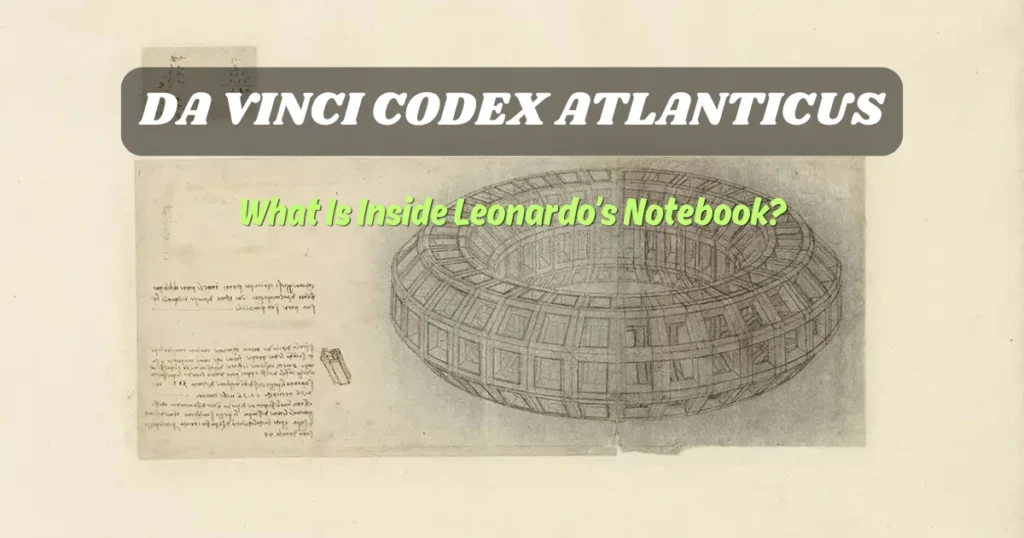
These ideas survive mainly in the Codex Atlanticus, the largest collection of Leonardo's papers, where war machines sit only pages away from studies of water flow and human anatomy. That juxtaposition is part of what makes Leonardo's notebooks so compelling: weapons of war drawn with the same careful hand as a study of a smiling face.
The sketches themselves are dense with annotations written in Leonardo's famous mirror script, moving right to left across the page.
Historians studying these pages have had to reconstruct not just the weapon's mechanics but Leonardo's thought process, since early drafts often show him testing one barrel arrangement, crossing it out, and refining the geometry in the margin.
This kind of visible trial and error is part of what makes the Codex Atlanticus such a valuable historical document. It is less a finished blueprint and more a running record of an engineer thinking on paper.
Many of these same pages also contain early studies for Leonardo's armored fighting vehicle, a design historians often describe as a conceptual ancestor of the modern tank, and travelers curious about the full scope of his military engineering often pair a museum visit with a guided walking tour through Leonardo's Milan, which places these sketches in the context of the city he actually worked in.
How the Leonardo da Vinci Machine Gun Works
Leonardo's design is best understood as a system rather than a single trigger-and-barrel weapon. It relied on staggered firing groups, a rotating or repositionable frame, and a division of labor between the soldiers operating it.
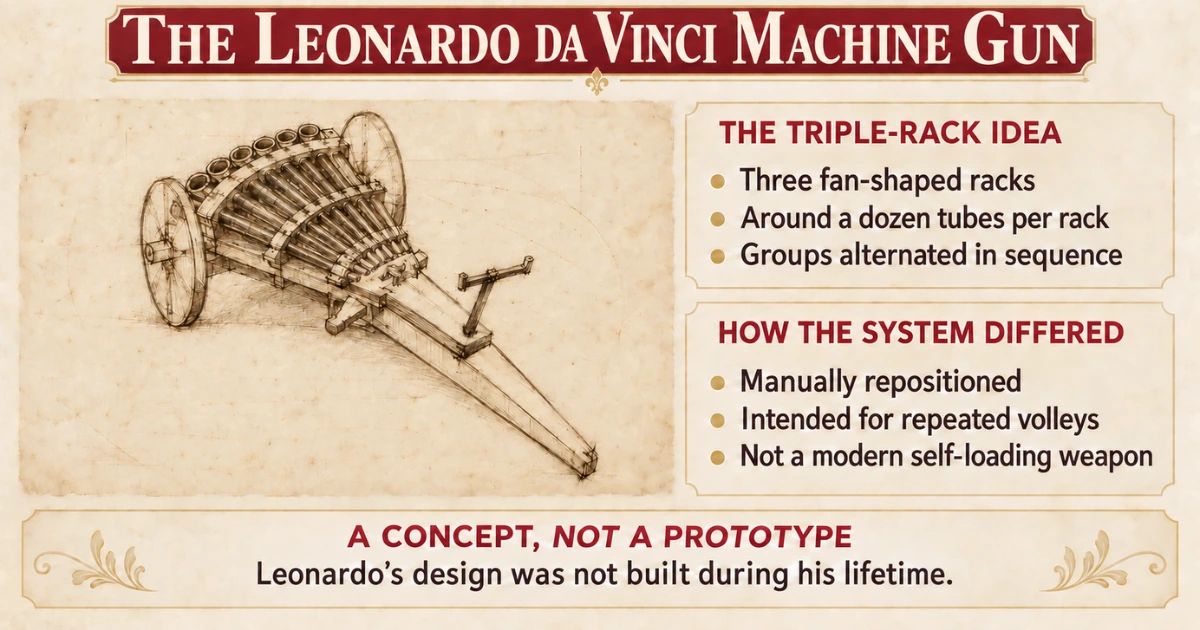
The Triple-Rack Barrel System
The most famous version of the sketch shows three fan-shaped racks of barrels mounted on a single rotating base. Each rack held around a dozen small-caliber barrels. While one rack was firing, the other two could be reloaded or cooled, keeping the weapon in near-constant use.
Rotating Mechanism and Rapid Fire
A hand-cranked mechanism allowed the operator to rotate the next loaded rack into firing position. This is the detail most people mean when they ask whether Leonardo invented the machine gun: not a self-loading weapon in the modern sense, but a manually rotated system designed for sustained volleys rather than single shots.
Comparison to Other War Machines
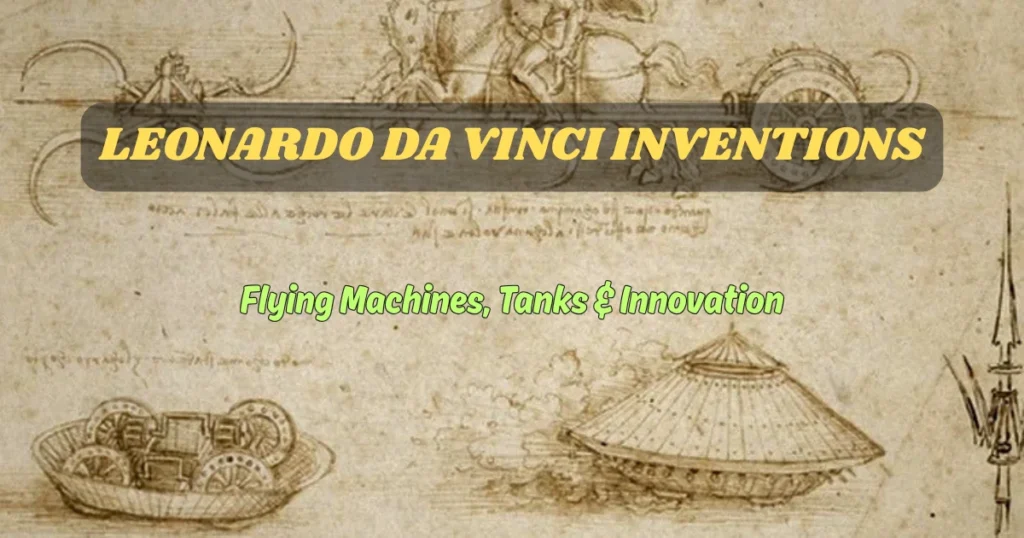
The multi-barrel gun did not exist in isolation. Leonardo sketched it alongside a self-propelled armored vehicle, sometimes called his fighting vehicle or early tank concept, built as a covered, cone-shaped shell mounted on wheels with cannons positioned around its circumference.
He separately explored the mechanics of flight in his famous studies of flying machines, including his ornithopter design based on observations of bird wings. Together, these drawings paint a picture of an engineer thinking simultaneously about movement on land, in the air, and through sustained firepower.
None of these three concepts was built during Leonardo's lifetime. They existed as proposals, more thought experiments in mechanical possibility than functioning prototypes.
Some historians even argue that Leonardo intentionally included design flaws in a few of his war machine sketches, possibly to prevent the ideas from being stolen or misused if the notebooks fell into the wrong hands.
Whether or not that theory holds specifically for the multi-barrel gun, it reflects how carefully historians have had to read these pages, treating them as much as puzzles as blueprints.
A closer look at Renaissance military engineering
Guided tours of Milan's da Vinci-related sites often lead visitors past replicas of his war machines alongside his flying and hydraulic studies.
- Full-scale wooden models of Leonardo's war machine sketches
- Context on how his military work connects to his art and anatomy studies
- Time built in to view the Codex Atlanticus pages up close
Visitors often note that seeing the models in scale changes how they read the original sketches.
Where to See the Leonardo da Vinci Machine Gun Today
The original sketches are fragile paper manuscripts, so they are not always on public display, but the ideas behind them are very much accessible through museums and permanent exhibitions dedicated to Leonardo's engineering work.
Museums with Leonardo's War Machine Designs
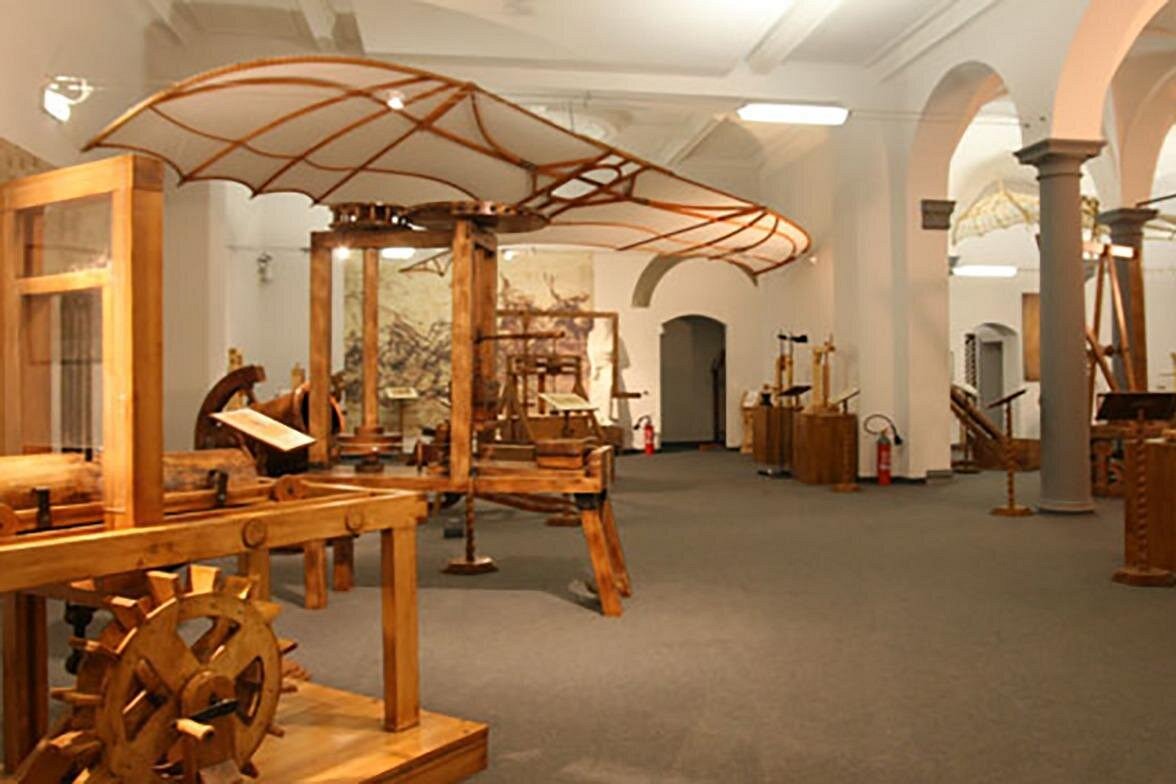
The Museo Nazionale della Scienza e della Tecnologia Leonardo da Vinci (Leonardo da Vinci Museum of Science and Technology) in Milan houses one of the world's largest collections of full-scale models built from Leonardo's technical drawings, including reconstructions of his war machines.
Walking among these wooden models gives a physical sense of scale that a page of sketches simply cannot.
Codex Atlanticus and Where It's Housed
The Codex Atlanticus itself is kept at the Biblioteca Ambrosiana in Milan, bound today into twelve volumes after centuries of rearrangement. It contains roughly 1,100 pages covering subjects as varied as flight, hydraulics, mathematics, and military engineering, making the war machine sketches just one thread in a much larger body of work.
Because of its age and fragility, pages rotate through occasional exhibitions rather than being displayed permanently, so checking current exhibits before a visit is worthwhile for anyone hoping to see an original page rather than a facsimile.
Model Recreations in Museums
Beyond Milan, smaller touring exhibitions and science museums across Europe occasionally feature reconstructed models of Leonardo's weapons, built by engineers and historians who worked directly from his manuscript drawings.
These reconstructions are useful precisely because Leonardo's sketches, while detailed, were never meant to be assembly instructions. Building a physical model forces historians to resolve ambiguities in the drawings, and comparing different museums' interpretations of the same sketch can reveal just how much room for interpretation his notebooks actually contain.
Discover Leonardo Machines in Milan
See full-scale reconstructions of Leonardo’s inventions and discover the engineering ideas behind his designs
Explore Leonardo Military DesignsLeonardo da Vinci Museum Visit, Milan
A guided visit through the science museum's Leonardo galleries, where full-scale models of his war machines and flying devices stand alongside his original notebook sketches.
- Access to war machine and flying machine model halls
- Historical context from a guide familiar with the Codex Atlanticus
- Flexible time slots for individuals and small groups
Travelers often say the guide's explanations made the engineering details easier to follow than reading the placards alone. View museum visit details
Exploring Leonardo da Vinci in Milan
Milan is where Leonardo spent nearly two decades of his working life, and it remains the city most closely tied to his engineering notebooks, including the war machine sketches discussed here.
Beyond the science museum and the Ambrosiana library, the city holds traces of his presence in its streets, canals, and civic architecture, much of which he was personally asked to help design.
Leonardo advised on Milan's canal system, contributed to plans for the cathedral, and painted The Last Supper on a refectory wall near where his notebooks were later archived.
Walking through Milan today with this context in mind changes how the city reads. A canal lock is no longer just infrastructure, but a trace of the same engineering mind that sketched a rotating multi-barrel gun.
That layering of history is part of why so many travelers choose to explore Leonardo's Milan on foot, connecting the dots between his art, his engineering, and the physical city he helped shape.
Leonardo's story doesn't end in Milan, though. His creative and scientific life stretched across Florence, where he trained as a young artist; Venice, where he consulted on military defenses; Rome, where he worked under papal patronage; and Paris, near where he spent his final years.
Each city adds a different layer to understanding how his war machine concepts fit into a much broader life of invention.
Experiencing Leonardo's War Machines in Person
Reading about the Leonardo da Vinci machine gun is one thing. Standing in front of a full-scale wooden reconstruction, built strictly from his notebook measurements, is an entirely different experience.
The Museo Nazionale della Scienza e della Tecnologia in Milan remains the most direct way to bridge that gap, as it houses dozens of working models based on Leonardo's original technical drawings.
Visitors typically move through galleries organized by theme: water engineering, flight, and weaponry, so the multi-barrel gun sits in direct visual conversation with his tank concept and his flying machine studies. Seeing them together makes clear that Leonardo treated war, like art, as a problem to be studied from first principles.
For travelers who want structure rather than a self-guided wander, a small-group museum tour with a guide who can walk through the mechanics of each model adds useful context, particularly for anyone without a background in Renaissance military history.
See Leonardo's War Machines in Milan
Final Thoughts
This post explored the Leonardo da Vinci machine gun and what it reveals about the mind behind the Mona Lisa. Long before Leonardo was celebrated purely as a painter, he was a working military engineer whose notebooks reveal restless curiosity about how conflict, movement, and mechanics all fit together.
The Renaissance is often remembered for its art, but sketches like this one show it was equally a period of engineering ambition. Leonardo never separated his creative work from his technical work; the same hand that shaded a smile also drew gear ratios and barrel geometry, and he treated both as expressions of the same underlying curiosity about how things function.
Seeing the reconstructed models in Milan, standing near the same notebooks that once sat on Leonardo's own desk, turns an interesting historical fact into something far more tangible: a direct line to how one of history's most curious minds actually worked.
Few historical figures reward an in-person visit quite the way Leonardo does, precisely because so much of his genius shows up in the small, working details that a photograph or a summary can never fully capture.
Related Post You May Like

Disclosure: This page may contain affiliate links. If you book through them, we may earn a small commission at no extra cost to you. Learn more.
Free Leonardo Milan Travel Guide
Plan Your Leonardo Trip in Milan
A premium mini guidebook for smarter Milan planning, including the best ticket strategy, Leonardo map, and practical visitor advice.
Get the Free Guide
Download the guide and receive practical Milan planning tips by email.
Download the Free Guide >> Leonardo Bianchi is the founder of Leonardo da Vinci Inventions & Experiences, a cultural travel guide helping visitors explore Leonardo da Vinci’s art, inventions, and legacy across Italy and Paris.