
(Last updated: Aug 2026)
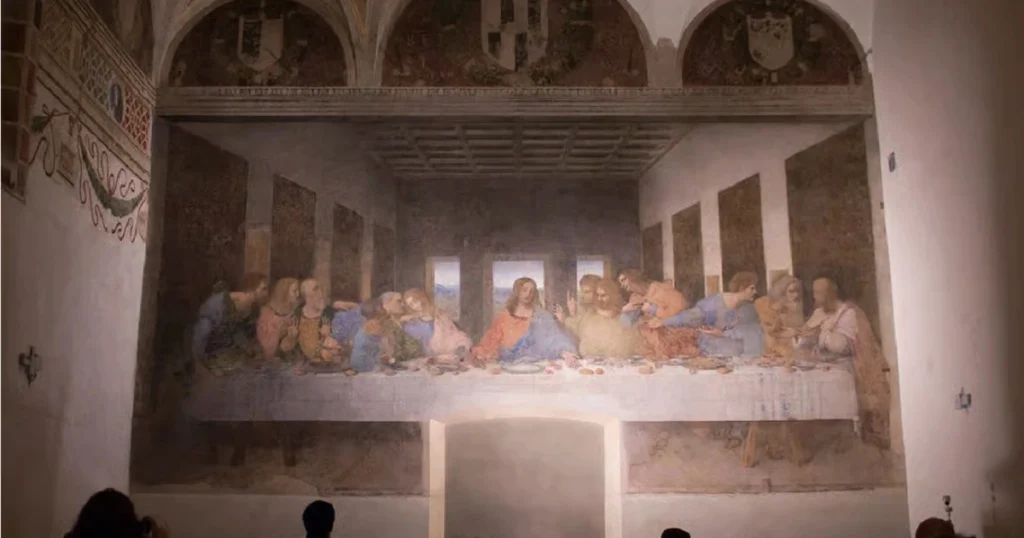
The Last Supper is Leonardo da Vinci's monumental wall painting in the refectory of the Convent of Santa Maria delle Grazie in Milan, Italy.
Created between 1494 and early 1498, it is not a true fresco. Instead, Leonardo used an experimental dry-painting technique that allowed him to work slowly and achieve remarkable psychological depth, but it also made the masterpiece fragile almost from the moment it was completed.
Because of its delicate condition, visitor access is strictly limited through timed, advance reservations.
Key Facts
| Artist | Leonardo da Vinci |
| Created | 1494 – early 1498 |
| Location | Refectory of the Convent of Santa Maria delle Grazie, Piazza Santa Maria delle Grazie 2, Milan |
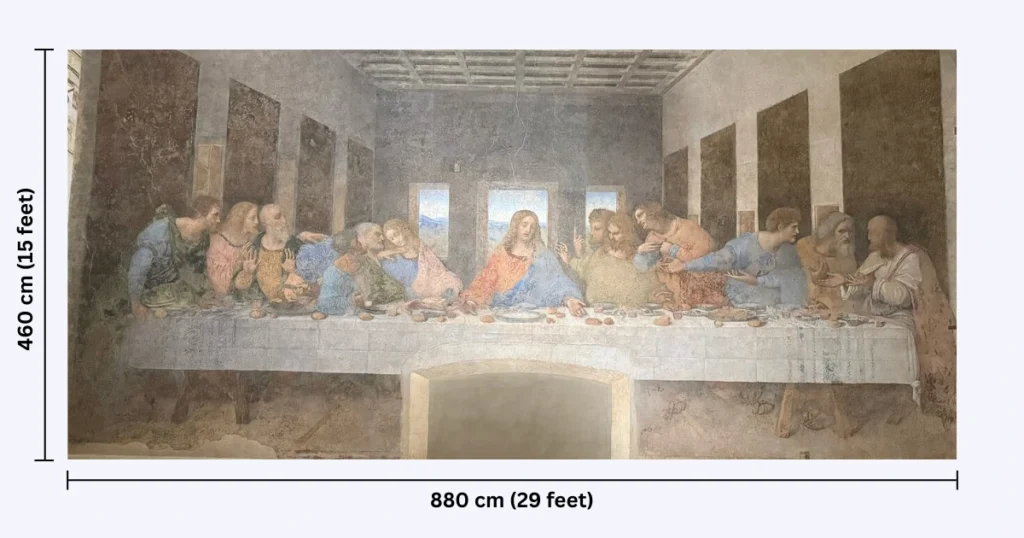
| Dimensions | 460 cm × 880 cm (approx. 15 ft × 29 ft) |
| Technique | Dry mural technique — pigment applied over a white ground layer rather than true wet-plaster fresco |
| Commissioned by | Ludovico Sforza ("il Moro"), Duke of Milan |
| UNESCO Status | Part of the Santa Maria delle Grazie World Heritage listing |
| Major Restoration | Completed in 1999 after approximately two decades of conservation work |
| Current Visitor Access | Timed-entry reservations required. Availability and procedures may change, so always verify current information on the official booking website before your visit. |
Most people picture The Last Supper long before they ever see it — from postcards, textbooks, parody paintings, even a Renaissance-themed pizza box. What rarely comes across in reproduction is how precarious the original actually is.
This is a painting that has been slowly vanishing since roughly a decade after Leonardo finished it, the casualty of an artistic gamble that paid off in genius and cost the work its own longevity.
Understanding that the gamble is the key to understanding both the painting itself and why seeing it in person today looks nothing like walking into an ordinary museum gallery.
What Is The Last Supper Painting in Milan?
Ludovico Sforza, the ruling Duke of Milan, wanted his family's chosen church — Santa Maria delle Grazie, a Dominican convent he intended to transform into a dynastic mausoleum — to have a dining-hall mural worthy of its ambitions. Leonardo, already working for the Sforza court as an engineer, designer, and painter, took on the refectory wall as his canvas.
He began around 1494 and worked on it, on and off, until early 1498, at a pace far slower than that of a typical fresco commission of the period. That slowness was not laziness. It was a direct consequence of the technique he chose, and that choice is really where this story begins.
Why The Last Supper Isn't a True Fresco
Leonardo's Experimental Dry-Painting Technique
Traditional fresco painting requires an artist to apply pigment to wet plaster and work quickly before it sets — a method that rewards speed and confidence but punishes revision. Leonardo, whose entire creative process depended on layering, adjusting, and reworking, wanted none of that constraint.
Instead, according to the museum that now preserves the work, he prepared the wall with a white ground layer and then painted with a "greasy tempera" made by combining pigment with egg-based binder and, most analyses suggest, oil — applying it to the dry, prepared surface rather than to wet plaster.
This gave him something fresco could never offer: time. He could return to a face, rework an expression, blend a shadow, days or weeks after first laying down the paint.
Why This Choice Caused Centuries of Deterioration
The trade-off was durability. Because the paint sat on top of the wall rather than fusing into it the way fresco pigment does, it was never as stable, and the refectory's location — close to the convent kitchens, in a building exposed to humidity — accelerated the damage.
Pigment loss was already visible within a few decades of Leonardo's completion of the work. What followed were centuries of well-intentioned but often damaging restoration attempts, each one adding its own layer of interpretation over what remained of the original.
The most significant of these was a meticulous, scientifically driven restoration led by Pinin Brambilla Barcilon that ran from the late 1970s through 1999, aiming to strip away centuries of overpainting and stabilize what genuinely remained of Leonardo's hand.
A 2023 study published in the Journal of the American Chemical Society went further still, using advanced synchrotron analysis on paint fragments to identify specific lead-based compounds that point to deliberate, sophisticated paint chemistry on Leonardo's part — evidence that even his materials science was ahead of his time, for better and for worse.
How Big Is The Last Supper Painting?
Dimensions and Scale Inside the Refectory
The painting measures 460 by 880 centimeters — roughly 15 feet high and 29 feet wide — covering the entire end wall of what was once the monks' dining hall. It is Leonardo's largest surviving work aside from the ceiling decoration of the Sala delle Asse in Milan's Sforza Castle.
Why the Scale Matters for the Composition
That size wasn't incidental. Leonardo used the wall's full width to stretch his apostles into four clusters of three, each group reacting to Christ's announcement that one of them will betray him, with the vanishing point of his famously precise linear perspective converging directly behind Christ's head.
Standing in the refectory, the effect was — and still is — meant to feel like the room itself extends into the painted scene, an illusion that only works at this scale and from this angle.
What Does The Last Supper Depict?
The Moment Leonardo Chose to Capture
Rather than showing a static, posed gathering, Leonardo painted the instant of dramatic disclosure: Christ has just told the twelve apostles that one of them will betray him, and the painting captures the wave of shock, denial, and confusion rippling down the table.
It's a psychological snapshot rather than a formal portrait — which is precisely what sets it apart from earlier Last Supper depictions and why art historians still point to it as a turning point in how narrative painting could work.
Identifying Judas and the Apostles' Reactions
Unlike many earlier versions of the subject, which isolated Judas on the opposite side of the table to mark him as the outsider, Leonardo placed him within the same group as the other apostles — recognizable instead through his posture, his shadowed expression, and the way he instinctively pulls back and clutches a small bag of silver.
It's a subtler, more damning form of identification: Judas isn't set apart by geography; he's set apart by what his body language gives away.
What Most People Misunderstand
The single most common misconception is that this is a fresco. It isn't, and that distinction is not just technical trivia — it's the reason the painting has needed near-constant intervention for over 500 years while true frescoes from the same era, painted using the traditional wet-plaster method, have often survived in far better condition.
The second misconception is logistical: many first-time visitors assume they can simply show up, buy a ticket at the door, and walk in, the way they might at most museums. In reality, access has been tightly controlled since the 1999 restoration, specifically to protect the fragile surface, so a reservation made well in advance is required.
Why This Matters in Leonardo's Story
The Last Supper sits at a fascinating hinge point in Leonardo's career. It was painted during the same restless decade in which he was deep in his studies of anatomy, light, and human emotion — pursuits that show up directly in the individualized, almost documentary reactions of each apostle.
It also demonstrates something characteristic of Leonardo across his entire body of work: a willingness to prioritize innovation and expressive ambition over practical reliability, whether he was designing a flying machine that couldn't yet fly or painting a mural using a technique never tested at this scale. The painting's fragility isn't a footnote to its genius — it's part of the same story.
Where to See It
The painting remains in its original location: the refectory adjoining the Church of Santa Maria delle Grazie, at Piazza Santa Maria delle Grazie 2 in Milan, a UNESCO World Heritage Site.
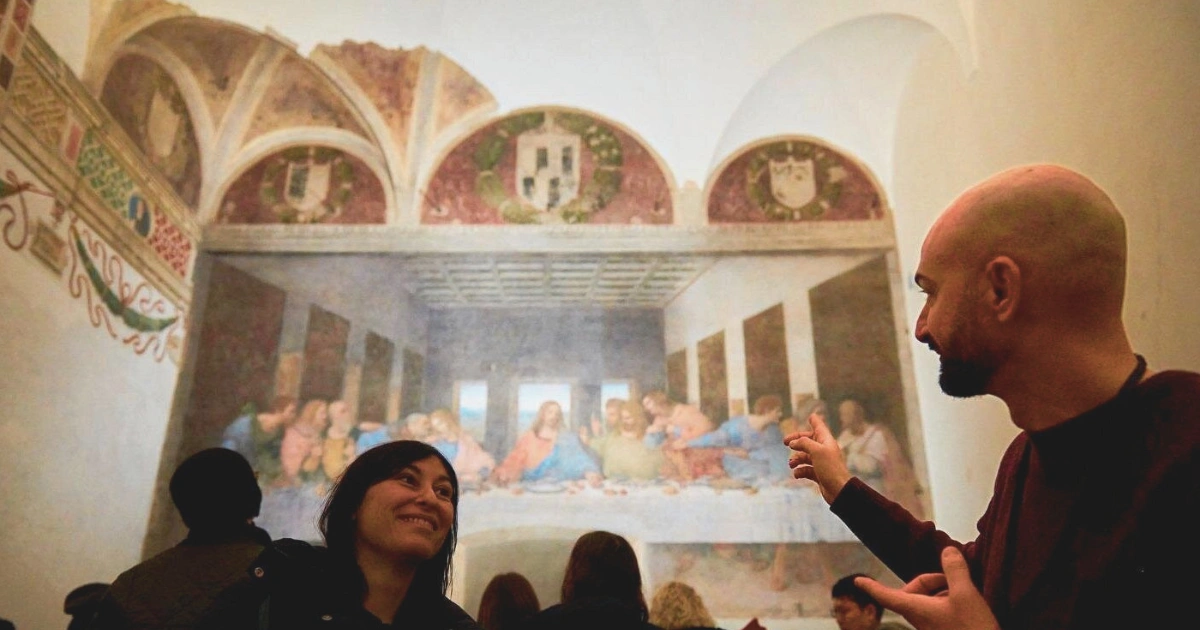
Once you understand why this painting is so carefully protected, the practical question naturally follows: how do you actually get in to see it? Because of the conservation measures described above, entry is restricted to small, timed groups inside the refectory, and tickets are released in advance through official booking channels.
Details such as opening hours, pricing, and booking windows change from season to season, so rather than repeating potentially outdated figures here, we've built a dedicated planning guide that stays up to date.
Plan Your Visit the Right Way
Now that you understand why every minute inside the refectory is carefully managed, you're ready to plan around it — booking windows open months ahead and the most popular dates sell out quickly.
Ready to Plan Your Visit?
Because The Last Supper has limited daily access, tickets often sell out early. Explore available tickets and guided tours.
Plan Your Last Supper VisitContinue Exploring Leonardo
- Where Is The Last Supper Painting Located?
- Leonardo da Vinci's Paintings: The Complete Guide
- People in the Last Supper painting: Who are they really
- Who Is Judas in The Last Supper? Decoding Leonardo's Apostles
FAQs about The Last Supper Painting in Milan
Inside the refectory of the Convent of Santa Maria delle Grazie, Piazza Santa Maria delle Grazie 2, Milan, Italy.
It measures 460 cm high by 880 cm wide — about 15 by 29 feet — covering the entire end wall of the refectory.
No. Leonardo used a dry-painting technique, applying tempera-based paint over a prepared ground layer rather than working into wet plaster, as a true fresco requires.
The dry technique Leonardo used never bonded with the wall as durably as fresco does, and the refectory's humid environment accelerated pigment loss almost from the start, leading to centuries of damage and restoration attempts.
Entry is arranged in short, timed visiting slots inside the refectory as part of the museum's conservation measures. For the current duration and booking process, check the official visitor information before you travel.
Visitor numbers are limited to protect the environmental conditions inside the refectory — humidity and particulate matter both threaten the fragile paint layer — so access is managed through advance, timed bookings rather than open admission.
Final Thoughts
It's easy to walk past a reproduction of The Last Supper — on a mug, a magnet, a textbook cover — without registering that the real thing has spent five centuries fighting to stay visible at all.
Leonardo's decision to trade fresco's durability for tempera's flexibility gave the world one of the most psychologically alive paintings ever made, and it's also the reason a visit today requires planning rather than spontaneity.
Once you know that trade-off, the reservation requirement stops feeling like bureaucracy and starts feeling like exactly what it is: the ongoing cost of keeping a five-hundred-year-old gamble on the wall a little longer.
Related Post You May Like

Disclosure: This page may contain affiliate links. If you book through them, we may earn a small commission at no extra cost to you. Learn more.
Free Leonardo Milan Travel Guide
Plan Your Leonardo Trip in Milan
A premium mini guidebook for smarter Milan planning, including the best ticket strategy, Leonardo map, and practical visitor advice.
Get the Free Guide
Download the guide and receive practical Milan planning tips by email.
Download the Free Guide >> Leonardo Bianchi is the founder of Leonardo da Vinci Inventions & Experiences, a cultural travel guide helping visitors explore Leonardo da Vinci’s art, inventions, and legacy across Italy and Paris.