
(Last updated: Sep 2026)
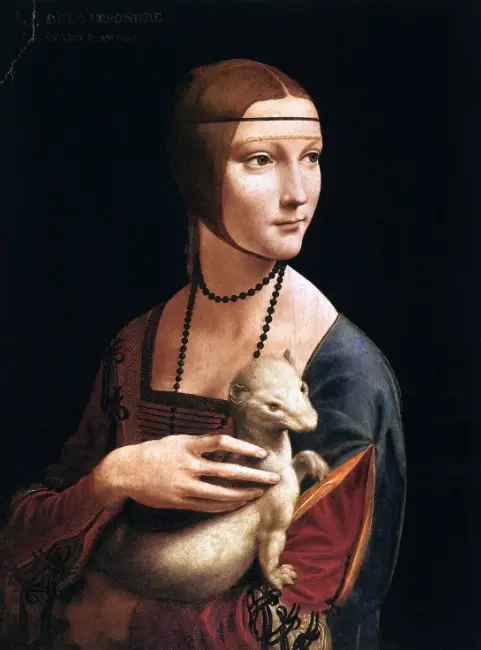
Lady with an Ermine by Leonardo da Vinci is one of the quietest, most hypnotic portraits ever painted. Created in Renaissance Milan, it shows a young woman caught mid-turn, as if she just heard her name called from across the room.
The painting matters because it changed what a portrait could do. Before Leonardo, sitters were painted stiff and frozen, usually in profile. Cecilia Gallerani looks like she is about to speak.
That shift from decoration to psychology is part of why Renaissance art still feels startlingly modern, and why standing in front of the real panel hits differently than any photograph ever could. It roots you in a specific court, a specific decade, and a woman whose life reads like a Renaissance drama.
This post is all about Lady with an Ermine by Leonardo da Vinci, from the meaning behind the animal in her arms to exactly where you can see the painting today.
What is lady with an ermine?
Lady with an Ermine is a portrait painted by Leonardo da Vinci around 1489–1491 in Milan. It depicts Cecilia Gallerani, a young noblewoman associated with the Sforza court, holding a white ermine. The painting is considered one of the earliest modern portraits in Western art and now hangs in the Czartoryski Museum in Kraków, Poland.
The Artistic Genius Behind Lady with an Ermine
Leonardo painted this portrait of a lady with an ermine at a moment when he was still building his reputation in Milan, working for Duke Ludovico Sforza on everything from court festivals to canal design to military engineering.
He was not yet the household name he is today. The portrait shows what happens when that restless, scientific curiosity turns toward a single human face, and it is worth remembering that Leonardo saw painting and anatomy as parts of the same discipline, not separate skills.
A Radical New Way to Paint a Portrait
Most Italian portraits from this period show the sitter in strict profile, flat and formal, almost like a coin on a wall. That style was safe, dignified, and completely static. Leonardo broke that rule here. He turned Cecilia's body one way and her head another, so her gaze drifts toward something happening outside the frame, as though she has just reacted to a sound or a person entering the room.
It is the first hint of the pose Leonardo would later refine in the Mona Lisa, and it makes this painting feel less like a formal record and more like a captured second lifted out of a real afternoon at court.
The Symbolism Hidden in the Ermine
The animal in her arms is not decoration, and understanding the lady with an ermine meaning changes how the whole panel reads.
In Renaissance folklore, an ermine would supposedly rather face a hunter than dirty its white coat, so it became shorthand for purity, restraint, and moral cleanliness, qualities a court painter would want associated with his patron's mistress. The word also plays on Cecilia's surname, since the Greek term for the animal, galée, echoes "Gallerani," a visual pun that Renaissance viewers would have caught immediately.
At the same time, Ludovico Sforza had recently been honored with the Order of the Ermine by the King of Naples, so the animal quietly signals whose court, and whose protection, this woman belonged to. A single creature is doing the work of a name, a virtue, and a political alliance all at once.
Leonardo's Use of Light and Movement
Look closely at the hand resting on the ermine's back. The fingers are built from soft, layered shadow rather than hard outlines, an early example of the smoky modeling technique known as sfumato that Leonardo would spend his career perfecting.
There is no harsh line separating skin from fur or fur from fabric, only a gradual shift in tone that tricks the eye into seeing depth. Even the animal seems to twist in the same direction as Cecilia, ears alert and body tensed, so the whole panel feels like one continuous motion rather than a static pose borrowed from an earlier century.
Why Lady with an Ermine Became Famous
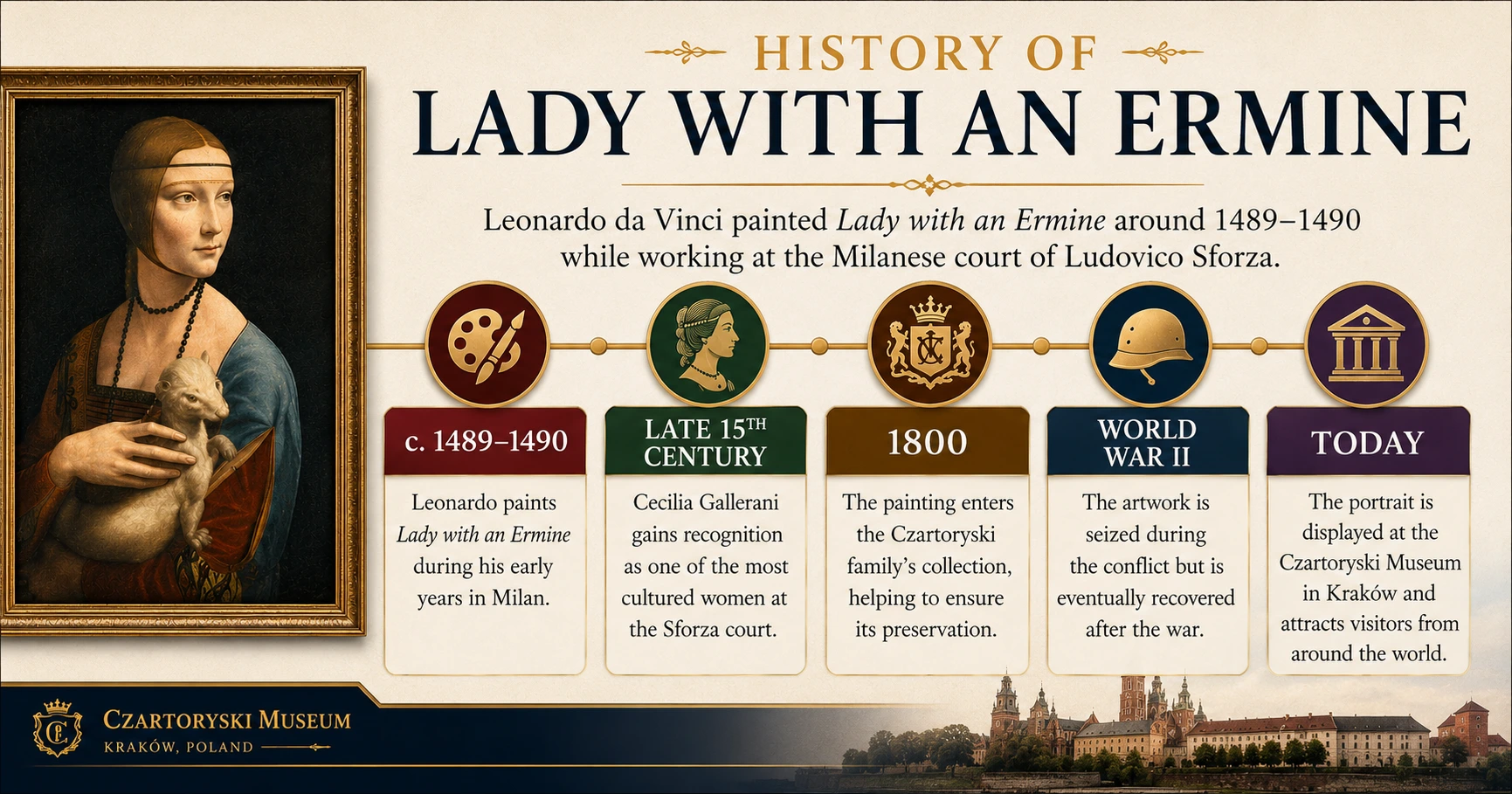
A great technique alone rarely creates a legend. This particular Leonardo da Vinci painting of a lady with an ermine became famous because of who she was, what happened to the panel over five centuries, and how rarely it leaves home compared to Leonardo's other surviving works.
Cecilia Gallerani and the Sforza Court
Cecilia Gallerani was a teenager, likely around sixteen, when she became the mistress of Duke Ludovico Sforza, but she was far from a passive figure at court. She was known for her sharp mind, for reading and writing Latin poetry, and for later running her own literary salon in Milan that attracted scholars and writers long after her relationship with the Duke ended.
A court poet, Bernardo Bellincioni, even wrote a sonnet praising Leonardo for making her look so alive that nature itself seemed jealous of the painted version. That idea, of a portrait that outdoes reality, still describes the effect this woman with an ermine has on people standing in front of her today.
A Painting That Survived War and Theft
Few Renaissance paintings carry a more dramatic modern chapter than this one. During the Second World War, the Nazi governor-general of occupied Poland, Hans Frank, took the portrait from Kraków and kept it hanging in his private residence, reportedly moving it with him more than once as the war turned against Germany.
It was recovered by Allied forces near the end of the war, found among looted art in Bavaria, and eventually returned to Poland, which is part of why so many people specifically search for how the lady with an ermine was stolen. The panel's survival through both centuries and a world war adds real weight to standing in front of it in person, knowing how easily it could have been lost for good.
For travelers piecing together that history on the ground, many people fold a stop at the painting into a broader walk through Kraków's Old Town and former royal quarter, often through an independently guided history walk through Kraków's Old Town, which is a practical way to see where this chapter of the story actually unfolded.
How It Compares to Leonardo's Other Masterpieces
Leonardo left behind only four confirmed portraits of women, and this is one of them, alongside the Mona Lisa. Compared to the Mona Lisa hanging behind glass in Paris, the Last Supper fading slowly on a refectory wall in Milan, the Annunciation on display in Florence, or the record-priced Salvator Mundi whose location is still debated, Lady with an Ermine rarely travels at all.
It has left Poland only a handful of times in the last century, most notably for a landmark 2019 exhibition in Paris marking five hundred years since Leonardo's death. That scarcity is exactly why so many art lovers plan a trip specifically to see her, rather than treating the visit as a passing detour on the way to somewhere else.
Where to See Lady with an Ermine Today
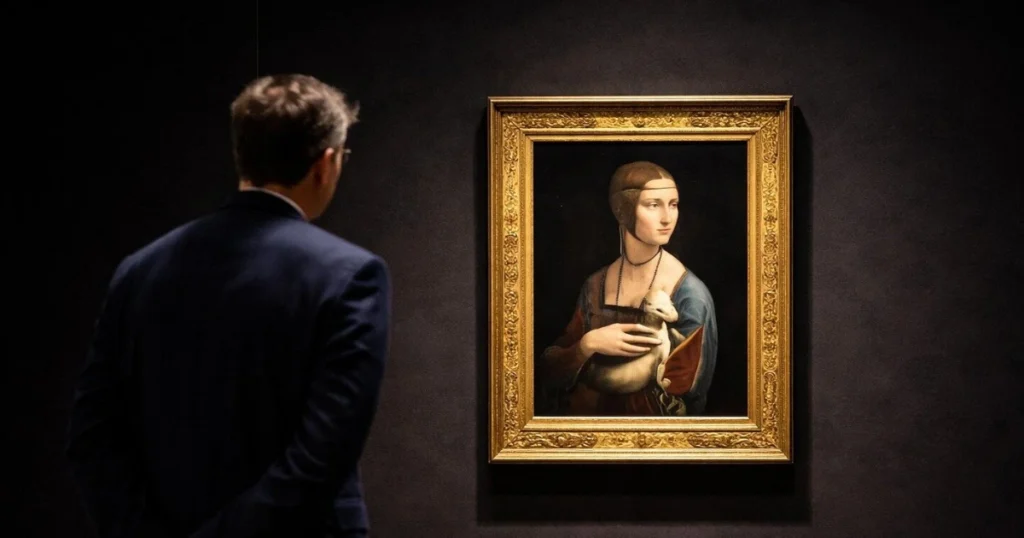
Knowing the history is one thing. Standing in the actual room with the panel is an entirely different experience, and it is why this painting keeps drawing visitors to a single Polish museum every year.
Inside the Czartoryski Museum
The lady with an ermine is at the Czartoryski Museum in Kraków, part of the National Museum system. It was founded in the late 1700s by Princess Izabela Czartoryska, who purchased the painting in Italy and brought it back to Poland, making the museum one of the earliest public collections in Europe.
The portrait has remained closely tied to Polish national identity ever since, surviving partitions, two world wars, and decades under communist rule before landing back on public view. After a long, careful renovation, the museum reopened with the painting displayed in its own dedicated room, lit and climate-controlled specifically for a five-hundred-year-old wood panel.
Best Time and Tips for Visiting
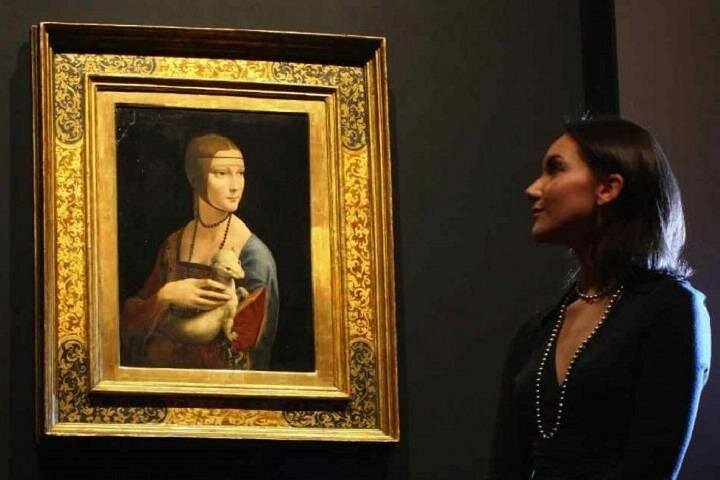
Because the painting hangs alone in a single climate-controlled space, visits can feel calm and almost private even when the rest of the museum is busy.
Arriving earlier in the day tends to mean fewer people crowding that one room, and tickets are worth reserving in advance since access to the portrait is sometimes limited to timed entry slots. Photography without flash is usually permitted, but the room itself is small, so patience is part of the experience rather than an inconvenience.
Ready to Plan Your Visit?
A guided walk through Kraków's historic center with a visit to the museum housing Leonardo's portrait.
See the Lady with an ErmineExperiencing Kraków Beyond the Painting
- Wawel Castle — A short walk away along the river.
- Kazimierz District — Adds another layer to Kraków’s complex 20th-century history.
- Main Market Square — One of Europe’s largest medieval squares, surrounded by cafés and church towers.
Exploring Leonardo da Vinci in Kraków
Leonardo himself never set foot in Poland, yet one of his most personal paintings has lived there for over two centuries. That gap between the artist and the city is part of what makes Kraków such an unexpected stop on any Leonardo-focused trip, and why the portrait of a lady with an ermine feels both almost out of place and exactly right at the same time.
The painting's presence there is really a story about eighteenth-century collectors, Polish patriotism, and wartime survival, layered atop a Renaissance original, which gives a single museum room in Kraków a depth that few other single-painting stops in Europe can match.
Travelers who start in Kraków often build the rest of their route around Leonardo's actual footsteps, from the studios and courts of Milan, where this very portrait was painted, and the workshops of his early years in Florence, to the influence he left behind in Venice, the commissions he took on in Rome, and the final years he spent near the French court outside Paris.
Seen together, those cities trace the arc of an entire career, and Kraków quietly closes the loop by holding onto one of its most human moments.
Final Thoughts
This post was all about Lady with an Ermine by Leonardo da Vinci, a small panel that carries an outsized amount of history for its size.
Leonardo's genius was never just about technical skill, even though the sfumato shading and anatomical precision still hold up under close inspection five hundred years later. It was about noticing that a painted face could hold a personality, a moment, and a mood, decades before that idea became standard practice across European art.
That shift helped define the Renaissance as much as any invention, fresco, or scientific sketch in Leonardo's notebooks, and it is exactly why seeing the original in Kraków, rather than a print, a postcard, or a screen, still changes how people describe her afterward. A photograph can show you the composition.
Only the room in the Czartoryski Museum can show you the way her expression seems to shift as you move, which is the closest thing Renaissance Milan left behind to meeting Cecilia Gallerani in person.
Related Post You May Like


Disclosure: This page may contain affiliate links. If you book through them, we may earn a small commission at no extra cost to you. Learn more.
Free Leonardo Milan Travel Guide
Plan Your Leonardo Trip in Milan
A premium mini guidebook for smarter Milan planning, including the best ticket strategy, Leonardo map, and practical visitor advice.
Get the Free Guide
Download the guide and receive practical Milan planning tips by email.
Download the Free Guide >> Leonardo Bianchi is the founder of Leonardo da Vinci Inventions & Experiences, a cultural travel guide helping visitors explore Leonardo da Vinci’s art, inventions, and legacy across Italy and Paris.