
(Last updated: Sep 2026)
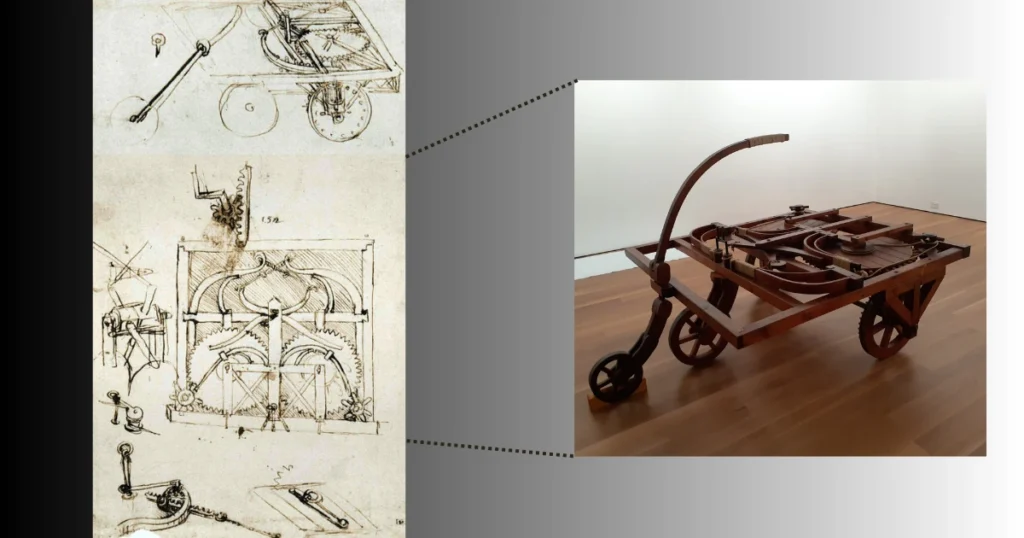
The Leonardo da Vinci self-propelled cart is a spring-driven wooden vehicle that Leonardo sketched more than 500 years ago, decades before anyone had a word for "automobile." It looks like a simple wooden box on wheels at first glance.
Look closer, and you find gears, coiled springs, and a steering mechanism that some historians now call the ancestor of the modern car.
This little machine matters because it captures more than just one invention. It shows how Leonardo thought. He didn't just draw pictures of the future — he engineered working logic that took engineers nearly 500 years to fully decode.
Understanding this cart also opens a door into the world of da Vinci car design, his water systems, and the civil engineering ideas that shaped Renaissance Italy. It's one of the clearest windows into why people still travel across Europe just to stand in front of his notebooks.
This post is all about the Leonardo da Vinci self-propelled cart, how it worked, why it still fascinates engineers today, and where you can see a working model of it in person.
What is the Leonardo da Vinci Self-Propelled Cart?
The Leonardo da Vinci self-propelled cart is a three-wheeled wooden vehicle designed around 1478 and recorded in his notebooks known as the Codex Atlanticus. It moved by stored spring tension rather than by animal or human power, making it one of the earliest known concepts of a self-driving machine. Some historians consider it the world's first programmable robot, since its direction could be preset before it moved.
The Engineering Idea Behind the Leonardo da Vinci Self-Propelled Cart
Leonardo lived in a world built almost entirely around muscle. Horses pulled carriages. Oxen pulled plows. Human hands turned every crank.
So when Leonardo sketched a cart that moved on its own, he wasn't just doodling. He was questioning one of the most basic assumptions of his time: that motion required a living creature behind it.
A Renaissance Answer to a Modern Problem
The self-propelled cart grew out of Leonardo's fascination with theatrical machinery. Court festivals in Florence and Milan often required dramatic effects, such as a wagon that appeared to move by magic across the stage or a mechanical beast that startled guests during a banquet.
Leonardo, always the practical engineer, decided to solve that problem with mechanics instead of illusion. He treated stage tricks the same way he treated bridges and fortresses: as problems that deserved a real mechanical answer, not a trick of ropes and hidden hands.
It helps to remember the world Leonardo was working in. Milan under the Sforza family was a city obsessed with spectacle. Dukes wanted their festivals to feel impossible, almost magical, and they hired engineers like Leonardo to make that happen.
A cart that rolled across a stage without a visible pusher or puller would have stunned an audience that had never seen anything move without muscle behind it. That theatrical starting point is easy to overlook, but it explains why the cart needed to be self-contained, quiet, and precisely controlled rather than powerful or fast.
Part of a Larger Machine Vocabulary
The cart wasn't an isolated idea. It shares design DNA with other Leonardo da Vinci engineering inventions, including his water wheel systems and early canal lock concepts. Leonardo treated stored energy, whether from water, weight, or springs, as a puzzle to solve again and again in different forms. The cart is essentially that same spring logic turned into transportation.
This is what separates Leonardo from many inventors of his era. He rarely solved a problem once and moved on. Instead, he circled back to the same handful of mechanical principles for decades, testing them in new contexts.
A spring that stores energy for a cart isn't so different, conceptually, from a weight that stores energy to drive a clock, or water that stores energy behind a lock gate.
Once you notice this pattern, the self-propelled cart stops looking like a standalone curiosity and starts looking like one chapter in a much longer engineering notebook.
How the Leonardo da Vinci Self-Propelled Cart Works
Modern engineers who studied the sketches in the 1990s built working replicas, and what they found changed how historians describe this Leonardo da Vinci machine. It wasn't a toy. It was a legitimate mechanical system with a surprising amount of built-in intelligence.
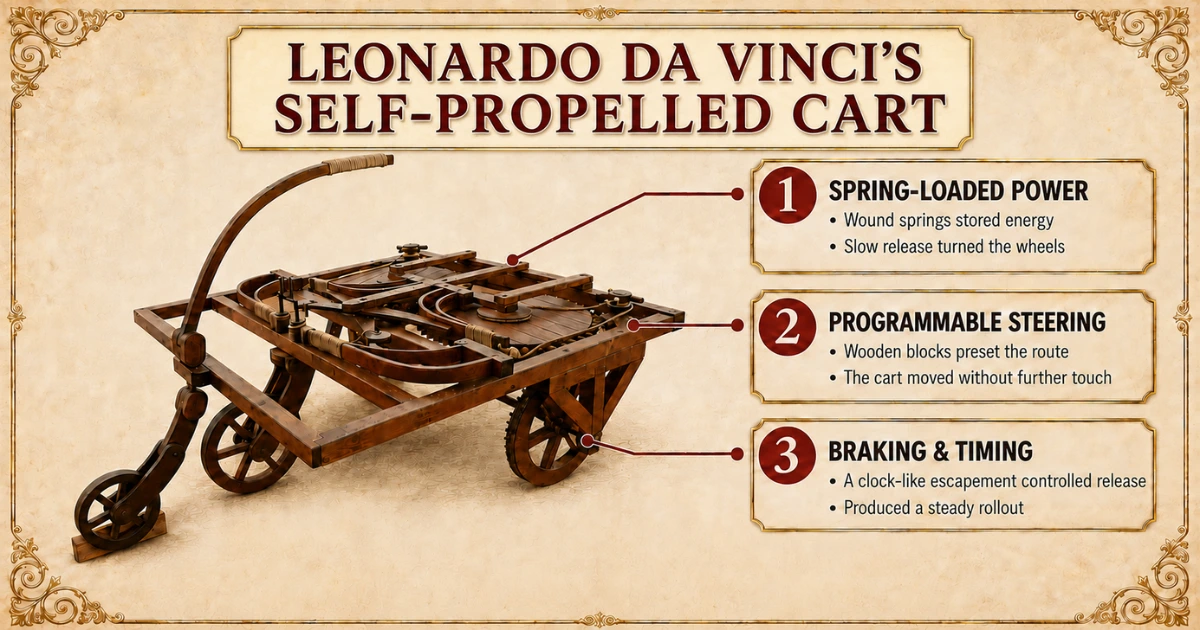
Spring-Loaded Power
Instead of a motor, the cart relied on large coiled springs housed inside drum-shaped mechanisms. Workers would wind the springs before use, storing mechanical energy the same way a modern wind-up toy stores tension. Releasing that tension slowly turned the wheels.
Programmable Steering
This is the detail that stuns people most. The cart included wooden blocks that could be inserted into a rotating mechanism to predetermine its rotation path. In modern terms, this was a basic form of programming. Operators could set the machine's route before it ever moved, without touching it again once it started.
Braking and Timing Controls
Replicas also revealed an escapement mechanism, similar to that in mechanical clocks, which regulated how quickly the springs released their energy. This kept the cart from lurching forward all at once and gave it a controlled, steady rollout, an early example of Leonardo blending clockwork precision with vehicle design.
Why It Took Centuries to Understand
For hundreds of years, Leonardo's notebook pages describing the cart were treated as unfinished sketches, interesting but incomplete. It wasn't until the 20th century, when engineers began systematically translating his mirror-written notes and reconstructing his drawings in three dimensions, that the full mechanical logic became clear.
Researchers at Italy's Institute and Museum of the History of Science, now the Museo Galileo, built a working model in the 1990s that finally proved the cart could function exactly as Leonardo intended.
That gap between invention and confirmation, roughly five centuries, is part of what makes this Leonardo da Vinci machine so remarkable. He wasn't simply ahead of the tools of his own time. He lacked the tools needed to properly test his own ideas.
Many of the mechanical principles behind this cart reappear in the exhibits that historians and engineers still study today, and travelers curious to see these gears turn in real life often plan their trip around a guided walk through Florence's Renaissance engineering museums, where working models sit alongside the original notebook pages that inspired them.
Where to See the Leonardo da Vinci Self-Propelled Cart Today
The original notebook pages describing the cart are housed in the Codex Atlanticus, a bound collection of Leonardo's drawings held at the Biblioteca Ambrosiana in Milan. However, the sketches themselves are only shown to the public periodically due to their fragility and age.
Working Replicas You Can Actually See
The most accessible way to experience this Leonardo da Vinci self-propelled car concept is through the full-scale, functioning replicas built from his original measurements. The Museo Galileo in Florence and the Museo Leonardiano in Vinci both display physical models that demonstrate the spring, gear, and steering systems in action.
Why Seeing It in Person Changes the Story
Photos of the cart don't fully explain it. Standing next to the replica, watching the wheel mechanism actually roll forward along a preset path, makes the leap from Renaissance notebook to functioning machine feel real rather than theoretical. It's the difference between reading about an idea and watching it move.
What Else Is on Display Nearby
Both museums place the cart alongside other reconstructed Leonardo da Vinci machine designs, including his flying devices, musical instruments, and models of his water pumps and canal work. Seeing them together helps visitors understand that Leonardo rarely worked on one invention in isolation.
His notebooks jump between anatomy, hydraulics, weaponry, and stagecraft on the same page, and the museum displays are arranged to reflect that same restless, connective way of thinking.
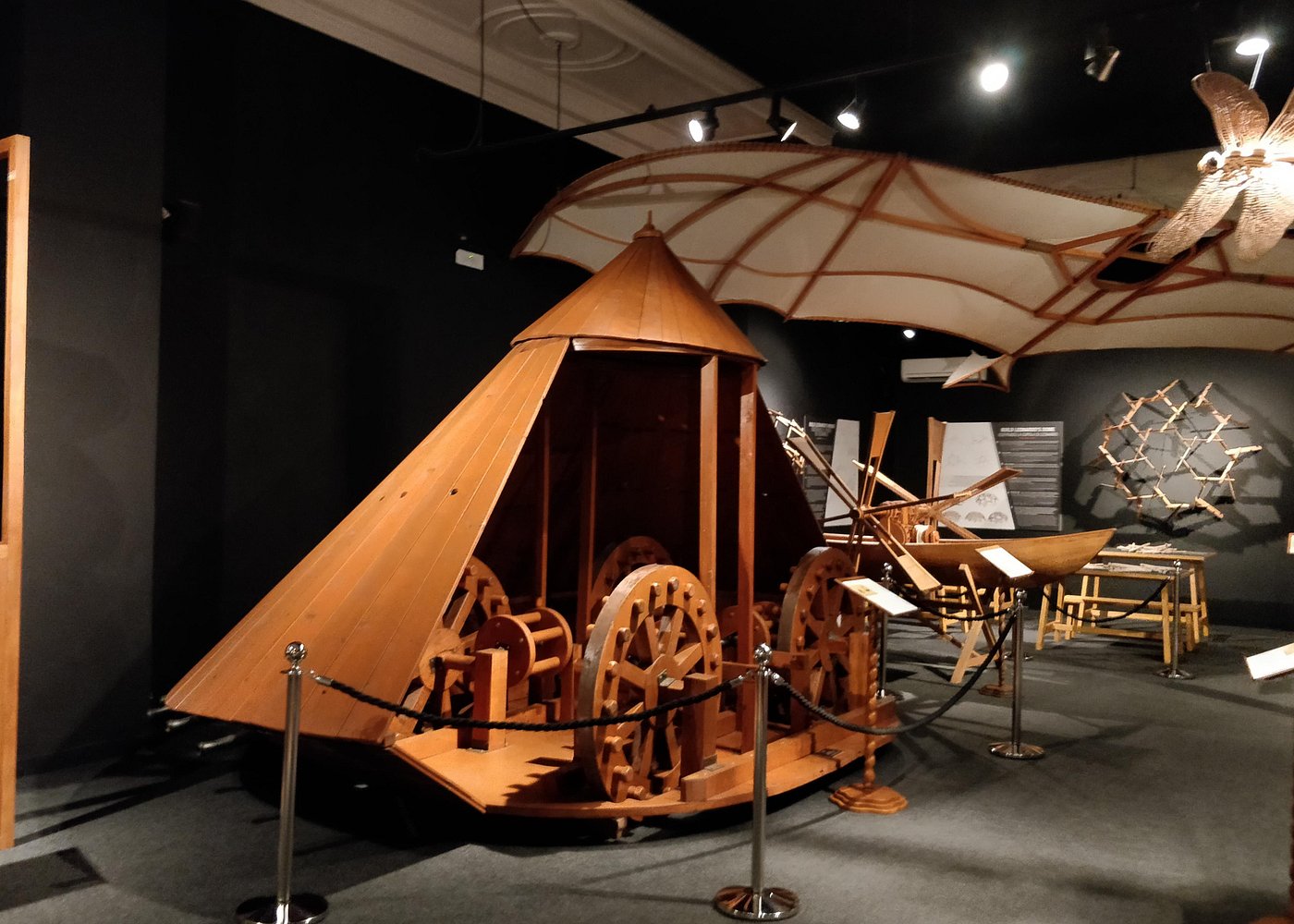
Discover Leonardo Inventions in Florence
See full-scale reconstructions of Leonardo’s inventions and discover the engineering ideas behind his designs
Explore Leonardo Machine DesignFlorence Renaissance Engineering Walk
A guided walk through Florence's museums of science and invention, built around the machines Leonardo actually designed.
- Small-group access to working mechanical replicas
- Context from a local guide trained in Renaissance history
- Stops near the Uffizi and the Arno riverside district
Visitors often note that seeing the gears move in person makes the engineering click in a way diagrams never quite manage. See tour details
Exploring Leonardo da Vinci in Florence
Florence sits at the center of Leonardo's engineering story. It's where he trained under Verrocchio, sketched early machine concepts, and later returned throughout his life to refine ideas that started as rough drawings in his notebooks. Walking its streets today puts you within a short distance of the collections that hold his mechanical legacy.
If this glimpse into the self-propelled cart made you curious about the rest of Leonardo's world, that curiosity tends to spread quickly. His engineering ideas connect to sites across Italy and France, from the water systems of Milan to his final home in Amboise. Florence is simply the easiest place to start.
The city's connection to Leonardo goes beyond a single workshop apprenticeship. It was in Florence that he first began filling notebooks with the kind of rapid, restless sketches that would eventually include the self-propelled cart.
The Uffizi Gallery holds early works tied to his training, and the surrounding streets, the Ponte Vecchio, the Arno riverbanks, the old artisan quarters, still resemble the city he would have walked through while these ideas were forming. Standing in that setting adds a layer of context that a textbook simply cannot replicate.
Milan, Venice, Rome, and Paris
Florence is only one stop in a much larger geography of Leonardo's life. Milan is where he spent nearly two decades developing engineering and hydraulic projects for the Sforza court, including work connected to the da Vinci canal lock system.
Venice holds records of his consulting work on defense and water management. Rome connects to the later years of his career under papal patronage, and Paris, or more precisely the nearby town of Amboise, is where he spent his final years and where he is buried.
Each city adds a different chapter to the same engineering story that, in many ways, starts with small mechanical experiments like the self-propelled cart.
Leonardo's Engineering Legacy Beyond the Cart
The self-propelled cart is just one of Leonardo da Vinci's many civil engineering inventions. His notebooks also contain detailed studies of the da Vinci canal lock system, an early mechanism for raising and lowering water levels that influenced canal design in Milan for generations.
His Leonardo da Vinci water pump concepts explored how to move water uphill using mechanical force rather than manual labor, and his water wheel sketches refined the conversion of flowing water into usable rotational energy.
A Pattern of Thinking, Not Just Isolated Inventions
Once you see the spring mechanism inside the cart, you start noticing the same problem-solving pattern everywhere else in his work. Store energy. Control its release. Direct its motion with precision. That single idea threads through his canal locks, his pumps, and his cart alike.
Why This Still Matters to Engineers Today
Modern robotics researchers have cited the cart's programmable steering as an early conceptual ancestor of autonomous systems. It's a small machine with an outsized place in the history of automation, one reason it keeps appearing in engineering curricula centuries after Leonardo first sketched it.
There's also a broader lesson in how Leonardo approached the Leonardo da Vinci car design problem compared to how we approach automation today. He didn't have electricity, computing, or even reliable metal casting.
Every constraint had to be solved with wood, springs, and careful geometry. That kind of limitation-driven creativity is exactly what modern engineering students study when they look at his notebooks: not just what he invented, but how he found workable answers with almost none of the materials we now take for granted.
From Cart to Canal: The Common Thread
It's worth pausing on how closely the cart's internal logic mirrors Leonardo's water-based inventions. The da Vinci canal lock relied on controlled release, gates opening and closing at precise moments to manage water flow between different levels.
The Leonardo da Vinci water pump used mechanical force to move water against gravity, converting one kind of energy into directed motion. The water wheel captured a natural, continuous force and turned it into steady rotation.
The self-propelled cart takes that exact same family of ideas- stored energy, controlled release, directed motion- and applies it to something that could roll across a floor. Seen this way, the cart isn't a strange one-off invention. It's a compact demonstration of Leonardo's entire engineering worldview.
Final Thoughts
This post was all about the Leonardo da Vinci self-propelled cart, the spring-driven wooden vehicle that quietly anticipated ideas about automation and self-guided motion centuries before anyone had the language to describe them.
It's a small, almost playful invention on the surface, yet it reveals the depth of Leonardo's genius: his instinct to question why anything needed a horse or a human hand at all.
That instinct shaped the Renaissance and still shapes how we think about machines today. Seeing a working replica in Florence or Vinci doesn't just illustrate history. It puts you in the same position Leonardo's contemporaries once stood in, watching a wooden cart roll forward on its own and wondering how it was possible.
Many travelers pair a visit to Florence's Renaissance engineering collections with the city's other Leonardo-connected sites, making it easy to see the ideas behind the cart in their full historical context. Explore Florence Experiences
Related Post You May Like

Disclosure: This page may contain affiliate links. If you book through them, we may earn a small commission at no extra cost to you. Learn more.
Free Leonardo Milan Travel Guide
Plan Your Leonardo Trip in Milan
A premium mini guidebook for smarter Milan planning, including the best ticket strategy, Leonardo map, and practical visitor advice.
Get the Free Guide
Download the guide and receive practical Milan planning tips by email.
Download the Free Guide >> Leonardo Bianchi is the founder of Leonardo da Vinci Inventions & Experiences, a cultural travel guide helping visitors explore Leonardo da Vinci’s art, inventions, and legacy across Italy and Paris.