
(Last updated: Sep 2026)
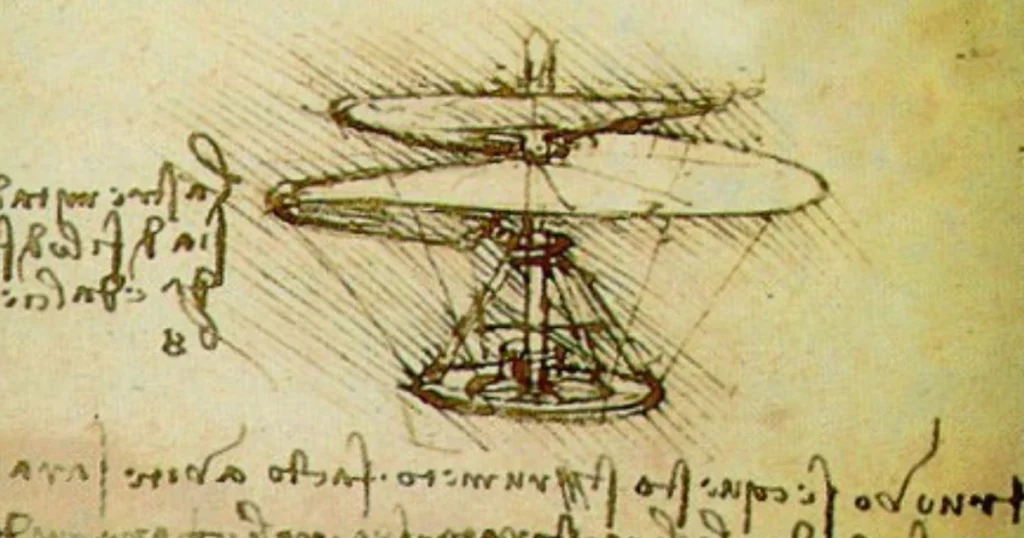
The da Vinci aerial screw is one of the earliest known designs for a machine meant to lift itself straight into the air. Sketched by Leonardo da Vinci around 1489, it looks less like an invention and more like a question drawn in ink: could a spinning surface push against air the way a screw pushes through wood?
For a design created centuries before the advent of engines, the aerial screw reveals how Leonardo approached problems no one else was asking about. He studied birds, air, and rotation with the same intensity he brought to painting faces, and the result was a sketch that still shows up in conversations about the history of flight.
Understanding why this drawing matters means understanding both Renaissance science and the curiosity that drove it.
This post is all about the da Vinci aerial screw — how it worked on paper, why it never flew, and where you can still see the ideas behind it today.
What is the da Vinci Aerial Screw?
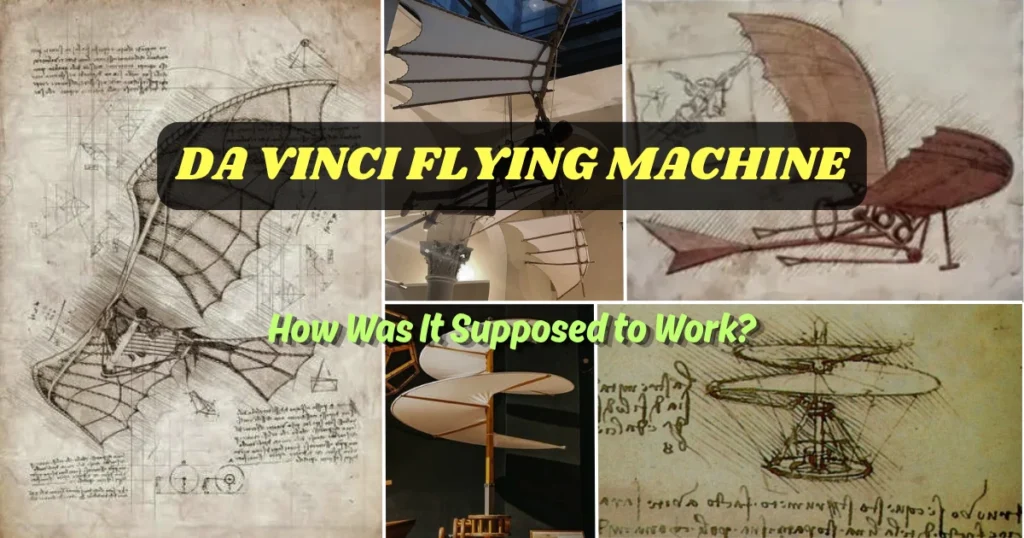
The da Vinci aerial screw is a flying machine concept sketched by Leonardo da Vinci in the late 1480s. It features a wide, spiral-shaped surface designed to rotate rapidly, theoretically compressing air beneath it to generate lift. Often called an early helicopter design, it was never built or tested in Leonardo's lifetime, but it remains a landmark in the history of aeronautical thinking.
The Engineering Idea Behind the Da Vinci Aerial Screw
Leonardo da Vinci did not draw the aerial screw as a whimsical fantasy. He drew it as an engineering hypothesis, built on close observation of how air, water, and solid materials interact. His notebooks from this period show him testing the logic of screws in water pumps, waterwheels in mills, and spirals in shells — all before applying that same spiral logic to open air.
A Mind Trained to See Patterns
By the time he sketched the aerial screw, Leonardo had already spent years dissecting birds and studying how their wings displaced air during flight. He treated flight as a mechanical problem rather than a magical one, which was a radical stance in the 1480s. This mindset is part of why his notebooks are still studied as scientific documents rather than just artistic curiosities.
The Screw as a Universal Machine
Archimedes' screw, used for centuries to move water uphill, was well known to Renaissance engineers. Leonardo's insight was to flip the concept on its head: instead of a screw moving water along its length, a much larger spiral could move air downward and, in theory, push the machine upward. It was an elegant leap from an ancient tool to an entirely new kind of machine.
Materials of Its Time
The aerial screw was designed to be built from linen stiffened with starch, stretched over a reed or wooden frame, much like the sails and structures Leonardo would have seen on ships and mills. This detail matters because it shows Leonardo wasn't sketching pure fantasy — he was working within the materials he trusted enough to specify by name.
How the Da Vinci Aerial Screw Works
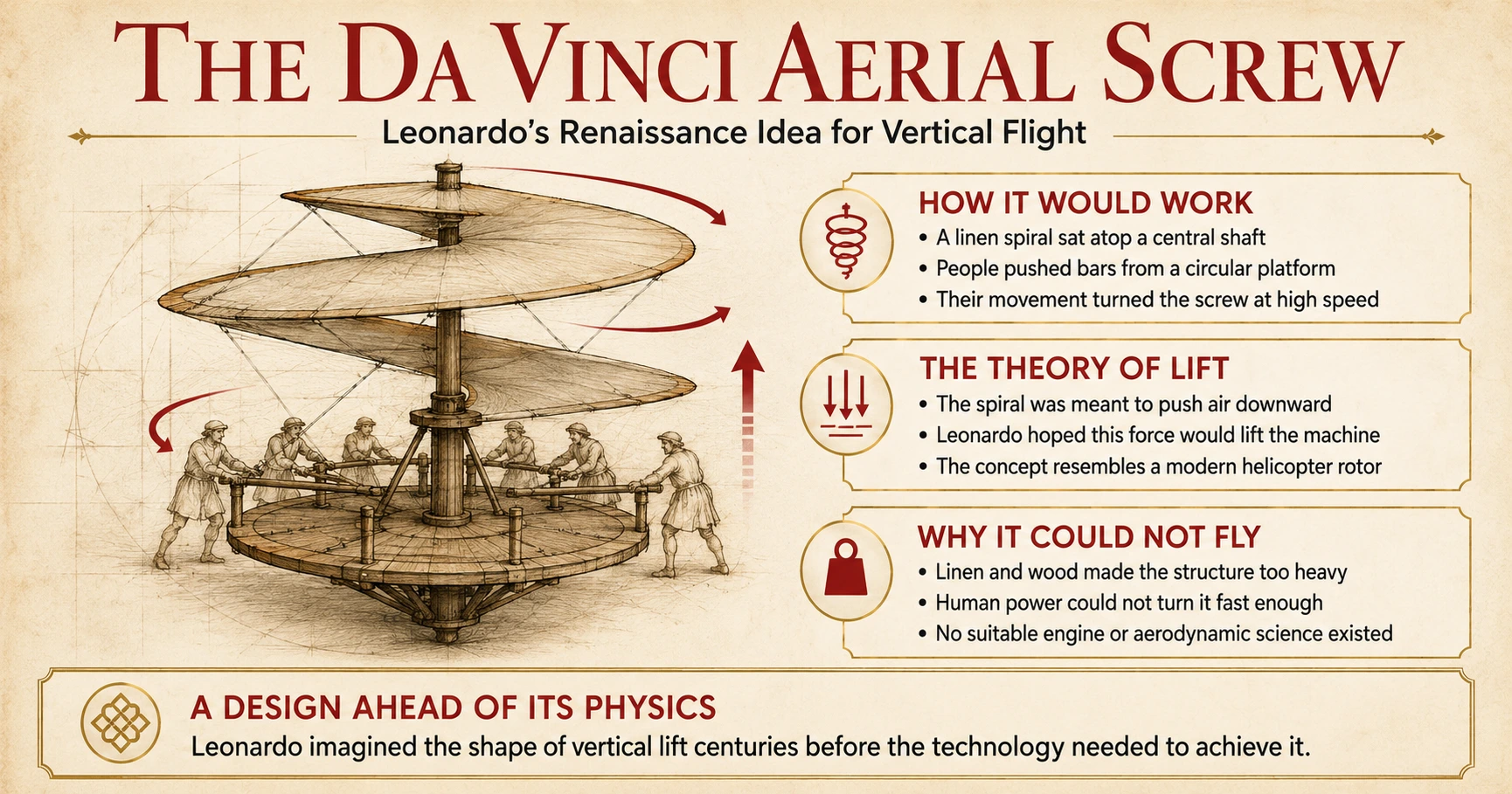
On paper, the mechanism is straightforward to describe, even if it would have been nearly impossible to power. A wide spiral surface, resembling a stretched corkscrew, sits atop a central shaft. Leonardo proposed that several people standing on a circular platform below would push against bars, rotating the shaft and the screw above them at high speed.
The Theory of Lift
As the spiral rotated, it was meant to "screw" itself into the air, compressing it beneath the surface and generating enough force to lift the structure off the ground. This is conceptually close to how a modern helicopter rotor generates lift, which is exactly why the aerial screw is so often called an early helicopter design.
The idea sits at a fascinating intersection of curiosity and physics, and it's part of why walking tours through Milan's da Vinci sites often pause here longer than expected, since a printed diagram rarely explains the mechanism as clearly as standing in front of a full-scale model.
Why It Could Never Have Flown
Modern engineers agree the aerial screw would not have generated enough lift, even with the strongest human crew imaginable. Linen and wood were far too heavy relative to the available power, and there was no engine capable of turning the screw fast enough. Leonardo lacked the metallurgy, the fuel, and the mathematics of aerodynamics that would only be developed centuries later.
A Design Ahead of Its Physics
The gap between Leonardo's idea and the technology needed to realize it is the whole story here. He understood the shape lift might require before anyone understood the science of lift itself. That gap is exactly what makes the sketch so significant to historians of engineering, rather than merely a footnote about a failed machine.
Seeing the Sketch in Context
The aerial screw drawing is housed in the Codex Atlanticus, a bound collection of Leonardo's technical pages spanning decades of his life.
- The Codex Atlanticus holds over 1,100 pages of Leonardo's engineering and scientific notes
- Pages are rotated on display, so the exact sheet shown varies by visit
- Full-scale models based on the sketch are displayed separately in Milan
Visitors often note that seeing the scale of the original notebook pages changes how they read the sketch afterward.
Where to See the Da Vinci Aerial Screw Today
The original sketch is not on constant public display, which surprises many first-time visitors. It lives inside a manuscript that is centuries old and extremely light-sensitive, so access is carefully managed.
The Codex Atlanticus in Milan
The drawing itself is part of the Codex Atlanticus, held at the Biblioteca Ambrosiana in Milan. Selected pages rotate through public exhibition, so the specific sheet containing the aerial screw is not always visible, though the library regularly features Leonardo's engineering pages in curated displays.
Full-Scale Models and Reconstructions
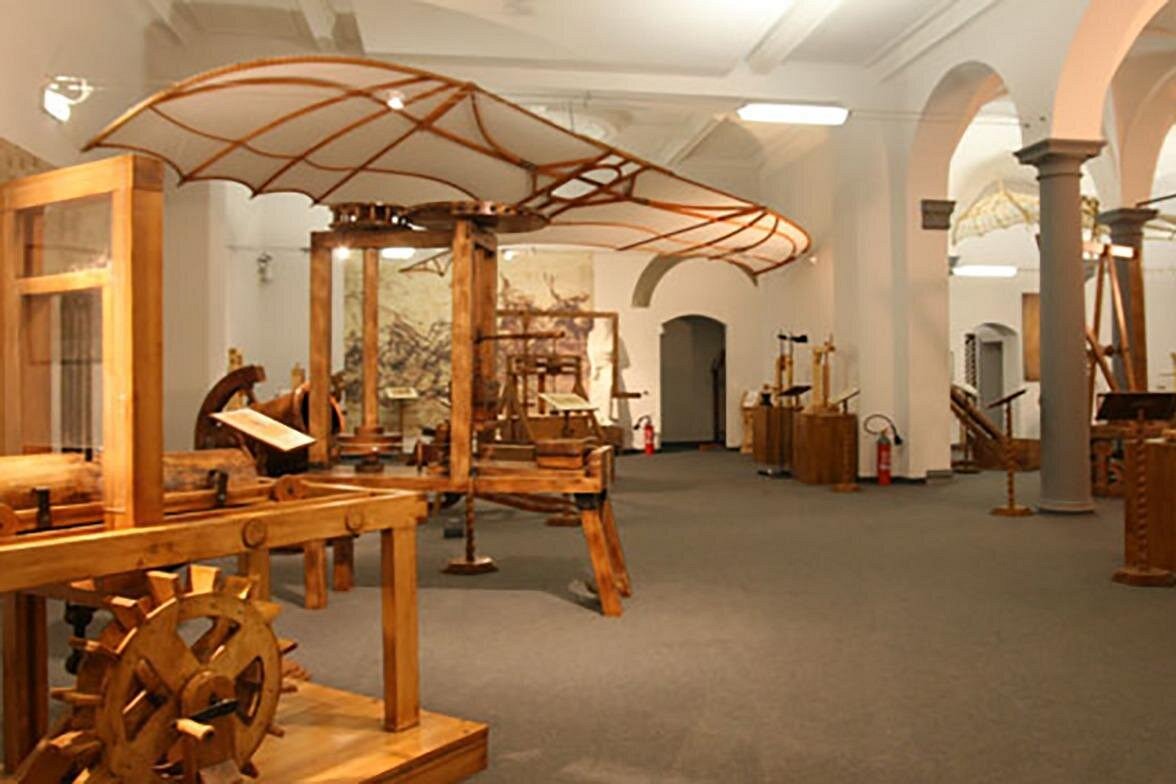
For a more tangible encounter, the Leonardo da Vinci Museum of Science and Technology in Milan houses a large wooden model built from Leonardo da Vinci's aerial screw sketch. Standing beneath it gives a far better sense of scale than any printed diagram, and it's usually the moment travelers say the invention finally "clicks."
Discover Leonardo Machines in Milan
See full-scale reconstructions of Leonardo’s inventions and discover the engineering ideas behind his designs
Explore Leonardo Museum ToursLeonardo da Vinci Museum, Milan
A guided visit through Milan's da Vinci collections, built around the machines and sketches rather than just the paintings.
- Full-scale reconstructions of the aerial screw and other flying machines
- Context on how each invention connects to Leonardo's notebooks
- Small-group pacing suited to close viewing of models
Many visitors find the models easier to understand than the original sketches alone. See current availability
Beyond Milan
Reproductions and study models of Leonardo's flying machines occasionally travel to exhibitions in other cities, including Florence and Rome. Checking a museum's current exhibition schedule before a trip is worthwhile, since Leonardo-focused shows are not always permanent installations.
Exploring Leonardo da Vinci in Milan
Milan holds a disproportionate share of Leonardo's engineering legacy compared to his painting legacy, which is largely tied to Florence. He spent nearly two decades in Milan working for Ludovico Sforza, producing not just The Last Supper but also hundreds of pages of technical studies, including the aerial screw.
Travelers piecing together a full picture of Leonardo often build an itinerary across several cities: Milan for engineering and notebooks, Florence for his artistic training, Venice for his military engineering work, Rome for his later years, and Paris, where he spent his final days and where several notebooks eventually landed.
Experiencing the Aerial Screw in Person
Reading about the aerial screw explains the idea; standing in front of the wooden model explains the ambition. The Leonardo da Vinci Museum of Science and Technology in Milan groups several of these reconstructions together, so the flying machines, the aerial screw, and Leonardo's other mechanical studies can be viewed as a connected body of thinking rather than isolated curiosities.
Seeing the scale up close makes the physics problem obvious in a way text cannot fully convey — the surface area needed, the weight of the materials, the sheer human effort the design would have required. It's a useful reminder that some of history's most influential ideas were valuable not because they worked, but because of the questions they forced later engineers to answer.
For travelers who want that context guided rather than self-directed, a local specialist can connect the sketch, the model, and the wider Codex Atlanticus collection into a single visit. Explore Leonardo da Vinci Museum Tickets
Final Thoughts
This post was all about the da Vinci aerial screw — a Renaissance sketch that treated flight as a solvable engineering problem centuries before anyone had the tools to solve it. Leonardo's genius wasn't in building a working helicopter; it was in framing the question so precisely that the shape of his answer still resembles the aircraft we build today.
That's the broader pattern across Leonardo's notebooks: ideas that outran the physics of their era, waiting for later generations to catch up. Seeing the aerial screw model in Milan, next to the pages of the Codex Atlanticus that inspired it, is one of the clearest ways to understand why Leonardo's engineering work still commands attention more than five hundred years later.
Related Post You May Like

Disclosure: This page may contain affiliate links. If you book through them, we may earn a small commission at no extra cost to you. Learn more.
Free Leonardo Milan Travel Guide
Plan Your Leonardo Trip in Milan
A premium mini guidebook for smarter Milan planning, including the best ticket strategy, Leonardo map, and practical visitor advice.
Get the Free Guide
Download the guide and receive practical Milan planning tips by email.
Download the Free Guide >> Leonardo Bianchi is the founder of Leonardo da Vinci Inventions & Experiences, a cultural travel guide helping visitors explore Leonardo da Vinci’s art, inventions, and legacy across Italy and Paris.