
(Last updated: June 2026)
You stand in a quiet, climate-controlled room in Milan. Across from you stretches a mural so familiar you feel you already know it — yet standing before it, you realize you don’t.
The figures lean, gesture, recoil. A hand reaches for bread. Another clutches a money bag. And in the center, utterly still, sits a man who has just said the words that shattered the table: “One of you will betray me.”
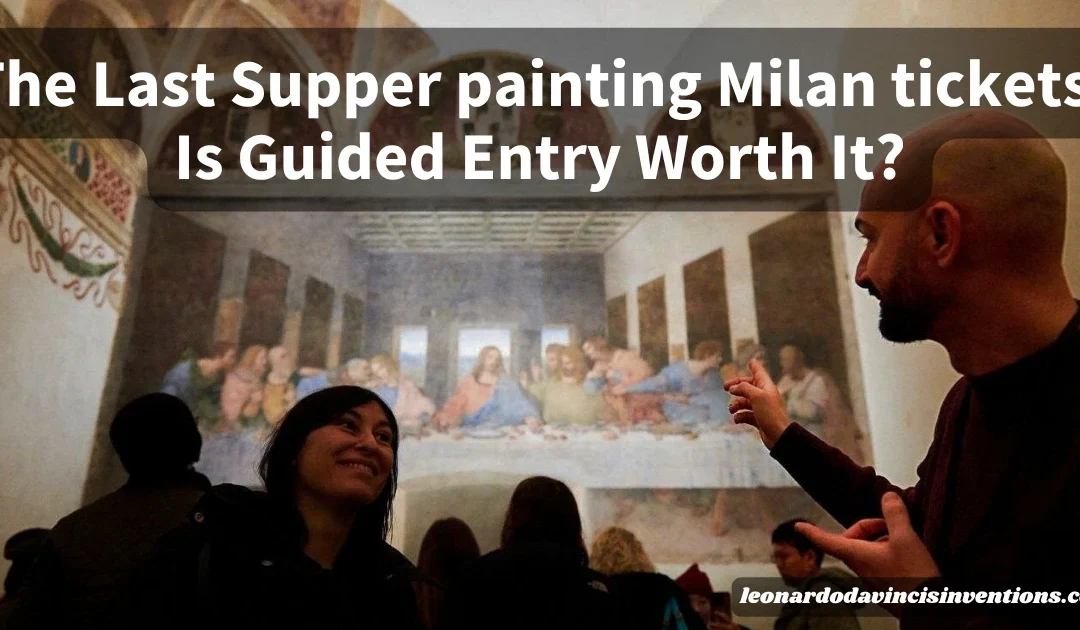
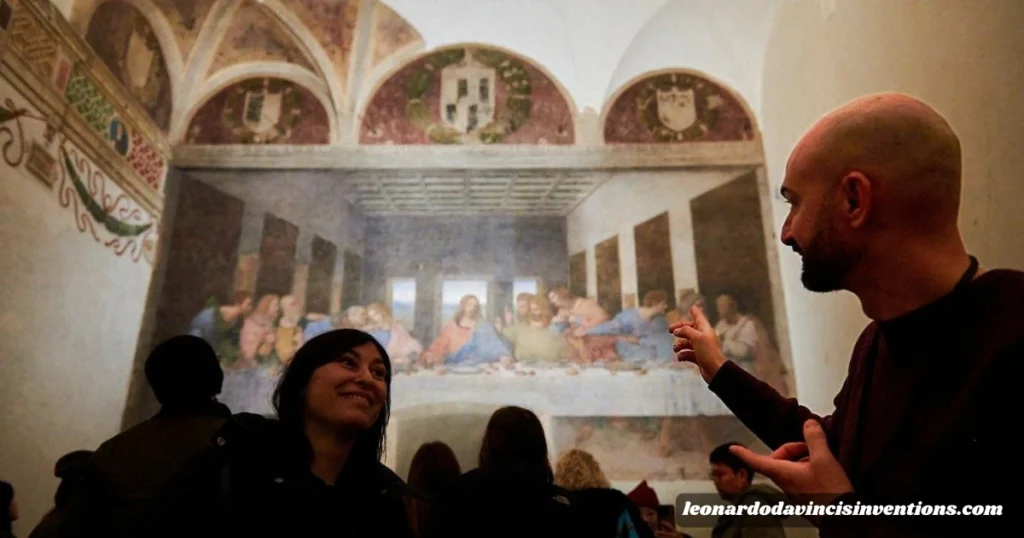
This is the moment Leonardo da Vinci froze in plaster, pigment, and oil between 1495 and 1498. And this is the moment you have exactly 15 minutes to absorb — because that is how long visitors are allowed inside the refectory of Santa Maria delle Grazie.
Understanding what the Last Supper painting Milan tickets actually grant you — and whether guided entry is worth the extra cost — is the difference between a rushed glance and one of the most powerful art experiences of your life.
Curious how this looks in real life? Explore guided Last Supper painting experiences in Milan and see what most visitors miss.
Why the Last Supper Is Unlike Any Other Masterpiece
Most of the world’s great paintings hang in museums, protected by glass, surrounded by dozens of other works competing for attention.
The Last Supper is different. It lives in the exact room Leonardo painted it for — the dining hall of a Dominican monastery — and it has never been moved. It cannot be moved. It is painted directly onto the wall.
That detail matters more than it sounds. Leonardo, in his famous restlessness, rejected traditional fresco technique, which required working quickly on wet plaster.
He wanted time to revise, to layer. So he invented a method: painting on dry plaster with tempera and oil. The result was visually richer — but disastrously fragile.
Within 20 years of completion, the paint began to flake. By the 1600s, monks had cut a doorway through Jesus’ feet. In 1943, an Allied bomb destroyed the roof of the refectory; only a wall of sandbags saved the mural.
What you see today is the result of a 22-year restoration that ended in 1999. Roughly 20 percent of what survives is believed to be Leonardo’s original hand.
The rest is centuries of repaint, carefully analyzed and partially removed. Knowing this changes how you look at it. You are not seeing a pristine work. You are seeing a ghost that refuses to disappear.
The Key Insight Most Visitors Never Notice
Walk into the refectory, and your eye will do what every eye does: go straight to Jesus at the center. The composition is designed to pull you there.
All the lines of the ceiling, the walls, the tapestries on either side — they converge on a single point just behind his right temple. That point is the vanishing point of the entire fresco. Leonardo placed it precisely at the head of Christ, so the geometry of the room itself bows toward him.
But here is what most visitors miss: the real drama is not in the center. It is among the twelve men around it.
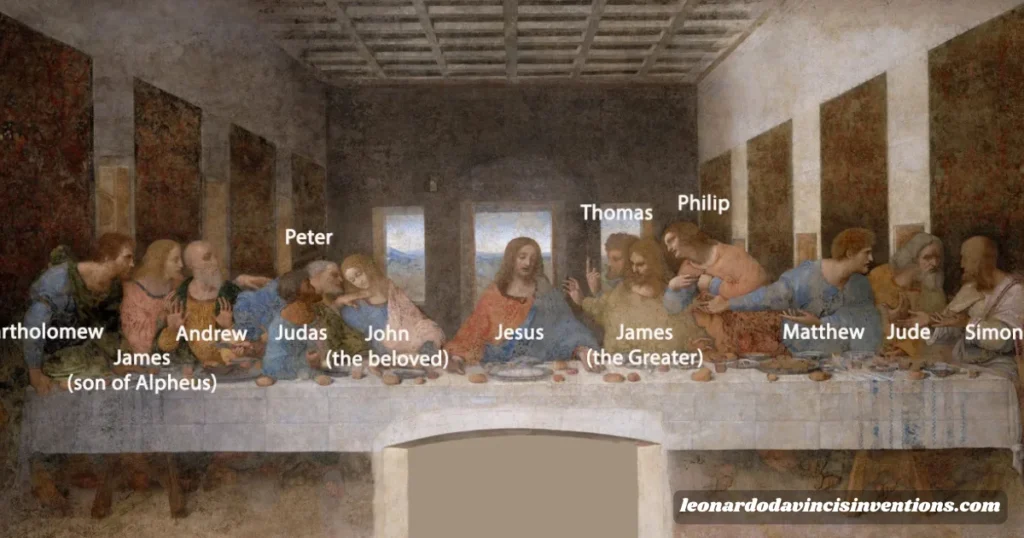
Leonardo divided the apostles into four groups of three—a visual rhythm that rolls outward from Jesus like a wave. Each group is in a different emotional state.
On the far left, Bartholomew has pushed himself up from the table, gripping the edge, leaning forward in shock. James the Lesser and Andrew are frozen mid-reaction.
Peter, impulsive as ever, lunges toward John with a knife already half-drawn — a chilling foreshadowing, because the same Peter will use that same knife in Gethsemane hours later. And between them, almost invisible, a figure leans back into shadow, clutching a small bag.
That figure is Judas. He is not seated apart, as earlier painters had shown him. Leonardo placed him among the disciples — because the horror of the moment is precisely that the betrayer is indistinguishable from the faithful.
His elbow has just knocked over the salt cellar, a detail traditionally read as an omen of broken trust. In his right hand, he holds the thirty pieces of silver. And his face is the only one in shadow.
This is the instant Leonardo chose: not the meal, not the institution of the Eucharist, but the half-second after Jesus says “one of you will betray me” and before anyone knows who. A psychological thunderclap rendered in paint.
Seeing this detail in person changes everything. Discover how visitors experience the Last Supper in Milan through an expert context that reveals its hidden meaning.
Interpreting What You’re Actually Looking At
Art historians have debated the symbolism of this single painting for 500 years, and the fact that you can still argue about it is part of what makes it extraordinary.
A few interpretive layers worth carrying with you:
| Key Detail | What You’re Seeing | Why It Matters |
|---|---|---|
| Groupings of Three | Four groups of three apostles, with Christ at the center | Creates mathematical harmony and reflects the Trinity, reinforcing theological meaning through structure |
| The Hands | Each disciple gestures differently—reaching, pointing, questioning, defending | Hands reveal emotion and character more clearly than faces, guiding how you read the scene |
| The Light | Light enters from the left, matching the real refectory windows | Extends the physical space, making the scene feel like part of the actual room |
| Empty Space Above Jesus | Three windows frame Christ, with the central one behind his head | Forms a natural “halo” using geometry instead of traditional religious symbols |
Where to See the Last Supper in Milan
The painting lives in the refectory (the monks’ old dining hall) attached to the church of Santa Maria delle Grazie, in the Magenta district west of Milan’s city center. The address is Piazza di Santa Maria delle Grazie 2. The nearest metro stops are Cadorna (M1/M2) and Conciliazione (M1), both about a seven-minute walk away.
The church itself is a UNESCO World Heritage site and worth entering — it’s free and open to visitors outside of mass — but the Last Supper is housed separately in the Cenacolo Vinciano museum next door, which has its own entrance and strict access rules.
Here is the critical thing to understand about tickets to see the Last Supper in Milan: only 35 people are allowed inside the refectory at a time, for exactly 15 minutes.
Visitors enter through a series of climate-controlled antechambers designed to stabilize humidity and remove dust from clothing. Then a door opens, you step into the room, and the clock starts.
Because of this bottleneck, tickets are released in fixed 15-minute slots, and demand overwhelmingly exceeds supply. Official tickets through the Cenacolo Vinciano website typically sell out weeks — sometimes months — in advance. If you try to grab Last Supper tickets last minute on the official website, you will almost always find them sold out.
This is why most visitors end up booking through authorized third-party operators who hold allotments of guided tickets. These cost more, but they include a small-group walkthrough with an art historian who explains exactly what you are about to see before you walk in — which matters enormously, because once you’re inside, there is no time to read placards or check your phone.
Experience This in Milan
This isn’t just something you read about — it’s something you feel standing inside that room. Knowing what to look for before you arrive transforms 15 minutes into something that stays with you.
Explore Guided Last Supper Experiences In Milan >>What It Feels Like to Stand in the Room
Reproductions of the Last Supper are everywhere — postcards, textbooks, refrigerator magnets in every gift shop in Milan. You think you know the painting. Then you walk into the refectory and realize you had no idea.
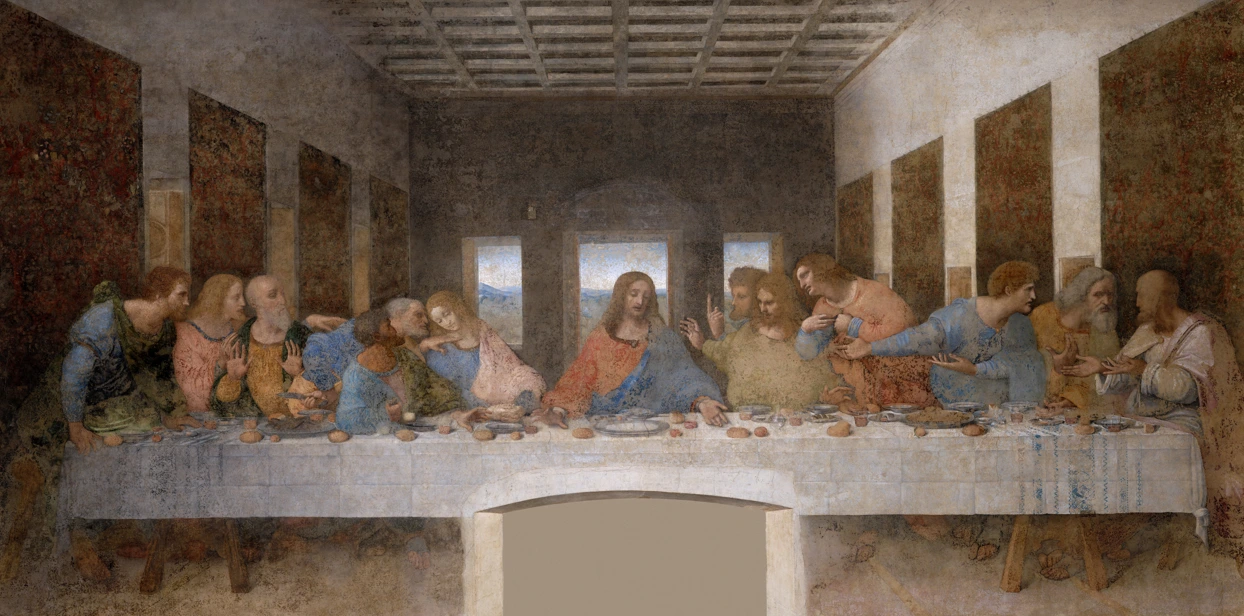
The first thing that hits you is scale. The mural is 15 feet tall and 29 feet wide. It covers an entire end wall. The figures are larger than life. Jesus and his disciples are towering over you, seated at a table close enough to touch. The room is quiet. No one talks above a whisper.
The second thing is the texture. In reproductions, the painting looks smooth. In person, you see every crack, every patch, every place where centuries have eaten through the pigment. It looks fragile — because it is. The faces of some apostles are almost ghostly; Thomas’s pointing finger, raised toward heaven, is the clearest thing in its section.
And then — the scale and the cracks fade, and you start seeing the story. The knife in Peter’s hand. The salt cellar tipping.
The light on Christ’s forehead. The hands, always the hands. By minute ten, you’ve stopped thinking about the painting at all. You’re thinking about the table, the accusation, the silence just before the answer.
When the guard politely indicates your time is up, you don’t want to leave. Everyone who has stood in that room knows the feeling.
It’s completely different standing in front of it. See how small-group visits to the Last Supper work and why timing matters.
How to Experience It: Tickets, Timing, and Whether to Go Guided
There are essentially three ways to secure tickets to see the Last Supper:
1. The official Cenacolo Vinciano website (cenacolovinciano.org). This is the cheapest route and the source of all legitimate tickets. Standard entry runs around €15, with an audio guide option. The catch: tickets are released on a rolling schedule, usually 2–3 months ahead, and evaporate within hours. If you are flexible with dates and can book far in advance, this is the purist’s choice.
2. Official guided tours run by the museum. These pair Last Supper museum tickets with a 45-minute expert-led walkthrough of the refectory and the church. Slightly more expensive, and also sell out quickly, but give you context you simply cannot absorb on your own in 15 minutes.
3. Authorized third-party operators. Authorized companies hold guaranteed allotments of Leonardo da Vinci Last Supper tickets, often bundled with a guided walking tour of the surrounding Magenta district or a broader Leonardo-themed itinerary. Prices are higher — typically €45 to €75 — but availability is the main reason travelers choose this route, especially for dates within a few weeks.
Is guided entry worth it? For most first-time visitors: yes, unambiguously. Here’s why. You have 15 minutes. You will not have time to read, research, or even process what you’re seeing before your time is up.
A good guide front-loads the context in the antechamber, then walks you in already knowing exactly where to look, what Leonardo changed from earlier versions, and which figure is Judas. You spend your 15 minutes seeing, not searching.
If you are an art historian, a serious Renaissance enthusiast, or someone who has studied the painting in depth, you can probably go unguided and have a profound experience. For everyone else, the guide pays for itself within the first two minutes inside the room.
How to Experience the Last Supper Without Missing the Details
Access is limited, and most visitors only get a few minutes inside. The difference is having the right context before you walk in.
- Skip-the-line timed entry
- Small-group guided access
- Expert explanation of key details
Practical Tips for Your Visit
Arrive early. The museum is strict about entry times. Show up at least 20 minutes before your slot; latecomers are not admitted, and refunds are not issued.
Bring ID. Your name will be on the reservation, and it will be checked at the door.
No large bags. Anything bigger than a small purse must be checked. No photography is permitted inside the refectory.
Combine it with Castello Sforzesco. Leonardo spent 17 years working in Milan under the Sforza dukes. The castle is a 15-minute walk away and adds depth to the context beautifully.
Morning is best. The light through the refectory windows is closest to what Leonardo designed for.
If you’re already planning to visit, take a look at the current Last Supper experience options before availability runs out.
The Last Supper Is a Painting That Refuses to Be Finished
What makes Leonardo’s Last Supper extraordinary is not just what he painted — it’s that the painting has been dying for 500 years and still commands every eye in the room. It has survived floods, bombs, clumsy restorations, and the slow chemistry of its own failing plaster.
It has been mocked, worshipped, copied, parodied, and printed on a billion surfaces. And still, when you walk into that quiet refectory in Milan, it stops you.
The painting will not be there forever. Every generation sees it slightly more faded than the last. You are lucky to have the option to stand in front of it at all — and that 15 minutes, used well, is one of the most memorable quarter-hours you will spend in Italy.
Go prepared. Know what to look for. And when the door opens into the refectory, do the one thing most visitors forget: stop. Breathe. Look at the hands.
Travel Essentials for Visiting Milan for the First Time
Preparing for a visit to Milan often comes down to a few small details that can make long museum days, historic walking routes, and city exploration significantly more comfortable.
Comfortable Walking Shoes
Milan’s major landmarks are often best experienced on foot, with visitors covering long distances between museums, churches, and historic streets. Supportive shoes can make a full day of exploration far more comfortable → explore comfortable walking shoes for long city days
Portable Power Bank
Navigation, photography, and digital tickets can quickly drain battery life during a full day in the city. A compact power bank helps avoid interruptions, with many visitors choosing lightweight options → view reliable portable chargers
Secure Crossbody Bag
Busy areas near major attractions can require extra awareness. Many travelers prefer a compact crossbody bag worn in front to keep essentials accessible and secure →
Explore practical crossbody bags for travel
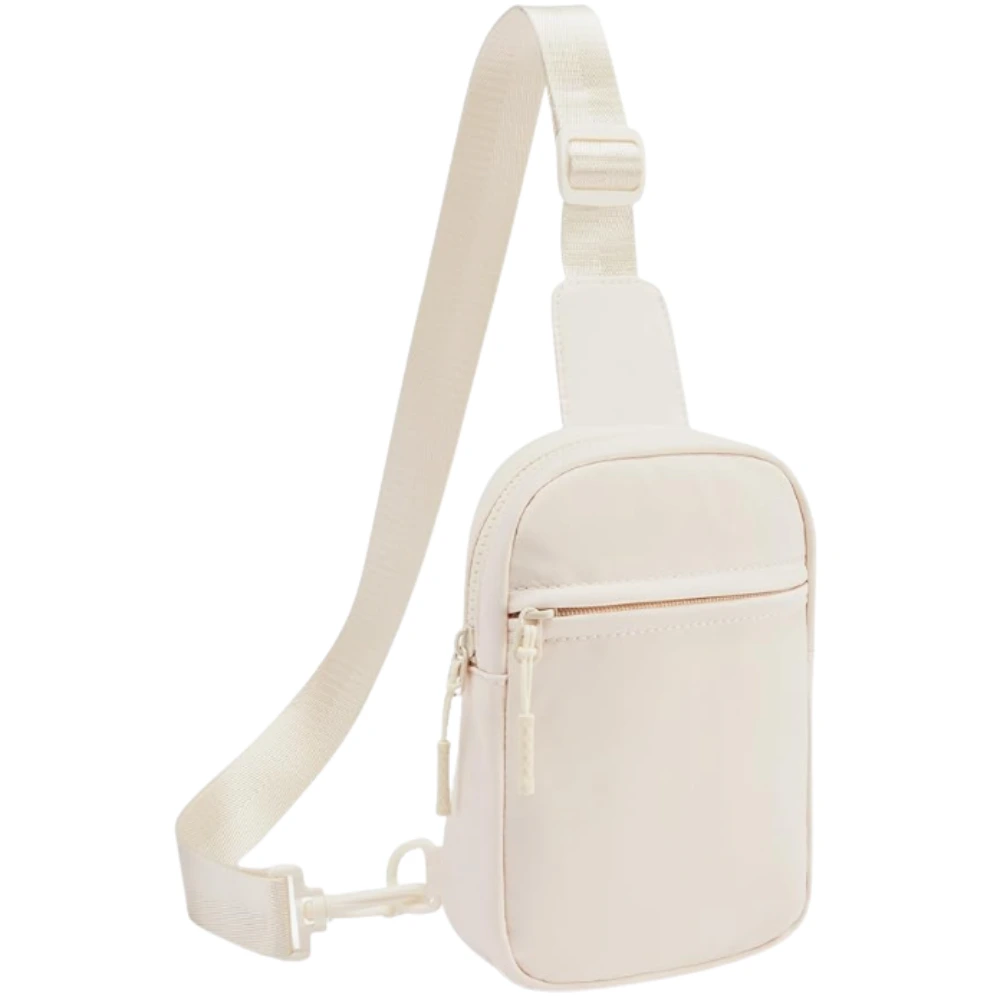
A compact option often preferred for full-day city travel.
FAQs about the Last Supper painting in Milan tickets
Yes, you must have a pre-booked ticket to see The Last Supper at the Cenacolo Vinciano. Reservations are mandatory for all visitors, including free-entry days, due to strict conservation rules and limited capacity.
Standard entry tickets to see The Last Supper cost about €15 per person, with optional guided tours costing more depending on the experience. Prices reflect the controlled 15-minute viewing and preservation requirements.
Tickets are difficult to get because visitor numbers are strictly limited, with small groups admitted for short time slots to protect the fragile painting. As a result, tickets often sell out weeks or months in advance.
No, you cannot simply turn up to see The Last Supper. Same-day tickets are generally not available, and advance booking is required for all visits through official channels or authorized providers.
No, there is no walk-in queue for The Last Supper. Entry is strictly controlled by timed tickets booked in advance, and only visitors with confirmed reservations are admitted.
There is no strict formal dress code, but visitors are expected to dress respectfully, as the painting is housed within the historic church complex of Santa Maria delle Grazie. Modest attire is recommended, especially when entering the church.
Related Post You May Like

Disclosure: This page may contain affiliate links. If you choose an experience through them, it helps support the site at no extra cost to you.
 Leonardo Bianchi is the founder of Leonardo da Vinci Inventions & Experiences, a cultural travel guide helping visitors explore Leonardo da Vinci’s art, inventions, and legacy across Italy and Paris.