
(Last updated: May 2026)
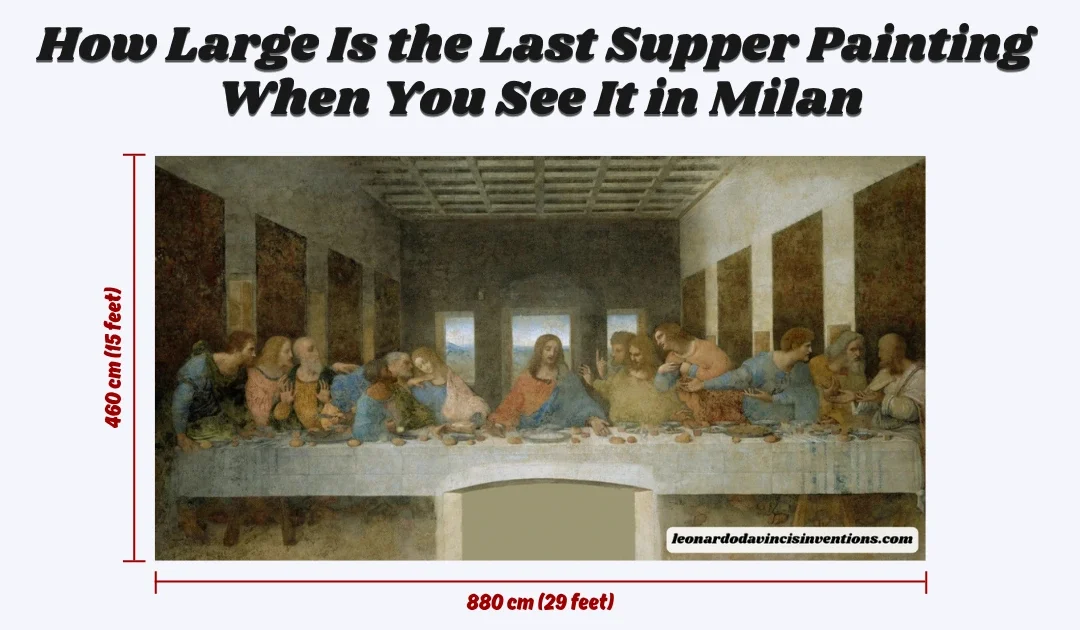
How large is the Last Supper painting? At roughly 4.6 metres tall and 8.8 metres wide, Leonardo da Vinci's mural is far bigger than most people expect — and that scale is part of why standing in front of it feels unlike anything else in a museum.
Painted directly onto the refectory wall of Santa Maria delle Grazie in Milan, the work was never meant to hang in a gallery. It was designed to be lived with — eaten beside, prayed beneath, and experienced at the scale of a real room. Understanding its physical dimensions, and the deliberate choices behind them, completely changes how you see the painting.
This post is all about how large is the Last Supper painting — its exact measurements, how Leonardo used that size intentionally, and how you can see it for yourself in Milan today.
What Is the Size of the Last Supper Painting?
The Last Supper painting measures approximately 460 cm × 880 cm (about 15 × 29 feet). Leonardo da Vinci completed it between 1495 and 1498 on the end wall of the dining hall at Santa Maria delle Grazie in Milan. It is a mural painted in tempera and oil on a plaster surface, not a traditional fresco.
The Artistic Genius Behind the Last Supper Painting Size
Leonardo did not choose that size by accident. Every centimetre was a decision.
Why He Painted It So Large
The refectory — the monks' dining hall — required a mural that would dominate the room without overwhelming it. Leonardo matched the painting's perspective to the room's actual sightlines. If you stood at the far end of the hall at the original viewing distance, the painted table appeared to extend your own dinner table. The apostles sat at the same height as the monks eating below them.
That is not a coincidence. It is one of the most sophisticated uses of perspective in the history of Western art.
The Technical Challenge He Set Himself
Traditional fresco required painting quickly on wet plaster, section by section. Leonardo wanted to work slowly — blending, adjusting, rethinking. So he experimented with tempera and oil on dry plaster instead. It gave him the control he needed for a painting of this complexity.
The gamble almost destroyed the work within his own lifetime. The paint began flaking within decades. But it also gave us the most psychologically detailed group portrait of the Renaissance — thirteen faces, each unmistakably different, each frozen at the exact moment Christ says, "One of you will betray me."
How Long Did It Take Leonardo to Paint the Last Supper?
Leonardo worked on the Last Supper from approximately 1495 to 1498 — about three years. Contemporary accounts suggest he sometimes worked for days without stopping, then would step back and study the wall in silence for hours. He was said to leave Judas's face unfinished longest, searching the streets of Milan for a face dark enough in character to match his vision.
When was the Last Supper painted? The commission came from Ludovico Sforza, Duke of Milan, who wanted the refectory of Santa Maria delle Grazie transformed into something worthy of a ducal burial chapel. The work was complete by 1498.
Visitors who join a guided tour of Santa Maria delle Grazie often leave with a far deeper understanding of the compositional decisions behind the painting — expert commentary on Leonardo's spatial illusions transforms what you see from an image into an argument.
Why the Last Supper Painting Became Famous
The Last Supper is one of the most reproduced images in human history. But why? There are technically superior paintings. There are more perfectly preserved works. The answer lies in what it does that no other painting manages at the same level.
A Single Moment, Thirteen Different Reactions
Most religious paintings of this scene before Leonardo's showed the figures in static, symbolic poses. Leonardo broke every convention. He depicted the exact second after Christ's announcement — and gave every apostle a unique, psychologically distinct response.
Philip presses his hands to his chest in anguish. Peter grips a knife. Thomas raises a single finger toward heaven. Judas, darker than the rest, grips a small bag. The composition radiates outward from Christ at the mathematical centre like a shockwave frozen in plaster.
Why Is the Last Supper Painting Important?
The Last Supper redefined how narrative art could work. Before Leonardo, sacred scenes were symbolic — figures arranged for theological clarity. After him, they were psychological — figures arranged for dramatic truth. Nearly every major narrative painting produced in Europe after 1500 owes a debt to what Leonardo figured out in that Milanese dining hall.
It also survived. Wars, floods, Napoleonic troops using the refectory as a stable, Allied bombing in World War II — the wall was left standing when the roof collapsed. The painting absorbed all of it and endured.
The Original Painting vs. Every Copy Ever Made
The Last Supper original painting is not what most people picture. Centuries of damage, repainting, and the slow failure of Leonardo's experimental technique mean the surface you see today is layered with later restorations. The most recent conservation project, completed in 1999 after 21 years of work, removed centuries of overpainting to reveal what Leonardo actually put on the wall.
What emerged was more subtle, more colourful, and more damaged than any reproduction suggests. You have to see the original to understand what was lost — and what survived.
— Experience Insight —
Seeing the Last Supper in person requires advance booking — timed entry is strictly controlled to protect the fragile surface. Guided access options are available through licensed operators in Milan.
- Entry is limited to 30 visitors per 15-minute slot, making the experience unusually intimate.
- Expert commentary helps decode the compositional and symbolic details invisible to the untrained eye.
- Many visitors find the scale of the work genuinely surprising after years of seeing it only in reproduction.
For visitors with limited time in Milan, combining Last Supper access with a guided city walk is a practical and rewarding option.
Where to See the Last Supper Painting Today
The Last Supper has never moved. It cannot move. It is part of the wall. If you want to see the original, there is only one place on earth: the refectory of Santa Maria delle Grazie on Piazza Santa Maria delle Grazie in Milan, Italy.
Santa Maria delle Grazie: The Church and the Refectory
The church itself is a UNESCO World Heritage Site, designated alongside the Last Supper in 1980. The Gothic nave was expanded under Ludovico Sforza in the 1490s — the same years Leonardo was working on the opposite wall. The building and the painting were designed as complementary parts of the same ducal vision.
The refectory is a separate entrance from the church. You pass through a climate-controlled airlock — a precaution against the humidity and particulate matter that visitors carry in. Then the doors open and the wall is in front of you.
Last Supper Tickets: What You Need to Know
Last Supper tickets are among the most in-demand museum reservations in Europe. Official tickets from the Vivaticket system often sell out weeks or months in advance. Timed entry is non-negotiable — you arrive at your slot, spend 15 minutes inside, and leave.
Guided tour operators with pre-allocated tickets can significantly simplify this process, especially for visitors who haven't planned months ahead. The guided format also means you don't spend your 15 minutes trying to identify which figure is which — you spend it looking.
Tours that include Last Supper access alongside Milan's broader Leonardo heritage — the Ambrosiana library's preparatory drawings, the Sforza Castle's painted rooms — give the painting a fuller context. You can explore Milan Last Supper guided tour options directly through licensed operators; look for tours with skip-the-line access and expert English-language guides.
What Visitors Actually Experience Standing Before It
The room is quiet. There are no other artworks competing for your attention. The painting takes up the entire end wall — all 8.8 metres of it — and it is at eye level. Not elevated on a pedestal, not behind thick glass. At eye level, the way it was always meant to be seen.
The scale hits you first. Then the detail — the embroidered tablecloth, the pewter plates, the scattered pomegranate seeds. Then the faces. Visitors often note that Judas is darker and more recessed than any reproduction suggests, and that the figure of Christ appears calmer — more resigned — than expected.
Exploring Leonardo da Vinci in Milan
Milan was Leonardo's most productive city. He spent nearly two decades here under the patronage of Ludovico Sforza, and the traces are everywhere. The Sforza Castle (Castello Sforzesco) still contains the Sala delle Asse — a ceiling covered in painted brambles and mulberry trees that Leonardo completed around 1498, in the same years as the Last Supper. The Biblioteca Ambrosiana holds the Codex Atlanticus, the largest single collection of Leonardo's drawings and notes in the world. A visit to Milan for the Last Supper naturally expands into a broader encounter with his work.
For those whose Leonardo journey extends beyond Milan, his work threads through the great cities of Renaissance Italy and France. His earliest paintings survive in Florence, where he trained under Verrocchio. The Louvre in Paris holds the Mona Lisa, the Virgin of the Rocks, and Saint John the Baptist. Venice holds his anatomical sketches at the Gallerie dell'Accademia. And Rome's Vatican Museums display works by his contemporaries that responded directly to his influence. Each city adds another dimension to understanding who Leonardo was and why he still matters.
Final Thoughts
This post was all about how large is the Last Supper painting — and the answer is more than a number. It is 460 by 880 centimetres of deliberate calculation: a wall-sized argument about perspective, psychology, and what painting can do that no other medium can. Leonardo spent three years on it, used a technique that nearly destroyed it, and created something so thoroughly studied and so endlessly reproduced that most people think they already know what it looks like. They don't. Not until they stand in front of it.
The Renaissance was not just a style. It was a transformation in how human beings understood themselves — their bodies, their history, their place in the cosmos. Leonardo was at the centre of it, and the Last Supper is perhaps his clearest statement of what that transformation looked like in practice. Seeing it in person, in the room it was made for, at the scale it was designed to be seen, is one of the genuinely irreplaceable experiences art offers. It is worth planning for.
FAQs about How Large Is the Last Supper Painting
Related Post You May Like
 Leonardo Bianchi is the founder of Leonardo da Vinci Inventions & Experiences, a cultural travel guide helping visitors explore Leonardo da Vinci’s art, inventions, and legacy across Italy and Paris.