
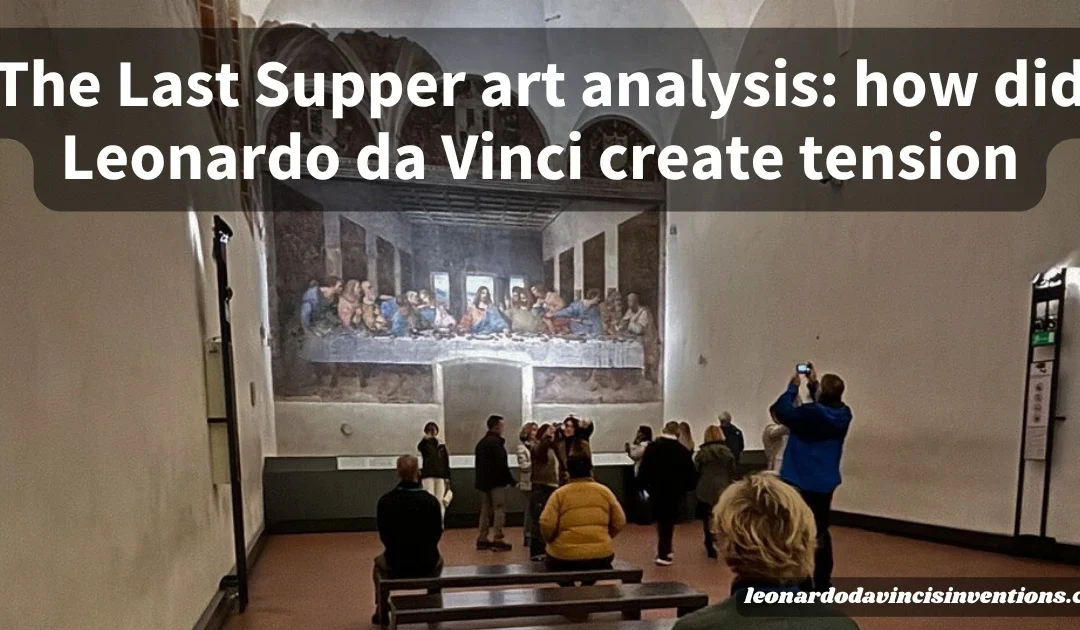
(Last updated: May 2026)
A full Last Supper art analysis reveals one of the most carefully constructed paintings in all of Western history — a work where every gesture, every expression, and every shadow was placed with deliberate intention. Leonardo da Vinci completed this monumental mural between 1495 and 1498, and it has not ceased to command attention since.
Understanding what da Vinci built into this painting changes how you see it entirely. It transforms a familiar image into something layered and alive. And if you ever stand before it in Milan, that knowledge makes the experience unforgettable.
This post is all about the Last Supper art analysis — from the technique Leonardo chose to the psychology embedded in each figure, and why it still matters more than five centuries later.
What Is the Last Supper Art Analysis?
The Artistic Genius Behind the Last Supper Painting
Leonardo's Revolutionary Technique
Most murals of Leonardo's era were painted in true fresco — wet plaster, fast brushwork, no second chances. Leonardo rejected that entirely.
He used a mixed tempera and oil technique applied directly to a dry plaster wall. This allowed him to work slowly, layer tones, and rework passages over weeks or even months. It was the approach of a painter obsessed with nuance.
The price was steep. Fresco bonds chemically with stone. Leonardo's method did not. Within decades, the paint began to flake and fade. His quest for perfection was fragile, making the painting's survival all the more remarkable.
Composition and Perspective
Leonardo used a single-point perspective system so precise that it draws every line in the room — the ceiling coffers, the tapestries, the table edge — directly toward Christ's right temple.
Christ sits at the geometric center of the composition. Light enters behind him, creating a natural halo without religious iconography. He alone is still. Around him, all twelve apostles react.
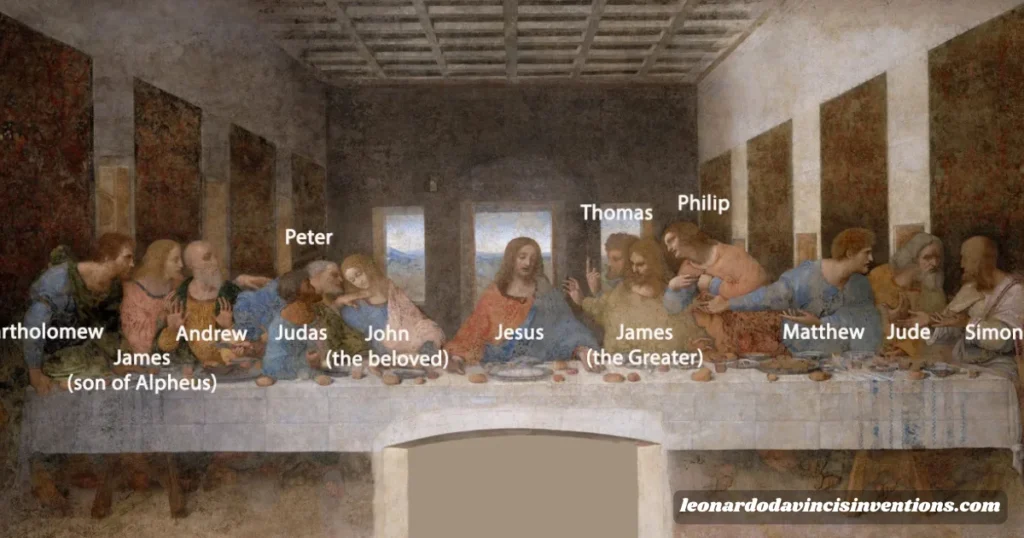
The apostles are organized into four groups of three. This was not random. Leonardo studied faces, physiognomy, and human emotion for years. Each cluster tells a small story within the larger one.
The Psychological Drama Within the Frame
The scene Leonardo captured is the moment Christ says: 'Truly I tell you, one of you will betray me.'
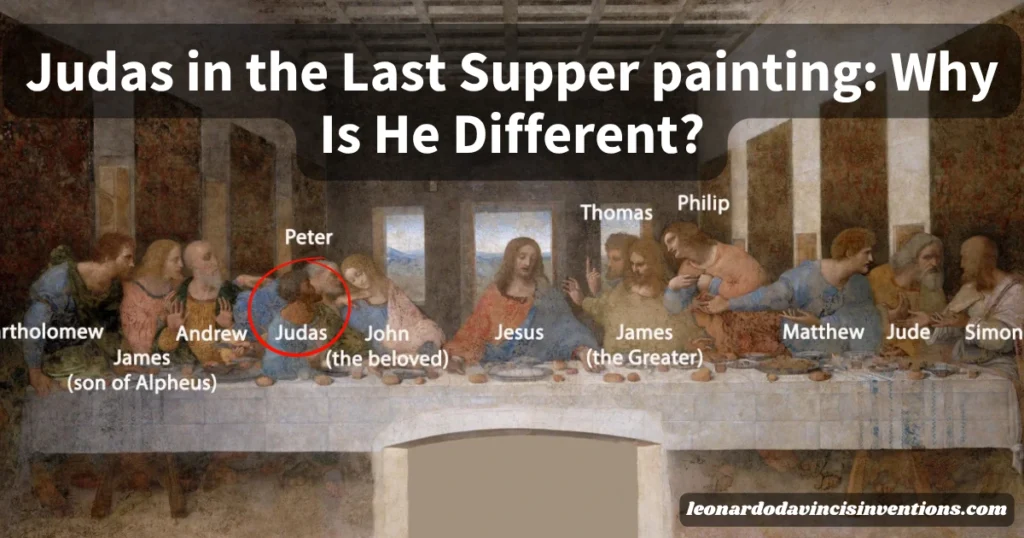
Each apostle's response is different. Bartholomew leans forward in shock. Judas — third from Christ's right — recoils and clutches a small bag. Peter grips a knife. John, Christ's beloved disciple, appears almost to swoon.
These are not saints rendered as symbols. They are human beings caught in a moment of crisis. That psychological realism was nearly unprecedented in devotional painting and marks the Last Supper as a turning point in Western art.
For those planning to visit Milan, the refectory that houses the painting only admits small groups at timed intervals — guided Last Supper tours in Milan with reserved access are one of the most reliable ways to secure entry and understand the full depth of what you are looking at.
Why the Last Supper Painting Became Famous
The Symbolism in the Last Supper Painting
The symbolism in the Last Supper painting operates on multiple levels simultaneously.
The number twelve carries its obvious religious weight — the twelve apostles, the twelve tribes of Israel. But Leonardo embedded subtler geometry. The groupings of three echo the Christian Trinity. The windows behind Christ form a triptych that frames his figure like an altarpiece.
Salt spills near Judas's arm — a traditional symbol of bad luck and treachery. The bread and wine on the table reference the Eucharist. Even the fish on the platters carries meaning: in early Christian symbology, the fish was a sign of the faithful.
None of this is accidental. Leonardo filled notebooks with studies of each apostle before he ever lifted a brush to this wall. The painting is the result of sustained, almost obsessive preparation.
Why Is the Last Supper Painting Important?
The Last Supper is important for reasons that extend well beyond its religious subject matter.
It is one of the first large-scale narrative paintings to prioritize psychological realism over symbolic convention. It shifted what devotional art could be — not just a representation of sacred figures, but a window into human emotion.
It also influenced virtually every major painter who came after. Raphael studied it. Rubens copied it. Even centuries later, its compositional logic continues to echo in the way artists frame group scenes.
And then there is the story behind the Last Supper painting that has fueled centuries of myth and inquiry — from questions about the identity of John to theories about hidden musical scores in the apostles' positions. Whether or not those theories hold water, they speak to something true: this painting rewards close looking more than almost any other work.
5 Surprising Facts About the Last Supper Painting
A few facts that tend to fascinate first-time visitors:
- The original painting measures roughly 460 x 880 centimeters — nearly nine meters wide.
- Leonardo worked on it for approximately 3 years, returning repeatedly to individual faces.
- During World War II, Allied bombing destroyed the refectory walls on three sides. The wall bearing the painting survived, partly protected by sandbags placed by Milanese citizens.
- The Last Supper medium — tempera and oil on plaster — meant the work was already deteriorating within Leonardo's lifetime. What we see today is partly a painting and partly centuries of restoration.
- Michelangelo never painted a Last Supper. The work often associated with him by that name belongs to other hands. There is only one da Vinci Last Supper original, and it remains in Milan.
Where to See the Last Supper Original Today
Santa Maria delle Grazie, Milan
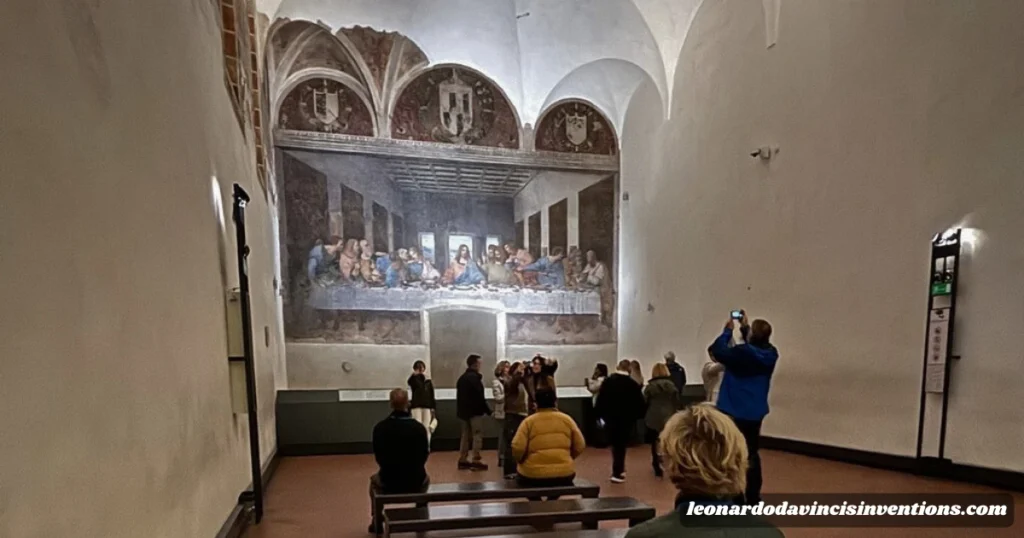
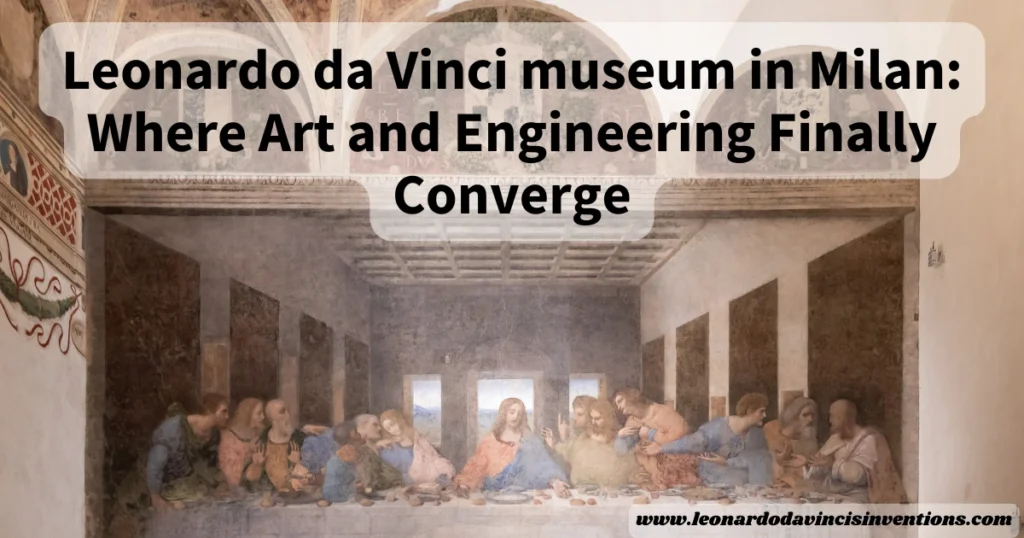
The Last Supper, the original, has never left Milan. It occupies the northern wall of the refectory — the former dining hall — of Santa Maria delle Grazie, a church and convent in the Magenta neighborhood of the city.
The space is not a gallery. It is a long, narrow room that was designed to serve food to Dominican monks. Leonardo's mural was intended to make the monks feel as though they were dining with Christ and the apostles. Standing at the threshold and looking down its length, that original intention becomes completely legible.
The climate inside is tightly controlled. Temperature and humidity are monitored constantly to slow the ongoing deterioration of the paint. Visitors are asked to pass through two airlocks before entering.
The Experience of Standing Before the Painting
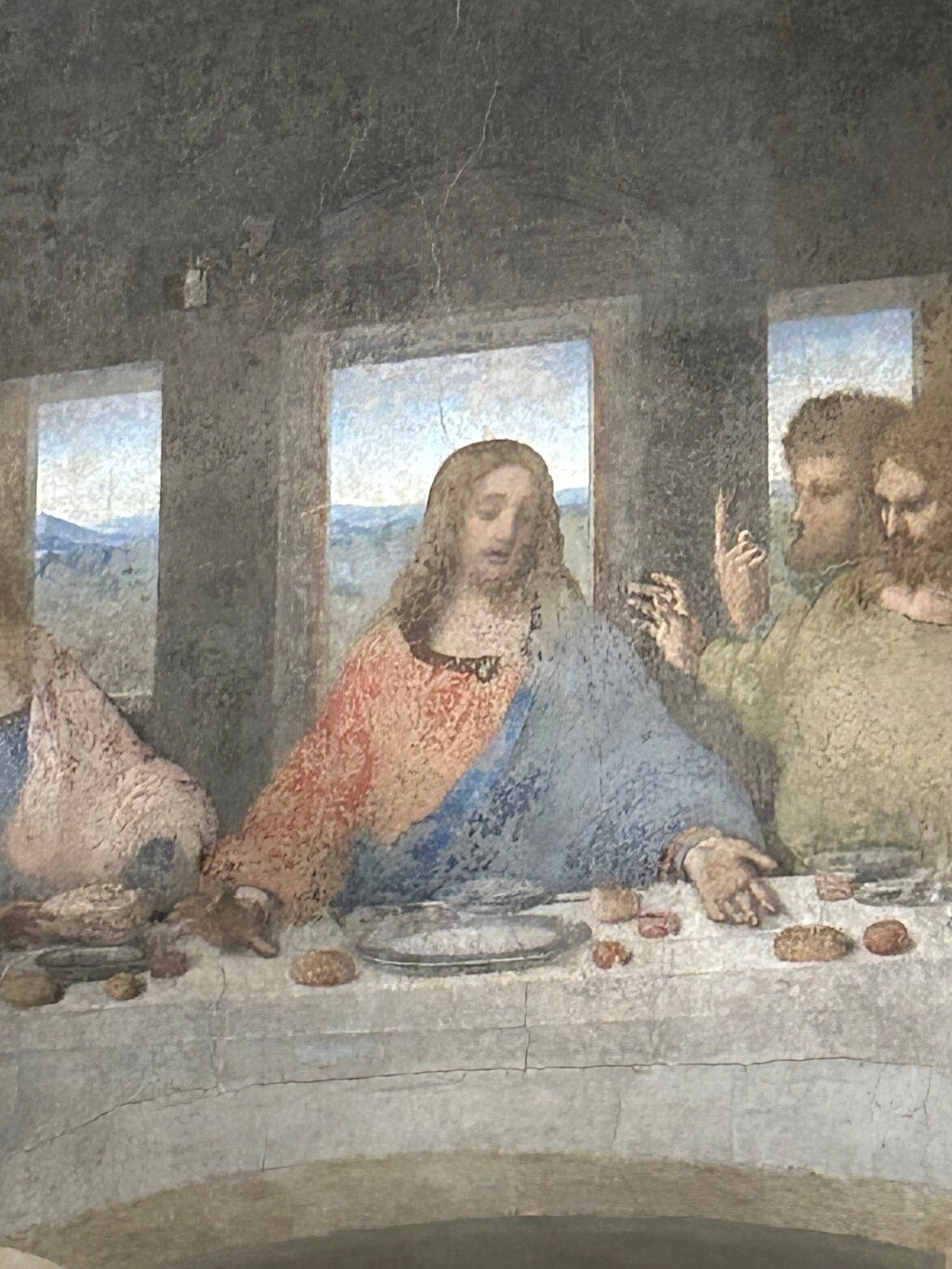
Photographs flatten everything. They cannot convey scale. The Last Supper is almost nine meters wide. The figures are slightly larger than life. Christ's hands, outstretched on the table, are painted with a stillness that reads as calm amid the surrounding agitation.
You notice things in person that reproduction erases entirely: the varying textures of the tablecloth, the individual architecture of each apostle's hands, the way Leonardo modeled the light falling across their faces.
Most visitors have fifteen minutes. It is not long. But it is enough — especially with the right preparation.
Many visitors find that arriving with structured knowledge makes those fifteen minutes feel far richer. Understanding who each apostle is and where they sit, knowing what Leonardo was technically attempting, and knowing which sections survived intact and which underwent restoration — all of this transforms passive looking into active reading.
A guided experience that covers this context before you enter the room can make the difference between seeing a famous painting and actually understanding one.
Understand The Last Supper inside Santa Maria delle Grazie
This guided visit includes timed entry to Il Cenacolo for a focused 15-minute viewing, followed by deeper context across the Santa Maria delle Grazie complex. Visitors often note how expert storytelling and restoration insights transform the moment from observation into understanding.
Exploring Leonardo da Vinci in Milan
Milan is where Leonardo spent nearly two decades, from 1482 to 1499, in the service of Ludovico Sforza. The Last Supper is the most visible legacy of that period, but it is far from the only one.
The Pinacoteca Ambrosiana holds his Musician portrait and an important collection of drawings. The Castello Sforzesco contains frescoes attributed to his workshop. The city's street grid still reflects engineering projects Leonardo contributed to.
Leonardo's influence extends beyond Milan, of course. Visitors interested in tracing his full journey through Italy often continue to Florence — where he trained under Verrocchio — and to Venice, Rome, and ultimately Paris, where he spent his final years in the service of the French king and where the Mona Lisa remains today.
Final Thoughts
This post was all about the Last Supper art analysis — and what emerges from that analysis is a portrait of Leonardo at the height of his powers, working in a medium he invented for himself, on a subject that gave him room to explore every obsession he had: human psychology, light and shadow, geometry, and the drama of a single suspended moment.
The Renaissance produced extraordinary things. But the Last Supper stands apart even within that company. It is a work that repays whatever attention you bring to it — in a book, on a screen, or, best of all, in a quietly climate-controlled room in Milan, with fifteen minutes and a great deal to look at.
Travel Essentials for Visiting Milan for the First Time
Preparing for a visit to Milan often comes down to a few small details that can make long museum days, historic walking routes, and city exploration significantly more comfortable.
Secure Crossbody Bag
Busy areas near major attractions can require extra awareness. Many travelers prefer a compact crossbody bag worn in front to keep essentials accessible and secure → explore practical crossbody bags for travel
Portable Power Bank
Navigation, photography, and digital tickets can quickly drain battery life during a full day in the city. A compact power bank helps avoid interruptions, with many visitors choosing lightweight options → view reliable portable chargers
Comfortable Walking Shoes
Milan’s major landmarks are often best experienced on foot, with visitors covering long distances between museums, churches, and historic streets. Supportive shoes can make a full day of exploration far more comfortable →
Explore comfortable walking shoes for long city days

FAQs about The Last Supper Art Analysis
The main message of The Last Supper is the dramatic moment when Jesus announces that one of his apostles will betray him, capturing the emotional and spiritual tension of that revelation. Leonardo focuses on human reactions—shock, anger, and disbelief—while emphasizing Christ’s calm central presence.
Yes, the painting contains layers of symbolism, such as the grouping of apostles in threes to reflect the Holy Trinity and geometric compositions that highlight Christ’s divinity. While many theories exist, art historians agree that Leonardo intentionally embedded symbolic meaning rather than secret codes.
The Last Supper is controversial because of ongoing debates about hidden meanings, reinterpretations in popular culture, and religious sensitivity to how the image is used or altered. Modern adaptations and theories—like those popularized in novels—have fueled disputes between scholars and the public.
There is no confirmed evidence of a specific lover, but historians often point to Gian Giacomo Caprotti (known as Salai), Leonardo’s longtime assistant, as a possible close companion. Their relationship remains debated, with no definitive proof of a romantic connection.
In Christian theology, Jesus’ betrayal by Judas is part of a larger divine plan leading to the crucifixion and redemption. The Gospels emphasize prophecy and fulfillment rather than focusing on forgiveness in that moment, leaving the question open to interpretation.
“Forty lashes minus one” refers to a traditional Jewish legal punishment limited to 39 lashes to avoid accidentally exceeding the biblical maximum of forty. It appears in historical and religious contexts as a regulated form of corporal discipline.
Related Post You May Like

Disclosure: This page may contain affiliate links. If you choose an experience through them, it helps support the site at no extra cost to you.
 Leonardo Bianchi is the founder of Leonardo da Vinci Inventions & Experiences, a cultural travel guide helping visitors explore Leonardo da Vinci’s art, inventions, and legacy across Italy and Paris.