
(Last updated: May 2026)
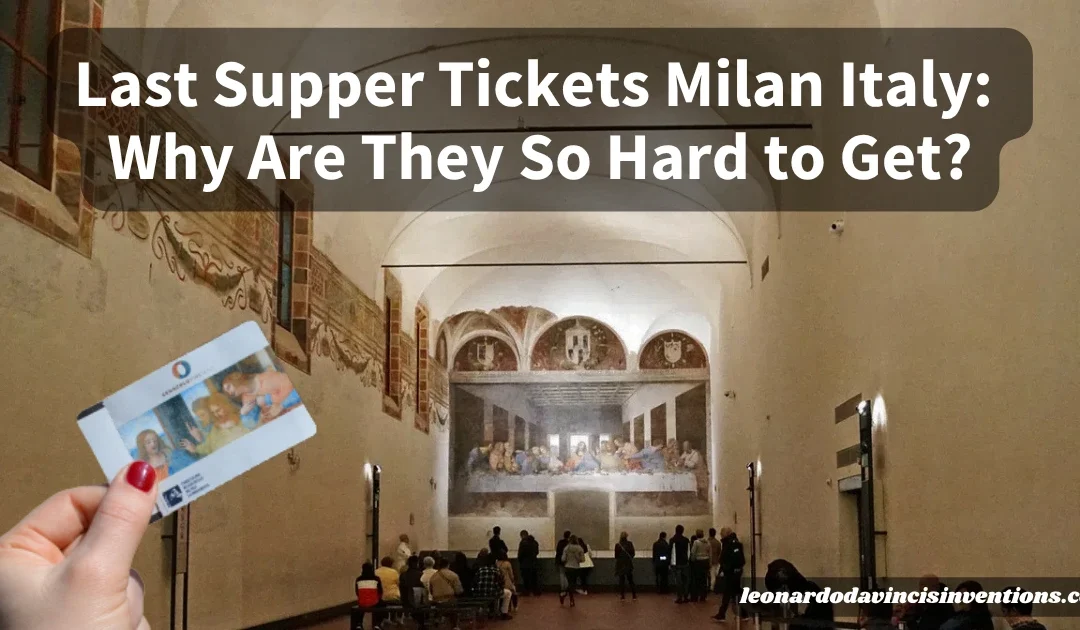
Last Supper Tickets Milan Italy: Why Are They So Hard to Get? You don’t realize how difficult it is—until you try. In Milan, more than a million people compete each year for a glimpse inside a quiet, climate-controlled room where the Last Supper still hangs.
The catch? You get just fifteen minutes—and most visitors never make it through the door. And the waiting list, at peak season, can stretch three months deep.
If you've ever tried to plan a trip to Milan and hit a wall the moment you looked for Last Supper tickets, you're not imagining things. Access isn't restricted because the museum wants to be difficult.
It's restricted because the painting is, quite literally, disintegrating — and the only way to keep it alive is to ration the breath of the people standing in front of it. Understanding that changes everything about how you plan your visit.
Curious how this looks in real life? Explore the guided Last Supper tickets experience in Milan, Italy, and see what most visitors miss.
Why a 500-Year-Old Dinner Scene Became the World's Most Protected Painting
Leonardo didn't paint the Last Supper the way a fresco is supposed to be painted. Traditional fresco demands speed — pigment applied to wet plaster, the colors locking into the wall as it dries.
Leonardo hated the method. It didn't let him layer, revise, or achieve the subtle translucency he wanted in the apostles' faces. So, between 1495 and 1498, while working on a wall in the refectory of the Dominican convent of Santa Maria delle Grazie, he invented his own technique: a drywall mixture of tempera and oil applied over a double layer of gesso and pitch.
It was a disaster in slow motion. Within twenty years, the paint was already flaking. By 1556, the biographer Giorgio Vasari described it as “a muddle of blots.”
Napoleon's troops used the refectory as a stable. In 1943, an Allied bomb flattened most of the building — but the wall with the painting, sandbagged by the friars, survived.
Every generation since has added its own layer of damage-control, culminating in a twenty-two-year restoration that ended in 1999 and stripped away centuries of overpaint to reveal what fragments of Leonardo's original hand remain.
What you see today is perhaps 20% Leonardo, 80% ghost. And that's precisely what makes getting tickets to see the Last Supper in Milan, Italy, feel less like tourism and more like a pilgrimage.
The refectory is sealed behind two airlock chambers that filter dust and moisture before you're allowed in. Groups are capped at around thirty people. Fifteen minutes, and then you're ushered out so the next group can enter — because human breath is one of the variables that ages the pigment fastest.
The Detail Nobody Tells You About Until You're Standing There
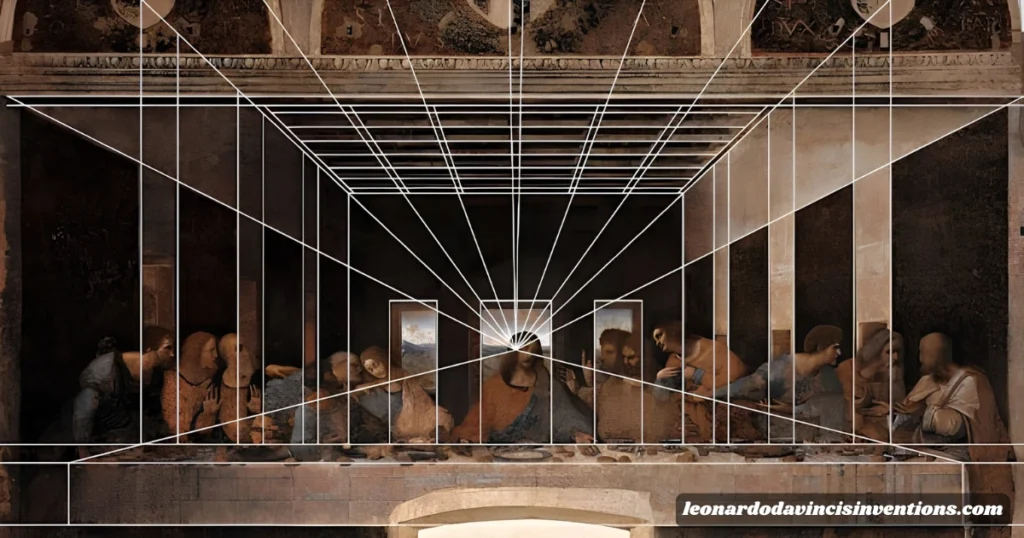
Most people know the scene. Jesus has just said, “One of you will betray me.” The twelve apostles react in four clusters of three — a compositional rhythm Leonardo borrowed from the tempo of music.
Judas clutches a small bag of silver. Peter holds a knife. John leans away. Everyone has a version of this story in their head before they walk in.
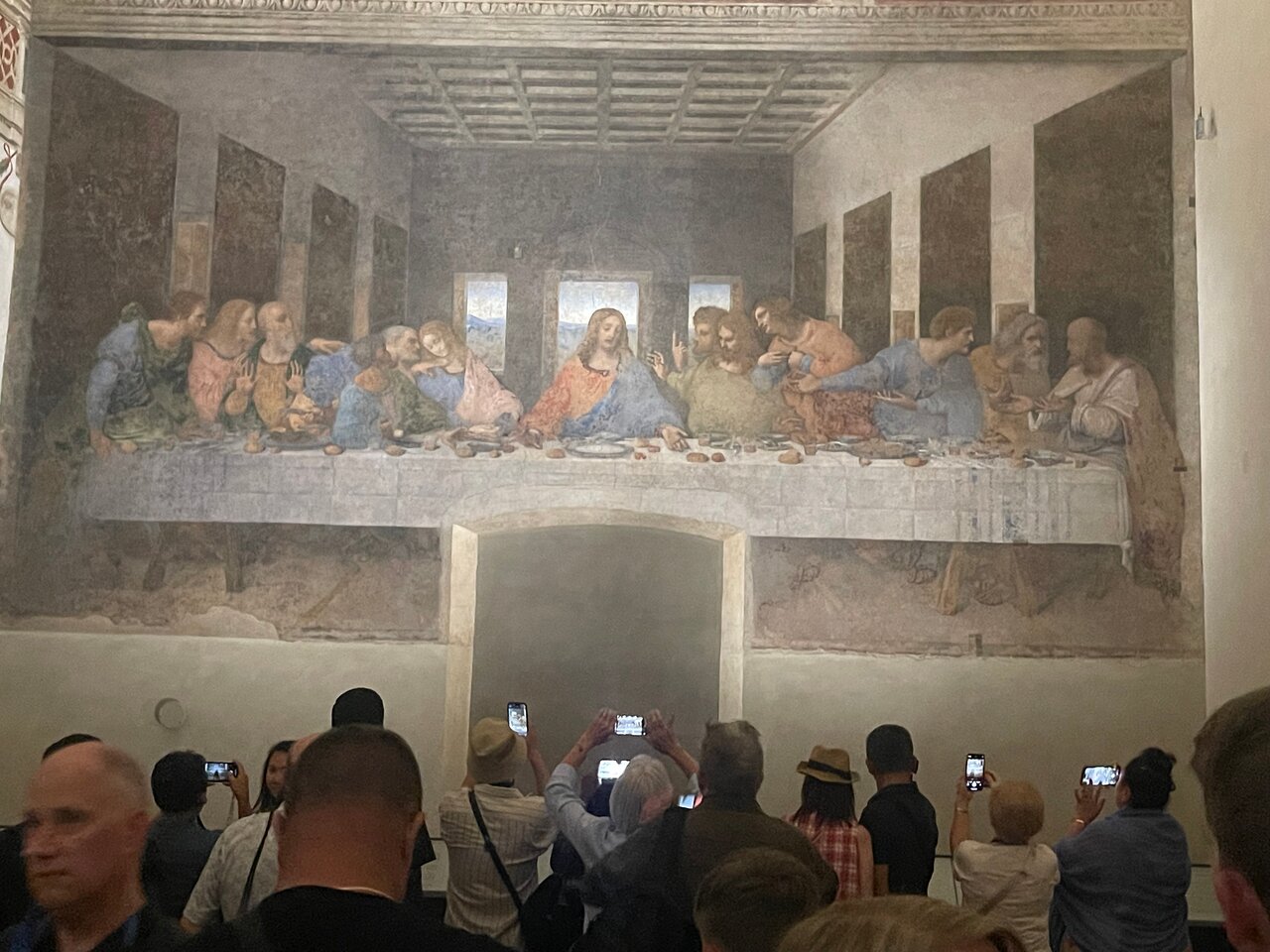
Here's what they don't tell you: Leonardo painted the room in the fresco to be a continuation of the actual refectory it hangs in. The vanishing point of the perspective — the single dot where every line of the ceiling and walls converges — sits exactly at Christ's right temple.
Stand in the center of the room, look up, and the painted coffered ceiling above the apostles becomes the extension of the real one above your head. For the Dominican friars who ate their silent meals in that room for four hundred years, Jesus was their thirteenth dinner companion. Every night.
That's the detail. The painting isn't a picture of the Last Supper. It's an architectural illusion designed to make one specific room, in one specific city, feel like the room where Christ ate his last meal.
You can't get that from a book. You can't get it from a screen. You can only get it by standing on the tiled floor of Santa Maria delle Grazie and letting your eyes do the math.
Seeing this detail in person changes everything. Discover how visitors experience the Last Supper in Milan through an expert context that reveals its hidden meaning.
What Leonardo Was Actually Painting — And Why It Still Matters
Art historians spend careers arguing about the theological reading of the fresco. Is this the moment of betrayal, or the institution of the Eucharist? Why does John look like he's about to fall asleep on Peter's shoulder? (Dan Brown's famous answer — that John is Mary Magdalene — is great fiction and bad art history; every apostle in Renaissance painting was rendered with the same youthful softness when he represented the “beloved disciple.”)
The richer reading is about human psychology. Leonardo wasn't interested in the symbolic Christ of medieval art, floating above his disciples with a gold halo.
He wanted the half-second after the accusation lands — where twelve men realize one of them is guilty and each silently asks, “Is it me?” Philip presses his hands to his chest in open disbelief. Bartholomew has half-risen from the bench. Thomas points skyward with the same finger he'll later use to probe Christ's wounds.
It's a study in shock, distributed across thirteen faces. Nothing in Western art had done this before. Leonardo essentially invented the modern ensemble scene — the idea that you could tell a story by reading the micro-expressions of a group reacting to the same information at once. Every heist-movie reveal and every courtroom drama since owes something to this wall.
Where to See The Last Supper in Milan (And How the Access Actually Works)
The painting lives where it has always lived: in the refectory of the Dominican convent adjoining the church of Santa Maria delle Grazie, at Piazza Santa Maria delle Grazie 2.
It's a fifteen-minute walk from the Duomo, or three stops on the red line (M1) from Cadorna FN to Conciliazione. The complex is a UNESCO World Heritage Site — not just the painting, but the entire convent, including the church's famous tribune designed by Donato Bramante.
Here's where most visitors get stuck. Tickets are released in waves by the official ticketing concessionaire, and the Last Supper tickets official website (cenacolovinciano.org) opens reservations roughly two to three months in advance.
The instant a window opens, a massive chunk of the inventory is absorbed by tour operators, authorized resellers, and school group bookings. What's left sells out in hours — sometimes minutes — for peak-season slots. If you're trying to secure tickets to see the Last Supper six weeks before your trip, the standalone entry option is almost always gone.
This is why guided-tour access exists as a parallel channel. Authorized operators hold reserved slots that don't go through the general public release, which means even when the official site shows a sold-out calendar, tickets to see the Last Supper in Milan, Italy, are often still available through guided experiences.
They cost more than bare entry — typically €45 to €75, versus €15 plus booking fee — but for most international visitors who can't afford to rebook their entire Milan itinerary around a single 15-minute slot, it's the practical option. And in a strange way, it's the better one, because the painting rewards context.
Experience This in Milan
This isn’t just something you read about — it’s something you feel standing inside that room. Knowing what to look for before you arrive transforms 15 minutes into something that stays with you.
Explore Guided Last Supper Experiences In Milan >>What It Actually Feels Like Standing in the Refectory
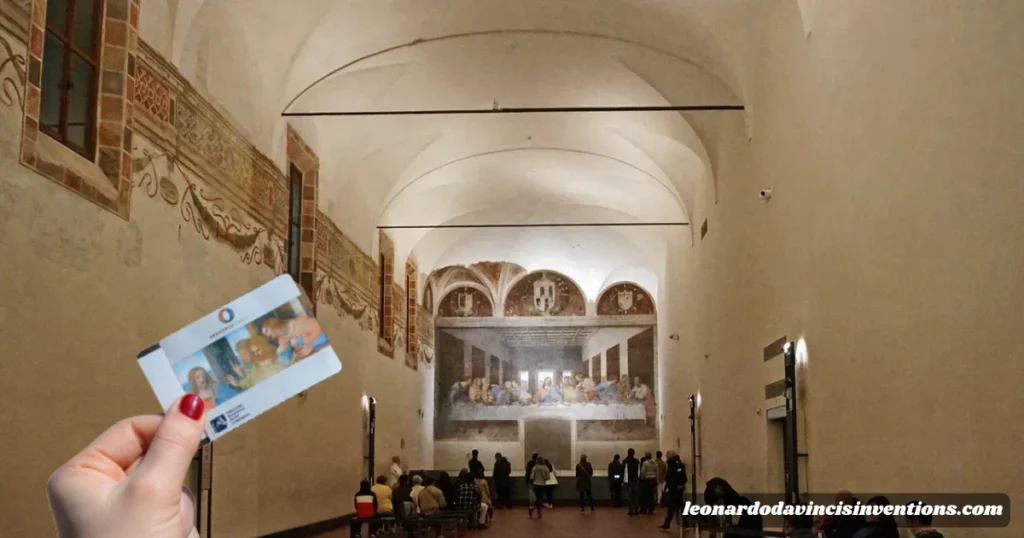
You arrive fifteen minutes before your slot. A staff member checks your booking against a printed manifest — miss your time, and you don't get in.
You're led from the courtyard into the first of two airlock chambers, a small room with automatic doors that close behind you before the next set opens. The air pressure changes slightly. A hush falls — the awareness that something rare is about to happen, and you only have a quarter of an hour to absorb it.
Then the second door opens, and you're inside the refectory.
The first thing that hits is the scale. Photographs flatten it. The painting fills an entire wall, fifteen feet high and twenty-nine feet wide, positioned just above eye level so Christ and the apostles appear to sit at a table slightly elevated above yours.
The second thing is the light — soft, cool, carefully filtered to protect the pigments. And the third, the thing nobody prepares you for, is the silence. Thirty people in a room, and you can hear someone's shoe shift on the tile. Phones are down. The painting does the talking.
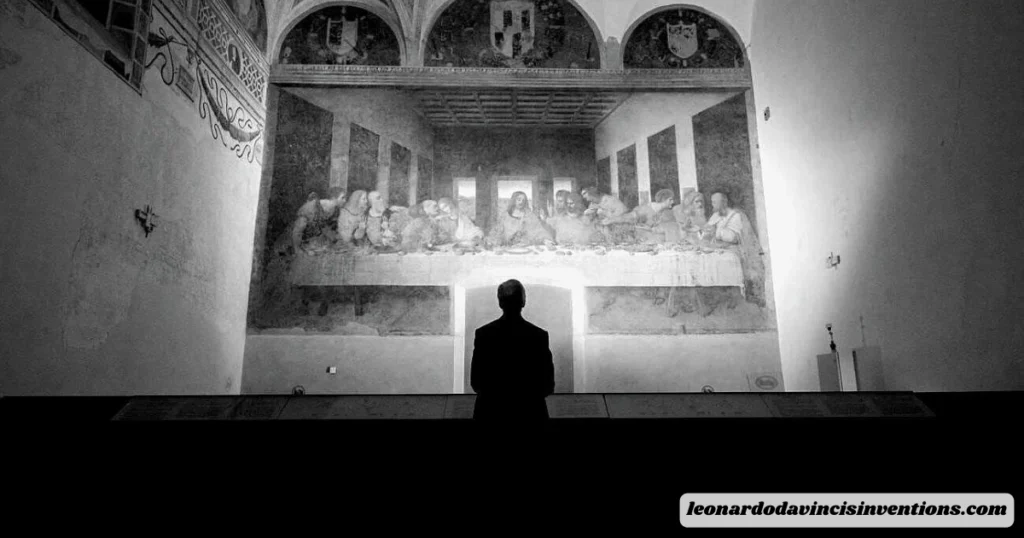
On the opposite wall, usually ignored, is Giovanni Donato da Montorfano's Crucifixion from 1495 — a vivid, crowded, completely conventional fresco painted at exactly the same time as Leonardo's. Montorfano's painting is technically intact and emotionally flat. Leonardo's is half-destroyed and alive. You feel the difference in your chest.
It's completely different standing in front of it. See how small-group visits to the Last Supper work and why timing matters.
Fifteen minutes go faster than you expect. A soft chime signals the end of the session. The doors open behind you, and you walk back out through the airlocks into the courtyard, blinking. Most people stand outside for a minute or two, not saying anything. It's that kind of experience.
How to Plan Your Visit (And What to Do When It Says “Sold Out”)
If you're planning months ahead, the calmest route is the official portal. Reservations open roughly 90 to 120 days before the entry date and can be booked in fifteen-minute windows from Tuesday through Sunday (the museum closes on Mondays and certain Italian holidays).
Entry runs from 8:15 AM to 6:45 PM. The earliest and latest slots tend to linger longest, because tour buses book mid-morning and early afternoon.
If you're planning within the next four to six weeks, assume the official site will show zero availability, and don't let that end your plans. This is the most common scenario, and it's the one most travelers misread as “I can't see the painting on this trip.”
That's almost never true. Authorized guided experiences are the standard workaround and remain one of the best ways for visitors with a shorter planning horizon to see the Last Supper in Milan. These tours typically package the refectory visit with a walking tour of the adjoining church and, sometimes, a broader Leonardo-themed itinerary through the Sforza Castle or the nearby Corso Magenta.
For last-minute travelers — the ones searching for Last Supper tickets last minute, the week of their trip — the options narrow but don't disappear. Cancellations happen. Some tour operators hold a small pool of flexible slots for bookings within seven days.
What is hopeless: showing up at Santa Maria delle Grazie without a booking and hoping to walk in. They physically will not let you past the first chamber without a timed reservation attached to your name and passport.
How to Experience the Last Supper Without Missing the Details
Access is limited, and most visitors only get a few minutes inside. The difference is having the right context before you walk in.
- Skip-the-line timed entry
- Small-group guided access
- Expert explanation of key details
A Few Practical Things Most Guides Don't Mention
Photography without flash is technically allowed, but the room is dim, and most phone photos come out muddy. A better use of your fifteen minutes: look. Really look. Start at the vanishing point, then work outward through the triads.
Find Judas (second from the left of Christ, clutching the bag, face in shadow). Notice that the feet of the apostles — cut off when a doorway was punched through the lower half of the fresco in 1652 — are gone forever. The painting you're looking at is a survivor, not an original.
Bring a passport or government ID; it's sometimes checked against the booking. Arrive twenty minutes before your slot — security processing has slowed in recent years. Bags larger than a small daypack must be checked at the coat check, which closes 10 minutes after your entry time.
And if you have the time, go to the church next door before or after. Santa Maria delle Grazie itself is quietly extraordinary — Bramante's apse is one of the most important pieces of High Renaissance architecture in Lombardy, and it sits there, largely unvisited, while the crowd files in and out of the refectory twenty feet away.
Most people who travel across continents to see the Leonardo never walk into the church. It's worth the fifteen minutes.
If you're already planning to visit, take a look at the current Last Supper experience options before availability runs out.
The Real Reason It's Worth the Effort
There's a version of tourism about checking things off a list, and another about having your sense of scale adjusted. The Last Supper is the second kind. It's not the biggest painting you'll ever see, or the most colorful, or the most intact.
It's something stranger: a 500-year-old argument about what painting could be, delivered in a half-ruined state, in a room engineered to keep it alive for another century. Standing in front of it, you're not just looking at a picture. You're looking at the reason every ensemble scene in Western art looks the way it does.
Getting in is hard by design, not by accident. The scarcity is the preservation strategy. And once you understand that — once you accept that securing Last Supper Milan tickets will take either three months of patience or the right guided channel — the whole experience reframes.
You're not fighting the museum. You're participating in what keeps the painting alive long enough for somebody's grandchild to stand in the same refectory, in the same silence, and feel the same shift in the chest when that second door opens.
Fifteen minutes. One wall. Five hundred years of argument and accident and care. It's worth crossing the city, and sometimes the continent, to stand inside a room engineered half a millennium ago to feel exactly like the room where it all happened.
Travel Essentials for Visiting Milan for the First Time
Preparing for a visit to Milan often comes down to a few small details that can make long museum days, historic walking routes, and city exploration significantly more comfortable.
Comfortable Walking Shoes
Milan’s major landmarks are often best experienced on foot, with visitors covering long distances between museums, churches, and historic streets. Supportive shoes can make a full day of exploration far more comfortable → explore comfortable walking shoes for long city days
Portable Power Bank
Navigation, photography, and digital tickets can quickly drain battery life during a full day in the city. A compact power bank helps avoid interruptions, with many visitors choosing lightweight options → view reliable portable chargers
Lightweight Day Backpack
Carrying essentials like water, tickets, and small personal items becomes easier with a compact backpack designed for daily use. Many visitors prefer lightweight designs that balance comfort and accessibility →
see lightweight day backpacks for travel

FAQs about the Last Supper tickets, Milan, Italy
The standard ticket to see The Last Supper in Milan costs about €15 for full admission, with reduced tickets around €2 and some free-entry categories. Guided tours and packages are significantly more expensive, often starting from €70 or more, depending on the experience.
Getting last-minute tickets is difficult, but possible through guided tours, third-party resellers, or checking for cancellations. Official tickets sell out quickly, so tours often remain the only realistic option when standard time slots are gone. Booking early or checking frequently for released spots improves your chances.
Yes, tickets are mandatory to see the Last Supper. Entry is strictly controlled through pre-booked time slots, and every visitor—including children—must have a reservation in advance. Walk-in access is not permitted due to conservation limits.
No, you cannot simply queue to enter. The museum operates on a strict reservation-only system with timed entry, meaning that without a ticket, you will not be allowed in—even if you arrive early or wait outside.
Tickets are hard to get because access is tightly limited to small groups (around 40 visitors) for just 15 minutes per visit to protect the fragile artwork. Combined with global demand and tickets released only every few months, availability disappears quickly.
Yes, visiting the Last Supper is widely considered worthwhile for its historical significance, artistic innovation, and emotional impact. Despite the short viewing time, it remains one of the most iconic Renaissance artworks and a once-in-a-lifetime cultural experience for many visitors.
Related Post You May Like


Disclosure: This page may contain affiliate links. If you choose an experience through them, it helps support the site at no extra cost to you.
 Leonardo Bianchi is the founder of Leonardo da Vinci Inventions & Experiences, a cultural travel guide helping visitors explore Leonardo da Vinci’s art, inventions, and legacy across Italy and Paris.