
(Last updated: Sep 2026)
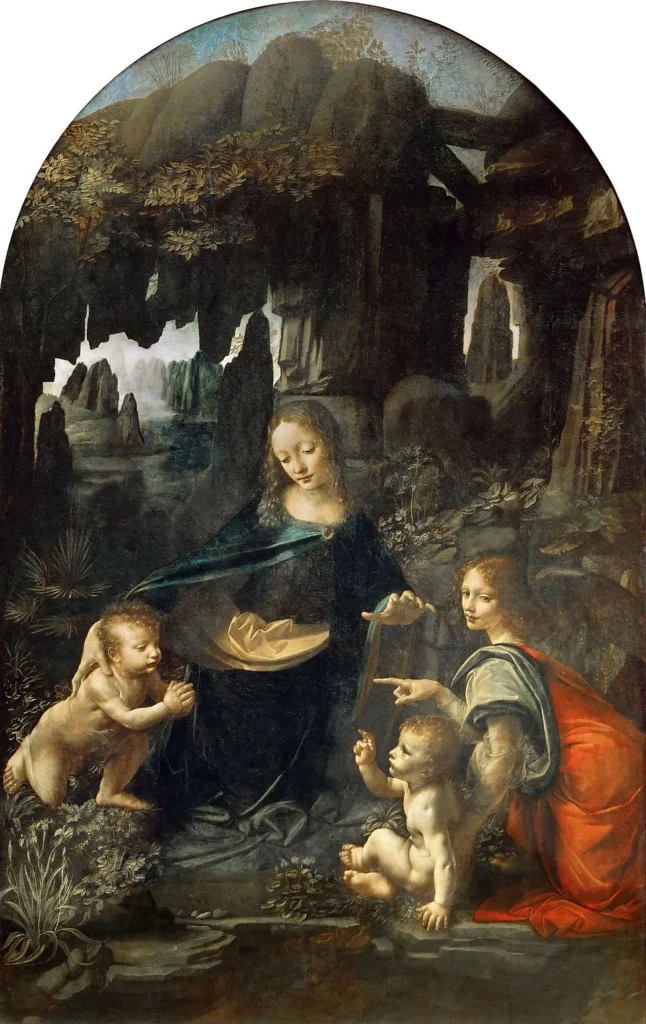
The Virgin of the Rocks by Leonardo da Vinci is one of the most quietly unsettling masterpieces to survive the Renaissance. It was painted not once, but twice, decades apart, and the two versions still puzzle art historians, theologians, and travelers today.
Long before it became a fixture of art history textbooks, the painting sat at the center of a legal dispute between Leonardo and the religious brotherhood that commissioned it. That disagreement is part of the reason two versions exist at all, one now in Paris and the other in London.
The painting also matters because of when it was made. Leonardo produced the first version early in his career, while he was still building the reputation that would later carry him to Milan's court, Florence's guild halls, and eventually the French royal court.
Seeing how fully formed his technique already was in the 1480s helps explain why patrons across Italy and, later, France competed for his attention. For anyone planning a Renaissance-focused trip to Paris, this painting is a natural anchor point, since it sits inside the same museum as the Mona Lisa but rewards a much slower, quieter kind of attention.
This post is all about the Virgin of the Rocks by Leonardo da Vinci, from why Leonardo painted it twice to where each version is housed today and what to notice when you see one in person.
What Is the Virgin of the Rocks?
The Virgin of the Rocks is a religious painting by Leonardo da Vinci showing the Virgin Mary, the infant Christ, the infant John the Baptist, and an angel gathered inside a rocky grotto. Leonardo painted two versions of the scene, also known as the Madonna of the Rocks, one displayed at the Louvre in Paris and the other at the National Gallery in London.
The Artistic Genius Behind the Virgin of the Rocks
A Commission Wrapped in Controversy
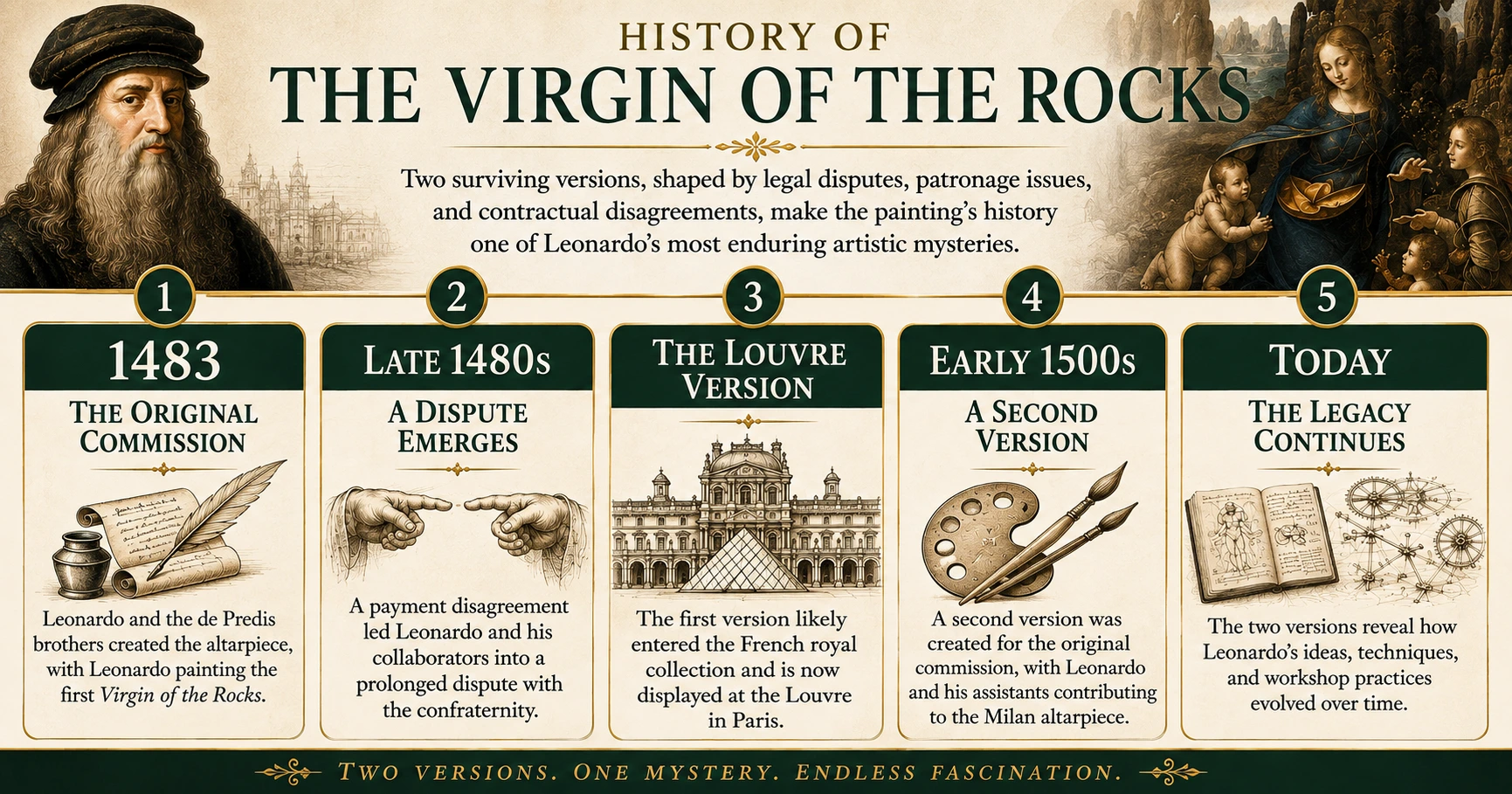
Leonardo da Vinci received the commission for the Virgin of the Rocks in 1483, shortly after arriving in Milan. The patron was the Confraternity of the Immaculate Conception, a religious brotherhood that wanted a large altarpiece for its chapel inside the church of San Francesco Grande. The contract was precise about size, subject matter, and even the gold leaf to be used, which makes what happened next all the more surprising.
Leonardo delivered a composition that broke from the brief in almost every way that mattered artistically. Rather than a stiff, symbolic arrangement of saintly figures, he painted something that felt like a real moment frozen inside a cave, lit from a hidden source and wrapped in atmosphere.
The confraternity apparently expected something closer to convention, and a dispute over payment dragged on for years. Many historians believe this dispute is the reason a second version of the painting was eventually produced.
Surviving legal documents show the disagreement was not a minor haggle. Leonardo and his collaborators argued that the agreed fee undervalued the work, and the case dragged through Milanese courts on and off for roughly two decades before a resolution was reached in the early 1500s.
That timeline overlaps almost exactly with the years scholars assign to the second version of the painting, which has led many historians to read the London canvas as the settlement piece, a replacement delivered once the financial dispute was finally resolved.
Sfumato and the Rocky Grotto Setting
The painting takes its name from its setting, a shadowy outcrop of rock where Mary, the infant Christ, the infant John the Baptist, and a kneeling angel are arranged in a pyramid of gazes and gestures. Leonardo used his signature technique of sfumato, a smoky blending of tone that removes hard outlines and lets forms emerge gradually from shadow.
The grotto itself is rendered with an almost scientific attention to geology and botany, reflecting Leonardo's lifelong habit of studying rocks, water, and plants as closely as he studied the human body.
That habit of observation is what separates the Virgin of the Rocks from earlier Renaissance devotional paintings. The rock formations are not a decorative background; they follow patterns Leonardo had actually studied in nature.
The result is a scene that feels less like a symbol and more like a place a viewer could step into, which is part of why the painting still draws close, patient looking centuries later.
Two Canvases, One Vision
The first version, now in the Louvre, is generally dated to around 1483 to 1486. A second version, now in the National Gallery in London, was completed later, likely with help from Leonardo's workshop, and is usually dated between 1495 and 1508.
The two paintings share the same basic composition, but subtle differences in gesture, lighting, and even the presence of halos and a cross set them apart.
Comparing the two side by side, even through photographs, is one of the more rewarding exercises in Renaissance art history. It shows how Leonardo revisited his own ideas over time, refining details rather than treating a finished composition as untouchable.
The figures themselves carry layers of symbolism that reward close reading. The angel, traditionally identified as Uriel, kneels beside the infant John the Baptist and points toward him, a gesture many art historians read as guiding the viewer's attention toward the child who will later baptize Christ.
Mary's hand hovers protectively above the infant Christ, who returns a blessing gesture toward John. Every figure in the grotto is connected by a chain of glances and gestures, which is part of why the composition feels unusually alive compared with more static altarpieces from the same period.
Why the Virgin of the Rocks Became Famous
A Painting Caught Between Two Cities
Part of what makes the Virgin of the Rocks so widely discussed is the unusual fact that it is a duplicate. Very few Leonardo compositions exist in two accepted versions, both largely attributed to his hand. That rarity alone has kept scholars debating the painting for more than a century, and it gives casual visitors a genuinely interesting question to chase: which version came first, and why does it matter?
The painting's fame also grew alongside Leonardo's broader reputation. As later works such as the Mona Lisa, the Last Supper, and the disputed Salvator Mundi made Leonardo the most recognizable name of the Renaissance, earlier works like the Madonna of the Rocks were reexamined with renewed interest.
Visitors who come to Paris for the Mona Lisa often discover the Virgin of the Rocks hanging nearby, and it frequently becomes the quieter, more contemplative highlight of the visit.
Madonna of the Rocks vs Virgin of the Rocks: Same Painting, Two Names
Readers researching this painting often come across two different titles, the Virgin of the Rocks and the Madonna of the Rocks, and wonder whether these refer to different works. They do not. Both names refer to the same composition and the same pair of paintings; the difference is simply a matter of translation and convention.
"Madonna" is the Italian word for the Virgin Mary, so Italian sources and some English-language texts favor Madonna of the Rocks, while most English-language museum labels, including those at the Louvre and the National Gallery, use Virgin of the Rocks. Knowing this in advance avoids confusion when searching museum archives or academic papers, since both terms refer to the same two paintings.
The Debate Over Which Version Came First
Art historians generally agree that the Louvre version was painted first, closer to the original 1483 commission, while the National Gallery version followed as part of the long-running payment dispute with the confraternity.
Some scholars have argued the opposite, and the exact division of labor between Leonardo and his assistants on the London canvas remains debated. This kind of open question is part of what keeps the painting relevant in scholarship rather than settled as a finished chapter of art history.
Standing in front of either painting is also a chance to see how a Renaissance workshop actually operated. Travelers who want the full context sometimes pair a museum visit with a guided Louvre tour that focuses on Leonardo's work, which places the Virgin of the Rocks alongside the Mona Lisa and helps explain how the two paintings fit into the same creative period.
Where to See the Virgin of the Rocks Today
The Louvre Version in Paris
The earlier version of the Virgin of the Rocks hangs in the Denon Wing of the Louvre in Paris, in the same rooms that house much of the museum's Italian Renaissance collection. It sits a short walk from the Mona Lisa, making it easy to see both in a single visit, though the crowds around each painting tend to be very different. Where the Mona Lisa draws a constant wall of visitors, the Virgin of the Rocks usually allows for a slower, closer look at Leonardo's brushwork and use of shadow.
Ready to Plan Your Visit?
Discover The Virgin of the Rocks on your way to the Mona Lisa with skip-the-line Louvre entry
See Louvre Tour OptionsBefore planning a visit, it helps to check each museum's current hours and ticketing rules directly, since both the Louvre and the National Gallery periodically adjust entry procedures for major works.
The National Gallery Version in London
The later version of the painting is on permanent display at the National Gallery in London, in the museum's Sainsbury Wing among other major Italian Renaissance works. This version is slightly brighter in palette and includes details, such as visible halos, that are absent from the Louvre canvas. Seeing both versions in person, even on separate trips, is the clearest way to understand how Leonardo's thinking about the composition changed over time.
What to Notice Up Close
Up close, both paintings reward attention to a few specific details: the interlocking gazes and hand gestures that guide the eye through the composition, the geological accuracy of the rock formations, and the soft transitions of sfumato around each figure's face. Museum lighting in both Paris and London is designed to preserve these subtle gradations, so it is worth viewing the painting from a few different distances rather than relying on a single glance from across the room.
It also helps to look at the plants growing through the rocks in the foreground. Botanists who have studied the Louvre version have identified several species accurately enough to name them, a level of precision that was unusual for religious painting at the time. This detail reflects Leonardo's broader habit of treating nature as a subject worthy of study for its own sake, not merely as a backdrop for a devotional scene.
Visitors who know to look for this often find it changes how they read the rest of the painting, since the same careful observation extends to the water pooling near the figures' feet and the layered rock strata behind them.
Exploring Leonardo da Vinci in Paris
Paris holds only one piece of Leonardo's story, but it is a significant one. Beyond the Virgin of the Rocks, the Louvre's collection includes the Mona Lisa and other works connected to Leonardo's final years in France, where he lived under the patronage of King Francis I.
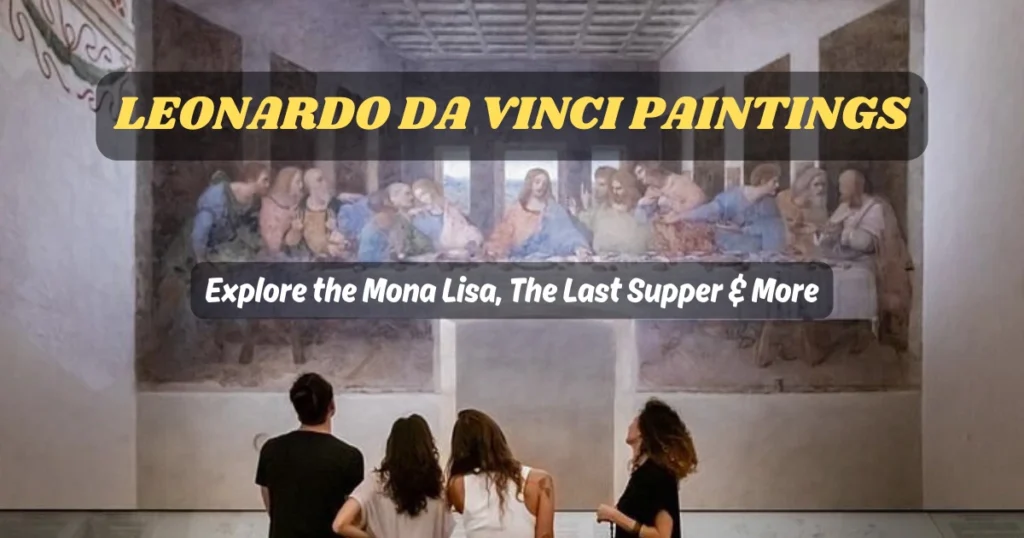
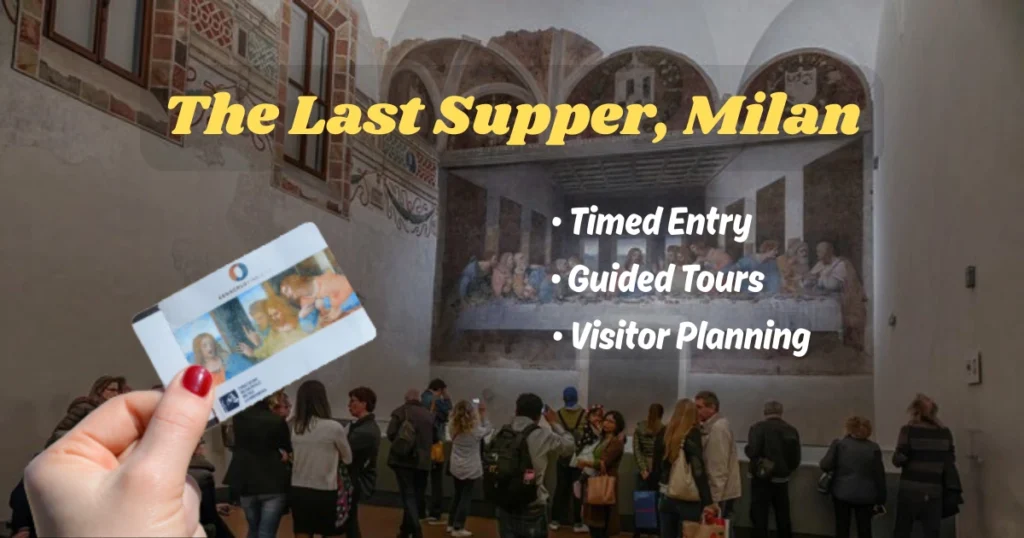
For travelers building a wider Leonardo itinerary, Milan is where the original Virgin of the Rocks commission began and where the Last Supper still covers a refectory wall.
From there, the trail continues through Florence, where Leonardo trained under Verrocchio and first developed his eye for anatomy, drapery, and landscape, and Venice, which holds some of his drawings and studies from a brief period of military consulting work.
Rome adds the broader context of the High Renaissance that Leonardo helped shape alongside contemporaries like Michelangelo and Raphael, while Paris closes the story, since it is where Leonardo spent his final years under the patronage of King Francis I and where two of his most studied paintings, the Virgin of the Rocks and the Mona Lisa, remain on public display today.
Together, these five cities trace the full arc of Leonardo's working life, from apprentice to court painter to elder statesman of Renaissance art. Visiting even two or three of them turns a single painting into a much fuller picture of how his ideas developed and traveled with him.
Final Thoughts
This post was all about the Virgin of the Rocks by Leonardo da Vinci, a painting that says as much about Leonardo's restless creative mind as it does about the religious scene it depicts. Few Renaissance works carry this much unresolved history, from a payment dispute that stretched across decades to a scholarly debate about authorship that continues today.
Seeing the painting in person, whether in the Louvre's galleries in Paris or the National Gallery's rooms in London, makes that history tangible. The soft shadows, the carefully studied rock formations, and the quiet interplay of glances between Mary, the two infants, and the angel are easier to appreciate up close than in any reproduction.
For anyone drawn to Leonardo's genius, standing in front of either version of the Virgin of the Rocks is one of the more direct ways to understand why his work has held its place at the center of art history for more than five hundred years.
Related Post You May Like

Disclosure: This page may contain affiliate links. If you book through them, we may earn a small commission at no extra cost to you. Learn more.
Free Leonardo Milan Travel Guide
Plan Your Leonardo Trip in Milan
A premium mini guidebook for smarter Milan planning, including the best ticket strategy, Leonardo map, and practical visitor advice.
Get the Free Guide
Download the guide and receive practical Milan planning tips by email.
Download the Free Guide >> Leonardo Bianchi is the founder of Leonardo da Vinci Inventions & Experiences, a cultural travel guide helping visitors explore Leonardo da Vinci’s art, inventions, and legacy across Italy and Paris.