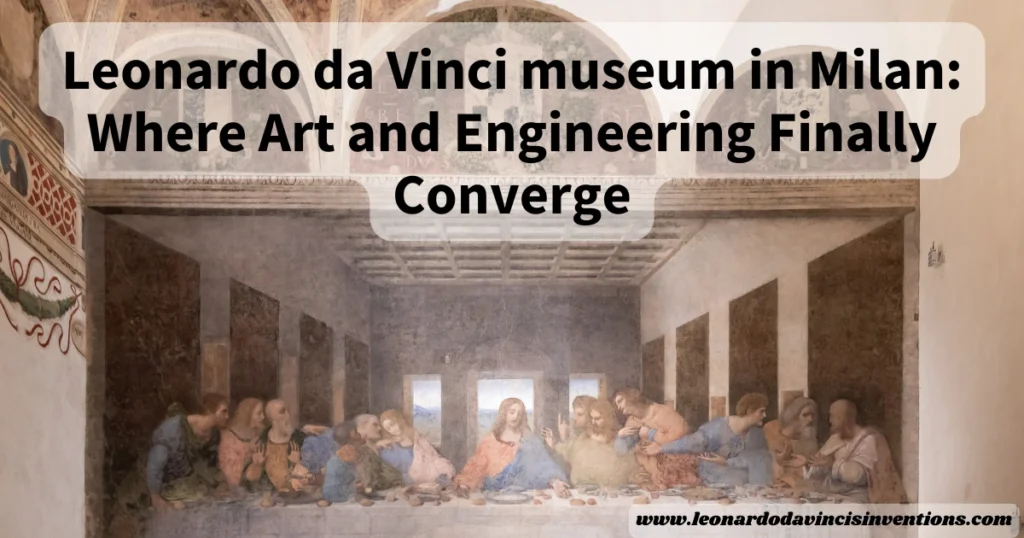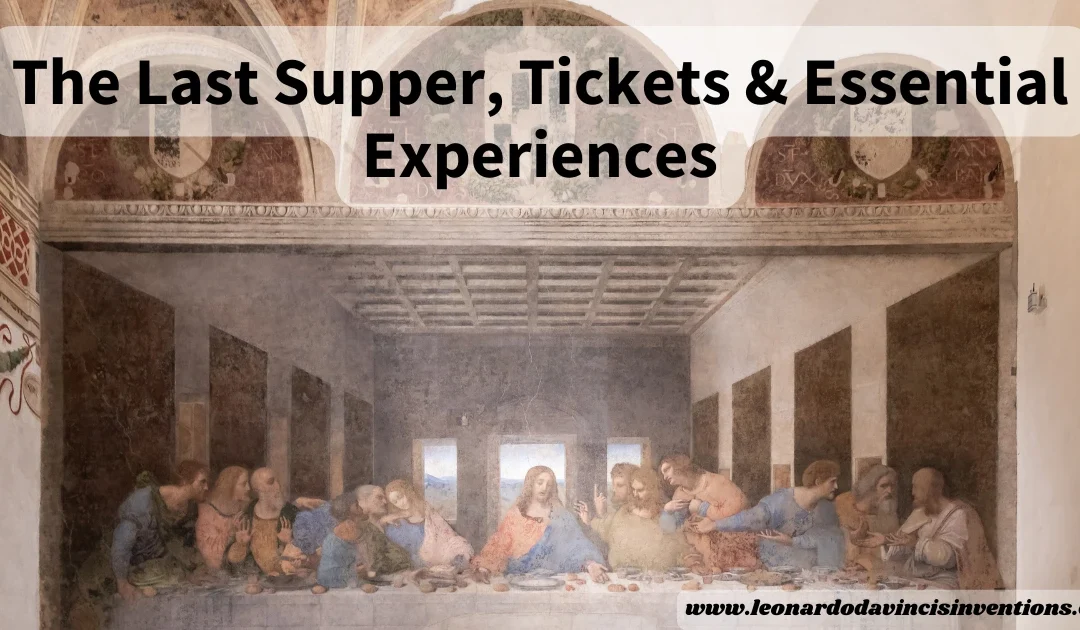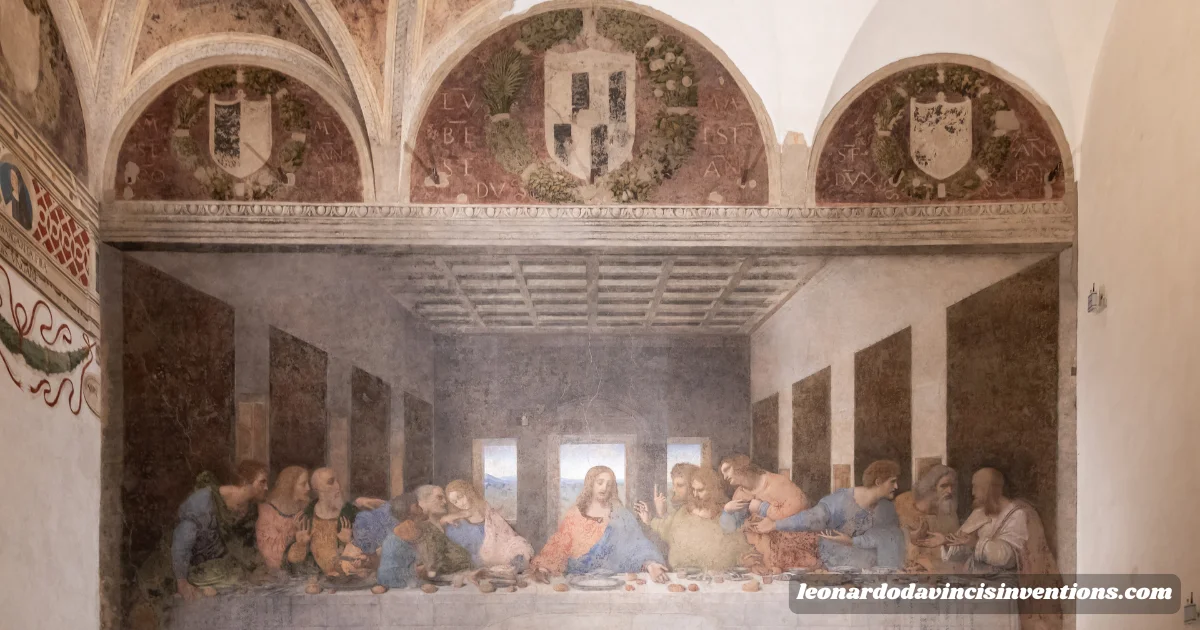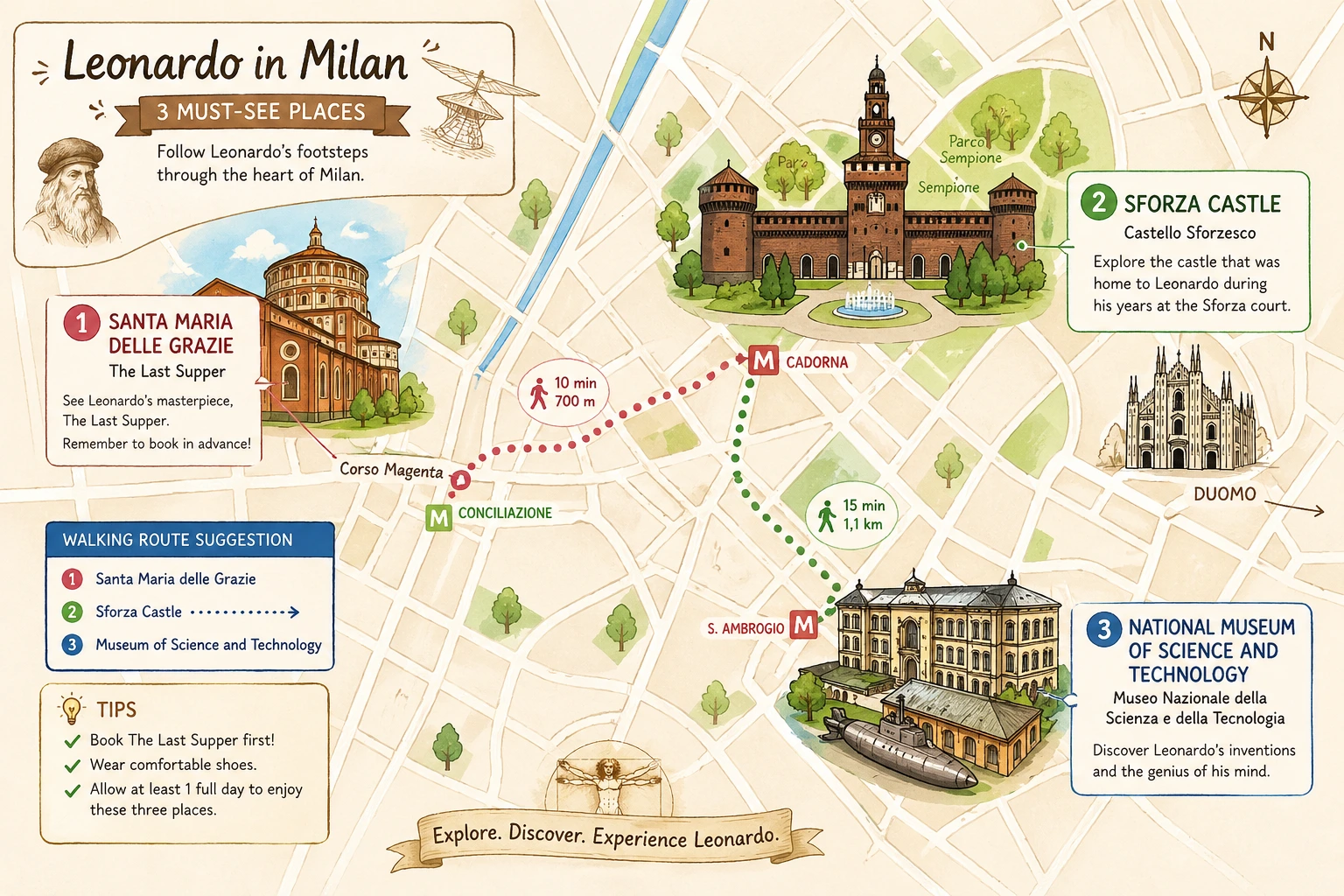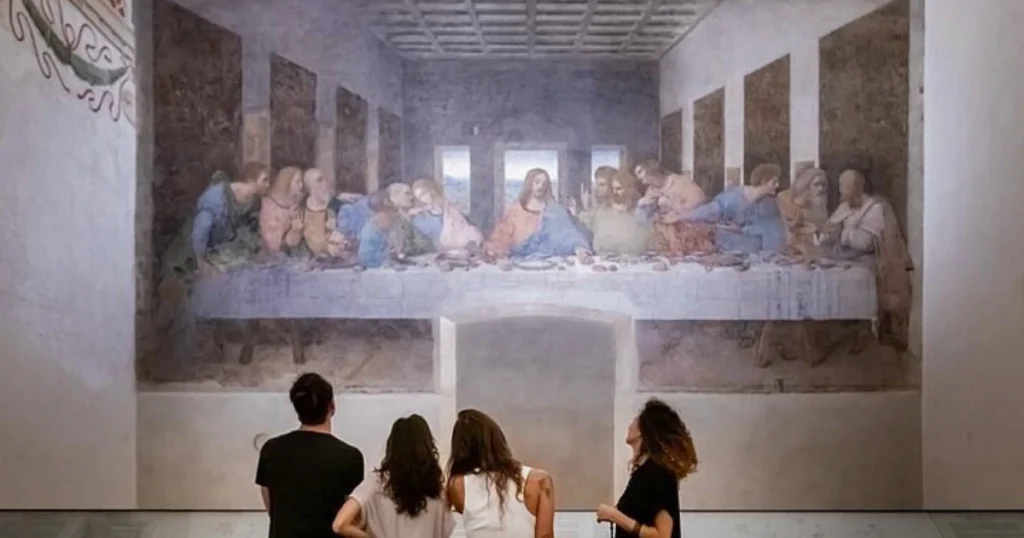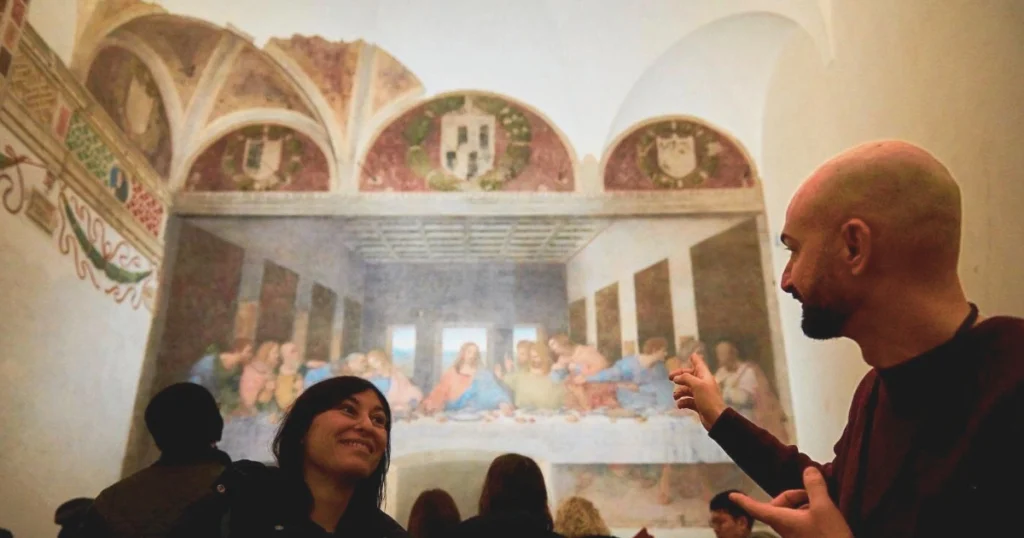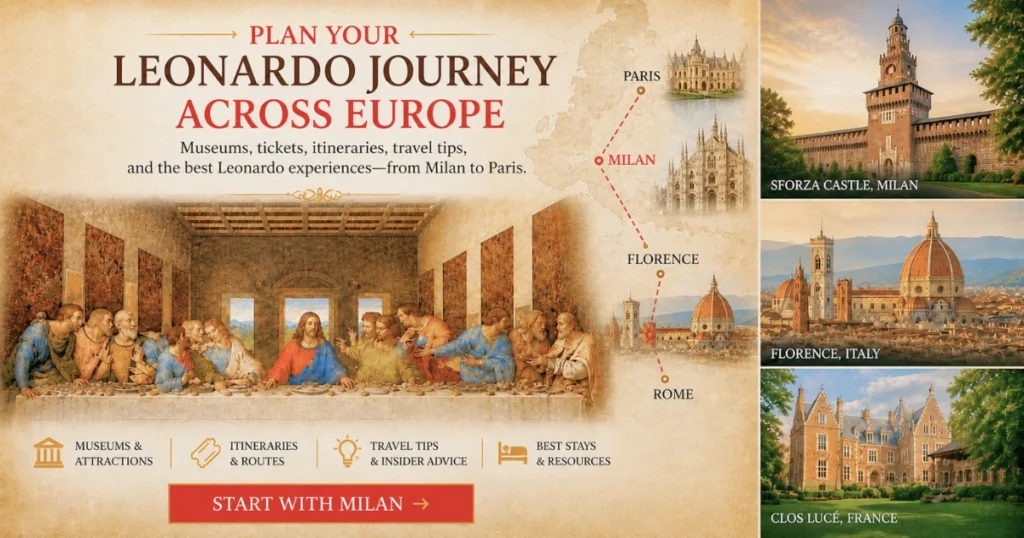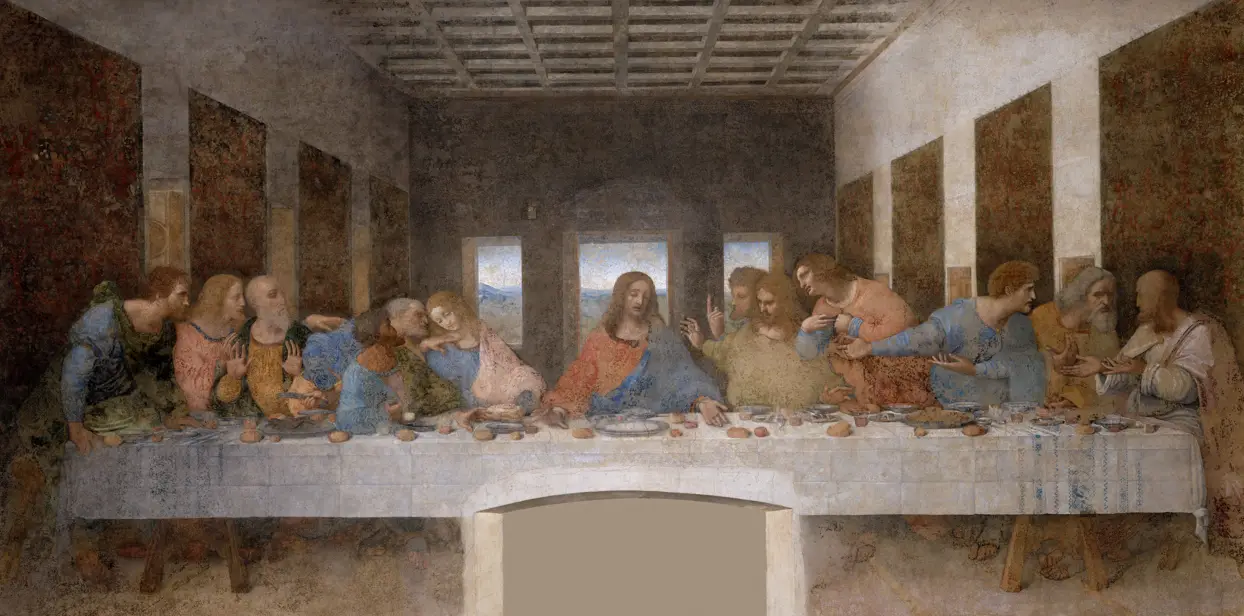
The Last Supper is the one Leonardo experience in Milan you can’t miss—and the hardest to access. Tickets are limited, timed, and often sell out weeks ahead.
Together, they form a single, connected story of Leonardo’s Milan. This guide shows you how to plan it right, choose the best ticket options, and experience it without missing what matters most.
The Last Supper: Visiting Reality and What You Need to Know
Let’s be direct: visiting The Last Supper is complicated. But it’s absolutely worth the effort.
Why The Last Supper Is Different
This isn’t a painting you can walk up to at any time. The mural’s current appearance is the result of extensive restoration campaigns, most notably the 21-year conservation project completed in 1999 by the Opificio delle Pietre Dure under the supervision of Italy’s Ministry of Cultural Heritage.
Here’s what that means in practice:
Visits are timed and limited. You’re allowed 15 minutes inside the room. Groups enter in controlled intervals. The number of daily visitors is capped.
Demand is extremely high. Tickets sell out weeks (sometimes months) in advance, especially during spring and summer. Last-minute availability is rare.
Booking independently requires planning. You need to check availability early and be flexible with your Milan dates if necessary.
This isn’t meant to discourage you. It’s meant to help you plan realistically.
The Booking Logic: What to Book First
If the Last Supper is a priority—and for most Leonardo travelers, it is—book it before you book anything else in Milan. Not after you book your hotel. Not after you book your flights. Before.
Choose your Milan dates based on Last Supper availability, not the other way around. This single decision eliminates most of the stress people experience when visiting.
Your Ticket Options: Independent vs Guided
You have two main options for visiting the Last Supper. Neither is “better”—they serve different needs.
Option 1: Timed-entry tickets (book directly)
Most affordable option
Requires checking availability early and monitoring for openings
No added context or explanation—just entry to the room
Best if you’ve already researched the painting and prefer exploring on your own
Option 2: Guided entry with context
Slightly more expensive
Includes guaranteed entry plus explanation before and after your viewing
Guides typically explain the composition, psychology, historical context, and technical challenges Leonardo faced
Best if you want meaning and story without doing extensive research beforehand, or if independent tickets are already sold out
How to Experience the Last Supper Without Missing the Details
Access is limited, and most visitors only get a few minutes inside.
The difference is having the right context before you walk in.
Both options give you the same 15 minutes inside the room. The difference is what happens before and after.
What the 15-Minute Visit Actually Feels Like
Fifteen minutes sounds short. And it is. But the experience is designed to be contemplative, not rushed.
You enter a quiet, climate-controlled room. The painting covers the far wall. You have space to look, to absorb, to move closer, to step back. There’s no jostling for position like at the Mona Lisa. The room can hold about 30 people at a time.
What surprises most visitors:
How much can you see in 15 minutes when the environment is calm
How the composition reveals itself gradually as your eyes adjust
How different it feels from seeing reproductions
For most visitors, guided entry is the best choice—especially if tickets are limited or this is your first visit.
Understanding The Last Supper Beyond the Image
What makes the Last Supper extraordinary isn’t scale or color—both have been compromised by time and Leonardo’s experimental painting technique. What endures is composition, psychology, and the moment Leonardo chose to depict.
Guides and pre-visit research often explain:
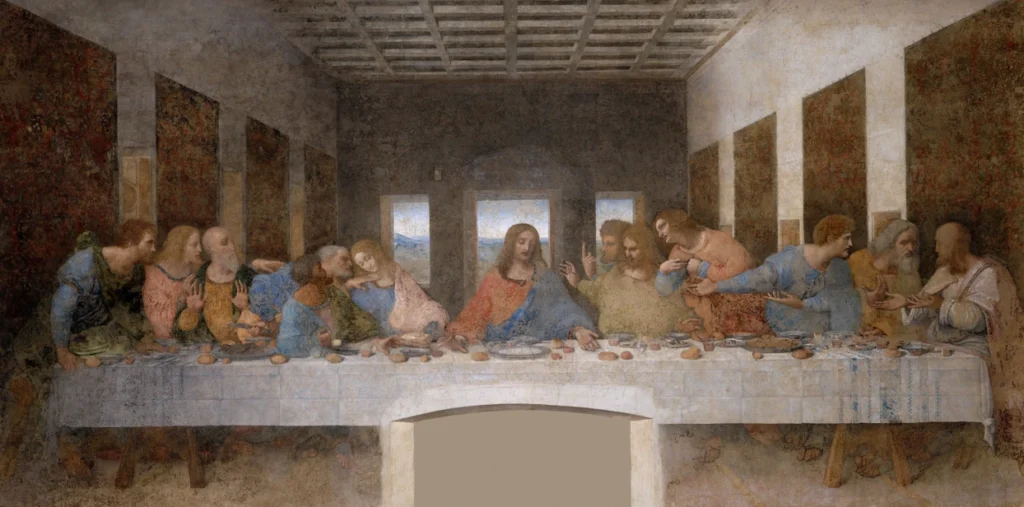
Why the moment matters. Leonardo didn’t paint a serene dinner. He painted the instant after Jesus says, “One of you will betray me.” The painting captures reaction—disbelief, anger, confusion, denial. Each apostle responds differently.
How geometry directs attention. The perspective lines converge on Jesus’s head. The architecture frames him. The composition creates a visual focal point that mirrors the narrative focal point.
How emotion is structured visually. Leonardo grouped the apostles into clusters of three, each group forming its own mini-drama. The painting is psychologically layered.
This context transforms a 15-minute viewing into something that stays with you. If you’re choosing between ticket-only and guided entry, consider whether you want to do this research yourself or have it explained on-site.
What Milan Is Best For (Leonardo Perspective)
Milan excels at two things for Leonardo-focused travelers:
The Last Supper. This is non-negotiable. If you care about Leonardo’s art, you eventually have to come to Milan. The painting is here, and only here, in the Convent of Santa Maria delle Grazie. No reproduction or photograph captures what it feels like to stand in that room.
Leonardo’s mature career and applied engineering. Milan Leonardo museum locations and exhibits tell the story of his working years—not just what he painted, but what he designed, built, and tested.
You’ll find material on his mechanical inventions, military projects, hydraulic studies, and urban planning ideas. This is Leonardo as a working engineer, not just a romantic genius.
Milan represents Leonardo at his most productive and practically engaged.
Leonardo da Vinci Museum in Milan: Options Beyond The Last Supper
Milan offers more than a single artwork. If you’re interested in Leonardo’s inventions, engineering, and applied thinking, Milan offers strong material across multiple Leonardo museums.
Science and Technology Museums
The Museo Nazionale Scienza e Tecnologia Leonardo da Vinci features permanent galleries dedicated to Leonardo, with reconstructed machines, annotated drawings, and interactive explanations. You’ll see models of his flying devices, mechanical systems, hydraulic studies, and military designs.
This Museo Leonardo da Vinci helps connect Leonardo’s art to his engineering mindset. The same observational skills he used to paint faces, he applied to water flow, wing mechanics, and gear ratios.
The museum is accessible, family-friendly, and doesn’t require advance booking during most of the year. Plan 2–3 hours if you want to explore the Leonardo galleries thoroughly.
Leonardo-Themed Exhibitions
Milan regularly hosts temporary exhibitions focused on Leonardo’s work, ranging from multimedia presentations to traveling collections of drawings and codices. These change seasonally, so check current listings if you’re interested in going deeper than the permanent collections.
Some of the Da Vinci Museum Milan exhibitions focus specifically on his Milan years—his projects for Duke Sforza, his urban planning ideas, and the engineering challenges he tackled during this period.
Walking Milan’s Leonardo-Era Districts
Some walking tours focus on Leonardo’s Milan years—his studio locations, his projects for the Duke, and the city’s role in his career. These are less common than art-focused tours, but worth seeking out if you want spatial and historical context for your experience at the Milan Leonardo da Vinci museum.
Your Best Milan Itineraries: 1-Day and 2-Day Leonardo Focus
1-Day Milan Leonardo Plan
Best for: Travelers passing through Milan who want the essential Leonardo experience without adding extra days.
Morning or afternoon (depending on your Last Supper time slot): The Last Supper. Check available time slots for your visit. Arrive 15 minutes early. Use the time before or after to explore the surrounding area of Santa Maria delle Grazie.
Remaining time: Visit the Museo Nazionale Scienza e Tecnologia Leonardo da Vinci or another Leonardo da Vinci museum in Milan. Spend 1–2 hours exploring mechanical models and invention displays.
Why this works: You see Leonardo’s most famous artwork and get a taste of his engineering mindset in a single day. The pacing is tight but manageable.
2-Day Milan Leonardo Plan
Best for: Travelers who want depth and time to absorb what they’re seeing.
Before or after: Walk through the Santa Maria delle Grazie neighborhood
Evening: Explore central Milan, settle into the city
Day 2 – Leonardo’s Engineering and Innovation
Morning: Leonardo da Vinci museum Milano visit—Museo Nazionale Scienza e Tecnologia (2–3 hours)
Afternoon: Additional Leonardo museum exhibit (if available) or broader Milan exploration
Optional: Leonardo-focused walking tour covering his studio locations and Duke Sforza’s Milan
If You Want to Experience Milan in Context
Planning a Leonardo-focused day in Milan often means moving carefully between sites — from Santa Maria delle Grazie to the Duomo and onward through the historic center.
Seen separately, each landmark tells part of the story. Viewed together, they reveal how Milan functioned during Leonardo’s years at court.
Experiencing these places within a single, connected narrative can make the city feel less like a checklist and more like a coherent chapter in his life.
Follow Leonardo Through Milan’s Historic Core
Experience Leonardo’s Milan in one seamless tour—The Last Supper and Sforza Castle, expertly guided.
Your art centerpiece. If Florence is your invention and context focus, Milan becomes your masterpiece focus. The Last Supper is the reason you add Milan to a Leonardo itinerary—everything else at the Leonardo da Vinci museum Milan locations supports or complements it.
The middle stop in a Florence → Milan → Paris route. This is one of the most common Leonardo travel patterns. Florence gives you the Renaissance context and inventions. Milan gives you the Last Supper and a mature career. Paris gives you the Mona Lisa and modern fame.
A standalone 1–2 day addition. Milan is well-connected by train to Florence (2 hours), Venice (2.5 hours), and other northern Italian cities. You can add Milan as a focused side trip without restructuring your entire itinerary.
Most Common Multi-City Combinations
Florence + Milan (3–4 days total): The strongest short route for Leonardo travelers. Inventions and context in Florence; The Last Supper and mature work in Milan.
Milan + Paris (4–5 days total): The two-masterpiece route. The Last Supper and the Mona Lisa, plus museum exhibits in both cities.
Florence + Milan + Paris (7+ days total): The full Leonardo circuit across invention, masterpiece, and legacy.
Milan anchors these itineraries because the Last Supper is irreplaceable. Everything else in a Leonardo trip is flexible—Milan is not.
Practical Tips for Milan Leonardo Travelers
Book The Last Supper first, before anything else. This cannot be emphasized enough. Availability determines your Milan dates, not the other way around.
Choose guided entry if it’s your first visit. The 15-minute time limit makes context especially valuable. Guides explain what to look for before you enter, which maximizes what you absorb during your brief viewing.
Balance art with invention-focused museums. If you’re spending two days in Milan, dedicate one to the Last Supper and one to a Leonardo da Vinci museum in Milan focused on engineering. The variety keeps the experience engaging.
Don’t rush. Milan’s Leonardo experience is intentionally slow and contemplative. Resist the urge to pack too much into one day. The Last Supper deserves space around it—time to arrive calm, time to absorb, time to reflect afterward.
Morning visits are often quieter. If you have flexibility in choosing your Last Supper time slot, early-morning entries tend to feel less hurried than late-afternoon ones.
Final Thought
This post was all about the Leonardo da Vinci museum in Milan — and why it deserves a top spot on every traveler’s and history lover’s itinerary.
How long should visitors spend at the Leonardo da Vinci Museum in Milan?
Most visitors spend about 2–4 hours exploring the Museo Nazionale Scienza e Tecnologia Leonardo da Vinci, with some choosing a shorter 1.5–2.5 hour visit for highlights or up to 4+ hours for interactive exhibits and workshops.
Where is the Da Vinci painting in Milan located?
Leonardo’s famous mural, The Last Supper, is displayed on the refectory wall of Santa Maria delle Grazie church in Milan, where visitors can view the masterpiece for 15 minutes on a timed basis.
What Leonardo da Vinci-related attractions are there to see in Milan?
In Milan, you can visit Leonardo-related sites, including The Last Supper at Santa Maria delle Grazie, the Museo Nazionale Scienza e Tecnologia Leonardo da Vinci, which features models of his inventions, and the interactive Leonardo3 Museum, devoted entirely to his work and machines.
Where is the museum of Leonardo da Vinci in Milan located?
The Museo Nazionale Scienza e Tecnologia Leonardo da Vinci is located at Via San Vittore 21 in Milan, inside a historic former monastery, and is Italy’s largest science and technology museum.
Is Sforza Castle worth visiting?
Yes — Sforza Castle (Castello Sforzesco) is widely considered worth visiting for its historic fortress setting, multiple affordable museums and art collections (including Renaissance works), and its pleasant park surroundings.
What other must-see Milan museums are linked to Leonardo da Vinci?
Other notable museums connected to Leonardo’s legacy include the interactive Leonardo3 Museum in Piazza della Scala and the nearby Pinacoteca Ambrosiana, which houses works and manuscripts by Renaissance masters, including da Vinci.
Leonardo da Vinci in Florence was not yet the universally celebrated master most people associate with his name today. His greatest fame is usually tied to Milan, home of The Last Supper, or to Paris, where the Mona Lisa now resides.
But Florence may be the most important city for understanding how Leonardo’s mind was formed.
Florence gave Leonardo something no single painting or invention could: a culture obsessed with geometry, anatomy, mechanics, art, and observation. A city where workshops trained apprentices to think across disciplines. Where patrons like the Medici family funded experimentation, not just decoration.
This post is all about the historical facts of Leonardo da Vinci in Florence, where his early artistic training, engineering ideas, and Renaissance mindset first took shape.
What Florence Is Best For (Leonardo Perspective)
Florence excels at three things for Leonardo-focused travelers:
Focus Area
What You’ll Experience
Why It Matters
Invention Museums with Working Models
Working reconstructions of bridges, flying machines, gears, and hydraulic systems.
Makes his engineering ideas visual, practical, and easy to grasp.
Renaissance Cultural Context
Insight into workshop training, like Verrocchio’s interdisciplinary studio.
Explains the roots of Leonardo’s art–science mindset.
Access to His Birthplace (Vinci & Anchiano)
Easy day access to Vinci and Anchiano from Florence.
Insight into workshop training, like Verrocchio’s interdisciplinary studio.
Florence doesn’t just show what Leonardo created—it shows why his thinking was different.
What to See in Florence: Leonardo Highlights
Leonardo da Vinci Museum in Florence Options
Florence is home to the Leonardo da Vinci Museum, dedicated to his mechanical and engineering ideas. These aren’t dusty displays. They’re designed to help you understand how Leonardo’s mind connected observation to design.
What makes these exhibits effective:
Physical reconstructions instead of only drawings
Clear explanations of how ideas worked (and why some didn’t)
Focus on curiosity and experimentation, not hero worship
Common themes you’ll encounter:
Bridge designs and structural engineering
Flying machines (the helicopter, aerial screw, and gliders)
Military inventions (the tank, siege machines, and defensive systems)
Gears, pulleys, and mechanical transmission systems
These museums are accessible even if you have no engineering background. The goal is to see Leonardo as a problem-solver, not just memorize facts.
Most Leonardo da Vinci Museum Florence tickets can be purchased on-site or in advance online. Unlike the Last Supper in Milan, timed entry is rare, though booking ahead during peak season (April–October) helps avoid lines.
Leonardo da Vinci Paintings in Florence
While Leonardo in Florence isn’t primarily about finished paintings, you’ll encounter works by his teacher Verrocchio and contemporaries like Raphael at the Uffizi. Leonardo da Vinci’s paintings in Florence are limited—he completed a few works here, and most were later moved to other collections.
But the artistic tradition he grew up in is everywhere: perspective studies, anatomical accuracy, and light modeling techniques that defined the period.
Walking through these galleries shows you what Leonardo was reacting to, building on, and eventually surpassing.
Leonardo da Vinci House in Florence
There is no preserved “Leonardo da Vinci house in Florence” in the traditional sense. Leonardo lived and worked in various locations in Florence during his years there, primarily in workshop settings such as Verrocchio’s studio. None of these sites functions as a house museum today.
However, his actual birthplace—a stone farmhouse in Anchiano, near Vinci—still stands and is open to visitors.
How far is Vinci from Florence? About 50 kilometers (30 miles), roughly an hour by car or 90 minutes by regional train and bus. Florence makes the most practical base for visiting this authentic Leonardo location.
Renaissance Walking Tours
Florence rewards context. A good Italian Renaissance walking tour doesn’t just show you buildings—it explains how Florence’s guild system, political structure, and patronage networks created an environment where someone like Leonardo could thrive.
Guided tours are most helpful when you want a framework quickly. They’re less essential if you enjoy self-directed exploration and reading museum labels at your own pace.
Practical Visiting Realities: Crowds, Pacing, and Museum Fatigue
Florence is walkable, compact, and tourist-friendly. But it’s also heavily visited, and museum fatigue is real.
Crowds are manageable but present. Florence isn’t as overwhelming as the Louvre or the Sistine Chapel, but expect lines at major museums (especially Uffizi and Accademia). Leonardo-focused invention museums tend to be quieter.
Museum fatigue sets in faster than you think. Most people can focus on detailed exhibits for 90 minutes to 2 hours before their attention drifts. Plan breaks. Don’t try to visit three museums in one afternoon.
Walking distances are short. Florence’s historic center is small. You can walk from one end to the other in about 20 minutes. This makes it easy to split your day between museums, walking tours, and downtime.
Timed entry is less common than in Milan. Most Leonardo da Vinci museum locations in Florence operate on a first-come, first-served or same-day basis. The exception is the Uffizi and Accademia during peak season—book those in advance if they’re on your list.
Morning visits are quietest. Leonardo’s invention museums and smaller exhibits are least crowded in the first hour after opening.
If You Want to See Where It Began
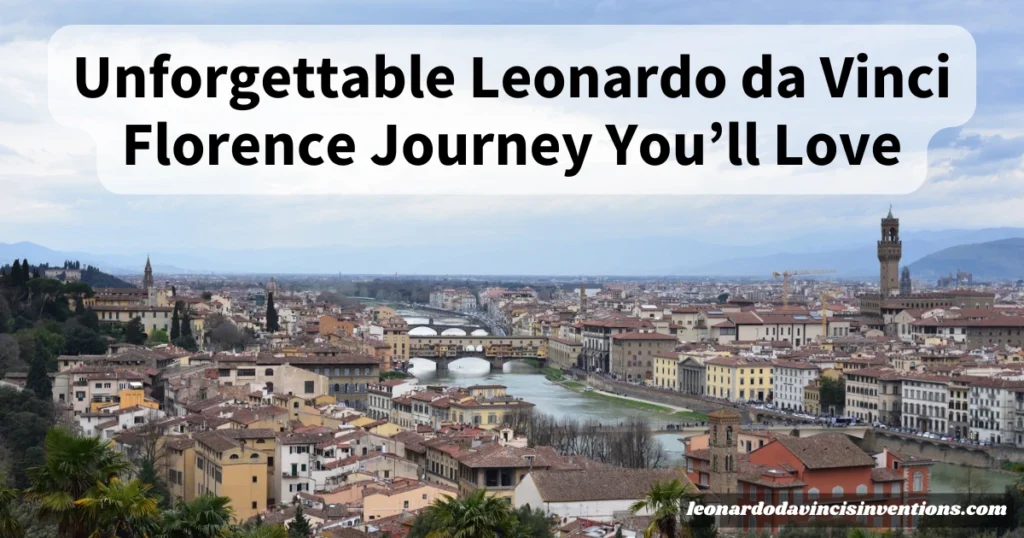
Florence explains how Leonardo’s thinking was shaped — the workshops, the guild culture, the Medici environment. But the story doesn’t end within the city walls. A short journey into the Tuscan countryside brings you to Anchiano and Vinci, where Leonardo was born and where his early life is interpreted in depth.
Seeing his birthplace adds a different dimension to your experience in Florence. It shifts the experience from understanding his ideas to standing in the landscape that formed them.
Step Inside Leonardo’s Birthplace in the Tuscan Hills
Travel from Florence to Anchiano and Vinci to explore where Leonardo’s life began and how his early environment shaped his thinking. This private day experience combines museum context, countryside landscapes, and a relaxed Tuscan lunch with seamless round-trip transport.
Optional experiences • No extra cost • Supports this site
Your Best Florence Itineraries: 1-Day and 2-Day Leonardo Focus
1-Day Florence Leonardo Plan
Best for: Travelers passing through Florence who want a concentrated Leonardo experience without adding extra cities.
Morning (9:00 AM – 12:00 PM): Visit the Leonardo da Vinci Museum in Florence. Spend 2–3 hours exploring working models, annotated drawings, and interactive exhibits. Focus on the machines that interest you most—flying devices, military engineering, structural systems.
Lunch break (12:00 PM – 1:30 PM): Eat near the historic center. Use this time to rest and avoid museum fatigue.
Afternoon (1:30 PM – 4:00 PM): Renaissance walking tour or a visit to the Uffizi. If you choose a walking tour, focus on workshops, Medici history, and the cultural environment that shaped Leonardo. If you choose the Uffizi, prioritize the rooms covering 15th-century Florentine art.
Why this works: You get both the inventions and the context in a single day without being overloaded. Florence is compact enough that you won’t waste time on logistics.
2-Day Florence Leonardo Plan
Best for: Travelers who want depth and a slower pace.
Day 1 – Leonardo’s Inventions and Mechanics
Morning: Leonardo da Vinci Florence museum visit (2–3 hours)
Afternoon: Second Leonardo museum or science-focused exhibit (if available)
Evening: Walk through the historic center, focusing on workshop districts and guild architecture
Day 2 – Renaissance Art and Cultural Context
Morning: Uffizi or Galleria dell’Accademia (focus on 15th-century Florentine art)
Afternoon: Renaissance walking tour, focusing on Medici patronage and workshop culture
Optional: Visit the Museo di San Marco to see Fra Angelico‘s frescoes (context for how Florence trained artistic minds)
Why this works: Day 1 immerses you in Leonardo’s mechanical thinking. Day 2 gives you the artistic and cultural world that made him possible. The pacing prevents fatigue and allows time to absorb what you’re seeing.
How Florence Fits Into a Multi-City Leonardo Trip
Florence works best as either:
Your starting point. If you’re building a multi-city Leonardo trip, starting with Leonardo da Vinci in Florence gives you the foundational context—the Renaissance culture, the workshop training, the Medici environment—that makes Milan and Paris more meaningful.
Your invention focus. If Milan is your art focus (The Last Supper) and Paris is your fame focus (Mona Lisa), Florence becomes your invention and engineering focus. This creates a balanced trip across Leonardo’s different contributions.
Your base for exploring Vinci. Leonardo’s birthplace is a short trip from Florence. If you want to visit Vinci and Anchiano (his actual birthplace farmhouse), Florence is the most practical base. How far is Vinci from Florence? About 50 kilometers—easily manageable as a half-day or full-day excursion.
Most Common Multi-City Combinations
Florence + Milan (3–4 days total): The strongest short route. Florence for inventions and context; Milan for The Last Supper and a mature career.
Florence + Vinci + Milan (5–6 days total): Adds the birthplace pilgrimage for true fans.
Florence + Milan + Paris (7+ days total): The full Leonardo art + invention tour across Europe.
Florence anchors all of these itineraries. It’s the context city that makes the other stops richer.
Can You Do a Day Trip to Florence from Rome?
Yes, but it’s tight. The high-speed train from Rome to Florence takes about 90 minutes. A day trip is technically possible—you’d have roughly 6–7 hours in Florence—but it works best if your focus is narrow (one Leonardo museum plus a walking tour, for example). For a deeper experience of Leonardo da Vinci in Florence, staying overnight gives you the time and pace you need.
Final thought
This post was all about Leonardo da Vinci in Florence — not as a checklist of attractions, but as the environment that shaped his way of thinking.
Florence is less about rushing through sites and more about understanding the world that made Leonardo possible. Take your time, follow what genuinely interests you, and allow the city’s history to reveal itself.
FAQs about Leonardo da Vinci in Florence
What did Leonardo da Vinci do in Florence?
Leonardo trained and worked in Florence at key moments of his life: he developed as an artist and designer in the city’s workshop culture, and later returned as an established master to take on technical and artistic projects for the Florentine state—most notably work connected to engineering surveys and planning around the Arno River.
Did Leonardo da Vinci come from Florence?
Not exactly. Leonardo was born in the Tuscan town of Anchiano, near Vinci—in the countryside outside Florence—so he’s closely tied to the Florentine region, but he was not born in Florence itself.
Why did Leonardo da Vinci move to Florence?
He moved to Florence as a teenager to train professionally, entering the world of elite Renaissance workshops where advanced drawing, painting, and technical skills were taught and where major patrons and commissions were concentrated.
Where are Leonardo da Vinci’s paintings in Florence?
The main place to see Leonardo’s paintings in Florence is the Uffizi Galleries, which hold major works from his early career—most famously the Annunciation (a youthful painting associated with his time in Verrocchio’s circle).
Is Da Vinci buried in Florence?
No. Leonardo died in France and is traditionally associated with a tomb at the Chapel of Saint-Hubert at the Château d’Amboise, not in Florence.
What is the most famous painting in Florence?
A strong contender for “most famous” is Botticelli’s The Birth of Venus, housed in Florence’s Uffizi Gallery—widely described as one of the most famous paintings in the world.
Leonardo da Vinci’s experience is more than admiring a famous painting—it’s discovering how one Renaissance genius reshaped art, science, and engineering. But if you’re planning to see his legacy in person, it’s not always clear which cities, museums, or works are truly worth your time.
This guide will help you find Leonardo’s most important locations, understand what each place reveals about his life, and navigate visits like the Last Supper or the Louvre more easily. You’ll also learn how Florence, Milan, and Paris each reveal a different side of his genius.
This post is all about Leonardo da Vinci experience and how to plan a meaningful journey through the places that shaped his legacy.
Quick Trip Planner: Choose Your Leonardo da Vinci Experience Path
Not sure where to start? Ask yourself what pulled you toward Leonardo.
The Art Lover Route
You want paintings, masterpieces, and Leonardo da Vinci’s important works in person.
Your must-visit cities:
Milan – The Last Supper (the single most important Leonardo da Vinci location for art pilgrims)
Paris – Mona Lisa at the Louvre, plus other Leonardo paintings
Florence – Renaissance context and the artistic culture that shaped it
The Inventions & Engineering Route
You want working models, reconstructed machines, and “how it works” explanations.
Your must-visit cities:
Florence – Multiple Leonardo da Vinci museum Florence locations with interactive exhibits
Milan – Science museums and innovation-focused displays
Vinci – Smaller-scale inventions tied to his birthplace
The Balanced “Best of Both” Route
You want art, inventions, and the full story of Leonardo’s world.
Your must-visit cities:
Florence – Inventions, Renaissance culture, and the world of the Medici family
Milan – The Last Supper plus Leonardo’s mature career period
Vinci – Optional add-on for a personal connection to his origins
If you only have time for two cities, Florence and Milan offer the strongest all-around Leonardo da Vinci experience.
Florence: Leonardo da Vinci Museum Florence Locations & Renaissance Context
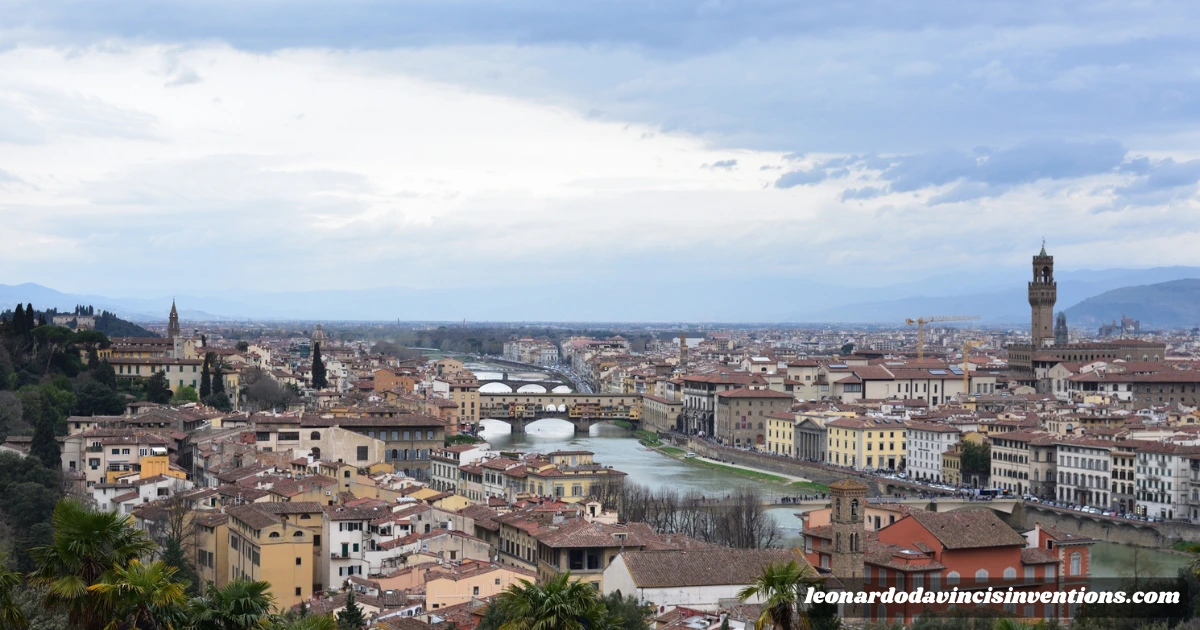
Florence is where many travelers fall in love with the Renaissance—not just as history, but as a living idea. Even when Leonardo isn’t the headliner, Florence explains the world that shaped him: workshops obsessed with geometry, patrons who funded genius, and a culture that bridged art and science.
What Florence Is Best For
Florence delivers three things for Leonardo-focused travelers:
Interactive invention exhibits. Multiple Leonardo da Vinci museums in Florence feature working models of his designs—machines you can see in motion, touch, and understand without having to read every placard. You’ll find reconstructions of his glider, pulleys, hydraulic systems, and military devices.
Renaissance cultural context. Leonardo didn’t emerge from nowhere. Florence explains how workshops like Verrocchio’s trained minds to think across disciplines. You get the “why” behind Leonardo’s approach.
Day trip access to Leonardo sites. Vinci and Anchiano (his birthplace) are short trips from Florence, making it easy to build a layered itinerary.
What to See in Florence
Leonardo’sinvention museums and exhibits. Florence offers multiple Leonardo da Vinci museum experiences featuring reconstructed machines, annotated drawings, and hands-on explanations. These aren’t dusty displays—they’re designed to help you see how Leonardo’s mind connected observation to engineering.
Renaissance walking tours. A good walking tour doesn’t just show you buildings. It explains how Florence’s political structure, guild system, and patronage networks created an environment where someone like Leonardo could thrive. The Medici family plays a major role in this story.
Art museums with Leonardo influence. While Leonardo’s finished paintings aren’t heavily represented in Florence, you’ll see the artistic tradition he grew up in—works by his teacher Verrocchio, contemporaries like Botticelli, and the techniques (perspective, anatomy, light) that defined the period.
When Guided Experiences Help Most in Florence
You don’t need a guide for everything. But Leonardo da Vinci tours are worth considering in Florence when:
You want a narrative framework that connects Leonardo to the Medici, the workshops, and the Renaissance mindset
You’re interested in inventions but don’t want to spend an hour reading technical descriptions
You’re short on time and need someone to prioritize what matters
Explore Leonardo inventions in Florence
Florence offers multiple Leonardo da Vinci museum Florence locations and walking tours that bring his machines and ideas to life. Guided experiences help when you want context fast or prefer explanations over reading labels.
Optional experiences • No extra cost • Supports this site
Milan: Leonardo da Vinci Museum in Milan & The Last Supper Strategy
If you’re building a Leonardo da Vinci experience around one single moment, Milan is it.
Leonardo spent nearly two decades in Milan, working for Duke Ludovico Sforza. This is where he created The Last Supper, designed military fortifications, experimented with theatrical engineering, and developed some of his most ambitious invention concepts.
Milan isn’t just “a Leonardo stop.” It’s where Leonardo became Leonardo.
What Milan Is Best For
The Last Supper. This is the reason most people visit Milan for a Leonardo da Vinci experience. It’s one of the most famous artworks on earth, and seeing it in person—on the wall of a refectory where it was painted over 500 years ago—is profound.
Leonardo’s mature career period. The Leonardo da Vinci museum in Milan tells the story of his working years (1482-1499), not just his paintings. You’ll find material on his engineering projects, court inventions, and the intellectual world he moved through.
Science and innovation exhibits. Milan has strong science museums that align with Leonardo’s interdisciplinary mindset. Even exhibits not explicitly about Leonardo often feature his influence on mechanics, optics, and engineering.
The Last Supper: How to Visit Without Stress
Let’s be direct: The Last Supper is complicated to visit, but it’s absolutely worth it.
Here’s what you need to know:
Visits are time-limited. You’re allowed 15 minutes inside the room. Groups enter in controlled intervals to protect the fragile mural.
Demand is extremely high. Tickets sell out weeks (sometimes months) in advance, especially in high season.
Booking independently requires planning. You need to check availability early and be ready to adjust your Milan dates if necessary.
Your options:
Timed tickets booked directly (well in advance). This is the most affordable option, but requires vigilance and flexibility with your schedule.
Guided entry with context. Slightly more expensive, but includes an explanation before and after your viewing, plus guaranteed entry. Helpful if you want meaning and story without doing research beforehand.
The single most important tip: Book The Last Supper before you book anything else in Milan.
If The Last Supper is a priority, make it the anchor of your Milan plans. Choose your Milan dates based on Last Supper availability, not the other way around.
Milan’s “Leonardo Layer” Beyond The Last Supper
If your curiosity leans toward inventions and engineering, Milan offers an additional Leonardo da Vinci museum in Milan:
Science and technology museums. Milan’s Museo Nazionale Scienza e Tecnologia features Leonardo invention galleries with models, drawings, and interactive explanations.
Leonardo-themed exhibitions. Temporary and permanent exhibitions often showcase reconstructed machines, annotated codices, and multimedia presentations of Leonardo’s ideas.
Milan walking tours. Some tours focus on Leonardo’s Milan years—his projects for the Duke, his studio locations, and the city’s role in his career.
Explore the Last Supper in Milan
Beyond The Last Supper, Milan offers science museums and Leonardo-focused exhibits that explore his inventions, engineering projects, and intellectual legacy.
Optional experiences • No extra cost • Supports this site
Vinci & Anchiano: Leonardo da Vinci Location Origins (A Quieter Add-On for True Fans)
If Florence and Milan are the “big chapters,” Vinci is the quiet prologue.
Leonardo was born in 1452 in the small town of Vinci, in the Tuscan countryside between Florence and Pisa.
The actual birthplace—a stone farmhouse in the nearby hamlet of Anchiano—still stands, and visiting it offers something the major museums can’t: a sense of place, scale, and the rural world from which Leonardo came.
What Vinci Is Best For
A more personal, reflective experience with Leonardo da Vinci. Vinci isn’t a blockbuster stop. It’s intimate. You’re walking the landscape Leonardo walked, seeing the hills and olive groves that shaped his early observations.
Smaller-scale invention exhibits. The Museo Leonardiano in Vinci features models and drawings, similar to Leonardo da Vinci museum Florence locations but in a quieter, less crowded setting.
A half-day or day trip for fans who want something beyond the famous stops. Vinci works best as an add-on, not a standalone destination.
How to Visit Vinci
Vinci is about an hour from Florence by car or regional train (with a short bus connection). Most travelers visit as a half-day trip, often combined with a stop in the nearby town of Pistoia or a wine-focused detour through Tuscan vineyards.
Day trips and guided experiences from Florence make logistics easier, especially if you want transportation and context taken care of.
Venice: Vitruvian Man Context and Museum Leonardo da Vinci Experience Alternatives
Venice presents a unique situation for Leonardo travelers. The original Vitruvian Man drawing is housed in Venice’s Gallerie dell’Accademia—but it’s rarely on public display due to its fragility.
Does that mean Venice isn’t worth a stop for Leonardo fans? Not at all.
What Venice Is Best For
Renaissance mood and intellectual context. Venice was a center of printing, mapmaking, and the exchange of ideas during Leonardo’s lifetime. The city’s museums and architecture give you a sense of the broader Renaissance world in which Leonardo lived.
Museums and exhibits that explain the period. Even without the original Vitruvian Man on view, the Leonardo da Vinci museum in Venice uses replicas, contextual exhibits, and multimedia presentations to explain Leonardo’s proportional studies and their connection to classical ideas.
Combining Leonardo with a world-class Venice visit. Venice is worth visiting for many reasons beyond Leonardo da Vinci. If you’re already planning a stop in Venice, adding a Leonardo layer enhances the experience without requiring a separate trip.
The Vitruvian Man Reality Check
The original drawing is fragile and light-sensitive. When it is displayed, it’s typically for short periods during special exhibitions.
Most travelers who want to “see” Leonardo da Vinci’s Vitruvian Man in Venice end up experiencing it through:
High-quality reproductions in museum exhibits
Multimedia presentations that explain the drawing’s significance
Context about Leonardo’s anatomical studies and classical influences
If seeing the original is essential to your trip, check the Gallerie dell’Accademia’s website for current exhibition schedules before booking your trip to Venice.
Paris: The Louvre, the Mona Lisa, and Managing Expectations
Paris is where Leonardo’s modern fame reaches maximum volume, because the Louvre is where millions of visitors meet Leonardo through the Mona Lisa.
What Paris Is Best For
Seeing Leonardo’s most famous painting. The Mona Lisa is in Paris, and if it’s on your Leonardo bucket list, the Louvre is unavoidable.
Experiencing Leonardo in a broader art context. The Louvre also houses other Leonardo da Vinci’s important works, including The Virgin of the Rocks and Saint John the Baptist. Seeing them together gives you a sense of Leonardo’s evolution as a painter.
Combining Leonardo with a world-class museum day. The Louvre is one of the greatest museums on earth. If you’re going anyway, adding a Leonardo focus is seamless.
The Mona Lisa Reality Check (And How to Enjoy It)
Let’s be honest about what you’re walking into.
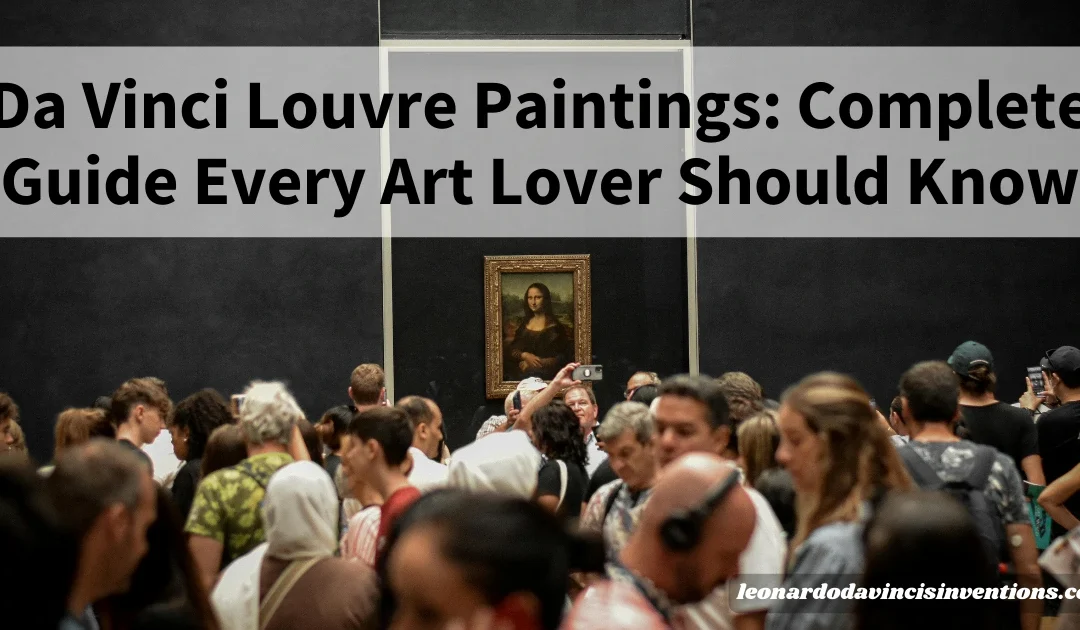
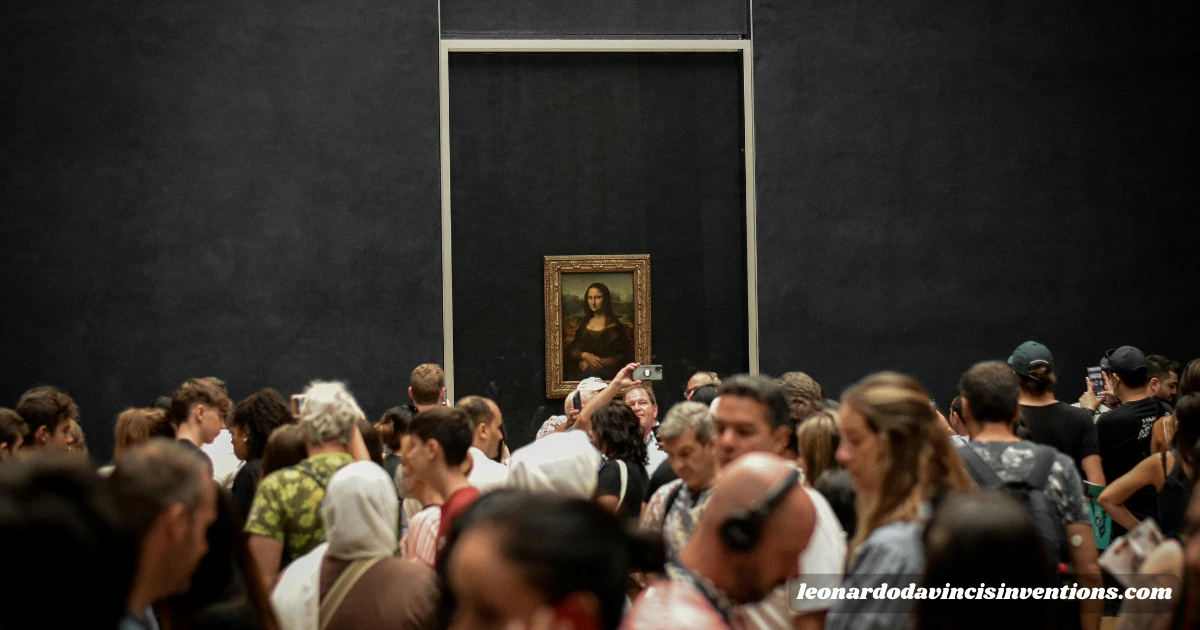
The crowd is real. The Mona Lisa painting is the most visited artwork in the world. The room is packed. You’ll be behind barriers. You’ll move through quickly.
The painting is smaller than most people expect. It’s 77 cm × 53 cm (about 30 × 21 inches). After seeing so many reproductions, the actual scale surprises people.
The experience is still worth it—if you set realistic expectations. You’re not going to have a quiet, contemplative moment alone with the painting. But you are seeing the actual Mona Lisa artwork, and that’s something.
How to Make the Louvre Visit Smoother
Book timed-entry tickets in advance. The Louvre limits daily visitors. Booking ahead guarantees entry and reduces wait times.
Consider a guided tour if you want structure. A good Louvre guide will:
Get you to the Mona Lisa efficiently
Show you other Leonardo artworks
Provide context that makes the visit more meaningful
Visit other Leonardo paintings in the Louvre. Don’t let the Mona Lisa crowd distract you from The Virgin of the Rocks and Saint John the Baptist. These are quieter, less mobbed, and give you space to actually look.
Experience Mona Lisa at the Louvre
Skip-the-line Louvre tickets and guided tours help you navigate the museum efficiently and see Leonardo da Vinci important works with context. Guides often include other Renaissance highlights alongside the Mona Lisa.
Optional experiences • No extra cost • Supports this site
Your Best Leonardo da Vinci Experience Itineraries: 1 Day, 3 Days, 5 Days, and 7 Days
1-Day Leonardo Focus (Florence Only)
Best for: Travelers passing through Florence who want a concentrated Leonardo da Vinci experience without adding extra cities.
Morning: Leonardo’s invention museum. Spend 2–3 hours exploring working models, annotated drawings, and interactive exhibits at a Leonardo da Vinci museum in Florence.
Afternoon: Renaissance walking tour. Focus on the workshops, patrons, and cultural context that shaped Leonardo’s early career.
Why this works: Florence gives you both inventions and context in a single city. You don’t need to juggle train schedules or timed entries.
3-Day Leonardo Circuit (Florence + Milan)
Best for: Most Leonardo travelers. This is the “strongest short route” for experiencing art, inventions, and context.
Day 1 – Florence (Inventions + Renaissance story)
Morning: Leonardo da Vinci museum in Florence visit
Afternoon: Renaissance walking tour or Uffizi visit for artistic context
Day 2 – Travel to Milan
Afternoon/evening: Explore Milan, settle in
Day 3 – Milan (The Last Supper + career context)
Morning or afternoon: The Last Supper (booked in advance)
Remaining time: Leonardo da Vinci museum in Milan, or the science exhibit
Why this works: You get the two most important Leonardo da Vinci museum cities in Italy without overextending. Florence provides inventions and context; Milan delivers the art masterpiece and mature-career story.
5-Day Deep Dive (Florence + Vinci + Milan)
Best for: True Leonardo fans who want the full arc—origins, inventions, masterpieces.
Days 1–2 – Florence
Day 1: Leonardo’s inventions and Renaissance museums
Day 2: Walking tour, Uffizi, or day trip prep
Day 3 – Vinci & Anchiano
Half-day or full-day trip to Leonardo’s birthplace
Optional: Combine with Tuscan countryside exploration
Days 4–5 – Milan
Day 4: The Last Supper + city exploration
Day 5: Science museum, Leonardo exhibits, or departure
Why this works: You add the personal, reflective Leonardo da Vinci location experience without sacrificing Florence or Milan. The pacing feels complete.
7-Day Leonardo Grand Tour (Florence + Milan + Paris)
Best for: Travelers who want to see Leonardo da Vinci’s important works across Europe and have time for a multi-city art journey.
Days 1–2 – Florence
Inventions, Renaissance context, Leonardo da Vinci tours
Day 3 – Vinci (optional add-on)
Birthplace visit, countryside
Days 4–5 – Milan
The Last Supper, science museums, Leonardo exhibits
Days 6–7 – Paris
Day 6: Louvre (Mona Lisa + other Leonardo paintings)
Day 7: Broader Paris exploration or departure
Why this works: You experience Leonardo’s legacy in three distinct contexts—invention culture (Florence), mature masterpiece (Milan), and modern fame (Paris).
Practical Tips for Planning Your Leonardo da Vinci Experience
Book High-Demand Experiences First
The Last Supper is the classic example. If it’s a priority, book it before you book flights, hotels, or anything else. Choose your Milan dates based on Last Supper availability, not the other way around.
Timed-entry sites and limited-access artworks sell out. Flexibility is your friend.
Understand the Timed-Entry Reality
The Last Supper allows 15 minutes inside the room. The Louvre uses timed entry to control crowds. Some Leonardo da Vinci museums in Italy limit group sizes.
This isn’t a bad thing—it protects the artworks and improves the experience. But it means spontaneous “I’ll just show up” visits often don’t work.
Use Guided Experiences Strategically (Not for Everything)
You don’t need a guide for every museum. Use Leonardo da Vinci tours when:
Entry is complicated or competitive (Last Supper, Louvre)
You want the story fast without reading every placard
The museum experience is more meaningful with context (Renaissance walking tours, art history explanations)
Skip the guides when you’re happy to explore on your own, or when the exhibit is self-explanatory.
Best Seasons for Leonardo Travel
Spring (April–May) and fall (September–October) offer the best balance of weather, crowd levels, and availability.
Summer (June–August) is high season. Expect crowds, heat, and higher prices. Book timed entries even further in advance.
Winter (November–March) is quieter and more affordable, but some smaller museums (especially in Vinci) may have reduced hours.
Keep Your Leonardo da Vinci Experience Balanced
A great trip includes variety:
1 day focused on inventions and models (Florence museums, Milan science exhibits)
1 day focused on art masterpieces (The Last Supper, Mona Lisa)
1 day focused on context and story (Renaissance walking tours, Medici history, Vinci birthplace)
Don’t try to see every Leonardo site in every city. Choose what resonates with your interests and build around that.
Final thought
This post was all about Leonardo da Vinci experience and how exploring the places connected to his life can reveal the depth of his curiosity and genius. Leonardo spent his life observing, experimenting, and asking questions about the world around him.
The best way to experience his legacy is not to see everything, but to follow what sparks your curiosity—whether it’s a masterpiece, an invention, or the landscapes that shaped his ideas.
FAQs about Leonardo da Vinci Experience
What was Leonardo da Vinci’s life like?
Leonardo da Vinci (1452–1519) was an Italian Renaissance polymath, active as a painter, engineer, inventor, scientist, and theorist. Born near Vinci (in Tuscany), he trained in Florence under the artist Andrea del Verrocchio and later worked in Milan, Florence, Rome, and France. He was known for his art, scientific studies, and detailed notebooks filled with sketches and ideas spanning anatomy, mechanics, and nature.
How many hours a day did Da Vinci sleep?
There are historical claims that Leonardo da Vinci followed an unusual sleep pattern known as a “polyphasic” schedule, with many short naps rather than long rest, sometimes described as totaling about 2 hours per day. However, these claims come from later speculation and are not definitively supported by primary historical evidence.
What is the Da Vinci Code experience?
The “Da Vinci Code experience” typically refers to tours, exhibitions, or media inspired by The Da Vinci Code, a best-selling novel by Dan Brown that blends mystery with fictional interpretations of Leonardo’s life and symbolism. It is not a historical account of Leonardo himself, but rather a cultural phenomenon that has influenced themed tours and attractions focused on art and secret symbolism (fictionally linked to his work). (This concept is based on cultural references to the novel; specific exhibits vary by location.)
Can you visit Leonardo da Vinci’s workshop?
You can’t visit Leonardo’s actual workshop, but several museums and interactive experiences bring it to life. For example, the Leonardo Interactive Museum in Florence features machines and inventions based on his codices, allowing visitors to see and operate many of his mechanical designs.
Was Leonardo da Vinci LGBTQ?
There is no definitive historical evidence about Leonardo’s sexual orientation. Some historians have interpreted his close relationships with male assistants, particularly Gian Giacomo Caprotti (known as Salaì), as indicative of possible same-sex attraction, but clear documentation confirming Leonardo’s sexual orientation does not survive. Historians tend to treat the topic as plausible but not conclusively proven. (Scholarly consensus acknowledges ambiguity.)
Is Mona Lisa worth $1 billion?
The Mona Lisa is considered priceless and is legally impossible to sell. However, when it was insured for a 1962 U.S. tour, it received a record valuation of $100 million, which, adjusted for inflation, roughly translates to over $1 billion today. Its cultural and historical value far exceeds any realistic market price.
Comparison of Medieval Food vs. Renaissance Food showing the shift from humble, survival-based meals in a dim medieval kitchen to lavish, art-filled banquets of the Renaissance (conceptual illustration)
The food of the Renaissance era truly diverged from the simple, limited diets of medieval times. Suddenly, culinary exploration and social dining became the norm.
The biggest changes? New World ingredients like tomatoes and chocolate, the rise of sugar as a sweetener, and meals transforming from basic sustenance into elaborate displays of wealth and status.
During the Renaissance, food evolved into an art form and a status symbol, rather than just a means of survival. The growing middle class began to acquire spices and cooking techniques that were once reserved for the nobility.
The medieval period was characterized by the Catholic Church’s rules for modest eating and a rigid feudal system that limited most people’s food choices to a bleak range. Then came the Renaissance, and suddenly, luxury and experimentation were in style.
This revolution touched everything—what proteins people ate, how bread marked social class, and how fresh produce from faraway places changed daily meals. Dining turned into a cultural event, not just a necessity.
The Transformation of Meat and Protein in Renaissance Era Food
Renaissance cooks began to move away from salted, preserved meats. Fresh preparations and exotic game birds stole the spotlight at noble tables.
Roasted peacock and swan became showpieces. Fresh fish started to replace salted versions, especially for those who could afford it.
From Preserved Pork to Fresh Roasted Meat: A Culinary Revolution
Medieval diets leaned heavily on preserved pork, bacon, and salted meats. That was mostly because storage options were limited.
With the Renaissance came better preservation and supply chains. Suddenly, cooks could serve fresh roasted meat much more often.
Fresh roasts became the stars of Renaissance banquets. Wealthy families flaunted their status with elaborate dishes of beef, veal, and mutton.
These new dishes required skilled cooks and the latest techniques. Improved ovens and equipment enabled the development of more flavorful and visually appealing presentations.
Exotic Game Birds Replace Medieval Staples: Peacock, Swan, and Pheasant on Noble Tables
The nobility ditched simple chicken and duck for dramatic game birds. Peacock, swan, and pheasant became must-haves for aristocratic feasts.
Cooks would re-feather peacocks after roasting them, turning dinner into a visual spectacle. Swans and cranes made appearances at the grandest banquets.
Pheasant and partridge were more practical but still impressive. They tasted great and were easier for kitchen staff to manage.
Hosting exotic game birds showcased artistry and wealth. It was all about making a statement—look at what I can hunt, look at what I can serve.
The Rise of Fresh Fish vs. Salted Fish: Cod, Salmon, and Sturgeon
Medieval tables were loaded with salted cod and herring. As transport improved, fresh fish became the new favorite for those who could get it.
Salmon gained popularity for its rich flavor and attractive appearance on the table. Sturgeon, especially its caviar, became a delicacy among the wealthy.
Fresh trout and pike showed up often at noble feasts. Coastal folks enjoyed oysters, mussels, and other shellfish. Sometimes, even porpoise and whale made an appearance at the most lavish spreads.
Preparing fresh fish took real skill. Renaissance cooks experimented with sauces and new methods to bring out the best in these premium proteins.
Wild Game and Unusual Proteins: Venison, Boar, and Even Dormice
Venison and wild boar were top prizes for Renaissance hunters. Serving these meats showed off your access to hunting grounds and noble connections.
Some tables even featured dormice, hedgehogs, or beavers. That might sound strange now, but back then, it was all about culinary adventure and trying something new.
Rabbit and hare were a bit more common and bridged the gap between everyday and exotic. Middle-class kitchens often included these wild proteins in their meals.
Turkey Arrives: How New World Poultry Changed Renaissance Era Food Forever
Turkey changed everything after Spanish explorers brought it back from the Americas. This large bird provided ample meat for growing households.
Its size made it perfect for grand presentations. Renaissance cooks developed new methods for preparing turkey, distinct from traditional European poultry recipes.
Turkey’s arrival kicked off a global culinary exchange. It effectively summarized how Renaissance-era food culture began to evolve as exploration introduced new flavors and ideas.
Bread, Grains, and the Social Hierarchy of Renaissance Era Food
Bread wasn’t just food anymore—it became a marker of social status. The type of grain, how it was prepared, and the final bread all said a lot about who you were.
White Bread vs. Brown Bread: Manchet, Rye, and the Class Divide
Meanwhile, the lower classes ate rye and mixed-grain breads. Darker, more nutritious, but definitely not a status symbol. The way bread was ground and baked mattered for both nutrition and social standing.
The Pasta Revolution: Tagliatelle, Ravioli, and Tortellini Enter European Cuisine
Tagliatelle, ravioli, and tortellini emerged as sophisticated new grain dishes. Italian cooks crafted these pastas to highlight their culinary skills and ingredients.
Making these pastas took refined flour and real technique. Noble households hired skilled cooks to create filled pastas with cheese and roasted meats.
The pasta craze spread from Italy through trade. Wealthy merchants brought these dishes to other courts, turning wheat into edible art.
Barley, Oats, and Millet: Medieval Porridge Gives Way to Renaissance Refinement
Barley, oats, and millet have been elevated from basic porridge to fancier dishes. Gruel was out, and seasoned, textured grain sides were in.
Cooks started adding vegetables like onions and garlic to these grains. The result? More complex recipes and a move away from just boiling everything.
The upper classes treated these grains as side dishes, not main courses. It’s a testament to how Renaissance cuisine elevated even humble ingredients.
Rice and Wheat Flour: Luxury Grains That Defined Renaissance Era Food
Rice arrived in the Mediterranean region via the trade route as a highly valued exotic luxury. The wealthy used it in sweet dishes and elaborate sides, setting it apart from everyday wheat.
Wheat flour quality mattered more than almost anything else. The whitest, finest flour produced the best breads and pastries for noble tables.
Processing and transporting these grains is costly. Serving them showed off wealth and access to trade.
How Bread Quality Signaled Status: From Black Bread to Aristocratic Manchet
Black bread sat at the bottom of the social ladder. Made from coarse grains, it was basic fuel for laborers and peasants who couldn’t afford better.
Aristocratic manchet needed skilled bakers and pricey ingredients. It went hand in hand with fine meats, such as venison, at feasts—luxury foods working together to showcase status.
Fresh Produce and New World Ingredients Transform Renaissance Era Food
New ingredients from the Americas began to appear during the Renaissance, disrupting traditional European fruit and vegetable varieties. Root vegetables remained important, but tomatoes and potatoes gradually made their way into kitchens, changing the culinary landscape.
Root Vegetables vs. Leafy Greens: Turnips, Carrots, and the Food Hierarchy
Root vegetables were everywhere. Turnips kept peasants going, while carrots gained favor with wealthier folks for their sweetness and color.
Parsnips and rutabagas helped people survive winter. These veggies stored well, making them indispensable during the cold months.
Leafy greens, such as cabbage, lettuce, and watercress, hold a distinct place in the food hierarchy. Cabbage was for the masses, often pickled into sauerkraut to extend its shelf life.
Preparation styles split along class lines. Peasants boiled roots into thick stews with the odd scrap of bacon, while the rich enjoyed fancy versions spiced up with exotic seasonings.
Seasonal Produce and Preserved Fruits: Apples, Pears, and Candied Delicacies
Fresh fruit eating followed the seasons during the Renaissance. Apples and pears filled autumn baskets, giving people crucial vitamins before winter set in.
People used preservation techniques to transform seasonal abundance into treats that could be enjoyed throughout the year. Wealthy households made candied fruits with imported sugar, transforming everyday apples into prized sweets.
Preservation Method
Common Fruits
Cherries, oranges, and lemons
Dried
Apples, pears, plums
All classes
Candied
Cherries, oranges, lemons
Wealthy only
In syrup
Peaches, pears
Upper class
Seasonal produce included strawberries, cherries, and early summer berries. These delicate fruits showed up fresh at wealthy feasts, but only for a short time each year.
Grapes played two roles—people ate them fresh and used them for wine. Both white and red grapes thrived in Mediterranean regions, fueling local economies.
The Arrival of Tomatoes and Potatoes: Exotic Foods That Changed Everything
Tomatoes appeared in Europe in the mid-16th century, but most folks saw them as decorative oddities. Wealthy Europeans cultivated these unusual plants in their gardens, not in their kitchens.
Potatoes also met with skepticism, despite being a nutritious food. Farmers in Europe stuck to familiar roots, such as turnips and parsnips, instead of these new tubers.
Change came slowly through the late Renaissance. Italian cooks started using tomatoes in sauces, laying the groundwork for what we call modern cuisine.
Spanish and Portuguese explorers brought these foods through their trade networks. Still, it took generations for people to embrace them truly.
Mediterranean Flavors: Artichokes, Fennel, and Fresh Herbs in Renaissance Cooking
Artichokes gained significant value in Italian Renaissance kitchens. Wealthy tables featured these Mediterranean vegetables, accompanied by olive oil and fresh herbs.
Fennel is offered in both bulb and seed form for cooking. Cooks used the bulbs as vegetables and ground the seeds into spice for roasted meats.
Fresh herbs like basil, rosemary, thyme, and sage brought simple ingredients to life. Monastery and castle gardens across Europe grew these herbs.
Italian cooks in the Renaissance combined herbs to enhance, rather than mask, natural flavors. That approach stood out in comparison to medieval cooking, which relied heavily on imported spices.
Mediterranean cooking styles spread north through trade. French and English kitchens gradually adopted Italian methods of preparing vegetables and herbs.
Beans, Peas, and Legumes: From Peasant Staples to Refined Renaissance Era Food
Beans and peas crossed class lines in the Renaissance. Poor families relied on these protein-rich foods, while the wealthy incorporated them into elaborate dishes.
Fava beans led the way in early Renaissance gardens, long before American varieties arrived. When people combined these hardy beans with grains, they got a solid protein boost.
Lentils and chickpeas frequently appeared in Mediterranean kitchens. Cooks flavored them with olive oil, garlic, and fresh herbs instead of just boiling them plain.
How people prepared legumes said more about class than the ingredients themselves. Peasants made basic porridge from dried peas, while aristocrats enjoyed them with pricey spices and bits of roasted meat.
Gardeners grew fresh peas as a luxury springtime treat. Wealthy tables across Europe celebrated these tender pods as a sign of seasonal plenty.
Frequently Asked Questions
Renaissance food differed from medieval meals due to the introduction of new ingredients, such as sugar and tomatoes, as well as more sophisticated cooking and presentation techniques. People enjoyed a greater variety and developed dining habits that showcased both their nutritional needs and social status.
What food did they eat during the Renaissance?
Renaissance folks ate bread, meat, and vegetables as staple foods. The wealthy went all out with exotic spices, sugar, and fancy dishes at banquets.
Exploration brought in new foods. Tomatoes, peppers, and chocolate arrived in the New World from the Old World in the 16th century.
The middle class got access to better ingredients than before. They could afford improved cooking and more variety than medieval peasants ever dreamed of.
What did people in the Renaissance eat for breakfast?
Breakfast in the Renaissance was usually simple. Most people ate bread, porridge, or leftovers from the day before.
The wealthy might add cheese, eggs, or a bit of meat. Breakfast wasn’t the main meal—people didn’t fuss over it.
The big meal happened at midday. Evening meals were lighter, especially compared to lunch.
What was the most common food eaten in medieval times?
Bread was the backbone of the medieval diet. Porridge from grains was another staple for most families.
Vegetables like cabbage, onions, and turnips appeared frequently. The peasants and commoners were often limited to a monotonous and unappetizing diet.
Meat is too expensive for most people, so only the wealthy can afford to eat it regularly. Commoners might get pork, chicken, or fish when they could.
What was Leonardo da Vinci’s favorite food?
Leonardo da Vinci liked simple, light meals that wouldn’t slow him down. He ate vegetables, fruit, and usually skipped heavy meat dishes.
Records say he enjoyed minestrone and fresh bread. Da Vinci thought that overeating dulled the mind and hurt creativity.
He appreciated a glass of wine with meals, but only in moderation. His eating habits matched Renaissance ideas about balance and self-control.
What did people drink in the Renaissance?
Water wasn’t always safe, so people turned to ale, beer, and wine. Alcoholic drinks were safer than questionable water sources.
The wealthy enjoyed imported wines and special drinks. Sugar became more widely available and was used to sweeten beverages.
People drank milk fresh when they could get it. Herbal teas and fruit juices were also on the menu, if they were lucky.
What did food look like in the 1500s?
Food presentation became much fancier during the 1500s. The Renaissance introduced haute cuisine, characterized by more intricate preparations and elaborate displays.
Wealthy families often took pride in presenting their meals in elaborate and decorative ways. Sugar sculptures and ornate pastries typically sat at the center of the table as eye-catching centerpieces.
The colors on the plate started to pop more, thanks to the addition of new spices and ingredients. Tomatoes and peppers arrived, adding reds that people hadn’t seen before.
Formal dinners typically consisted of several courses, served one after another. Hosts arranged each dish to impress their guests and show off a bit—maybe even a lot—of wealth and taste.
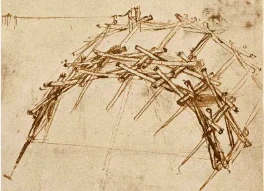
Da Vinci bridge calculations stand out as some of history’s most elegant solutions to challenging structural engineering problems.
These mathematical principles behind Leonardo’s self-supporting design still guide engineers today, especially when they’re working on earthquake-resistant structures, portable military bridges, or sustainable projects that rely on compression forces instead of expensive materials or permanent fasteners.
MIT studies confirmed the structural soundness of his 500-year-old equations. Norway even built a pedestrian bridge using these same ideas, demonstrating that da Vinci’s approach to load distribution and geometric stability remains adequate for modern infrastructure needs.
Architects and engineers continue to rely on Leonardo’s compression-only calculations for structures that require seismic resilience, support heavy loads without the use of fasteners, or rapid deployment.
His grasp of how interlocking members share weight through geometry has inspired emergency bridges and modular construction systems alike.
How Da Vinci Bridge Calculations Define Structural Integrity Through Compression-Only Architecture
Conceptual illustration of da Vinci’s compression-only arch, showing thrust line alignment and geometric load distribution.
Da Vinci bridge calculations demonstrate how compression-only structures achieve stability by carefully positioning the thrust line and utilizing friction lock mechanisms.
The design avoids tensile stresses and stays structurally feasible through mathematical relationships that govern arch geometry and load distribution.
Understanding the Compression-Only Arch and Thrust Line Within Masonry Depth
The compression-only arch sits at the heart of da Vinci’s method. Engineers must keep the thrust line within the masonry depth to prevent tensile failures. That takes careful calculation of the arch’s curvature and loading.
Modern analysis shows Leonardo understood thrust-line theory instinctively. The Golden Horn bridge design uses geometric ideas that wouldn’t become mainstream for centuries.
Key thrust line requirements:
Stays within the middle third of the arch depth
Doesn’t exceed masonry compression limits
Needs a continuous load path from the crown to the abutments
The flattened parabolic arch brings its own set of challenges. Engineers use trigonometric layout methods—basically echoing da Vinci’s sketches—to calculate thrust line deviation.
Calculating Lateral Thrust and Abutment Stability for Single-Span Masonry Arch Designs
Lateral thrust calculations show the horizontal forces sent to the bridge abutments. With a single-span masonry arch, these forces concentrate at two main points. Engineers figure out thrust magnitude from the arch’s geometry and loading.
Abutment stability calls for massive foundations to resist overturning moments. The span-to-rise ratio matters—a flatter arch pushes out more horizontal force.
Critical stability factors:
Foundation bearing capacity on actual soils
Abutment massing for thrust resistance
Safety factor against sliding and overturning
Modern feasibility studies look at 16th-century methods. Stone ashlar blocks require precise cutting to achieve the parabolic profile without the use of centering falsework.
Bearing Capacity and Foundation Settlement Testing in 16th-Century Construction Feasibility
Foundation settlement testing highlights key constraints for building the bridge. Engineers analyze bearing capacity using techniques available in 1502. The massive abutments need deep foundations to transfer loads safely.
Settlement tolerance calculations indicate the acceptable range of differential movement between supports. Modern studies use dimensional similitude to test foundations at smaller scales.
Foundation requirements include:
Pile foundations reaching bedrock
Raft foundations to spread out loads
Settlement monitoring during construction
A 240-meter span creates huge foundation loads for the 16th century. Bearing capacity analysis helps determine if old construction methods could handle the job.
Keystone Action and Friction Lock Mechanisms in Self-Supporting Bridge Design
Keystone action spreads loads through the arch crown, while friction lock mechanisms keep the structure together. The self-supporting design eliminates the need for mechanical fasteners by relying on the geometric interlocking of pieces.
Each stone block relies on friction and interlock, rather than mortar joints. This needs precise piece length optimization for equilibrium. The self-supporting bridge concept shows advanced force transfer ideas.
Friction lock principles:
Adjacent blocks interlock mechanically
Compression forces trigger frictional resistance
No tensile connections needed for stability
Modern replicas using glulam wood confirm these friction mechanisms. Engineers test 3D-printed models to verify whether geometry alone can transfer loads.
Load Paths and Stress Concentration Analysis for Flattened Parabolic Arch Geometry
Load paths in the flattened parabolic arch lead to complex stress patterns. Engineers examine stress concentration where the geometry changes. The arch rib carries the main loads, while the spandrel areas handle secondary forces.
Dynamic response calculations cover wind stability and seismic resilience. Compression-only structures offer redundancy through several load transfer paths.
Critical analysis points:
Max stress at quarter-span points
Load spread through arch depth
Stability under live loads and environmental forces
Modern structural analysis confirms the design’s feasibility with computational tools Leonardo never had. The math behind arch behavior backs up his intuitive engineering.
Why Modern Engineering Still Relies on Da Vinci Bridge Calculations for Seismic Resilience
Conceptual illustration showing how da Vinci’s compression-only bridge structure distributes seismic forces through thrust lines and spread footings, demonstrating earthquake-resistant stability rooted in geometric design.
Da Vinci bridge calculations provide key insights for earthquake-resistant design, utilizing compression-only structures and spread footings that effectively distribute seismic forces. The Leonardo da Vinci Golden Horn Bridge exemplifies structural principles that engineers continue to use in addressing seismic challenges.
Seismic Stability and Dynamic Response in Compression-Only Structures
Compression-only arch structures handle earthquake forces with geometric stability, in addition to material strength. The thrust line remains within the masonry depth during earthquakes, preventing tensile failures that can damage regular bridges.
Engineers study da Vinci’s flattened arch to see how compression forces move during ground motion. The parabolic shape channels lateral thrust to spread foundations, dodging stress points that often fail first in quakes.
Modern seismic codes use these ideas for unreinforced masonry. Compression-only systems offer redundancy that steel and concrete bridges often lack.
Abutment Massing and Overturning Resistance Through Splayed Foundation Design
Leonardo’s abutment stability calculations explain how massive foundations stop overturning in earthquakes. The splayed foundation boosts bearing capacity and lowers the center of gravity.
Today’s engineers use similar abutment massing for seismic zones. The foundation shape spreads loads over a larger area of soil, reducing settlement risks. This is especially useful for bridges on soft soils that are prone to liquefaction.
Key Foundation Principles:
Wider width-to-height ratios
Lower center of gravity
Better soil bearing spread
Less overturning moment
Settlement Tolerance and Factor of Safety in Leonardo da Vinci Golden Horn Bridge Analysis
The MIT study found impressive settlement tolerance in da Vinci’s design. Engineers tested the foundation’s movement by separating the support platforms until the bridge finally collapsed.
Modern bridge codes use these settlement ideas with higher safety factors. The compression-only structure adapts to uneven settlement through its geometry, rather than material failure.
Load paths shift automatically when foundations settle unevenly. This self-adjusting behavior gives seismic resilience that rigid structures can’t match.
3D-Printed Scale Model Testing and Dimensional Similitude at 1:500 Scale
Researchers built 3D-printed blocks at a 1:500 scale to check da Vinci’s structural math. The 126-block model showed how scaling laws affect compression arch behavior under seismic loading.
Dimensional similitude testing reveals how proportions impact seismic performance. Engineers use these scaling rules for modern compression arches in earthquake zones.
The friction lock between blocks creates distributed stiffness; no mortar is needed. This allows the bridge to flex during earthquakes while maintaining its integrity.
Wind Stability and Load Distribution Under Live Loads Using Period Methods
Da Vinci’s construction methods addressed wind stability through geometric proportions and intelligent load distribution. The span-to-rise ratio naturally resists wind without extra bracing.
Modern engineers look at these old methods to trace load paths in compression structures. Wind forces move through the arch rib and spandrel fill, not just at connection points.
Load Distribution Features:
Keystone action spreads wind loads sideways
Spandrel fill adds mass damping
Arch rib geometry channels forces to the foundations
Deck-arch interaction creates composite behavior
The self-supporting design skips fatigue-prone connections that usually fail under repeated wind loads.
How Da Vinci Bridge Calculations Inspire Contemporary Construction From Norway’s Glulam Arch to Modular Systems
Da Vinci bridge calculations highlight compression-only arch principles that modern engineers use with glulam construction, 3D-printed scale models, and modular systems. These calculations guide everything from piece length optimization to foundation settlement testing in current bridge design.
Glulam Parabolic Arch Design and Steel-Reinforced Deck in Norway: Replica Applications
The Norway bridge project from 2001 brings Leonardo’s thrust line calculations to life in a glulam parabolic arch. Engineers used laminated wood beams for the flattened arch, sticking to the original compression-only principles.
The steel-reinforced deck spreads live loads across the arch rib. This deck-arch interaction gives redundancy, much like Leonardo’s stone block distribution would have done.
Key specifications:
Main span: 40 meters
Total length: 109 meters
Material: Glulam timber with steel reinforcement
Construction cost: 12 million Norwegian kroner
Modern glulam lets engineers fine-tune the span-to-rise ratio. They can calculate the exact thrust line position within the wood depth, ensuring the bridge remains stable under dynamic loads.
Friction and Interlock Principles in 3D-Printed Blocks for Modern Testing
The 1:500 scale model had 126 individual pieces. These relied entirely on friction and interlock mechanisms.
The 3D-printed model demonstrated that mortar versus dry joints calculations remain valid after 500 years. Each block transfers loads through direct contact, without the use of adhesives or fasteners.
Testing parameters:
Scale ratio: 1:500
Block count: 126 pieces
Assembly time: 6 hours printing
Load capacity: Verified under foundation movement
Dimensional similitude laws show that Leonardo’s contact calculations scale accurately. The friction lock and interlocking wood design principles remain effective with modern materials and methods.
Piece Length Optimization and Trigonometric Layout for Self-Supporting Wood Variants
Leonardo’s trigonometric layout calculations help determine the best beam lengths for structural efficiency.
Modern engineers utilize these optimization formulas to design self-supporting bridge variants using standard lumber.
The geometric relationships between beam angles and contact points follow strict math rules. Each piece must hit specific load paths to maintain steady keystone action throughout the bridge.
Builders today often use 2×6 lumber or larger timbers, adhering closely to Leonardo’s original proportions. The trigonometric layout maintains a solid bearing capacity at every connection.
Critical measurements:
Beam angle calculations
Contact surface optimization
Load transfer points
Assembly sequence planning
Deck-Arch Interaction and Spandrel Fill Considerations in Modern Analogs
Modern modular bridge systems use Leonardo’s spandrel fill calculations to optimize load distribution. The deck-arch interaction creates composite behavior, which increases stiffness and seismic resilience.
Bailey-style military bridges employ similar concepts for rapid setup. These systems depend on calculated load paths that distribute weight through compression members.
Engineers need to consider how deck and arch components settle differently. Spandrel areas give important lateral stability under wind and dynamic loads.
Centering vs. No-Centering Construction and Ship Clearance Requirements for Navigational Channels
Leonardo’s no-centering construction approach cuts out the need for temporary falsework. That reduces project costs and construction headaches.
Modern applications include emergency bridge builds, where centering is just not practical. The Golden Horn bridge design required 43 meters of ship clearance, a standard still used for navigational channels.
Contemporary bridge designers use these clearance numbers for commercial shipping needs. Foundation settlement testing backs up Leonardo’s abutment stability calculations, even without centering support.
The structure reaches its full load capacity immediately after keystone placement, ensuring navigational access is available right away.
Frequently Asked Questions
Engineers and students often have questions about da Vinci bridge calculations and load-bearing formulas. These calculations help determine structural capacity, efficiency ratings, and safety factors for bridge designs.
How do you calculate how much a bridge can hold?
Bridge load capacity calculations figure out the maximum weight a structure can safely support. Engineers look at the materials, dimensions, and design of each bridge component.
The basic formula uses the bridge’s cross-sectional area, material strength, and safety factors. For da Vinci’s self-supporting bridge, calculations focus on compression forces rather than tension.
Engineers multiply the material’s compressive strength by the effective cross-sectional area. Then they add a safety factor—usually between 2 and 4—to make sure the bridge won’t fail if overloaded.
Load distribution patterns also affect capacity. Da Vinci’s bridge design utilizes interlocking beams to distribute weight evenly across the entire structure.
What is the Davinci method of bridge?
The Da Vinci bridge method uses interlocking wooden beams that support each other through compression. No fasteners, nails, or mortar hold the pieces together.
Each beam locks into place with the others using precise angles and weight distribution. The structure remains intact thanks to the friction between its parts.
This creates a self-supporting bridge that depends entirely on compression. The interlocking mechanism spreads loads across all the members.
Military engineers preferred this method because it enabled quick construction without the need for specialized tools. Soldiers could make crossings with local timber and basic carpentry skills.
What is the bridge formula?
The bridge formula calculates the maximum weight allowed on vehicle axles based on axle spacing. Federal regulations use this to protect bridges from overloading.
The formula: W = 500 × (LN/(N-1) + 12N + 36). W is max weight in pounds, L is axle spacing in feet, N is the number of axles.
This helps figure out safe vehicle weights for existing bridges. It prevents damage from trucks that go over design load limits.
For structural analysis, engineers use different formulas for different bridge types. Beam bridges utilize moment and shear calculations, while arch bridges focus on compression.
What is the formula for calculating bridge efficiency?
Bridge efficiency is the ratio of functional load capacity to total structural weight. The formula: Efficiency = (Live Load Capacity ÷ Dead Load) × 100%.
Higher efficiency ratios mean better design. Most modern bridges have a coefficient of friction between 0.3 and 0.8, depending on the span and materials used.
Da Vinci’s bridge achieves high efficiency due to its self-supporting geometry. The design eliminates unnecessary material while maintaining strength through compression.
Material use affects efficiency a lot. Bridges that use less material but hold more weight score higher.
What is the formula for load calculation?
Total load refers to the sum of dead loads and live loads acting on the bridge. The formula: Total Load = Dead Load + Live Load + Environmental Loads.
Dead loads are the bridge’s own weight and permanent fixtures. Live loads include traffic, pedestrians, and any temporary loads.
Environmental loads cover wind, snow, and seismic forces. Engineers add these up using combination factors from building codes.
For Da Vinci bridges, compression-only analysis simplifies load calculations. The entire structure transfers loads through compression, rather than complicated bending moments.
Is 10 or 20 psf dead load?
Dead load values depend significantly on the materials used and the construction method employed in building the bridge. You’ll usually see dead loads anywhere from 10 to 150 pounds per square foot (psf).
If you’re working with lightweight timber, consider using 10-15 psf. Concrete bridge decks? Those usually call for 50-75 psf in your calculations.
Steel beam bridges typically fall within the 20-40 psf range, although this depends on the size of the members. Material density and the thickness of everything will affect that number.
Engineers figure out dead loads by multiplying the density of the material by its thickness. Wood weighs approximately 35-50 pounds per cubic foot, while concrete weighs about 150 pounds per cubic foot.
Leonardo Bianchi is the founder of Leonardo da Vinci Inventions & Experiences, a cultural travel guide helping visitors explore Leonardo da Vinci’s art, inventions, and legacy across Italy and Paris.
Free Leonardo Travel Guide
Plan Your Leonardo Trip Across Italy & Paris
A simple, beautifully organized free guide for art lovers planning a smarter Renaissance trip.
If you're visiting Milan for Leonardo da Vinci, these are the experiences most travelers prioritize first — especially when tickets are limited and time is short.
This site is built for travelers who want more than surface-level sightseeing — helping you plan smarter visits around Leonardo da Vinci’s art, museums, and cities across Italy and Europe.
✔ Experience-first city guides
✔ Practical visitor planning, not generic lists
✔ Focused on what matters most on-site
Planning Your Renaissance Trip?
Explore Leonardo Across Italy & Paris
If Milan is only part of your journey, discover the best Leonardo-related museums, masterpieces, and cultural experiences across Florence, Venice, Rome, and Paris.
Curated city guides for travelers who want smarter planning, stronger context, and the experiences most visitors overlook.