
(Last updated: Sep 2026)
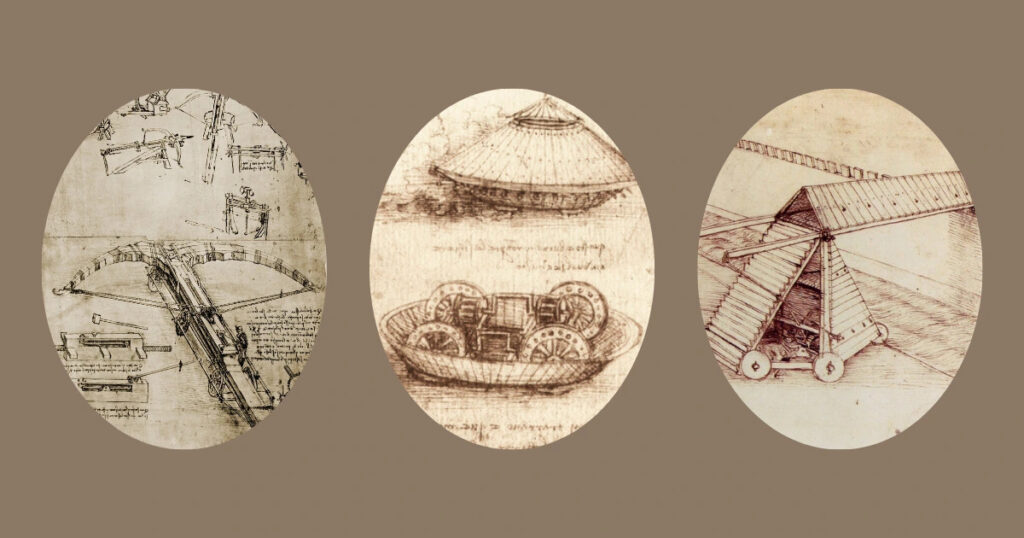
Leonardo da Vinci war machines reveal a side of the Renaissance master that few people picture when they think of the Mona Lisa. Long before he became famous as a painter, Leonardo worked as a military engineer, sketching weapons centuries ahead of their time.
These drawings weren't just fantasy. Rulers across Italy hired Leonardo specifically for his ability to imagine new ways of fighting, defending, and surviving on the battlefield.
Understanding why he designed them helps explain how his mind worked, and why his notebooks still fascinate historians, engineers, and travelers today.
This post is all about Leonardo da Vinci war machines and the ideas that made them possible.
What are Leonardo da Vinci war machines?
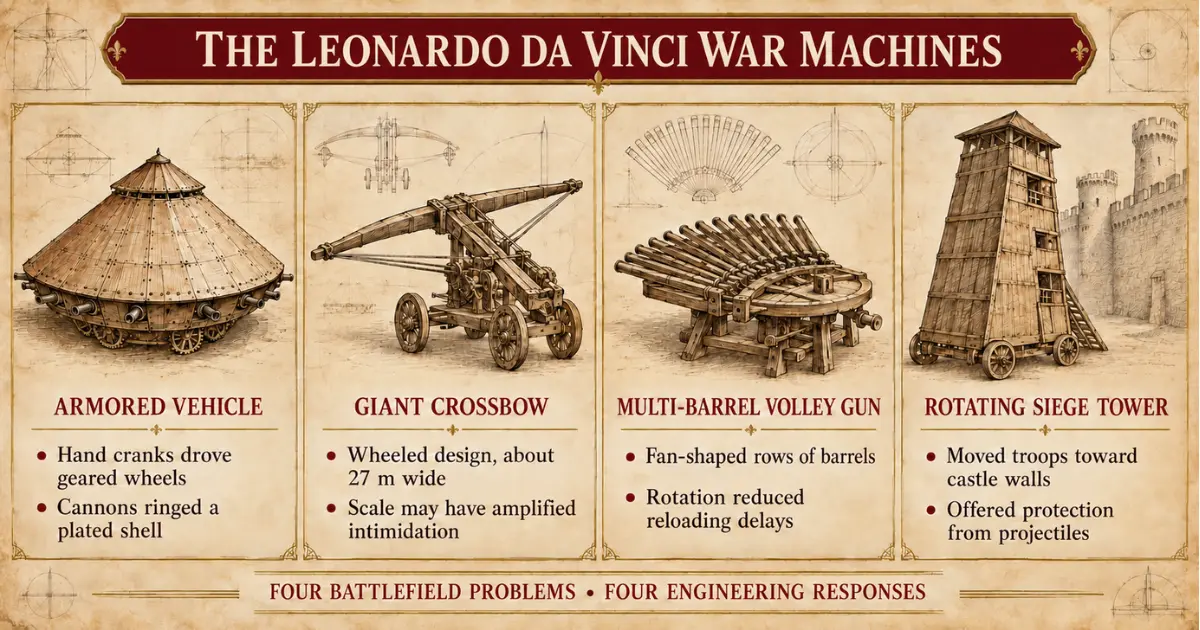
Leonardo da Vinci war machines are a collection of military inventions he sketched in his notebooks during the late 1400s and early 1500s, including an armored vehicle, a giant crossbow, a multi-barreled gun, and a rotating siege tower. Most were never built in his lifetime, but they showcased advanced engineering concepts still studied today.
The Engineering Idea Behind Leonardo da Vinci War Machines
Leonardo lived in a period when Italian city-states were almost constantly at war with each other. Milan, Florence, and Venice all needed engineers who could design fortifications, siege equipment, and weapons that gave their armies an edge. This demand shaped much of Leonardo's early career.
A Military Engineer Before a Painter
In 1482, Leonardo wrote a now-famous letter to Ludovico Sforza, the Duke of Milan. In it, he listed his skills as a military engineer first, mentioning bridges, cannons, armored vehicles, and siege equipment, before ever mentioning his talent for painting. This letter shows how seriously he approached the mechanics of warfare.
To understand how those sketches connect to real Milanese history, it helps to see the world Leonardo was designing for, and one way curious travelers do that is by exploring a guided walk through the historic quarters where Leonardo once worked for the Sforza court, such as a Milan walking tour covering Renaissance-era sites, which places his engineering career within the streets and courtyards where it actually unfolded.
Studying Nature to Understand Force
Leonardo's war machines weren't random inventions. He studied how birds flew, how water moved, and how muscles generated force, then applied those same observations to gears, levers, and springs.
This is why his weapon sketches often look almost biological, with parts that mimic joints, wings, or claws.
Designing for Defense, Not Just Attack
Many of his war machines were meant to protect soldiers as much as harm the enemy. His armored vehicle, for example, was designed to allow soldiers to move safely across open ground while still able to fire at attackers. This dual-purpose offense combined with protection is a theme that runs through nearly all of his military sketches.
How Leonardo da Vinci War Machines Work
Each of Leonardo's war machines solved a specific battlefield problem. Looking at how they were engineered shows just how far ahead of his time he really was.
The Leonardo da Vinci Tank: An Armored Vehicle Ahead of Its Time
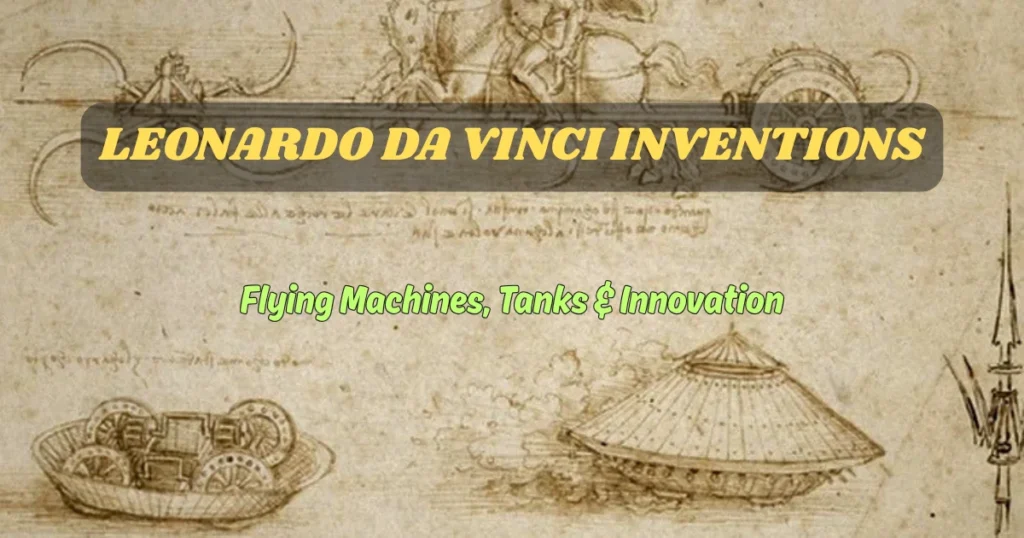
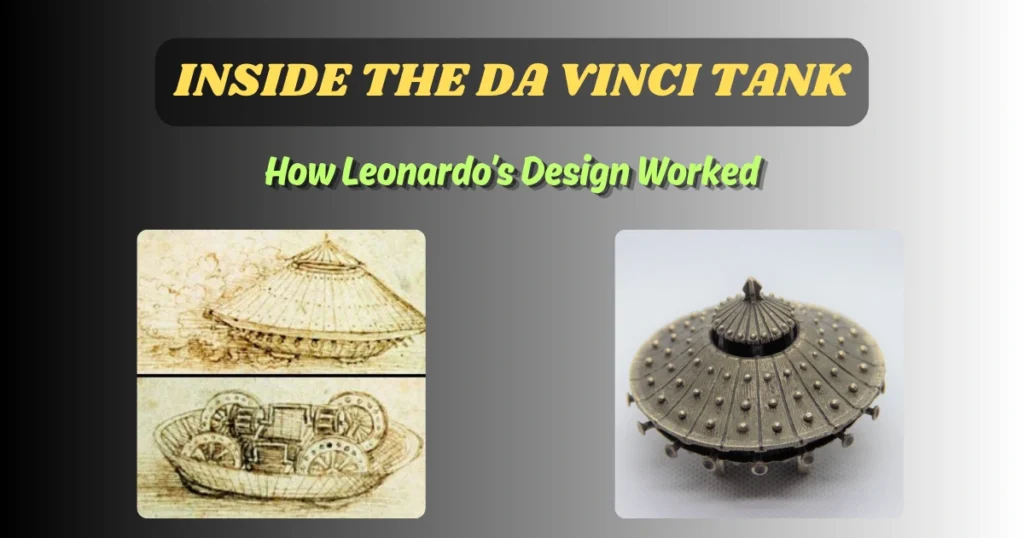
The design now nicknamed the "da Vinci tank" was a cone-shaped armored vehicle covered in metal plates, with cannons positioned around its circumference. Soldiers inside would turn a hand crank connected to gears, which rotated the wheels and moved the vehicle forward.
Historians who have studied the Leonardo da Vinci tank drawing note that Leonardo may have deliberately drawn the gears incorrectly, so the mechanism wouldn't actually work if the plans fell into enemy hands.
Interestingly, a full-scale replica of this Leonardo da Vinci armored car design was built centuries later, correcting the gear placement so that it could roll under its own power. It confirmed that the underlying concept, an early armored vehicle, was structurally sound even if the notebook version wasn't meant to be fully functional.
The Giant Crossbow: A Weapon of Psychological Warfare
Among his most striking sketches is a giant crossbow, sometimes called a ballista, estimated at 27 meters wide. The da Vinci giant crossbow was mounted on wheels for mobility and used a massive, bent bow arm to launch heavy projectiles, such as stones, at enemy fortifications.
Some historians argue that the sheer scale of Leonardo da Vinci's giant crossbow ballista was intended less for practical damage and more for intimidation. A weapon that size, rolled toward an enemy camp, would have been terrifying to see, regardless of how accurately it fired.
A Closer Look at Renaissance Military Sites
Several experiences around Milan and the Loire Valley let visitors connect these sketches to real locations
- Guided access to castle grounds once used for weapons testing and defense
- Explanations of how siege equipment like the giant crossbow was meant to function
- Time built in to view scale models based on Leonardo's original notebook sketches
Visitors often note that seeing a physical model makes the mechanics far easier to understand than the sketches alone.
The Da Vinci Machine Gun: A Multi-Barreled Solution to Reload Time
Reloading was one of the biggest weaknesses of early firearms. Leonardo's response was a design now referred to as the Leonardo da Vinci machine gun, though it functioned more like an early volley gun.
The Leonardo da Vinci machine gun design featured multiple barrels arranged in a fan shape, allowing soldiers to fire one row, then rotate to a fresh set of loaded barrels while the first row was reloaded.
This design directly targeted the problem of continuous fire, decades before anything resembling a true machine gun existed. It's one of the clearest examples of how Leonardo approached weapons as engineering puzzles rather than simple tools.
The Rotating Siege Tower
Leonardo also sketched a mobile siege tower designed to move troops up to castle walls while offering some protection from arrows and projectiles. Taken together with his other siege-equipment concepts, this shows a consistent focus on solving the logistics of attacking fortified positions, not just the moment of combat itself.
Where to See Leonardo da Vinci War Machines Today
None of Leonardo's original war machines survive as functioning devices, since almost all of them stayed on paper. However, his notebooks and later reconstructions are on public display at several locations associated with his life and work.
Museo Nazionale della Scienza e della Tecnologia, Milan
This science and technology museum in Milan houses one of the largest collections of models built from Leonardo's sketches, including versions of his armored vehicle and other military inventions. Seeing full-size wooden models makes the mechanics of the Leonardo da Vinci tank and crossbow far more tangible than viewing a flat sketch.
The Codex Atlanticus at Biblioteca Ambrosiana
Many of Leonardo's military inventions are documented in the Codex Atlanticus, a bound collection of his drawings and notes held at the Biblioteca Ambrosiana in Milan. Pages are rotated periodically for preservation, so what's on display changes over time.
Château du Clos Lucé, France
In the final years of his life, Leonardo lived near Amboise, France, where models of many of his inventions, including several war machines, are displayed today in the château's gardens and interior.
Walking through spaces tied directly to where these sketches were drawn tends to change how people read them. What looks abstract on a notebook page starts to make sense as a solution to a real, physical problem, which is part of why many travelers pair a museum visit with
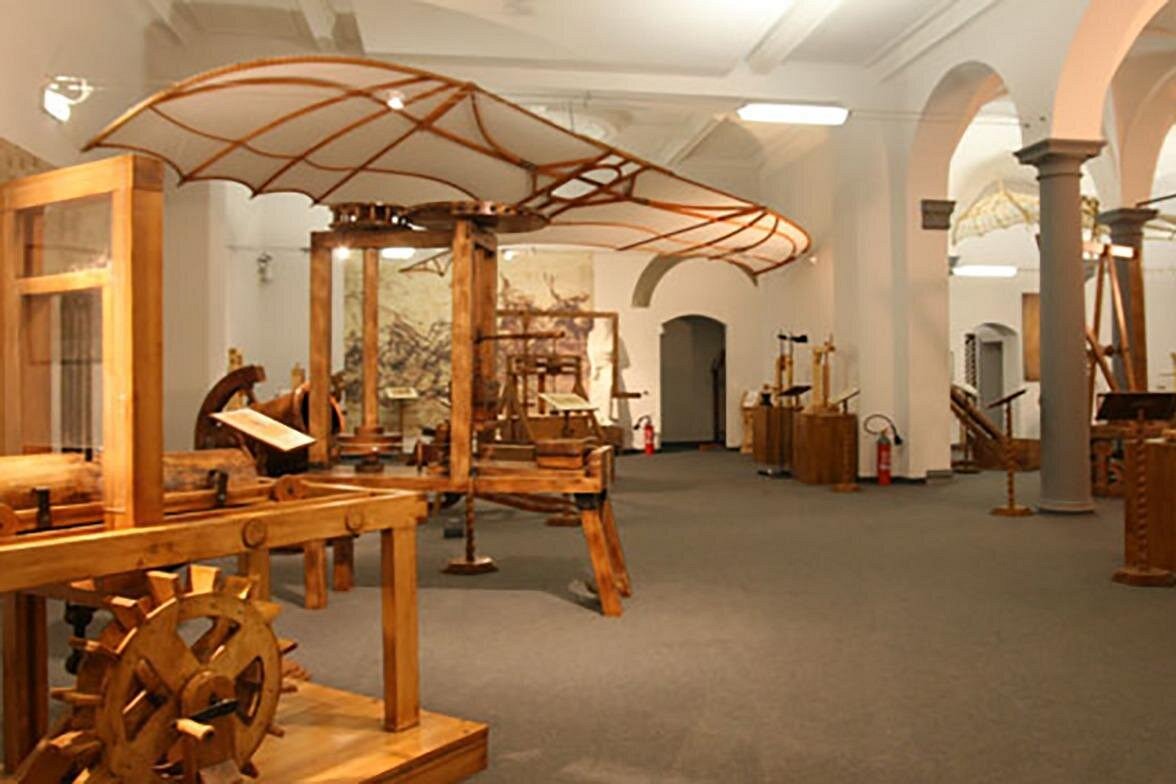
Discover Leonardo Machines in Milan
See full-scale reconstructions of Leonardo’s inventions and discover the engineering ideas behind his designs
Explore Leonardo Military DesignsMany visitors say the models help the engineering finally click in a way the sketches alone don't. View this Milan museum experience
Exploring Leonardo da Vinci in Milan
Milan was the city where Leonardo first developed his identity as a military engineer, working under Duke Ludovico Sforza for nearly two decades. It's also where the largest concentration of his war machine models is on display today, making it a natural starting point for anyone curious about this side of his career.
Leonardo's story doesn't stay in one place, though. His path continues through Florence, where he trained as a young artist; Venice, where he consulted on canal defenses; Rome, where he worked briefly under papal patronage; and finally Paris and the Loire Valley, where he spent his final years under King Francis I.
Experiencing Leonardo's Military Genius in Person
Reading about the Leonardo da Vinci tank or the giant crossbow ballista is one thing. Standing in front of a full-scale model built from his actual notebook measurements is an entirely different experience. It's where the engineering stops being an abstract idea and becomes something you can walk around and study up close.
Milan's science museum, the Ambrosiana library, and the grounds at Clos Lucé each offer a different piece of this story, from the original sketches to the physical reconstructions. Visiting even one of these sites tends to reshape how people think about Leonardo, shifting him from "the painter of the Mona Lisa" to a working military engineer who happened to also be one of history's greatest artists.
For travelers building a Renaissance-focused itinerary, a guided museum experience is a straightforward, low-effort way to see these models with the historical context explained on-site rather than pieced together from a plaque. Explore Leonardo da Vinci Experiences in Milan
Final Thoughts
This post was all about Leonardo da Vinci war machines, from the armored tank and giant crossbow to the multi-barreled gun and rotating siege tower.
What stands out across all of them isn't whether they were ever built, but the way Leonardo approached warfare as a series of engineering problems to be solved carefully, rather than as weapons to be feared.
That mindset, curiosity applied to nearly every field at once, is a large part of why his notebooks are still studied over 500 years later. Seeing the models in person, whether in Milan or at Clos Lucé, is one of the more direct ways to appreciate just how far his imagination reached beyond the canvas.
Related Post You May Like

Disclosure: This page may contain affiliate links. If you book through them, we may earn a small commission at no extra cost to you. Learn more.
Free Leonardo Milan Travel Guide
Plan Your Leonardo Trip in Milan
A premium mini guidebook for smarter Milan planning, including the best ticket strategy, Leonardo map, and practical visitor advice.
Get the Free Guide
Download the guide and receive practical Milan planning tips by email.
Download the Free Guide >> Leonardo Bianchi is the founder of Leonardo da Vinci Inventions & Experiences, a cultural travel guide helping visitors explore Leonardo da Vinci’s art, inventions, and legacy across Italy and Paris.