
(Last updated: Sep 2026)
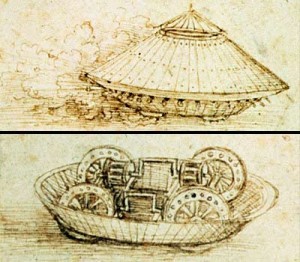
In 1487, Leonardo da Vinci sketched a war machine so far ahead of its time that historians still call it the da Vinci tank. It looked nothing like the tanks we know today, yet it carried the same idea: a mobile, armored shell that could carry weapons safely into battle.
Leonardo drew it not as a fantasy but as a real proposal, submitted to a duke who was actively seeking new ways to win wars.
The design matters because it shows how Leonardo thought. He wasn't just an artist chasing beauty. He was an engineer solving problems that wouldn't have real solutions for another four hundred years.
That combination of imagination and mechanical logic is exactly why standing in front of his sketches today feels different from looking at ordinary historical documents. You're looking at the first draft of an idea the world hadn't caught up to yet.
This post is all about the da Vinci tank, how it was designed, how it was meant to work, and where you can still see traces of it in Italy today.
What is the da Vinci Tank?
The da Vinci tank is a design for an armored military vehicle sketched by Leonardo da Vinci around 1487. Shaped like a flattened cone covered in angled wooden and metal plating, it was designed to carry multiple cannons and be propelled by manual crank power, protecting soldiers inside while firing outward in nearly every direction.
The Engineering Idea Behind the da Vinci Tank
A New Kind of War Machine
Warfare in the 1480s was brutal and mostly unprotected. Foot soldiers marched into open fields, cannons sat exposed on carts, and cavalry charges relied on speed rather than defense.
Leonardo looked at this problem the way he looked at anatomy or hydraulics: as a system that could be redesigned from the ground up. If soldiers were vulnerable because they had no cover, then the solution was to give them cover that could still move and still fight.
Leonardo's Military Ambitions in Milan
Leonardo pitched this idea while working for Ludovico Sforza, the Duke of Milan. In a now-famous letter, he listed his skills as a military engineer before ever mentioning painting. Among his claims was a covered vehicle, safe from enemy fire, that could break into enemy formations with cannons mounted around it.
This wasn't an isolated sketch. It fit inside a much larger set of Leonardo da Vinci military inventions, ranging from siege equipment to underwater breathing devices, all designed for a court that needed a military edge.
The Sketches That Changed Warfare Thinking
The surviving da Vinci tank sketch shows the vehicle from above and in cross-section, a technique Leonardo used constantly in his notebooks. This wasn't decorative drawing. It was functional documentation, closer to a modern engineering blueprint than to fine art.
That's part of why the Leonardo da Vinci tank drawing is still studied today: it reveals not just what he wanted to build, but how he thought through the mechanics of building it.
The gear mechanism sketched inside the vehicle is especially revealing, since it shows Leonardo working through the same rotational problems he explored in his studies of Renaissance Milan's engineering landmarks, where visitors can still trace how his mechanical thinking shaped the city around him.
How the da Vinci Tank Works
The Circular Armored Shell
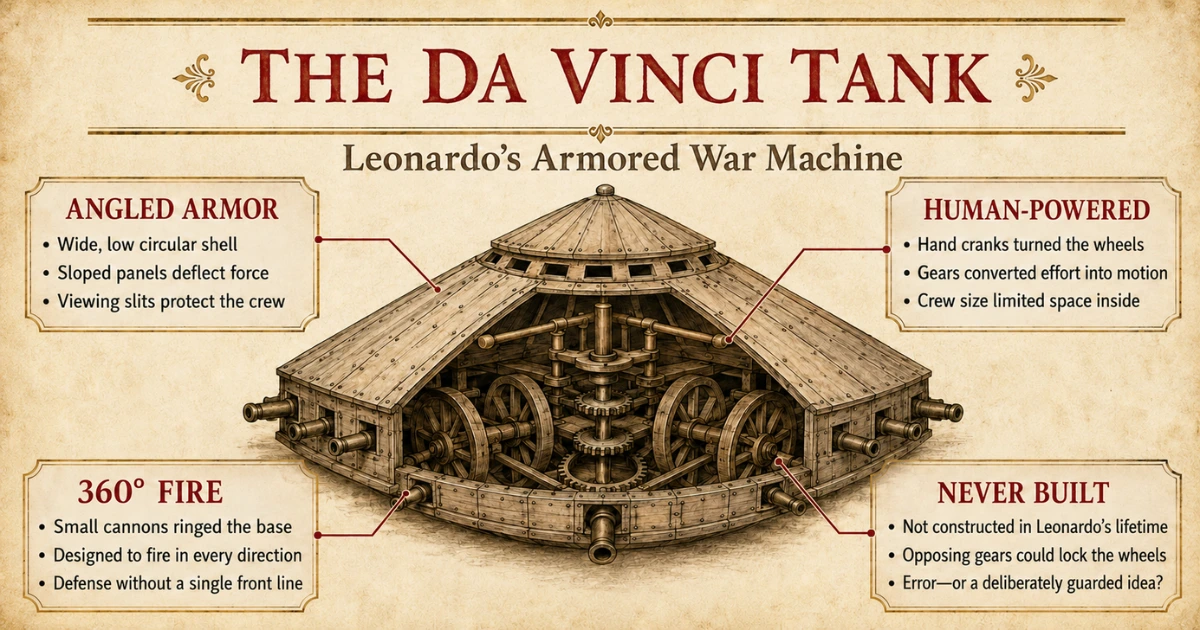
The da Vinci tank design is built around a wide, low, circular shell made of angled wooden panels reinforced with metal. The angle wasn't random. Sloped surfaces deflect incoming force better than flat ones, a principle modern armored vehicles still use. Small viewing slits along the top let the crew see out while staying protected inside.
The Hand-Cranked Gear System
Instead of an engine, Leonardo da Vinci armored car relied on manpower. Soldiers inside turned hand cranks connected to a gear system, which in turn moved the wheels. It was a clever way to translate human effort into mechanical motion, but it also introduced a serious limitation, since a crew large enough to move the vehicle left little room for the cannons it was meant to carry.
Cannons in Every Direction
Around the base of the shell, Leonardo placed a full ring of small cannons. In theory, the da Vinci armored car could fire outward at attackers approaching from any angle, something no other battlefield vehicle of the era could do.
This 360-degree firing arc is the detail most often cited in discussions of Leonardo da Vinci armored car concepts, because it shows Leonardo thinking about defense as a complete circle, not just a single front line.
Was the da Vinci Tank Ever Used?
No. The da Vinci tank was never built during Leonardo's lifetime, and most historians agree it likely couldn't have worked exactly as drawn. Later analysis of the sketch revealed that the front and rear gears were connected in a way that would have made the wheels turn in opposite directions, effectively locking the vehicle in place.
Some researchers believe this was simply an error. Others argue Leonardo deliberately drew a flawed mechanism in a proposal he knew a rival power might see, keeping the real, workable version for himself. Either explanation fits what we know about how carefully he guarded his ideas.
Where to See the da Vinci Tank Today
Museo Nazionale della Scienza e della Tecnologia in Milan
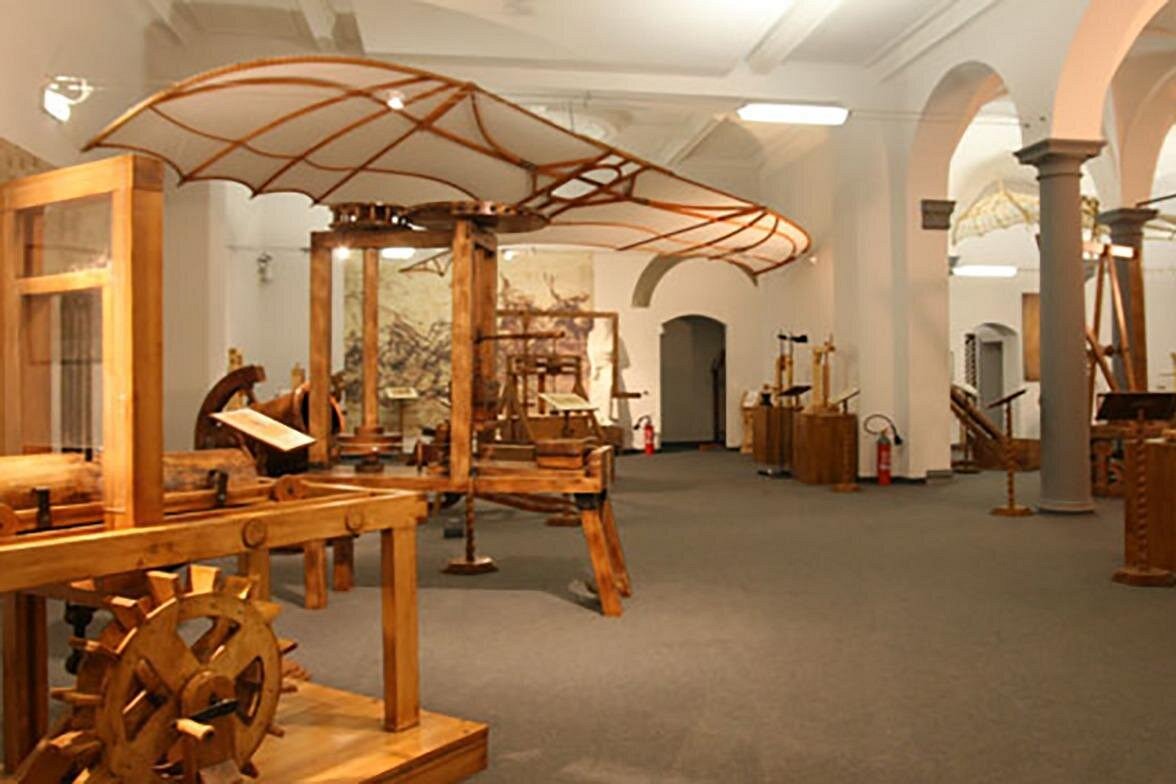
The best place to see the da Vinci tank brought to life is the Museo Nazionale della Scienza e della Tecnologia Leonardo da Vinci in Milan. The museum houses a full, working wooden model built from Leonardo's original notes, allowing visitors to see exactly how the gears, wheels, and cannon ring were meant to fit together.
Working Replicas and Models
Beyond Milan, replicas of the tank appear in exhibitions across Europe, often alongside models of Leonardo's other mechanical designs.
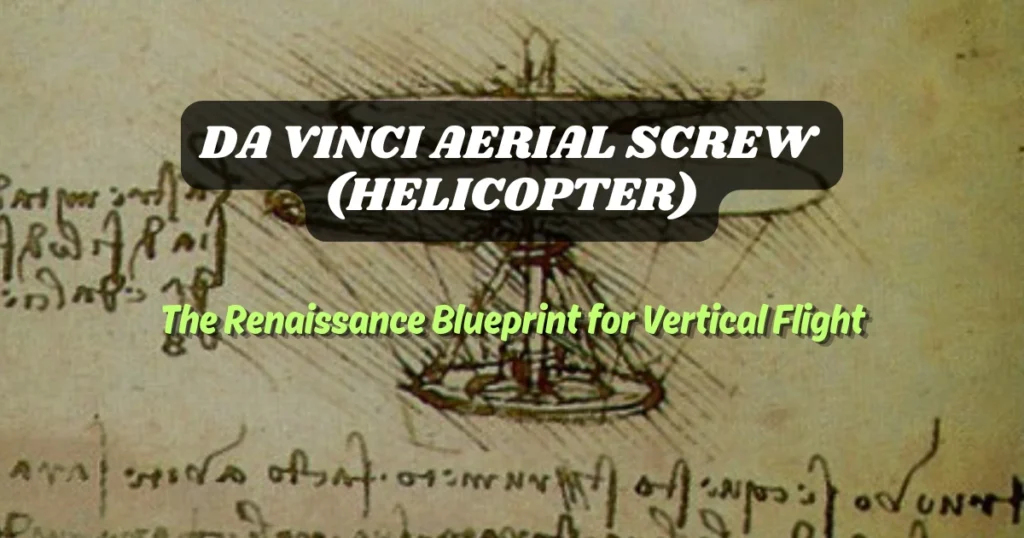
Seeing the models side by side makes it easier to understand how the tank connects to his broader engineering interests, including the Leonardo da Vinci flying machine and the Leonardo da Vinci helicopter concept, both of which share the same instinct for solving movement problems with gears and manual power.
Discover Leonardo Machines in Milan
See full-scale reconstructions of Leonardo’s inventions and discover the engineering ideas behind his designs
Explore Leonardo Museum ToursLeonardo da Vinci Museum Experience, Milan
A guided walkthrough of the Museo Nazionale della Scienza e della Tecnologia, focused entirely on Leonardo's mechanical inventions.
- Working models of the armored car, flying machine, and gear systems
- Context from a guide on how each sketch connects to Leonardo's notebooks
- Flexible entry times to fit a wider Milan itinerary
Many visitors find that seeing the mechanisms move in person makes the engineering click in a way the sketches alone don't. Check availability
Codex Atlanticus and Leonardo's Notebooks
The original Leonardo da Vinci tank sketch belongs to a larger collection called the Codex Atlanticus, housed at the Biblioteca Ambrosiana in Milan. Pages from the codex are rotated on display, so the tank drawing itself isn't always on view, but the surrounding pages still show the same handwriting, mirror script, and rapid-fire sketching style that produced it.
Exploring Leonardo da Vinci in Milan
Milan is where Leonardo spent nearly two decades of his working life, and it's where most of his military engineering ideas, including the tank, took shape. The city still holds physical traces of that period, from the science museum's mechanical models to the Church of Santa Maria delle Grazie, where his mural work happened just a short walk from where he was drafting weapons for the Sforza court.
For readers building a wider Leonardo itinerary, Milan pairs naturally with the artist's other major cities. Milan covers his engineering and military years, Florence covers his early training, Venice holds his hydraulic and defense proposals, Rome covers his later scientific work, and Paris is where he spent his final years and where the Louvre now holds several of his paintings.
Experience Leonardo's Genius in Milan Today
Reading about the da Vinci tank is one thing. Another stands next to a working model of it. In Milan, the gap between the sketch and the machine closes almost completely. Visitors can watch the gear system turn, see how the angled armor was meant to deflect force, and understand firsthand why the design was both brilliant and, in its original form, unworkable.
That kind of firsthand encounter with Leonardo's mechanical mind is really what a visit to Milan is built around, since the notebooks, the models, and the city itself all point back to the same restless engineering curiosity.
Travelers planning a stop at the science museum often combine it with a broader look at Leonardo's Milan, which is easy to arrange through a Leonardo da Vinci walking tour of Milan that covers the sites most closely tied to his engineering years.
Final Thoughts
This post was all about the da Vinci tank, the armored, hand-cranked war machine Leonardo sketched more than five hundred years ago.
It never rolled into battle, and its gears may have been designed to fail on purpose, but it still captures something essential about how Leonardo worked. He treated warfare, art, and anatomy as the same kind of puzzle, one that could be taken apart and rebuilt with better logic.
That's the real value of the Renaissance to a modern traveler. It's not just paintings behind glass. It's the chance to stand where these ideas were first drawn, and to see, in wood and metal, what one mind imagined long before the rest of the world was ready for it.
Related Post You May Like

Disclosure: This page may contain affiliate links. If you book through them, we may earn a small commission at no extra cost to you. Learn more.
Free Leonardo Milan Travel Guide
Plan Your Leonardo Trip in Milan
A premium mini guidebook for smarter Milan planning, including the best ticket strategy, Leonardo map, and practical visitor advice.
Get the Free Guide
Download the guide and receive practical Milan planning tips by email.
Download the Free Guide >> Leonardo Bianchi is the founder of Leonardo da Vinci Inventions & Experiences, a cultural travel guide helping visitors explore Leonardo da Vinci’s art, inventions, and legacy across Italy and Paris.