
(Last updated: Sep 2026)
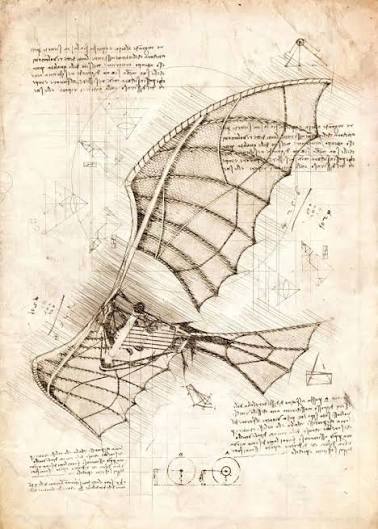
The da Vinci ornithopter is one of the most famous flying machine concepts ever sketched by a human hand. Long before airplanes existed, Leonardo da Vinci imagined a wooden and fabric contraption that could flap like a bird and lift a person into the sky.
To understand this invention is to step inside the mind of a man who watched birds for hours, studied their wings bone by bone, and refused to accept that flight was reserved for animals alone.
His notebooks show a historical importance that goes far beyond a single sketch: they mark one of the earliest serious, mechanically reasoned attempts to solve human flight, centuries before the Wright brothers ever tested a glider at Kitty Hawk.
Most people know Leonardo as a painter, but the ornithopter is proof that his real obsession was systems — how muscle, bone, air, and wood could be arranged to do something nature had already perfected.
Seeing these pages in person, in the cities where Leonardo actually lived and worked, adds a layer of wonder that no textbook photo can replicate. A printed diagram in a history book feels static.
The same diagram, viewed a few feet from Leonardo's own handwriting in a Milanese archive, feels like a living idea that simply hasn't finished happening yet. That gap between "concept" and "flight" is exactly what makes this invention endlessly fascinating to travelers, engineers, and dreamers alike.
This post is all about the da Vinci ornithopter, the thinking behind it, how it was supposed to work, and where you can still encounter it today.
What is the da Vinci ornithopter?
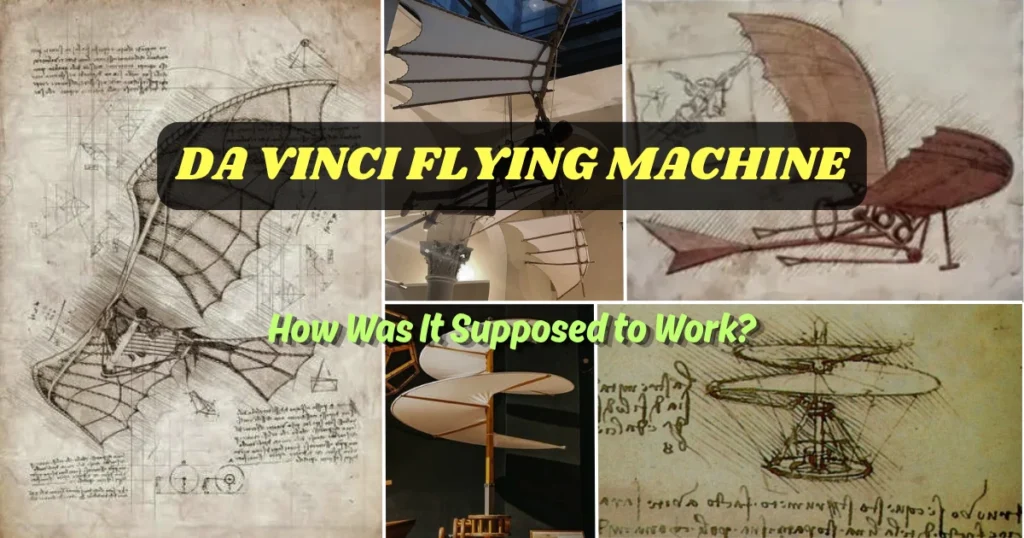
The da Vinci ornithopter is a flying machine concept designed by Leonardo da Vinci in the late 1480s. It used large, hinged wings powered by a person's arms and legs, mimicking a bird's flapping motion in flight. Leonardo never built a full-scale working version, but his detailed sketches remain some of the earliest engineering studies of powered human flight.
The Engineering Idea Behind the da Vinci Ornithopter
Leonardo did not start with a machine. He started with a question: why can birds fly, and why can't we? That question sent him down a path of observation that few of his contemporaries would have bothered to walk.
Watching Birds Before Building Wings
Leonardo filled pages of his notebooks with studies of bird anatomy, feather structure, and wing motion. He dissected bird wings, measured their proportions, and compared them to the human arm.
This research became the foundation for what we now call the Leonardo da Vinci wing designs — mechanical limbs meant to copy nature rather than compete with it.
From Biology to Blueprint
Once Leonardo understood how a wing generated lift, he translated that biology into wood, leather, and rope. His ornithopter drawings show pulleys, levers, and pedal systems, all designed so that a person lying face down could flap the wings using both arm strength and leg power.
This is the same engineering instinct behind the aerial screw da Vinci inventions, another flight concept from the same creative period, though it worked on a completely different principle.
A Machine Ahead of Its Materials
The idea was sound in theory but limited by technology. Sixteenth-century materials simply couldn't produce the strength-to-weight ratio needed for a human to generate enough lift by muscle power alone.
Leonardo may have sensed this limitation himself, which is part of why later sketches shift away from flapping wings toward gliding and screw-based designs.
The Role of the Renaissance Workshop
Leonardo didn't develop these ideas in isolation. He trained in Florentine workshops where painters, sculptors, and engineers often shared the same physical space and the same problem-solving habits.
That environment taught him to treat a flying machine the way he treated a fresco: plan every proportion before touching the final material.
This same disciplined approach shows up across his other flight concepts, including a Leonardo da Vinci glider he sketched as a simpler, unpowered alternative to the flapping-wing design, and the rotating aerial screw, a da Vinci invention later generations would compare to an early helicopter rotor.
A Dream Rooted in Real Physics
What separates Leonardo's approach from earlier flight myths — stories of wax wings and doomed leaps from towers — is that he was working from measurable physical principles.
He studied air resistance, the angle of a wing during descent, and the way a bird adjusts its tail to steer. These weren't guesses. They were early, hand-drawn versions of what aerodynamics would eventually become as a formal science, hundreds of years later.
How the Da Vinci Ornithopter Works
At its core, the machine was meant to function like an enormous mechanical bird strapped to a human pilot.
The Wing Mechanism
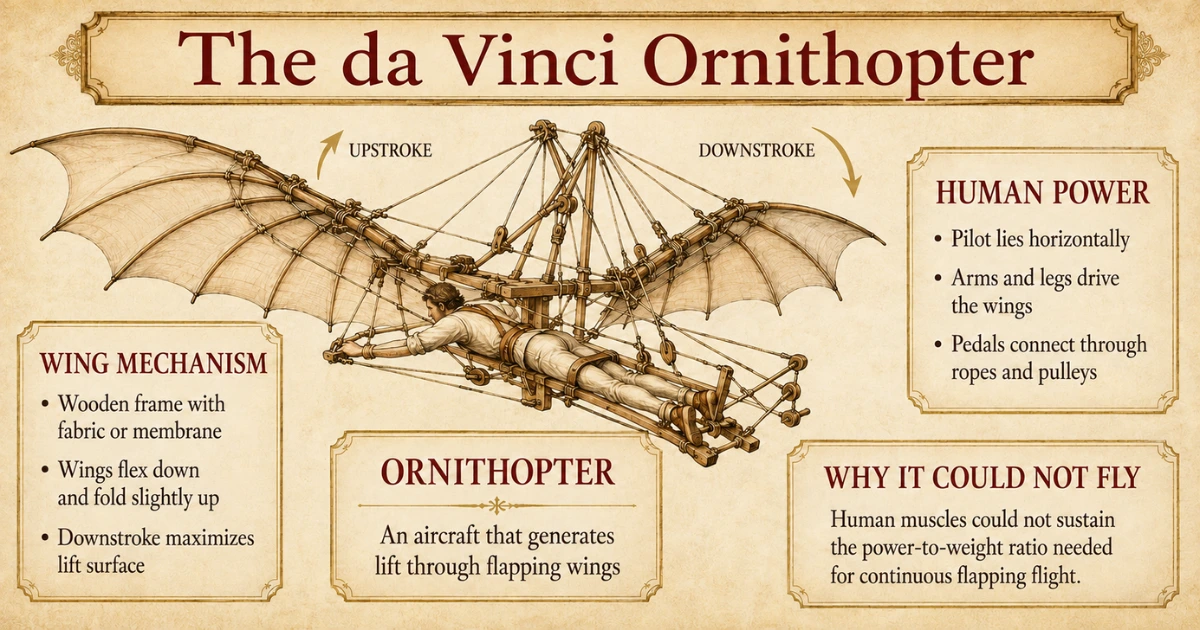
The wings were built from a wooden frame covered in stretched fabric or animal membrane, designed to flex on the downstroke and fold slightly on the upstroke, much like a real bird's wing.
This flexing motion is central to how the ornithopter works: it reduces resistance when the wing rises and maximizes lift-generating surface when the wing pushes down.
Some of Leonardo's most detailed studies survive today, including a Leonardo da Vinci ornithopter sketch showing the pilot lying horizontally, using foot pedals connected to the wing frame by rope-and-pulley systems, freeing the arms to control a separate wing motion.
Human Power as the Engine
Because there were no engines in the 1480s, the pilot's own body supplied all the energy. Leonardo calculated that combining arm and leg strength would produce a greater flapping force than arms alone, which is why several versions of da Vinci's ornithopter drawings show a full-body harness rather than simple handheld wings.
Why It Never Truly Flew
Modern engineers have tested scale replicas, and the consensus is consistent: human muscles cannot sustain the power-to-weight ratio required for continuous flapping flight. The concept was brilliant, but the human body itself was the missing engine.
This is one reason historians still debate exactly who invented the ornithopter as a workable device, since Leonardo's version remained theoretical rather than proven in the air.
Even so, the term "ornithopter" is now used broadly to refer to any aircraft that generates lift through flapping motion, a category whose intellectual roots trace directly back to Leonardo's sketches.
How It Compares to Leonardo's Other Flight Concepts
The ornithopter wasn't Leonardo's only attempt at solving flight, and comparing it to his other designs makes his engineering range clearer.
The da Vinci wings concept relied entirely on muscle-powered flapping, while his later glider studies removed the flapping motion altogether and focused on gliding down from height using fixed, rigid wings, closer in spirit to how modern hang gliders work.
His Leonardo da Vinci aerial screw, sometimes nicknamed an early helicopter, took a third approach entirely, using a rotating spiral surface to try to "screw" itself upward through the air rather than flapping or gliding.
None of the three ever flew in Leonardo's lifetime, but together they show a mind testing every plausible mechanical path to the same goal.
A Closer Look at the Notebooks
Leonardo's flight studies are scattered across several manuscripts, including the famous da Vinci's dream of flight preserved in the Codex on the Flight of Birds.
- Detailed wing anatomy comparisons between birds and humans
- Mechanical diagrams for pedal and pulley systems
- Early notes that hint at the later Leonardo da Vinci glider concepts
Visitors who study these pages in person often note how small and precise the handwriting is, a detail that rarely comes across in printed reproductions.
Where to See the Da Vinci Ornithopter Today
You won't find a flying original, but you will find something arguably more valuable: the actual sketches, wooden models, and detailed reconstructions built from Leonardo's own measurements.
Milan and the Codex Atlanticus
Many of Leonardo's engineering pages, including flight studies related to the Leonardo da Vinci flying machine concept, are held in Milan's Biblioteca Ambrosiana as part of the Codex Atlanticus. Milan was also where Leonardo spent years working for Ludovico Sforza, developing engineering ideas that ranged from war machines to flight.
Museum Models and Reconstructions
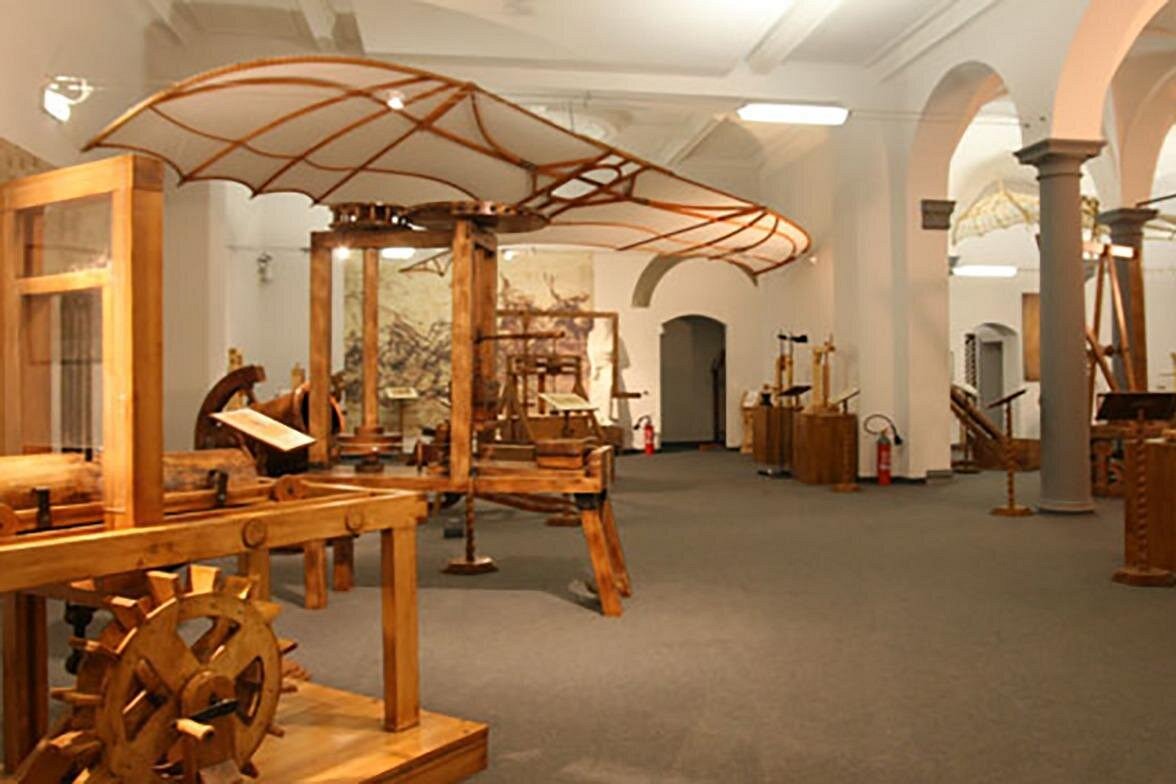
Several museums have built full-scale wooden models based directly on Leonardo's ornithopter drawing and wing measurements. Walking around one of these models makes the mechanics click in a way that a flat diagram never quite manages — you can see exactly how the pedal connects to the wing joint.
Wandering through a gallery dedicated to Leonardo's engineering sketches naturally leads many travelers to a guided exploration of Milan's Leonardo da Vinci Museum of Science and Technology, which helps connect the notebook pages to the physical city where Leonardo actually worked.
Beyond Milan
Related sketches and studies appear in collections in Turin, Paris, and the Royal Library at Windsor. Together, these pages form the most complete record we have of any Renaissance attempt at engineered human flight.
The Codex on the Flight of Birds, specifically, held in Turin, is considered one of the purest examples of Leonardo's study of nature before drawing a single mechanical part.
Why the Legacy Still Matters
Modern aerospace engineers still reference Leonardo's flight studies, not because his exact mechanisms work, but because his method does. Observe nature, translate the observation into measurable mechanics, then test the design against real-world limits.
That process is the backbone of aerospace engineering today, and it's part of why so many aviation museums worldwide credit Leonardo, even briefly, as a conceptual starting point for human flight rather than a footnote.
Exploring Leonardo da Vinci in Milan
Milan is where much of Leonardo's engineering imagination took shape. He arrived in the early 1480s at the invitation of the Sforza court, and during these Milanese years he produced most of his flight studies, war machine designs, and mechanical sketches.
Beyond the flight studies, the city holds "The Last Supper" and decades of records from his time serving the Sforza dukes, making it one of the richest starting points for tracing his mechanical mind. Walking Milan's historic center today, it's easy to imagine an engineer-artist splitting his time between painting commissions and sketchbooks full of wings and gears.
From Milan, Leonardo's story naturally extends outward. His artistic training took root in Florence, where he apprenticed under Verrocchio and first began blending art with observational science.
His final years unfolded in Paris, where he lived under the patronage of King Francis I and where many of his manuscripts eventually came to rest. His broader Italian legacy connects through Venice, where he briefly advised on military engineering, and Rome, where Renaissance engineering and art both flourished under papal and noble patronage.
Tracing this path city by city turns Leonardo from a name in a textbook into a traveler's itinerary.
Experiencing Leonardo's Flight Studies in Person
Reading about the ornithopter is one thing. Standing in front of the actual pages where Leonardo worked out wing ratios and pulley angles is an entirely different experience. It reframes the invention from "an old sketch" into "a real engineering attempt by a real person," which is exactly the shift that makes Renaissance history feel alive rather than distant.
Milan's museums dedicated to Leonardo's engineering work display wooden reconstructions of the ornithopter alongside his other flight concepts, including the aerial screw and glider studies. Seeing the scale of these models side by side helps explain why some of his ideas eventually worked centuries later, while flapping-wing flight remained out of reach.
Explore Leonardo’s Machines in Milan
See full-scale reconstructions of Leonardo’s inventions and discover the engineering ideas behind his designs
Explore Leonardo Museum ToursLeonardo da Vinci Engineering Trail, Milan
A guided walk through the sites and museum halls connected to Leonardo's mechanical studies, including his flight sketches.
- Small-group access to key Leonardo engineering exhibits
- Context on the Codex Atlanticus and flight manuscripts
- Time to view full-scale wooden machine reconstructions
Travelers often mention how much clearer the mechanics feel once they've seen a full-scale model up close. View this experience
Before deciding how deeply to delve into Leonardo's flight studies, it helps to know the exhibits are self-paced, well-documented in English, and organized around the same engineering logic Leonardo used himself — biology first, mechanics second.
Final Thoughts
This post was all about the da Vinci ornithopter, and the deeper you go into it, the clearer it becomes that Leonardo wasn't just doodling fantasy machines. He was applying real observation, real anatomy, and real mechanics to a problem humanity wouldn't solve for another four hundred years. That combination of curiosity and discipline is the real signature of the Renaissance mind.
Whether you're drawn to the biology behind the wing design, the mechanics of the pedal system, or simply the boldness of the dream itself, the ornithopter remains one of the clearest windows into how Leonardo thought. It shows a Renaissance mind treating a myth — human flight — as a solvable engineering problem, centuries before the tools existed to actually solve it.
And if you ever find yourself in Milan, standing in front of the notebook pages or a full-scale reconstruction, you'll understand why so many people say the sketches feel more alive in person than in any book.
The wing joints, the pulley angles, the tiny corrections in the margins — they all point to a man who wasn't just dreaming about flight. He was working, patiently and methodically, to earn it.
Related Post You May Like

Disclosure: This page may contain affiliate links. If you book through them, we may earn a small commission at no extra cost to you. Learn more.
Free Leonardo Milan Travel Guide
Plan Your Leonardo Trip in Milan
A premium mini guidebook for smarter Milan planning, including the best ticket strategy, Leonardo map, and practical visitor advice.
Get the Free Guide
Download the guide and receive practical Milan planning tips by email.
Download the Free Guide >> Leonardo Bianchi is the founder of Leonardo da Vinci Inventions & Experiences, a cultural travel guide helping visitors explore Leonardo da Vinci’s art, inventions, and legacy across Italy and Paris.