
(Last updated: Sep 2026)
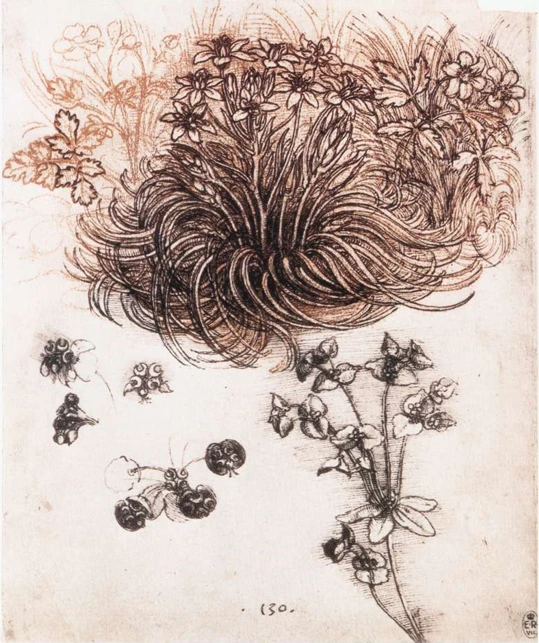
Leonardo da Vinci nature studies reveal an artist who treated every leaf, root, and eddy of water as a scientific puzzle worth solving. He didn't just draw what he saw. He drew what he understood, after staring at it far longer than most people ever would.
That habit of relentless looking is why his botanical drawings still feel alive five centuries later. Long before microscopes or field guides existed, he was already asking why a leaf spirals the way it does, or why a river bends the way it does, and answering with a pencil instead of a formula.
These studies matter beyond art history. They show the private side of a public genius, the sketches he made for no one but himself, with no patron watching and no commission to fulfill. That privacy is part of the appeal.
Seeing these pages in person, even briefly, changes how his finished paintings read afterward, because you start noticing the same restless curiosity hiding in the folds of a painted sleeve or the curl of a painted river.
This post is all about Leonardo da Vinci nature studies, where they came from, why they became some of the most studied drawings in history, and where you can still find them today.
What are Leonardo da Vinci nature studies?
Leonardo da Vinci nature studies are the artist's drawings and notes on plants, water, geology, and natural forms, made between roughly 1478 and 1519. They include botanical studies such as the Star of Bethlehem, water studies from his notebooks, and observations later recorded in codices such as the Codex Leicester.
The Artistic Genius Behind Leonardo da Vinci's Nature Studies
Drawing as a Form of Thinking
For Leonardo, a drawing wasn't a finished product. It was a way of working through a question. When he sketched a plant, he was measuring it, comparing it to others, and testing an idea about how growth itself worked. Art historians describe this as visual thinking: using the pencil the way a modern scientist might use a lab notebook.
This is part of what separates his botanical drawings from the decorative plant illustrations common in his era. Leonardo wasn't illustrating a known fact. He was trying to discover one, one careful line at a time.
The Rule Hidden in a Tree
One of his most striking observations, now sometimes called da Vinci's rule, concerns tree branches. He noticed that if you add up the cross-sectional area of all the branches at any height in a tree, the total roughly equals the cross-sectional area of the trunk below them. Botanists confirmed the pattern centuries later. Leonardo saw it just by looking, and by looking again, and again.
He applied the same patience to how leaves spiral around a stem, a pattern scientists now call phyllotaxis. Long before anyone had a name for it, Leonardo had already sketched the geometry.
From Loose Sheets to Bound Codices
Leonardo never organized his own notes for publication. He worked on loose sheets, folded pamphlets, and small notebooks he carried on his belt, jotting observations wherever he happened to be standing.
After his death in 1519, his student Francesco Melzi inherited the papers and tried to bring some order to the chaos, but the full archive was eventually scattered across collections in Milan, Paris, London, and beyond.
That scattering is part of why Leonardo da Vinci's nature studies can feel like detective work today. A single train of thought about a plant's growth pattern might start on one sheet in Windsor and continue, years later and pages away, in a notebook now sitting in a different country entirely.
Piecing the ideas back together is still an active area of scholarship.
Why Leonardo da Vinci's Nature Studies Became Famous
The Star of Bethlehem and Botanical Accuracy
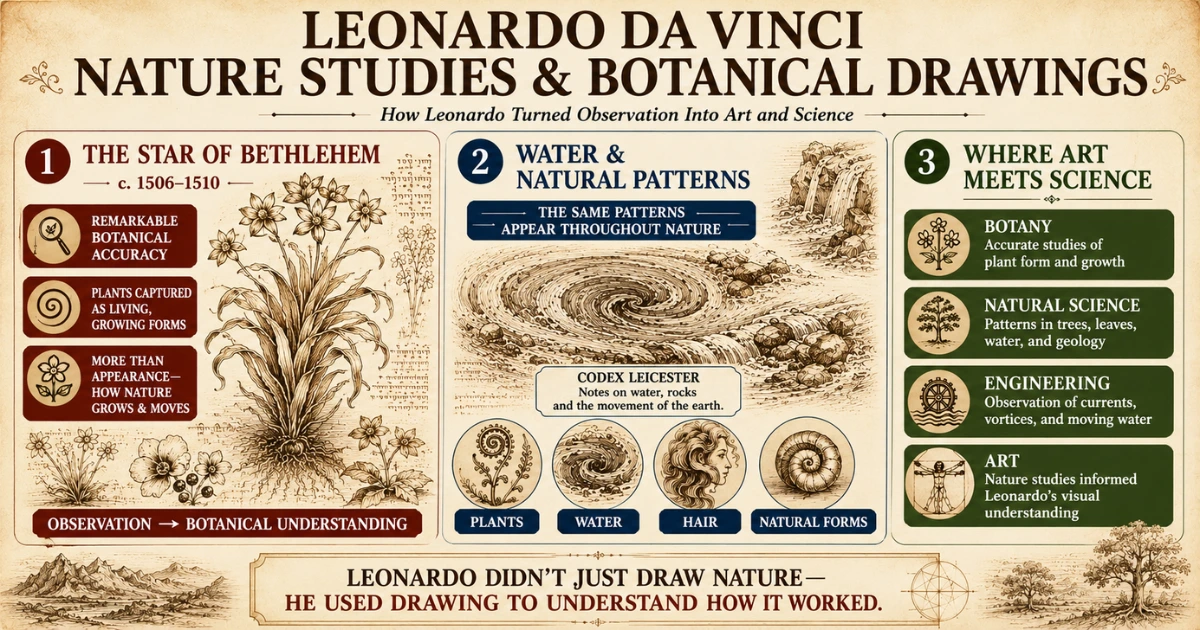
Leonardo's drawing known as The Star of Bethlehem and Other Plants, made around 1506 to 1510, is often held up as the high point of his botanical work. The central plant is rendered with a spiraling, almost restless energy, its leaves twisting exactly the way they do in life.
Surrounding plants, including wood anemone and spurge, are drawn with the same exactness. Botanists today still use the sheet to confirm which species he was looking at.
What makes the drawing remarkable isn't just the accuracy. It's the sense of motion. Leonardo didn't draw a static specimen pressed flat in a book. He drew a living plant caught mid-growth, which is part of why the sheet still feels startlingly modern.
Water, Nature's Driving Force
Leonardo was arguably even more obsessed with water than with plants. His notebooks are filled with studies of currents, eddies, and turbulence, often on the same pages as sketches of hair or drapery, because he saw the same spiraling logic in all three.
He is widely credited with the observation that water is the driving force of all nature, a line that captures how central the element was to his entire scientific worldview.
These water studies eventually found a home in what's now called the Codex Leicester, a notebook devoted largely to water, rocks, and the movement of the earth.
If you want to trace how a single curious mind connected botany, hydraulics, and geology into one worldview, following that notebook through history is a good place to start with a guided walking tour of Leonardo's world, since seeing the physical settings he studied often clarifies the notebooks more than reading about them ever does.
Leonardo da Vinci Quotes About Nature
Leonardo's notebooks are full of short, plainspoken observations rather than grand pronouncements. He wrote about water as the vehicle that carries nature's forces, about the sun never seeing a shadow, about learning from the "school" of nature itself rather than from other men's books.
These fragments matter because they show his botanical drawings weren't a side project. Nature was, in his own words, the teacher he trusted most.
Influence on Art and Science
The reach of these drawings goes well past art history. Botanists cite the Star of Bethlehem sheet as an early, technically sound record of the plant's growth habit.
Historians of science point to his branch-and-trunk observation as an early example of quantitative thinking about biology, centuries before botany had the vocabulary to describe it that way.
Engineers studying fluid dynamics still reference his water sketches, because the swirling vortex patterns he drew by eye match what modern imaging shows in real turbulent flow.
That crossover is unusual. Most Renaissance artists who studied nature did so to make their paintings more convincing. Leonardo did that too, but he kept going long after the paintings were finished, chasing the underlying pattern for its own sake.
It's part of why historians so often reach for the word "genius" without irony when they talk about this particular body of work.
Where to See Leonardo da Vinci's Nature Studies Today
The Royal Collection, Windsor Castle
The single richest source of Leonardo's nature studies is the Royal Collection Trust, which holds around 600 of his drawings, more than half of all his surviving sheets.
The Star of Bethlehem lives here, along with dozens of botanical, geological, and water studies. The collection is based at Windsor Castle, with selections regularly shown at The Queen's Gallery in London and occasionally touring to other UK museums.

Explore Windsor Castle & the Royal Collection
Visit Windsor Castle and discover its connection to Leonardo’s remarkable drawings
See Windsor Castle ToursA guided visit connecting Windsor Castle with the Leonardo drawings on view in London helps make sense of how the Royal Collection came together.
- Skip-the-line entry to Windsor Castle's State Apartments
- Context on how the Leonardo drawings entered royal hands
- Optional pairing with a Queen's Gallery visit in London
Travelers often mention that having a guide on hand makes the sheer scale of the Castle easier to navigate in a single day. See Windsor Castle tour options
The Codex Leicester, on Loan Worldwide
Unlike most of Leonardo's manuscripts, the Codex Leicester isn't housed in a single museum. Purchased by Bill Gates in 1994, it travels periodically to public exhibitions around the world, having appeared in cities including Seattle and London, as well as at various venues across Europe and Asia.
Checking a museum's current schedule before a trip is worthwhile, since this particular notebook doesn't stay in one place for long.
Digital Archives and the Codex Atlanticus
For sheets that rarely leave storage, the Biblioteca Ambrosiana in Milan holds the Codex Atlanticus, Leonardo's largest bound collection of drawings, including botanical and mechanical studies side by side across nearly 1,700 pages.
It's a working archive rather than a single showpiece, so seeing a botanical sheet there often means it's displayed alongside a hydraulic diagram or an architectural sketch from an entirely different year, which says something about how little Leonardo separated these fields in his own mind.
Many institutions, including the Royal Collection, have also digitized high-resolution scans of their Leonardo holdings, which is often the easiest way to study individual leaves and stems up close before ever setting foot in a gallery.
That said, scans tend to flatten the texture of the ink and chalk, which is part of why so many visitors describe the in-person experience as unexpectedly moving even when they already knew the image well from books.
Exploring Leonardo da Vinci in London
London sits at the center of any trip built around Leonardo's nature studies, since the Royal Collection's holdings are shown both at Windsor and at The Queen's Gallery in the city itself. It's a useful home base for a wider Leonardo itinerary, one that naturally extends toward the artist's Italian roots.
From London, the trail leads back to the places that shaped his eye for detail in the first place. Milan holds the Codex Atlanticus and The Last Supper, and it's where Leonardo spent his most productive years as a court engineer and painter under the Sforza family.
Florence and the surrounding Tuscan hills are where he first sketched local plants as a young apprentice in Andrea del Verrocchio's workshop, absorbing habits of close observation that never left him. Venice holds some of his geographical and cartographic studies, a reminder that his curiosity about landscape extended into mapmaking as well as botany.
Rome, where he spent several years late in life under papal patronage, and Paris, where he died in 1519 and where the Louvre now holds several of his finished paintings, round out a route that follows his career from provincial apprentice to celebrated court artist.
Each city adds a different layer to the nature studies themselves, since the plants and landscapes he sketched often trace back to wherever he happened to be living at the time.
Seeing the Drawings in Person
Reading about a Leonardo botanical drawing and standing in front of one are different experiences. Reproductions flatten the ink.
In person, you can see where his pen pressed harder around a leaf's edge, or where he went back over a stem to correct its curve, or where a smudge of chalk shows he rested his hand on the page while thinking. That kind of detail is easy to miss in a photograph and impossible to miss in the room.
Scale matters too. Many of the sheets are smaller than people expect, closer to the size of a modern notebook page than a gallery painting, which makes sense once you remember these were working documents rather than public artworks.
Standing close enough to see the pen strokes is part of what makes the experience feel less like viewing history and more like looking over someone's shoulder while they work something out in real time.
If a visit to Windsor or London is part of your plans, it's worth building in enough time to actually sit with a few sheets rather than rushing past them, and a small-group tour of Windsor Castle and the Royal Apartments, which typically includes background on the Royal Collection's holdings, tends to make that pacing easier to manage than visiting alone.
Many visitors note that having context on which room historically displayed the drawings, and how the collection was assembled, made the botanical sheets land differently than expected.
Final Thoughts
This post was all about Leonardo da Vinci nature studies, from the spiraling leaves of the Star of Bethlehem to the water currents that filled his notebooks for decades.
What comes through in all of it is a mind that refused to separate art from investigation. Every botanical drawing is also a small scientific argument, made five hundred years before the tools existed to prove him right.
That's the real case for seeing this work in person rather than only in books. The Renaissance produced plenty of skilled painters, but very few people who used a pencil the way Leonardo did: as an instrument for understanding the natural world, one leaf and one current at a time.
His paintings made him famous in his own lifetime. His nature studies, largely unseen until centuries after his death, are arguably what earned him the reputation as the most complete mind of the Renaissance.
If you ever find yourself standing in front of the Star of Bethlehem or a page of his water studies, it's worth slowing down. These weren't made to impress an audience. They were made by someone trying to figure out how the world actually works, and that honesty is still visible in every line five hundred years later.
Related Post You May Like


Disclosure: This page may contain affiliate links. If you book through them, we may earn a small commission at no extra cost to you. Learn more.
Free Leonardo Milan Travel Guide
Plan Your Leonardo Trip in Milan
A premium mini guidebook for smarter Milan planning, including the best ticket strategy, Leonardo map, and practical visitor advice.
Get the Free Guide
Download the guide and receive practical Milan planning tips by email.
Download the Free Guide >> Leonardo Bianchi is the founder of Leonardo da Vinci Inventions & Experiences, a cultural travel guide helping visitors explore Leonardo da Vinci’s art, inventions, and legacy across Italy and Paris.