
(Last updated: Sep 2026)
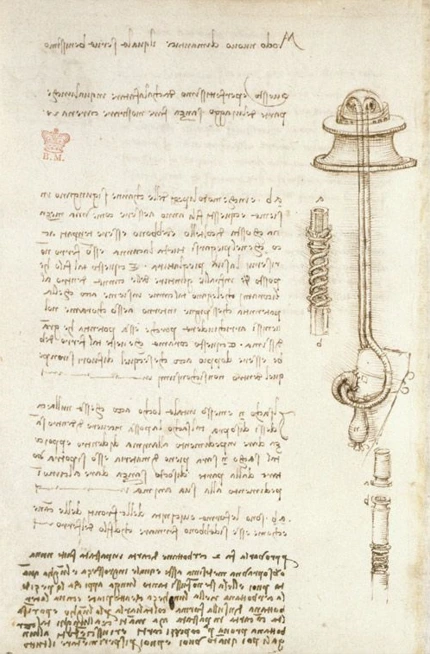
The Codex Arundel is one of the strangest and most revealing notebooks Leonardo da Vinci ever filled. Housed today in London, it holds 283 folios of sketches, calculations, and private thoughts that Leonardo never meant anyone else to read.
That's exactly what makes it so valuable. Most of what survives of Leonardo comes to us as finished paintings or polished treatises, the kind of work he cleaned up and presented on purpose.
The Codex Arundel is different. It's raw, unordered, and personal — closer to a Leonardo da Vinci diary than a formal manuscript, filled with half-finished thoughts, crossed-out calculations, and sketches he clearly never expected anyone else to judge.
Seeing it in person adds something a textbook never can: the sense that you're looking over the shoulder of a man thinking in real time, four hundred years before most of the ideas he sketched ever left the page.
This post is all about Codex Arundel — what's inside it, how it survived five centuries of wars, collectors, and shipping crates, and where you can go see it for yourself.
What is Codex Arundel?
Codex Arundel is a bound manuscript of 283 paper folios containing notes, sketches, and calculations written by Leonardo da Vinci between roughly 1478 and 1518. Named after the Earl of Arundel, who acquired it in the seventeenth century, it is now held at the British Library in London and covers mechanics, geometry, rivers, and daily observations.
Historical Background
A Notebook Leonardo Never Planned to Bind
Unlike the Codex Leicester, which reads almost like a single, themed essay on water, the Codex Arundel was never meant to be a single object.
Leonardo carried loose sheets of paper with him for decades, jotting down whatever crossed his mind — a diagram of a river, a note on Latin grammar, a sketch of a peacock feather. Nobody sorted them while he was alive.
In 1508, while working in Florence at the house of his friend Piero di Braccio Martelli, Leonardo himself described the project in a short note at the start of a section. He called it a "collection without order," gathered from many older papers with the plan to sort it properly later. He never got the chance.
What we now read as one Leonardo da Vinci notebook is really dozens of smaller da Vinci notebooks, pressed together after his death by people trying to make sense of a genius's filing system.
From Melzi to the Earl of Arundel
When Leonardo died in 1519, his loyal student Francesco Melzi inherited his papers. After Melzi's own death, the collection scattered — sold, split up, and traded across Europe by people who didn't always grasp what they were holding. Some sheets ended up in Spain.
That's where Thomas Howard, the second Earl of Arundel, found them around 1636. He brought the pages back to England, and his grandson later gave them to the Royal Society.
In 1831, the British Museum purchased the manuscript, and when the British Library split off from the Museum in 1973, the Codex Arundel's home at the British Library became official. It's been in London ever since — arguably longer than it was ever in Leonardo's own hands.
Why 283 Folios, and Not the Whole Story
It's worth remembering that the Codex Arundel is only a fraction of what Leonardo actually produced. Historians estimate that over 7,000 pages of his notes survive today, spread across at least a dozen separate collections in Milan, Paris, Turin, Madrid, and Windsor, among other cities.
Some scholars believe the true total once ran far higher, with entire notebooks lost over the centuries to fire, water damage, or simple neglect.
That makes the 283 surviving Arundel folios a genuine survival story. Paper this old and this well-traveled had every chance to disappear along the way.
The fact that it didn't — that it moved from a workshop in Florence to a Spanish collector's shelf to an English earl's library and finally into a climate-controlled case in London — is almost as remarkable as anything written on its pages.
Leonardo's Role and Influence
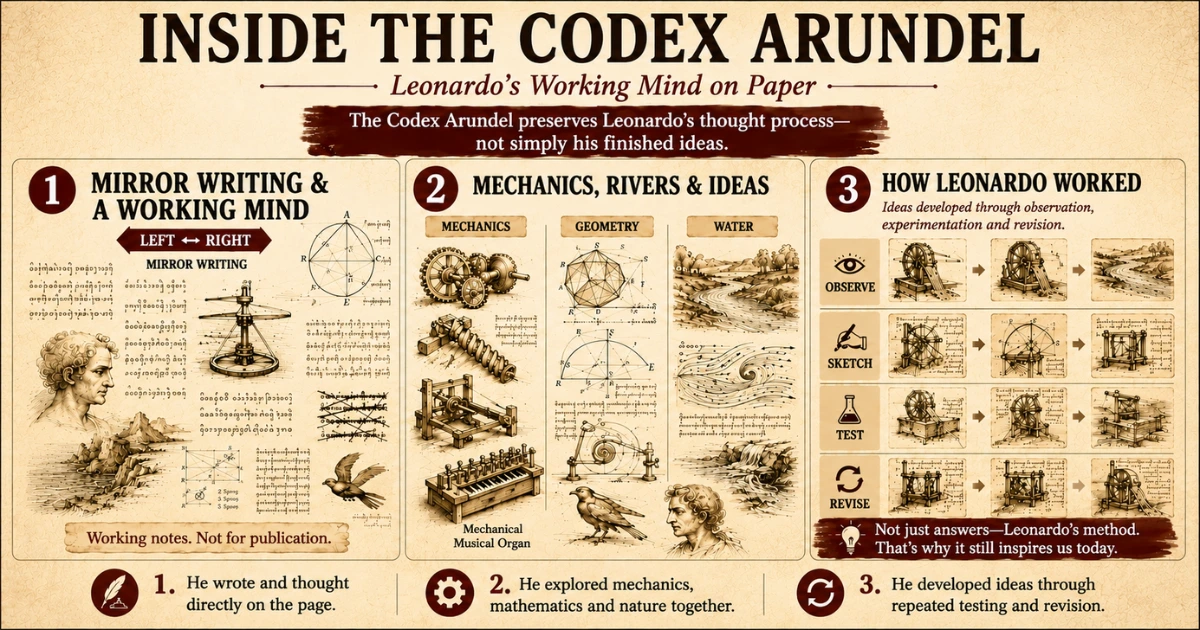
Mirror Writing and a Working Mind
Flip open any page, and the first thing you'll notice is that it doesn't read left to right. Leonardo wrote in mirror script — left-handed, moving from right to left — likely because it was simply the most comfortable way for a left-handed writer to avoid smudging wet ink. Historians still debate whether it was also a habit of privacy.
Whatever the reason, it turns the codex into something closer to a Leonardo da Vinci journal than a public document. There's no audience being written for. A da Vinci note might jump from a geometry proof to a shopping list on the same page, which is part of why the codex feels so alive today.
Mechanics, Rivers, and Ideas Ahead of Their Time
Mechanics and mathematics dominate the collection. Folios on Euclidean geometry sit next to detailed studies of how rivers erode their banks, how gears transfer force, and how a mechanical organ might play four musical parts at once using rotating pegged wheels — an idea centuries ahead of the player piano.
Some pages hint at inventions Leonardo chose to keep quiet. In one passage, he describes a way to stay underwater for long periods, then explains that he won't publish the method, worried it could be used to sink ships and harm sailors — an early, uneasy brush with the ethics of military technology.
Alongside the science, the codex is full of Leonardo da Vinci drawings in the margins: birds mid-flight, coastal cliffs, faces caught mid-expression. The da Vinci drawings scattered through Arundel rarely get the spotlight that the Mona Lisa does, but they show the same restless eye.
Compared to the tightly focused Codex Leicester or the enormous Codex Atlanticus — a much larger compilation held in Milan — the Codex Arundel feels more like Leonardo's actual desk drawer. Less curated, more honest.
Why Engineers and Historians Still Study It
The Codex Arundel isn't just a curiosity for art lovers. Engineers and historians of science return to it because it shows Leonardo's method, not just his conclusions. He tests an idea, sketches a variation, notes where the logic breaks down, and moves on — the same iterative process that shows up in modern design and prototyping today.
That's part of why the codex keeps turning up in academic papers on the history of mechanics and hydraulics. It isn't a finished theory of how rivers behave or how gears should mesh. It's the working proof of someone building that theory in real time, five hundred years before the tools existed to test most of it properly.
Where to Experience This Legacy Today
The British Library Treasures Gallery
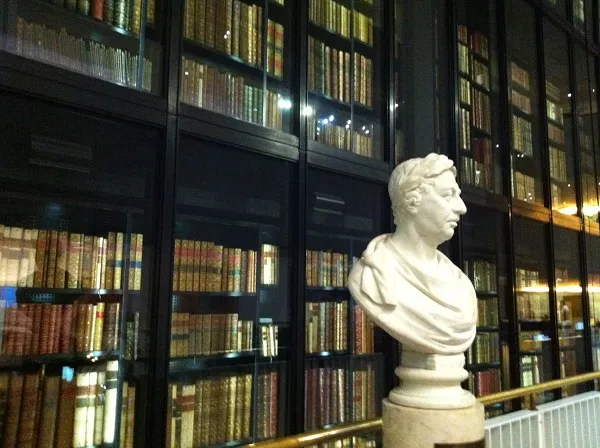
You don't need a scholar's pass to see pages from the Codex Arundel. The British Library's Treasures Gallery is open daily and free to enter, and it displays the manuscript alongside other icons of written history, including the Magna Carta and the Lindisfarne Gospels. Pages are rotated periodically to protect the paper, so what's on view changes over time.
Standing in front of the real folio hits differently than seeing it on a screen. The ink is faded in places, the handwriting cramped and hurried, and you can see exactly where Leonardo's hand moved across the page five hundred years ago.
Many visitors planning a London trip build a Leonardo hour into a wider day, since the Treasures Gallery sits close to several other stops worth exploring, and a guided walk through central London's historic quarter, timed around a Treasures Gallery visit, is a straightforward way to fit it into a single afternoon without over-planning.
Turning the Pages: Codex Arundel Online
If a trip to London isn't in the cards right now, the British Library partnered with Microsoft on a project called Turning the Pages, which digitized roughly 570 pages of the Codex Arundel for free public viewing.
It's not a substitute for the original, but it's a genuinely good way to explore individual folios, zoom into the mirror writing, and get a feel for the range of subjects before you ever board a plane.
Between the physical gallery and the digital archive, the Codex Arundel is among the more accessible aspects of Leonardo's legacy worldwide. Plenty of his paintings live behind thick glass and long queues. This notebook, by comparison, is remarkably easy to actually study — whether you're standing in front of it or scrolling through it from home.
Exploring Leonardo da Vinci in London
London holds more of Leonardo's legacy than most visitors expect. Beyond the British Library, the city's museums and historic quarters carry threads that connect back to Renaissance Italy, even though Leonardo himself never crossed the Channel.
It's a useful home base if you're building out a wider da Vinci notebooks trail across Europe — one that naturally continues toward Milan, where the enormous Codex Atlanticus is kept and where Leonardo spent nearly two decades working for the ruling Sforza family, and Florence, the city that shaped his early training and where he returned repeatedly throughout his life.
From there, the trail keeps going. Venice holds Leonardo's studies on fortifications and canals, drawn up during his brief but productive stint advising the Venetian military on defending the city against waterborne invasion.
Rome connects to his final years in Italy, when he worked under papal patronage on projects that were often more experimental than practical. And Paris is where his story ends — he spent his last years there as a guest of King Francis I, and the Louvre now holds the largest single collection of his finished paintings anywhere in the world.
Each city adds a different layer to the same restless mind you'll meet on the pages of the Codex Arundel, and each one rewards a slightly different kind of visit.
Seeing Leonardo's Notebook in Person
Reading about the Codex Arundel is one thing. Standing a few feet from the actual paper Leonardo wrote on is another experience entirely — the kind that tends to stick with people long after a trip ends.
The British Library in London is the place to do it, and the Treasures Gallery makes the visit simple: free entry, no advance ticket required for the gallery itself, and a rotating display, so no two visits are quite identical.
What you'll actually see is a page of dense, cramped mirror writing, often paired with a diagram — a gear, a river bend, a bird's wing — that shows Leonardo working out a problem in real time. It matters because this isn't a copy or a reproduction; it's the object itself, carried through five centuries of collectors, wars, and one very lucky purchase by the British Museum in 1831.
Visitors often note that the manuscript looks smaller and more fragile than they expected, which somehow makes the ideas inside it feel even larger.
London Historic Highlights Walk
Pair your London walk with a visit to the British Library’s Treasures Gallery to experience Leonardo’s legacy.
Explore Tours Near the British LibraryLondon Historic Highlights Walk
A guided walk through the streets and landmarks around the British Library and central London's historic quarter.
- Small-group format with a local guide
- Covers key historic and literary landmarks nearby
- Flexible morning or afternoon start times
Many travelers pair this walk with a self-guided stop at the Treasures Gallery to see the Codex Arundel the same day. Check availability
Before you go, it's worth knowing that entry to the British Library itself costs nothing, and the Codex Arundel shares gallery space with some of the most important documents in Western history — so it rewards setting aside a bit more time than a quick photo stop.
Final Thoughts
This post was all about Codex Arundel — a notebook that was never supposed to be a single book at all, held together by later hands and centuries of luck. What makes it worth knowing isn't just the science inside it, though the mechanics, river studies, and geometry are remarkable on their own.
It's the reminder that Leonardo's genius wasn't a finished, polished thing. It was messy, curious, and constantly in motion, exactly like the loose pages that make up this codex.
That's the real gift of the Renaissance's most famous mind: he left behind not just masterpieces, but a working record of how he thought. Most of history's great inventors and artists only show us their finished results.
Leonardo, almost by accident, left behind the rough drafts too — the crossed-out lines, the half-solved equations, the sketches that never became anything at all. Standing in front of that record in person, on real paper, in a quiet gallery in London, is one of the few ways left to get genuinely close to it.
Related Post You May Like


Disclosure: This page may contain affiliate links. If you book through them, we may earn a small commission at no extra cost to you. Learn more.
Free Leonardo Milan Travel Guide
Plan Your Leonardo Trip in Milan
A premium mini guidebook for smarter Milan planning, including the best ticket strategy, Leonardo map, and practical visitor advice.
Get the Free Guide
Download the guide and receive practical Milan planning tips by email.
Download the Free Guide >> Leonardo Bianchi is the founder of Leonardo da Vinci Inventions & Experiences, a cultural travel guide helping visitors explore Leonardo da Vinci’s art, inventions, and legacy across Italy and Paris.