
(Last updated: Sep 2026)
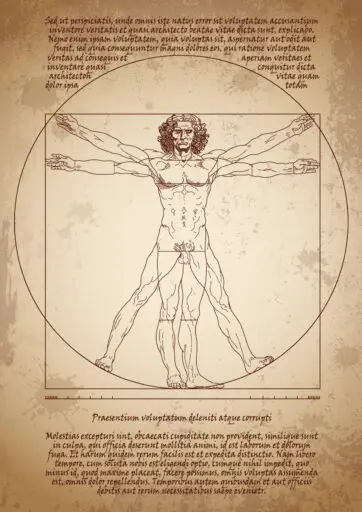
The Vitruvian Man is one of the most recognized drawings in the history of art. Even people who have never set foot in a museum know this image of a man with outstretched arms and legs, framed by a circle and a square.
It looks simple at first glance, but it holds centuries of scientific curiosity, artistic ambition, and Renaissance thinking. Understanding the drawing changes how you see Leonardo da Vinci as a whole, and it adds real depth to any trip through Italy.
Once you know the story behind it, a museum visit stops being a quick photo stop and becomes something you actually feel.
This post is all about the da Vinci Vitruvian Man, from why Leonardo drew it to where you can stand in front of it today.
What is the Vitruvian Man?
The Vitruvian Man is a pen-and-ink drawing by Leonardo da Vinci, created around 1490. It shows a nude male figure in two overlapping poses, inscribed inside a circle and a square. The drawing illustrates ideal human proportions as described by the ancient Roman architect Vitruvius, blending art, mathematics, and anatomy into a single image.
The Artistic Genius Behind the da Vinci Vitruvian Man
Leonardo da Vinci rarely separated art from science. For him, drawing was a way of thinking. The Vitruvian Man came out of this habit, sketched onto a page of one of his personal notebooks rather than commissioned as a formal artwork.
Leonardo's Notebooks and the Search for Perfect Proportion
Leonardo filled thousands of notebook pages with studies on anatomy, engineering, water flow, and flight. The Vitruvian Man sits inside this larger body of work known as the Leonardo da Vinci notebooks.
He was not trying to create a masterpiece for public display. He was working through a problem: could the human body fit perfectly inside a circle and a square, the two most "ideal" shapes in classical geometry?
To answer that, he measured limbs, torsos, and the spread of arms and legs with obsessive precision. The result reads almost like a diagram, but the confident linework and the sense of movement in the figure still carry the hand of a master artist.
What makes the page unusual is that Leonardo wrote directly around the figure. Dense mirror-script notes surround the drawing, recording his measurements and observations in the reversed handwriting he used throughout his notebooks, readable only with a mirror.
That detail alone tells you this was never meant as a finished piece for a patron's wall. It was a working page, meant for Leonardo's own eyes, which is part of why it feels so personal even five centuries later.
Art historians also point out that the drawing reflects a broader shift occurring in Florence and Milan at the time. Painters and thinkers were moving away from purely symbolic or religious representations of the body and toward something closer to direct observation.
Leonardo's contemporaries were dissecting cadavers, studying bone structure, and comparing human anatomy to architecture. The Vitruvian Man sits at the center of that shift, treating the human body as both a scientific subject and a work of art.
Vitruvius, Circles, and Squares: The Science Inside the Drawing
The drawing takes its name from Vitruvius, a Roman architect who wrote that the human body was the model for ideal proportion in architecture. Vitruvius argued that if you stretched out your arms and legs, your body would touch the edges of a perfect circle and a perfect square.
Leonardo tested this idea by hand. He discovered that Vitruvius's original description did not quite work geometrically, so he adjusted the figure's stance until the proportions actually fit.
That small correction is a quiet but powerful example of Leonardo's mind: respectful of the old texts, yet unafraid to test them against reality.
Why the Vitruvian Man Became Famous
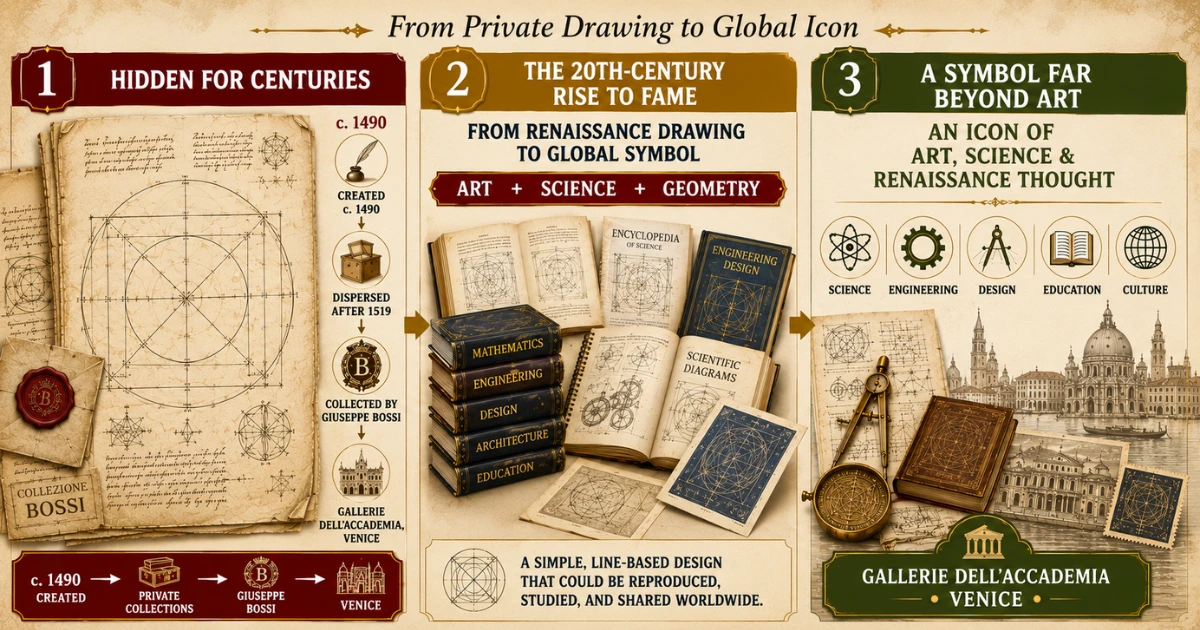
For centuries, the Vitruvian Man was known mostly to scholars and collectors. Its journey to global icon status took a long and interesting path.
From Private Notebook Page to Global Icon
The drawing stayed largely out of public view for hundreds of years. Leonardo's notebooks were scattered and passed through private hands after his death in 1519.
The Vitruvian Man eventually made its way into a set of drawings acquired by the collector Giuseppe Bossi in the early 1800s, and from there into the collection where it still lives today.
Its rise to fame accelerated in the 20th century, as reproductions of the drawing appeared in textbooks, design manuals, and popular science. The image became a shorthand for the entire Renaissance idea that art and science could explain the same truths about the world.
A Symbol Beyond Art: Science, Medicine, and Pop Culture
Today the Vitruvian Man shows up far outside the art world. It appears on medical association logos, engineering textbooks, coins, and countless product designs. It has been referenced in films, advertising, and even spacecraft plaques meant to represent humanity itself.
That reach is part of why so many travelers specifically seek it out. People are not only curious about a drawing; they are curious about an idea that has quietly shaped how we think about the human body for more than 500 years.
Part of the fascination also comes from how well the image translates. Unlike a painting, which depends on color and brushwork, the Vitruvian Man is essentially a diagram, and diagrams travel easily.
It can be printed in black and white, embossed on a coin, or reduced to a simple icon without losing its meaning. That flexibility is a major reason it became one of the most reproduced images of the Renaissance, right alongside the Mona Lisa and The Last Supper.
That curiosity is exactly what draws so many visitors to Venice in the first place, where a guided walk through the city's Renaissance landmarks often connects details like this one to the buildings and collections you pass along the way.
Where to See the Vitruvian Man Today
Here is where things get interesting for anyone planning a trip. Unlike the Mona Lisa, which greets millions of visitors every year at the Louvre, the Vitruvian Man is far harder to actually see in person.
Inside the Gallerie dell'Accademia in Venice
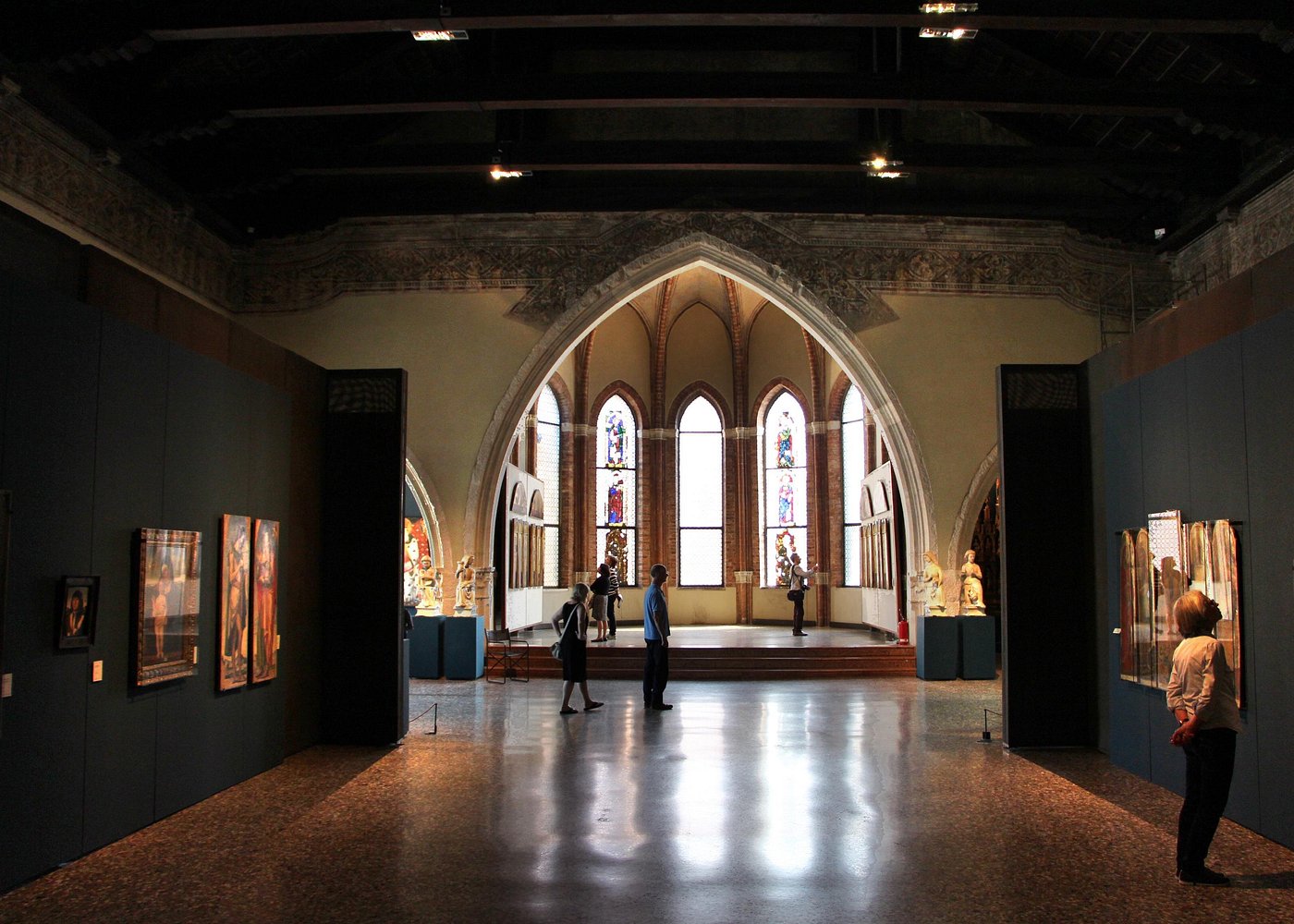
The original drawing is held by the Gallerie dell'Accademia in Venice, a museum best known for its collection of Venetian Renaissance painting. It has been part of the collection since 1822, when the Austrian government purchased it along with a set of other Leonardo drawings.
The museum itself sits inside a former religious complex on the Grand Canal, in the Dorsoduro district, one of the most atmospheric corners of the city. Even without the Vitruvian Man on view, the Accademia houses major works by artists such as Titian, Giorgione, and Tintoretto, so a visit is worthwhile regardless of the timing.
Why This Drawing Is So Rarely on Display
Because the Vitruvian Man is drawn in ink on fragile paper, it cannot handle constant light exposure the way an oil painting can. The Gallerie dell'Accademia stores the drawing under controlled temperature and light conditions, and it is generally shown to the public only for short periods, roughly every six years.
There have been rare exceptions. In 2019, for the 500th anniversary of Leonardo's death, a Venice court cleared the way for the drawing to travel to the Louvre in Paris for a landmark exhibition, after an earlier request had been turned down by a heritage protection group.
In 2025, the Accademia brought it back on view as the centerpiece of its "Corpi Moderni" exhibition, exploring the Renaissance fascination with the human body. Outside of moments like these, the drawing usually stays out of sight, which is exactly why checking current exhibition dates before a trip matters so much.
If your visit doesn't line up with one of these rare display windows, that isn't a wasted trip. The museum's permanent galleries still tell the surrounding story well, from Vitruvius's original architectural theories to how Leonardo's contemporaries approached the human figure.
Many visitors say the anticipation of possibly catching the drawing on a future trip becomes part of the appeal, turning the Accademia into a place worth returning to rather than a single box to check off.
Explore Leonardo’s Venice
Discover Renaissance Venice with a guide, exploring the Accademia and Dorsoduro while uncovering the story of Leonardo’s Vitruvian Man
See Leonardo Venice Tours ›Planning around a Leonardo-focused day in Venice
A guided route through Dorsoduro and the Accademia area provides context for the story of the Vitruvian Man, even when it is not on display, which is rare.
- Covers the Accademia's Renaissance painting collection
- Explains the Vitruvian Man's conservation story on site
- Pairs naturally with a walk through Dorsoduro's canals
Many visitors find it easier to make sense of the museum's layout with a guide pointing out where the drawing usually resides.
Exploring Leonardo da Vinci in Venice
Venice is only one stop on the wider map of Leonardo's life and work across Italy and France. Milan is where he spent nearly two decades, painting The Last Supper and filling notebooks with engineering sketches.
Florence shaped his early training as an artist. Rome connected him to the church and papal patrons later in his career, while Paris became his final home under the patronage of King Francis I, and today houses the Mona Lisa.
Tracing this path helps explain why a single notebook page ended up in a Venetian museum rather than staying in Milan or Florence, where Leonardo actually drew it.
Leonardo's own relationship with Venice was brief. He passed through the city around 1500, consulting on defense engineering during a period of tension with the Ottoman Empire, but he never lived there long-term.
The Vitruvian Man's presence in the city today is really a story about later collectors, not about Leonardo's own travels.
That's part of what makes tracking his path across Italy so rewarding. Each city holds a different piece of the puzzle, shaped less by chance and more by where patrons, politics, and collectors happened to take his work after his death.
Planning Your Own Leonardo da Vinci Experience in Venice
Seeing the Vitruvian Man in person, even in reproduction form at the Accademia when the original is off display, connects you to something bigger than a single drawing.
You're standing in the museum that has protected this fragile sheet of paper for two centuries, surrounded by the Venetian art world Leonardo never lived in but still influenced from a distance.
Visitors who walk through the Gallerie dell'Accademia typically see room after room of large Venetian altarpieces and canvases, a striking contrast to the intimate scale of Leonardo's notebook page.
That contrast is part of the point: it shows just how differently Leonardo worked from his Venetian contemporaries, sketching quietly rather than painting for grand public spaces.
Understanding that difference is part of why so many people choose to explore the museum with some guidance rather than walking through cold.
Before you go, it's worth confirming current exhibition dates directly with the museum, since the Vitruvian Man's display schedule changes from year to year. A well-planned visit, paired with some background on the drawing itself, turns a quick stop into one of the more memorable parts of a Venice trip.
Final Thoughts
This post was all about the da Vinci Vitruvian Man, from the geometry problem that inspired it to the fragile sheet of paper now protected inside a Venetian museum.
Leonardo's genius was never about a single skill. He moved between art, anatomy, and mathematics as if they were all the same language, and the Vitruvian Man is one of the clearest proofs of that.
It's also worth remembering that Leonardo never intended this page to become famous. He was solving a private puzzle about proportion, geometry, and the human form, scribbled onto paper that was never meant for public eyes.
The fact that it became one of the most reproduced images in history says as much about later generations, who recognized something universal in it, as it does about Leonardo himself.
Whether you catch the original during one of its rare public appearances or simply walk the halls of the Gallerie dell'Accademia knowing where it usually rests, you're engaging with a piece of the Renaissance that still shapes how we think about the human body today. That's a rare thing for any single sheet of paper to hold onto for over five hundred years.
Related Post You May Like



Disclosure: This page may contain affiliate links. If you book through them, we may earn a small commission at no extra cost to you. Learn more.
Free Leonardo Milan Travel Guide
Plan Your Leonardo Trip in Milan
A premium mini guidebook for smarter Milan planning, including the best ticket strategy, Leonardo map, and practical visitor advice.
Get the Free Guide
Download the guide and receive practical Milan planning tips by email.
Download the Free Guide >> Leonardo Bianchi is the founder of Leonardo da Vinci Inventions & Experiences, a cultural travel guide helping visitors explore Leonardo da Vinci’s art, inventions, and legacy across Italy and Paris.