
(Last updated: Sep 2026)
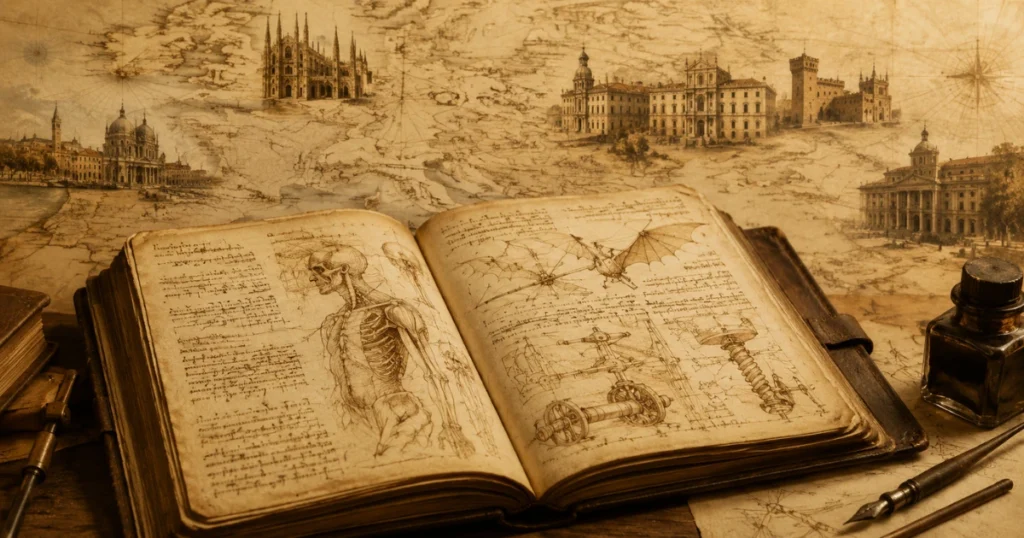
Da Vinci drawings are scattered across seven cities and three countries, and almost none of them stay in permanent public view.
Leonardo filled roughly 7,200 surviving pages with anatomy studies, flying machines, river maps, and the faces of strangers he passed on the street, and today those pages live inside libraries, royal collections, and museum vaults from Milan to Madrid.
These aren't paintings hanging behind velvet ropes. Most of Leonardo's sketches are drawn in ink, chalk, or metalpoint on paper that is now over 500 years old, which means light exposure can damage them permanently.
That fragility is exactly why seeing one in person feels different from seeing a print of the Mona Lisa. You're looking at the actual page Leonardo's hand touched, often shown for only a few weeks a year, in a room built specifically to protect it.
This post is all about da Vinci drawings — where they're kept, where they're actually shown, and how to plan a trip around the difference between the two.
What Are Da Vinci Drawings?
Da Vinci drawings are the surviving sketches, diagrams, and notebook pages created by Leonardo da Vinci between roughly 1478 and 1519. They cover anatomy, engineering, botany, and art theory, and are held today in institutions including the Biblioteca Ambrosiana, the Royal Collection, and the Louvre.
The Story Behind Leonardo da Vinci's Drawings
A Scientist's Sketchbook, Not a Portfolio
Leonardo never intended his notebooks for public display. They were working documents — a place to think with a pen.
He filled thousands of pages with mirror writing, running text backward from right to left, alongside diagrams of muscles, gears, water currents, and bird wings. He drew what he saw and then drew it again from a different angle, trying to understand not just how something looked but how it worked.
The range is what still surprises people. A single notebook might move from a preparatory drawing for an unfinished painting, to a page of nature studies recording how water swirls around a rock, to a rough Leonardo da Vinci map of a river valley he was surveying for a duke's military engineers.
A few pages later, the subject shifts again to Leonardo da Vinci engineering drawings for gears, pulleys, or a device to test the strength of a wire. His personal notes, often just a few words squeezed into a margin, are as revealing as the drawings themselves — reminders to himself to ask a mathematician a question, or observations about light that he clearly meant to return to later.
This habit is why the drawings still feel alive. A painting shows Leonardo's finished thought. A notebook page shows the thought in progress, crossed-out lines and all.
Art historians and engineers still study these pages today, because Leonardo was often centuries ahead of the tools needed to build what he imagined.
How the Notebooks Scattered Across Europe
After Leonardo died in France in 1519, his notebooks passed to his student Francesco Melzi. Over the following century, collectors, sculptors, and royal courts broke up Melzi's collection and carried pieces across Europe.
The sculptor Pompeo Leoni compiled one enormous volume, now called the Codex Atlanticus, and separately assembled the collection that ended up at Windsor Castle.
Other pages surfaced in royal libraries in Turin and Madrid, in private English collections that eventually reached the British Library and the V&A, and in Institut de France manuscripts in Paris.
No single museum owns "the" Leonardo drawing collection. That's the part most travel guides skip, and it's exactly why this guide exists.
The word "codex" simply means a bound manuscript, so when you see a Leonardo da Vinci codices list online, you're really looking at a handful of separate notebooks — Atlanticus, Arundel, Forster, Windsor, Madrid, and the Institut de France manuscripts — that were assembled, split apart, and reassembled by different owners over five centuries.
Each Leonardo da Vinci notebook was named after whoever compiled or bought it, which is why the naming can feel inconsistent from one museum to the next.
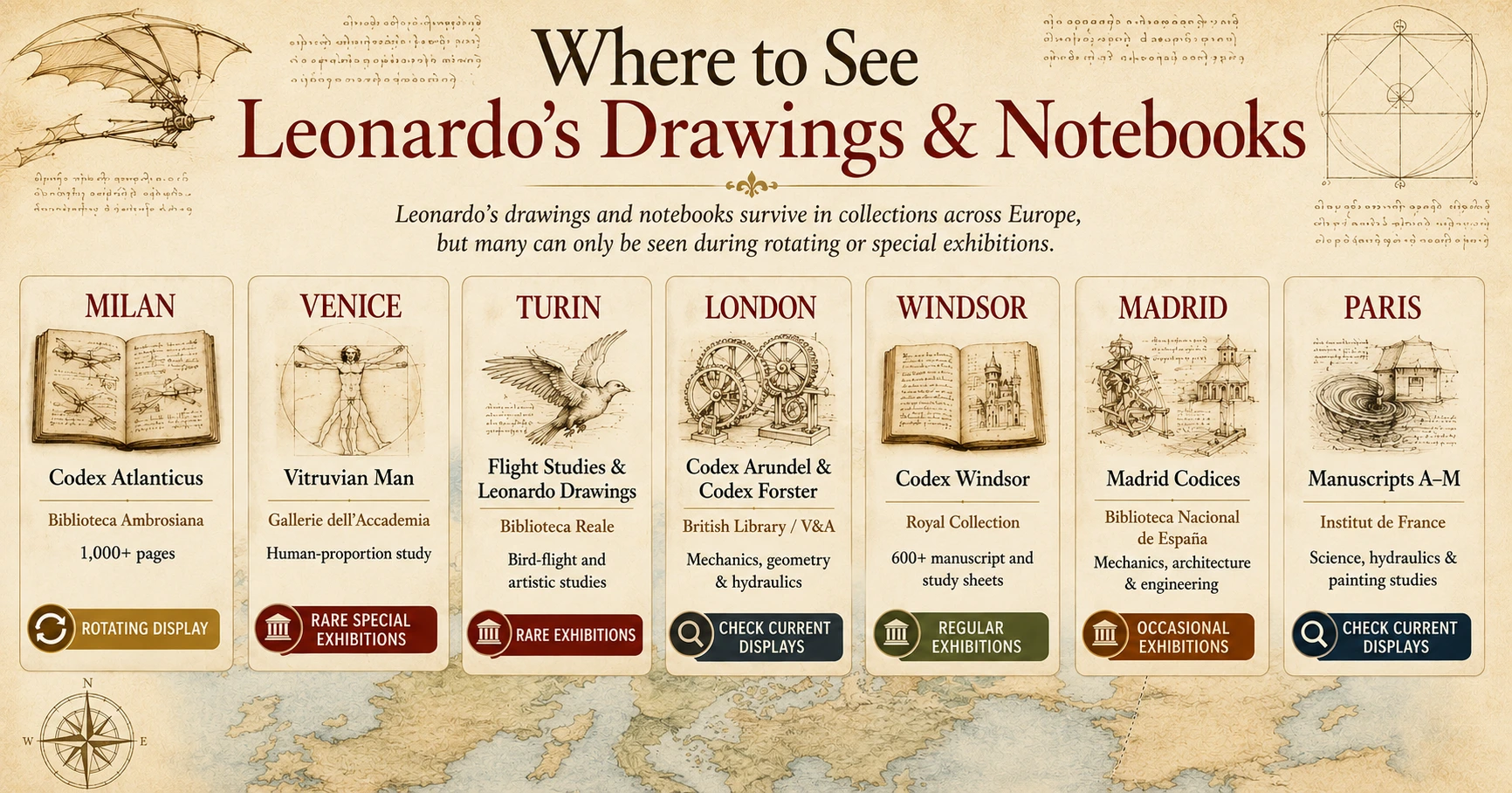
Where to See Leonardo's Drawings & Notebooks Today
| Drawing / Notebook | City | Institution | What It Contains / Known For | Display Status | How to See It |
|---|---|---|---|---|---|
| Codex Atlanticus | Milan | Biblioteca Ambrosiana | 1,000+ pages on flying machines, weapons, mathematics & music | Rotating display | Selected sheets rotate roughly every 3 months |
| Vitruvian Man | Venice | Gallerie dell’Accademia | Leonardo’s famous study of ideal human proportions | Rare special exhibitions | Check the museum’s exhibition calendar before visiting |
| Leonardo Self-Portrait | Turin | Biblioteca Reale | Famous red-chalk self-portrait | Rare exhibitions | Displayed only every few years; check exhibitions first |
| Codex on the Flight of Birds | Turin | Biblioteca Reale | 18-page notebook on bird flight & flying-machine ideas | Rare exhibitions | Check for special exhibitions before planning a visit |
| Codex Arundel | London | British Library | Papers on mechanics, geometry & architecture | Not specified | Check the British Library for current display information |
| Codex Forster | London | Victoria and Albert Museum (V&A) | Three pocket notebooks on hydraulics & geometry | Not specified | Check the V&A for current display information |
| Codex Windsor / Anatomical Drawings | Windsor / London | Royal Collection | 600+ sheets, including about 150 anatomical studies | Regular exhibitions | Look for rotating selections at The King’s Gallery |
| Madrid Codices | Madrid | Biblioteca Nacional de España | Mechanics, gears, architecture, geometry & military engineering | Occasional exhibitions | Check for temporary exhibitions; not permanently displayed |
| Manuscripts A–M | Paris | Institut de France | Manuscripts covering hydraulics, painting theory & other studies | Not specified | Check the Institut de France for display information |
How to Experience Leonardo's Drawings in Person
Codex Atlanticus, Biblioteca Ambrosiana
A guided walk through Milan's historic library, ending in the reading room where sheets from Leonardo's largest surviving notebook are shown on rotation.
- Skip-the-line entry to the Codex Atlanticus exhibit
- Access to the adjoining Pinacoteca, with works by Caravaggio and Raphael
- Roughly 90 minutes, self-paced
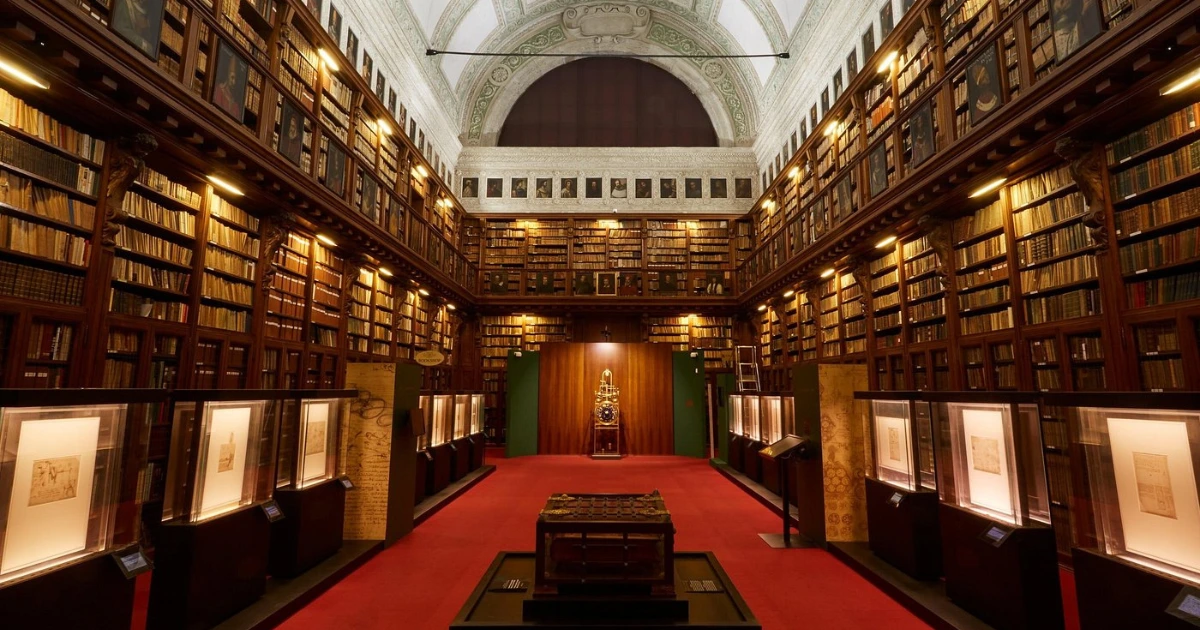
See the Codex Atlanticus
Step inside the Biblioteca Ambrosiana to see rotating sheets from Leonardo’s largest surviving notebook and explore its historic art collection.
See Codex Atlanticus TicketsMany visitors find the reading room itself, with its original wooden shelving, as memorable as the pages on display. Check availability in Milan
Planning Around Rotating Displays
The single most useful thing to know before booking a trip around any da Vinci drawing is that "held by" and "currently on display" are two different things.
Drawings and manuscripts are made of paper, ink, and chalk, all of which fade under sustained light exposure, so no institution keeps its Leonardo sheets on permanent view.
The Ambrosiana rotates its Codex Atlanticus sheets roughly every three months, so something is usually visible in Milan. Windsor rotates its anatomical studies through regular exhibitions at The King's Gallery, so London is also a reasonably safe bet.
Venice, Turin, and Madrid are the opposite case — their most famous sheets appear only during occasional special exhibitions, sometimes years apart, so it's worth checking each institution's calendar before building a trip around a specific drawing like the Vitruvian Man.
A practical habit worth adopting: before finalizing any leg of a Leonardo-focused trip, check the museum's own exhibition page rather than relying on a general travel article, since rotation schedules shift and special loans can pull a sheet out of its home city for months at a time.
It's a small extra step, but it's the difference between planning a detour around an empty case and planning one around the real thing.
The Best Cities to Start Your Journey
If your time is limited, Milan offers the most reliable combination of volume and access: the Codex Atlanticus rotates regularly, the Ambrosiana sits five minutes from the Duomo, and Leonardo's Last Supper is a short walk away at Santa Maria delle Grazie.
London is the strongest second stop, thanks to the Royal Collection's regular Leonardo exhibitions and the British Library's Codex Arundel. From there, Venice, Turin, Madrid, and Paris become destinations worth timing around a specific exhibition rather than a guaranteed viewing.
There's a natural order to discovering all this, too. First comes the surprise of learning how much survives — thousands of pages, not a handful of famous sheets.
Then comes the fascination of realizing how differently each page reads, from tender preparatory drawing to cold engineering diagram.
That fascination tends to turn into a genuine urge to see one in person, and once that urge sets in, the only remaining question is which city to check first. Milan, for most travelers, is that first check.
Exploring Leonardo da Vinci in Milan
Milan is where Leonardo spent the longest stretch of his working life, and it shows. Beyond the Codex Atlanticus, the city holds the Last Supper, the Sforza Castle rooms he decorated, and streets he mapped for the Duke of Milan's engineers. It's the natural hub for a wider Leonardo itinerary.
From Milan, the trail continues outward: Florence for his early training and the Uffizi's paintings, Venice for the Vitruvian Man, Rome for his final Italian years, and Paris for the Mona Lisa and the manuscripts at the Institut de France. Each city adds a different layer to the same restless mind.
Final Thoughts
This post was all about da Vinci drawings — where they're kept, where they actually go on view, and why those are so often two different addresses.
What stays with most visitors isn't just the sketches themselves, though a page of anatomical studies or a flying-machine diagram is genuinely startling to see up close.
It's the reminder that Leonardo's genius wasn't confined to finished masterpieces. It lived in the margins, in crossed-out calculations and half-formed machines, in a mind that treated every observation as a question worth drawing.
Seeing one of these pages in person, even briefly, is a different experience than seeing it reproduced online.
The paper has texture. The ink has depth. And knowing that the sheet in front of you might not be shown again for years tends to sharpen the moment considerably. If a Leonardo notebook happens to be on view in a city you're already visiting, it's worth rearranging an afternoon for.
Before booking flights around a single drawing, it's worth starting somewhere the odds are in your favor — and reserving a spot at the Ambrosiana in Milan is the most dependable place to begin.
Related Post You May Like



Disclosure: This page may contain affiliate links. If you book through them, we may earn a small commission at no extra cost to you. Learn more.
Free Leonardo Milan Travel Guide
Plan Your Leonardo Trip in Milan
A premium mini guidebook for smarter Milan planning, including the best ticket strategy, Leonardo map, and practical visitor advice.
Get the Free Guide
Download the guide and receive practical Milan planning tips by email.
Download the Free Guide >> Leonardo Bianchi is the founder of Leonardo da Vinci Inventions & Experiences, a cultural travel guide helping visitors explore Leonardo da Vinci’s art, inventions, and legacy across Italy and Paris.