
(Last updated: May 2026)
The inventions of Leonardo da Vinci represent one of the most extraordinary leaps of human imagination in recorded history. Born in Tuscany in 1452, Leonardo filled thousands of notebook pages with designs for machines, structures, and devices that would not be realized for centuries.
His sketches described flying machines, armored vehicles, hydraulic systems, and robotic figures — all imagined during a time when most of Europe still relied on hand tools and animal labor.
Leonardo fascinates historians and travelers alike because he defied easy classification. He was a painter, sculptor, architect, musician, mathematician, and engineer — all at once.
His notebooks, scattered across the libraries and museums of Europe, reveal a mind that never stopped asking questions. Understanding his inventions means understanding the Renaissance itself: a moment when human curiosity about the natural world seemed to have no limits.
This post is all about the inventions of Leonardo da Vinci — tracing the ideas, machines, engineering principles, and cultural legacy that continue to inspire engineers, artists, and travelers around the world.
What Are the Inventions of Leonardo da Vinci?
The inventions of Leonardo da Vinci are a collection of mechanical, civil, and military designs recorded in his private notebooks between roughly 1478 and 1519. They include flying machines, early automotive concepts, hydraulic engineering solutions, and war machines — ideas that were centuries ahead of their time and continue to influence modern science and engineering.
Leonardo da Vinci and the Renaissance: The World That Shaped His Inventions
Leonardo was born at a remarkable moment. The Italian Renaissance was transforming European thinking about art, science, and the natural world.
Cities like Florence, Milan, and Venice were centers of wealth and patronage, and powerful rulers competed to attract the best minds of the age. Leonardo benefited directly from this environment.
He trained as a painter in Florence under the master Andrea del Verrocchio. But from the beginning, Leonardo’s curiosity extended far beyond the canvas.
He studied anatomy, geology, botany, and mechanics with the same intensity he brought to painting. His notebooks — written in his famous mirror script — document a lifelong habit of observation and experimentation.
Understanding this historical context is essential for anyone visiting Leonardo exhibitions or Renaissance museums. His inventions did not appear from nowhere. They were the product of a culture that celebrated inquiry, combined with a personal genius that could not be contained by any single discipline.
Leonardo’s Notebooks: The Source of His Inventions
Leonardo’s sketches of inventions survive in approximately 7,200 pages of manuscript material, spread across institutions in Italy, France, England, and Spain. Collections such as the Codex Atlanticus in Milan and the Windsor Collection in England preserve designs for everything from canal locks to flying machines.
These notebooks were never published during his lifetime. Many remained unknown for centuries. It was only as scholars began cataloguing and studying them in the 19th and 20th centuries that the full scale of his inventive genius became clear.
Today, Leonardo da Vinci‘s inventions list searches reflect a global curiosity about what exactly this one man imagined.
Leonardo’s Patrons and the Demand for Innovation
Much of Leonardo’s engineering work was commissioned. Ludovico Sforza, Duke of Milan, employed Leonardo from around 1482 to 1499.
Leonardo’s famous letter of introduction to the Duke outlined his skills as a military engineer — designing war machines, fortifications, and siege weapons — before mentioning his abilities as a painter almost as an afterthought.
This context explains why so many of Leonardo’s inventions fall into the categories of military and civil engineering. His patrons needed practical solutions: better weapons, stronger city walls, more efficient waterways. Leonardo delivered designs — though many were never built.
Leonardo da Vinci Civil Inventions: Engineering the Renaissance World
Leonardo’s ideas in civil engineering were deeply practical. He thought carefully about cities, water, infrastructure, and transportation. Many of his concepts anticipated developments that would not be realized for hundreds of years.
Leonardo da Vinci Canal Lock and Hydraulic Engineering
Water management was one of Leonardo’s great obsessions. He designed improvements to canals and irrigation systems for the plains of Lombardy in northern Italy. His concept for the canal lock — a device that allows boats to move between sections of water at different levels — helped transform inland navigation.
Leonardo studied water with the eye of both a scientist and an artist. His drawings of rivers, whirlpools, and flood patterns are extraordinarily accurate. His hydraulic work influenced canal construction across Europe and remains a touchstone of early civil engineering.
Da Vinci Bridge and the Swing Bridge
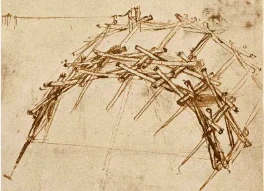
Leonardo designed at least two remarkable bridge concepts. His self-supporting bridge — a design requiring no nails, bolts, or adhesives — uses interlocking wooden beams to create a stable structure. A full-scale version of the design was built in Norway in 2001, proving its engineering soundness five centuries after Leonardo sketched it.
Leonardo da Vinci’s swing bridge concept offered military commanders a portable crossing that could be quickly assembled and disassembled. These designs demonstrate his ability to think about infrastructure as a strategic and logistical challenge, not merely a construction problem.
The Ideal City: Urban Planning Ahead of Its Time
After a devastating plague swept Milan in the 1480s, Leonardo proposed a radical redesign of the city. His ideal city concept introduced the idea of separating pedestrian and vehicular traffic across multiple levels—an idea central to modern urban planning. He also proposed underground canals for waste removal, anticipating modern sewage systems by centuries.
These urban ideas were never realized during his lifetime. But they reflect the same systematic thinking that characterized all of Leonardo’s work: observe the problem carefully, understand its causes, then design a solution that addresses the root, not just the symptom.
Leonardo da Vinci Flying Machine: Dreaming of Human Flight
Perhaps nothing captures the imagination more than Leonardo’s obsession with flight. He studied birds for decades, filling pages with careful observations of wing anatomy, feather structure, and the mechanics of lift. His flying machine concepts represent some of the most visionary engineering of the Renaissance.
Leonardo da Vinci Glider and the Ornithopter
Leonardo’s most famous flying machine designs include the ornithopter — a device with flapping wings powered by human muscle. He sketched dozens of versions, experimenting with different wing shapes and mechanical linkages. While human-powered ornithopters would not achieve true flight, Leonardo’s analysis of aerodynamics was remarkably sophisticated.
His glider concept, by contrast, recognized that fixed wings could generate lift without flapping. This insight anticipated the principles of modern gliding and fixed-wing aircraft. The Leonardo da Vinci glider designs show an understanding of airflow over curved surfaces that would not be formalized in physics for another three centuries.
Leonardo da Vinci Helicopter: The Aerial Screw
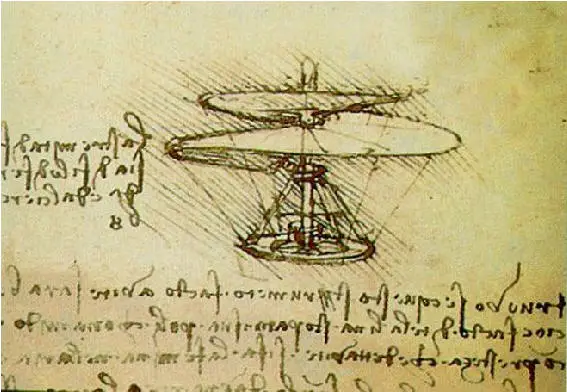
One of Leonardo’s most iconic sketches depicts what he called the aerial screw — a device with a large helical rotor designed to compress air and achieve vertical lift. This concept directly anticipates the principle of the modern helicopter, though Leonardo’s version could not have worked with the materials and power sources available in the 15th century.
The aerial screw remains one of the most recognized images from his notebooks. Replicas appear in science museums worldwide, and the design is frequently cited as evidence of Leonardo’s extraordinary capacity to visualize physical principles before the science existed to explain them.
Leonardo da Vinci Parachute and Landing Gear
Leonardo also sketched a pyramidal parachute design, describing a linen canopy large enough to slow a person’s descent from any height. Modern testing of replicas has confirmed that the design is aerodynamically sound.
Even more remarkably, he also designed a form of Da Vinci landing gear — a shock-absorbing structure intended for an aerial vehicle. The fact that he considered the problem of landing, not just of flight, demonstrates the systematic completeness of his engineering thinking.
Leonardo da Vinci Mechanical Inventions: The Machine Age Before Its Time
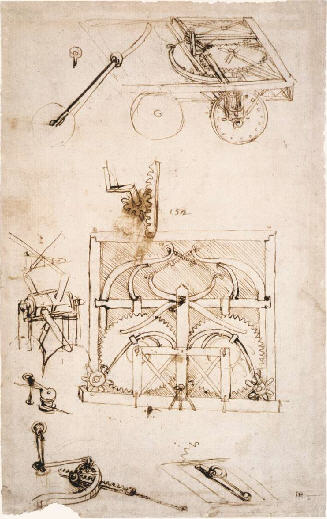
Beyond civil engineering and flight, Leonardo designed a remarkable range of mechanical devices. Many of these anticipated industrial technologies by centuries. His understanding of gears, bearings, cams, and springs was far ahead of his time.
Leonardo da Vinci Car: The Self-Propelled Cart
Leonardo designed what many historians consider the world’s first self-propelled vehicle — a cart driven by coiled spring mechanisms and steerable using a rudimentary steering system. The Leonardo da Vinci car was not designed to carry passengers; it was likely intended as a prop for theatrical performances at the Sforza court.
A working reconstruction was built by researchers at the Museo Nazionale della Scienza e della Tecnologia in Milan in 2004, confirming that the design functions as intended. The cart is widely cited as an ancestor of the modern automobile.
Da Vinci Ball Bearing, Cam Hammer, and the Mirror Grinding Machine
Leonardo’s mechanical notebooks include early descriptions of ball bearings — devices that reduce friction between moving parts. These are now fundamental components in almost every motor and machine in the modern world. His understanding of friction and rotational mechanics was centuries ahead of the formal physics of the time.
His cam hammer design used rotating cams to repeatedly lift and drop a hammer head, anticipating automated manufacturing. The Leonardo Mirror Grinding Machine — designed to grind concave mirrors with mechanical precision — represents an early vision of factory automation. These designs answer the question of what da Vinci invented in ways that continue to surprise even professional engineers.
Leonardo da Vinci Mechanical Drum and Robotic Knight
Da Vinci also designed musical automatons and mechanical performers. Leonardo da Vinci’s mechanical drum used cams to create programmable rhythmic patterns — an early form of mechanical music sequencing.
Most astonishing of all is the Leonardo da Vinci robotic knight — a suit of armor animated by internal cables and pulleys, capable of sitting, standing, and moving its arms. Reconstructions suggest it was built for court entertainment. It is considered one of history’s first humanoid robots.
These designs illustrate how Leonardo’s interests in art, engineering, and entertainment were inseparable. For him, a mechanical drummer and a flying machine were simply different expressions of the same curiosity about how the world moves.
Da Vinci War Machines: Engineering for the Battlefield
War was a constant reality of Renaissance Italy. City-states fought each other for territory, influence, and survival. Engineers who could design better weapons and defenses were enormously valuable. Leonardo offered his military engineering skills to multiple patrons, and his notebooks contain some of his most dramatic designs.
Leonardo da Vinci Tank and Armored Vehicle
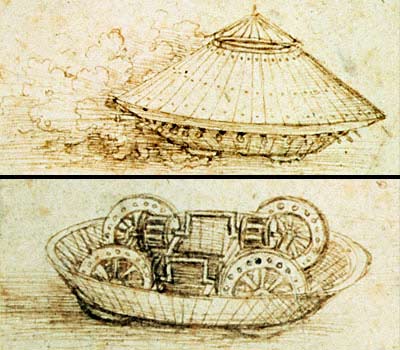
Among the most famous of his war machines is the Leonardo da Vinci tank — a covered, armored vehicle shaped like a turtle shell, armed with cannons on all sides, and powered by men turning cranks inside. The design anticipated the armored fighting vehicle by more than four centuries.
Historians have noted an apparent flaw in the gear design: the wheels would turn in opposite directions, preventing the gear from turning. Some scholars believe this was intentional — a deliberate sabotage to prevent the design from being used. Whether accidental or deliberate, the design’s conceptual ambition is extraordinary.
Leonardo da Vinci Crossbow, Catapult, and Multi-Barrel Gun
Leonardo designed massive crossbows on wheeled platforms, capable of firing projectiles with enormous force. He also sketched improved catapult designs with adjustable firing mechanisms. These siege weapons reflected the military needs of Renaissance rulers, who defended walled cities and attacked fortifications.
Leonardo da Vinci machine gun design — technically a multi-barrelled organ gun — placed multiple barrels in a fan arrangement, allowing one group to fire while others were reloaded. This concept of continuous fire anticipated the principle of the modern machine gun. These designs show Leonardo thinking systematically about the problem of sustained firepower.
Leonardo da Vinci Diving Suit: War Beneath the Waves
One of Leonardo’s most unusual military designs is his diving suit — a leather suit with a bag for air storage and breathing tubes, intended to allow a diver to approach enemy ships underwater and damage them from below. The suit was designed for use in Venice, whose lagoon setting made underwater sabotage a plausible military tactic.
The design is technically credible, and its military purpose is clear. It represents Leonardo’s willingness to think across all dimensions of the battlefield — land, air, and water.
Where to Experience Leonardo’s Legacy
Leonardo’s life and work touched several major European cities, each of which preserves a different aspect of his genius. For travelers interested in Renaissance history, following Leonardo’s trail is one of the most rewarding journeys Italy and France offer.
Florence: Where Leonardo Began
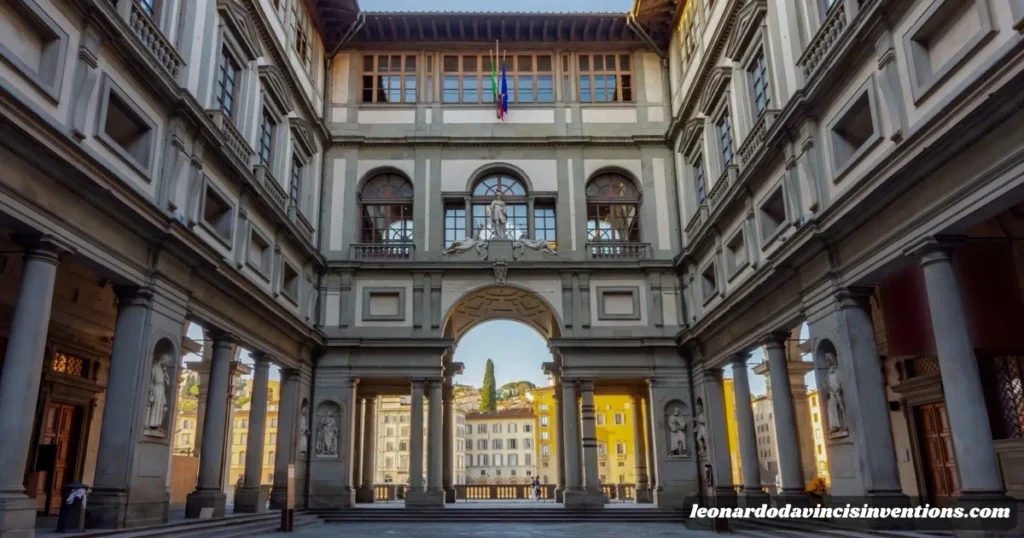
Florence is where Leonardo grew up and trained. The Uffizi Gallery houses some of his early paintings, including the Annunciation and the unfinished Adoration of the Magi. The Museo Nazionale del Bargello contains sculptural works from his early Florentine period.
The city itself is a Renaissance museum. Walking through the historic center — a UNESCO World Heritage Site — means moving through the same streets where Leonardo encountered the art, ideas, and patrons that shaped his early career.
Milan: The Heart of Leonardo’s Engineering Work
Milan is arguably the most important city for understanding Leonardo, the engineer and inventor. He lived and worked there from approximately 1482 to 1499 and again from 1506 to 1513.
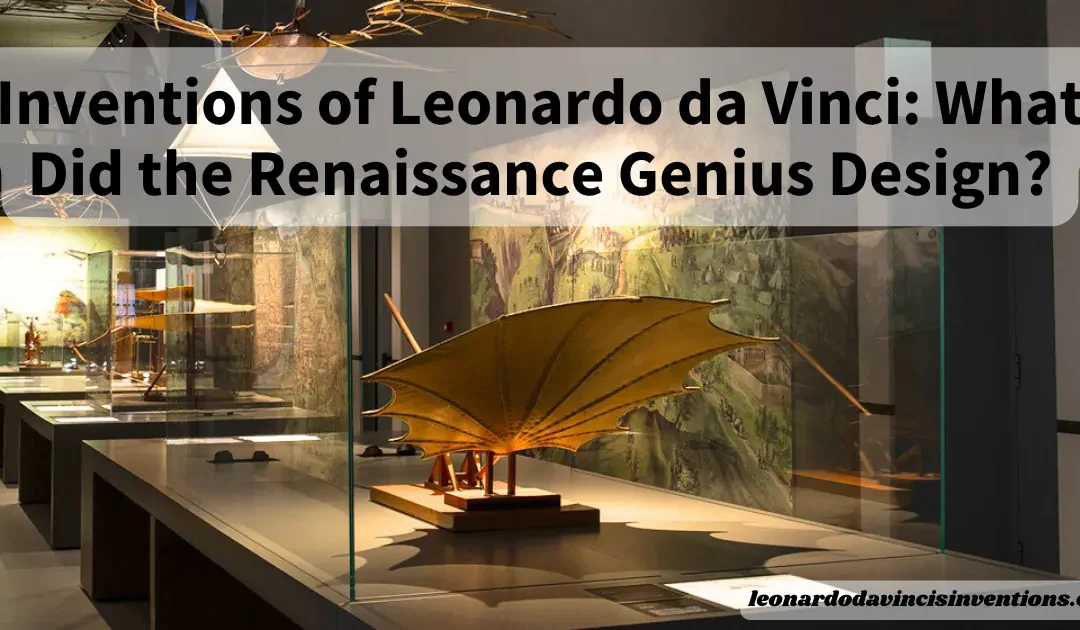
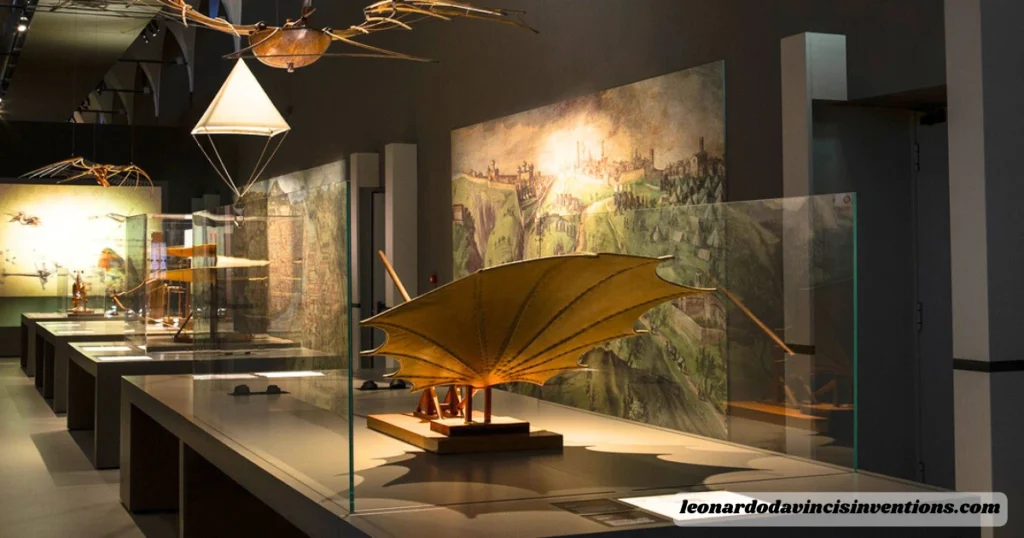
The Museo Nazionale della Scienza e della Tecnologia Leonardo da Vinci is the world’s largest Leonardo museum, housing an extraordinary collection of models based on his notebook drawings — including reconstructions of the aerial screw, the armored vehicle, the robotic knight, and dozens of other machines.
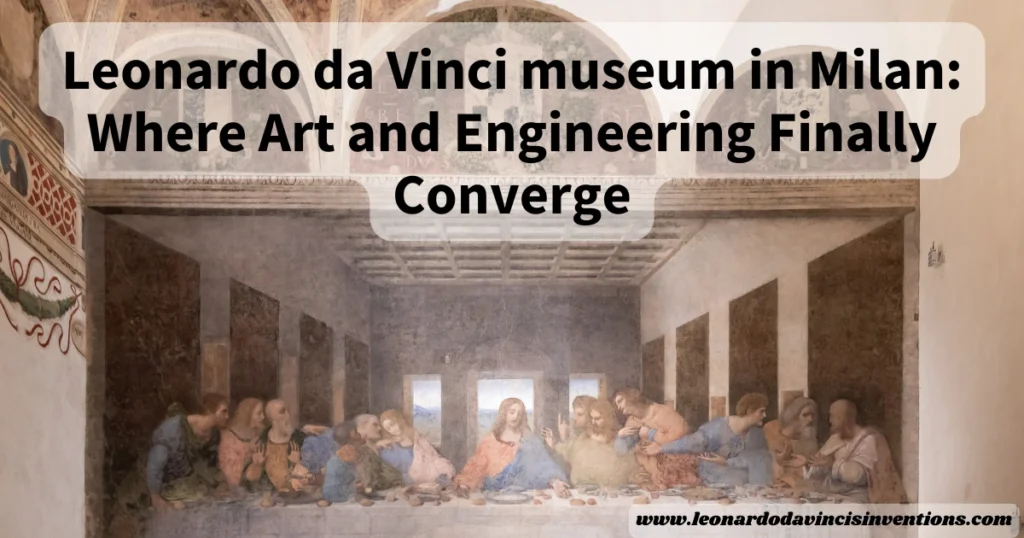
The Castello Sforzesco, where Leonardo worked under Ludovico Sforza, still stands and contains frescoes connected to his studio. And in the nearby refectory of Santa Maria delle Grazie, visitors can view The Last Supper — one of the most important paintings in the world — in its original location.
Vinci and Paris: Birthplace and Final Home
The hilltop town of Vinci, in Tuscany, is Leonardo’s birthplace and the site of the Museo Leonardiano — a dedicated Leonardo museum spread across two historic buildings. The museum offers a comprehensive introduction to his life, art, and inventions, and the surrounding countryside recalls the Tuscan landscape that appears in many of his paintings.
Leonardo spent his final years in France, at the Château du Clos Lucé near Amboise, at the invitation of King Francis I. The château has been preserved as a museum and includes a park with large-scale models of Leonardo’s machines. The nearby Château d’Amboise, where Leonardo is buried, completes the journey.
Experience Leonardo’s World in Person
Reading about Leonardo’s inventions is one thing. Seeing reconstructed models, handling interactive exhibits, and walking through the spaces where he worked is something altogether different. Several dedicated Leonardo museums and Renaissance cities offer exceptional experiences for curious travelers.
Dedicated Leonardo Museums
The Museo Nazionale della Scienza e della Tecnologia in Milan is the premier destination for Leonardo’s legacy in mechanical and engineering. The Leonardo da Vinci galleries present over 130 models based on his drawings, accompanied by original facsimile pages from his notebooks. The museum also offers educational programs and guided tours in multiple languages.
The Museo Leonardiano in Vinci presents the full arc of his life, from his birth in the Tuscan hills to his final years in France. For visitors who want to understand Leonardo the man as well as the inventor, Vinci is an essential destination.
Renaissance Cities and Cultural Tours
Florence, Milan, Venice, and the Loire Valley in France all form part of the broader Leonardo travel circuit. Guided tours focusing on Renaissance art and engineering are available in each of these cities, ranging from half-day museum visits to multi-day itineraries covering the full geography of his life.
Many tours combine visits to Leonardo sites with broader Renaissance history — the Uffizi, the Duomo, the Sforza Castle, the Loire châteaux — providing rich context for understanding why Leonardo emerged from this particular time and place.
Interactive Exhibitions and Traveling Shows
In recent years, large-scale traveling exhibitions dedicated to Leonardo da Vinci have toured major cities in Europe, North America, and Asia. These exhibitions typically combine facsimile notebook pages, reconstructed machine models, and immersive digital displays to bring his work to new audiences.
Planning to explore Leonardo da Vinci’s world in 2026?
| Exhibition / Museum | Location | Dates | What to See | Best For | Booking Needed |
|---|---|---|---|---|---|
| Leonardo da Vinci – 500 Years of Genius | Miami, USA | Until April 2026 | Immersive exhibits, interactive displays, reconstructed inventions | Families, interactive learners | Recommended |
| DaVinci The Exhibition | Detroit, USA | Oct 2025 – May 2026 | 65+ machine models, artwork studies, hands-on STEM displays | Students, engineering fans | Recommended |
| Leonardo da Vinci: Art & Science | Côte d’Azur, France | Feb – June 2026 | Art-science exhibits, cultural programs, educational displays | Art lovers, cultural travelers | Recommended |
| Leonardo da Vinci Museum (New Opening) | Pueblo, USA | Opening Spring 2026 | Permanent interactive museum, invention-focused exhibits | Families, year-round visitors | Optional |
Whether visiting a permanent museum in Milan or a traveling exhibition in your home city, engaging with Leonardo’s inventions in three dimensions transforms the experience of his genius from historical fact into something viscerally present.
Final Thoughts
This post is all about the inventions of Leonardo da Vinci across four major domains: civil engineering, flight, mechanical design, and military technology. Across all of these fields, a consistent pattern emerges: Leonardo observed the natural world with exceptional precision, identified underlying principles, and translated those principles into practical designs that anticipated technologies by centuries.
His legacy is not merely historical. Leonardo da Vinci’s inventions used today — from ball bearings to parachutes, from hydraulic engineering to the concept of the armored vehicle — remind us that the gap between imagination and reality is, in the end, a matter of time and materials. Leonardo had the imagination. The world eventually caught up with the materials.
FAQs about The Inventions of Leonardo da Vinci
Leonardo da Vinci’s major inventions include flying machines such as the ornithopter and the aerial screw (an early helicopter concept), the parachute, an armored vehicle (a tank), a diving suit, and mechanical devices such as a robot and a self-propelled cart. Most existed only as sketches, but many have been successfully reconstructed from his detailed notebook designs.
There is no conclusive evidence about Leonardo da Vinci’s sexuality, though many historians suggest he may have been gay. In 1476, he was accused of sodomy in Florence, but the charges were dropped due to insufficient evidence. Since he never married and left little personal documentation, his private life continues to be debated by scholars.
Leonardo da Vinci is most famous for painting the Mona Lisa and The Last Supper, two of the most influential artworks in history. Beyond art, he is also celebrated for his scientific studies and inventive designs, which helped define the ideal of the Renaissance “universal genius.”
Leonardo da Vinci did not invent the gun, which already existed in Europe before his time. However, he designed advanced military devices such as multi-barreled cannons and other weapons that improved firing efficiency, showing his innovative approach to warfare technology.
There is no single “most important” invention, but Leonardo’s flying machine concepts—especially the aerial screw (helicopter-like design)—are often considered the most influential. These ideas anticipated modern aviation principles centuries before they became technologically possible.
Leonardo da Vinci’s IQ is unknown, as modern intelligence testing did not exist during his lifetime. Some estimates suggest it may have been extremely high, often cited as 180–220, but these figures are not scientifically verifiable and should be viewed as informal guesses rather than factual measurements.
Related Post You May Like


Disclosure: This page may contain affiliate links. If you choose an experience through them, it helps support the site at no extra cost to you.
 Leonardo Bianchi is the founder of Leonardo da Vinci Inventions & Experiences, a travel and research guide exploring where to experience Leonardo’s art, engineering, and legacy across Italy and Paris.