
(Last updated: Sep 2026)
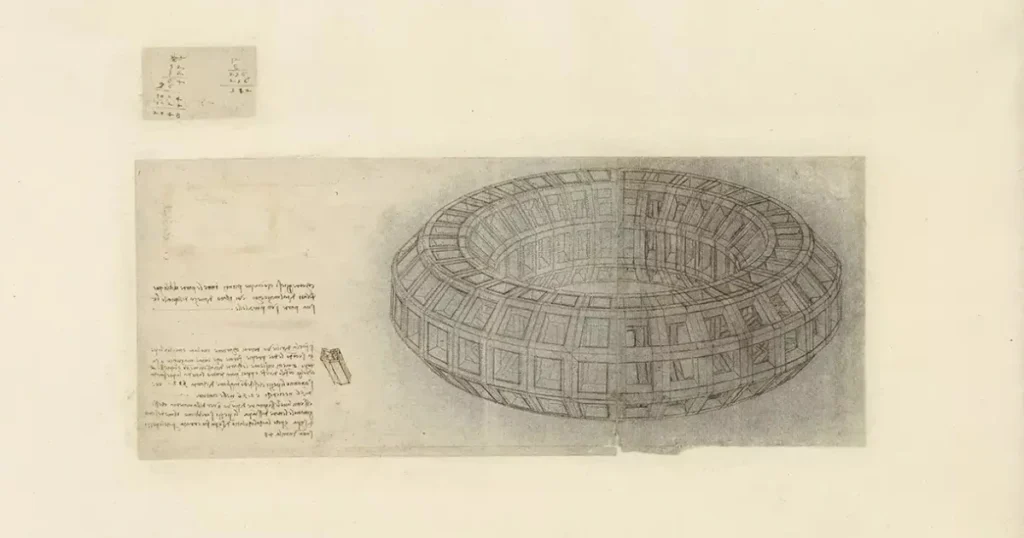
Da Vinci Codex Atlanticus is the single largest surviving collection of Leonardo da Vinci's drawings and writings, and it still sits in the same Milanese library that has protected it for almost four centuries.
Turning through its pages feels less like reading a finished book and more like eavesdropping on a mind that never stopped sketching, calculating, and questioning.
Historians treat the codex as the closest thing we have to a direct transcript of Leonardo's thinking, since it spans over four decades of his working life and touches nearly every subject he studied, from military engineering to hydraulics to human flight.
For travelers, that same density is what makes the codex such a rewarding starting point. Understanding what's on these pages changes how the rest of Milan, and Leonardo's other notebooks, come into focus once you're standing in front of them.
This post is all about the da Vinci Codex Atlanticus — what's inside it, how it survived five hundred years of history, and where you can still see it today.
What is the Codex Atlanticus?
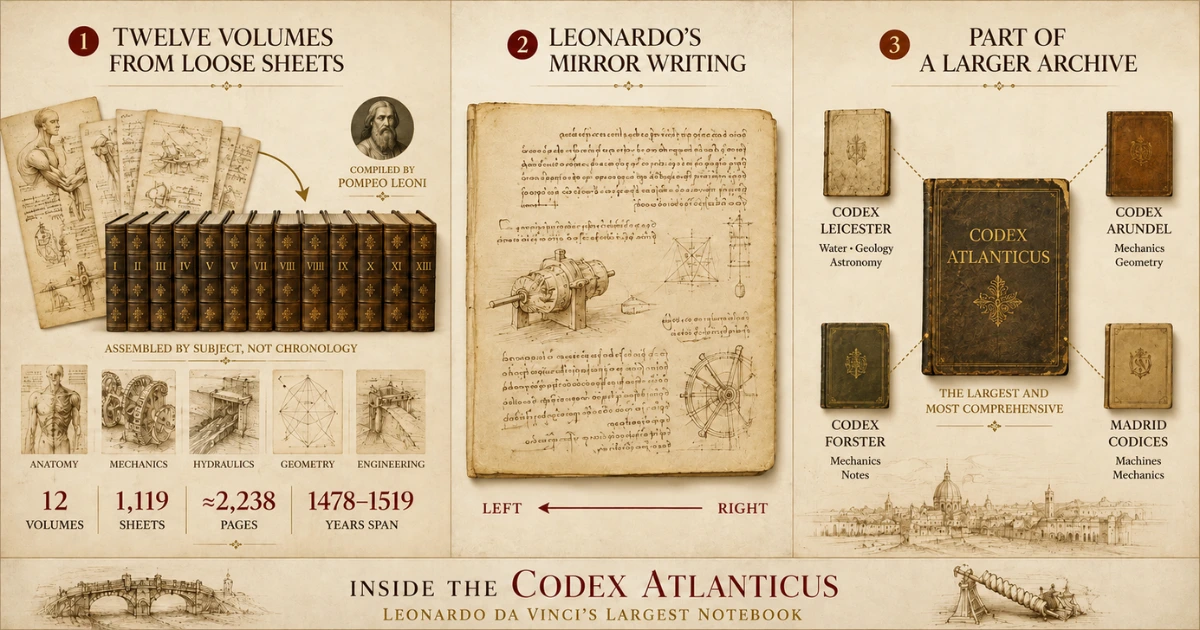
The Codex Atlanticus is a twelve-volume collection of 1,119 sheets of paper containing Leonardo da Vinci's drawings, diagrams, and notes, compiled after his death by the sculptor Pompeo Leoni. Covering the years 1478 to 1519, it contains Leonardo's studies in engineering, mechanics, mathematics, and military design and is housed today at Milan's Biblioteca Ambrosiana.
The Engineering Idea Behind the da Vinci Codex Atlanticus
A Working Notebook, Not a Finished Book
Most of what fills the da Vinci Codex Atlanticus was never meant for anyone else to read. Leonardo used these pages the way an engineer today might use a whiteboard: to think out loud, test an idea, and move on to the next one.
Sketches of gear trains sit next to shopping lists. A diagram for a canal lock shares space with a quick doodle of a cat chasing its tail. That mix is exactly why historians value the codex so highly. It shows Leonardo's mind mid-motion, not cleaned up or simplified for an audience.
The pages weren't originally bound together at all. Leonardo carried loose sheets of different sizes, often folded into small, pocket-sized notebooks he could pull out wherever he happened to be working.
Decades after his death, the sculptor Pompeo Leoni gathered hundreds of these individual sheets, which he had inherited through Leonardo's pupil Francesco Melzi, and mounted them on larger pages, loosely sorted by subject rather than by date.
That process is the origin of the codex readers encounter today: a patchwork built from a lifetime of scattered notes, reassembled into something closer to an archive than a traditional manuscript.
From War Machines to Flying Machines
Open the Leonardo da Vinci Codex Atlanticus and the sheer range of subjects is almost dizzying. Leonardo sketched a giant crossbow designed to intimidate as much as to fire, plans for armored fighting vehicles, and diagrams for canal systems meant to move water and boats through Milan.
He drew Archimedean screws for lifting water, gear trains for machinery, and early studies of flight that echo the ideas explored more fully in his separate Codex on the Flight of Birds.
Some of these drawings are wildly ambitious and were never built. Others, like his studies of pumps and hoists, reflect real problems he was hired to solve for Milanese patrons and the Sforza court. Leonardo also filled pages with more modest, almost domestic mechanisms: automated looms, spring-driven devices, and tools meant to speed up ordinary workshop tasks.
Seeing those smaller sketches next to the giant crossbow is a useful reminder that Leonardo's engineering work wasn't only about spectacle. Much of it was practical problem-solving for the city he was living in at the time.
What ties the sketches together isn't a single invention or a single field. It's a method: observe closely, draw precisely, and test an idea on paper long before committing to it in wood or metal. That habit, repeated across more than a thousand pages, is the real engineering achievement hiding inside the codex.
How the Codex Atlanticus Works
Twelve Volumes Built From Loose Pages
In its current form, the da Vinci Codex Atlanticus is bound into twelve large volumes holding 1,119 sheets, roughly 2,238 pages once both sides are counted. The pages span 1478 to 1519, covering Leonardo's early years in Florence through his final months in France.
Because Pompeo Leoni organized the sheets by theme rather than chronology, a single volume can jump from anatomy to hydraulics to military design within just a few pages.
Reading it front to back won't give you a neat timeline of Leonardo's life. Instead, it gives you a cross-section of everything he was thinking about at once, which is arguably more revealing than a chronological diary would be.
Later restoration work in the twentieth century unbound the original nineteenth-century mounting and rehoused each sheet individually, allowing conservators to preserve both sides of pages that had previously been glued flat against cardboard.
That restoration is part of why the codex is legible and well-documented today, rather than fading quietly in storage.
Mirror Writing and Leonardo's Private Method
Much of the text running alongside the drawings is written in mirror script, moving right to left across the page, legible only when held up to a mirror. Leonardo was left-handed, and writing this way likely kept his hand from smudging wet ink as it moved across the sheet. It may also have simply suited how he thought.
Either way, it means the notes were never written for easy reading by outsiders. Combined with personal abbreviations and shorthand, the text in the Codex Atlanticus reads more like a private lab notebook than a manuscript ever intended for publication.
That privacy is part of what makes the codex feel so immediate. You're not reading Leonardo's polished conclusions. You're reading his process, mid-sentence, before he had decided what any of it meant.
Curious readers planning a trip often like to see this working method up close rather than only in photographs, and one practical way to do that is through a guided small-group visit to the Biblioteca Ambrosiana, which sets aside time specifically to look at original Leonardo folios alongside a docent who can walk through the mirror script and margin notes in more depth.
A Bridge to Leonardo's Other Codices
The da Vinci Codex Atlanticus is the largest of Leonardo's notebooks, but it's just one piece of a much bigger paper trail.
The Codex Leicester focuses on water, geology, and astronomy, and is one of the few Leonardo manuscripts still in private hands. The Codex Arundel and Codex Forster, both held in London, cover mechanics and geometry in smaller, more portable formats.
The Madrid Codices, rediscovered only in the 1960s after being misfiled for centuries, contain detailed studies of machine elements and mechanics.
Leonardo's anatomy drawings, including the famous Vitruvian Man, mostly live in a separate collection rather than inside the Atlanticus itself, though the Atlanticus shares the same analytical eye: a human body, a bridge, and a gear system all get the same careful, measured geometry.
Together, these notebooks form the closest thing we have to Leonardo's personal archive, and the Codex Atlanticus is the natural starting point for exploring the rest.
Where to See the Codex Atlanticus Today
The Biblioteca Ambrosiana in Milan
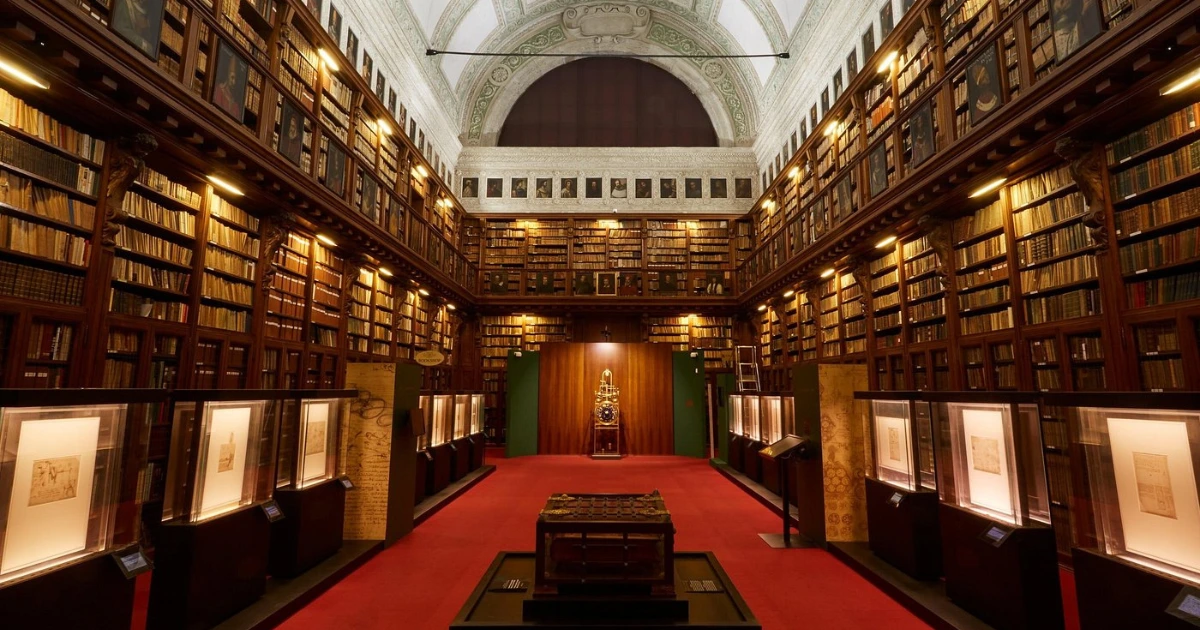
The da Vinci Codex Atlanticus has lived in Milan's Biblioteca Ambrosiana since 1637, when the Milanese nobleman Galeazzo Arconati donated it, along with eleven other Leonardo notebooks, to the library founded by Cardinal Federico Borromeo.
The codex left Italy only once, when Napoleon's forces seized it during the occupation of Milan in 1796 and transported it to Paris; it returned home in 1815, after the Congress of Vienna ordered looted works restored to their original owners.
Today the Biblioteca Ambrosiana and its adjoining gallery, the Pinacoteca Ambrosiana, sit near Piazza San Sepolcro in central Milan, not far from where Leonardo himself once worked and sketched the city's layout.
Because the original sheets are fragile, the museum rotates a small selection of folios on public display rather than exhibiting all 1,119 at once. Seeing even a handful of original pages in person, inside the same building that has protected them since the seventeenth century, is a different experience than looking at even the best reproductions.
Browsing the Codex Online
For anyone who can't get to Milan right away, the Biblioteca Ambrosiana digitized every page of the da Vinci Codex Atlanticus in high resolution as part of a project marking the 500th anniversary of Leonardo's death.
The platform lets visitors zoom into individual sketches, read scholarly annotations, and browse by theme rather than by page number. It's a genuinely useful way to get familiar with specific drawings before a trip, or to explore the codex on its own if a visit isn't in the plans yet.
Still, a screen can only show so much. The physical scale of the original sheets, the texture of five-hundred-year-old paper, and the sheer density of notes packed into every margin tend to come through only in person.
Researchers have used the digitization project to cross-reference drawings that were separated during Pompeo Leoni's original mounting, reconnecting sketches that once belonged to the same original sheet before Leonardo's papers were cut apart and rearranged.
That kind of detective work is easier to appreciate once you've spent time with the physical volumes and understand just how much the codex was reorganized over the centuries.
Exploring Leonardo da Vinci in Milan
Milan is where Leonardo spent the better part of two decades, first from 1482 to 1499 and again from 1506 to 1513, and it's where most of the Codex Atlanticus took shape.
Beyond the Biblioteca Ambrosiana, the city still holds The Last Supper, canal designs echoed in Milan's Naviglio waterways, and archival traces of the engineering work Leonardo carried out for the Sforza court.
Walking between these sites turns the codex from an abstract idea into something rooted in real streets and buildings, rather than just a name attached to a museum case.
For a fuller picture, it's worth exploring Leonardo's presence beyond Milan too: Milan, where he spent his most productive engineering years; Florence, where he trained and painted some of his earliest work; Venice, where he consulted on defensive engineering; Rome, where he worked in the Vatican's orbit late in his career; and Paris, where he spent his final years and where the Codex Atlanticus itself briefly ended up after Napoleon's campaigns.
Each city adds a different layer to a story that begins on the pages of this one notebook.
Seeing Leonardo's Milan in Person
Reading about the Codex Atlanticus is one thing. Standing in the rooms that have guarded it for almost four hundred years is another.
A visit to the Biblioteca Ambrosiana and the adjoining Pinacoteca puts you a few feet from original Leonardo sheets, displayed alongside paintings and manuscripts collected by the same Renaissance-era library.
Many visitors combine the Ambrosiana with a wider walk through Leonardo's Milan, taking in The Last Supper, the Sforza Castle, and the streets where he lived while filling these pages with engineering sketches.
Seeing the actual scale of the notebook, thick with cross-outs and crowded margin notes, tends to change how people read about Leonardo afterward. The ideas stop feeling like museum trivia and start feeling like the work of one very restless, very specific person.
See the Codex Atlanticus
Step inside the Biblioteca Ambrosiana to see rotating sheets from Leonardo’s largest surviving notebook and explore its historic art collection.
See Codex Atlanticus TicketsLeonardo's Milan: Ambrosiana & The Last Supper
A guided half-day walk connecting the Biblioteca Ambrosiana, home of the Codex Atlanticus, with the wider footprint Leonardo left across Milan.
- Timed entry to see original Leonardo folios at the Ambrosiana
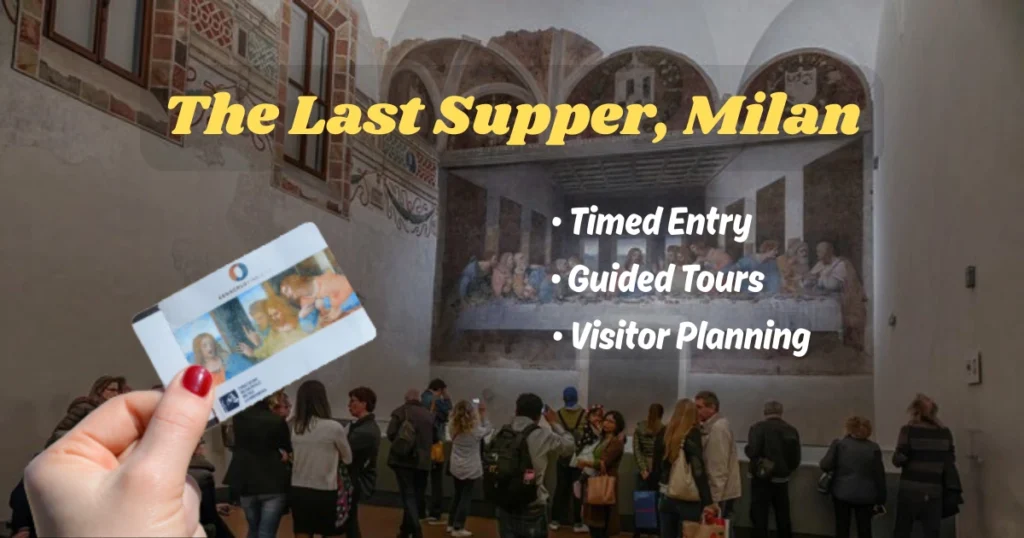
- A guided viewing of The Last Supper, booked well ahead of the visit date
- Context on Leonardo's engineering work for the Sforza court
Many visitors find that seeing the original pages first makes the rest of Leonardo's Milan easier to follow.
Guided access to the Ambrosiana and The Last Supper is limited, since both sites cap daily visitor numbers to protect the artwork. Checking availability a little ahead of a trip to Milan is generally worth the few minutes it takes.
Final Thoughts
This post was all about the da Vinci Codex Atlanticus, the largest surviving record of how Leonardo actually thought. Across twelve volumes and more than a thousand sheets, you can watch one mind move between war machines, water systems, flight, and geometry without ever settling into a single lane.
That restlessness is part of what makes Leonardo's Renaissance legacy so hard to categorize, and so easy to keep studying centuries later.
Whether you explore it through the Ambrosiana's digital archive or in front of the original pages in Milan, the codex rewards patience more than speed. Few documents let you get this close to a genius mid-thought, cross-outs, tangents, and all.
Seeing it in person, in the city where most of it was drawn, adds a layer that photographs alone can't quite deliver — and it's a reminder that the Renaissance wasn't just paintings on museum walls, but also long nights of sketching, revising, and figuring things out one page at a time.
Related Post You May Like

Disclosure: This page may contain affiliate links. If you book through them, we may earn a small commission at no extra cost to you. Learn more.
Free Leonardo Milan Travel Guide
Plan Your Leonardo Trip in Milan
A premium mini guidebook for smarter Milan planning, including the best ticket strategy, Leonardo map, and practical visitor advice.
Get the Free Guide
Download the guide and receive practical Milan planning tips by email.
Download the Free Guide >> Leonardo Bianchi is the founder of Leonardo da Vinci Inventions & Experiences, a cultural travel guide helping visitors explore Leonardo da Vinci’s art, inventions, and legacy across Italy and Paris.