
(Last updated: Sep 2026)
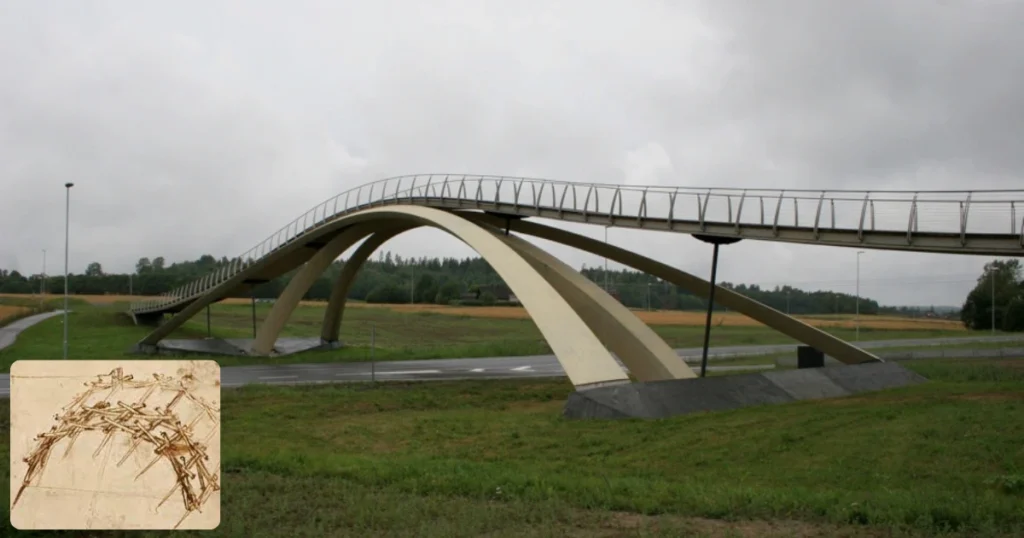
Did Leonardo da Vinci's inventions work, or were they simply beautiful drawings that never left the page?
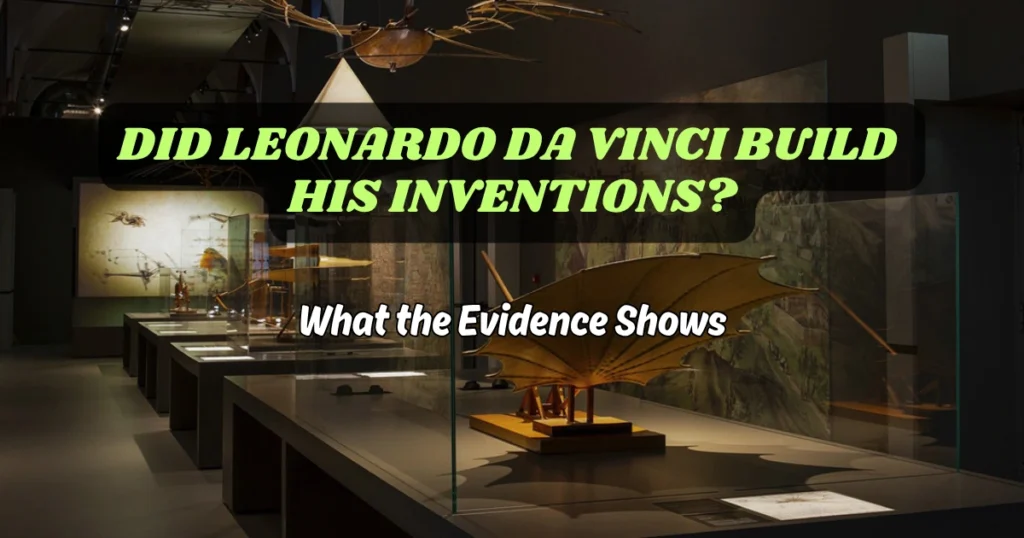
It's one of the most common questions people ask after seeing his notebooks for the first time. Leonardo filled thousands of pages with tanks, flying machines, and mechanical carts, but he built almost none of them himself.
That gap between sketch and machine is exactly why historians and engineers still argue about which ideas actually held up.
Understanding what Leonardo got right — and where his designs ran into real physical limits — matters for more than trivia night. It changes how you see the Renaissance itself, a period often remembered for art but quietly powered by obsessive engineering curiosity.
It also changes how a museum visit feels. Standing in front of a reconstructed model hits differently once you know whether it's a faithful machine or an educated guess dressed up for display.
This post is all about whether Leonardo da Vinci's inventions worked, and what four centuries of testing, modeling, and reconstruction have actually taught us.
Did Leonardo da Vinci's inventions work?
Asking whether Leonardo da Vinci's inventions worked means asking if his mechanical designs could function as physical machines, not whether he personally built and tested them. Most existed only as notebook sketches. Modern engineers evaluate them using scale models, computer simulations, and full-size reconstructions to judge whether the underlying mechanics hold up.
The Engineering Idea Behind Leonardo da Vinci's Inventions
An Observer of Nature Before an Inventor
Before Leonardo ever sketched a machine, he studied the thing the machine was meant to imitate or improve on. He watched birds bank and glide for years before drawing a single wing mechanism.
He studied how water moved through channels before designing locks and pumps. This habit of close observation is what separates his notebooks from the era's ordinary technical drawings.
It also explains why some of his ideas were so far ahead of what Renaissance workshops could actually produce. Leonardo was reasoning from first principles about motion, force, and resistance, sometimes decades before the vocabulary of physics existed to describe what he was doing.
From Notebook Sketch to Mechanical Concept
Most of Leonardo's inventions never had a single, finished blueprint. Many pages show the same idea reworked several times, with gears added, removed, or resized between versions.
That's part of why the question "did Leonardo da Vinci's inventions work" resists a simple yes-or-no answer — engineers often compare a specific reconstruction against one of many versions.
His designs generally fall into a few categories once tested: mechanically workable ideas where the core mechanism functions, concepts that work only with modest modifications, ideas that are conceptually brilliant but impractical given Renaissance-era materials and power sources, and a handful that simply can't be evaluated confidently because the surviving drawing leaves out too much information.
How Leonardo da Vinci's Inventions Work — Or Don't
The Armored Vehicle: Could the "Tank" Work?
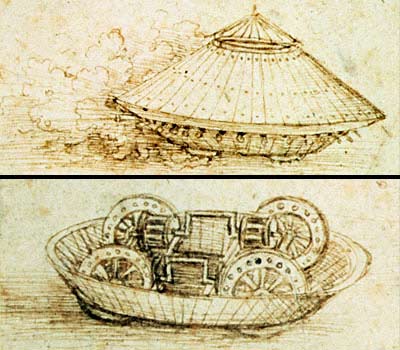
Leonardo's armored vehicle is one of his most famous sketches, and one of his most debated. The design shows an enclosed, cone-shaped shell mounted on wheels, ringed with cannons, and powered by men cranking gears inside.
As a defensive concept, it's genuinely clever: an armored, mobile gun platform was well ahead of its time.
The mechanical sticking point is the gearing. As drawn, some reconstructions found that the internal gears would have driven the front and rear wheels in opposite directions, effectively locking the vehicle in place.
Some historians have suggested Leonardo deliberately built this error in, so the design couldn't be stolen and used against Florence. Others think it's simply an unresolved sketch he never fully worked through. Neither theory has sufficient evidence to be treated as a settled fact.
The Aerial Screw and the Limits of Human-Powered Flight
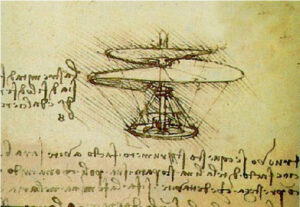
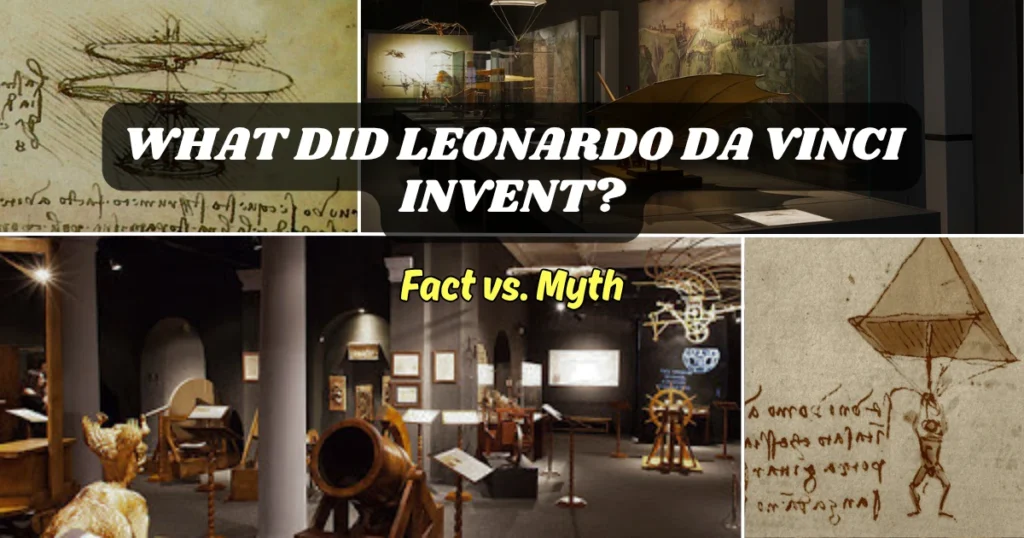
The aerial screw — often called an early helicopter concept — is a rotating helical surface designed to "screw" its way upward through the air, similar in principle to how a screw bites into wood.
The concept behind lift generated by a spinning surface isn't wrong. Modern helicopters use rotors for exactly that reason.
What Leonardo lacked wasn't insight; it was a power source. A human being simply can't generate enough force relative to their own body weight to spin a structure that large fast enough to lift off, and the materials available at the time would have made the screw too heavy regardless.
The idea correctly identifies a mechanism for flight, but the machine as drawn could never have carried a person off the ground.
A Closer Look: Testing Leonardo's Ideas in Person
Several museums now let visitors walk right up to working scale reconstructions of these exact machines, gears and all.
- Hands-on models of the armored vehicle, aerial screw, and self-propelled cart
- Explanations of where each design succeeds and where it hits real mechanical limits
- Original notebook facsimiles displayed alongside the physical builds
Visitors often note that seeing the gears turn changes how the sketches read on the page.
The Parachute and the Self-Propelled Cart
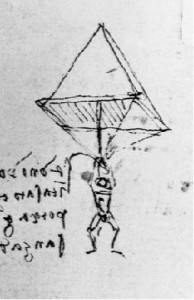
Leonardo's parachute design, a rigid pyramid-shaped canopy stretched over a wooden frame, is one of the better-tested ideas in his notebooks. Modern skydivers and engineers have built and jumped with reconstructions closely based on the sketch, and the canopy has functioned as a parachute.
That's a case where a reconstruction tested Leonardo's underlying principle rather than proving that a Renaissance-built version would have flown just as safely, since modern materials are lighter and more consistent than those a 1500 workshop could produce.
The self-propelled cart is arguably his most mechanically sound invention. Powered by coiled springs rather than an animal, it used a system of gears to move on its own and could even be steered along a pre-set path.
Reconstructions built directly from his drawings have moved under their own power. It's less flashy than a tank or a flying machine, but it may be the clearest proof of Leonardo thinking rigorously about stored mechanical energy.
Did Leonardo's Military Machines Work?
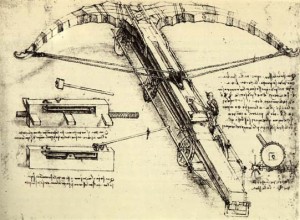
Leonardo also sketched a giant crossbow, a multi-barrel artillery piece he sometimes called the "organ gun," and various catapult designs. It's tempting to ask the same question of each — could this weapon work — but that framing misses something important.
Crossbows, catapults, and early artillery already existed in Leonardo's era. He wasn't inventing these categories from nothing; he was studying, enlarging, modifying, and combining known technologies to see if a better version was possible.
So the more useful question for these designs isn't "could this technology work?" It's "would Leonardo's particular version have offered a real advantage over what already existed?"
His giant crossbow, for instance, uses mechanically sound principles for storing and releasing tension, but its enormous scale raises real questions about transport and battlefield practicality.
His multi-barrel gun cleverly solves the reload-speed problem of single-barrel artillery, though whether it was ever built or just sketched as a proposal remains unclear.
Bridges, Canals, and Practical Engineering
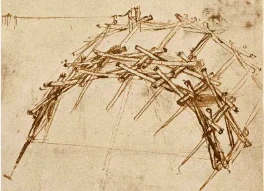
It's easy to let tanks and flying machines dominate the conversation, but a lot of Leonardo's most solid engineering work involved far less dramatic problems: bridges, canal locks, water-lifting devices, pumps, gears, bearings, and cranes. These practical systems reveal steady, testable mechanical reasoning rather than speculative leaps.
His studies of friction, gearing, and hydraulic force are considered genuinely ahead of their time by historians of engineering, even though they rarely appear in popular retellings of his life.
They're a useful reminder that his reputation as an inventor doesn't rest solely on futuristic-looking machines. Much of it comes from patient, grounded problem-solving applied to the everyday infrastructure of Renaissance cities.
The Real Obstacle: Renaissance Materials and Power
Even when a mechanism made perfect sense on paper, one question kept coming up: could it have actually been built and operated with what was available around 1500? Several constraints recur across Leonardo's more ambitious designs.
Power is the biggest one. Human or animal muscle can only generate so much force relative to weight, which severely limits the ability to achieve flight. Weight is another — wood, rope, iron, and fabric add up quickly at full scale, even when a small model feels light in the hand.
Materials matter too, since modern reconstructions often benefit from metals and fabrics that are lighter and more consistent than anything a Renaissance workshop could produce. Manufacturing precision is a quieter but equally important factor, since complex gear systems depend on accurate, repeatable fabrication that didn't yet exist.
Friction behaves differently at scale, and a mechanism that spins freely in a tabletop model can bog down considerably once built full-size. Finally, scale itself is deceptive — a working miniature doesn't guarantee that a giant version will behave the same way under real-world loads.
Taken together, these constraints explain why so many of Leonardo's ideas can be mechanically sound and still impractical for their era. The concept was often right. The century wasn't ready for it.
What Modern Reconstructions Can — and Can't — Prove
Every time a museum or engineering team builds a working model from one of Leonardo's sketches, it's worth asking exactly what that model demonstrates.
A successful reconstruction can show that a mechanism moves, that a notebook sketch can be translated into a real physical object, and that the underlying mechanical principle makes sense. It can also reveal missing components or ambiguous details in the original drawing.
What it can't do is confirm that Leonardo built one himself, that he ever tested one, or that he intended a given sketch as a finished construction plan rather than a working idea still in progress.
It also can't guarantee that a machine built from period-accurate materials in 1500 would have performed the way a modern reconstruction does. That distinction — evidence of a working concept versus proof of a working Renaissance machine — is the single most important idea for understanding this topic honestly.
Where to See Leonardo da Vinci's Inventions Today
Museums Built Around Working Models
A handful of museums specialize in turning Leonardo's notebook pages into physical, often interactive, machines. Rather than displaying static replicas behind glass, many let visitors turn cranks, watch gears engage, and see for themselves why certain designs succeed, and others stall out. This is where the abstract question of whether an invention "worked" becomes something you can actually observe.
Milan: The City Where Leonardo Engineered
Milan is the natural home base for this kind of exploration. Leonardo spent roughly two decades there working for Duke Ludovico Sforza, and much of his engineering output — canal designs, military concepts, mechanical studies — came directly out of problems the city asked him to solve.
Walking through Milan today, with that history in mind, changes how ordinary bridges and waterways look.
For travelers who want the mechanical side of Leonardo explained in person rather than read about it secondhand, a guided walk through Milan's science and technology museum is worth exploring alongside a local expert, who can point out exactly which reconstructions are faithful builds and which are best guesses that fill gaps in the notebooks.
Which Leonardo Inventions Could Actually Work?
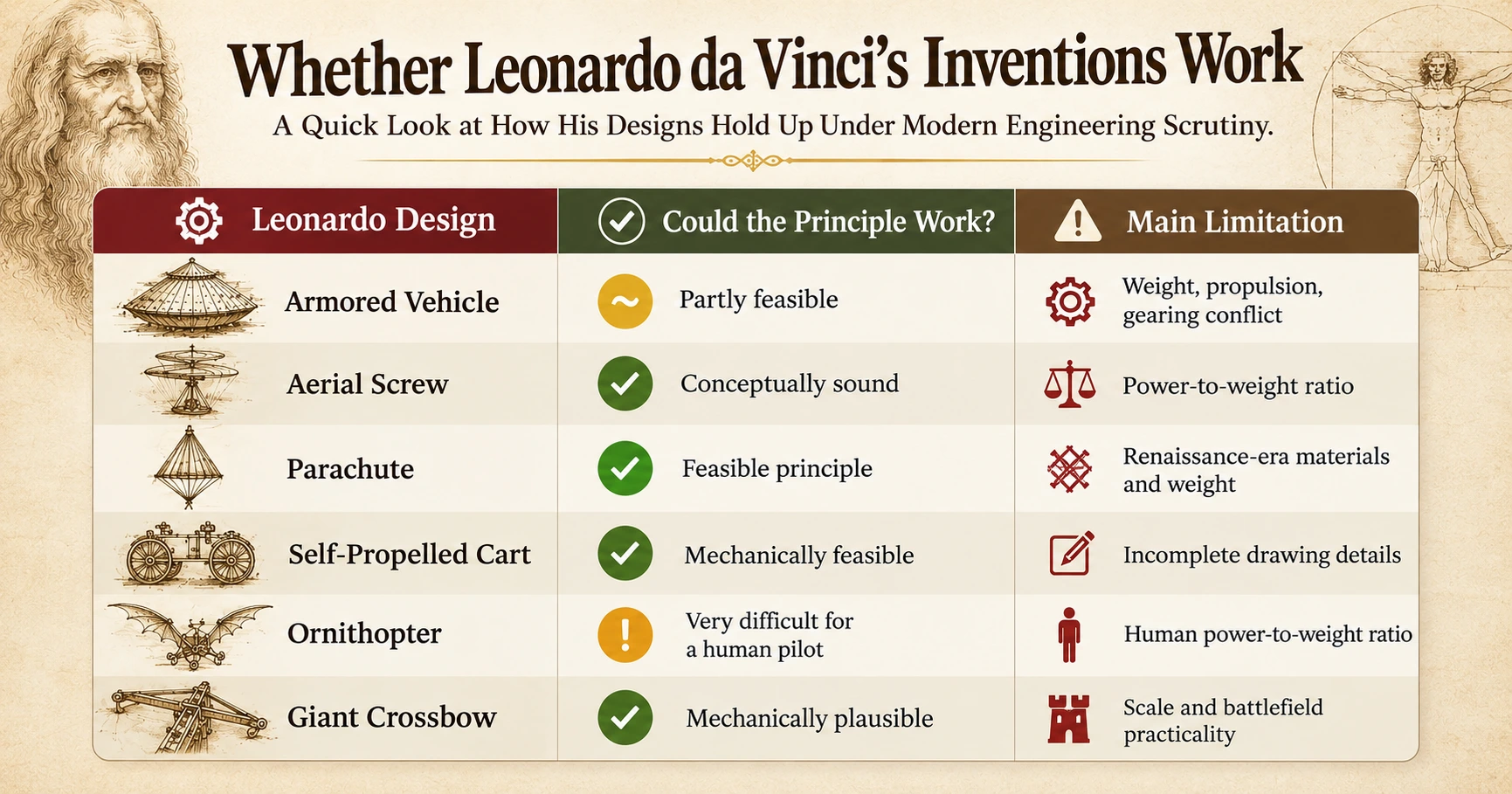
Notice that none of these get a flat "yes" or "no." That's the honest answer. A working scale model tells you a mechanism is sound, not that Leonardo built one, tested one, or that a full-size Renaissance version would have performed identically.
Materials, friction, and scale all behave differently once you move from a tabletop model to a life-size machine, which is exactly why modern reconstructions are treated as evidence, not proof.
Experiencing Leonardo's Engineering Legacy in Person
Reading about gear ratios and power-to-weight limits only goes so far. The machines themselves — the cranks, the springs, the counterweights — are built to be seen turning, not described in a paragraph.
Milan's science and technology museum houses one of the largest collections of physical reconstructions of Leonardo's work in the world, built directly from his notebook pages and displayed alongside the sketches that inspired them.
Standing next to a life-size aerial screw makes its power problem obvious in a way no diagram can fully capture.
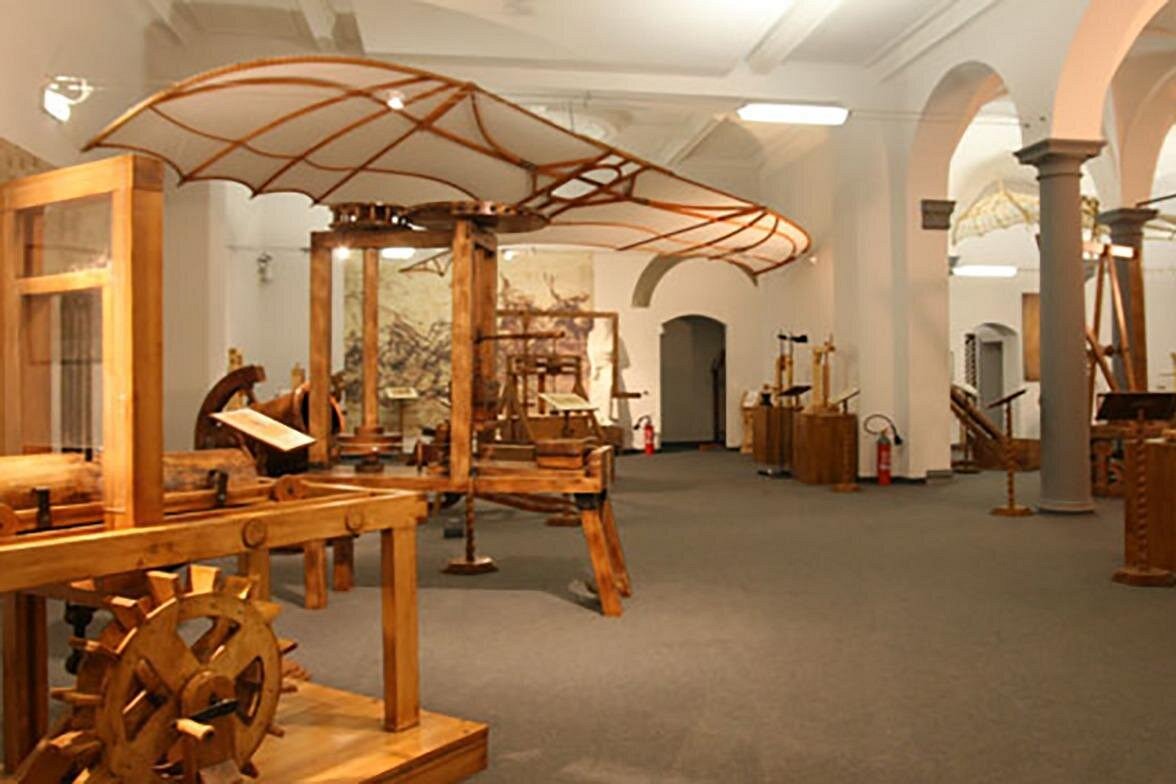
Explore Leonardo’s Machines in Milan
See full-scale reconstructions of Leonardo’s inventions and discover the engineering ideas behind his designs
Explore Leonardo Museum ToursLeonardo da Vinci Museum Guided Visit, Milan
A guided walk through the museum's Leonardo gallery, focused on how his mechanical designs were reconstructed and tested.
- Working models of the tank, cart, and aerial screw
- Context on which designs were built as drawn versus reinterpreted
- Small-group format with a guide who covers the engineering, not just the biography
Many visitors say the guide's explanations made the mechanical limitations click in a way the notebooks alone don't. Check availability
Before deciding whether this is the kind of visit worth planning around, it helps to know that these experiences are typically small-group and run on a fixed schedule, so context and access tend to matter more than convenience alone.
Exploring Leonardo da Vinci in Milan
Milan isn't the only place shaped by Leonardo's engineering mind, but it's arguably the most concentrated.
In Milan, between his mechanical studies for the Sforza court and his architectural work on the city's canal system, theory and practical infrastructure met most directly. It's a natural starting point for anyone tracing the invention side of his career, rather than the purely artistic side found elsewhere.
From there, the trail widens. Florence shaped his early training and habits of observation; Venice is linked to his military engineering consultations; Rome is associated with later projects from his final working years; and Paris is where he spent his last days under the patronage of King Francis I.
Each city adds a different layer to understanding how his inventions took shape.
Final Thoughts
This post was all about whether Leonardo da Vinci's inventions work, and the honest answer sits somewhere between yes and no.
Some designs, like the self-propelled cart and the parachute, hold up remarkably well under modern testing. Others, like the aerial screw, reveal brilliant thinking limited by the physical realities of the time.
What ties them together isn't a perfect track record — it's a mind that treated drawing as a way of thinking through mechanical problems long before anyone had the tools to build most of them.
That's really the Renaissance lesson hiding inside all these machines. Seeing a reconstructed tank or cart move in person doesn't just settle an engineering debate — it puts you in the room with the same curiosity that drove Leonardo to keep sketching in the first place, five hundred years before anyone could prove him right.
Related Post You May Like

Disclosure: This page may contain affiliate links. If you book through them, we may earn a small commission at no extra cost to you. Learn more.
Free Leonardo Milan Travel Guide
Plan Your Leonardo Trip in Milan
A premium mini guidebook for smarter Milan planning, including the best ticket strategy, Leonardo map, and practical visitor advice.
Get the Free Guide
Download the guide and receive practical Milan planning tips by email.
Download the Free Guide >> Leonardo Bianchi is the founder of Leonardo da Vinci Inventions & Experiences, a cultural travel guide helping visitors explore Leonardo da Vinci’s art, inventions, and legacy across Italy and Paris.