Leonardo da Vinci ball bearing is a fascinating piece of engineering history. You might wonder how such a small invention can have a significant impact on technology.
This post will explore how da Vinci’s design reduced friction between moving parts and enabled advancements in modern machinery.
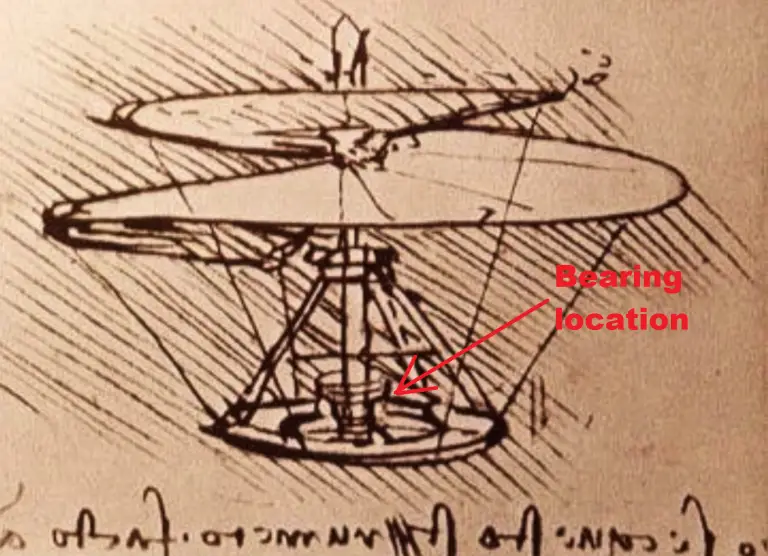
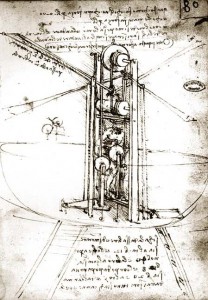
Leonardo da Vinci designed the ball bearing between 1498 and 1500 to reduce friction in his other inventions, like the helicopter.
Though his helicopter never achieved actual flight, the principles behind ball bearings were revolutionary. Their design allows for smoother motion, essential in many mechanical devices today.
His ingenious sketches show a vision ahead of his time. Leonardo’s work laid the foundation for many modern innovations.
Understanding Leonardo da Vinci’s contributions to engineering allows one to appreciate the lasting impact of his ideas on technology and beyond. His notebooks contain more information about his conceptualization of bearings.
Leonardo da Vinci Ball Bearing: Historical Context
Leonardo da Vinci made notable advancements in engineering and art during the Renaissance. His diverse interests extended to mechanics, where his designs, including the ball bearing, displayed his ingenuity.
Leonardo da Vinci’s Life
Leonardo da Vinci, born in 1452 in Vinci, Italy, is one of history’s most renowned polymaths. During his lifetime, he excelled as an artist and gained a reputation as an engineer and inventor. His works reflect a deep curiosity and relentless pursuit of knowledge.
Da Vinci studied anatomy, physics, and engineering, which contributed to his well-rounded approach to invention. Among his many creations, the Leonardo da Vinci Ball Bearing stands out for its innovative attempt to reduce friction, an insight that remains valuable in modern engineering.
His legacy can still be seen in the fields of art and science today, particularly in his remarkable works such as the Mona Lisa and The Last Supper.
Inventions and Mechanical Contributions
Leonardo’s mechanical designs were varied and imaginative. His inventions ranged from war machines to flying devices. One significant design was the ball bearing, sketched around 1498–1500.
This invention aimed to decrease friction between surfaces. It has practical applications, including use in rotating parts, as seen in today’s machinery.
Leonardo dared to conceptualize devices like early helicopters and tanks. While many of his ideas were never built during his lifetime, they laid foundational concepts for future technological advancements.
Historians often view the ball bearing as a critical development, reinforcing da Vinci’s importance in mechanical engineering. His extensive sketches and notes remain a testament to his visionary approach and continue to inspire engineers and inventors worldwide.
Analysis of the Ball Bearing Concept
The Leonardo da Vinci Ball Bearing design is a remarkable blend of mechanical insight and innovation. It reduces friction and supports rotational motion, laying the groundwork for modern engineering. This concept highlights Leonardo’s forward-thinking and mechanical genius.
Mechanical Principles
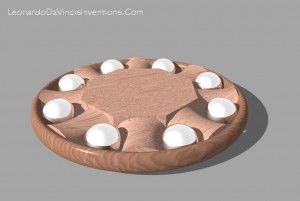
Leonardo da Vinci’s ball bearing (3D view)
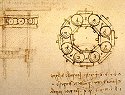
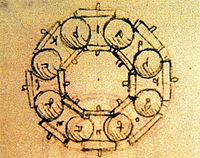
Leonardo da Vinci’s sketches reveal his intention to reduce friction between moving parts. He conceptualized a bearing that utilized small metal balls to maintain smooth motion.
This mechanism required a ‘cage’ to keep the balls evenly spaced, which was key in providing stability and efficient motion. His work shows a deep understanding of friction dynamics and mechanical systems.
Da Vinci’s design aimed to optimize the power-to-weight ratio, a crucial factor for inventions like his helicopter. Devices could function more smoothly and efficiently by lowering friction, marking a significant leap in mechanical design.
These principles of friction management and motion optimization have remained relevant, influencing countless subsequent engineering feats.
Comparison to Modern Ball Bearings
Today’s ball bearings differ significantly in materials and precision. They use high-grade stainless steel and other advanced materials, which ensure durability and efficiency.
Despite these advancements, the core idea of using balls to reduce friction remains a testament to Leonardo da Vinci’s foresight.
Unlike Leonardo’s design, modern bearings can handle higher loads and run at incredible speeds. Nonetheless, his sketches demonstrate an early understanding of bearings’ advantages in mechanical systems.
Exploring da Vinci’s inventive spirit offers insight into his role as a pioneer in engineering. It highlights how his concepts have evolved into essential components of modern machinery.
Influence on Subsequent Technology
Leonardos helicopter with bearing
Leonardo da Vinci’s exploration of ball bearings marked a significant leap in engineering. His designs have fueled numerous advancements in machinery and engineering that continue to benefit modern technology.
Advancements Inspired by da Vinci’s Design
Leonardo da Vinci’s ball-bearing concept provided engineers with a framework for reducing friction between moving parts. His sketches, dated between 1498 and 1500, demonstrated how spherical elements could support axial loads in rotating applications. Though Leonardo did not construct a functioning ball bearing, he laid the groundwork for later developments.
Over time, da Vinci’s ideas led to technological enhancements. The first patented ball bearing, credited to Philip Vaughan, appeared in 1794.
This invention applied the principles initially detailed by Leonardo, highlighting his enduring influence on mechanical design. Engineers today utilize similar concepts in machinery, showing Leonardo’s pivotal role in technological progress.
Ball Bearing Uses
Ball bearings can be found in any machine with rotary motion. If you read this post on a PC or laptop, the CPU fan is a ball-bearing fan.
Ball-bearing machines are still used in engines, kitchen appliances, bicycles, and many other machines. They were so important that the Royal Air Force (RAF) regularly bombed German Ball-Bearing Factories during World War II to try to stop the German War Machine.
Nowadays, ball bearings are machine-created and can attain an accuracy of within thousandths of a millimeter. The most undersized ball bearings are found in watches and remote-controlled (RC) helicopters. You can learn more about Leonardo’s use of ball bearings in his helicopter.
Ball Bearings in Contemporary Machinery
Ball bearings are essential to modern machinery, enabling smooth, efficient movement. Inspired by Leonardo da Vinci’s insights, these components reduce friction and wear in countless applications. They are integral in automotive, aerospace, and industrial equipment.
Ball bearings enhance machine performance and longevity, enabling higher speeds and greater precision. Companies continuously innovate to improve materials and design, ensuring adaptability to technological demands.
Leonardo da Vinci’s vision is evident as contemporary engineers refine these components, proving the sustained impact of his idea. His pioneering concept remains a foundation for ongoing advancements in machinery and engineering, emphasizing his importance in technological history.
Final Thoughts
Leonardo da Vinci’s contribution to the concept of the ball bearing showcases his pioneering spirit and scientific curiosity. His sketches, made between 1498 and 1500, demonstrate his understanding of how to reduce friction to enable smoother machine movement. These early designs hint at modern ball bearings, which are critical to technological advancements today.
Throughout history, figures like Philip Vaughan and John Harrison built upon da Vinci’s foundation, refining the ball bearing for practical use.
Vaughan, in particular, is credited with creating the first recorded patent for a ball bearing in 1794. His work allowed for significant improvements in the mechanical industry, enhancing the efficiency of various machines.
Key Takeaways:
Leonardo da Vinci’s sketches laid the groundwork for future innovations.
Philip Vaughan’s ball-bearing patent brought this invention into widespread use.
FAQs about da Vinci Ball Bearing
Did Da Vinci invent the ball bearing?
Leonardo da Vinci did not invent the modern ball bearing, but he was one of the first to sketch a working design. His drawings showed balls placed between rings to reduce friction—very similar to modern bearings. However, practical ball bearings were only developed and patented centuries later.
What was Da Vinci’s most famous invention?
Leonardo da Vinci is most famous for conceptual inventions such as the aerial screw (an early helicopter), armored vehicles (tanks), and flying machines. Although many were never built in his lifetime, these designs demonstrated advanced engineering ideas far ahead of their time.
Which brand of ball bearing is best?
There is no single “best” ball bearing brand, as performance depends on the application. However, leading manufacturers such as SKF, Timken, NSK, and FAG are widely recognized for their quality, durability, and precision in industrial and automotive applications.
Who is the father of bearing?
Leonardo da Vinci is often called the “father of the modern bearing” because he designed the basic structure of ball bearings (rings, rolling elements, and a cage). However, the first modern patented bearing was later created by Philip Vaughan in 1794.
Did Leonardo da Vinci ever invent anything?
Yes, Leonardo da Vinci designed many innovative machines, including flying devices, military equipment, and mechanical tools. While few were built during his lifetime, his notebooks show working concepts that influenced future engineering and technology.
What were Leonardo da Vinci’s last words?
According to historical accounts recorded by Giorgio Vasari, Leonardo’s last words expressed regret, saying he had not fully achieved the potential of his work. A commonly cited version is that he felt he had “offended God and mankind” by failing to achieve perfection in his art.
Leonardo perpetual motion machine has intrigued thinkers for centuries, challenging the very laws of physics.
The idea of a machine that moves forever without external energy is captivating but impossible, given principles such as the conservation of energy.
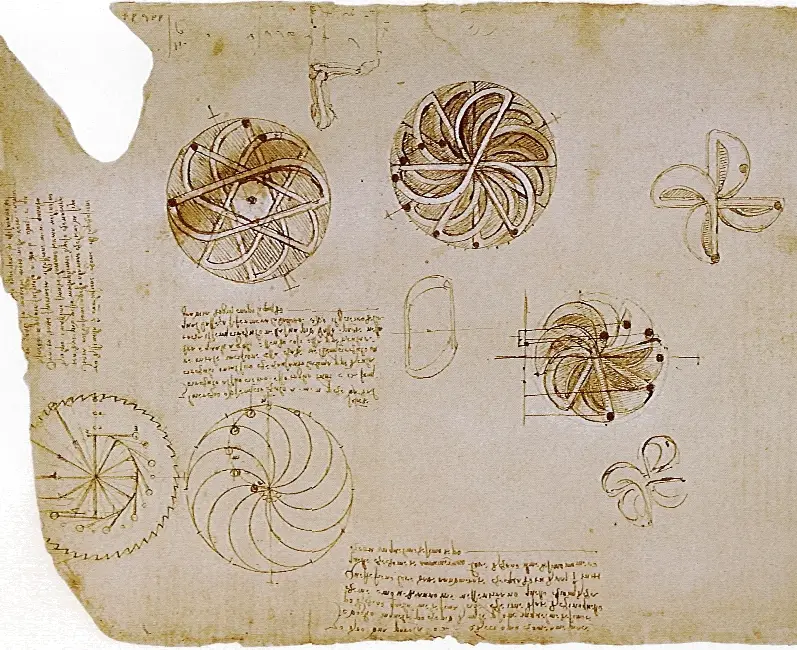
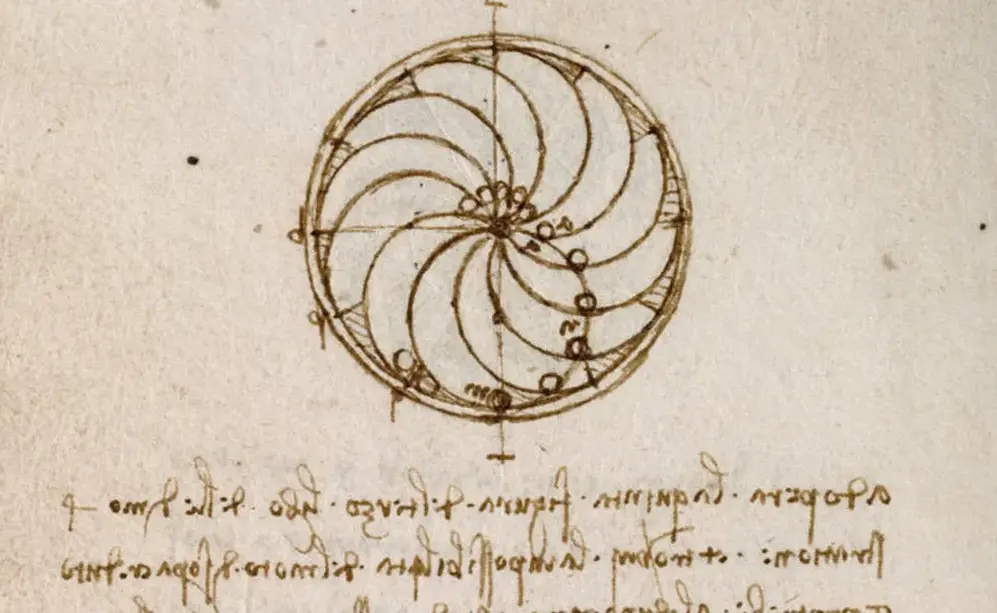
His first design sketches, simple yet ingenious, included a wheel with ball bearings shifting its center of gravity, theoretically allowing continuous motion.
Fascinated by mechanics, Leonardo da Vinci tackled the age-old problem of designing such machines. While his perpetual motion efforts eventually proved unfeasible, they offered valuable insights into mechanical motion.
His explorations are well documented in manuscripts such as the Codex Atlanticus, which showcase a range of ideas, from overbalanced wheels to centrifugal pumps.
Historians and engineers continue to study Leonardo’s work, not for its practicality but for the creativity it represents. Although Leonardo acknowledged the challenges, his experiments demonstrate his relentless curiosity and innovation.
Leonardo da Vinci’s Quest for Perpetual Motion
Leonardo da Vinci explored the concept of perpetual motion when inventors were eager to solve this intriguing challenge. He created detailed designs and drawings, demonstrating his innovative approach to mechanical motion.
Historical Context
During the Renaissance, inventors were fascinated by a machine that could operate indefinitely without an external energy source.
This quest involved creating a perpetual motion machine capable of endless movement. Da Vinci’s investigations into this concept occurred during an era of scientific curiosity and technological advancement.
Although the science of the time had not yet ruled out the possibility, later thermodynamic studies showed that perpetual motion could not be achieved.
Da Vinci’s Conceptual Designs
Leonardo’s designs were a testament to his creativity and engineering prowess. One well-known creation was the da Vinci wheel, which features overbalanced wheels with weights to keep the machine in continuous motion.
Another example included intricate systems of ball bearings across multiple tracks, designed to continuously shift the wheel’s center of gravity and sustain rotation.
While captivating, these designs remained theoretical and have not achieved perpetual motion. If you are interested in Da Vinci’s mechanical inventions, you can find more insight into his unique approach.
The Science of Perpetual Motion
Understanding why perpetual motion machines like Leonardo’s cannot function involves fundamental physics.
The laws of thermodynamics, developed centuries later, explain that energy cannot be created or destroyed, making perpetual motion impossible.
These principles rendered it infeasible for machines to operate without energy loss. Leonardo’s attempts highlight early human efforts to question and push the boundaries of the physical world, inspiring generations of inventors and enthusiasts.
Mechanical Principles Behind Perpetual Motion
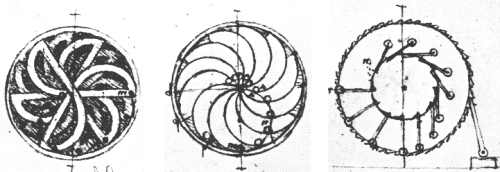
Leonardo da Vinci wheels (the first, second, and third designs, from the left)
Leonardo’s first perpetual motion invention is a simple overbalanced wheel.
In the above design, the weight of the ball bearings within the machine constantly shifts the wheel’s center of gravity away from the center point, allowing continuous rotation.
The design has three tracks, each with its ball bearing running within it.
His second design incorporates levers, a pawl, and a racket system into the overbalanced wheel. The wheel’s central hub ensures the levers are controlled throughout its rotation.
The pawl-and-ratchet system prevents the wheel from rotating clockwise. This can be seen in the images above and will be demonstrated in the video at the bottom of the page.
His third and most elegant design is for another overbalanced wheel. This design has twelve tracks, each bearing a ball.
Once again, the center of gravity is constantly shifted by the movement of the balls along the curved tracks during the wheel’s rotation. This design is shown in the images above and demonstrated in operation in the video at the end of the page.
Leonardo decided against investigating perpetual motion any further after he wrote (in mirror writing) beside the designs: “For every action, there is an opposite and equal reaction” (the machines would not work).
That quote is also from Isaac Newton’s Third Law of Motion, which was written 200 years before Newton was born!!!
Understanding the Conservation of Energy
The conservation of energy principle states that energy cannot be created or destroyed; it can only be transformed from one form to another.
In a perpetual motion machine, energy must be continuously generated without input. However, a perpetual motion machine of the first kind violates this law because it claims to produce work without any energy source.
Leonardo da Vinci understood this challenge and recognized the difficulty in achieving continuous motion without an energy supply. While he designed various machines, such as the da Vinci wheel, his studies concluded that energy loss through friction and other forces made perpetual motion impossible.
Challenges in Creating a Perpetual Motion Machine
Creating a perpetual motion machine involves overcoming significant obstacles related to mechanical efficiency and energy loss.
The machines must achieve continuous work output without any energy input, which contradicts fundamental laws of physics.
Leonardo’s perpetual motion machine attempts demonstrated how friction and air resistance decrease efficiency, leading to energy loss.
Influence and Legacy
Leonardo da Vinci’s exploration of perpetual motion machines, although he concluded that such devices were impossible, left a lasting impression on science and art. His ideas continue to inspire inventors and creative minds worldwide.
Impact on Future Generations of Inventors
The Leonardo da Vinci perpetual motion machine influenced future generations of inventors by encouraging them to explore the boundaries of possibility.
Although he determined that perpetual motion couldn’t exist, his dedication to understanding mechanics provided valuable insights for future scientists and engineers.
His investigations demonstrated the importance of experimentation and the scientific method, laying the groundwork for later technological advancements.
Inventors were inspired to examine the laws of physics more deeply. They explored ways to minimize energy loss in machines, thereby improving efficiency across many fields.
This enduring curiosity highlights Leonardo’s role in pushing the limits of human imagination in pursuit of scientific truth.
Modern Interpretations and Artistic Inspirations
In contemporary times, the idea of the da Vinci wheel remains a powerful symbol of innovation.
Artists and creators draw inspiration from Leonardo’s inventions. His work’s intersection of art and science captivates creative minds, leading to unique interpretations across various media.
Art installations and creative projects often feature elements reminiscent of the perpetual motion machine example. These creations pay homage to Leonardo’s ingenuity and reflect the timeless allure of attempting the impossible.
Through exhibitions and artistic endeavors, the concept of perpetual motion fascinates and challenges perceptions of nature and technology.
Myths and Misconceptions
Leonardo da Vinci’s plans for a perpetual motion machine have inspired fascination for centuries.
Despite this intrigue, the fundamental question remains: Is there a perpetual motion machine? The concept continues to stir debates and misconceptions in scientific circles and beyond.
Dispelling Common Myths
Perpetual motion machines are often thought to defy the basic laws of physics. Many believe Da Vinci’s wheel, a well-known perpetual motion invention, could work indefinitely without external energy.
This is a myth. The laws of thermodynamics state that energy cannot be created or destroyed, making true perpetual motion impossible.
Leonardo’s designs, though innovative, were theoretical. None of the designs, including his self-spinning wheel, have succeeded because they require an energy source to overcome natural resistance and friction.
Despite this, the allure of breaking free from energy constraints fuels imagination.
The Physics of Impossibility
The theory of perpetual motion conflicts with established scientific principles.
For example, the first law of thermodynamics states that energy in a closed system remains constant. In practical terms, this means perpetual motion cannot exist. Even Leonardo da Vinci’s perpetual motion machine falls short due to these fundamental laws.
It dictates that energy systems tend to move towards disorder. Machines cannot operate continuously without energy loss. Hence, these principles invalidate attempts to create self-sustaining devices.
Examining Modern Iterations
Leonardo da Vinci’s concepts of perpetual motion have sparked interest in modern attempts to bring such machines to life. These efforts explore whether perpetual motion can genuinely exist.
Contemporary Experiments
Contemporary experiments often focus on the possibility of creating a successful perpetual motion machine.
Innovators try various designs inspired by historical figures like Leonardo da Vinci. Experiments include overbalanced wheels similar to those in Da Vinci’s designs, which use weights to maintain continuous motion.
Despite efforts, no working perpetual motion machine has been demonstrated due to the laws of thermodynamics, which state that energy cannot be created or destroyed. Thus, the question remains: Is perpetual motion possible?
Perpetual Motion in Popular Culture
Perpetual motion fascinates not only scientists but also popular culture. Movies, books, and TV shows often explore the concept, imagining worlds where these machines defy the laws of physics. The intrigue of designs like Leonardo da Vinci’s wheel captures the public imagination.
The idea remains a topic of debate, with skeptics questioning whether perpetual motion exists. While the answer, in reality, is no, these devices offer endless possibilities in fiction.
This continued fascination keeps the discussion alive, blending history, science, and fantasy in ways that captivate audiences worldwide.
Final Thoughts
Leonardo’s perpetual motion machine has fascinated people for centuries. Although he concluded that actual perpetual motion was impossible, his designs and experiments contributed significantly to the study of mechanics.
His exploration of self-propelling machines included concepts like the overbalanced wheel. In this design, ball bearings are shifted continuously to drive the motion.
The concept of perpetual motion challenged him to solve technical problems, such as friction between moving parts. He studied how machines might overcome these issues using creative designs.
Despite determining perpetual motion could not be achieved, Leonardo’s work in this area showed his innovative thinking and ability to push the boundaries of existing knowledge.
Key Takeaways: Leonardo’s efforts illustrate his genius and curiosity. While perpetual motion machines remain impossible, his ideas have inspired countless inventors and engineers. The mythical allure of machines that move forever without energy has led to further exploration of alternative energy sources and improvements in machine efficiency.
FAQs about Leonardo Perpetual Motion Machine
Will a perpetual motion machine ever exist?
No, a true perpetual motion machine is considered impossible according to modern physics. It would violate the laws of thermodynamics, especially the conservation of energy and the principle that energy is always lost to friction or heat.
What were Leonardo da Vinci’s last words before he died?
There is no fully verified historical record of Leonardo da Vinci’s exact last words. Some later accounts claim he expressed regret about not fully realizing his potential, but these reports lack direct evidence and remain uncertain.
Who invented the first perpetual motion machine?
There is no confirmed inventor of a working perpetual motion machine, but early designs date back to the Middle Ages, including concepts by figures like Villard de Honnecourt and Bhāskara II, who proposed wheels that were supposed to run indefinitely.
Has anybody invented a perpetual motion machine?
No, no one has ever successfully built a true perpetual motion machine. Despite many attempts throughout history, all designs either fail or rely on hidden energy sources, making them scientifically invalid.
Can we time-travel in 2050?
There is no scientific evidence that time travel will be possible by 2050. While theoretical physics explores concepts like relativity and wormholes, practical time travel—especially to the past—remains speculative and far beyond current technology. (No credible scientific confirmation available.)
How close are we to a perpetual motion machine?
We are not close to creating a perpetual motion machine, because it violates fundamental physical laws. Even highly efficient modern machines still lose energy, meaning true perpetual motion remains unattainable in principle.
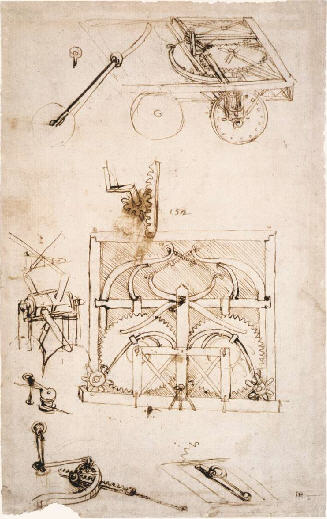
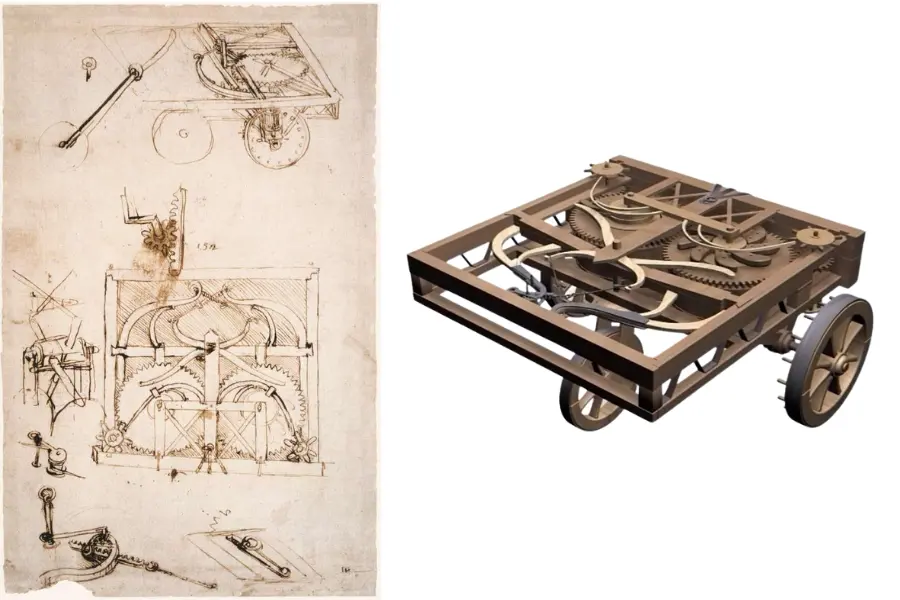
Leonardo da Vinci’s self-propelled car design (left) and its 3D model (right)
(Last updated: April 2026)
Leonardo da Vinci car, a self-propelled cart, showcases the ingenuity of this Renaissance polymath.
He designed this cart to move independently without external force, making it a pioneering idea in transportation.
While the concept was conceived in the 15th century, the technology was advanced and foreshadowed future automotive developments.
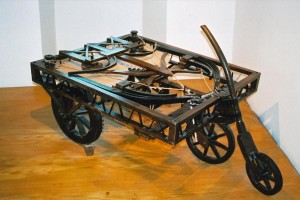
This self-propelled vehicle, known as Leonardo’s self-propelled cart, functions with a complex system of gears and springs that propel it forward.
Despite being invented long before engines, the cart is often regarded as the ancestor of modern cars, drawing interest from historians and engineers alike.
Its innovative design showcased da Vinci’s exceptional foresight into future technological advancements.
They meticulously recreated the car, using the original designs and materials specified by da Vinci.
This project highlighted the challenges and the brilliance of his original blueprint, inspiring modern inventors and historians to re-examine da Vinci’s contributions to the world of transport.
Leonardo da Vinci: The Inventor
Leonardo da Vinci’s self-propelled cart
FAQs about Leonardo da Vinci Car
Did Leonardo da Vinci invent the car?
Leonardo da Vinci did not invent the modern car, but he designed a self-propelled cart around 1478, which is widely considered a precursor to the automobile. His design used springs and gears to move without human pushing, making it one of the earliest concepts of a vehicle.
Did Leonardo da Vinci have a car?
No, Leonardo da Vinci did not own or use a car in the modern sense. His self-propelled cart existed only as a design in his notebooks and was never built or used during his lifetime.
Who drew the first car in 1478?
The earliest known sketch of a self-propelled vehicle, from 1478, is attributed to Leonardo da Vinci. His drawings in the Codex Atlanticus show a spring-powered cart that could move and even follow a programmed path.
Will cars be self-driving by 2050?
Many experts expect self-driving cars to be widely developed and more common by 2050, as autonomous technology is already advancing rapidly. However, full global adoption will depend on safety, regulation, and infrastructure improvements, so timelines may vary by region. (General consensus based on current technological trends; no single definitive source.)
Who invented the very first car?
The first full-scale working automobile is usually credited to Nicolas-Joseph Cugnot, who built a steam-powered vehicle in 1769–1770. Later, Karl Benz developed the first modern gasoline-powered car in 1886.
Who came first, BMW or Mercedes?
Mercedes-Benz came first. Its origins trace back to Karl Benz’s automobile in 1886, while BMW was founded later in 1916. This makes Mercedes one of the oldest car manufacturers in the world.
Leonardo da Vinci Parachute is a fascinating invention from the Renaissance era that combines creativity with intricate design.
Da Vinci‘s parachute, designed in the 1480s, is remarkable because it aimed to prove that a human could safely descend from heights using a canopy of sealed linen cloth supported by wooden poles.
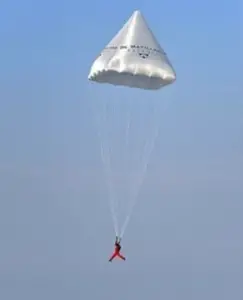
In the late 20th century, daredevil Adrian Nicholas tested da Vinci’s concept. Nicholas constructed the parachute according to da Vinci’s original design specifications and boldly jumped from a hot-air balloon at 10,000 feet. The successful flight affirmed that da Vinci’s ideas, though centuries old, were revolutionary and feasible.
The invention reflects da Vinci’s forward-thinking approach to science and engineering, showcasing his desire to push the boundaries of human exploration. Leonardo da Vinci’s story continues to inspire engineers, scientists, and artists by bridging the gap between art and science.
The Invention of the Leonardo da Vinci Parachute
Leonardo da Vinci parachute was a groundbreaking concept in the history of flight devices. This section explores the parachute invention’s historical origins, da Vinci’s time context, and the process behind his design.
Who Invented the Parachute?
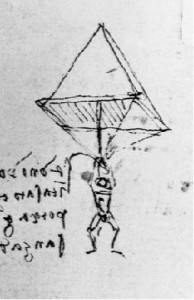
The idea of the parachute can be traced back to Leonardo da Vinci, who sketched the initial concept in the late 15th century. His drawing depicted a pyramid-shaped device made from sealed linen cloth and wooden poles.
Although Leonardo da Vinci’s innovations in art and science were ahead of his time, Sebastien Lenormand wasn’t credited with the first practical parachute jump until the 18th century. While da Vinci’s parachute was not built or tested during his lifetime, it laid the groundwork for a critical advance in aviation. His idea remained theoretical until much later, illustrating his forward-thinking approach to invention.
The Historical Context of the Leonardo da Vinci Parachute
During the Renaissance, thinkers like Leonardo da Vinci explored new concepts in science and technology. The parachute was one of many visionary projects da Vinci worked on. His fascination with flight also led to the creation of the ornithopter, another innovative design intended to mimic bird flight.
The Renaissance era was a period of questioning and innovation, and da Vinci’s parachute reflects his curiosity about the laws of nature and movement. Although the technology of the time limited the feasibility of these inventions, his work laid the foundation for future innovations.
How Leonardo da Vinci’s Parachute Design Came to Be
Leonardo da Vinci’s parachute design was unique for its time. He proposed a pyramid-shaped canopy made of wood and linen to slow a person’s descent from a height.
His sketches show a meticulous attention to detail, blending his artistic skills with scientific inquiry. Although da Vinci never saw his ideas come to fruition, modern tests have validated the effectiveness of his design.
Recently, replicas of his parachute have been built and successfully tested, proving the concept he originated centuries ago. Da Vinci’s ability to conceptualize complex mechanics remains impressive, showcasing his unparalleled genius.
Understanding the Design of the Leonardo da Vinci Parachute
Leonardo da Vinci parachute was a remarkable concept demonstrating his forward-thinking approach in the Renaissance era. The design featured innovative elements, unique materials, and a distinctive shape that set it apart from modern parachutes.
Key Features of the Leonardo da Vinci Parachute Design
The Leonardo da Vinci parachute design included a pyramid shape that deviated from the circular canopy typical in today’s parachutes. It was intended to control descent with a frame attached to a square canopy.
Da Vinci believed this design could slow a person’s fall and allow for a safe landing. This innovation showcased his understanding of aerodynamics and physics.
Despite being conceptualized in the 15th century, the parachute has been discussed and tested to see if it would function as intended. This further underlines his advanced thinking and creativity during his time.
Materials Used in the Leonardo da Vinci Parachute
Leonardo’s parachute was designed using wood and canvas. The wooden frame provided structure and support for the canopy, while the canvas served as the main surface that captured the air.
These materials were readily available during da Vinci’s time, making it possible to construct such devices without modern technology.
The emphasis was on creating a lightweight yet robust design. The choice of wood and canvas reflects da Vinci’s ability to utilize existing materials effectively in his inventions. This design paved the way for later advancements in parachute construction using similar principles.
The Pyramid Shape of the Leonardo da Vinci Parachute
One of the most intriguing aspects of the Leonardo da Vinci parachute was its pyramid shape. Unlike typical rounded parachutes, it featured a square base and an angular canopy. This shape was intended to control airflow and provide stability during descent.
The unique design demonstrated da Vinci’s foresight in anticipating potential challenges of free fall and landing. His drawings and concepts were remarkably ahead of their time, influencing later developments in parachute technology. This design was a testament to his ingenuity and an early exploration of flight and aerodynamics.
Testing the Leonardo da Vinci Parachute
The First Test of Leonardo da Vinci Parachute
Leonardo da Vinci parachute was an innovative concept that eventually led to practical field tests. Modern skydivers like Adrian Nicholas dared to bring da Vinci’s designs into the real world, providing significant insights.
Did Leonardo da Vinci’s Parachute Work?
Leonardo da Vinci’s parachute design featured a pyramidal shape made from wood and canvas. The question of whether Leonardo da Vinci’s parachute worked captured enthusiasts and experts alike.
In 2000, British skydiver Adrian Nicholas undertook a bold experiment. He built a parachute based on Leonardo’s original drawings.
Nicholas successfully descended using a parachute from an altitude of 10,000 feet, proving Leonardo’s concept viable despite prior skepticism. This experiment demonstrated that even a 500-year-old design can be effective when constructed precisely, challenging the doubts of earlier experts who believed it would fail.
Modern Interpretations of the Leonardo da Vinci Parachute
Modern interpretations of Leonardo da Vinci’s parachute reflect a blend of admiration and curiosity. Skydivers and historians revisit da Vinci’s design to test its principles against contemporary standards.
Who invented the parachute has fascinated many, with da Vinci’s version representing a significant stepping stone.
Leonardo’s parachute is far from sleek, modern fabric chutes, yet enthusiasts appreciate the historical and technical insights such experiments provide.
Tests have inspired innovations in parachute design, blending the old with the new. They confirm the enduring appeal of Leonardo da Vinci’s inventions and showcase his genius in seeing beyond his time.
How to Make a Leonardo da Vinci Parachute: A DIY Guide
Creating a replica of Leonardo da Vinci’s parachute can be engaging. To start, you need to study Leonardo’s original parachute sketch.
The framework involves lightweight wood cut into a pyramidal shape. Cover the frame with sturdy fabric, such as canvas. Ensure the joints are secure to withstand air pressure. Follow the proportions closely to maintain stability and integrity.
This project allows enthusiasts to connect with history and offers insights into da Vinci’s inventive process. It serves as an accessible yet enlightening way to explore the fusion of art and science in Leonardo da Vinci’s inventions.
Final Thoughts
Leonardo da Vinci parachute design was a remarkable example of his inventive mind.
Conceived in the late 15th century, this design featured a pyramid-shaped canopy made from wood and cloth. Although the concept was theoretical during his time, modern experiments have proven that his design could indeed work.
Da Vinci’s creativity extended beyond the parachute. His sketches and notes included ideas for flying machines, which were well ahead of their time. These inventions showcased his deep interest in aerodynamics and the possibilities of human flight.
A key element of the parachute’s design was its simplicity. Unlike modern parachutes, da Vinci’s concept relied on basic materials and a straightforward structure. This simplicity made it a fascinating subject for enthusiasts who wish to recreate historical innovations.
The legacy of da Vinci’s parachute continues to inspire innovators and historians alike. His work is a testament to the enduring impact of visionary ideas.
Key Takeaways: Leonardo da Vinci’s parachute highlights his genius and forward-thinking nature. Even centuries later, his ideas continue to captivate and inspire. His work bridges the gap between art and science, paving the way for future technological advancements.
FAQs about Leonardo da Vinci Parachute
Did Leonardo da Vinci invent the parachute?
Leonardo da Vinci did not invent the parachute, but he created one of the earliest known designs in the late 15th century. His sketches show a pyramid-shaped parachute made of linen and wood, demonstrating an early understanding of air resistance and controlled descent.
Who was the first person to ever parachute?
The first recorded successful parachute jump was made by André-Jacques Garnerin in 1797, when he descended safely from a hydrogen balloon over Paris. Earlier experiments existed, but his jump is considered the first true high-altitude parachute descent.
Which Renaissance master invented the parachute?
The Renaissance figure most commonly associated with the parachute is Leonardo da Vinci, who sketched one of the earliest designs around 1485–1495. Although not the true inventor, his concept greatly influenced later developments.
Did Leonardo da Vinci’s glider work?
Leonardo da Vinci’s glider and flying machine designs did not work in practice during his lifetime. They remained theoretical because the materials and power sources available in the Renaissance were insufficient for sustained flight.
Who invented parachutes?
The first practical parachutes were developed in the 18th century, particularly by Louis-Sébastien Lenormand, who performed an early public jump in 1783. Later inventors refined the design into the modern parachute used today.
What are the 5 inventions of Leonardo da Vinci?
Leonardo da Vinci designed many groundbreaking inventions, including the flying machine (ornithopter), the aerial screw (helicopter concept), the parachute, the armored vehicle (tank), and the self-propelled cart. Most were never built but influenced future technology.
Da Vinci Landing Gear remains one of the lesser-known yet fascinating innovations of the Renaissance genius.
He crafted a landing gear system prototype to help early flying machines take off and land safely.
This invention demonstrates Leonardo da Vinci‘s forward-thinking approach to solving flight challenges when aviation was still a dream.
Exploring the intricacies of his landing gear concept reveals Leonardo’s impressive understanding of mechanical devices.
The design showcased elements intended to reduce shock during landing, highlighting his anticipation of real-world flying conditions.
Current flying machines owe a nod to Da Vinci’s pioneering ideas, which set a foundation for modern aviation technology.
Leonardo’s contributions go beyond painting and sculpture, showcasing his multifaceted genius.
His work on flight, including his landing gear designs, underscores his timeless influence and innovative spirit.
For those seeking to uncover the mind behind these inventions, learning about his landing gear can spark an interest in history and aviation.
Historical Context of Da Vinci’s Designs
Leonardo da Vinci’s contributions to engineering are profound, reflected in his work on the Da Vinci Landing Gear and other innovative designs. These works showcased his imagination and scientific approach during the Renaissance, making a lasting impact.
Early Sketches and Concepts
Leonardo da Vinci’s early sketches reveal a mind deeply engaged with the mechanisms of flight.
His designs often involved intricate systems of gears and pulleys, exemplified by the Leonardo Da Vinci Landing Gear.
Although he explored numerous ideas, such as ornithopters and spiral gears, these were mainly theoretical due to the technological limitations of his time.
Da Vinci’s work laid the groundwork for future inventors and remains a testament to his innovative spirit.
His drawings provide valuable insights into his efforts to make flight feasible long before the Wright brothers succeeded.
Influence on Renaissance Engineering
Da Vinci’s engineering pursuits significantly inspired his contemporaries and future generations.
His use of da Vinci gears and other complex mechanical systems showcased the era’s fascination with blending art with science.
During the Renaissance, a period marked by exploration and innovation, his designs, like the Leonardo da Vinci flying machine, stood out for their detail and ambition.
Though not all his concepts were constructed, they influenced the engineering principles that emerged in later centuries.
His approach bridged the gap between imagination and mechanical reality, demonstrating how art and technology could coexist.
Da Vinci’s legacy in engineering remains influential as a visionary, highlighting the importance of curiosity and creativity in scientific progress.
Overview of Da Vinci Landing Gear
The Da Vinci Landing Gear is an innovative design showcasing Leonardo da Vinci’s mechanical ingenuity. It features unique mechanical principles, specific design specifications, and applications for envisioned flying machines.
The design incorporated da Vinci’s understanding of momentum and force, integrating gears to regulate the movement of the landing gear components.
This forward-thinking approach enabled compensation for mechanical stresses, which is crucial to maintaining the aircraft’s structural integrity.
Design Specifications
Leonardo da Vinci’s design featured wooden frames combined with leather, ropes, and spring combinations to absorb impact.
The light yet durable materials suited the limited technological capabilities of his time.
The landing gear system, reminiscent of a modern bicycle’s suspension, aimed to provide a smooth landing experience.
His attention to detail ensured the landing system’s effectiveness, especially when precise control was necessary for safe operation.
Intended Aircraft Applications
The Da Vinci Landing Gear was conceptualized for one of his flying machine designs, particularly a glider-like structure.
While Leonardo da Vinci did not build a flying machine, his designs, including the spiral-helical wing concept, hinted at practical ideas for flight.
The landing gear’s role was to ensure a safer and more controlled experience during experimental flights, paving the way for future aviation advancements.
Although his work was not realized in his lifetime, it laid the groundwork for the study of aircraft landing systems in later centuries.
Technical Analysis of Da Vinci Landing Gear
The Da Vinci Landing Gear showcases Leonardo’s ingenuity, combining material innovation with mechanical complexity. Its design reflects Da Vinci’s fascination with flight and the principles of physics that govern such mechanisms.
Material Considerations
Leonardo Da Vinci’s landing gear would have been primarily crafted from wood and metal, typical materials available during the Renaissance.
These materials were chosen for their strength and durability, which are crucial for the safe landing of his flying machines.
Metal components reinforced the structure, providing necessary support where wooden elements might falter under stress.
Rope or leather might also have been incorporated to aid in the retraction and extension of the gear, highlighting Leonardo’s attention to functionality and practicality.
Stress and Load Calculations
Da Vinci gears in the landing mechanism needed to withstand significant force during landing.
He likely calculated the stress on each component to ensure safety and stability.
Leonardo aimed to evenly distribute stress throughout the structure by understanding how weight and impact forces interact.
This foresight helped prevent potential failures, ensuring the stability of Leonardo da Vinci’s flying machine during touchdown.
It showed his remarkable grasp of mechanics and foreshadowed principles in modern engineering stress analysis.
Comparative Analysis with Modern Gear
The modern aircraft landing gear system
The evolution of materials and techniques is evident when comparing Leonardo Da Vinci’s landing gear to modern landing gear.
Contemporary gear systems use advanced materials such as carbon composites and titanium to achieve higher strength-to-weight ratios.
While the technology of his era limited Da Vinci’s designs, they laid the groundwork for modern landing gear systems.
The contrast highlights how his early conceptual work influenced today’s innovations, bridging historical creativity with modern advancements in aerospace design.
FAQs about Da Vinci Landing Gear
Did any of Leonardo da Vinci’s flying machines work?
No, none of Leonardo da Vinci’s full-scale flying machines successfully worked in his lifetime. His designs remained sketches and concepts because the materials and power sources available during the Renaissance were insufficient to achieve sustained flight.
Did Leonardo da Vinci invent gears?
Leonardo da Vinci did not invent gears, as they had existed since ancient times. However, he made important contributions by designing complex gear systems and mechanical devices, improving the use of gears in machines and automation.
Who truly invented the first airplane?
The first successful powered airplane is widely credited to the Wright brothers, who achieved controlled, sustained flight in 1903. Earlier inventors like Leonardo da Vinci created theoretical designs, but they were not built or flown.
Did the aerial screw work?
Leonardo’s aerial screw—often considered a prototype helicopter—did not work in practice. The design lacked a powerful engine and used materials that were too heavy, rendering it incapable of generating sufficient lift for human flight.
Did Da Vinci invent the airplane?
Leonardo da Vinci did not invent the airplane, but he was among the first to study flight scientifically and to design machines resembling airplanes and helicopters. His work laid early conceptual foundations for aviation centuries before it became a reality.
What was Da Vinci’s most famous invention?
Leonardo da Vinci’s most famous invention is often considered his flying machine (ornithopter), which attempted to mimic the motion of bird wings. It represents his deep interest in flight and remains one of his most iconic engineering ideas.
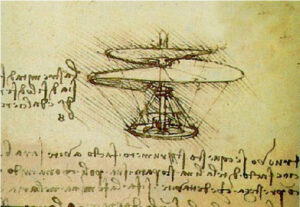
The Leonardo da Vinci helicopter — more precisely, the aerial screw — stands as one of the most astonishing conceptual leaps in the history of human invention. Sketched in Milan around 1489, this machine was not simply a curiosity. It was a bold, rational attempt to solve the problem of human flight, five centuries before the Wright brothers lifted off the ground at Kitty Hawk.
What makes this invention so fascinating is its starting point: pure observation. Leonardo watched birds, studied air currents, and analysed the way screws worked in water. He then asked a question nobody had seriously pursued before — could the same principle that drives a screw through a solid material also drive a machine through the air? That question produced one of the most iconic drawings in the history of science.
From a historical perspective, the aerial screw matters because it demonstrates a completely new way of thinking about machines, nature, and the human body’s relationship to the physical world. It reveals a Renaissance mind at full stretch — one that refused to accept the boundaries between disciplines. Leonardo was a painter, yes. But he was also an engineer, an anatomist, a naturalist, and, in this case, an early aeronaut in everything except flight itself.
For anyone visiting museums in Milan, Florence, or Paris — or exploring Leonardo’s world through cultural travel — understanding this invention transforms the experience. You stop seeing a sketch on a page. You begin to see the inside of one of history’s greatest minds.
This post is all about the Leonardo da Vinci helicopter — what it was, how it worked, why it still matters, and where you can encounter it today.
What Is the Leonardo da Vinci Helicopter?
The Leonardo da Vinci helicopter is a flying machine concept designed by Leonardo around 1489. It features a large helical surface made of linen or reed, intended to compress air downward and lift the craft off the ground. While never built in Leonardo’s lifetime, it is now regarded as the world’s earliest documented conceptual ancestor of the helicopter.
The Engineering Idea Behind the Leonardo da Vinci Helicopter
Leonardo’s Design Concept
Leonardo conceived the aerial screw as a direct application of Archimedes’ principle — the same logic that makes a screw thread move through a material — applied to air instead of wood or metal. The machine was designed to spin rapidly about a vertical axis. As the helical surface rotated, Leonardo believed it would compress the air beneath it sufficiently to generate upward lift.
His notebook sketch, now held in the collections linked to the Codex Atlanticus, shows the machine in clean detail: a wide horizontal rotor roughly eight metres in diameter, constructed from linen stretched over a framework of iron wire and reed. A central shaft runs through the middle. A crew of four men would run on a platform below, pulling on ropes wound around the shaft to set the whole structure spinning.
The da Vinci aerial screw was not designed to carry passengers aloft as a modern helicopter does. Rather, Leonardo saw it as a demonstration of a principle. He was testing, on paper, whether the physics he observed in nature could be harnessed mechanically. That ambition was extraordinary for 1489.
Renaissance Engineering Principles
To understand the aerial screw, you have to understand Renaissance engineering as Leonardo practised it. He believed that nature operated according to consistent mechanical laws, and that the human mind — through careful observation and rigorous drawing — could decode those laws and put them to use.
Water screws had existed since antiquity. Leonardo had studied them carefully. He also studied bird anatomy in remarkable detail, noting the relationship between wing surface area, body weight, and air resistance. The da Vinci flying machine concept drew on all of these studies simultaneously.
What distinguishes his approach from mere speculation is the precision of his geometry. The spiral of the aerial screw is not arbitrary. It follows a carefully reasoned mathematical logic based on the pitch needed to generate thrust. Whether the machine could have worked in practice is another question. But the thinking behind it was structurally sound for its era.
Leonardo also understood, at least partially, the problem of torque. Modern engineers note that without a counter-rotating mechanism, the platform of the aerial screw would simply spin in the opposite direction to the rotor — a fundamental challenge that would not be fully resolved until the 20th century. But the fact that Leonardo was thinking at this level of detail is remarkable in itself.
How the Leonardo da Vinci Helicopter Works
Mechanical Design
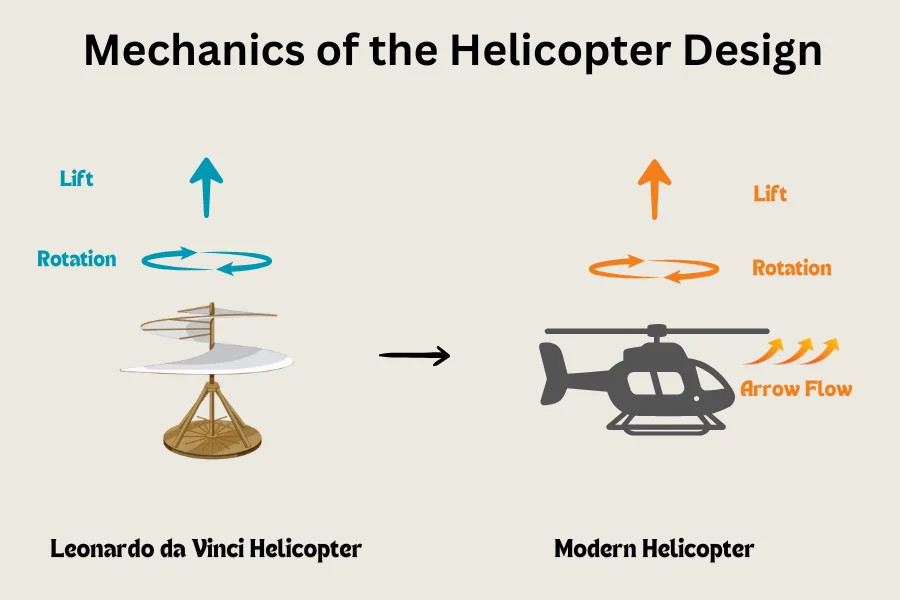
The core mechanical idea of the da Vinci helicopter sketch is elegantly simple. A large helical surface — the aerial screw — is mounted horizontally on a central vertical shaft. When the shaft is rotated rapidly, the helical surface is intended to bite into the air in the same way a drill bit bites into wood: by combining rotational motion with a forward (in this case upward) thrust vector.
The linen fabric stretched across the iron wire frame would need to be sized, Leonardo calculated, to provide enough surface area to overcome the weight of the machine and its operators. His sketch suggests a diameter of roughly eight braccia — approximately five to eight metres depending on which Florentine unit of measurement is applied.
The power source is human. Four operators on the central platform would run in a circle, pulling rope handles attached to the shaft. This would theoretically spin the rotor to the speed required.
In modern analysis, this is perhaps the greatest practical flaw: human muscle cannot generate the sustained rotational velocity needed for a surface of this size to produce meaningful lift. But as a conceptual demonstration, the logic is sound.
Structural Principles
Leonardo’s choice of materials was deliberate. Linen provided a light, semi-porous surface that could be made reasonably airtight. The iron wire provided the frame with structural rigidity without excessive weight. Reed — a material Leonardo used repeatedly in his engineering sketches — added further lightness to the supporting framework.
The overall structure was intended to be as light as possible relative to its surface area. This reflects Leonardo’s deep understanding of the relationship between weight, surface, and force — a relationship he had explored extensively in his studies of bird flight and water dynamics.
Modern engineers who have studied the da Vinci screw design closely note that while a full-scale version of this machine could not achieve flight with human power alone, a smaller, motorised version of the same principle does generate lift. The underlying physics is not wrong. It is simply constrained by the power-to-weight limitations of human muscle in Leonardo’s era.
Why the Idea Mattered
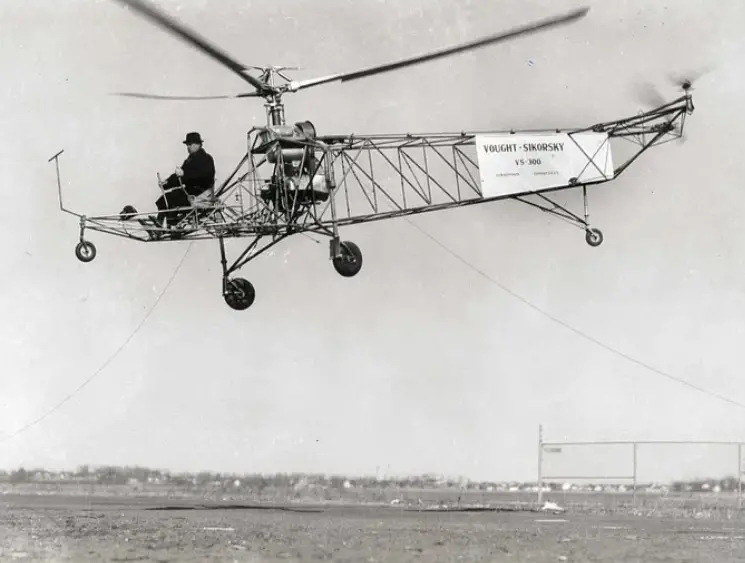
The First Helicopter by Igor Sikorsky, VS-300, 1939
The significance of Leonardo da Vinci aviation thinking goes far beyond whether any individual machine could have flown. What matters is the conceptual framework he established. He identified the correct mechanical principle — a rotating helical surface compressing a fluid (air) to generate upward thrust — centuries before anyone else arrived at the same conclusion.
The first practical helicopter flight occurred with Igor Sikorsky in 1939, nearly 450 years after Leonardo’s sketch. When engineers in the 20th century began solving the problems of vertical flight, they were, unknowingly, working through many of the same questions Leonardo had posed. The fact that his notebooks were not widely available to those engineers makes the parallel even more striking.
Understanding the da Vinci helicopter facts in this light changes how you read the sketch. It is not a failed invention. It is a correct identification of a problem and a structurally sound first approach to solving it — produced by a man working entirely from observation and reason, with no tradition of aeronautical engineering to draw on.
Where to See the Leonardo da Vinci Helicopter Today
Museums and Exhibitions
The original notebook page containing Leonardo’s sketch of an aerial screw is part of the Codex Atlanticus, the largest collection of Leonardo’s drawings and writings. The Codex is held at the Biblioteca Ambrosiana in Milan, Italy. Selected folios from the Codex are occasionally displayed in temporary exhibitions, and the Ambrosiana is worth visiting for anyone seriously interested in Leonardo’s engineering legacy.
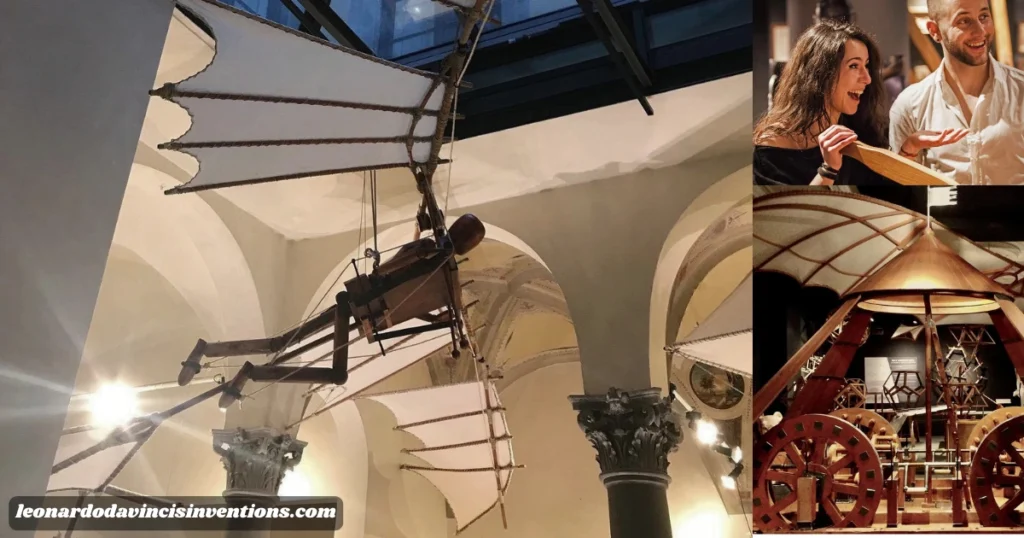
In Milan, the Museo Nazionale della Scienza e della Tecnologia Leonardo da Vinci is the single most important destination for anyone interested in Leonardo da Vinci inventions. The museum holds an extensive collection of reconstructed models based on Leonardo’s engineering sketches, including large-scale models of the aerial screw and other flying machine concepts. These physical reconstructions make the Da Vinci helicopter design immediately comprehensible, unlike a flat sketch.
The Château du Clos Lucé in Amboise, France — the residence where Leonardo spent the last three years of his life as a guest of the French king Francis I — also maintains a remarkable permanent exhibition of reconstructed Leonardo machines in its gardens and interior rooms. A working-scale model of the aerial screw is among them. The setting, in the Loire Valley, combines historical atmosphere with direct engagement with Leonardo’s ideas.
Plan Your Visit: Experiencing the Aerial Screw in Person
Seeing a physical reconstruction of the Leonardo da Vinci helicopter concept in person is a genuinely different experience from looking at a photograph of the original sketch. The scale becomes real. The materials become tangible. And the practical challenge of generating lift through human-powered rotation suddenly makes complete sense in a way that no written description can fully convey.
For visitors planning a trip to Milan, guided tours focused specifically on Leonardo’s engineering legacy are available through several reputable operators. These tours typically combine a visit to the Museo della Scienza with additional stops at Leonardo-related sites across the city, providing historical context that deepens the experience considerably beyond what a solo visit can offer.
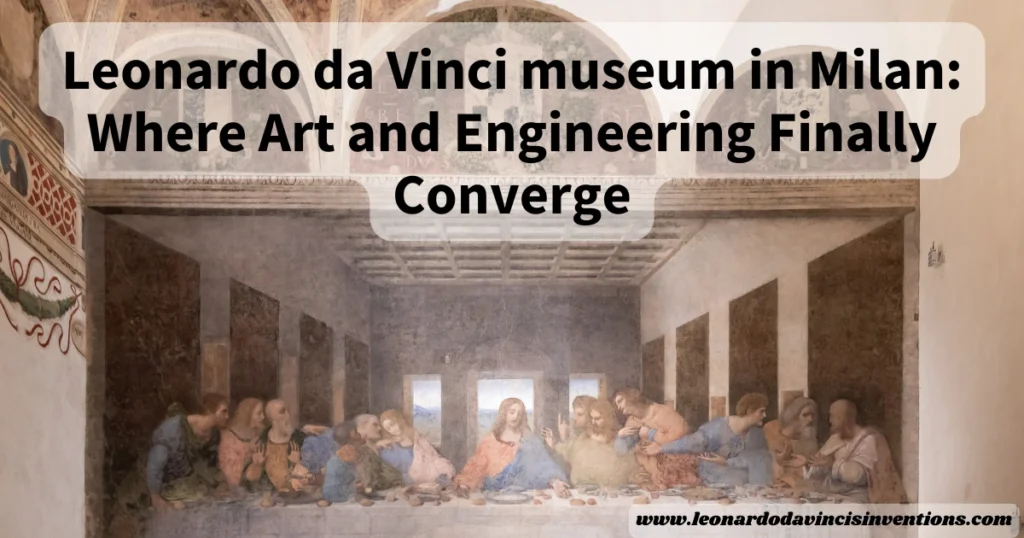
Some also include access to Santa Maria delle Grazie and The Last Supper, making for a remarkably comprehensive day.
Many visitors choose an entrance-only ticket for flexibility, while others prefer a guided tour for deeper historical context. If you plan to see a reconstruction of the aerial screw in person, it helps to compare ticket and tour options before your visit.
Milan was the city that most profoundly shaped Leonardo’s engineering ambitions. It was here, working for Ludovico Sforza, that he filled notebook after notebook with designs for machines, anatomical studies, hydraulic engineering plans, and architectural proposals. Visiting the city with Leonardo in mind transforms it into something far richer than a fashion capital — a living laboratory of Renaissance ambition.
If you are planning a broader Leonardo-focused itinerary, there is no shortage of destinations to explore. Each city offers a different dimension of his genius — from the engineering reconstructions of Milan to the painted masterpieces of Florence, the scholarly manuscripts of Paris, and the quiet rural setting of Vinci itself. Some helpful guides to continue your journey:
Vinci, Tuscany — visiting Leonardo’s birthplace and the Museo Leonardiano
Final Thoughts
This post was all about the Leonardo da Vinci helicopter — one of the most audacious and intellectually rigorous inventions in the long history of human attempts to fly. Leonardo did not build a flying machine. But he identified the right principle, worked through the physics with extraordinary care, and committed it all to paper with the clarity and precision that defined everything he did.
Five centuries later, engineers working on vertical flight would independently arrive at the same conclusions. That is not a coincidence. It is a testament to the quality of Leonardo’s thinking.
Renaissance history, engineering, art, and cultural travel all converge at moments like this one. If you have the opportunity to follow Leonardo’s ideas through the museums and cities that preserve them, take it. The journey is unlike anything else in history.
FAQs about Leonardo da Vinci Helicopter
Did Leonardo da Vinci invent the helicopter?
Leonardo da Vinci did not invent a working helicopter, but he designed an early concept called the “aerial screw” in the late 1400s. This design is considered the first known idea of vertical flight and influenced later aviation developments.
Who designed the first helicopter?
The first practical helicopter was designed by Igor Sikorsky. His VS-300 successfully flew in 1939 and introduced the modern single-main-rotor-and-tail-rotor design still used today.
What happened to Leonardo da Vinci’s flying machine?
Leonardo’s flying machine, including the aerial screw, was never built or tested in his lifetime. It remained a conceptual design in his notebooks, though modern reconstructions have shown the underlying principles were valid.
Did Leonardo da Vinci make the first airplane?
No, Leonardo da Vinci did not build the first airplane. He created detailed sketches of flying machines based on bird flight, but powered, controlled airplane flight was first achieved by the Wright brothers in 1903.
What did Leonardo da Vinci do for aviation?
Leonardo contributed to aviation by studying flight scientifically and by designing early machines such as the aerial screw and gliders. His work introduced key ideas about lift, air movement, and mechanical flight centuries before modern aviation.
Where was the first helicopter invented?
The first practical helicopter was developed in the United States. Igor Sikorsky’s VS-300 made its first flight in 1939 in Stratford, Connecticut, marking the beginning of modern helicopter aviation.
Leonardo Bianchi is the founder of Leonardo da Vinci Inventions & Experiences, a travel and research guide exploring where to experience Leonardo’s art, engineering, and legacy across Italy and Paris.




 Leonardo Bianchi is the founder of Leonardo da Vinci Inventions & Experiences, a travel and research guide exploring where to experience Leonardo’s art, engineering, and legacy across Italy and Paris.