Leonardo da Vinci Kits
We currently offer the following kits –
Leonardo’s Perpetual Motion Machines

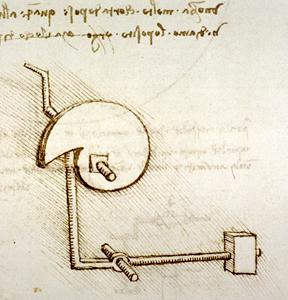
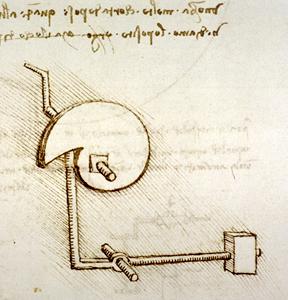
The da Vinci Cam Hammer is a fascinating machine highlighting Leonardo da Vinci's incredible foresight and ingenuity.
This invention revolutionized mechanical tools. It was used for centuries, especially during the Industrial Revolution.
By exploring the design and impact of the cam hammer, one can appreciate its lasting influence on engineering.
This article provides an in-depth look at how Leonardo’s design works and its historical significance for those intrigued by mechanical history and innovation.
You will discover how this invention showcases the connection between art, science, and technology.
Through this exploration, enthusiasts can learn about the cam hammer's notable features, including its reliance on a rotating cam to lift and drop a hammer.
Those interested in machinery's practical applications and evolution will find da Vinci Cam Hammer's story informative and engaging.
Leonardo da Vinci was a pioneer during the Renaissance known for his incredible ingenuity. His contributions to the industrial and artistic realms are well recognized, notably the development of innovative machinery, such as the da Vinci Cam Hammer.
During the Renaissance, from the 14th to the 17th centuries, there was a surge of interest in art, science, and technology. This era encouraged creativity and sparked numerous intellectual advancements.
Da Vinci thrived in this environment, seamlessly blending art and science. He explored various fields, pushing boundaries and creating designs ahead of his time.
His dual role as an artist and engineer enabled him to conceive inventions that significantly impacted multiple industries.
Leonardo's fascination with machinery led to the creation of devices like the cam hammer. This invention used a rotating cam to repeatedly lift and drop a hammer, making metalworking more efficient.
His drawings showcased an advanced understanding of mechanical principles, inspiring modern engineers.
The da Vinci Power Hammer exemplifies his innovative spirit, illustrating his ability to merge artistic flair with engineering expertise.
The da Vinci Cam Hammer represents a unique blend of innovation and mechanical ingenuity. It introduces a cam-driven mechanism that has had a significant impact on fields such as metalworking and engineering.
Leonardo da Vinci's Cam Hammer features a design ahead of its time. This ingenious creation utilizes a cam to convert rotational motion into a linear pounding action.
The cam, an oblong wheel, pushes a hammerhead upwards while gravity pulls it back down, creating a rhythmic pounding effect.
This simple yet effective mechanism allows the hammer to perform work with minimal energy input.
Unlike direct contact mechanisms, the cam design reduces wear and tear, ensuring longer life and less maintenance.
Leonardo's insight into mechanical advantage laid the groundwork for future advancements and influenced designs used during the Industrial Revolution.
The cam hammer can be seen as a precursor to modern automated machinery.
The da Vinci Cam Hammer offered significant improvements in efficiency over traditional hand tools.
During the Industrial Revolution, these hammers could deliver up to 20 strikes per second, using gravity combined with the cam's mechanical lifting action.
This level of speed was instrumental in shaping and forming metal quickly and precisely.
The increased hammering rate allowed for higher productivity in workshops and the fabrication of intricate metal components, such as sheet metal and armored machines.
Despite its historical context, the da Vinci power hammer concept highlighted the potential of mechanized labor, reducing manual effort and increasing output.
The da Vinci Cam Hammer marks a pivotal moment in the development of machinery. It played a key role in the metalworking and engineering fields. Below, we explore how this invention advanced metalwork and influenced engineering practices.
The da Vinci power hammer advanced metalworking by introducing automation in the forging process. This innovation allowed metalworkers to handle larger quantities of metal efficiently.
Leonardo da Vinci's design used a cam mechanism that enabled continuous hammering without manual effort.
This reduced the physical labor required in metalworking shops and improved precision in the creation of metal tools and components.
The cam hammer was a precursor to more advanced machinery, paving the way for the Industrial Revolution.
Blacksmiths could achieve consistent results, which is crucial for creating uniform metal goods.
It was a transformative step in automating tasks that had traditionally relied on human strength and skill.
Leonardo da Vinci's cam hammer significantly impacted engineering by showcasing how mechanical systems could replace manual labor.
The design leveraged physics principles to automate repetitive tasks, demonstrating early ideas of mechanization.
This influenced future inventors and engineers to explore similar concepts in various fields.
Da Vinci’s work on the cam hammer laid the foundation for the creation of complex machines.
Engineers began to appreciate the efficiency of automated processes and incorporated them into their designs.
The cam mechanism, in particular, highlighted the potential for gears and levers in machinery, which became core elements in engineering design.
These principles are evident in modern systems, underscoring da Vinci’s enduring legacy in engineering.
The da Vinci Cam Hammer continues to fascinate enthusiasts and historians alike. This section explores how modern technology and historical curiosity intersect in replicating and understanding the cam hammer's unique design and purpose.
Enthusiasts and engineers worldwide have attempted to recreate the da Vinci Cam Hammer, testing its functionality with today's materials and technology.
These models often involve careful study of Leonardo da Vinci's original sketches and the integration of modern engineering tools for precision.
By placing the cam mechanism correctly and maintaining balance, creators aim to understand and showcase the hammer's mechanical brilliance.
Many hobbyists and professionals share their builds and experiments online, offering insights into the challenges and successes of these projects.
The availability of resources such as 3D printing and CNC machining has enabled the creation of accurate models, advancing hands-on study of da Vinci's innovative ideas.
The da Vinci Power Hammer serves an educational purpose beyond mere replication. It allows students and history buffs to delve into Renaissance engineering concepts.
Through these projects, learners can explore basic mechanics, such as the impact of cams and pulleys, bringing historical theories into a tangible form.
Museums and educational platforms often utilize the cam hammer design to illustrate the foundation of modern machinery.
By studying these interpretations, individuals better appreciate how past innovations inform present technologies.
Interactive demonstrations can further enrich educational experiences, making the complex concepts behind the hammer both approachable and engaging.
Da Vinci's Cam Hammer is a striking example of innovative engineering, combining mechanical ingenuity with practical applications. It employs a system where materials and construction are critical and utilizes kinetic principles to drive the hammer mechanism efficiently.
The Da Vinci Cam Hammer typically uses robust materials to withstand repetitive motion. Materials like wood and metal were chosen for their strength and durability in the original designs.
These materials ensure long-lasting functionality.
The cam mechanism was often crafted from dense wood or forged metal, allowing it to resist wear and maintain precision.
A wooden or metal frame provides stability while the moving parts are securely attached.
The hammer itself is usually a large block of metal, often made of iron or steel, that provides the necessary weight to generate impact force.
The choice of materials dramatically affects the machine's performance and longevity, and quality construction is critical to ensuring components work together seamlessly.
The primary function of the Da Vinci Power Hammer relies on kinetic principles: a rotating cam lifts the hammer, then releases it to strike with force.
This rotational motion converts to linear motion.
The cam's design is pivotal—it must be shaped correctly to efficiently transfer energy from rotation to the hammer.
The da Vinci hammer converts potential energy into kinetic energy by elevating and suddenly dropping it.
The precision of the cam's shape and the balance of the mechanical components are essential.
These principles enable continuous, rapid striking, which is crucial for applications in metalworking and forging.
Correctly harnessing these principles enables effective use and maximizes the power of each strike.
There is no historical evidence that Leonardo da Vinci had a single “favorite tool.” However, his notebooks show that he frequently used drawing instruments such as pens, compasses, and measuring tools, which were essential for sketching his inventions and studying geometry and mechanics.
Leonardo da Vinci did not invent a working helicopter, but he designed the “aerial screw,” a spiral flying machine concept in the late 1400s. It is considered a precursor to the modern helicopter, although it could not fly with the materials and power available at the time.
There is no definitive historical proof of a confirmed “male lover.” However, many historians believe that Leonardo may have had close, possibly romantic relationships with his pupils, particularly Salaì (Gian Giacomo Caprotti). This interpretation is based on historical writings, but it remains debated.
No, there is no historical evidence that Leonardo da Vinci and Michelangelo were lovers. In fact, records suggest they were rivals, often competing for artistic commissions and holding differing artistic styles and personalities.
Leonardo da Vinci never married and had no known children. His legacy was carried on instead by his students and his extensive notebooks, artworks, and scientific studies.
Leonardo da Vinci’s IQ is unknown and cannot be accurately measured, as modern IQ tests did not exist in his time. Some estimates suggest he may have had an exceptionally high IQ (often speculated between 180–220), but these figures are not scientifically verified.
(Last updated: April 2026)
Leonardo da Vinci ball bearing is a fascinating piece of engineering history. You might wonder how such a small invention can have a significant impact on technology.
This post will explore how da Vinci's design reduced friction between moving parts and enabled advancements in modern machinery.
Leonardo da Vinci designed the ball bearing between 1498 and 1500 to reduce friction in his other inventions, like the helicopter.
Though his helicopter never achieved actual flight, the principles behind ball bearings were revolutionary. Their design allows for smoother motion, essential in many mechanical devices today.
His ingenious sketches show a vision ahead of his time. Leonardo's work laid the foundation for many modern innovations.
Understanding Leonardo da Vinci’s contributions to engineering allows one to appreciate the lasting impact of his ideas on technology and beyond. His notebooks contain more information about his conceptualization of bearings.
Leonardo da Vinci made notable advancements in engineering and art during the Renaissance. His diverse interests extended to mechanics, where his designs, including the ball bearing, displayed his ingenuity.
Leonardo da Vinci, born in 1452 in Vinci, Italy, is one of history’s most renowned polymaths. During his lifetime, he excelled as an artist and gained a reputation as an engineer and inventor. His works reflect a deep curiosity and relentless pursuit of knowledge.
Da Vinci studied anatomy, physics, and engineering, which contributed to his well-rounded approach to invention. Among his many creations, the Leonardo da Vinci Ball Bearing stands out for its innovative attempt to reduce friction, an insight that remains valuable in modern engineering.
His legacy can still be seen in the fields of art and science today, particularly in his remarkable works such as the Mona Lisa and The Last Supper.
Leonardo's mechanical designs were varied and imaginative. His inventions ranged from war machines to flying devices. One significant design was the ball bearing, sketched around 1498–1500.
This invention aimed to decrease friction between surfaces. It has practical applications, including use in rotating parts, as seen in today's machinery.
Leonardo dared to conceptualize devices like early helicopters and tanks. While many of his ideas were never built during his lifetime, they laid foundational concepts for future technological advancements.
Historians often view the ball bearing as a critical development, reinforcing da Vinci’s importance in mechanical engineering. His extensive sketches and notes remain a testament to his visionary approach and continue to inspire engineers and inventors worldwide.
The Leonardo da Vinci Ball Bearing design is a remarkable blend of mechanical insight and innovation. It reduces friction and supports rotational motion, laying the groundwork for modern engineering. This concept highlights Leonardo's forward-thinking and mechanical genius.
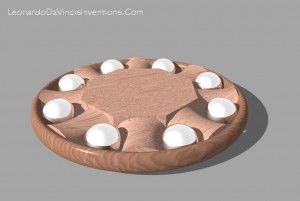
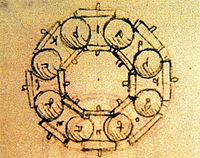
Leonardo da Vinci's sketches reveal his intention to reduce friction between moving parts. He conceptualized a bearing that utilized small metal balls to maintain smooth motion.
This mechanism required a 'cage' to keep the balls evenly spaced, which was key in providing stability and efficient motion. His work shows a deep understanding of friction dynamics and mechanical systems.
Da Vinci's design aimed to optimize the power-to-weight ratio, a crucial factor for inventions like his helicopter. Devices could function more smoothly and efficiently by lowering friction, marking a significant leap in mechanical design.
These principles of friction management and motion optimization have remained relevant, influencing countless subsequent engineering feats.
Today’s ball bearings differ significantly in materials and precision. They use high-grade stainless steel and other advanced materials, which ensure durability and efficiency.
Despite these advancements, the core idea of using balls to reduce friction remains a testament to Leonardo da Vinci's foresight.
Unlike Leonardo’s design, modern bearings can handle higher loads and run at incredible speeds. Nonetheless, his sketches demonstrate an early understanding of bearings' advantages in mechanical systems.
Exploring da Vinci's inventive spirit offers insight into his role as a pioneer in engineering. It highlights how his concepts have evolved into essential components of modern machinery.
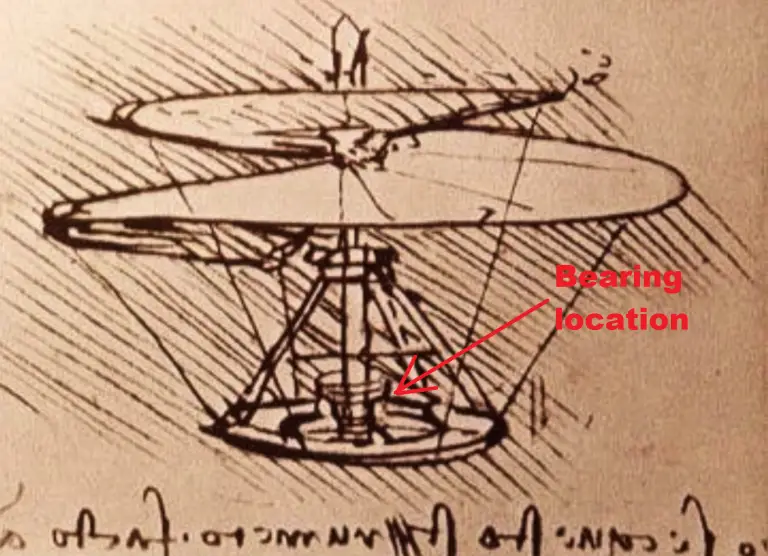
Leonardo da Vinci's exploration of ball bearings marked a significant leap in engineering. His designs have fueled numerous advancements in machinery and engineering that continue to benefit modern technology.
Leonardo da Vinci's ball-bearing concept provided engineers with a framework for reducing friction between moving parts. His sketches, dated between 1498 and 1500, demonstrated how spherical elements could support axial loads in rotating applications. Though Leonardo did not construct a functioning ball bearing, he laid the groundwork for later developments.
Over time, da Vinci's ideas led to technological enhancements. The first patented ball bearing, credited to Philip Vaughan, appeared in 1794.
This invention applied the principles initially detailed by Leonardo, highlighting his enduring influence on mechanical design. Engineers today utilize similar concepts in machinery, showing Leonardo's pivotal role in technological progress.
Ball bearings can be found in any machine with rotary motion. If you read this post on a PC or laptop, the CPU fan is a ball-bearing fan.
Ball-bearing machines are still used in engines, kitchen appliances, bicycles, and many other machines. They were so important that the Royal Air Force (RAF) regularly bombed German Ball-Bearing Factories during World War II to try to stop the German War Machine.
Nowadays, ball bearings are machine-created and can attain an accuracy of within thousandths of a millimeter. The most undersized ball bearings are found in watches and remote-controlled (RC) helicopters. You can learn more about Leonardo’s use of ball bearings in his helicopter.
Ball bearings are essential to modern machinery, enabling smooth, efficient movement. Inspired by Leonardo da Vinci's insights, these components reduce friction and wear in countless applications. They are integral in automotive, aerospace, and industrial equipment.
Ball bearings enhance machine performance and longevity, enabling higher speeds and greater precision. Companies continuously innovate to improve materials and design, ensuring adaptability to technological demands.
Leonardo da Vinci's vision is evident as contemporary engineers refine these components, proving the sustained impact of his idea. His pioneering concept remains a foundation for ongoing advancements in machinery and engineering, emphasizing his importance in technological history.
Leonardo da Vinci's contribution to the concept of the ball bearing showcases his pioneering spirit and scientific curiosity. His sketches, made between 1498 and 1500, demonstrate his understanding of how to reduce friction to enable smoother machine movement. These early designs hint at modern ball bearings, which are critical to technological advancements today.
Throughout history, figures like Philip Vaughan and John Harrison built upon da Vinci's foundation, refining the ball bearing for practical use.
Vaughan, in particular, is credited with creating the first recorded patent for a ball bearing in 1794. His work allowed for significant improvements in the mechanical industry, enhancing the efficiency of various machines.
Key Takeaways:
Leonardo da Vinci did not invent the modern ball bearing, but he was one of the first to sketch a working design. His drawings showed balls placed between rings to reduce friction—very similar to modern bearings. However, practical ball bearings were only developed and patented centuries later.
Leonardo da Vinci is most famous for conceptual inventions such as the aerial screw (an early helicopter), armored vehicles (tanks), and flying machines. Although many were never built in his lifetime, these designs demonstrated advanced engineering ideas far ahead of their time.
There is no single “best” ball bearing brand, as performance depends on the application. However, leading manufacturers such as SKF, Timken, NSK, and FAG are widely recognized for their quality, durability, and precision in industrial and automotive applications.
Leonardo da Vinci is often called the “father of the modern bearing” because he designed the basic structure of ball bearings (rings, rolling elements, and a cage). However, the first modern patented bearing was later created by Philip Vaughan in 1794.
Yes, Leonardo da Vinci designed many innovative machines, including flying devices, military equipment, and mechanical tools. While few were built during his lifetime, his notebooks show working concepts that influenced future engineering and technology.
According to historical accounts recorded by Giorgio Vasari, Leonardo’s last words expressed regret, saying he had not fully achieved the potential of his work. A commonly cited version is that he felt he had “offended God and mankind” by failing to achieve perfection in his art.
(Last updated: April 2026)
Leonardo perpetual motion machine has intrigued thinkers for centuries, challenging the very laws of physics.
The idea of a machine that moves forever without external energy is captivating but impossible, given principles such as the conservation of energy.
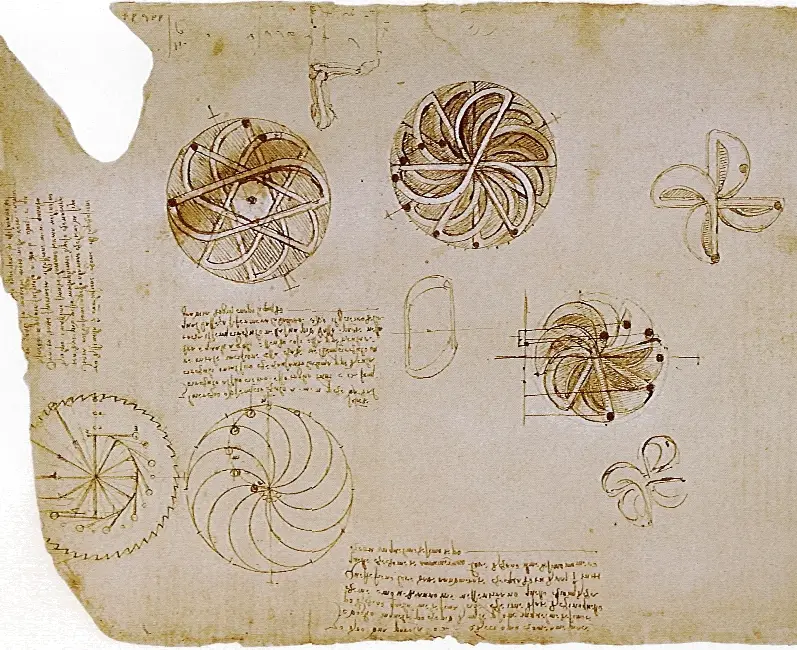
His first design sketches, simple yet ingenious, included a wheel with ball bearings shifting its center of gravity, theoretically allowing continuous motion.
Fascinated by mechanics, Leonardo da Vinci tackled the age-old problem of designing such machines. While his perpetual motion efforts eventually proved unfeasible, they offered valuable insights into mechanical motion.
His explorations are well documented in manuscripts such as the Codex Atlanticus, which showcase a range of ideas, from overbalanced wheels to centrifugal pumps.
Historians and engineers continue to study Leonardo's work, not for its practicality but for the creativity it represents. Although Leonardo acknowledged the challenges, his experiments demonstrate his relentless curiosity and innovation.
Leonardo da Vinci explored the concept of perpetual motion when inventors were eager to solve this intriguing challenge. He created detailed designs and drawings, demonstrating his innovative approach to mechanical motion.
During the Renaissance, inventors were fascinated by a machine that could operate indefinitely without an external energy source.
This quest involved creating a perpetual motion machine capable of endless movement. Da Vinci's investigations into this concept occurred during an era of scientific curiosity and technological advancement.
Although the science of the time had not yet ruled out the possibility, later thermodynamic studies showed that perpetual motion could not be achieved.
Leonardo's designs were a testament to his creativity and engineering prowess. One well-known creation was the da Vinci wheel, which features overbalanced wheels with weights to keep the machine in continuous motion.
Another example included intricate systems of ball bearings across multiple tracks, designed to continuously shift the wheel's center of gravity and sustain rotation.
While captivating, these designs remained theoretical and have not achieved perpetual motion. If you are interested in Da Vinci's mechanical inventions, you can find more insight into his unique approach.
Understanding why perpetual motion machines like Leonardo's cannot function involves fundamental physics.
The laws of thermodynamics, developed centuries later, explain that energy cannot be created or destroyed, making perpetual motion impossible.
These principles rendered it infeasible for machines to operate without energy loss. Leonardo's attempts highlight early human efforts to question and push the boundaries of the physical world, inspiring generations of inventors and enthusiasts.
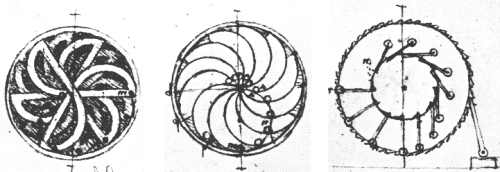
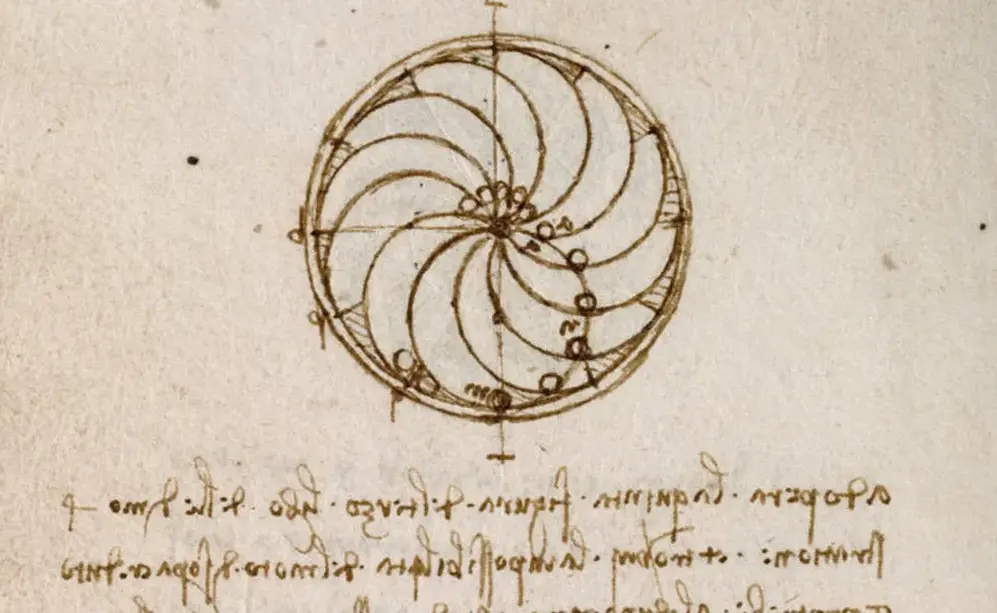
Leonardo’s first perpetual motion invention is a simple overbalanced wheel.
In the above design, the weight of the ball bearings within the machine constantly shifts the wheel's center of gravity away from the center point, allowing continuous rotation.
The design has three tracks, each with its ball bearing running within it.
His second design incorporates levers, a pawl, and a racket system into the overbalanced wheel. The wheel's central hub ensures the levers are controlled throughout its rotation.
The pawl-and-ratchet system prevents the wheel from rotating clockwise. This can be seen in the images above and will be demonstrated in the video at the bottom of the page.
His third and most elegant design is for another overbalanced wheel. This design has twelve tracks, each bearing a ball.
Once again, the center of gravity is constantly shifted by the movement of the balls along the curved tracks during the wheel's rotation. This design is shown in the images above and demonstrated in operation in the video at the end of the page.
Leonardo decided against investigating perpetual motion any further after he wrote (in mirror writing) beside the designs: “For every action, there is an opposite and equal reaction” (the machines would not work).
That quote is also from Isaac Newton's Third Law of Motion, which was written 200 years before Newton was born!!!
The conservation of energy principle states that energy cannot be created or destroyed; it can only be transformed from one form to another.
In a perpetual motion machine, energy must be continuously generated without input. However, a perpetual motion machine of the first kind violates this law because it claims to produce work without any energy source.
Leonardo da Vinci understood this challenge and recognized the difficulty in achieving continuous motion without an energy supply. While he designed various machines, such as the da Vinci wheel, his studies concluded that energy loss through friction and other forces made perpetual motion impossible.
Creating a perpetual motion machine involves overcoming significant obstacles related to mechanical efficiency and energy loss.
The machines must achieve continuous work output without any energy input, which contradicts fundamental laws of physics.
Leonardo's perpetual motion machine attempts demonstrated how friction and air resistance decrease efficiency, leading to energy loss.
Leonardo da Vinci's exploration of perpetual motion machines, although he concluded that such devices were impossible, left a lasting impression on science and art. His ideas continue to inspire inventors and creative minds worldwide.
The Leonardo da Vinci perpetual motion machine influenced future generations of inventors by encouraging them to explore the boundaries of possibility.
Although he determined that perpetual motion couldn't exist, his dedication to understanding mechanics provided valuable insights for future scientists and engineers.
His investigations demonstrated the importance of experimentation and the scientific method, laying the groundwork for later technological advancements.
Inventors were inspired to examine the laws of physics more deeply. They explored ways to minimize energy loss in machines, thereby improving efficiency across many fields.
This enduring curiosity highlights Leonardo's role in pushing the limits of human imagination in pursuit of scientific truth.
In contemporary times, the idea of the da Vinci wheel remains a powerful symbol of innovation.
Artists and creators draw inspiration from Leonardo's inventions. His work's intersection of art and science captivates creative minds, leading to unique interpretations across various media.
Art installations and creative projects often feature elements reminiscent of the perpetual motion machine example. These creations pay homage to Leonardo's ingenuity and reflect the timeless allure of attempting the impossible.
Through exhibitions and artistic endeavors, the concept of perpetual motion fascinates and challenges perceptions of nature and technology.
Leonardo da Vinci's plans for a perpetual motion machine have inspired fascination for centuries.
Despite this intrigue, the fundamental question remains: Is there a perpetual motion machine? The concept continues to stir debates and misconceptions in scientific circles and beyond.
Perpetual motion machines are often thought to defy the basic laws of physics. Many believe Da Vinci's wheel, a well-known perpetual motion invention, could work indefinitely without external energy.
This is a myth. The laws of thermodynamics state that energy cannot be created or destroyed, making true perpetual motion impossible.
Leonardo's designs, though innovative, were theoretical. None of the designs, including his self-spinning wheel, have succeeded because they require an energy source to overcome natural resistance and friction.
Despite this, the allure of breaking free from energy constraints fuels imagination.
The theory of perpetual motion conflicts with established scientific principles.
For example, the first law of thermodynamics states that energy in a closed system remains constant. In practical terms, this means perpetual motion cannot exist. Even Leonardo da Vinci's perpetual motion machine falls short due to these fundamental laws.
The second law of thermodynamics further clarifies the impossibility by highlighting the concept of entropy.
It dictates that energy systems tend to move towards disorder. Machines cannot operate continuously without energy loss. Hence, these principles invalidate attempts to create self-sustaining devices.
Leonardo da Vinci's concepts of perpetual motion have sparked interest in modern attempts to bring such machines to life. These efforts explore whether perpetual motion can genuinely exist.
Contemporary experiments often focus on the possibility of creating a successful perpetual motion machine.
Innovators try various designs inspired by historical figures like Leonardo da Vinci. Experiments include overbalanced wheels similar to those in Da Vinci's designs, which use weights to maintain continuous motion.
Despite efforts, no working perpetual motion machine has been demonstrated due to the laws of thermodynamics, which state that energy cannot be created or destroyed. Thus, the question remains: Is perpetual motion possible?
Perpetual motion fascinates not only scientists but also popular culture. Movies, books, and TV shows often explore the concept, imagining worlds where these machines defy the laws of physics. The intrigue of designs like Leonardo da Vinci's wheel captures the public imagination.
The idea remains a topic of debate, with skeptics questioning whether perpetual motion exists. While the answer, in reality, is no, these devices offer endless possibilities in fiction.
This continued fascination keeps the discussion alive, blending history, science, and fantasy in ways that captivate audiences worldwide.
Leonardo's perpetual motion machine has fascinated people for centuries. Although he concluded that actual perpetual motion was impossible, his designs and experiments contributed significantly to the study of mechanics.
His exploration of self-propelling machines included concepts like the overbalanced wheel. In this design, ball bearings are shifted continuously to drive the motion.
The concept of perpetual motion challenged him to solve technical problems, such as friction between moving parts. He studied how machines might overcome these issues using creative designs.
Despite determining perpetual motion could not be achieved, Leonardo's work in this area showed his innovative thinking and ability to push the boundaries of existing knowledge.
Key Takeaways: Leonardo's efforts illustrate his genius and curiosity. While perpetual motion machines remain impossible, his ideas have inspired countless inventors and engineers. The mythical allure of machines that move forever without energy has led to further exploration of alternative energy sources and improvements in machine efficiency.
No, a true perpetual motion machine is considered impossible according to modern physics. It would violate the laws of thermodynamics, especially the conservation of energy and the principle that energy is always lost to friction or heat.
There is no fully verified historical record of Leonardo da Vinci’s exact last words. Some later accounts claim he expressed regret about not fully realizing his potential, but these reports lack direct evidence and remain uncertain.
There is no confirmed inventor of a working perpetual motion machine, but early designs date back to the Middle Ages, including concepts by figures like Villard de Honnecourt and Bhāskara II, who proposed wheels that were supposed to run indefinitely.
No, no one has ever successfully built a true perpetual motion machine. Despite many attempts throughout history, all designs either fail or rely on hidden energy sources, making them scientifically invalid.
There is no scientific evidence that time travel will be possible by 2050. While theoretical physics explores concepts like relativity and wormholes, practical time travel—especially to the past—remains speculative and far beyond current technology. (No credible scientific confirmation available.)
We are not close to creating a perpetual motion machine, because it violates fundamental physical laws. Even highly efficient modern machines still lose energy, meaning true perpetual motion remains unattainable in principle.
(Last updated: April 2026)
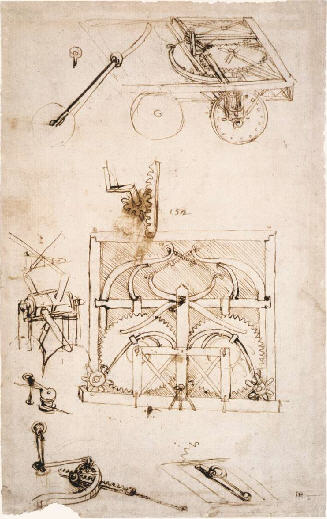
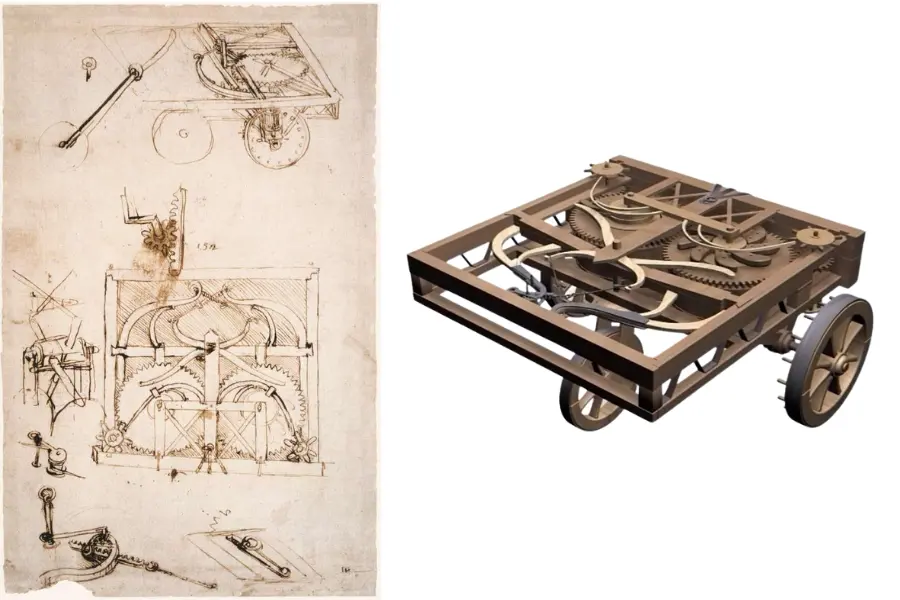
Leonardo da Vinci car, a self-propelled cart, showcases the ingenuity of this Renaissance polymath.
He designed this cart to move independently without external force, making it a pioneering idea in transportation.
While the concept was conceived in the 15th century, the technology was advanced and foreshadowed future automotive developments.
This self-propelled vehicle, known as Leonardo's self-propelled cart, functions with a complex system of gears and springs that propel it forward.
Despite being invented long before engines, the cart is often regarded as the ancestor of modern cars, drawing interest from historians and engineers alike.
Its innovative design showcased da Vinci's exceptional foresight into future technological advancements.
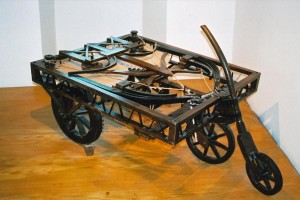
In the early 2000s, a team from The Institute and Museum of the History of Science in Florence attempted to bring Leonardo’s vision to life.
They meticulously recreated the car, using the original designs and materials specified by da Vinci.
This project highlighted the challenges and the brilliance of his original blueprint, inspiring modern inventors and historians to re-examine da Vinci’s contributions to the world of transport.
Leonardo da Vinci did not invent the modern car, but he designed a self-propelled cart around 1478, which is widely considered a precursor to the automobile. His design used springs and gears to move without human pushing, making it one of the earliest concepts of a vehicle.
No, Leonardo da Vinci did not own or use a car in the modern sense. His self-propelled cart existed only as a design in his notebooks and was never built or used during his lifetime.
The earliest known sketch of a self-propelled vehicle, from 1478, is attributed to Leonardo da Vinci. His drawings in the Codex Atlanticus show a spring-powered cart that could move and even follow a programmed path.
Many experts expect self-driving cars to be widely developed and more common by 2050, as autonomous technology is already advancing rapidly. However, full global adoption will depend on safety, regulation, and infrastructure improvements, so timelines may vary by region. (General consensus based on current technological trends; no single definitive source.)
The first full-scale working automobile is usually credited to Nicolas-Joseph Cugnot, who built a steam-powered vehicle in 1769–1770. Later, Karl Benz developed the first modern gasoline-powered car in 1886.
Mercedes-Benz came first. Its origins trace back to Karl Benz’s automobile in 1886, while BMW was founded later in 1916. This makes Mercedes one of the oldest car manufacturers in the world.
 Leonardo Bianchi is the founder of Leonardo da Vinci Inventions & Experiences, a cultural travel guide helping visitors explore Leonardo da Vinci’s art, inventions, and legacy across Italy and Paris.