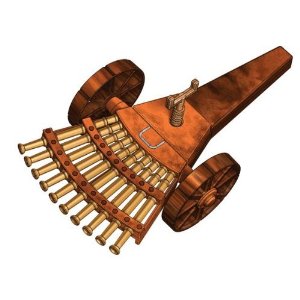
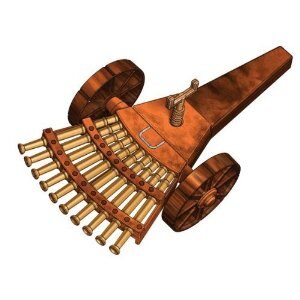
Leonardo da Vincimachine gun was the first auto-firing weapon ever invented. He designed it in such a way that when it was first fired another set of barrels would rotate around and ready to fire almost immediately. Like most of his inventions for war this machine was supposed to break the spirit of the enemy through fear.
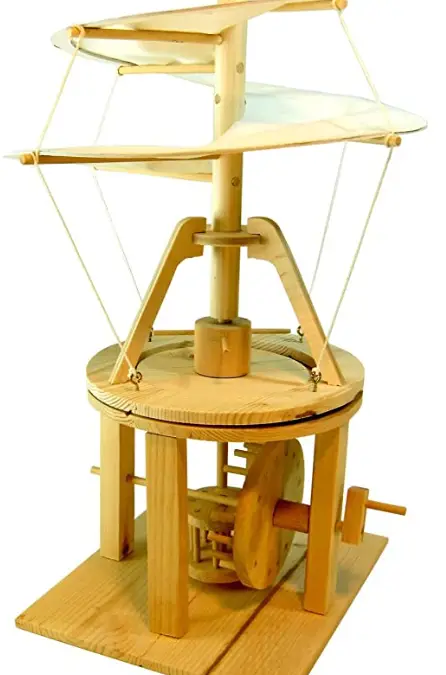
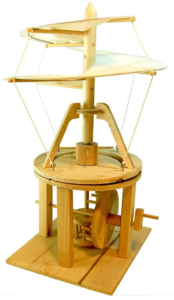
Leonardo da VinciHelicopter model is based on his original sketch. It is of wood and canvas construction (exactly as it should be) and this model simply snaps together and no gluing is required.
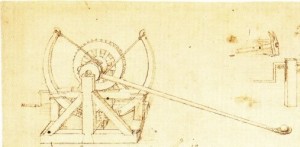
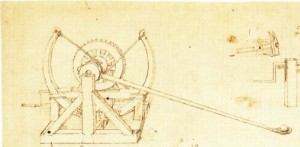
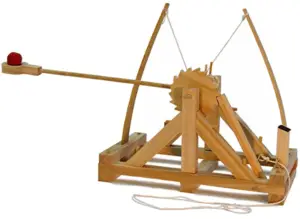
Leonardo da Vincicatapult models are both simple and ingenious. The mechanical catapult involves a pawl and rachet system which incrementally tightens the firing system. As the system is tightened, the forces put into the system by the operator (1 soldier) are transferred to both the ropes and tension arms of the catapult. For catapult locking mechanism, on releasing the firing pin (the pawl), the stored energy is instantly transferred from the ropes and tensioning arms to the swing arm which would contain a lead ball/cannonball.
What does a catapult look like – this machine looks like it could have been operated by a handful of soldiers: four or five soldiers for moving/repositioning/aiming the catapult and 2 men for operating the machine – one to tighten the mechanism and one to release the firing pin.
Interesting facts about catapults – this machine would undoubtedly have wrought havoc upon any castle/fort it attacked. It could be reloaded and retightened very quickly. For catapult firing, as with all medieval catapults, the soldiers may have decided to fire flaming ballistics or even disease-ridden dead bodies into the castle they were attacking – this usually spread either fire or disease very quickly within the walls of the target castle/fort. Within a castle that is under sustained attack, water supplies quickly begin to dwindle and the population begin to grow weak due to lack of food, thereby decreasing their odds of putting out any flames and increasing their odd of succumbing to illness from disease-ridden bodies flung over the walls.
Who invented the catapult – catapults were used in the early 4th century BC. which was invented by Greek Diodorus Siculus in 399 BC as part of the equipment of the Greek army.
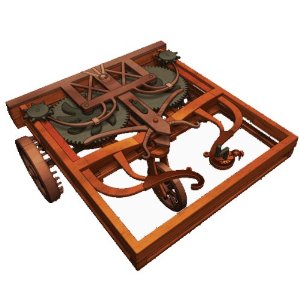
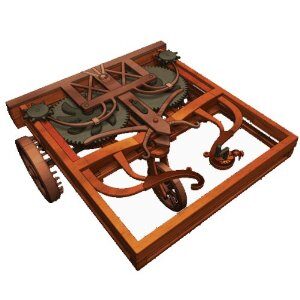
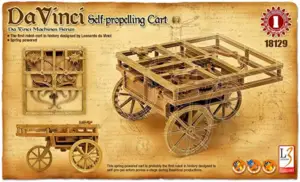
The Leonardo da Vinci Automobile model replicates exactly what he sketched in his original design. This is a snap together model so no gluing is required. Leonardo’s automobile is the first self-propelled machine in history.
Leonardo Mirror Grinding Machine represents a fascinating chapter in the history of invention and creativity.
Those curious about historical innovations and their impact always thirst for understanding how these mechanisms worked and what made them special.
By exploring this machine, you'll uncover insights into Leonardo da Vinci's ingenuity and its lasting influence on optical technologies.
Leonardo designed this machine to produce high-quality optical surfaces, revolutionizing mirror-making in his time.
His innovative mechanism used a rotating tool driven by gears, allowing precise control over the grinding process.
This design enabled the production of high-quality optical devices, such as telescopes, by creating mirrors with exceptional optical performance.
The machine's role in the development of telescopes and optical lenses highlights Leonardo's foresight and technical skill.
It shows how his contributions paved the way for future advancements in optics.
Leonardo Mirror Grinding Machine
The Leonardo Mirror Grinding Machine represents a significant advancement in optical technology and demonstrates Leonardo da Vinci's innovative approach.
His designs focused on improving the precision and quality of optical instruments.
Leonardo da Vinci's Contributions
Leonardo da Vinci was a pioneer in optical engineering. His mirror grinding machine was designed to produce high-quality optical surfaces.
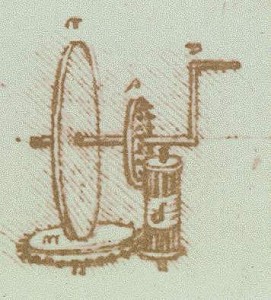
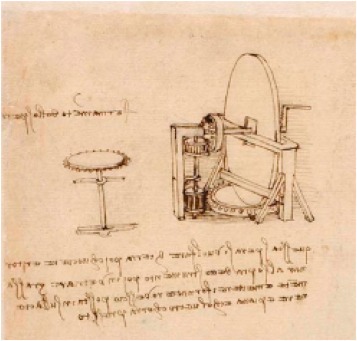
Da Vinci's sketches, preserved in the Codice Atlantico, showed machines capable of grinding concave, sizable, high-focal-length mirrors.
By enhancing the accuracy of mirror surfaces, he contributed significantly to the development of telescopes and optical lenses.
His vision laid the groundwork for future advancements in optical instruments.
Development of Mirror Grinding Technologies
The process of mirror grinding has evolved considerably since Leonardo's time. His innovative design used gears, providing high accuracy.
This principle of using machinery for precision grinding laid the foundation for modern optical technology.
Leonardo’s techniques demonstrated the potential of mechanical tools to improve mirror quality, thereby influencing the design of later mirror-grinding machines.
These developments were crucial for better light focusing in telescopes and other optical devices. Over time, these principles have led to more advanced and efficient methods in mirror manufacturing, contributing significantly to scientific discoveries and optical advancements.
Technical Specifications
The Leonardo Mirror Grinding Machine was an innovative device that crafted high-quality optical surfaces by polishing mirrors with gears and rotating tools.
Understanding its design and material composition provides insight into its effectiveness.
Design Overview
The mirror grinding machine used a series of gears with a rotating tool, ensuring precise control over the grinding process.
Leonardo da Vinci designed it to create both concave and convex mirrors.
This machine demonstrated an advanced understanding of mechanical engineering principles for its time.
The intricate gear system allowed for adjustable speeds, enhancing the precision and quality of the surface finish.
Materials and Components
High-quality metals formed the primary materials in the construction of the mirror grinder.
The machine's frame typically consisted of durable metals, ensuring stability and longevity.
The rotating tool, a key component, was made from materials capable of maintaining their shape under pressure, including metals and abrasive substances.
These materials contributed to the machine's ability to produce superior optical surfaces, essential for telescope applications.
Dimensions and Tolerances
Leonardo designed the mirror grinding machine with precision in mind. While the exact dimensions may not be detailed, the sketches suggest a compact form that allows for easy operation.
The machine accommodated a range of mirror sizes, from small concave mirrors to large convex ones.
Tight tolerances were likely maintained to ensure the mirrors were ground to the desired curvature and smoothness.
Achieving these specifications was critical for accurate light reflection, a primary function of the mirrors.
Operational Principles
Leonardo da Vinci's mirror grinding machine design in Codex Atlanticus
Leonardo Mirror Grinding Machine showcases a blend of artistic genius and technical ingenuity.
The machine's design emphasizes the precise grinding necessary for optical quality and innovative mechanics for efficient operation.
Grinding and Polishing Processes
The mirror grinding machine developed by Leonardo was a pioneering device for creating optical surfaces.
Precision and efficiency were key, as the machine utilized a rotating tool to shape and smooth the mirror's surface.
This grinding process required a careful balance between pressure and rotation speed to avoid damaging the delicate material.
During the Renaissance, this method produced mirrors of superior quality compared to manual polishing techniques.
Polishing followed grinding and involved the use of abrasive materials to achieve a reflective finish.
This polishing process is crucial for mirrors, as it enhances their ability to reflect light accurately.
Leonardo's design allowed for consistent pressure and movement, ensuring the mirror's surface remained flat and transparent.
This systematic approach to grinding and polishing demonstrated his understanding of the optical needs of his time.
Accuracy and Precision
The design of the mirror grinder machine focused on achieving high levels of accuracy and precision to produce superior optical surfaces.
One critical factor was controlling movement and alignment, which affected the uniformity of the mirror's shape.
Leonardo's device accounted for these variables through a well-thought-out mechanical system.
Maintaining precision in the machine's operation was essential due to the complexity of grinding concave and convex mirrors.
Leonardo stressed the importance of fine adjustments within the machine's structure.
This allowed for modifications suited to various focal lengths and mirror shapes, a concept detailed in his sketches, such as those in the Codice Atlantico.
The machine's enhanced precision was pivotal in advancing optical technologies during the Renaissance.
Applications and Impacts
The Leonardo Mirror Grinding Machine was a significant innovation that influenced astronomy and optics. This section explores its key impacts in these fields, highlighting specific instances where Leonardo da Vinci's designs contributed to technological advancements.
Astronomical Observations
The introduction of Leonardo's mirror-grinding machine profoundly affected astronomical studies.
The device enabled the production of high-quality concave mirrors, which were essential for telescopes.
These mirrors enabled astronomers to observe celestial bodies in greater detail than before.
The improved surface precision meant telescopes could focus light more effectively, enhancing image clarity.
Telescopes using concave mirrors enabled discoveries of planets, moons, and stars that were previously difficult to observe.
This advancement paved the way for a greater understanding of the cosmos.
Although Leonardo's exact designs weren't implemented in his time, his innovations laid critical groundwork for future developments in telescope manufacturing.
Advancements in Optics
Leonardo's mirror-grinding machine also spurred improvements in optics.
By designing a mechanism for precise mirror shaping, he helped create better-quality optical instruments.
His method of using rotating tools and gears to control the grinding process enabled the production of mirrors with unique surface accuracy.
This technological leap was crucial for developing devices like cameras and microscopes, which rely on precise optics.
The ability to produce mirrors with the correct curvature transformed how lenses were made.
This led to advancements in both scientific research and everyday technologies.
The principles established by Leonardo's mirror-grinding techniques continue to influence modern optical engineering, underscoring his lasting impact on the field.
Final Thoughts
Leonardo Mirror Grinding Machine is a testament to Leonardo da Vinci's ingenuity and forward-thinking approach.
Designed for creating optical surfaces, this machine utilized a rotating tool powered by gears, showcasing a blend of art and engineering.
This machine enabled the precise grinding of concave, sizeable focal-length mirrors, highlighting Leonardo's attention to detail. His designs initiated innovations that later became evident in astronomical instruments.
Leonardo's influence can be seen in various fields. His sketches of grinding machines were ahead of their time and inspired future advancements in mirror-making technology.
Key Takeaways: Leonardo Mirror Grinding Machine exemplifies da Vinci's pioneering spirit in mechanical design. It played a significant role in the evolution of optical engineering and laid a foundation for future innovators in mirror technology.
FAQs about Leonardo Mirror Grinding Machine
What was Leonardo da Vinci's mirror technique?
Leonardo da Vinci is famous for his mirror-writing technique, in which he wrote from right to left so the text could only be read in a mirror. Historians believe this may have helped prevent smudging (since he was left-handed) or kept his ideas private.
Did da Vinci's machines work?
Most of Leonardo da Vinci’s machines were never built or fully functional during his lifetime. While his designs were highly advanced, they were limited by the materials and technology available in the Renaissance, though some have been proven workable through modern reconstructions.
What did Leonardo da Vinci do in 1478?
In 1478, Leonardo da Vinci received an independent commission to paint an altarpiece for the Chapel of Saint Bernard in Florence, marking an important step in his career as an independent artist and engineer.
What did Leonardo da Vinci call his flying machine?
Leonardo da Vinci’s most famous flying machine is commonly called the “ornithopter,” a design inspired by the flapping wings of birds. In some writings, he also referred to a large version as the “Grande Nibbio” (great kite).
Did Leonardo da Vinci have a high IQ?
There is no verified IQ score for Leonardo da Vinci, as IQ testing did not exist during his lifetime. However, he is widely regarded as a genius for his extraordinary achievements in art, science, and engineering.
Who has 325 IQ in the world?
There is no scientifically verified person with an IQ of 325. Claims of extremely high IQ scores (above 200) are generally speculative or exaggerated, as modern IQ tests are not designed to reliably measure such high values. (No credible scientific source supports a 325 IQ claim.)
Leonardo Bianchi is the founder of Leonardo da Vinci Inventions & Experiences, a cultural travel guide helping visitors explore Leonardo da Vinci’s art, inventions, and legacy across Italy and Paris.
Planning Milan?
See The Last Supper Without Missing the Details
Tickets are limited and visits are short. Start with the Milan guide before choosing your Last Supper experience.
If you're visiting Milan for Leonardo da Vinci, these are the experiences most travelers prioritize first — especially when tickets are limited and time is short.
This site is built for travelers who want more than surface-level sightseeing — helping you plan smarter visits around Leonardo da Vinci’s art, museums, and cities across Italy and Europe.

 Leonardo Bianchi is the founder of Leonardo da Vinci Inventions & Experiences, a cultural travel guide helping visitors explore Leonardo da Vinci’s art, inventions, and legacy across Italy and Paris.