The Leonardo da Vinci machine gun is a fascinating example of Renaissance-era ingenuity and foresight. You may find yourself intrigued by the idea of a famous artist contributing to weapons development.
This article will explore how Leonardo da Vinci's imaginative designs paved the way for future advancements in weaponry.
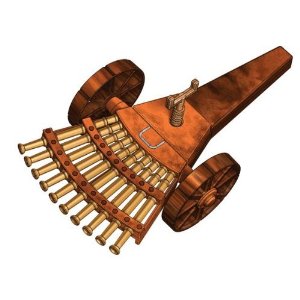
Leonardo's machine gun, also known as the 33-barreled organ, was a unique prototype designed to address the slow reloading time of traditional firearms. Arranging multiple barrels in a fan shape enabled rapid successive firing, which was groundbreaking for its time.
Though never built, Leonardo's design was a precursor to modern automatic firearms.
Beyond just the machine gun, this inventive mind conceived various other war machines, including armored cars and giant crossbows. His work as a military engineer demonstrated his unparalleled ability to merge art with practical technology applications.
History and innovation enthusiasts will appreciate how his ideas influence the design of contemporary weapon systems.
Leonardo da Vinci Machine Gun: Historical Context
Leonardo da Vinci's inventive genius during the Renaissance led to many groundbreaking ideas. His concepts for military technology, such as the machine gun, showcased his imaginative approach to warfare.
Invention during the Renaissance
During the Renaissance, Leonardo da Vinci emerged as one of the most influential figures in art, science, and engineering. His ideas often included significant technological advancements.
The Leonardo da Vinci machine gun is a prime example of his foresight in modern weaponry. Developed in the 15th century, it proposed a rotating barrel system allowing continuous firing without reloading delays. This idea laid the groundwork for future advancements in artillery.
The Renaissance period was marked by a desire to explore new ideas, and da Vinci's work reflected this spirit of innovation and curiosity. His visionary designs were not limited to weapons but also included concepts like the Leonardo da Vinci flying machine and the much-discussed Leonardo da Vinci tank.
Leonardo da Vinci's Military Designs
Leonardo da Vinci's military designs were ahead of their time, encompassing a range of da Vinci war machines. His work demonstrated a deep understanding of engineering principles, which he applied to create innovative solutions for military challenges.
Among his creations, the Leonardo da Vinci machine gun stood out for its unique approach. Featuring a 33-barreled organ gun, it aimed to improve firing rates and efficiency.
While these designs were revolutionary, they remained conceptual during his lifetime. This fascination with engineering extended beyond weapons, influencing later inventors and paving the way for future advancements in military technology.
Design and Mechanisms
Leonardo da Vinci's machine gun showcases his remarkable ability to envision complex mechanical systems. This innovation foreshadowed the evolution of modern artillery and highlighted his forward-thinking approach to weaponry.
Technical Specifications
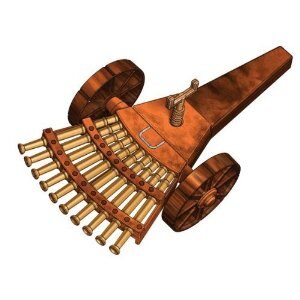
The da Vinci machine gun, often compared to the 33-barrel organ, was a marvel of engineering for its time. It featured multiple small-caliber barrels arranged in a fan shape, allowing for simultaneous firing. This design increased the rate of shots and offered a wide spread of bullets.
A crucial feature was its mobility. The gun's carriage had wheels, enabling easy movement on the battlefield.
Leonardo's sketches detailed loading mechanisms and the elevation adjustments necessary for aiming. The concept was to overwhelm enemies with a barrage of firepower, a strategy that still resonates in modern artillery systems.
Innovations in Weaponry
Leonardo's design was ahead of its time in terms of military technology. His war machines, like this machine gun, were part of a broader vision that included other ingenious inventions such as the Leonardo da Vinci tank and the parachute Leonardo da Vinci.
These devices underscore his understanding of the dynamics of war and defense mechanisms.
The concept of rapid-fire artillery, which was not fully realized until centuries later, highlights Leonardo's pioneering thought. His machine gun laid the groundwork for future developments in weaponry.
Artistic Representation
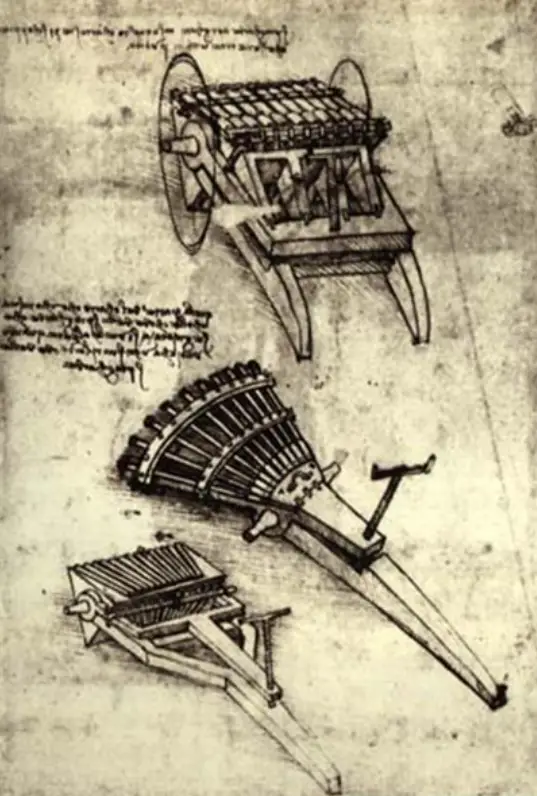
Leonardo da Vinci Machine Gun Drawing
Leonardo da Vinci's machine gun exemplifies his visionary art, blending mechanics and aesthetics. His sketches reflect his innovative approach to engineering and showcase early ideas that predate modern firearms.
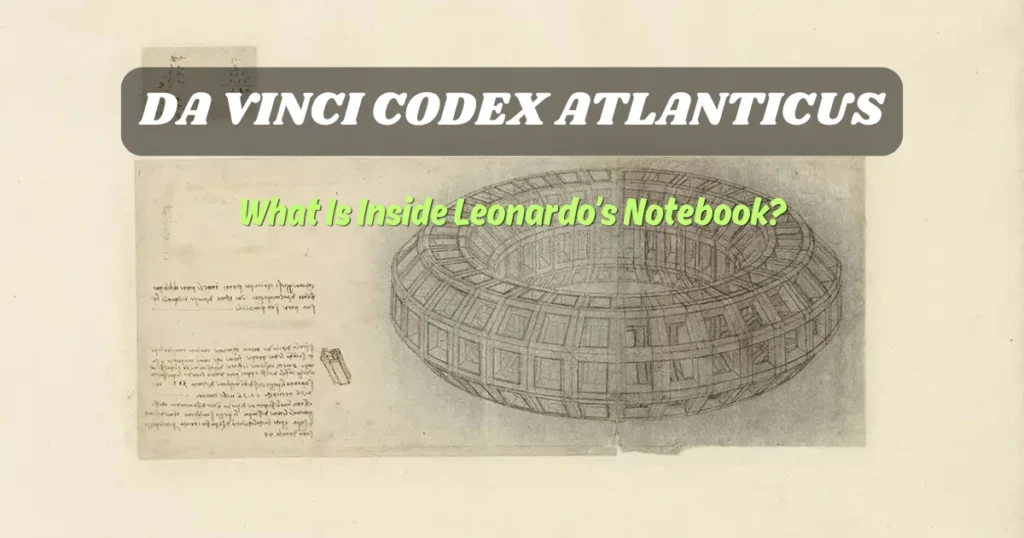
Sketches in the Codex Atlanticus
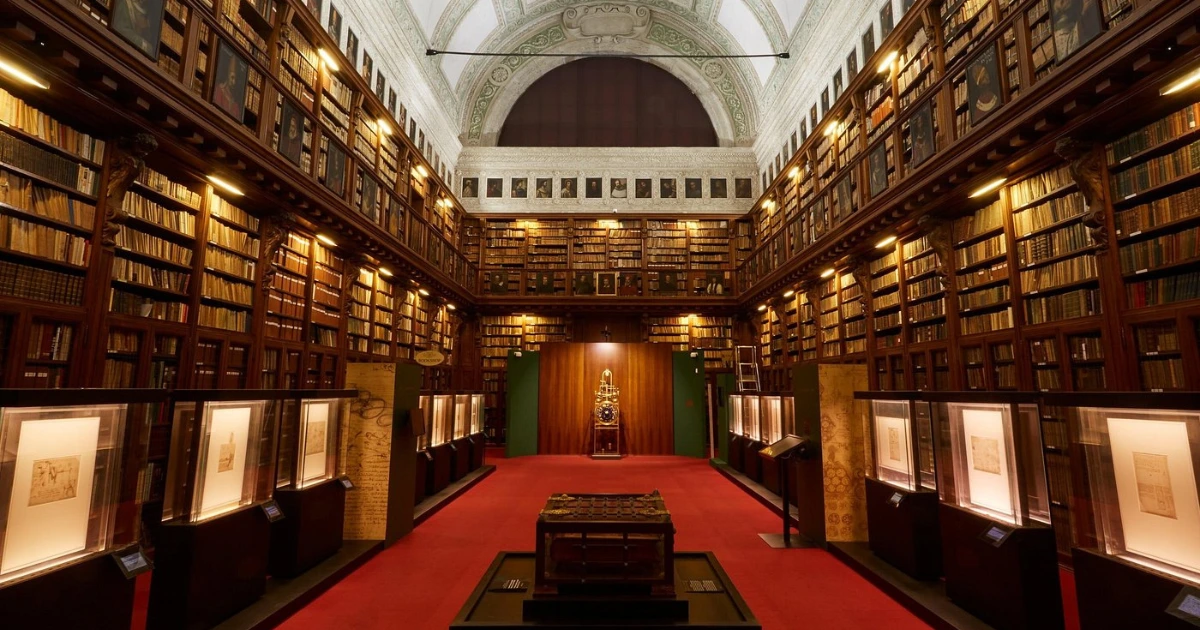
In the Codex Atlanticus, Leonardo da Vinci created detailed designs for multiple-barrel machine guns. This collection of drawings, part of the Biblioteca Ambrosiana in Milan, includes a 33-barreled organ gun resembling organ pipes aligned together. These sketches highlight his artistic finesse and his ability to envision warfare technology.
Da Vinci focused on machine guns and explored other military inventions, such as the Leonardo da Vinci cannon and various war machines. His designs were intended to improve firing rates in conflict situations.
Though his machine gun concept was never built, it paved the way for modern engineering discussions.
Leonardo’s work exhibits a seamless fusion of art and science. His drawings stand as artistic representations that reveal his unique perspective on innovation. This blend of creativity and engineering showcases da Vinci's profound impact on art and technology.
Reproduction and Models
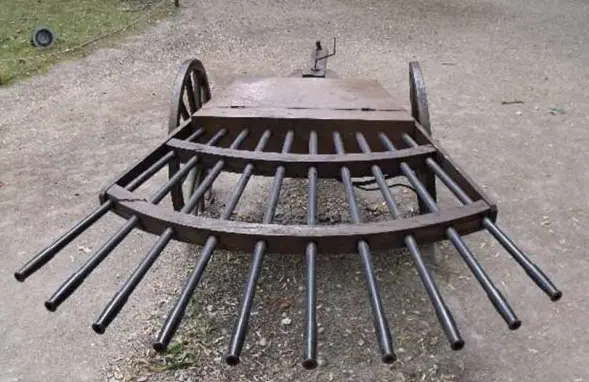
Da Vinci Machine Gun-Real Model, Château in Amboise, France
Recreating Leonardo da Vinci's machine gun involves understanding and adapting his original designs for modern construction. This task appeals to history enthusiasts and engineers who appreciate da Vinci's ingenuity.
Contemporary Reconstructions
Leonardo da Vinci's machine gun, sometimes called a rapid-fire crossbow, was detailed in his famous notebook, the Codex Atlanticus. Enthusiasts and historians have recreated this design to explore its practicality. The machine gun aimed to fire multiple shots rapidly, an idea unique to da Vinci's time.
Producing this machine includes using materials and methods that mirror the 16th-century vision.
The Leonardo3 Museum provides insights into these machines by displaying digital and physical models.
Their exhibits allow visitors to interact with da Vinci's concepts, including crossbow designs andflying machines. Building these models deepens our appreciation for his inventive genius and showcases how his ideas, such as the Leonardo da Vinci machine gun, remain significant engineering advancements.
Final Thoughts
Leonardo da Vinci's machine gun designs showcase his remarkable foresight and creativity in the field of weapon innovation. His concept of a multi-barreled weapon addressed the slow reloading times of early firearms.
Several of his designs, like the 33-barreled organ gun, can be seen as prototypes for modern artillery.
Leonardo's innovative use of multiple cannons firing in succession demonstrated his deep understanding of battlefield needs.
Despite their potential, these designs mainly remained theoretical due to technological and resource constraints. However, his ideas did influence later generations.
Key Takeaways: Leonardo da Vinci's ideas on machine guns were ahead of his time, laying the groundwork for future advancements in rapid-fire weaponry. His inventive spirit continues to inspire engineers and inventors today.
FAQs about Leonardo da Vinci machine gun
Did Leonardo da Vinci make a machine gun?
Leonardo da Vinci did not create a true modern machine gun, but he designed a “33-barreled organ”, a multi-barreled weapon that could fire in rapid succession. It used rows of small cannons on a rotating platform to allow continuous firing and cooling, making it a precursor to modern machine guns.
Who invented the first machine gun?
The first true machine gun is generally credited to Hiram Maxim, who invented the Maxim gun in 1884. Unlike earlier designs, it was fully automatic, using recoil energy to reload and fire continuously without manual operation.
What weapons did Leonardo da Vinci invent?
Leonardo designed numerous weapons, including the 33-barreled organ gun, armored vehicles (tanks), a giant crossbow, and improved cannons. His focus was on increasing firepower, mobility, and battlefield efficiency through innovative mechanical designs.
Did Da Vinci design war machines?
Yes, Leonardo da Vinci created many designs for war machines in his notebooks. These included artillery systems, defensive vehicles, and siege weapons, showing his role as a military engineer who applied scientific thinking to warfare.
What is Da Vinci's greatest invention?
There is no single “greatest” invention, but some of Leonardo’s most famous designs include the aerial screw (early helicopter), armored vehicle, and multi-barrel gun. These stand out because they introduced ideas far ahead of the technology of his time.
Did Da Vinci invent anything?
Leonardo da Vinci did not mass-produce inventions, but he created hundreds of innovative designs and concepts across engineering, anatomy, and science. Many were never built, yet they influenced later technological developments and demonstrate his extraordinary creativity.
The da Vinci Bridge is one of the most remarkable engineering concepts to emerge from the Renaissance — a structure so cleverly designed that it holds itself together without a single nail, rope, or fastener. Conceived by Leonardo da Vinci around 1502, this portable bridge challenged everything people thought they knew about construction and military logistics.
What makes it truly fascinating is its simplicity. Leonardo didn't rely on complex materials or advanced tools. He used pure geometry. The logs interlock under their own weight, each pressing against the others to create stability rather than collapse. The more weight placed on the bridge, the stronger it becomes.
Historically, this idea arrived at a pivotal moment. Europe's armies were crossing rivers, building supply lines, and conquering new territories. A bridge that could be assembled and disassembled in minutes — with no hardware — was not just clever. It was revolutionary. Leonardo designed it for Cesare Borgia, the ruthless military commander for whom he briefly served as an engineer.
Understanding the Leonardo da Vinci self-supporting bridge also transforms how you experience his legacy in museums and exhibitions today. When you stand in front of a reconstruction — whether in Milan, Florence, or a science museum elsewhere in Europe — you're not just looking at a model. You're seeing proof that a man working in the late 15th century was thinking about structural engineering in ways that engineers still admire today.
This post is all about the da Vinci bridge — its design, its history, how it works, and where you can see it brought to life in person.
What Is the Da Vinci Bridge?
The da Vinci bridge is a self-supporting, freestanding structure designed by Leonardo da Vinci around 1502. It uses interlocking logs or beams — with no fasteners of any kind — to create a stable, load-bearing bridge. Its design relies on compression and friction. Each beam supports the others, and the entire structure becomes stronger under load.
The Engineering Idea Behind the Da Vinci Bridge
Leonardo's Design Concept
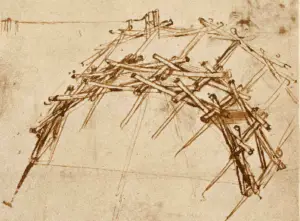
Leonardo sketched the bridge in Codex Atlanticus, his extraordinary collection of notes and drawings now housed at the Biblioteca Ambrosiana in Milan. The sketch is deceptively simple — a series of curved beams crossing over and under each other in a repeating pattern.
The genius lies in what's not there. No nails. No rope. No mortar. The beams themselves are the fasteners. Each one rests in a notch created by the others, held in place by gravity and lateral compression.
Leonardo envisioned this as a military tool. A portable structure that soldiers could assemble quickly to cross rivers during campaigns. It could also be disassembled and carried to the next crossing point. In an era when most bridges took weeks to build, this was an extraordinary tactical advantage.
Renaissance Engineering Principles
Leonardo was working during a period when engineers were beginning to move beyond inherited Roman techniques. He studied proportion, physics, and mechanics obsessively — filling thousands of pages with observations about how the natural world behaves under force and load.
His approach to the self-supporting da Vinci bridge reflects this broader method. Rather than asking "how do we fasten these beams together?", he asked, "How can the beams fasten themselves?" That shift in thinking — from addition to integration — is deeply characteristic of how Leonardo approached nearly every design problem.
Renaissance engineering principles emphasized harmony between form and function. A well-designed structure was expected to be both beautiful and efficient. The da Vinci bridge achieves both. Its interlocking geometry has an elegance that engineers and mathematicians still find compelling today.
Why the Idea Mattered
The da Vinci bridge design mattered for several reasons beyond its immediate military use.
Principle
Explanation
Why It Matters
Structural Stability
Achieved entirely through geometric interlocking, without nails or fasteners
Designed to be quickly assembled, disassembled, and transported
Crucial for military logistics, where mobility determined strategic advantage
Scalability
Works at any size, from small models to full-scale timber structures
Demonstrates universal physics principles still used in education today
Leonardo da Vinci self-supporting bridge is an engineering marvel from the Renaissance.
It stands purely through balance and clever design. This bridge captures Leonardo’s ability to merge art, science, and functionality in a single masterpiece.
How the Da Vinci Bridge Works
Mechanical Design
The structure consists of two types of elements: support beams that run lengthwise, and cross-members that lock them in place. The cross-members are notched or curved so they nestle into the gaps between support beams. When assembled correctly, each beam is trapped in position by the others.
The overall shape is slightly arched when viewed from the side. This arch is not decorative — it's structural. The curve distributes compressive forces outward toward the banks of the river, following the same principle used in Roman arches.
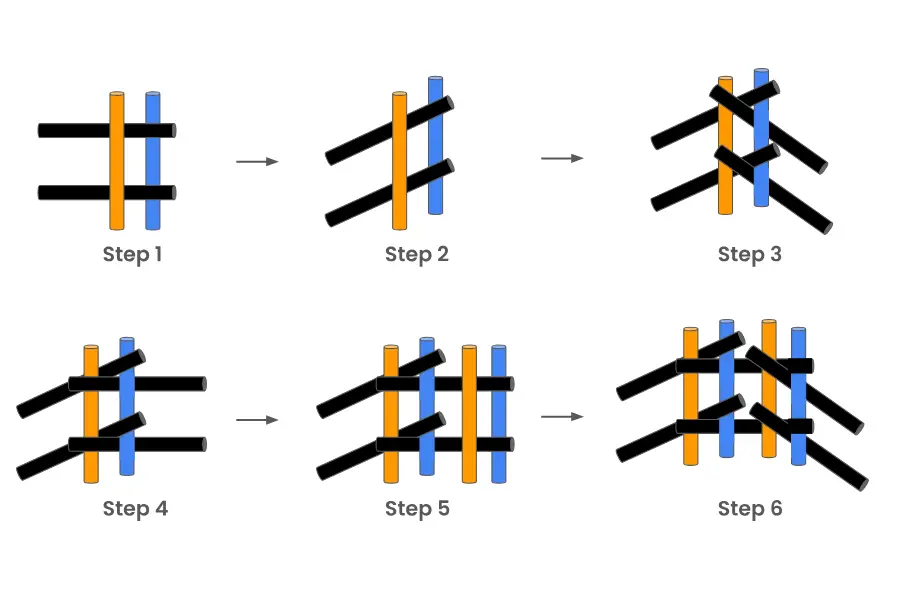
If you're following da Vinci bridge step-by-step instructions, you'll typically begin by laying the central cross-members, then weave the outer beams over and under them in a specific sequence. The exact order matters. Assembled incorrectly, the structure falls apart. Assembled correctly, it holds firm even under significant weight.
Structural Principles
The Leonardo da Vinci self-supporting bridge works because of two physical forces: compression and friction.
Compression occurs when the beams press against each other. Each beam is wedged between two others, creating a squeeze that locks it in place. The harder you push down on the bridge, the more the beams squeeze together, and the stronger the structure becomes.
Friction prevents the beams from sliding apart under lateral force. The contact points between beams are large enough that friction — the resistance between two surfaces pressing together — holds everything in alignment.
These are the same forces at work in a stone arch or a barrel vault. Leonardo understood this intuitively, and his da Vinci bridge calculations (though never published in his lifetime) reflect a sophisticated grasp of structural mechanics.
This counterintuitive behavior — where more load means more strength — is the hallmark of a well-designed compressive structure. It's the same reason Roman aqueducts have survived for two thousand years.
The da Vinci bridge is now a popular teaching model in physics and engineering classrooms worldwide. Students build da Vinci bridge models from popsicle sticks or craft sticks to explore structural principles firsthand. The bridge has appeared in science fairs, university engineering programs, and even professional architectural workshops.
Is the da Vinci bridge strong? When built correctly, yes — remarkably so. Some full-scale reconstructions have supported the weight of multiple adults walking across simultaneously.
How to Build A Leonardo Da Vinci Bridge with Popsicle Sticks (DIY Guide)
Fun, Educational, and Hands-On
Building a Da Vinci bridge at home or in the classroom is fun and educational. You can use popsicle sticks, pencils, or even wooden dowels.
Materials you'll need:
Popsicle sticks (about 20–30 or more, depending on your desired length)
A flat surface (like a desk or table)
Patience and a curious spirit!
Da Vinci Bridge Instructions (step-by-step guide)
Step 1: Arrange your base sticks. Place four popsicle sticks on a flat surface, parallel to each other and evenly spaced. In your guide, these are shown with the orange side up and the blue side down to help visualize orientation.
Step 2: Lift the base. Gently lift the parallel sticks slightly off the surface. This begins creating the arch shape and allows weaving to start smoothly.
Step 3: Insert two cross sticks. From the right side, weave two black popsicle sticks through the lifted structure. These sticks secure the base together and form the first layer of crossing.
Step 4: Lift again. Carefully lift the structure higher to create space and tension for the next set of sticks. This helps stabilize the early framework.
Step 5: Add two more parallel sticks. Place two additional popsicle sticks on top, parallel to the original base sticks, with the same orange side up and blue side down. This starts creating the layered arch.
Step 6: Weave in two more cross sticks. From the right side again, insert two more black sticks, weaving them through the new parallel sticks. By this point, the structure should start to hold itself — this is the self-supporting stage.
Repeat and extend. Repeat Steps 5 and 6 as many times as you'd like to extend the bridge. Each additional layer makes it longer and stronger.
Test and fine-tune. Once your bridge stands on its own, carefully test it by placing small objects on top. Watch how the forces are distributed and adjust if needed. Try different lengths or angles to explore how the design changes.
Tips:
Use smooth, sturdy sticks for better stability and easier weaving.
Move slowly and gently when lifting or weaving to avoid collapse.
Challenge yourself by using pencils, chopsticks, or dowels for a different style!
The most direct way to encounter the da Vinci bridge in real life is through the science and technology museums that hold reconstructions based on Leonardo's original sketches.
The Museo Nazionale della Scienza e della Tecnologia Leonardo da Vinci in Milan is the definitive destination. It holds the world's largest collection of wooden models based on Leonardo's designs, many of which were constructed directly from the Codex Atlanticus. The bridge model is displayed alongside dozens of other machines — flying devices, hydraulic systems, military equipment — in a way that allows visitors to understand Leonardo's engineering thinking as a whole.
The museum is housed in a 16th-century monastery in Milan's Sant'Ambrogio district, which adds a genuinely Renaissance atmosphere to the visit. Wandering through the long wooden galleries, surrounded by reconstructed machines, is unlike any other museum experience in Italy.
In Florence, the Museo Galileo and the broader network of science-focused cultural spaces also explore Renaissance engineering, though the Milan museum remains the gold standard for Leonardo's mechanical designs.
Modern Reconstructions
One of the most celebrated real-world tests of Leonardo da Vinci's self-supporting bridge took place in 2019, when researchers at MIT conducted a detailed structural analysis and built a full-scale replica. Their findings confirmed that the design would have worked exactly as Leonardo intended — stable, load-bearing, and deployable without tools.
In Norway, a permanent bridge inspired by Leonardo's original golden horn bridge concept (a proposal he made to Sultan Bayezid II of the Ottoman Empire in 1502) was built near Oslo in 2001. The Leonardo Bridge in Ås, designed by artist Vebjørn Sand, spans a pedestrian path and demonstrates how a 500-year-old concept can translate into a fully functional modern structure.
Leonardo had originally proposed this bridge as a span across the Golden Horn inlet in Istanbul — one of the longest bridges of the ancient world, had it been built. The Ottoman sultan declined, and the design remained on paper for five centuries.
Visitor Experience and City Context
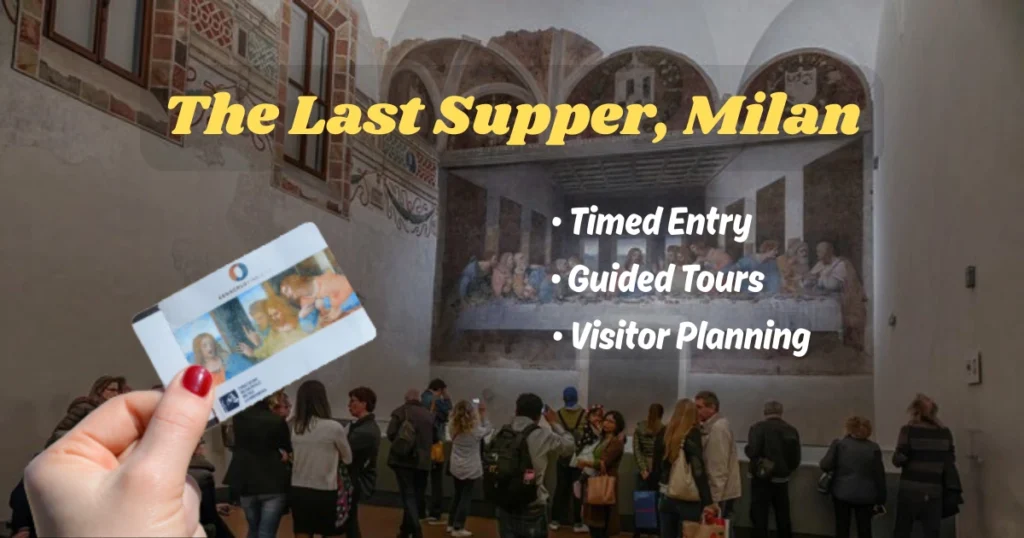
Visiting Milan to see da Vinci bridge models and related engineering exhibits fits naturally into a broader Leonardo itinerary. The city holds the most concentrated collection of Leonardo's work anywhere in the world — including The Last Supper fresco at Santa Maria delle Grazie, which requires advance booking, and the Codex Atlanticus itself at the Biblioteca Ambrosiana.
A visit to the science museum typically takes two to three hours. The Leonardo collection alone is extensive, but the wider museum — which covers Italian scientific history from the Renaissance to the Space Age — rewards a longer visit.
Milan is also an excellent base for day trips to other Leonardo-connected sites in Lombardy, including Vigevano (where Leonardo designed urban improvements for Ludovico Sforza) and the Navigli canal district, where Leonardo contributed to hydraulic engineering.
Many visitors choose an entrance-only ticket for flexibility, while others prefer a guided tour for deeper historical context. If you're traveling with a particular interest in Leonardo's engineering work, a specialist-guided visit can make the connections between his drawings and the physical models far more vivid.
See the Codex Atlanticus
Step inside the Biblioteca Ambrosiana to see rotating sheets from Leonardo’s largest surviving notebook and explore its historic art collection.
Milan is the city most deeply connected to Leonardo's working life. He spent nearly twenty years here under the patronage of Ludovico Sforza, producing some of his greatest paintings, engineering projects, and scientific notebooks. The da Vinci bridge concept, the canal systems, the equestrian monument, and The Last Supper all belong to this Milanese period.
Walking through Milan with Leonardo in mind is a genuinely different experience from a standard city tour. The science museum, the refectory at Santa Maria delle Grazie, the Ambrosiana library, and the Castello Sforzesco each hold a different piece of his legacy — and together they sketch the full portrait of a mind that could move between painting, architecture, hydraulics, and military engineering without ever losing its curiosity.
For further reading on Leonardo's world, explore our guides to:
This post is all about the da Vinci bridge — a structure that continues to amaze engineers, educators, and cultural travelers five centuries after Leonardo sketched it in a notebook. What makes it endure isn't just its cleverness. It's the proof it offers that genuine creative thinking can solve problems in ways that conventional thinking never would.
Leonardo didn't invent the arch, the beam, or friction. But he combined them in a way that had never been done before — producing something portable, elegant, and powerful. That combination is the essence of Renaissance innovation. It's also why his notebooks feel so startlingly modern when you read them today.
If you ever have the chance to stand in front of a full-scale reconstruction — or even to build a small model yourself from popsicle sticks — take it. There's a moment, when the last beam locks into place and the whole structure suddenly becomes rigid and stable, when you understand exactly what Leonardo understood. It's not just engineering. It's an idea about how things can support one another.
FAQs about the da Vinci Bridge
How does the Da Vinci bridge work?
The da Vinci bridge works through a system of interlocking wooden beams that hold each other in place using compression, gravity, and friction. As weight is applied, the beams press together more tightly, creating a stable, self-supporting structure without nails or ropes.
What is the story behind Da Vinci's bridge?
Leonardo da Vinci designed his self-supporting bridge while working as a military engineer, likely under Cesare Borgia. The bridge was intended to be quickly assembled and dismantled, allowing armies to cross rivers efficiently and remove the structure to prevent pursuit.
Is the Da Vinci bridge strong?
Yes, the da Vinci bridge is surprisingly strong because its design distributes weight evenly across all beams. In fact, the structure often becomes more stable as additional weight is applied, since the forces increase the locking effect between the pieces.
How much weight can a Da Vinci bridge hold?
The exact weight a da Vinci bridge can hold depends on its size and materials, but experiments and models show it can support significant loads relative to its scale. Even simple classroom models can hold heavy objects, while engineered versions have demonstrated the ability to support structural loads effectively.
What is the physics behind the Da Vinci bridge?
The bridge relies on key physics principles such as compression, tension, and friction. Each beam transfers force to the next, creating a chain of balanced forces that stabilize the structure. The geometry ensures that loads are distributed evenly, preventing collapse.
What are the principles of the Leonardo da Vinci bridge?
The main principles behind the da Vinci bridge are self-supporting geometry, interlocking design, and load distribution. The beams form a “self-locking” system where each piece depends on the others, allowing the bridge to stand without fasteners while remaining portable and scalable.
Leonardo da Vinci Catapult is an intriguing invention. Its design stands out for combining artistic creativity with scientific precision. The catapult featured a leaf-spring system and a rotating drum mechanism, enhancing the power and efficiency of traditional catapults.
Leonardo da Vinci's innovative approach to warfare and defense fascinates those who are curious about the future applications and impacts of his catapult.
His designs significantly influenced military technology and made notable contributions to the broader engineering field. The Leonardo da Vinci Catapult enables visitors to delve more deeply into these revolutionary concepts.
This invention is a testament to da Vinci’s forward-thinking mindset, reflecting his unique perspective on the relationship between form and function.
Studying his improvements to this device reveals the extensive knowledge and creativity he applied to his work.
Historical Context of Leonardo da Vinci's Inventions
Leonardo da Vinci, a renowned figure of the Renaissance, made significant contributions to science and engineering. His inventions, such as the Leonardo da Vinci Catapult, reflect the era's interest in military advancements and innovation.
The Renaissance and Militaristic Inventions
Europe experienced a surge in cultural, scientific, and technological progress during the Renaissance. This period was characterized by a renewed interest in classical knowledge and a desire to innovate. Military technology also saw significant advancements during this time.
Ancient Greek catapults had been used for centuries, but their designs evolved over time. Leonardo da Vinci, intrigued by these ancient mechanical devices, developed his version.
The Leonardo da Vinci Catapult improved upon previous designs by incorporating innovative features that increased its power and range.
Military engineering was critical during the Renaissance, as conflicts and territorial expansions were rampant. Da Vinci's work stood out because he combined artistic skill with practical engineering, resulting in sophisticated designs ahead of their time.
Extensively studied catapult models provide insight into his genius and the technological capabilities of the period.
Leonardo's Role as an Inventor and Engineer
Leonardo da Vinci’s role extended beyond that of an artist. He was also a visionary engineer and inventor. He applied his understanding of mechanics and physics to create artistic and functional designs.
Da Vinci's inventive genius is evident in designs like the armored vehicle and the Leonardo da Vinci Catapult. Though many of his inventions were not built during his lifetime, they influenced later engineering developments. Leonardo’s notebooks reveal detailed sketches and ideas that often blended creativity with scientific exploration.
His ability to envision machines like the catapult, which he designed to meet the needs of his time, underscores his impact. Leonardo’s legacy as an engineer has left an indelible mark on technological advancements, inspiring generations of inventors.
Design and Mechanics of the Catapult
Leonardo da Vinci's catapult showcases his ingenuity in reimagining medieval catapult design, achieving greater efficiency and power. By studying existing mechanics, he aimed to enhance projectile launching by exploring innovative materials and mechanisms.
Conceptual Drawings and Notes
Leonardo da Vinci created detailed sketches and notes demonstrating his visionary approach to catapult design. Although his catapult was not an entirely new invention, he sought to refine existing concepts through thoughtful adjustments. One of his designs included a double-leaf spring mechanism, allowing increased tension and power.
His sketches were precision-oriented, accounting for force vectors and projectile trajectories. Careful calculations ensured stability and balance, which is vital for an effective launch. Although his designs were not built during his lifetime, they offer insight into his mechanical brilliance and forward-thinking approach.
Mechanical Principles and Operation
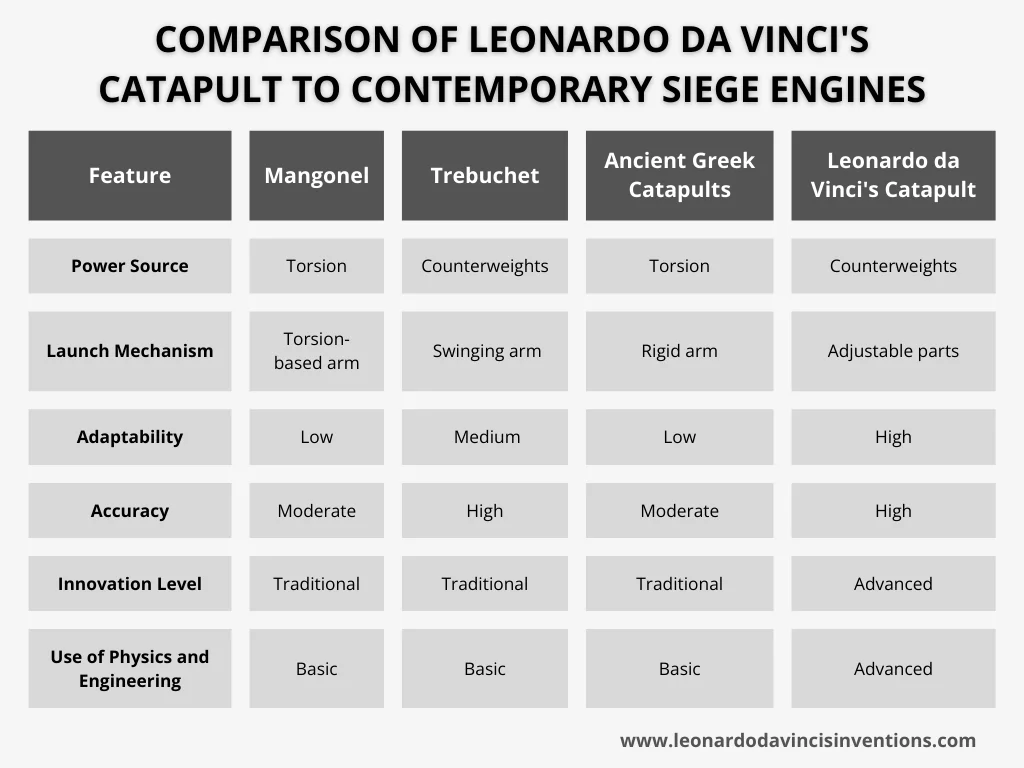
Leonardo da Vinci's catapult's core mechanics revolved around tension and torque to enhance the launching force. Unlike traditional torsion-based catapults, it utilized a spring leaf mechanism. This adjustment enabled more controlled and powerful launches, thereby increasing the range and impact of projectiles.
Leonardo also focused on improving the loading and firing mechanism, aiming to simplify the process and make it more efficient for potential wartime use.
His understanding of torque and tension motivated this enhancement, ensuring each component worked symmetrically. As a result, da Vinci's catapult demonstrated artistic prowess and a sophisticated understanding of engineering principles.
Construction and Materials
Leonardo da Vinci's catapult showcases the innovative use of materials and construction techniques. Its design reflects a blend of wood and rope preferences, and its unique approach to tension and counterweight systems enhanced its efficiency as a war machine.
Wood and Rope Preferences
Leonardo da Vinci's catapult relied on carefully selected wood and rope, both vital to its functionality. Hardwoods like oak were preferred for their durability and strength, which is essential for withstanding the stress of launching projectiles. Softwoods, despite being lighter, were less common in such applications.
Ropes made from natural fibers, such as hemp, were both flexible and strong. Hemp's elasticity was crucial for efficiently absorbing and releasing energy during the firing process. The combination of hardwood for structural components and hemp for tension elements ensured a balance between strength and flexibility, thereby maximizing the power and range of the projectiles.
Tension and Counterweight Systems
Leonardo da Vinci's approach to tension-and-counterweight systems in his catapult design was distinctive. These mechanisms were crucial for the catapult's ability to launch projectiles.
By optimizing the tension in the ropes and employing counterweights, the da Vinci catapult could achieve significant force and distance.
Tension was carefully adjusted by winding ropes, a method derived from earlier torsion-based catapults, such as the ancient Greek models. This tension-powered mechanism enabled controlled, precise releases, while counterweights provided the necessary balance to maintain stability during operation.
This integrated system of tension and counterweights exemplifies Leonardo da Vinci's ingenuity. He combined ancient catapult principles with his inventive enhancements, and this thoughtful design and construction enabled his catapult to perform effectively as a formidable weapon.
Leonardo da Vinci's Influence on Warfare
Leonardo da Vinci's innovative designs transformed the landscape of military technology. His work on war machinery, such as the da Vinci catapult, provided fresh insights into the capabilities and mechanisms of siege engines.
Comparison to Contemporary Siege Engines
Impact on Military Engineering
Leonardo da Vinci's contributions extended beyond weaponry, influencing the broader field of military engineering. His sketches, which included detailed mechanisms and structural designs, inspired future generations to explore new engineering possibilities.
The da Vinci catapult showcased how art and science could converge to improve military technology. His emphasis on precision and efficiency paved the way for modern engineering strategies used in warfare.
By balancing practicality with creativity, da Vinci's inventions encouraged a shift from brute force to more calculated, efficient methods of attack, altering the course of military strategy development. His work on siege engines remains a testament to his profound impact on military design and engineering.
Exploring the Evolution of Catapults Throughout History
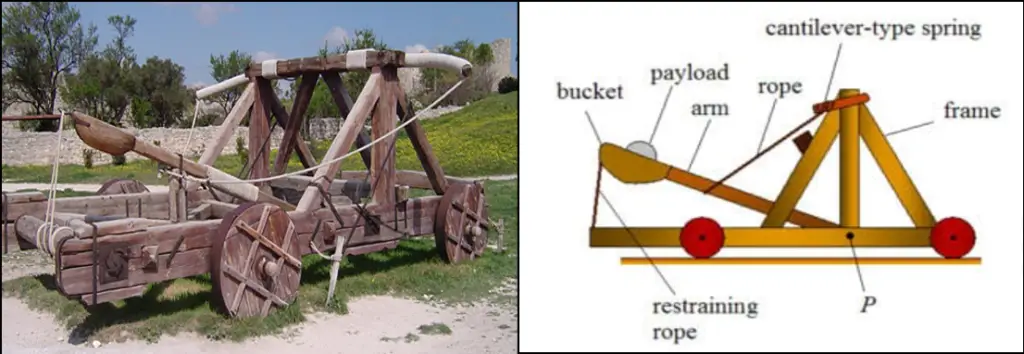
Mangonel Catapult - The First Known Catapults
The question of who invented the catapult takes us back to the ancient world. The first known catapults were developed in ancient Greece in the 4th century BC, specifically by a Syracuse engineer named Dionysius the Elder.
Unlike the da Vinci catapult, these early devices relied on torsion power from twisted ropes or sinew rather than tension or counterweights. This type of catapult, also known as a mangonel catapult, used the stored energy in the twisted ropes to hurl projectiles toward the enemy.
Mangonel Catapult
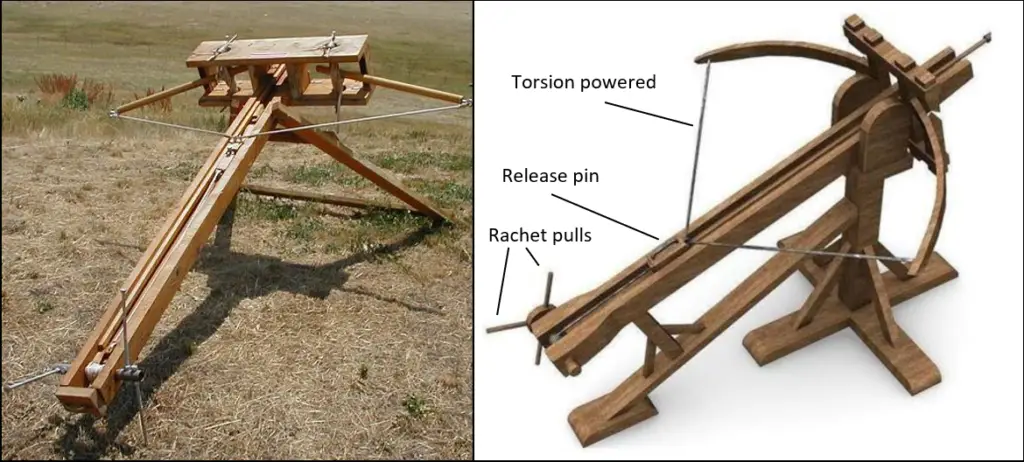
Ballista Catapult
As centuries passed, the design blueprints of catapults underwent significant changes. Greek and Roman engineers refined and diversified catapult designs, introducing new mechanisms like the ballista and onager.
It's fascinating to compare these classical designs with the more sophisticated da Vinci catapult, a testament to the evolution of engineering over the millennia.
Ballista Catapult
In East Asia, the Mongols advanced catapult technology by developing the Mongolian catapult, also known as theHwacha. This innovation could fire multiple projectiles at once, a stark contrast to the single-projectile designs common in the West.
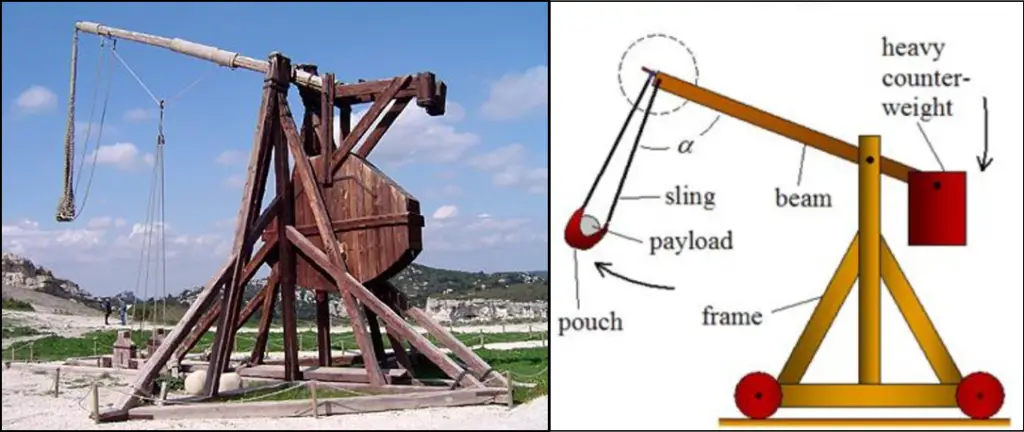
Trebuchet Catapult
Catapult technology saw another shift during the Middle Ages. The most prominent type of catapult used during this period was the trebuchet. This siege weapon used a counterweight mechanism, unlike the da Vinci catapult's tension-based design.
Trebuchet Catapult
Trebuchets were the pinnacle of medieval siege technology, capable of hurling large projectiles over long distances. The introduction of counterweight technology marked a significant departure from the ancient torsion catapult design, leading to more powerful and efficient siege engines.
Despite the differences in design and the centuries that separate them, the trebuchet and Leonardo da Vinci's catapult share a common purpose: to utilize mechanical advantage to achieve power and precision beyond human capabilities.
Facts and Curiosities
5 Fun Facts About Catapults
Here are five fun facts about catapults that might surprise you:
The Greek engineer Dionysius invented the catapult in 399 BC.
'catapult' comes from the Greek words 'kata,' meaning 'downwards,' and 'paleo,' meaning 'to toss.'
During the Middle Ages, some catapults launched diseased animals or corpses over castle walls to spread disease among the enemy. It is a disturbing yet fascinating example of early biological warfare.
The most enormous catapult ever recorded in history was built by Edward I of England during the siege of Stirling Castle in 1304. It was named 'Warwolf'.
Today, a catapult is used for a variety of purposes, ranging from launching aircraft from aircraft carriers and pitching baseballs to launching lifeboats.
Da Vinci's Catapult: 4 Lesser-Known Facts
There are 4 Leonardo da Vinci catapult facts that might not be commonly known:
Leonardo da Vinci's catapult design was more sophisticated and powerful than those used at the time. It was designed for accuracy, not just power.
Da Vinci's design used a spring-like tension mechanism, unlike the torsion-based catapults of the ancient world.
There's no record that da Vinci's design was ever built during his lifetime. It existed only as sketches in his notebook until modern enthusiasts brought it to life.
In Italian, the word 'catapulta' is sometimes used to refer to Leonardo da Vinci's catapulta.
Modern-Day Uses of Catapults
In contrast to their original role as siege engines, catapults are used in modern times for a remarkably diverse range of purposes. The physics principles that catapults employ have found applications in various modern technologies:
The aviation industry catapults planes from aircraft carriers, enabling them to take off quickly.
The entertainment industry utilizes various forms of special effects, ranging from amusement park rides to film and stage effects.
Sports equipment, such as baseball pitching machines, employs a catapult mechanism.
Aircraft Catapult in an Aircraft Carrier
Modern Replications and Educational Projects
Modern efforts to recreate Leonardo da Vinci's catapult bridge the past and the present. These reconstructions offer practical insights into historical siege technologies and engaging educational experiences for learners.
Reconstruction Attempts
Enthusiasts and historians today are captivated by the task of bringing da Vinci's catapult to life. They aim to precisely replicate da Vinci's intricate designs using advanced techniques such as 3D printing and laser cutting. Instructables provides step-by-step instructions for constructing these models, making them accessible to hobbyists and educators.
These projects highlight da Vinci's work's elegance while showcasing improvements in design and function over traditional catapult weapon systems. These reconstructions show a clear link between ancient engineering concepts and modern manufacturing capabilities.
Learning Tools in Science and History
Da Vinci catapult replicas serve as valuable educational tools, bringing to life the history of catapults and connecting students with ancient technologies and the evolution of military strategies.
Schools and museums often use these models to teach physics and engineering principles. Through hands-on interaction, tension, force, and trajectory become tangible.
For children and students, working with these replicas fosters curiosity. Educational resources, such as those found on Teaching Expertise, provide activities that nurture creative thinking by marrying historical context with scientific understanding. This makes learning about the catapult's ancient Greek origins and its application in warfare both entertaining and informative.
Final Thoughts
Leonardo da Vinci's catapult is a testament to his endless curiosity and genius. His variations on the traditional catapult design showed his willingness to rethink and improve upon existing technologies.
These improvements highlighted his interest in mechanics and physics, which were ahead of their time.
Leonardo explored various concepts, including the use of leaf springs to enhance throwing power.
These sketches demonstrated his understanding of torque and tension forces, paving the way for more dynamic catapult designs.
Though da Vinci’s catapult designs were not widely adopted during his lifetime, they contributed to technological progress and revealed his innovative spirit.
This aspect of his work reflects his approach to numerous inventions, where creativity and science intersect.
Key Takeaways:
Leonardo da Vinci's catapult was not just functional but also displayed an innovative application of mechanical principles.
His relentless pursuit of improvement is evident in his approach to designing the catapult.
Leonardo's fusion of art and science continues to inspire modern engineering and design, offering insights that remain relevant today.
FAQs about Leonardo da Vinci Catapult
Did Leonardo da Vinci invent the catapult?
No, Leonardo da Vinci did not invent the catapult, as it had already existed since ancient times. Instead, he redesigned and improved catapult mechanisms, introducing innovations like spring-based systems and rotating drums to increase power and efficiency.
Who invented the first catapult?
The earliest catapults were developed in the ancient world, particularly in Greece and possibly earlier in the Near East, with records dating back to at least the 7th century BC. These early machines used stored energy (tension or torsion) to launch projectiles.
What is Da Vinci's most famous invention?
Leonardo da Vinci is best known for conceptual inventions such as the aerial screw (an early helicopter), the armored vehicle (a tank), and the giant crossbow. While many were never built, they showcased advanced engineering ideas far ahead of their time.
Did Da Vinci invent the trebuchet?
No, Leonardo da Vinci did not invent the trebuchet. This powerful siege engine originated earlier, likely in ancient China and later in medieval Europe. Leonardo studied and redesigned similar machines, but did not originate the concept.
Who was the first to use a catapult?
Catapults were first used in ancient warfare, particularly by early civilizations such as the Greeks and peoples of the Near East. Historical records also show their use in ancient Jerusalem, where machines launched large stones at enemies.
What are the 4 types of catapults?
Four common types of catapults are the ballista, mangonel, trebuchet, and spring-powered catapult. Each uses different mechanisms—such as torsion, counterweight, or tension—to launch projectiles with varying power and range.
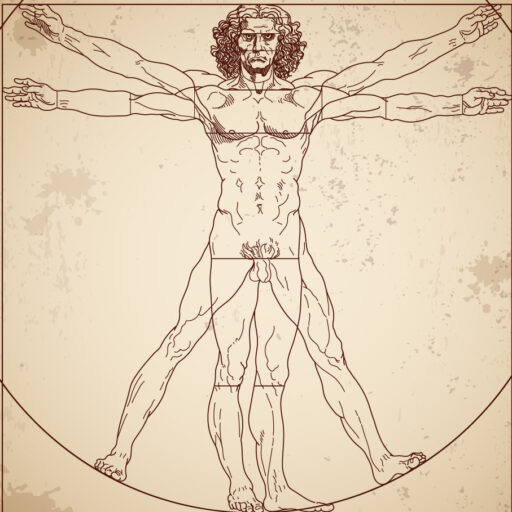
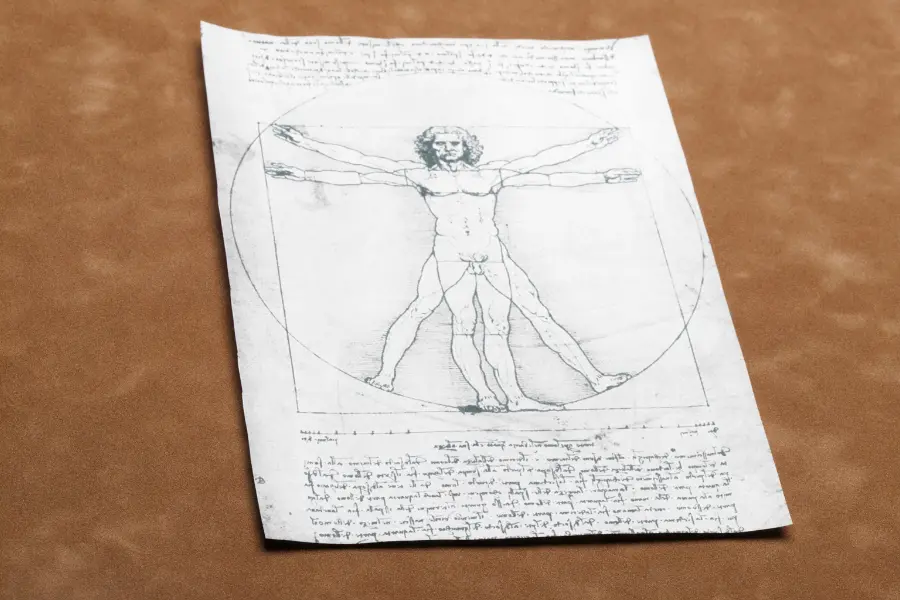
The Vitruvian Man drawing is one of Leonardo da Vinci's most iconic works. It represents the perfect blend of art and science.
This masterpiece showcases the ideal human proportions, as inspired by the writings of the ancient Roman architect Vitruvius.
It stands as a symbol of the Renaissance's dedication to exploring humanity's connection with the universe.
Exploring this drawing offers insights into Leonardo's harmonious vision of geometry, anatomy, and symmetry.
You can marvel at how the male figure fits perfectly within a circle and a square, representing the harmony between humans and nature. Leonardo's work continues to fascinate people with its blend of meticulous observation and philosophical inquiry.
Those seeking to understand the drawing's significance must be aware of how Vitruvius' ideas on architecture and the human body influenced Leonardo's exploration of these themes.
The Vitruvian Man is a fundamental study of the balance between art and anatomical science. It captures the essence of the Renaissance quest for knowledge and understanding.
Vitruvian Man Drawing: Historical Context
Leonardo da Vinci's drawing of the Vitruvian Man is a remarkable blend of art and science. It captures human proportions with mathematical precision and artistic mastery.
Two key influences shaped this iconic artwork: da Vinci's Renaissance environment and the teachings of the ancient Roman architect Vitruvius.
Leonardo da Vinci's Era
Europe experienced a revival of art, science, and culture during the Renaissance. Leonardo da Vinci epitomized this era's spirit of discovery.
He combined artistic skill with scientific inquiry, as seen in the Vitruvian Man drawing.
This period sparked a profound interest in human anatomy, which led Da Vinci to explore the human form with unmatched detail.
Influential thinkers and artists of his time shared knowledge, fostering interdisciplinary studies.
This cultural environment significantly impacted da Vinci's approach to his work, which combined the visual arts with empirical study.
His innovative methods offered a new perspective on art and its connection to science.
Influence of Vitruvius
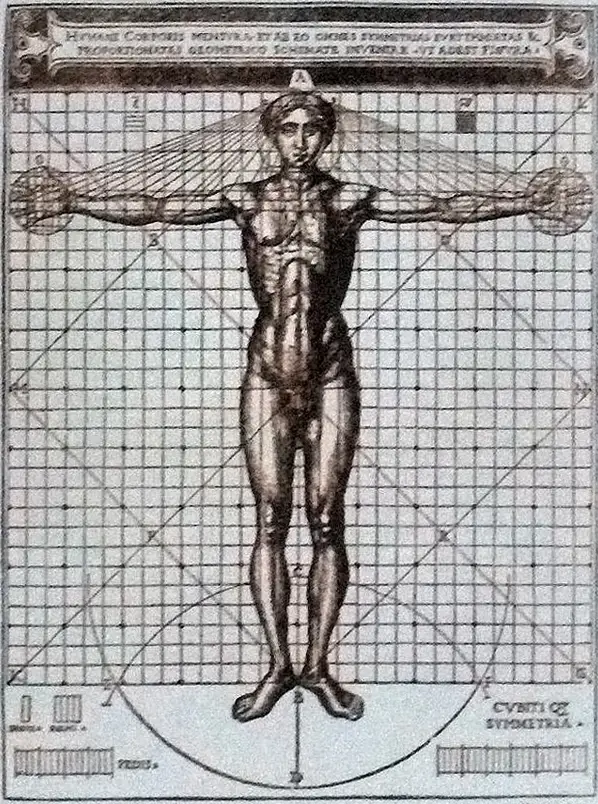
The Vitruvian Man by Vitruvius
An ancient Roman architect, Vitruvius outlined principles of architecture and proportion that inspired da Vinci. His writings emphasized harmony between human dimensions and architecture.
Da Vinci applied these concepts to human anatomy in his drawing, illustrating the ideal proportions of the human body.
This influence is evident in the geometric forms of the Vitruvian Man drawing, where the human figure aligns with a circle and a square.
This representation showcases Vitruvius' belief in symmetry and brings a philosophical dimension to da Vinci’s creation.
The combination of Vitruvius’ ideas with Leonardo’s artistry highlights the drawing's significance as a fusion of art and science.
Analysis of the Artwork
The Vitruvian Man by Leonardo da Vinci is a remarkable representation of the blend between art and science. This illustration employs geometric forms to connect the human body with the universe, revealing profound insights into Renaissance ideals.
Iconography
The iconography of the Vitruvian Man showcases da Vinci's engagement with proportion and symmetry.
This drawing perfectly fuses the principles of ancient Roman architect Vitruvius withRenaissance ideals.
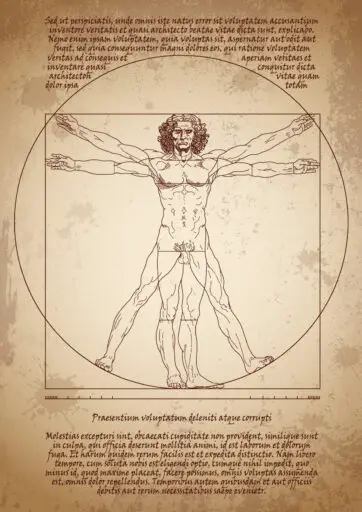
It features a male figure in two superimposed positions with arms and legs apart, inscribed in a circle and a square.
This Vitruvian Man artwork becomes a potent symbol of harmony in mathematics and the universe, capturing the humanist belief that humans mirror the larger cosmos.
He achieves balance and harmony within the drawing by using precise geometric shapes.
The two positions of the figure inside the circle and square create a dynamic visual design.
The meticulous placement of the limbs demonstrates da Vinci's attention to detail and indicates his understanding of human anatomy and mathematical precision.
This piece's composition makes it an enduring example of the intersection of science and art during the Renaissance era.
Proportions
The proportions in the Vitruvian Man drawing reflect da Vinci’s exploration of thehuman form's mathematical dimensions.
The figure's outstretched limbs fit perfectly within the circle and square, representing ideal human proportions.
According to Britannica, the drawing underscores the notion that the body and these shapes have a precise geometric correspondence, symbolizing physical and cosmic harmony.
Scientific Significance
The Vitruvian Man by Leonardo da Vinci is more than an artwork; it represents the blend of art and science.
It reflects Leonardo da Vinci's mastery of anatomy and his fascination with geometry and proportion.
Anatomical Accuracy
Da Vinci's Vitruvian Man drawing showcases remarkable anatomical accuracy.
At a time when the human body was often misunderstood, this drawing highlighted a detailed understanding of human anatomy.
Leonardo studied cadavers, gaining insights into muscles, bones, and skin.
The Vitruvian Man demonstrates this scientific exploration, showing how the body's parts fit together harmoniously.
His ability to combine art with detailed anatomical study set a new standard for realistic human representation, influencing artists beyond the Renaissance.
Geometry and Symmetry
Geometry plays a crucial role in the Vitruvian Man artwork.
Da Vinci aligned the figure within a square and a circle, representing geometric symmetry, which was central to Renaissance art.
Vitruvian Man geometry illustrates the connection between human proportions and architectural principles.
This combination highlights the belief that humans reflect the universe's structure.
It emphasizes symmetry as an ideal in art and architecture.
By doing so, Leonardo illustrates the beauty and mathematical logic inherent in nature and design.
The Golden Ratio
The concept of the Golden Ratio is evident in the proportions of the Vitruvian Man.
This mathematical principle suggests a harmoniously pleasing ratio found in nature.
Leonardo's portrayal aligns with the Golden Ratio, linking the human body to universal design principles.
The Vitruvian Man proportions illustrate how different body parts relate to one another numerically.
This drawing serves as a visual definition of mathematical beauty, merging art, mathematics, and nature.
Through this, Leonardo demonstrated how art and science are not separate but deeply interconnected disciplines.
Cultural Impact
Leonardo da Vinci's drawing of the Vitruvian Man has left a lasting mark onRenaissance and modern cultures. This iconic artwork symbolizes the blend of art and science and has inspired various interpretations over the centuries.
Renaissance Influence
During the Renaissance, the Vitruvian Man artwork embodied the era's fascination with human anatomy and proportions.
Artists and scholars admired how Da Vinci combined scientific accuracy with artistic expression.
The drawing'sgolden ratio and geometric patterns mirrored the Renaissance pursuit of perfection.
Many artists of the time were motivated by this work to explore similar themes.
Leonardo aimed to capture the harmony between the human body and the universe by depicting a man with perfect proportions.
Thus, the drawing symbolized the Renaissance's focus on the ideal human.
Contemporary Interpretations
In modern times, the Vitruvian Man's meaning has evolved beyond its initial artistic and scientific context.
Today, it represents concepts of balance and symmetry in various fields, including architecture and design.
Artists and creators continue to reinterpret this drawing, seeing it as a model of human potential and exploration.
In popular culture, the Vitruvian Man image is often used to illustrate the intersection of art, science, and philosophy.
Its iconic nature makes the drawing a recognizable reference in modern media, highlighting its timeless significance and enduring relevance.
Preservation and Conservation
The Vitruvian Man drawing requires careful handling to ensure its longevity. Due to its delicate nature, experts store it in a controlled environment.
Controlled light and temperature levels help prevent damage to its fragile ink and paper.
To protect this iconic work of art, the Vitruvian Man, it is rarely displayed in public. When shown, it is generally under strict supervision, using protective barriers to minimize exposure. Preventing any direct contact is crucial for most cultural institutions.
Storage Guidelines:
Temperature: 18-22°C
Humidity: 40-50%
Lighting: Low UV-emitting sources
These measures are crucial for preserving the quality and longevity of Leonardo da Vinci's Vitruvian Man. The balance between public display and conservation is always a challenge for curators.
Reproductions and digital formats allow people to appreciate the Vitruvian Man image without risking the original. This approach supports education and preservation, ensuring the drawing remains part of cultural discussions about the Vitruvian Man proportions.
Institutions focus on educational efforts to explain what the Vitruvian Man means and its importance in artand science. Public access doesn't have to come at the expense of the drawing's integrity, ensuring that future generations can learn from this masterful work.
Exhibition History
Gallerie dell'Accademia in Venice, Italy
Leonardo da Vinci's Vitruvian Man drawing is a masterpiece often cited for its depiction of ideal human proportions. Though the artwork is renowned, its exhibition history has been selective due to its delicate nature.
Notable Displays
One of the most significant exhibitions of the Vitruvian Man was held at the Louvre in 2019, marking the 500th anniversary of Leonardo da Vinci's death.
Although typically kept out of public view due to its fragile condition, the Gallerie dell'Accademia in Venice lent the drawing. Previously, the Vitruvian Man had been displayed infrequently, underscoring its status as a rare yet treasured work in art history. Each exhibition offers a unique opportunity forart enthusiaststo appreciate the intricacies of da Vinci’s work.
Public Accessibility
The Vitruvian Man is generally kept out of public view to ensure its preservation. It is part of the collection at the Gallerie dell'Accademia in Venice, where it is carefully protected.
Because of its condition, the artwork is not included in regular exhibitions. Art lovers and scholars often rely on reproductions and analyses to study its proportions and meanings.
On rare display, it attractssignificant public attention, demonstrating its enduring fascination and importance in understanding Renaissance art and human anatomy.
Where Leonardo’s Renaissance Vision Can Be Experienced
The Vitruvian Man is preserved in Venice, but its intellectual roots trace back to Florence’s artistic workshops and Milan’s courts. Visiting these Italian cities reveals how Leonardo’s anatomical studies, artistic practice, and Renaissance environment shaped this iconic drawing.
Explore Leonardo’s Renaissance World in Context
The Vitruvian Man becomes more meaningful when placed within the cities where Leonardo studied anatomy, geometry, and classical texts. The Leonardo Travel Hub offers a city-by-city guide to Florence, Milan, Venice, and beyond—showing how his artistic and scientific legacy can be experienced today.
Optional experiences • No extra cost • Supports this site
Legal and Ethical Considerations
The Vitruvian Man drawing, a renowned work by Leonardo da Vinci, has sparked numerous legal and ethical debates, ranging from ownership claims to discussions of commercial rights.
Ownership Disputes
Ownership disputes over the Vitruvian Man drawing often center on national heritage laws and regulations. Italy has strict rules in place to preserve its cultural heritage. It considers such art national treasures, making it difficult for private entities to assert ownership claims.
These laws have sparked debates on whether artworks in public collections can be sold on the market. The Vitruvian Man ishoused in the Galleria dell'Accademia di Venezia, under Italy's robust cultural protection. This protection elevates the artwork’s status, complicating ownership-related legal battles.
Image Rights
The question of who controls the image rights of the Vitruvian Man artwork presents another legal challenge. Although Leonardo da Vinci died in 1519, making the image public domain under European laws, Italy implemented additional restrictions.
For example, using the Vitruvian Man image for commercial purposes requires permission and may incur fees.
Laws like these reflect a broader trend of governments influencing historical art. This regulation impacts everything from educational uses to commercial marketing.
Enforcement of these laws helps generate revenue for public institutions and preserves the integrity of the drawing. Legal professionals and artists must stay informed about these evolving rights to navigate the effective use of such iconic images.
Technical Studies
Leonardo da Vinci's Vitruvian Man drawing showcases impressivetechnical skills. Understanding the materials and how the artwork has been preserved is essential to appreciating its lasting significance.
Materials and Techniques
Leonardo da Vinci created the Vitruvian Man drawing in the late 15th century using a metal point, pen, and ink, as well as watercolor on paper.
The different media enabled precise lines and detailed shading, highlighting his mastery of both art and science.
He aimed to accurately capture human proportions, inspired by the ideas of the ancient Roman architect Vitruvius.
Leonardo's detailed study of the human body involved dissecting numerous corpses, which gave him the knowledge to illustrate the perfect proportions described by Vitruvius.
This dedication to precision and scientific inquiry makes this artwork remarkable within Renaissance art.
Condition Over Time
Over the centuries, the Vitruvian Man has faced challenges in preservation. Due to its age, the paper is delicate, and exposure to light can cause further deterioration.
Institutions must carefully manage their exposure to prevent damage.
While innovative, the skilled use of metalpoint and watercolor contributes to the drawing's fragility.
Art historians and conservationists take extraordinary measures to ensure its long-term preservation.
For instance, the drawing is usually kept in controlled environments to minimize exposure and maintain its condition.
The Vitruvian Man's status as a vital piece of art history requires ongoing efforts to preserve its integrity. This will allow future generations to explore its mathematical and artistic significance,as da Vinci understood.
Influence on Modern Art
The Vitruvian Man, a famed drawing by Leonardo da Vinci, significantly impacted modern art by highlighting the connection between art and science. This drawing has shaped artistic techniques and is used in education to explore proportion and human anatomy.
Artistic Inspirations
The influence of the Vitruvian Man in modern art springs from its unique representation of human proportions.
Artists have drawn inspiration from this iconic image to explore symmetry and balance.
Da Vinci's understanding of geometry and proportion inspired countless artists to integrate these concepts into their creations, resulting in more scientifically informed designs.
Modern artists often reference theVitruvian Man to explore themes of human perfection and the relationship between humans and the universe.
This drawing serves as a cornerstone for understanding proportion, a concept evident in various art forms and installations today.
Educational Use
The Vitruvian Man is essential for understanding human anatomy and proportion in educational settings.
The drawing illustrates ideal human body proportions, which have become helpful to both art students and those studying human biology.
Educational resources often incorporate theVitruvian Man drawing to teach these principles in a straightforward manner.
Art classes analyze drawings to understand their precision, while anatomy lessons use them to juxtapose scientific data with artistic interpretation.
This dual role underscores its significance in laying the groundwork for much of what is taught about human proportions today.
Comparative Analysis
The Vitruvian Man by Leonardo da Vinciis not just a drawing; it holds significant meaning in the history of art and human anatomy. This analysis explores how this piece relates to da Vinci's other works and contrasts with art from the same period.
Similar Works by da Vinci
Leonardo da Vinci often explored human anatomy in his art. The Vitruvian Man drawing is a prime example, showing detailed human body proportions.
This approach is evident in his anatomical sketches, particularly in his studies of the human skull and muscles.
In hisnotebooks, da Vinci combined scientific inquiry with artistry.
He used sketches to illustrate the balance between art and mathematics, echoing themes found in the artwork of the Vitruvian Man. These notebooks reveal da Vinci’s deep interest in the golden ratio, which he applied to his understanding of human proportions.
His painting, The Last Supper, also uses proportion and perspective. Both works demonstrate how da Vinci merged art with science.
The Vitruvian Man not only fits into this category but also serves as a guide on how proportions can define beauty and function.
Contrasts with Contemporary Art
Many artists during da Vinci's time focused on religious themes and symbolic imagery. The Vitruvian Man diverges from this by emphasizing mathematical precision and human anatomy.
While most contemporary art highlighted divine subjects, this piece explored the earthly form of man.
Art from the Renaissance often depicted religious scenes, but da Vinci's work took a different approach. The Vitruvian Man's meaning reflects a shift towards humanism and the study of the natural world.
Artists like Michelangelo also studied anatomy, but da Vinci's work went beyond what was typical at the time.
In contrast, other contemporary artists focused on spiritual or mythical themes. Da Vinci, however, used his observations to understand the human figure through the principles of geometry. This combination of science and art set his work apart, establishing a standard for future generations.
Final Thoughts
The Vitruvian Man drawing remarkably represents the harmony between art and science. Leonardo da Vinci skillfully blends anatomical precision with geometric principles, reflecting his interest in human proportion and symmetry.
This drawing is an artistic endeavor and a study of the human body. It shows the influence of Vitruvius, a Roman architect who believed in the correlation between human form and architectural proportion.
Key Elements:
Proportion: Balancing circles and squares to depict the human figure.
Symmetry: Highlighting harmony in form and function.
Influence: Inspiration drawn from Vitruvius' writings.
The Vitruvian Man is a masterpiece of the Renaissance, serving as a visual tool that bridges various fields, including art, science, and philosophy. Over the years, many scholars have praised its significance.
The Vitruvian Man drawing is an iconic representation of human proportion and the study of geometry. It connects art and science by exploring the human body's symmetry.
What does the Vitruvian Man symbolize?
The Vitruvian Man symbolizes the harmony between human proportions and the universe. Leonardo da Vinci illustrated how the human body reflects the symmetry of the cosmos.
What is the hidden message in the Vitruvian Man?
The hidden message explores the connection between physical realms and divine order. Da Vinci used the drawing to demonstrate the unity of art and science.
What does Vitruvian stand for?
Vitruvian refers to Vitruvius, a Roman author and architect whose principles on ideal human proportions inspired da Vinci's work.
Is the Vitruvian Man theory true?
The Vitruvian Man is based on geometric theories rather than empirical evidence. It is a conceptual illustration of ideal proportions rather than a scientific fact.
What is the math behind the Vitruvian Man?
The drawing embodies mathematical precision. It uses the ratios found in ancient texts to depict ideal human proportions, combining a circle and a square.
What do the words on the Vitruvian Man say?
The text accompanying the drawing refers toVitruvius's ideas on ideal body measurements. Da Vinci's notes provide insights into these ancient guidelines.
What was the original concept of the Vitruvian Man?
Vitruvian Man was conceived to illustrate Vitruvius's principles. It visualized how human anatomy mirrors the universe's structural design.
What does the Vitruvian Man tattoo mean for guys?
A Vitruvian Man tattoo often signifies the wearer's appreciation for the balance between art and science. It represents a pursuit of knowledge and understanding.
What is the meaning of the Vitruvian Woman?
While "Vitruvian Woman" is not a historical artifact, it draws from the same principles of proportion. It is a modern adaptation symbolizing equality in representation.
Why does the Vitruvian Man have 4 arms?
The four arms and legs show different positions of the man's movement. This illustrates the combination of human proportions fitting within a circle and a square.
Disclosure: This page may contain affiliate links. If you choose an experience through them, it helps support the site at no extra cost to you.
Leonardo da Vinci was one of the greatest anatomists of all time. He dissected more than 30 human cadavers, studied every aspect of anatomy and physiology, and documented his findings with unparalleled beauty and clear imagery.
Leonardo studied anatomy to improve his drawings of the human body, but he also brought a scientist’s perspective to the discipline. Da Vinci’s early anatomical studies focused on bones and muscles, but he combined anatomy and physiology from the very beginning. Anatomists in Leonardo’s time often dissected stress-free bodies, such as drunks and tramps, whose bodies were usually male.
Leonardo Bianchi is the founder of Leonardo da Vinci Inventions & Experiences, a cultural travel guide helping visitors explore Leonardo da Vinci’s art, inventions, and legacy across Italy and Paris.
Planning Milan?
See The Last Supper Without Missing the Details
Tickets are limited and visits are short. Start with the Milan guide before choosing your Last Supper experience.
If you're visiting Milan for Leonardo da Vinci, these are the experiences most travelers prioritize first — especially when tickets are limited and time is short.
This site is built for travelers who want more than surface-level sightseeing — helping you plan smarter visits around Leonardo da Vinci’s art, museums, and cities across Italy and Europe.



 Leonardo Bianchi is the founder of Leonardo da Vinci Inventions & Experiences, a cultural travel guide helping visitors explore Leonardo da Vinci’s art, inventions, and legacy across Italy and Paris.