
(Last updated: Sep 2026)
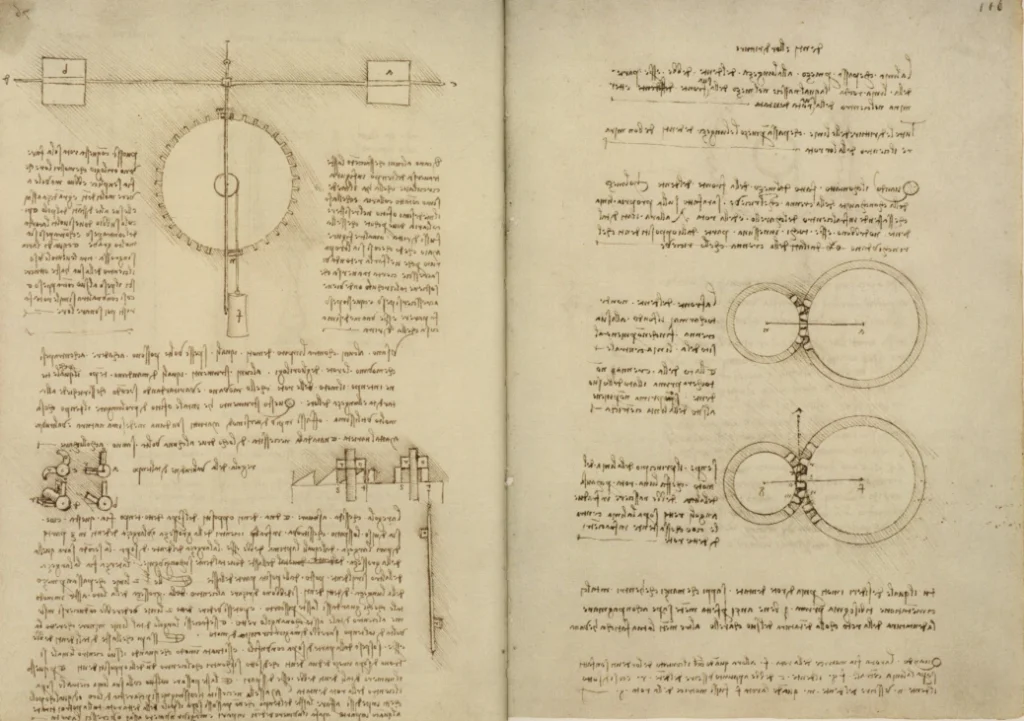
Leonardo da Vinci mirror writing is one of the strangest habits ever left behind by a genius, and once you notice it, you can't stop staring at it. Open almost any page from his notebooks, and the words run the wrong way, tracking from right to left, each letter flipped like a reflection in glass.
It matters because those pages are the closest thing we have to Leonardo's actual thoughts, scribbled in real time between sketches of flying machines, river currents, and human anatomy.
Seeing that handwriting in person, whether on a page at the British Library or projected across a wall in Milan, turns an abstract idea of "genius" into something physical you can stand in front of.
This post is all about Leonardo da Vinci mirror writing: why he did it, what historians actually know, and where you can see his notebooks for yourself.
What is Leonardo da Vinci mirror writing?
Leonardo da Vinci mirror writing is the reversed, right-to-left script Leonardo used in his personal notebooks. Each letter is flipped, so the text only reads normally when held up to a mirror. He used it for thousands of pages of private notes, though he switched to ordinary left-to-right writing for anything meant for other readers.
Historical Background
A Notebook for Every Curiosity
Leonardo never published a single finished book in his lifetime. Instead, he filled loose sheets and bound notebooks with observations on almost everything he encountered: water currents, bird flight, the mechanics of the eye, weapons, and stage machinery for court festivals.
Historians estimate that roughly 7,000 of these pages survive today, out of what may once have been as many as 28,000. They were never meant to be a polished manuscript. They were a working mind, caught mid-thought, which is exactly why the mirror writing feels so personal.
You aren't reading a document written for an audience. You're reading notes Leonardo wrote for no one but himself.
That distinction shapes almost everything about how these pages look. Diagrams crowd the margins. Sentences trail off mid-thought before jumping to an unrelated observation about anatomy or hydraulics on the same sheet.
There is no table of contents, no consistent order, because there didn't need to be one. Leonardo was the only reader he had in mind.
Growing Up Left-Handed in Renaissance Florence
Leonardo was born in 1452 near the Tuscan town of Vinci, and contemporaries described him as "mancino," the Italian word for left-handed. In a workshop culture built around quills and wet ink, that detail matters more than it sounds.
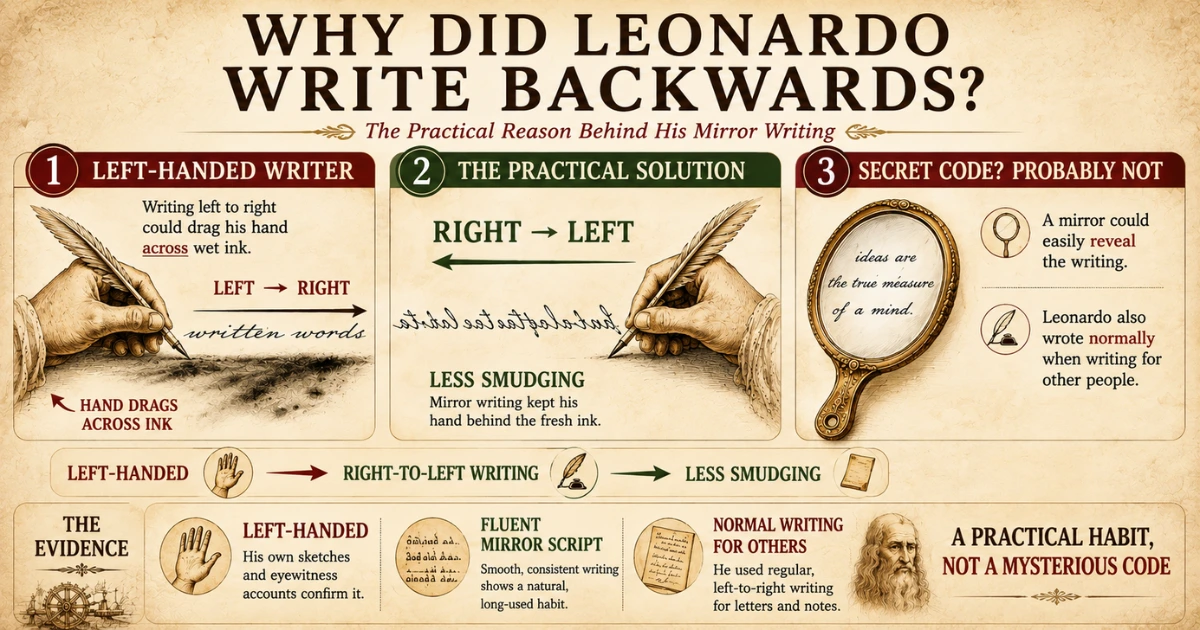
A right-handed scribe drags the hand away from fresh ink while writing left to right. A left-handed one drags straight through it, smearing the line behind the pen.
Leonardo's solution was simple: write backward, from right to left, so the hand always moves away from what was just written.
He trained as a young apprentice in Florence, in the workshop of the sculptor and painter Andrea del Verrocchio, surrounded by other artists learning to draw, cast bronze, and prepare pigments.
It was a hands-on education built on constant observation, and it likely reinforced habits Leonardo carried for the rest of his life, including the practical, self-taught workaround of writing everything for himself in reverse.
How the Notebooks Were Rediscovered
For centuries after his death in 1519, Leonardo's notebooks were scattered across private collections, cut apart, rebound, and sold in pieces. Some sheets were separated from the codices they once belonged to and were reunited only, on paper at least, through later scholarship.
Scholars began reconstructing the full scope of his writing and drawing only in the nineteenth century, and institutions such as the British Library and the Victoria and Albert Museum in London later became central to the preservation and study of his mirror script.
Today, digitization has done what centuries of private ownership couldn't. High-resolution scans mean anyone can zoom into a single reversed letter from thousands of miles away, something that would have been unthinkable to the collectors who once guarded these pages behind locked cabinets.
Leonardo's Role and Influence
Why Did Leonardo da Vinci Write Backward?
The most widely accepted explanation is refreshingly unglamorous: he was left-handed, and mirror writing kept his hand from smudging the page. It was a practical fix to a physical problem, not a secret code.
Sketches drawn by Leonardo himself show his left hand at work, and people who watched him paint and write left records confirming it.
It's worth remembering how writing actually worked in the fifteenth century. Quill pens released ink slowly and unevenly, and the paper of the period absorbed it, keeping it wet longer than we're used to with modern ink.
For a right-handed writer moving left to right, the hand trails behind the fresh line, safely clear of the wet ink. For a left-handed writer doing the same thing, the hand drags directly across everything just written.
Reversing the direction of writing solves that problem instantly, without needing a special pen, a different posture, or any tool at all. It's the kind of elegant, low-effort fix that shows up again and again across Leonardo's engineering notebooks: solve the physical problem in the simplest way the body allows.
The Secrecy Theory, and Why Most Historians Doubt It
A more romantic theory has followed Leonardo for centuries: that he wrote in reverse to hide his ideas from the Catholic Church or from rivals who might steal his inventions. It's an appealing story, and it's part of why "Da Vinci Code" style mysteries have stuck to his name.
But the theory has a weak spot. Mirror writing is not a real code. Anyone with a small mirror, or simply the patience to read slowly, can work through it. For a mind capable of designing flying machines and dissecting the human eye, that is far too thin a disguise to count as genuine secrecy.
Curiosity about the man behind the handwriting tends to build the moment you learn there's more mirror-written material out there than most people ever see, and travelers who want to look closer at Leonardo's working notebooks and sketches often start with a guided look at where his manuscripts and studies are kept in Milan, which places the handwriting back in the context of the workshop it came from.
A Private Habit, Not a Fixed Rule
Leonardo didn't mirror-write everything. When a page was meant for someone else- a patron, a collaborator, a letter- he wrote normally, left to right. The backward script appears almost entirely in his personal notes, which suggests it was less a statement and more a comfortable default, the way a person might always take notes in their own private shorthand.
What Modern Handwriting Analysis Adds
Researchers who study Leonardo's manuscripts have also pointed to something less romantic than secrecy: consistency. His reversed letters are fluent and evenly spaced, not the halting, deliberate strokes of someone encoding a message character by character.
That fluency is itself a clue. A real cipher usually shows hesitation, since the writer has to think through each substitution. Leonardo's mirror script reads instead like someone who had been writing this way so long it no longer required conscious effort, further support for the smudge-avoidance explanation over the code-breaking one.
Where to Experience This Legacy Today
The British Library's Codex Arundel
In London, the British Library holds the Codex Arundel, more than 500 pages of Leonardo's notes on water, weight, motion, and geometry, almost entirely in mirror script. Selections are periodically shown in exhibitions, and high-resolution scans let you study individual pages up close, mirror-reversed text and all.
The Victoria and Albert Museum's Forster Codices
A short walk away, the V&A holds the Forster Codices, a set of small pocket notebooks Leonardo likely carried with him. Their modest size is part of the story. These weren't grand manuscripts made for display. They were tools, meant to travel in a coat pocket and be filled in wherever a new idea struck.
The Codex Atlanticus in Milan
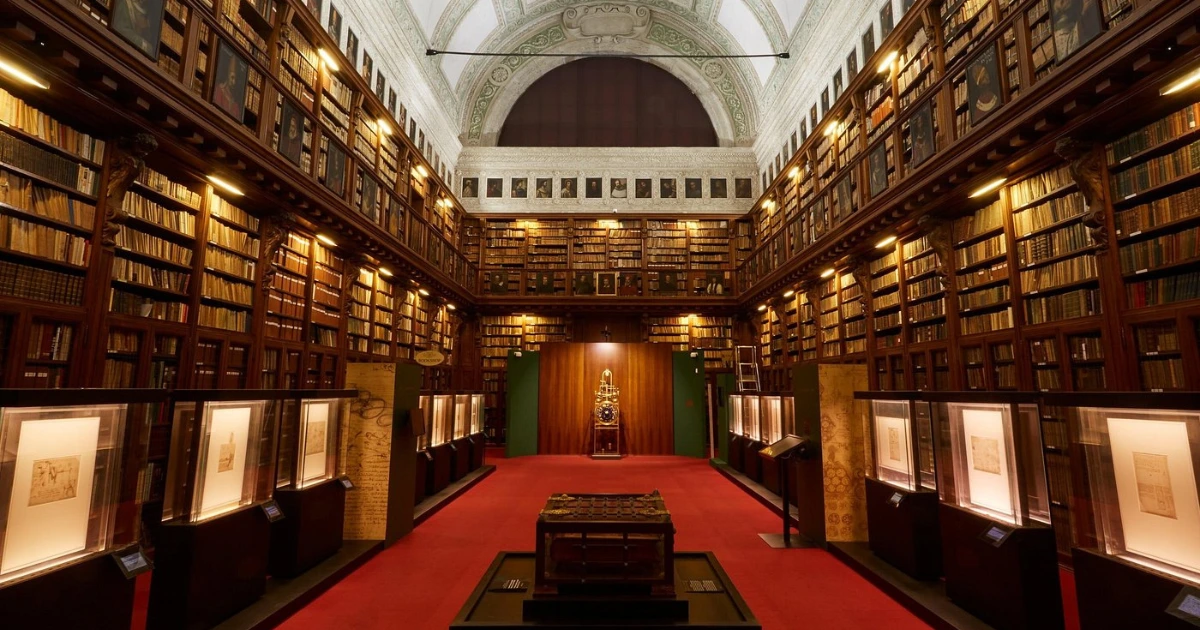
The largest single collection of Leonardo's papers, the Codex Atlanticus, lives at the Biblioteca Ambrosiana in Milan, the city where he spent nearly two decades working for the Sforza court. Twelve bound volumes hold more than 1,100 pages spanning four decades of his life, covering everything from hydraulics and flight to weaponry and geometry.
Pages rotate on display, so a visit can mean seeing sketches, mechanical designs, and mirror-written notes that were never gathered anywhere else in this volume.
Many visitors find that seeing the actual scale and density of these pages changes how they think about Leonardo's notebooks entirely.
Windsor Castle and the Royal Collection
Outside Italy, the Royal Collection at Windsor Castle holds one of the finest groups of Leonardo's anatomical and figure studies, many of which are annotated in his familiar reversed hand. These sheets, drawn from direct observation of dissections he conducted himself, show mirror writing used exactly as intended: quick working notes made alongside careful, exacting drawings.
Exploring Leonardo da Vinci in Milan
Milan is arguably the best single city for tracing Leonardo's working life, since this is where he spent his most productive years and left behind both notebooks and finished masterpieces.
He arrived around 1482 to work for Duke Ludovico Sforza, and stayed on and off for nearly two decades, designing canals, court pageants, and weapons alongside his paintings.
Beyond the Codex Atlanticus, the city holds The Last Supper at Santa Maria delle Grazie and interactive exhibits recreating his machines from the manuscript pages, giving visitors a rare chance to see a mirror-written sketch and the working model built from it side by side.
If Milan sparks an appetite for more, Leonardo's footprint reaches across Italy and France. His birthplace and early training sit around Florence, where he apprenticed under Verrocchio and painted some of his earliest surviving work, while Venice holds engineering studies tied to the city's defenses and canal systems.
Later chapters of his life are connected to Rome, where he worked briefly under papal patronage, and his final years and burial are tied to Paris, near the Château du Clos Lucé where he died in 1519.
Each city adds a different layer to the same notebooks, since Leonardo carried his private mirror-written habit with him wherever he worked.
Seeing Leonardo's Mirror Writing in Milan
Reading about mirror writing is one thing. Standing in front of a page of it, dense with reversed letters and tiny diagrams squeezed into the margins, is another.
The Biblioteca Ambrosiana displays rotating selections from the Codex Atlanticus, and the nearby Leonardo3 museum uses full-scale models and digital reconstructions to walk visitors through how his notes turned into working machines.
Together, they show what the handwriting was actually for: fast, private thinking, captured the moment it happened.
It also reframes what the rest of Milan means once you've seen it. Walking past the Sforza Castle or standing in front of The Last Supper hits differently when you know the same hand that painted it also filled thousands of pages with backward notes on light, water, and anatomy the night before.
The city stops being a checklist of sights and starts feeling like the inside of one very restless mind.
See Leonardo’s Mirror Writing in Milan
See Leonardo’s mirror-written notes and discover how his sketches and ideas came together
Explore Leonardo’s NotebooksLeonardo's Milan: Notebooks and Machines Tour
A guided walk through the collections and models connected to Leonardo's manuscripts and inventions.
- Small-group access to sites tied to Leonardo's notebooks
- Context on how his mirror-written notes became working designs
- A local guide to explain what's on each page
Visitors often note how much clearer the notebooks feel once they've seen the machines built from them. See Details
If you're mapping out a Milan itinerary around Leonardo's manuscripts, it helps to book ahead, since access to some notebook displays is limited and rotates by season.
Final Thoughts
This post was all about Leonardo da Vinci mirror writing, and how a simple, practical habit turned into one of the most enduring puzzles attached to his name. Strip away the code-breaking myths, and what's left is more human: a left-handed man solving an everyday problem in the fastest way available to him, thousands of times over, across thousands of pages.
That's part of what makes the Renaissance, and Leonardo specifically, so compelling to encounter in person. His genius wasn't only in finished paintings; it was in the mess of thinking that came before them.
Seeing the actual notebooks, backward script and all, is one of the few ways left to get that close to how his mind worked.
Related Post You May Like


Disclosure: This page may contain affiliate links. If you book through them, we may earn a small commission at no extra cost to you. Learn more.
Free Leonardo Milan Travel Guide
Plan Your Leonardo Trip in Milan
A premium mini guidebook for smarter Milan planning, including the best ticket strategy, Leonardo map, and practical visitor advice.
Get the Free Guide
Download the guide and receive practical Milan planning tips by email.
Download the Free Guide >> Leonardo Bianchi is the founder of Leonardo da Vinci Inventions & Experiences, a cultural travel guide helping visitors explore Leonardo da Vinci’s art, inventions, and legacy across Italy and Paris.