
(Last updated: Sep 2026)
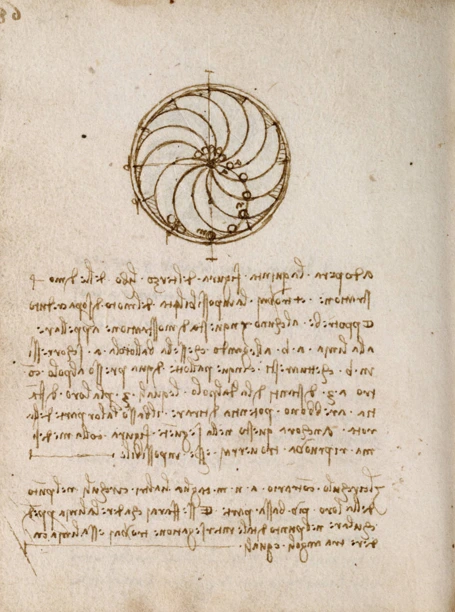
Codex Forster is one of the most personal windows we have into Leonardo da Vinci's restless mind — a set of pocket-sized notebooks small enough to carry in a coat, yet packed with centuries of curiosity.
Bound into three separate volumes and written in Leonardo's famous mirror writing, these pages move from canal-digging machinery to the geometry of solid shapes without ever slowing down.
Historically, the Forster Codices matter because they show Leonardo's thinking in real time. He sketches an idea, calculates a measurement, crosses something out, and moves on, all on paper he likely carried through the streets of Milan and Florence.
For anyone planning a trip to London, that history becomes tangible: a rare chance to stand inches from pages Leonardo actually touched, rather than reading about them in a textbook.
This post is all about Codex Forster, tracing how five separate notebooks became three bound codices, what they reveal about Leonardo's mind, and where you can see them for yourself today.
What is Codex Forster?
Codex Forster is a collection of five notebooks by Leonardo da Vinci, bound into three volumes and held at the Victoria and Albert Museum in London. Named after collector John Forster, who bequeathed them in 1876, the codices cover hydraulic engineering, geometry, proportion, and mechanics and were written between roughly 1487 and 1505.
Historical Background
From Loose Pages to Bound Codices
Leonardo rarely worked in a prebound book. Like several of his other notebooks — the Codex Atlanticus, the Codex Arundel, and the Codex Leicester — he wrote on loose sheets bought from Milan's stationers, tucking them into his belongings as he traveled.
After his death in 1519, the pages passed to his pupil Francesco Melzi. Scholars believe they were later folded and gathered into small booklets, now in the possession of the Spanish sculptor Pompeo Leoni, whose numbering and signature can still be traced across sections of Codex Forster I.
John Forster's Gift to London
The manuscripts take their name not from Leonardo himself but from John Forster, a nineteenth-century English literary critic and biographer best remembered for his biography of Charles Dickens.
Forster acquired the five notebooks during his lifetime and, on his death in 1876, bequeathed them to what is now the Victoria and Albert Museum, along with the rest of his personal library.
That single gift is the reason one of the most significant collections of Leonardo da Vinci notebooks now sits permanently in London rather than in Italy or France.
Why the Codices Bear Three Different Names
Although often discussed as a single Codex, the collection is technically three bound volumes: Codex Forster I, II, and III. Codex Forster I combines the earliest notebook the museum owns, begun around 1487 to 1490 in Milan, with the latest, completed around 1505 in Florence.
Codex Forster II gathers two notebooks compiled in Milan while Leonardo served Duke Ludovico Sforza, and Codex Forster III, the most miscellaneous of the three, dates to roughly 1490 to 1493.
None of them follow a strict chronological or thematic order, which is part of what makes reading them feel like looking directly over Leonardo's shoulder.
Small Books Built for a Traveling Mind
Part of what makes the Forster Codices so distinctive is their size. The three volumes measure roughly 14.5 by 10 centimeters, 9.5 by 7 centimeters, and 9 by 6 centimeters, small enough to slip into a pocket or satchel.
Leonardo almost certainly carried pages like these with him as he moved between commissions, jotting down an idea for a canal lock in one sitting and a study of a shadow's edge in the next.
That portability is easy to forget when the notebooks are displayed behind protective glass today, but it is essential to understanding why the pages feel so unfiltered.
These were not manuscripts written for an audience. They were a working Leonardo da Vinci journal, meant only for the eyes of the man holding the pen.
Leonardo's Role and Influence
Hydraulic Engineering and the Movement of Water
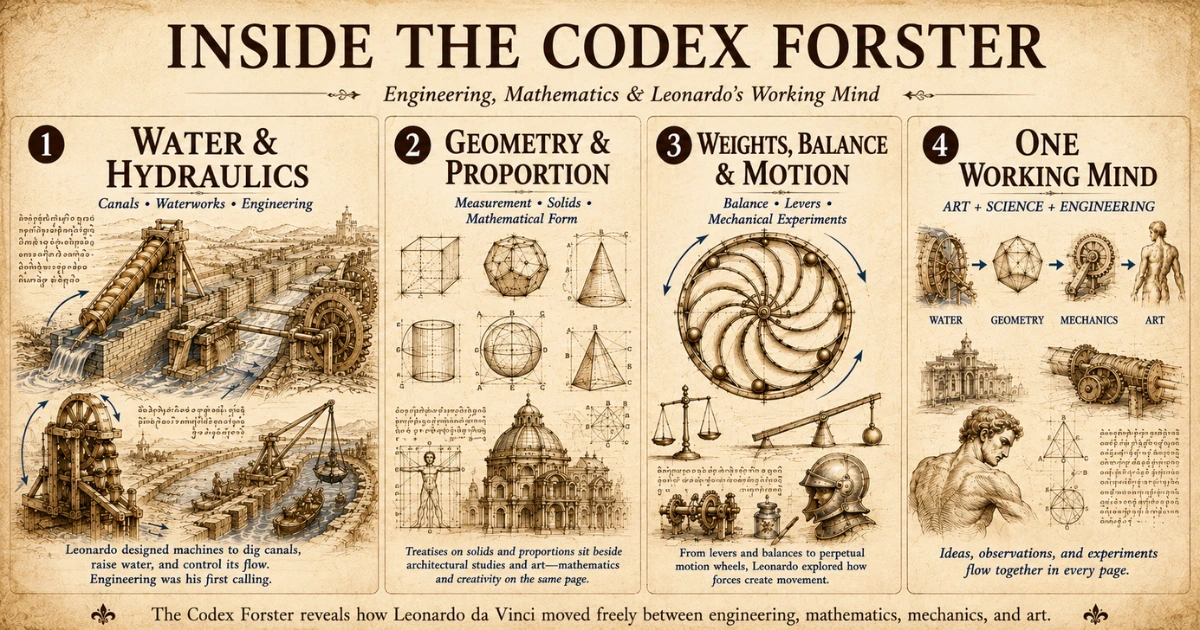
Codex Forster I reveals how seriously Leonardo took his work as a military and civil engineer. Its pages are filled with devices for digging canals and for raising and moving water, the kind of practical technology Milan's rulers valued as much as Leonardo's paintings.
When Leonardo wrote to Ludovico Sforza offering his services, he described himself first as an engineer capable of building bridges and waterworks, and only briefly mentioned painting near the end of the list. The Forster notebooks are proof that this wasn't just a sales pitch.
Geometry, Proportion, and the Study of Solids
Alongside the engineering sketches, Codex Forster I includes a short treatise on measuring solid geometric shapes, while one notebook in Codex Forster II is devoted almost entirely to the theory of proportions.
These pages sit close to sketches of weaving frames, architectural studies, and even a tender drawing of the Virgin and Child, a reminder that Leonardo moved fluidly between mathematics and art within the same handful of pages, often on the same day.
Weights, Balances, and the Mechanics of Motion
The second notebook bound into Codex Forster II turns to the theory of weights and balances, alongside early sketches exploring perpetual motion, drawings of helmets, and even a recipe for mixing paint.
Because Leonardo wrote in mirror writing, reading right to left, he often began what looks like the back of the book first. Historians still debate whether Leonardo's mirror writing was a practical habit for a left-handed writer or a way to keep his notes private, but either way, it turns every page into something closer to a coded Leonardo da Vinci diary than to a formal scientific journal.
A Mind That Refused to Separate Art from Science
What stands out most across the Forster notebooks isn't any single invention or theory, but the way Leonardo moved naturally between them.
A page of hydraulic calculations sits a few folios away from a figure study. A note on the weight of a lever is paired with a sketch of a helmet's visor. This wasn't disorganization; it was how Leonardo actually worked.
Every Leonardo drawing in these pages exists because a question needed answering, whether artistic, mechanical, or mathematical. That refusal to separate disciplines is arguably Leonardo's single greatest influence on how we understand creativity today, and the Forster Codices capture it in a rawer, more immediate form than his finished paintings ever could.
Where to Experience This Legacy Today
Inside the Victoria and Albert Museum (V&A)
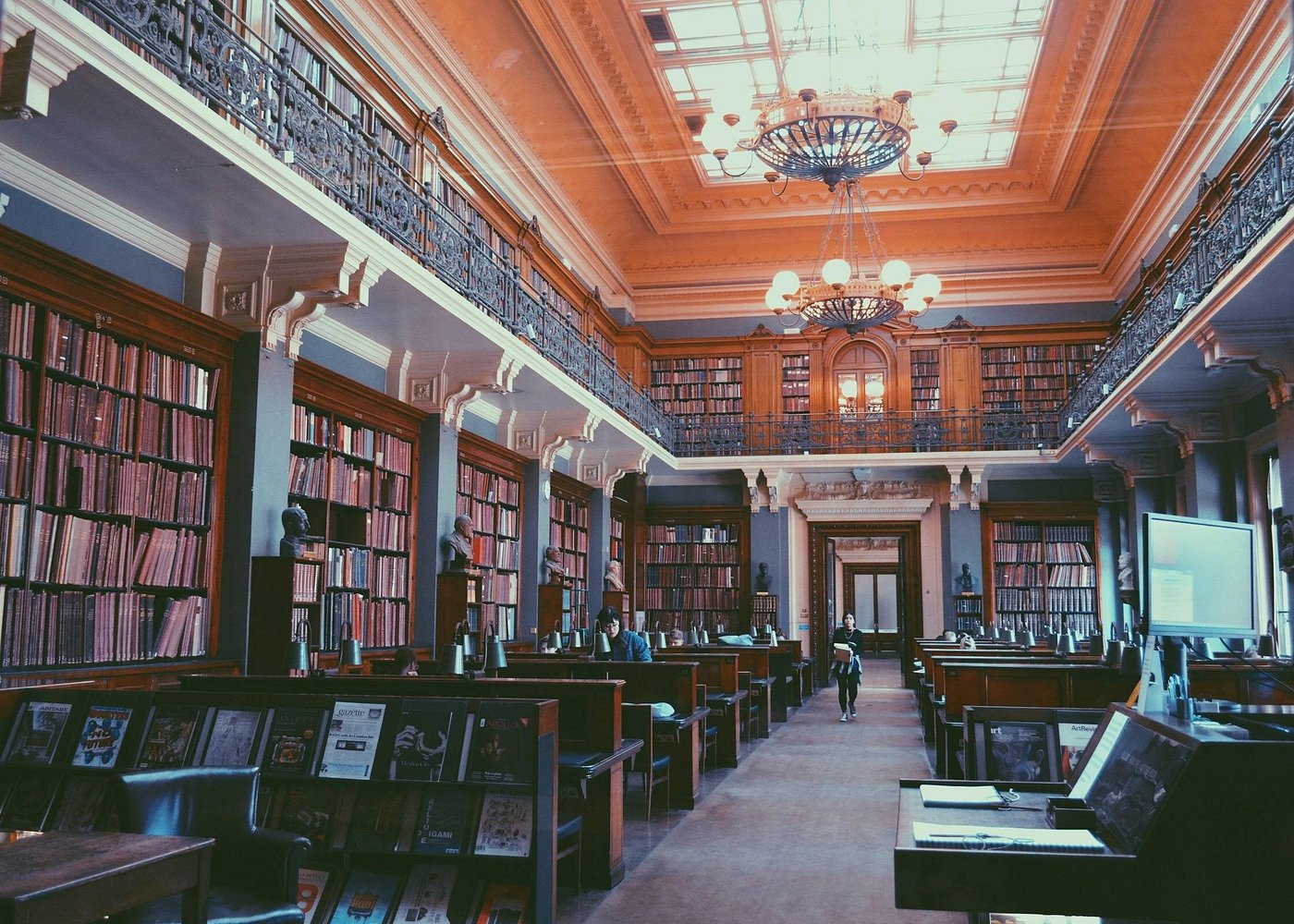
Today, the three volumes live in the V&A's manuscripts collection, cared for under strict conservation conditions because the paper is centuries old and extremely fragile. Seeing them in the museum's galleries connects the small, private object Leonardo once carried in his pocket to the vast public institution now responsible for protecting it.
The V&A itself is enormous, spanning galleries of sculpture, fashion, furniture, and design history that stretch across several floors, so the manuscript rooms holding Codex Forster can be easy to miss without a plan for the day. Visitors who come specifically for the notebooks often discover that a well-paced introduction to the museum's layout makes the visit far easier to manage.
Many first-time visitors find it helpful to start their day with a guided walk through the V&A's Leonardo-related galleries, timed so the fragile manuscripts and the museum's wider collection can both be seen without rushing.
Exploring the Codices Through Digital Access
For the 500th anniversary of Leonardo's birth in 2019, the V&A began digitizing the complete Forster Codices, a project that continued despite pandemic-related delays and is now complete.
Every page of these Leonardo da Vinci notebooks can be examined online in extraordinary close-up detail, letting researchers and casual readers alike compare Leonardo's drawings side by side with pages from other collections using shared digital viewing standards.
It's the closest most people will get to reading Leonardo's actual writings, line by line, without a conservator standing beside them.
How Codex Forster Compares to Leonardo's Other Notebooks
Codex Forster is only one piece of a much larger body of Leonardo da Vinci notebooks. The Codex Atlanticus, held in Milan's Biblioteca Ambrosiana, is the largest surviving collection of his papers, running to more than a thousand pages on everything from flight to fortification.
The Codex Arundel, kept at the British Library just a few miles from the V&A, covers similarly wide-ranging scientific notes gathered over several decades. The Codex Leicester, famous for Leonardo's observations on water, astronomy, and geology, is privately owned and rarely displayed to the public.
Compared to these, Codex Forster is smaller in scale but unusually intimate — pocket-sized books that read less like formal research and more like a running Leonardo da Vinci journal, closer to a diary than a treatise.
For visitors, this comparison matters both practically and historically. Because the Codex Leicester rarely travels and the Codex Atlanticus stays largely in Milan, London's Forster Codices and the British Library's Codex Arundel represent one of the only places in the world where two substantial Leonardo notebook collections sit within a short taxi ride of each other.
Anyone building a research trip or a curiosity-driven weekend around Leonardo da Vinci notebooks can realistically see both in a single visit to the city.
Exploring Leonardo da Vinci in London
London's connection to Leonardo runs deeper than a single museum shelf. Beyond the Forster Codices, the city holds other traces of his life and legacy, from the Codex Arundel at the British Library to Leonardo-related works scattered through London's wider museum network.
Pairing a visit to the V&A with the broader story of Leonardo across Europe often deepens the experience of seeing his work in person, since so much of what he wrote and drew only makes sense in light of where he was living at the time.
Travelers curious about where else his notebooks, paintings, and influence can be found often continue their journey toward Milan, where he served the Sforza court and produced much of the engineering material found in the Forster Codices, or Florence, where his artistic training began and where the latest pages of Codex Forster I were completed.
From there, guides to Venice, Rome, and Paris fill in the rest of a career that never stayed in one place for long, tracing Leonardo from military consultant to court painter to his final years in France.
Seeing Codex Forster in Person: A London Experience
Reading about Codex Forster is one thing; standing in front of it is another. The Victoria and Albert Museum sits in South Kensington, surrounded by some of London's richest cultural institutions, and a visit built around Leonardo's notebooks naturally opens onto the museum's much larger collection of decorative arts, design, and world history.
Visitors who come specifically for the Forster Codices often find themselves staying for hours, drawn in by everything else the V&A has to offer.
Some travelers prefer to structure their day with a guided visit that situates Codex Forster within the wider context of the museum and the surrounding city. A well-run tour typically includes background on Leonardo's life in Milan and Florence, an introduction to the V&A's broader collection, and practical guidance on seeing the notebooks without missing the museum's other highlights.
Many visitors find that pairing the museum visit with a short guided introduction helps the notebooks make more sense in context, especially on a first trip to London.
This kind of framing tends to matter most for visitors who aren't already familiar with Leonardo's biography. Knowing that Codex Forster I bridges two very different moments in his life, or that the mirror writing running across every page reflects a habit rather than a puzzle, changes how the manuscripts read once you're standing in front of them.
A short amount of context before entering the gallery can turn a quick look at old paper into a much clearer sense of who Leonardo was and how he actually worked.
See Codex Forster at the V&A
Discover Codex Forster and explore the V&A galleries that bring Leonardo’s remarkable world into context
Explore V&A ToursV&A and Leonardo Highlights, South Kensington
A guided walk through the V&A's design and manuscript galleries, built around the history behind Codex Forster.
- Context on Leonardo's Milan and Florence years
- An orientation to the V&A's wider collection
- Small-group pacing suited to first-time visitors
Many visitors note that having a guide on hand makes the fragile, easy-to-miss manuscript galleries far simpler to find. See current availability
Before planning a visit, it's worth knowing that the V&A's Leonardo material is included in general admission, and the museum publishes its own visiting hours and gallery locations directly on its website.
Whichever way you choose to explore it, seeing Codex Forster in person is still the most direct way to understand why these small notebooks have outlasted five centuries.
Final Thoughts
This post was all about Codex Forster, from its origins as loose sheets carried through Renaissance Milan and Florence to its permanent home in London.
What began as private scratch paper for one of history's most curious minds became, through a nineteenth-century book collector's bequest, one of the most complete surviving records of how Leonardo actually thought.
Seeing that thought process in person — the crossed-out calculations, the mirror writing, the sketches crowded onto pocket-sized pages — is a different experience than reading about the Renaissance in a book.
It's a reminder that behind every finished Leonardo da Vinci drawing was a working notebook much like this one, and that the V&A's careful conservation of Codex Forster is what makes it still possible to see that legacy in person today.
Related Post You May Like

Disclosure: This page may contain affiliate links. If you book through them, we may earn a small commission at no extra cost to you. Learn more.
Free Leonardo Milan Travel Guide
Plan Your Leonardo Trip in Milan
A premium mini guidebook for smarter Milan planning, including the best ticket strategy, Leonardo map, and practical visitor advice.
Get the Free Guide
Download the guide and receive practical Milan planning tips by email.
Download the Free Guide >> Leonardo Bianchi is the founder of Leonardo da Vinci Inventions & Experiences, a cultural travel guide helping visitors explore Leonardo da Vinci’s art, inventions, and legacy across Italy and Paris.