
(Last updated: Sep 2026)
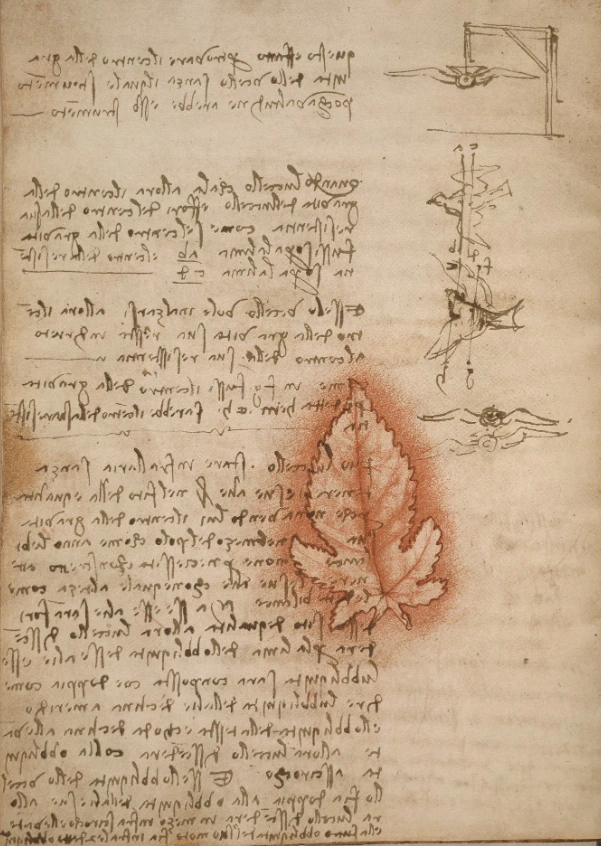
The Codex on the Flight of Birds is a small, unassuming notebook that Leonardo da Vinci filled with sketches, notes, and half-formed calculations about how birds stay airborne.
He wrote most of it around 1505, cramming observations of pigeons and kites between diagrams of wings, wind currents, and balance. Long before anyone built a working aircraft, these pages show a Renaissance mind trying to reverse-engineer nature itself.
That's what makes the codex historically important: it's one of the earliest known attempts to treat flight as a problem that could be solved through observation and engineering, rather than a myth reserved for gods and birds.
It also enhances a travel experience in a very specific way. Reading about Leonardo's ideas is one thing. Standing in front of the actual pages, or seeing full-size models built from his sketches, turns an abstract fact — "Leonardo dreamed of flying" — into something you can see with your own eyes.
This post is all about the Codex on the Flight of Birds: what's inside it, how Leonardo's ideas on flight actually worked, and where you can experience this remarkable manuscript today.
What is the codex on the flight of birds?
The Codex on the Flight of Birds is a small notebook, roughly 18 folios long, that Leonardo da Vinci wrote around 1505. It records his direct observations of birds in flight alongside sketches analyzing lift, balance, and wing movement. Leonardo used these notes to refine his ideas for human flying machines, including concepts closely tied to the ornithopter.
The Engineering Idea Behind the Codex on the Flight of Birds
Why Leonardo Studied Birds Instead of Machines First
Leonardo didn't start by drawing propellers or engines, because none of that existed yet. He started by watching.
For years, he observed pigeons, kites, and other birds near Florence and Milan, tracking how they adjusted their wings mid-flight to catch or spill air. His reasoning was simple: if birds had already solved the problem of flight, then studying their bodies was the fastest path to understanding the physics behind it.
This is what separates the Codex on the Flight of Birds from a simple sketchbook. It reads more like a working research notebook, with Leonardo testing ideas, correcting himself, and jotting down questions mid-thought.
Some pages even have his notes running in mirror script, the reversed handwriting he used throughout his notebooks, possibly to make his private research harder to skim at a glance.
The Codex Page by Page: What's Actually Inside
The manuscript mixes several kinds of content on nearly every page. There are anatomical-style studies of wings, arrows tracing airflow, and short paragraphs describing what Leonardo believed was happening physically as a bird banked or glided.
A few pages step outside bird biology entirely and sketch mechanical devices meant to mimic that motion using cables, pulleys, and articulated wooden wings, worn or operated by a person.
Compared to Leonardo's other manuscripts, this codex is tightly focused. It doesn't wander into hydraulics or fortifications the way the Codex Atlanticus does. It stays locked onto one question: how does something heavier than air stay up?
From Notebook to Notebooks: Where It Fits Among the Codices
Leonardo left behind thousands of manuscript pages, which were later bound into different collections by subsequent owners and scholars.
The Codex Atlanticus is the largest of these, a sprawling scrapbook of engineering, art, and science assembled from loose sheets. The Codex Leicester, by contrast, focuses almost entirely on water, rock formations, and astronomy.
Placed next to those, the Codex on the Flight of Birds stands out for its narrow, obsessive focus on a single problem, which is part of why historians treat it as a distinct, self-contained study rather than a scattered set of notes.
The manuscript's own history is almost as interesting as its contents. It passed through several private collections after Leonardo's death, and its pages were rearranged more than once by later owners who bound them into a different order than Leonardo originally intended.
Scholars in the twentieth century worked to reconstruct the likely original sequence, matching handwriting, ink, and subject matter page by page. That reconstruction is part of why modern facsimiles and museum descriptions can confidently walk through the notebook as a connected line of thought rather than a random stack of sketches.
What "Flight of Birds" Actually Meant to Leonardo
It's worth pausing on the title itself. For Leonardo, the flight of birds wasn't a poetic phrase; it was a literal subject of study, closer to what we'd now call a field study.
He treated each wingbeat, glide, and course correction as data worth recording, then looked for patterns across species. That mindset, more scientist than artist, is exactly why historians now read this codex as an early example of applied aerodynamics thinking, centuries before the term existed.
How the Codex on the Flight of Birds Works
Leonardo's Theory of Lift and Balance
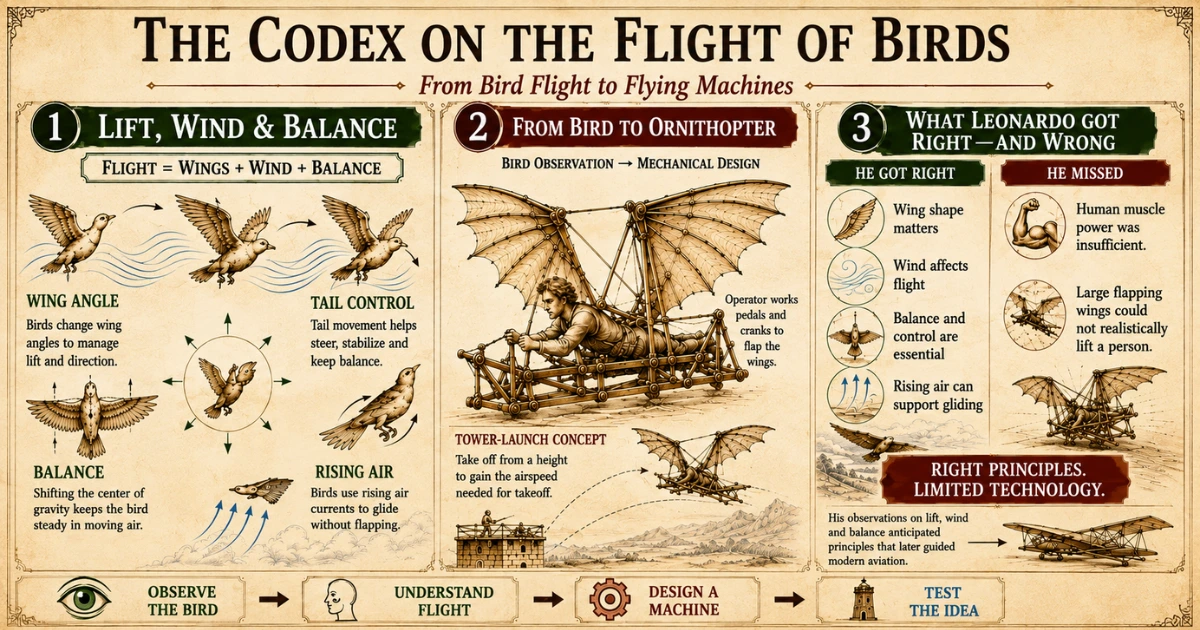
Leonardo's central insight, expressed in dozens of small sketches, was that a bird's tail and how it shifts its center of gravity matter just as much as its wings. He describes birds making constant tiny adjustments to stay balanced in moving air, comparing the process to a person balancing on a boat.
He didn't have the vocabulary of modern aerodynamics, no concept of lift coefficients or airfoils, but he was circling the same territory: air behaves differently depending on the shape and angle of the surface moving through it.
He also paid close attention to wind itself, describing how birds use rising air to glide without flapping. That observation, made by hand in the early 1500s, anticipates the basic principle behind soaring flight that glider pilots still rely on today.
The Ornithopter Connection
The word most closely tied to this codex is ornithopter, a flying machine designed to generate lift by flapping wings rather than using fixed wings or rotors. Leonardo's ornithopter sketches, some found in this codex and others in related manuscripts, show a human operator lying inside a wooden frame, working pedals and hand cranks connected to large articulated wings.
None of Leonardo's flying machines were ever built and flown during his lifetime, and modern engineers generally agree the human body doesn't produce enough power to flap wings large enough to fly. But that's not really the point.
The ornithopter sketches show Leonardo applying the bird observations from this codex directly into mechanical form, which is exactly why the two subjects, bird flight and flying machines, are so closely linked in his notebooks.
Later pages in the codex go a step further, sketching a tower-launch concept in which the operator would take off from a height rather than flat ground, using gravity to help generate the initial airspeed that a flapping wing alone couldn't provide. It's a small detail, but it shows Leonardo thinking like an engineer solving a practical launch problem, not just an artist sketching a fantasy.
Several museums have translated these sketches into full-scale, functioning wooden models you can see up close, and walking among them is one of the more effective ways to actually understand how Leonardo's mechanical thinking worked, something many travelers explore through a guided visit to Milan's Leonardo da Vinci museum exhibits, where the models sit alongside explanations of the original sketches.
What the Codex Got Right, and Where It Fell Short
Leonardo correctly identified that wing shape, wind, and balance were all connected, and that flight was a matter of physics rather than magic. Where he fell short was scale: he didn't yet grasp that muscle power alone couldn't lift a human-sized wing.
It would take another four centuries, and the shift from muscle power to engines, before his underlying instincts about lift and control were finally proven right by the Wright brothers.
It's also worth noting what Leonardo got right almost by accident. Modern aviation didn't end up using flapping wings at all, yet several of his observations about wind, gliding, and balance map surprisingly well onto how fixed-wing aircraft actually behave.
Historians of science tend to describe the codex less as a flight manual and more as an early proof that careful observation, even without the right tools or terminology, can point to the right answer decades or centuries before the technology needed to prove it.
Where to See the Codex on the Flight of Birds Today
The original manuscript isn't something you'll stumble across by accident. It's held at the Biblioteca Reale, the Royal Library, in Turin, part of the Musei Reali Torino collection, alongside other Leonardo material, including his famous self-portrait sketch.
Because manuscript pages are light-sensitive, the codex isn't always on permanent public display, so checking current exhibition status before visiting is worth doing.
The Biblioteca Reale in Turin
The Biblioteca Reale sits inside the Royal Palace complex in central Turin, a city that doesn't get nearly as much Leonardo attention as Milan or Florence, despite holding one of his most focused scientific manuscripts. When the codex or related drawings are on display, visitors can see Leonardo's actual handwriting, mirror-script and all, alongside the delicate bird and wing sketches described above.
The library itself is worth slowing down for, independent of the codex. It sits inside a working royal residence, so a visit naturally combines Leonardo's manuscript with the surrounding architecture and the rest of the Musei Reali collection, including other drawings, decorative art, and the palace's own history.
That combination is part of why Turin rewards travelers willing to step slightly off the usual Florence-Milan-Rome circuit.

Discover the Codex on the Flight of Birds
Walk through Turin’s Musei Reali and explore the history and attribution of Leonardo’s celebrated self-portrait
Explore Turin Leonardo ToursWhat a guided visit adds: A knowledgeable guide can point out details that are easy to miss on your own, such as the mirror script or the faint pencil corrections Leonardo made mid-thought.
- Context on why Turin, rather than Florence or Milan, ended up holding this manuscript
- A closer look at the bird and wing sketches, explained page by page
- Connections drawn between the notebook and Leonardo's other flying-machine designs
Visitors often note that having someone explain the sketches in real time makes the manuscript feel far less abstract than reading about it beforehand.
Seeing the Ideas in Motion: Milan and Beyond
If the manuscript itself isn't on display during your visit, the ideas inside it are easier to find than you might expect. Milan's science and technology museum houses a well-known collection of full-scale models built from Leonardo's flying machine and mechanical sketches, giving a hands-on sense of what the notebook's ideas were actually working toward.
Leonardo's Flying Machines, Milan
A guided walk through the museum's collection of full-scale models built directly from Leonardo's engineering sketches.
- Working replicas of ornithopter and glider concepts
- Side-by-side comparisons with Leonardo's original drawings
- A guide connecting the models back to his notebook studies
Many visitors find it helps the bird-flight sketches click into place once they see the mechanical version standing in front of them. Check availability
Seeing the models doesn't replace the manuscript, but it fills the gap between "Leonardo studied birds" and "Leonardo tried to build a flying machine," which is really the whole story this codex tells.
Exploring Leonardo da Vinci in Turin
Turin rarely tops anyone's Leonardo itinerary, which is part of what makes it interesting. The Biblioteca Reale's holdings connect directly to the wider trail of cities where Leonardo lived, worked, and left material behind, from the workshops of Florence, where he trained, to Milan, where many of his engineering ideas took shape.
From there, the trail extends further still. Venice holds some of his most famous anatomical studies, including work connected to Leonardo's broader interest in how bodies, human and animal, move and balance, the same instinct that drives the bird sketches in this codex.
Rome reflects his later years working under papal patronage, a period when his engineering interests broadened well beyond flight. Paris is where he spent his final years and where the Louvre now holds several of his major works.
Each city adds a different piece to the picture this codex only hints at on its own, and together they turn a single notebook into the starting point for a much larger journey through Leonardo's life and thinking.
Final Thoughts
This post was all about the Codex on the Flight of Birds, a small notebook that captures Leonardo da Vinci at his most curious: watching birds, questioning what he saw, and trying to translate it into something a person could build. It's a reminder that Renaissance genius wasn't just about painting or invention in isolation, but about a relentless habit of observation that connected the two.
Seeing this manuscript, or the flying-machine models it inspired, is a different experience from reading about it. The mirror-script, the faint corrections, the sketches of wings mid-motion, all of it makes Leonardo's obsession with flight feel immediate rather than distant.
If you're building a Leonardo-focused trip, this is one of those details worth planning around, because it's easy to read past in a textbook and hard to forget once you've seen it in person.
Related Post You May Like


Disclosure: This page may contain affiliate links. If you book through them, we may earn a small commission at no extra cost to you. Learn more.
Free Leonardo Milan Travel Guide
Plan Your Leonardo Trip in Milan
A premium mini guidebook for smarter Milan planning, including the best ticket strategy, Leonardo map, and practical visitor advice.
Get the Free Guide
Download the guide and receive practical Milan planning tips by email.
Download the Free Guide >> Leonardo Bianchi is the founder of Leonardo da Vinci Inventions & Experiences, a cultural travel guide helping visitors explore Leonardo da Vinci’s art, inventions, and legacy across Italy and Paris.