
(Last updated: Sep 2026)
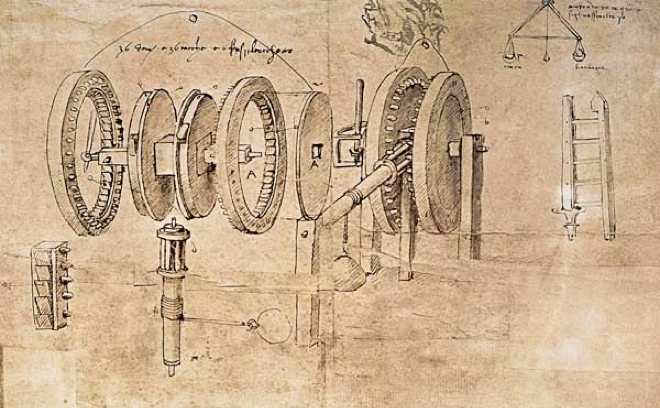
Leonardo da Vinci engineering drawings are not illustrations of finished machines. They are records of a mind mid-thought, working out how a gear should turn or a wing should flex before either existed anywhere but on paper. Long before engineers had blueprints, Leonardo had his notebooks, and in them, drawing itself became a form of reasoning.
That matters for anyone who has ever stood in front of one of his sketches in a museum and felt a strange thrill, the sense of watching someone think in real time across five centuries. These pages carry weight because they capture process, not just product: the crossed-out attempt, the second try in the margin, the note scribbled backward in his famous mirror script.
Seeing that in person changes how the whole Renaissance feels, less like a distant era of finished masterpieces and more like a live workshop you've just walked into.
This post is all about Leonardo da Vinci engineering drawings, what they show, how Leonardo built them, and where you can still see the real pages today.
What are Leonardo da Vinci engineering drawings?
Leonardo da Vinci engineering drawings are the technical sketches Leonardo produced across his notebooks and codices to study mechanics, motion, and structure. Rather than finished plans, they are working drawings: diagrams, cutaways, and annotated sketches he used to think through how machines and mechanisms might actually function.
The Engineering Idea Behind Leonardo da Vinci Engineering Drawings
A Notebook Instead of a Workshop
Leonardo never ran an engineering firm and rarely had the budget to build what he imagined. What he had was paper, ink, and an unusual habit of drawing everything he tried to understand.
He carried small notebooks on his belt, according to his own descriptions, jotting down mechanisms he noticed in mills, cranes, and looms as he traveled between Florence, Milan, and later Rome and France.
Over his lifetime, he filled thousands of pages with this kind of visual thinking, and estimates of how many drawings Leonardo da Vinci actually produced generally land somewhere around 4,000 to 7,000 surviving sheets, a number made more remarkable by how much has been lost over five centuries.
Entire notebooks are known to have vanished, sold off, broken apart, or simply misplaced by collectors long before museums began treating them as historical treasures.
What survived did so almost by accident of collecting habits rather than careful preservation. Sheets were cut apart, reordered, and bound into new volumes by later owners, which is part of why the codices we see today rarely follow Leonardo's original sequence.
Reading them now means reading a puzzle reassembled centuries after the fact, one more reason why a knowledgeable guide or a well-annotated exhibit adds so much when you're standing in front of the real pages.
Drawing as a Thinking Tool
For Leonardo, a sketch wasn't a way to present an idea he'd already worked out. It was the working-out itself. He would draw a gear system from one angle, then again from another, then slice it open to show the parts nobody could normally see.
This is the core difference between his engineering drawings and his inventions: the inventions are the "what," the drawings are the "how." A page on a screw-cutting device isn't really about the device. It's about Leonardo testing, on paper, whether his own idea could hold together.
From Curiosity to Mechanism
Leonardo's engineering sketches rarely stayed within a single discipline. A study of water flow around an obstacle could inform the design of a hydraulic pump. A dissection of a bird's wing could shape the joints of a flying machine.
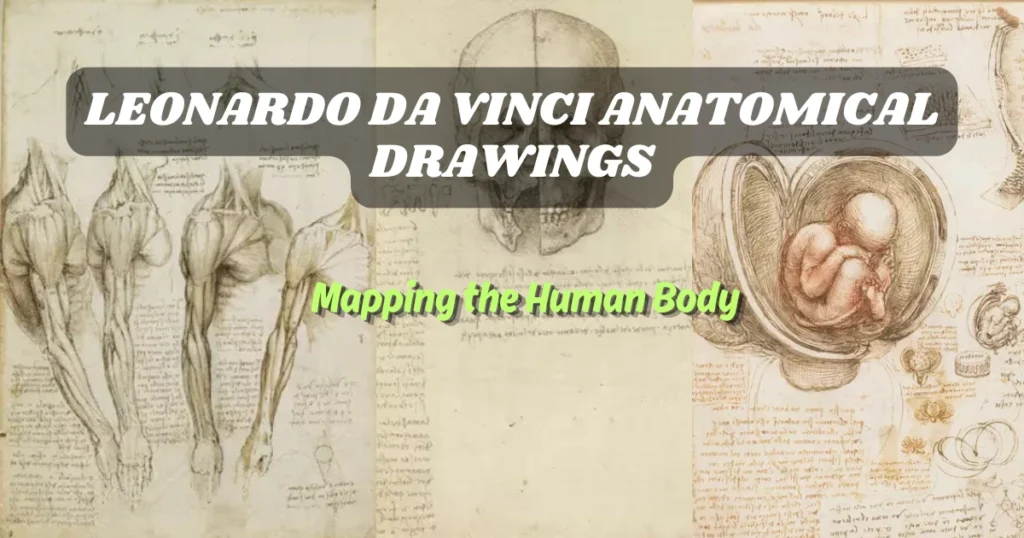
This is also where his anatomy work quietly overlaps with his mechanical work. Leonardo da Vinci's anatomy drawings and his engineering sheets share the same visual language of cutaways, layers, and labeled parts, because to Leonardo, a body and a machine were both systems worth taking apart on paper to understand.
How Leonardo da Vinci Engineering Drawings Work
Cutaway Views and Exploded Parts
One of the clearest signs of Leonardo's engineering mind is the cutaway view, a drawing sliced open to reveal the internal mechanism.
He used this technique constantly, showing gear teeth meshing inside a housing, or the internal structure of a pump, long before "exploded diagram" was a standard engineering term. It let him, and lets us, see a working part rather than just its outer shell.
Motion, Gears, and Components
Many of his most famous drawings aren't static objects at all; they're studies of motion. Leonardo sketched the same gear train at different points in a cycle, or drew arrows and repeated lines to suggest how a component would swing or rotate.
He was essentially animating mechanics by hand, breaking movement into stages the eye could follow on a flat page.
His studies of gearing alone cover an unusual range: ratchets that allow motion in only one direction, worm gears for converting rotary motion into linear force, and epicyclic arrangements where one gear orbits another.
He drew springs under tension and coils being wound, trying to work out how stored energy might later release in a controlled way. None of this was abstract theorizing. Each sketch reads like a question he was trying to answer with his own hand before he could answer it with a working model.
Annotations and Mirror Writing
Almost every sheet is dense with handwriting running right to left, a habit historians generally attribute to Leonardo being left-handed rather than to any attempt at secrecy.
These notes aren't captions. They're calculations, corrections, and short arguments with himself, sometimes doubting the very mechanism he'd just drawn. Reading the annotations alongside the sketch is part of what makes these pages feel less like art and more like an engineer's lab notebook.
Many of these techniques are easiest to appreciate up close, in the presence of the original ink and paper rather than a printed reproduction, which is part of why a guided look at Milan's da Vinci manuscript collections tends to change how visitors read these pages afterward.
Leonardo's Drawing Techniques, in Practice
Leonardo da Vinci's drawing techniques for engineering work differ noticeably from his figure studies. Where his portraits rely on sfumato, soft, blended transitions of tone, his technical sheets favor sharp contour lines, cross-hatching for shading on curved metal parts, and a consistent, almost architectural sense of proportion.
If you're curious how to draw like Leonardo da Vinci step by step in this technical mode, the method he used is a useful starting point: rough contour first, then internal structure, then shading, then written notes filling whatever space is left.
It's less about artistic flourish and more about clear, functional communication, which is exactly what made his sketches useful engineering tools rather than only beautiful drawings.
Where to See Leonardo da Vinci Engineering Drawings Today
The Codex Atlanticus in Milan
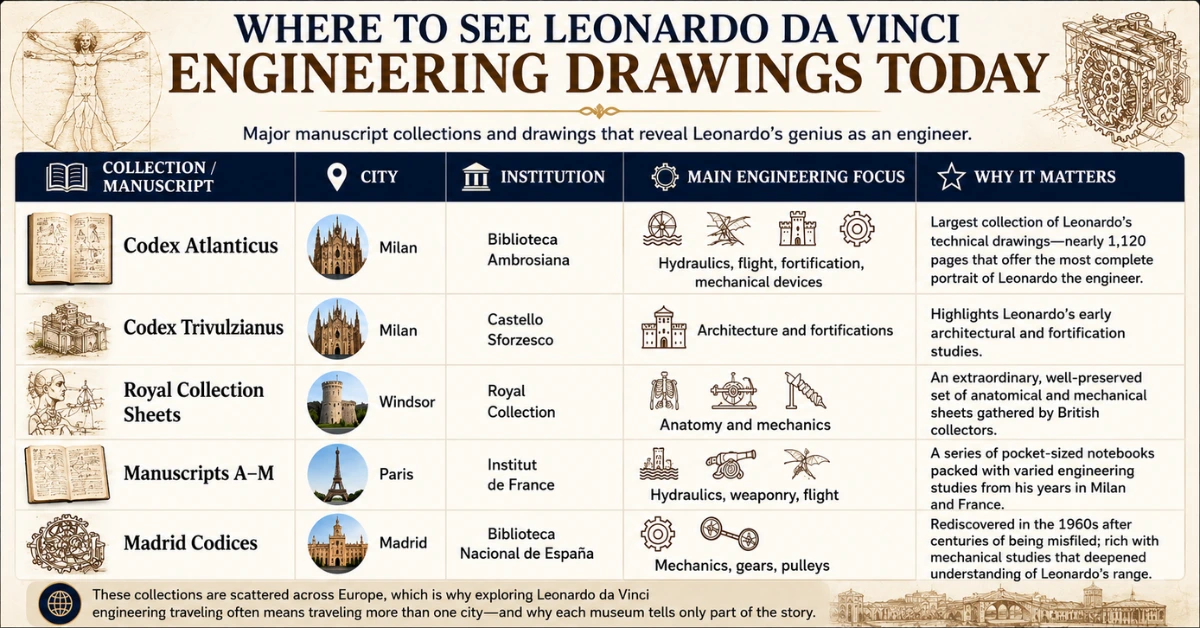
The single largest collection of Leonardo's technical drawings is the Codex Atlanticus, nearly 1,120 pages bound together long after his death and held today at the Biblioteca Ambrosiana in Milan.
It covers an enormous range of his engineering interests: hydraulics, flight, fortification, and mechanical devices, making it the closest thing to a complete portrait of Leonardo the engineer.
See the Codex Atlanticus
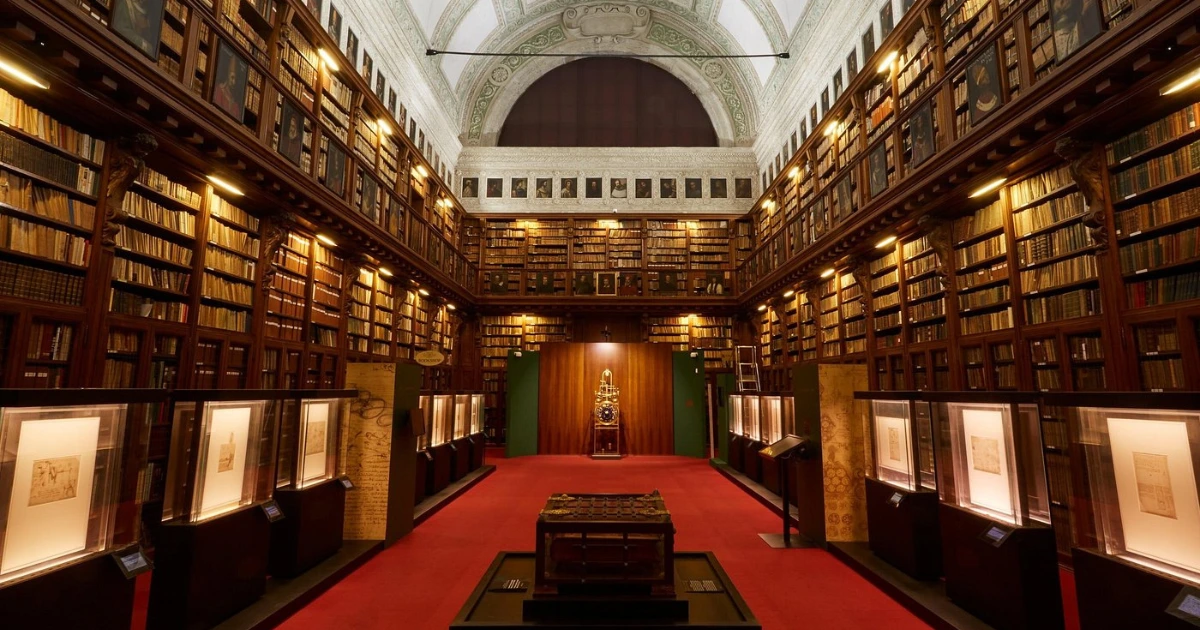
Step inside the Biblioteca Ambrosiana to see rotating sheets from Leonardo’s largest surviving notebook and explore its historic art collection.
See Codex Atlanticus TicketsBiblioteca Ambrosiana, Milan
A guided visit to the Ambrosiana pairs its art collection with rotating pages from the Codex Atlanticus.
- Rotating original Codex Atlanticus pages on display
- Context from a local guide on Leonardo's working methods
- Combines easily with a wider Milan itinerary
Other Codices Around the World
Leonardo's notebooks are scattered across a handful of major collections, and each one leans toward a different part of his engineering thinking. The Codex Trivulzianus is housed in Milan at the Castello Sforzesco, with a focus on his early architectural and fortification studies.
The Royal Collection at Windsor holds an extraordinary set of his anatomical and mechanical sheets, gathered by British collectors long after his death and now among the best preserved of all his pages.
The Institut de France in Paris holds a group of his manuscripts labeled simply A through M, small pocket-sized notebooks packed with hydraulics, weaponry, and flight studies from his years working under French and Milanese patronage.
The Biblioteca Nacional de España in Madrid holds two codices rediscovered only in the 1960s after being misfiled for centuries, and they turned out to be dense with mechanical studies, including detailed gear and pulley systems that reshaped how historians understood his engineering range.
Together, these collections are why serious study of Leonardo's famous drawings usually involves more than one city, and why any single museum only ever tells part of the story.
Visitors often note that seeing even a few original sheets changes how the rest of Leonardo's work reads. Check current availability
Exploring Leonardo da Vinci in Milan
Milan is where a surprising amount of Leonardo's engineering mind lives on paper. He spent nearly two decades there under the patronage of Ludovico Sforza, and it shows in his notebooks: studies for canal locks he genuinely helped design, proposals to reinforce the city's fortifications, and plans to redirect water through the surrounding Lombard plain.
That landscape, flat, canal-fed, and dependent on careful water management, shaped much of his hydraulic thinking, and it's still visible in parts of the city today. Anyone building a wider Leonardo trip should treat Milan as a hub rather than a single stop.
From there, the trail naturally extends outward. Florence holds his early training ground and formative years. Venice connects to his brief but notable engineering consultations for the Republic. Rome preserves the period during which he worked under papal patronage. And Paris, both through the Institut de France manuscripts and his final years at Amboise, closes the story of where his drawings ended up and where he did too.
Where the Drawings Lead: Seeing the Machines Come Alive
Reading about Leonardo's engineering drawings only goes so far. Ask most people what Leonardo da Vinci was famous for and they'll say the Mona Lisa, or maybe The Last Supper.
Fewer know that alongside the paintings sat this restless, lifelong habit of investigating everything mechanical he encountered, and that habit is easiest to grasp standing in front of the actual pages, or in front of working models built from them.
Several museums connected to the Ambrosiana and to Milan's science museum reconstruct machines directly from Leonardo's sketches, so a visitor can watch a gear train move the way it only ever moved on paper during his lifetime.
That's the real payoff of engaging with this material in person: the annotations stop looking like decoration and start looking like an argument Leonardo was having with himself, page by page, about whether an idea would actually work.
A crossed-out gear ratio, a note questioning his own math, a second attempt squeezed into the margin- these details are nearly invisible in a textbook reproduction but unmistakable on the original sheet, where ink pressure and correction marks are still legible after five hundred years.
A well-timed, well-guided visit to Milan's collections is a natural way to close that loop, letting the historical study turn into something you've actually stood in front of. It also tends to reorder how the rest of a Leonardo-focused trip feels, since the paintings and the drawings start to read as two expressions of the same working method rather than two separate careers.
Before booking, it's worth a quick look at what a guided pass to the Ambrosiana and its Codex Atlanticus rotation currently includes, since access to specific pages varies by season. See Milan Leonardo Experiences
Final Thoughts
This post was all about Leonardo da Vinci engineering drawings, the sketches, cutaways, and annotated pages that show Leonardo thinking his way toward machines he mostly never got to build. What makes them remarkable isn't polish. It's the visible struggle: the crossed-out gear, the recalculated ratio, the note in the margin arguing with the drawing above it.
That combination of genius and doubt is very Renaissance, a period defined by people testing old assumptions in full view. Seeing these pages in person, in Milan or anywhere else his notebooks survive, is still the clearest way to feel that testing happen, five hundred years after the ink dried.
Related Post You May Like


Disclosure: This page may contain affiliate links. If you book through them, we may earn a small commission at no extra cost to you. Learn more.
Free Leonardo Milan Travel Guide
Plan Your Leonardo Trip in Milan
A premium mini guidebook for smarter Milan planning, including the best ticket strategy, Leonardo map, and practical visitor advice.
Get the Free Guide
Download the guide and receive practical Milan planning tips by email.
Download the Free Guide >> Leonardo Bianchi is the founder of Leonardo da Vinci Inventions & Experiences, a cultural travel guide helping visitors explore Leonardo da Vinci’s art, inventions, and legacy across Italy and Paris.