
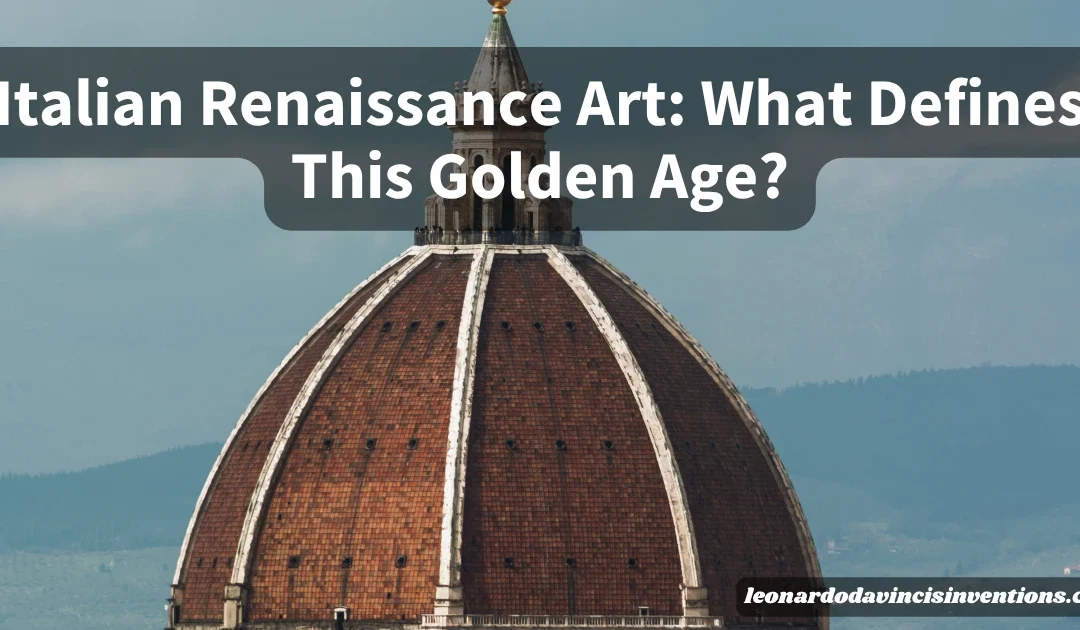
Architecture During The Renaissance: What Defined It?
(Last updated: May 2026)
Architecture during the Renaissance was one of the most dramatic transformations in the history of human design — a moment when builders, artists, and thinkers deliberately turned away from the towering spires of the medieval world and reached instead toward the calm, rational beauty of ancient Greece and Rome.
This shift was not just aesthetic but reflected a new understanding of humanity’s place in the world. Renaissance architects designed buildings based on harmony, proportion, and classical ideals, creating spaces that felt deeply human.
Leonardo da Vinci, though he built little, explored bold architectural ideas through his notebooks, revealing remarkable insight. Understanding these principles transforms how you experience Renaissance cities like Florence, Milan, and Rome.
This post is all about architecture during the Renaissance — its origins, defining features, greatest buildings, and enduring legacy in the modern world.
What Is Architecture During the Renaissance?
Renaissance architecture began in 15th-century Italy and spread across Europe. Inspired by classical antiquity, it emphasized symmetry, proportion, and geometric design using columns, arches, and domes. It became the foundation for much of Western architecture.
The Origins of Renaissance Architecture
To understand the Renaissance, you first need to understand what came before it. For most of the medieval period, European architecture was defined by the Gothic style — soaring cathedrals with pointed arches, ribbed vaults, flying buttresses, and vast stained-glass windows that seemed to dissolve the stone walls in colored light.
Gothic vs. Renaissance architecture is one of the great contrasts in art history. Where Gothic buildings aimed for the vertical — reaching toward heaven — Renaissance buildings sought the horizontal. They emphasized the ground plane, the human scale, and the careful balance of parts. This was a revolution driven by ideas, not just by changing tastes in stone.
Humanism in Architecture: The Human at the Center
The philosophical movement known as humanism placed the human being, rather than the divine, at the center of intellectual life. In architecture, this translated into a new concern with human proportion.
Filippo Brunelleschi, working in Florence in the early 1400s, studied the ruins of ancient Rome with a tape measure in hand. He returned with a renewed understanding of the classical orders — Doric, Ionic, and Corinthian — and applied them to new buildings in ways that felt both ancient and thrillingly fresh.
The idea that architecture should reflect human dignity and rational order became one of the defining principles of the age. Buildings were no longer simply functional shelters or expressions of religious awe. They became statements about what it meant to be human in a newly confident civilization.
Architects During the Renaissance: The Founding Figures
Three figures of early Renaissance architecture and their contributions.
| Architect | Key Contribution | Notable Works | Impact on Renaissance Architecture |
|---|---|---|---|
| Filippo Brunelleschi | Pioneered Renaissance architecture through engineering and classical design | Florence Cathedral Dome, Ospedale degli Innocenti | Launched Renaissance architecture and revived classical design principles |
| Leon Battista Alberti | Defined Renaissance architecture through scholarly theory | De re aedificatoria (architectural treatise) | Set classical design rules that shaped European architecture |
| Michelozzo di Bartolomeo | Applied Renaissance ideals to urban living and palace design | Medici Palace (Palazzo Medici Riccardi) | Blended grandeur with function in Renaissance homes |
Later generations added new voices. Donato Bramante brought the style to Rome and designed the original plan for St. Peter’s Basilica.
Andrea Palladio, working in the Veneto in the 16th century, synthesized everything that had come before into a body of work so influential that it gave its name to an entire architectural tradition: Palladian architecture. His Four Books of Architecture became the bible of builders across Europe and the Americas for the next three centuries.
Leonardo da Vinci and the Architecture of the Mind
Leonardo da Vinci never built a major structure, but his architectural thinking was extraordinary. His notebooks contain hundreds of drawings of ideal cities, centrally planned churches, military fortifications, and hydraulic systems. He worked alongside Bramante in Milan and contributed ideas for the crossing tower of Milan Cathedral.
What set Leonardo apart was his insistence on understanding structure from the inside out. He studied how forces moved through arches and vaults, as he did how blood moved through the body. Architecture, for Leonardo, was not decoration applied to structure — it was structure made beautiful by necessity.
Renaissance Architecture Characteristics and Features
Renaissance architecture has a set of clearly recognizable features. Once you know what to look for, you will spot them everywhere — from the churches of Florence to the country houses of England to the neoclassical buildings of Washington, D.C.
The Defining Characteristics of Renaissance Architecture Style
The most fundamental characteristic is symmetry. Renaissance buildings are almost always symmetrical along a central axis. This was a deliberate rejection of the organic, asymmetric growth of medieval buildings, which were often added to over centuries without any master plan.
Key features of the Renaissance architectural style include:
- Columns and pilasters based on the classical orders (Doric, Ionic, Corinthian)
- Round arches, in contrast to the pointed Gothic arch
- Hemispherical domes, often set on a drum to increase their visual height
- Flat or coffered ceilings, replacing Gothic ribbed vaults
- Rusticated stonework at the base of buildings, giving a sense of solidity
- Pediments above doors and windows, borrowed from ancient temples
- Mathematical proportions governing the relationship between all parts of a building
Renaissance Architecture Features in Religious Buildings
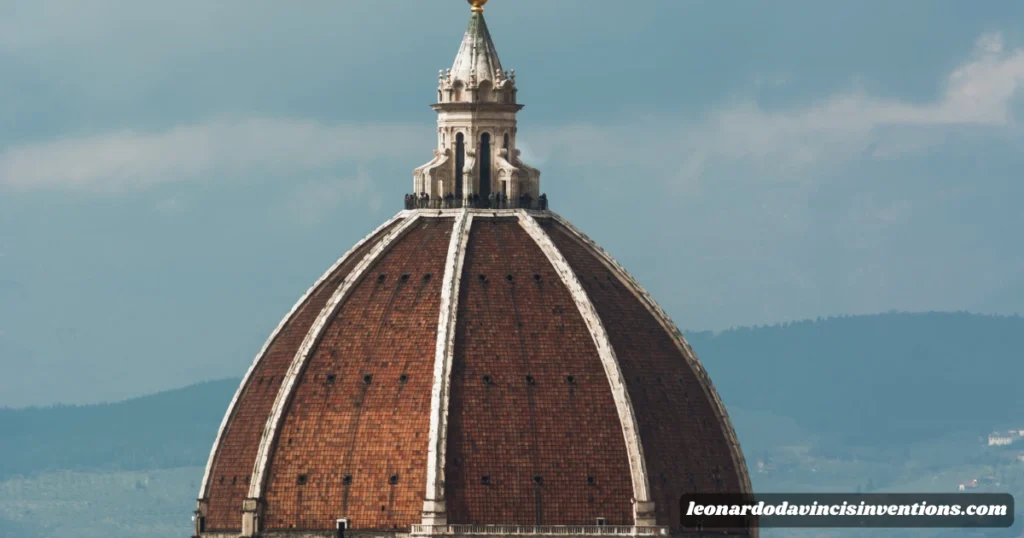
Renaissance cathedrals and churches represent some of the most ambitious architectural experiments of the age. The dome was the supreme challenge. Brunelleschi’s dome for Florence Cathedral, completed in 1436, remains one of the greatest engineering achievements in history.
It was built without a traditional wooden centering frame — a feat that had seemed impossible until Brunelleschi solved it through a combination of innovation and genius.
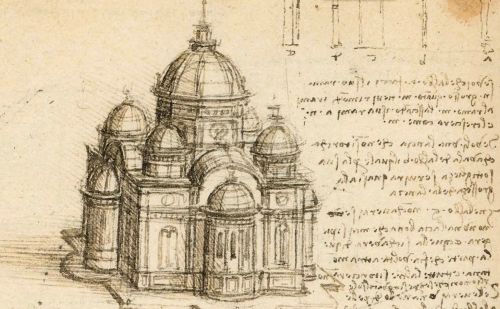
Later Renaissance churches, like Bramante’s Tempietto in Rome (1502), explored the idea of the centrally planned church — a building whose geometry radiates outward from a central point, like a circle or a Greek cross. Leonardo himself sketched numerous variations on this theme in his notebooks, imagining churches whose perfect geometry would mirror the perfection of divine creation.
The Renaissance Architecture Drawing Tradition
One of the signal achievements of the Renaissance was the development of architectural drawing as a discipline. Medieval builders worked from rough sketches and relied on accumulated craft knowledge. Renaissance architects developed precise orthographic drawings — plans, elevations, and sections — that allowed complex buildings to be fully designed on paper before a single stone was laid.
Leonardo’s architectural drawings are among the most beautiful and technically sophisticated of the period. His plans for centrally planned churches, his studies of staircase geometry, and his investigations of dome construction combine the precision of an engineer with the vision of an artist. These drawings are now preserved in codices in Milan, Paris, and Windsor, and they continue to astonish architects and historians.
Renaissance Architecture Examples
The best way to understand Renaissance architecture is to look at specific buildings. Each of the following examples illustrates a different aspect of the movement’s ideals and ambitions.
Italian Renaissance Architecture: The Florentine Foundations
Florence is where the Renaissance began, and its architecture tells the story better than any textbook. Brunelleschi’s Ospedale degli Innocenti (1419–1427) is often cited as the first true Renaissance building — a loggia of slender Corinthian columns and round arches that replaced the heavy, irregular forms of the Gothic period with something light, rational, and deeply satisfying.
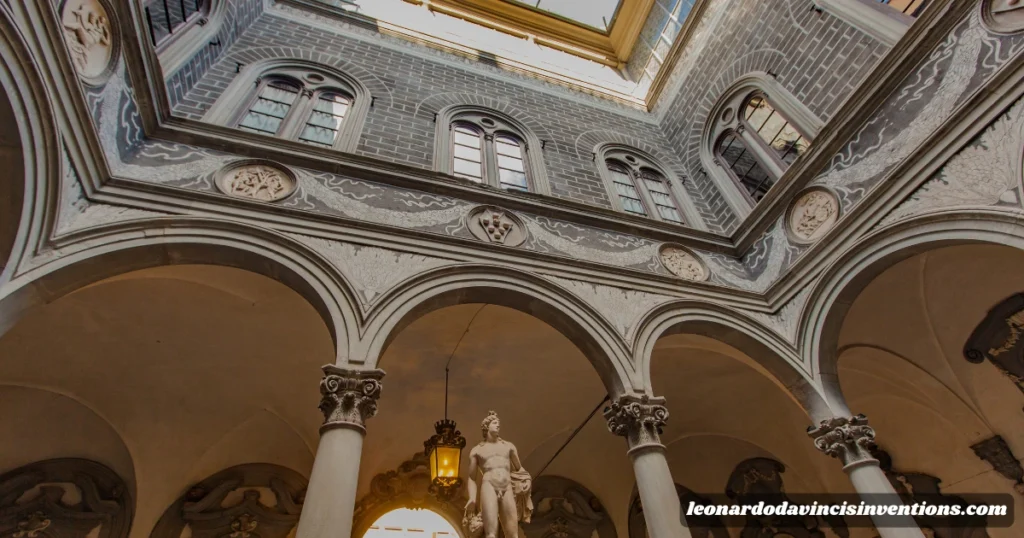
The Palazzo Medici Riccardi, designed by Michelozzo, introduced the Renaissance palace type: three stories of rusticated stone, each story slightly lighter in weight and texture than the one below, crowned by a projecting classical cornice. This formula was copied across Italy and eventually across Europe.
Architecture in Florence during the Renaissance effectively invented the model for the urban residence that architects followed for the next four centuries.
High Renaissance Architecture: Rome and the Grand Vision
The High Renaissance, roughly from 1490 to 1527, saw the center of architectural innovation shift from Florence to Rome. The papacy, newly wealthy and newly ambitious, commissioned buildings on a scale that dwarfed anything built in Florence.
The project that dominated the age was the rebuilding of St. Peter’s Basilica, which consumed the energies of Bramante, Raphael, Antonio da Sangallo, Michelangelo, and finally Giacomo della Porta before it was completed.
Michelangelo‘s contribution — the great dome, completed after his death — is perhaps the single most influential piece of architecture in the Western tradition. It set the template for capital domes around the world, from the Pantheon in Paris to the Capitol in Washington, D.C.
French and Spanish Renaissance Architecture: The Style Goes North
As the 16th century progressed, Renaissance ideas spread northward across the Alps. In France, the style arrived through Italian artists and architects invited to the French court.
The Château de Chambord (begun 1519) is the most famous example of French Renaissance architecture — a vast hunting lodge that combines an Italian symmetrical plan with a French roofscape of towers and chimneys that owes much to the Gothic tradition.
Spanish Renaissance architecture, known as Plateresque in its early phase for its resemblance to silverwork, mixed Italian classical details with exuberant surface decoration rooted in the Gothic and Moorish traditions. The façade of the University of Salamanca is perhaps the finest example — a wall of stone so richly carved that it seems to vibrate.
Later Spanish Renaissance architecture, under the influence of Juan de Herrera, turned toward a severe, unornamented classicism, best seen in the massive monastery-palace of El Escorial.
Baroque and Renaissance Architecture
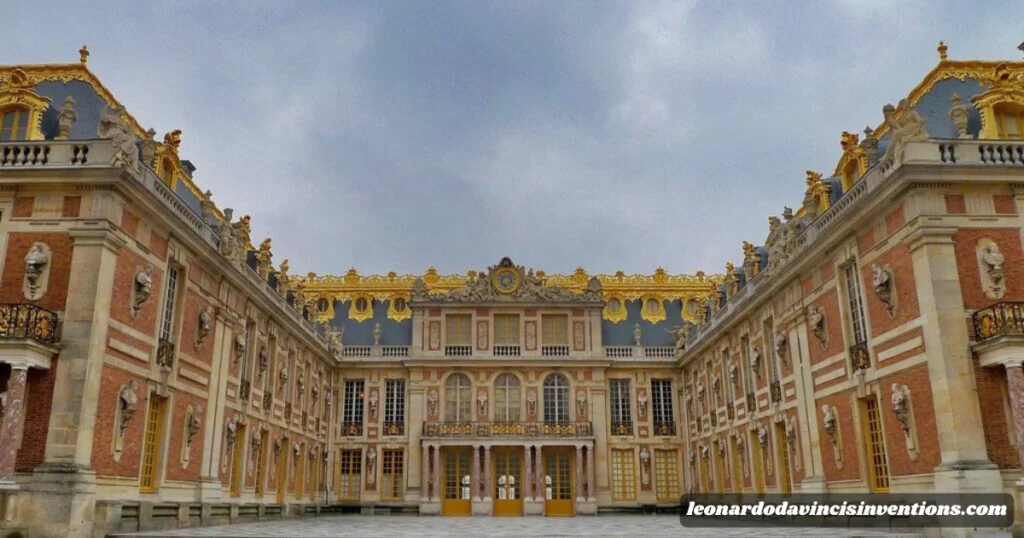
The Baroque style that emerged around 1600 did not break completely with the Renaissance. It grew from it, keeping the classical vocabulary of columns, arches, and domes, but inflating and dramatizing them to create effects of overwhelming grandeur and emotional power.
Evolution of architectural styles (From Gothic to Baroque).
| Architectural Style | Time Period | Key Characteristics | Significance |
|---|---|---|---|
| Gothic | 12th–15th century | Pointed arches, ribbed vaults, flying buttresses, vertical emphasis | Dominated medieval Europe; focused on height, light, and religious grandeur |
| Early Renaissance | 15th century | Symmetry, proportion, columns, domes, classical Roman inspiration | Marked a return to classical antiquity; began in Florence with Brunelleschi |
| High Renaissance | Late 15th–early 16th century | Harmony, balance, geometric clarity, monumental scale | Perfected classical ideals; architecture became more refined and unified |
| Baroque | 17th century | Dramatic forms, bold ornamentation, contrast of light and shadow | Emphasized emotion and grandeur; often used to express power and religion |
Characteristics of Baroque Architecture: The Renaissance Pushed to Its Limits
Where Renaissance architecture prized calm and rational order, Baroque architecture sought movement, drama, and surprise. Curved facades replaced flat ones. Columns twisted like corkscrews. Light was manipulated through hidden windows to create theatrical effects that seemed almost supernatural.
The key characteristics of Baroque architecture include exaggerated ornamentation, dramatic use of light and shadow (known as chiaroscuro, a term borrowed from painting), curved and dynamic forms, grand staircases and spatial sequences, and a deliberate effort to engage the viewer’s emotions rather than simply satisfy the intellect.
Renaissance Revival Architecture: The Style Reborn
The influence of the Renaissance did not end with the Baroque period. In the 19th century, a wave of Renaissance revival architecture swept across Europe and North America. Architects looking for a style that combined grandeur with classical legitimacy returned to the models of 15th- and 16th-century Italy.
Banks, libraries, museums, and government buildings across the United States and Britain were built in this Renaissance revival mode — their rusticated stone bases, round-arched windows, and projecting cornices all echoing the Florentine palaces of Michelozzo and Alberti. The style communicated stability, learning, and civic virtue — qualities that the patrons of these institutions wanted their buildings to project.
Where to Experience Leonardo’s Legacy: Renaissance Cities and Museums
Understanding Renaissance architecture is one thing. Standing inside a Brunelleschi church or beneath the dome of St. Peter’s is something else entirely.
These buildings were designed to be experienced with the body, not just admired from photographs. For travelers, the cities of Italy — and several cities beyond — offer unmatched opportunities to encounter Renaissance architecture in person.
Florence: The Birthplace of Renaissance Architecture
Florence is the essential destination for anyone interested in Renaissance architecture. The Cathedral and Brunelleschi’s dome, the Ospedale degli Innocenti, the Palazzo Vecchio, the Palazzo Medici Riccardi, the Basilica of San Lorenzo — the city is an open-air museum of the style’s development from its earliest experiments to its fullest expression.
The Uffizi Gallery, one of the world’s great Leonardo museums and Renaissance art destinations, houses works that illuminate the connection between art and architecture during the Renaissance. Paintings by Botticelli, Leonardo, and Raphael are set against architectural backgrounds that tell you as much about Renaissance space as any building you can visit.
Milan: Where Leonardo Built His Ideas
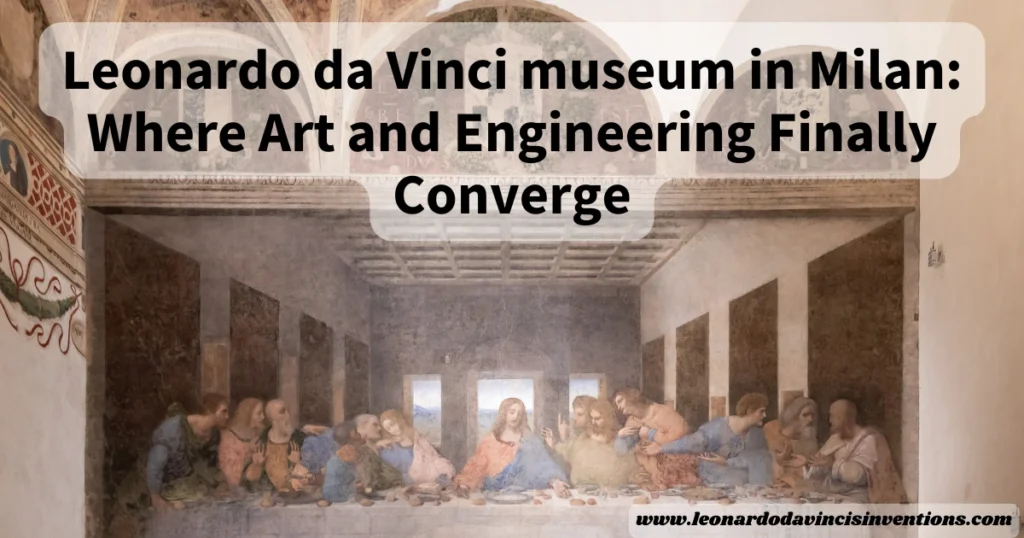
Milan was Leonardo’s home for nearly twenty years, and the city retains powerful traces of his presence. The refectory of Santa Maria delle Grazie, where The Last Supper is painted on the wall, is both a Renaissance architectural space and one of the most important exhibitions of Leonardo’s work in the world. The building itself, with its elegant brickwork and graceful apse, conveys the refined Lombard Renaissance style that surrounded Leonardo during his most productive years.
The Biblioteca Ambrosiana holds important Leonardo manuscripts, including the Codex Atlanticus, his largest surviving collection of drawings. The Museo Nazionale della Scienza e della Tecnologia displays wooden models of many of his mechanical and architectural inventions — a remarkable way to see his ideas brought to life in three dimensions.
Vinci and Paris: Following Leonardo Across Borders
The town of Vinci, Leonardo’s birthplace in the Tuscan hills, houses the Museo Leonardiano — one of the finest specialist Leonardo museums in the world. Its collection of models, reproductions, and documents brings Leonardo’s inventive mind to life in a setting surrounded by the Tuscan landscape he knew as a child.
Paris is the other essential city on any Leonardo trail. The Louvre holds the Mona Lisa and several other Leonardo paintings, as well as one of the world’s richest collections of Renaissance art and architecture drawings.
Leonardo spent the last three years of his life in France as a guest of King Francis I, living at the Château du Clos Lucé near Amboise. That château is now a museum dedicated to his life and work, with an extraordinary park of full-scale models of his machines.
Experience Leonardo’s World in Person
Visiting Renaissance cities and Leonardo museums is one of the most rewarding cultural experiences available to modern travelers. The buildings, artworks, and archives of the Renaissance are remarkably well preserved, and the institutions that care for them are deeply committed to making them accessible to general visitors.
Guided Tours of Renaissance Architecture
A knowledgeable guide transforms a visit to any Renaissance site. In Florence, specialist architectural tours of the cathedral complex explain how Brunelleschi solved the engineering problems of the dome in ways that no photograph or diagram can fully convey.
In Milan, guided visits to The Last Supper are tightly controlled — only small groups are admitted for short periods — but the experience of standing before Leonardo’s masterpiece in its original architectural setting is unforgettable.
Leonardo Exhibitions and Permanent Collections
Major Leonardo exhibitions are held regularly across Europe, often marking anniversaries of his birth or death. These temporary exhibitions bring together drawings, codices, and paintings from collections around the world, offering the rare opportunity to see works that are normally scattered across different institutions.
Planning to explore Leonardo da Vinci’s world in 2026?
| Exhibition / Museum | Location | Dates | What to See | Best For | Booking Needed |
|---|---|---|---|---|---|
| Leonardo da Vinci – 500 Years of Genius | Miami, USA | Until April 2026 | Immersive exhibits, interactive displays, reconstructed inventions | Families, interactive learners | Recommended |
| DaVinci The Exhibition | Detroit, USA | Oct 2025 – May 2026 | 65+ machine models, artwork studies, hands-on STEM displays | Students, engineering fans | Recommended |
| Leonardo da Vinci: Art & Science | Côte d’Azur, France | Feb – June 2026 | Art-science exhibits, cultural programs, educational displays | Art lovers, cultural travelers | Recommended |
| Leonardo da Vinci Museum (New Opening) | Pueblo, USA | Opening Spring 2026 | Permanent interactive museum, invention-focused exhibits | Families, year-round visitors | Optional |
For travelers planning a dedicated Leonardo journey, the key permanent collections are at the Louvre in Paris, the Uffizi in Florence, the Pinacoteca Ambrosiana in Milan, the Royal Collection at Windsor (which holds the largest collection of Leonardo drawings in the world), and the Museo Leonardiano in Vinci.
Each of these institutions offers a different facet of Leonardo’s genius — and together they constitute an incomparable education in Renaissance art and architecture.
Practical Tips for Renaissance Architecture Tourism
Visiting Renaissance cities requires some planning. In Florence, book tickets for the dome climb and the Uffizi well in advance, especially in summer. In Milan, Last Supper reservations often sell out weeks or months ahead.
Many of the most rewarding Renaissance architecture experiences — simply walking the streets of a historic center, sitting in a piazza surrounded by 15th-century buildings, or visiting a smaller church with frescoes intact — require no ticket.
Final Thoughts
This post was all about architecture during the Renaissance, from its humanist origins in early 15th-century Florence to its global legacy in revival styles that shaped the modern built environment. Along the way, it traced the ideas of symmetry, proportion, and classical order that defined the movement — and the extraordinary minds, from Brunelleschi to Palladio, who gave those ideas physical form.
Leonardo da Vinci was not primarily an architect, but his work reveals the depth of his genius. He studied architecture as he did everything else—seeking to understand its underlying principles.
His drawings were not just artistic but showed how structures and the world itself function. Even today, Renaissance architecture continues to shape modern cities, reflecting Leonardo’s lasting influence and vision.
FAQs about Architecture During The Renaissance
Architecture during the Renaissance marked a return to classical Greek and Roman design, replacing the Gothic style. Buildings emphasized symmetry, proportion, and geometry, with features like columns, arches, and domes. It reflected humanist ideas, focusing on balance and harmony in design.
A key characteristic of Renaissance architecture is symmetry, where buildings are designed with balanced proportions around a central axis. This creates harmony and order, reflecting classical ideals of beauty and rational design.
The Renaissance is characterized by humanism, a revival of classical antiquity, emphasis on proportion and symmetry, scientific inquiry, artistic realism, use of perspective, and cultural innovation across art, architecture, and science. These traits shaped both architecture and broader intellectual life.
Famous examples include Brunelleschi’s dome of Florence Cathedral, St. Peter’s Basilica in Rome, and the Palazzo Medici in Florence. These buildings showcase classical elements like domes, columns, and harmonious proportions.
Renaissance architecture began in Florence, Italy, in the early 15th century. From there, it spread across Italy and eventually throughout Europe, influencing cities like Rome, Venice, and beyond.
The Renaissance style is defined by a revival of classical Greek and Roman principles, including symmetry, proportion, and the use of architectural elements like columns, arches, and domes. It emphasizes harmony, balance, and a human-centered design approach.
Related Post You May Like


Disclosure: This page may contain affiliate links. If you choose an experience through them, it helps support the site at no extra cost to you.
 Leonardo Bianchi is the founder of Leonardo da Vinci Inventions & Experiences, a travel and research guide exploring where to experience Leonardo’s art, engineering, and legacy across Italy and Paris.