
(Last updated: Sep 2026)
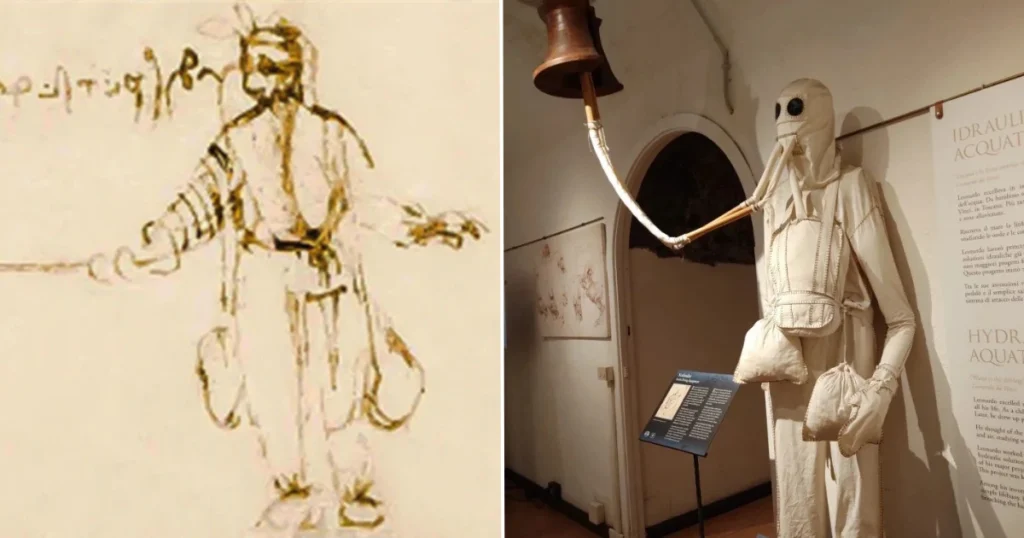
The Leonardo da Vinci diving suit is one of the strangest and most quietly brilliant ideas to come out of the Renaissance mind that gave us the flying machine and the armored tank. Long before anyone had a working theory of underwater breathing, Leonardo was sketching leather suits, hollow canes, and floating breathing tubes meant to let a person walk unseen along the harbor floor.
It's easy to picture Leonardo only as a painter. But sketches like this one reveal a different side of him: an engineer thinking about warfare, survival, and the physical limits of the human body underwater.
Understanding this invention adds depth to any visit to the cities where he lived and worked, because it shows a Renaissance mind solving problems centuries before the technology existed to test them.
This post is all about the Leonardo da Vinci diving suit — how it worked, why he designed it, and where you can still see the ideas behind it today.
What is the Leonardo da Vinci Diving Suit?
The Leonardo da Vinci diving suit is a set of underwater breathing designs Leonardo sketched around 1500, combining a leather suit, a face mask, and reed or cane tubes connected to a floating air source. It was conceived as a tool for underwater sabotage, not exploration, and it was never built or tested during his lifetime.
The Engineering Idea Behind Leonardo da Vinci Diving Suit
A Renaissance Response to Naval Warfare
Leonardo sketched his underwater breathing devices while he was working in Venice, a city whose entire identity depended on control of the sea.
Venice was bracing for a possible naval attack by the Ottoman fleet, and Leonardo, always drawn to problems of defense, began thinking about how a diver could approach an enemy ship unseen and disable it from below the waterline.
This wasn't idle curiosity. Renaissance engineers were regularly hired to solve military problems, and an underwater saboteur capable of drilling holes in hulls or cutting anchor ropes would have been a genuinely useful weapon.
The diving suit sketches sit alongside notes on other underwater tools, including proposals for divers to attack ships from beneath, connecting the invention directly to Venice's naval anxieties.
Sketches Hidden in the Codex Atlanticus
The designs survive in the Codex Atlanticus, the largest collection of Leonardo's papers, now held in Milan. The drawings are sparse compared to his anatomical studies, more technical shorthand than finished illustration, which is part of why historians debate exactly how the full apparatus was meant to fit together.
Travelers who want to see how these Renaissance-era defense concerns shaped the city can trace the connection further with a guided walk through Venice's historic naval sites, which place Leonardo's era of maritime tension in a physical, walkable context.
How Leonardo da Vinci Diving Suit Works
The Leather Suit and Breathing Tubes
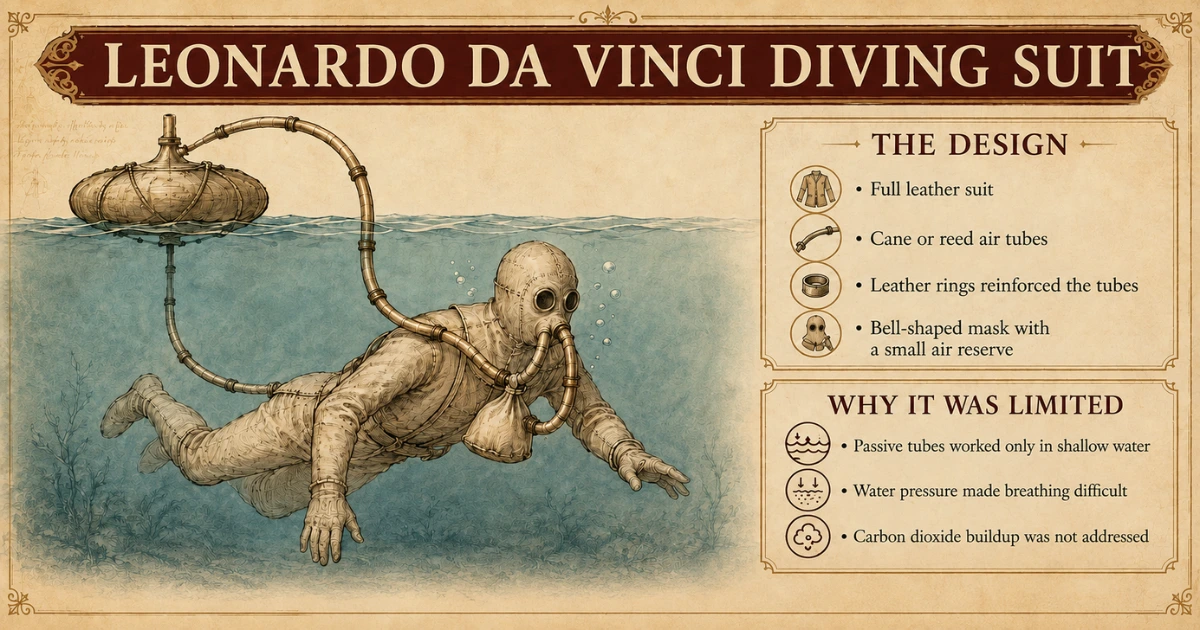
Leonardo's design called for a full leather suit meant to keep the diver dry and somewhat insulated. Air would travel to the diver through cane or reed tubes running up to the surface, reinforced with leather rings to stop them from collapsing under water pressure.
A separate sketch shows a bell-shaped mask with a bag attachment, an early attempt at trapping a small reserve of air near the face.
Design Challenges and Limitations
The core problem Leonardo never fully solved is water pressure. A simple tube open to the surface only works in very shallow water; beyond a few feet, pressure makes it nearly impossible to draw breath through a passive tube.
There's also no evidence he accounted for carbon dioxide buildup inside an enclosed mask. This is why Leonardo da Vinci's diving suit worked: it's really two separate questions: the concept was sound, but the physics of deeper, sustained diving was beyond what any Renaissance workshop could engineer.
He was decades ahead of the marine biology and physics needed to make it fully functional.
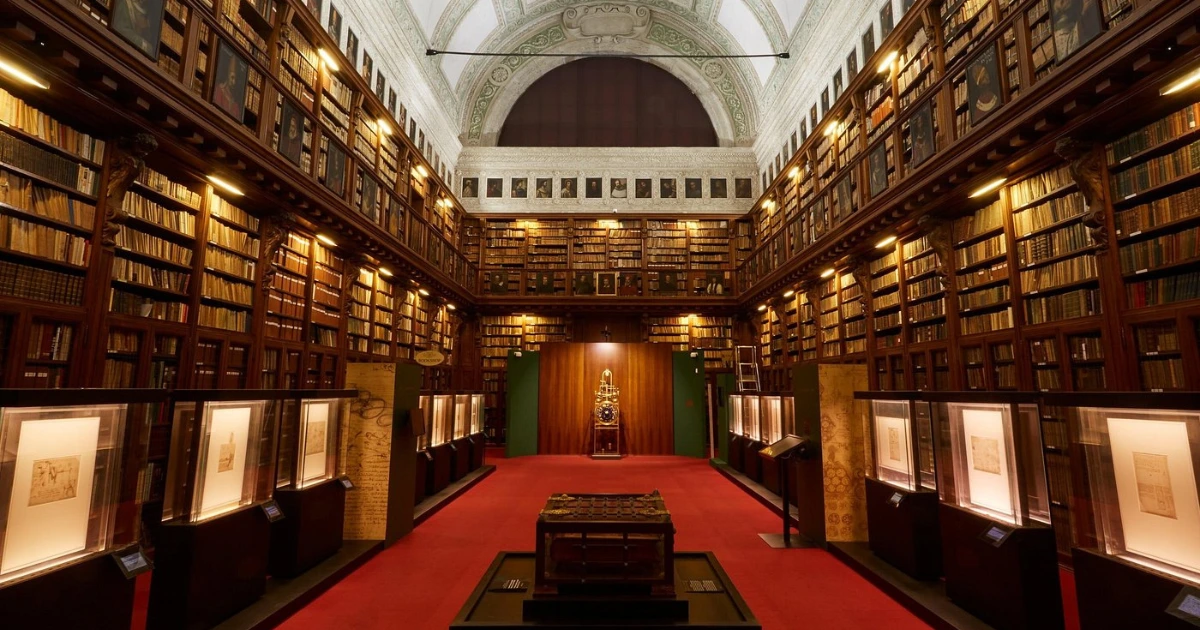
See the Codex Atlanticus
Step inside the Biblioteca Ambrosiana to see rotating sheets from Leonardo’s largest surviving notebook and explore its historic art collection.
See Codex Atlanticus TicketsCodex Atlanticus & Leonardo's Milan
A guided visit through Milan's Leonardo collections places the diving suit sketches alongside his other engineering studies.
- Access to sites connected to the Codex Atlanticus
- Context on Leonardo's military and engineering commissions
- Small-group pacing suited to close viewing of manuscript pages
Many visitors find that seeing the original sketch scale changes how they read the invention entirely. Check availability for Milan Leonardo tours
Where to See Leonardo da Vinci Diving Suit Today
Original Sketches in Milan and Venice
The original Leonardo da Vinci diving suit sketch pages are held at the Biblioteca Ambrosiana in Milan, in the Codex Atlanticus. Because manuscript pages are light-sensitive, the specific folios on public display rotate, so the diving suit sketch isn't always the page showing at any given time.
Venice itself holds no original manuscript, but it holds the historical context: this is the city the invention was built to defend.
Museum Reconstructions and Models
Several Leonardo-themed science museums, including exhibits in Milan and traveling exhibitions across Europe, have built physical models based on the diving suit facts recorded in his notebooks. These reconstructions help visitors understand the engineering logic in three dimensions in a way the flat sketch alone doesn't communicate.
Experiencing Leonardo's Underwater Vision in Venice
Standing on the Venetian lagoon, it's easier to understand why an underwater weapon made sense here. The city has no land defenses in the traditional sense — the water is the wall. Leonardo's diving suit was one answer to a very specific, very real threat: an enemy fleet approaching by sea with no easy way to stop it on land.
Visiting Venice with this invention in mind changes what you notice. The canals, the shipyards of the old Arsenale, the maritime museums along the waterfront — all of it connects back to the same defensive logic that shaped Leonardo's sketch.
A focused walking route through these sites lets you see firsthand what the diving suit was designed to protect against.
Before deciding how to spend a day here, it's worth knowing that a small-group Venice Arsenale and maritime history tour covers this exact stretch of naval history in more depth than a self-guided walk typically allows.
Exploring Leonardo da Vinci in Venice
Venice is only one stop in Leonardo's much longer story. His formative training happened in Florence, where he apprenticed and painted some of his earliest known works. His most productive engineering years were spent in Milan, home to the Codex Atlanticus itself. His final years were spent near the French court, a chapter explored further in coverage of Paris.
For travelers building a Leonardo-focused itinerary, it's worth also looking at his connections to Rome, where he worked under papal patronage later in life. Each city holds a different piece of the engineering mind that produced the diving suit, the flying machine, and the tank.
Final Thoughts
This post was all about the Leonardo da Vinci diving suit and what it reveals about a mind that never stopped asking "what if."
The suit was never built, never tested, and would have failed in real ocean depths — but the thinking behind it, the leather sealing, the tube-fed air, the attempt to solve a problem no one else was even asking for, is unmistakably Renaissance in its ambition.
That's really the pattern across all of Leonardo's inventions, from the diving suit to the flying machine. Seeing the sketches in person, in the cities that shaped them, turns a paragraph in a textbook into something you can stand in front of and actually understand.
Related Post You May Like

Disclosure: This page may contain affiliate links. If you book through them, we may earn a small commission at no extra cost to you. Learn more.
Free Leonardo Milan Travel Guide
Plan Your Leonardo Trip in Milan
A premium mini guidebook for smarter Milan planning, including the best ticket strategy, Leonardo map, and practical visitor advice.
Get the Free Guide
Download the guide and receive practical Milan planning tips by email.
Download the Free Guide >> Leonardo Bianchi is the founder of Leonardo da Vinci Inventions & Experiences, a cultural travel guide helping visitors explore Leonardo da Vinci’s art, inventions, and legacy across Italy and Paris.