
(Last updated: April 2026)
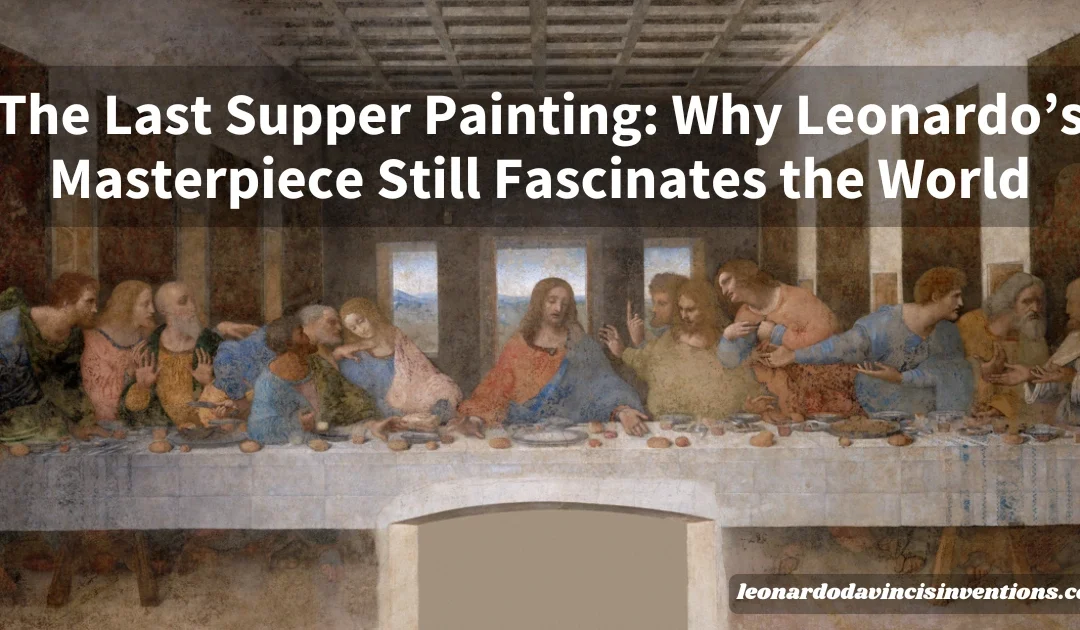
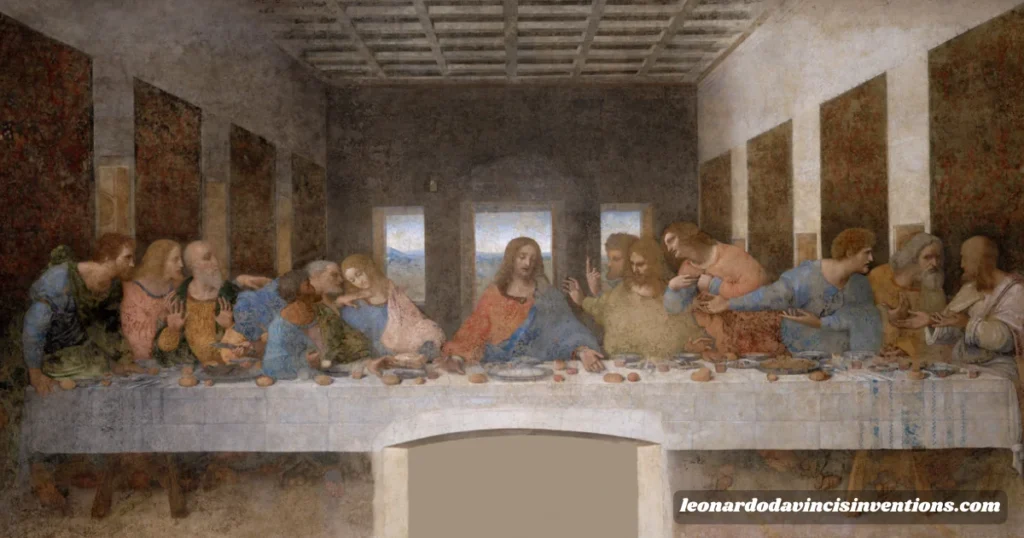
The Last Supper painting is one of the most recognized and deeply studied works of art in human history. Created by Leonardo da Vinci in late 15th-century Milan, it captures a single, charged moment from the Gospel of John with a psychological precision that no painting before it had achieved.
What makes this work so extraordinary is not just its subject. It is the way Leonardo approached storytelling through paint — building tension, capturing emotion, and using geometry and light in ways that feel almost theatrical. Standing in front of it today, even in its weathered state, visitors often describe the experience as quietly overwhelming.
The painting has survived wars, floods, and centuries of neglect. It has been reproduced millions of times. And yet nothing compares to seeing the original, preserved in the refectory of Santa Maria delle Grazie in Milan. The scale alone — nearly nine meters wide — changes how you understand it completely.
Historically, the da Vinci Last Supper marks a turning point in Western art. It helped define what the High Renaissance would become: a period in which human emotion, narrative depth, and scientific observation merged into something entirely new. Understanding this painting means understanding that moment in history.
This post is all about The Last Supper painting — its origins, its meaning, and how you can experience it in person today.
What Is The Last Supper Painting?
The Last Supper painting is a monumental mural by Leonardo da Vinci, painted between approximately 1495 and 1498 on a wall of the refectory at Santa Maria delle Grazie in Milan, Italy. It depicts the moment Jesus announces that one of his apostles will betray him, capturing twelve distinct emotional reactions in a single, unified scene.
The Artistic Genius Behind The Last Supper Painting
Leonardo da Vinci received the commission from Ludovico Sforza, the Duke of Milan, sometime around 1495. The work was meant for the dining hall — or refectory — of the Dominican convent attached to Santa Maria delle Grazie. It was intended to inspire the monks who ate there daily. What Leonardo delivered went far beyond a devotional image.
Leonardo’s Experimental Technique
One of the most important facts about the Last Supper painting is that Leonardo did not use the traditional fresco technique. Fresco requires painting quickly onto wet plaster, which did not suit Leonardo’s slow, methodical process. Instead, he applied tempera and oil-based paint directly onto a dry plaster wall that had been coated with a special sealant.
This gave him more time to revise and layer. But it also made the painting extremely vulnerable to moisture and temperature changes. The deterioration began within decades of its completion. That fragility is part of the reason the work feels so precious today — seeing it is a kind of privilege.
Renaissance Innovation in Composition
The genius of the da Vinci Last Supper lies in its composition. The apostles are arranged in four groups of three on either side of Christ, who sits alone at the center. The architectural lines of the room — the ceiling, the tapestries, the windows — all converge toward Jesus in a single vanishing point. Your eye has no choice but to rest on him.
At the same time, every figure is doing something different. Each one reacts to the announcement of betrayal in a way that reflects his individual character. Leonardo studied human expression obsessively. He reportedly visited the city’s jails and streets to observe extreme emotional states, using those observations to build the faces you see on the wall.
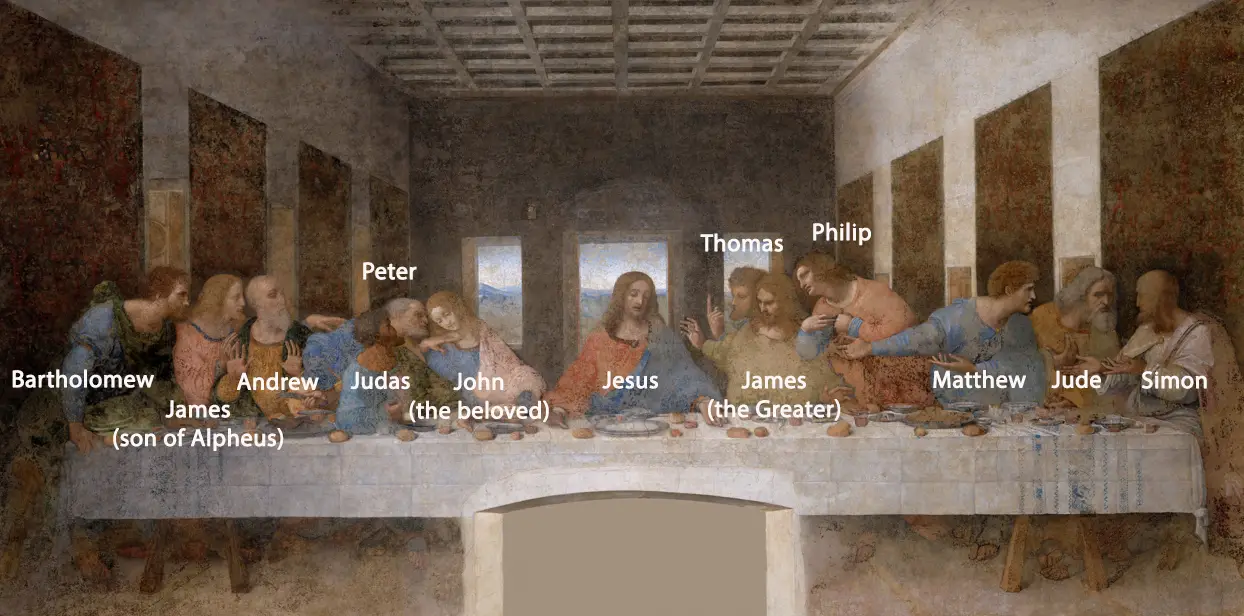
From left to right:
– Bartholomew: referred to as Nathaniel
– James, son of Alphaeus: Spent three years witnessing the teachings of Jesus
– Andrew: The first disciple to be called to follow Jesus
– Peter: His name means ‘rock,’ denied Jesus thrice but repented.
– Judas Iscariot: Betrayed Jesus
– John the Beloved: The youngest disciple and Jesus’ favorite
– Jesus
– Thomas: Doubted Jesus after His resurrection
– James the Greater: The first disciple to be martyred
– Philip: A disciple from the city of Bethsaida
– Matthew: Once a tax collector before becoming a disciple
– Jude Thaddeus: Often shown with a flame around his head
– Simon the Zealot: One of the most obscure apostles
Where Is Judas in The Last Supper Painting?
Many visitors ask: Where is Judas in the Last Supper painting? Unlike earlier depictions, where Judas was often isolated on the opposite side of the table, Leonardo places him among the other apostles. He sits third from the left — slightly recoiled, gripping a small bag (believed to represent the thirty pieces of silver), his face cast in subtle shadow.
This placement was revolutionary. It created psychological ambiguity rather than simple moral labeling. It forced the viewer to look closer, to read the figures more carefully. That demand for active looking is part of what makes the painting feel so modern.
Why The Last Supper Painting Became Famous
The original Last Supper painting became famous during Leonardo’s own lifetime. Visitors traveled to Milan specifically to see it. The writer Luca Pacioli, Leonardo’s friend and collaborator, described the work in 1498 as already incomparable. Its fame never really faded — even as the paint began to deteriorate.
Historical Events That Shaped Its Survival
The painting has survived remarkable hardships. In 1652, a doorway was cut through the wall directly below it, removing the feet of several figures. In World War II, the building was bombed, and the roof collapsed — but the wall bearing the painting was protected by sandbags and somehow held. Napoleon’s troops once used the refectory as a stable. Moisture, salt, and pollution have all taken their toll.
What we see today is in many ways a composite: layers of different restoration efforts, some more careful than others. A major restoration completed in 1999 took twenty-two years and aimed to remove as many of the damaging overpaints as possible, bringing the surviving original pigment back into view.
Cultural Impact Across Centuries
The Leonardo da Vinci painting The Last Supper has influenced art, theology, and popular culture in ways almost impossible to measure. Countless artists have copied, parodied, and reinterpreted it.
It has appeared in novels, films, and political cartoons. Dan Brown’s The Da Vinci Code brought global attention to questions about the figures depicted — including the ongoing debate about the Last Supper Mary Magdalene theory, which suggests the figure to Christ’s right may not be the apostle John but Mary Magdalene herself.
Most art historians reject this interpretation. But the fact that the painting can still generate such debate, centuries after its creation, speaks to how deeply it continues to engage the imagination.
Why It Still Matters Today
Why is the Last Supper painting important? Because it changed the rules. Before Leonardo, sacred scenes were largely symbolic and hieratic. After him, they became psychological and human.
The apostles are not icons. They are individuals, caught in a moment of shock, confusion, and grief. That shift — from symbol to person — is one of the defining contributions of the High Renaissance to Western culture.
Where to See The Last Supper Painting Today
The Last Supper painting in Milan is housed in the refectory of Santa Maria delle Grazie, a UNESCO World Heritage Site. The address is Piazza di Santa Maria delle Grazie 2, in the Magenta district of central Milan. It is easily accessible by metro, tram, or on foot from most of the city’s main neighborhoods.
The Last Supper Painting Location and Visitor Experience
Visiting the Last Supper is unlike visiting most museums. Access is tightly controlled. Groups of approximately 30 visitors are admitted at a time for a 15-minute viewing session. You pass through a series of climate-controlled chambers before entering the refectory itself — a precaution designed to stabilize temperature and humidity and protect what remains of the paint.
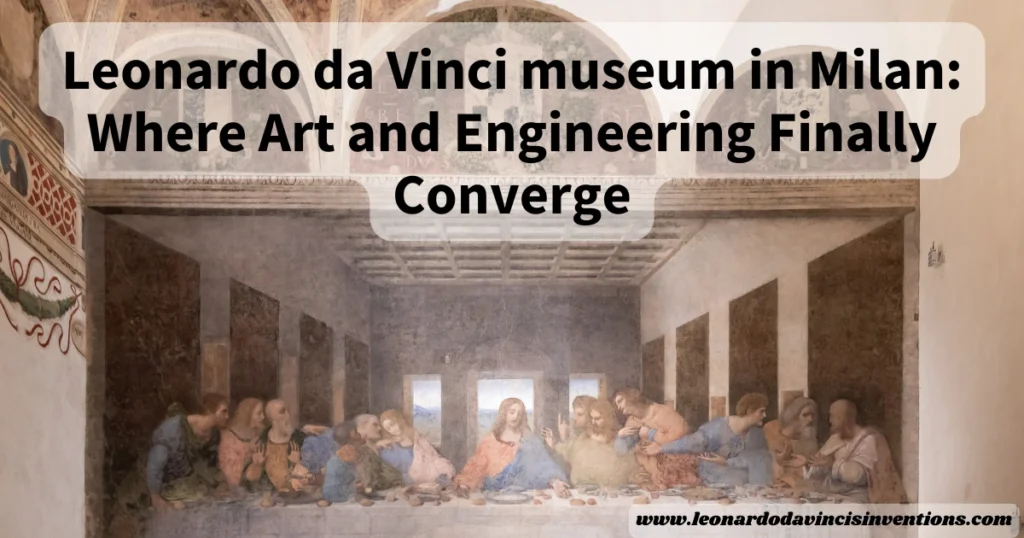
The room is quiet. The lighting is carefully managed. And then there it is — the entire north wall, covered by Leonardo’s figures, looking back at you across five hundred years. Many visitors find it genuinely emotional. The scale is the first surprise. The detail is the second. The condition — damaged, yes, but still astonishingly present — is the third.
On the opposite wall hangs a large Crucifixion fresco by Giovanni Donato da Montorfano, painted in 1495. It provides a fascinating contrast: traditional fresco technique versus Leonardo’s experimental approach, both in the same room.
Last Supper Tickets and Planning Your Visit
Last Supper tickets must be booked in advance — often weeks or months ahead, especially during peak tourist season. Walk-up availability is extremely rare. Tickets can be purchased through the official booking system or from authorized tour operators offering entrance-only access, skip-the-line options, or fully guided experiences.
A guided tour is particularly valuable here. The painting rewards context. Understanding why Leonardo placed each figure where he did, what the original colors may have looked like before centuries of damage, and how the room functioned in monastic life — all of this deepens what you see.
Many visitors choose an entrance-only ticket for flexibility, while others prefer a guided tour for deeper historical context. If you plan to see this work in person, it helps to compare ticket types before your visit — availability goes quickly, especially in spring and summer.
Nearby Leonardo Works and the Milan Museum Experience
The Last Supper is the centerpiece of any Leonardo-focused trip to Milan, but the city has more to offer. The Pinacoteca Ambrosiana holds Leonardo’s Portrait of a Musician as well as the Codex Atlanticus — a bound collection of Leonardo’s drawings and notes that represents the largest surviving collection of his written work.
The Castello Sforzesco, once home to the Sforza court that Leonardo served, contains another late Leonardo fresco in the Sala delle Asse.
Milan was Leonardo’s city for nearly two decades. Walking its streets with that in mind changes the experience entirely. The city is not just a backdrop to the painting. It is part of the story.
Exploring Leonardo da Vinci in Milan
Milan holds more of Leonardo’s legacy than perhaps any other city in the world. He arrived here around 1482, seeking patronage from Ludovico Sforza, and stayed for nearly two decades. During that time, he painted, engineered, designed festivals, and filled notebook after notebook with ideas that were centuries ahead of their time.
The city still bears the marks of his presence. From the refectory of Santa Maria delle Grazie to the grand halls of the Castello Sforzesco, from the quiet rooms of the Ambrosiana to the outdoor canal systems he helped redesign, Milan offers a layered and deeply rewarding Leonardo trail.
Explore more of his world through our guides below:
- Leonardo da Vinci in Milan — Complete City Guide
- Leonardo da Vinci in Florence — His Early Years
- Leonardo da Vinci in Paris — The Louvre Collection
- Leonardo Museums in Milan — What to See and Where
Final Thoughts
This post was all about The Last Supper painting — and the more you look at it, the more it gives back. It is a painting about betrayal and loyalty, about the fragility of a moment, and about the capacity of a single human mind to hold all of that complexity in paint.
Leonardo was not simply illustrating a scripture passage. He was thinking it through, asking questions about line, color, and shadow that no text could fully answer.
Renaissance Milan was a city alive with ambition — artistic, political, and scientific. Leonardo sat at the center of it all, working on inventions, paintings, and ideas simultaneously, never fully satisfied, always reaching.
The Last Supper painting is the most public evidence we have of that restlessness. It asks you to look carefully, to stay longer than you planned, and to leave with more questions than you arrived with. In that sense, it is the most Leonardesque thing Leonardo ever made.
FAQs about The Last Supper Painting
The real Last Supper by Leonardo da Vinci is located in the refectory (dining hall) of the Convent of Santa Maria delle Grazie in Milan, Italy, where it was originally painted on the wall in the late 15th century.
The painting shows Jesus Christ and his twelve apostles: Bartholomew, James (son of Alphaeus), Andrew, Judas Iscariot, Peter, John, Thomas, James (son of Zebedee), Philip, Matthew, Jude Thaddeus, and Simon the Zealot. Together, they form the 13 figures seated at the table.
The painting depicts the biblical moment when Jesus announces that one of his apostles will betray him, capturing each disciple’s emotional reactions. Leonardo portrays this dramatic scene from the Gospel of John with remarkable realism, perspective, and human expression.
Yes, you can visit The Last Supper in Milan, but access is strictly limited to protect the fragile mural. Visitors must book tickets in advance, and viewing is typically restricted to small groups for short time slots.
Mary Magdalene is not depicted in Leonardo’s Last Supper. The figure often mistaken for her is actually John the Apostle, traditionally shown as a youthful, beardless man seated next to Jesus.
A commonly reported account states that Leonardo da Vinci said, “I have offended God and mankind because my work did not reach the quality it should have,” expressing regret about his unfinished work.
Related Post You May Like

Disclosure: This page may contain affiliate links. If you choose an experience through them, it helps support the site at no extra cost to you.
 Leonardo Bianchi is the founder of Leonardo da Vinci Inventions & Experiences, a cultural travel guide helping visitors explore Leonardo da Vinci’s art, inventions, and legacy across Italy and Paris.