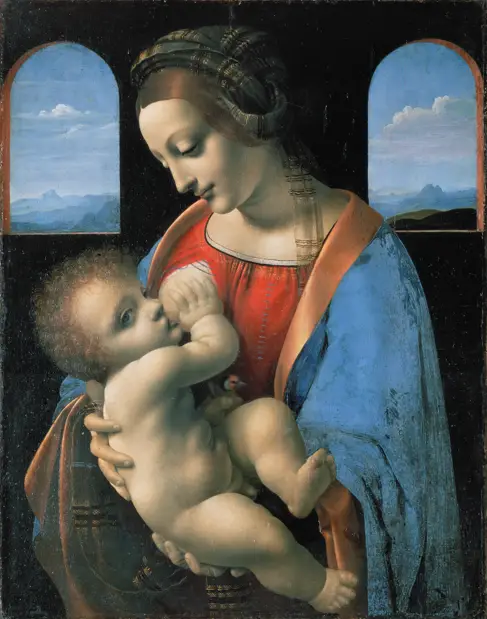
Location: Hermitage Museum, Saint Petersburg, Russia
The Madonna Litta by Leonardo da Vinci has its figures positioned in a dark room with two arched arches, similar to his earlier Madonna of the Carnation, and a mountainous scene in aerial view can be seen beyond. Christ holds a goldfinch in his left hand as a symbol of his impending Passion.
The Virgin Mary is breastfeeding Baby Jesus. While breastfeeding, Mary appears respectable. She is looking at Jesus with her eyelashes dropped. She is dressed in a brilliant red gown with an orange-copper border and a light blue mantle. She covers her head with a transparent veil, which extends under her robe to her right and left hands.
Baby Jesus has curly hair and appears to be a healthy, fat infant. He resembles, albeit slightly younger, Baby Jesus in Leonardo da Vinci’s Virgin of the Rocks in the National Gallery. Jesus enthusiastically takes his mother’s breast while glancing around to ensure he is not missing anything in his surroundings. He clutches Mary’s breast in his right hand and a goldfinch in his left.
Interestingly, Mary and Jesus do not have a halo around their heads, which is unusual for Leonardo but not uncommon in his work. In the background, two symmetrical arched windows show a mountain panorama and a blue sky with clouds.
History of the Madonna Litta
The Madonna Litta painting could be one of the Madonna and Child paintings recorded in Leonardo’s studio prior to or during his first Milanese period 1481 to 1483. Leonardo stated on a drawing in the Uffizi that he had begun “two Virgin Maries” in late 1478, and an inventory of his workshop written in 1482 (part of the Codex Atlanticus) cites two paintings of “Our Lady” once more.
According to several readings, the second of them is either “nearly finished, in profile” or “finished, almost in profile.” The Virgin’s head in the Madonna Litta might be described in either way, hence it has been suggested that the painting was started during Leonardo’s first Florentine era and then abandoned until it was completed by a pupil in Milan.
However, scientific investigation of the picture has revealed that it was created by only one person. Scholars disagree on the piece’s attribution, with some claiming it is the work of a Leonardo disciple such as Marco d’Oggiono or Giovanni Antonio Boltraffio; however, the Hermitage Museum believes it is an autograph work by Leonardo. The picture was named after the House of Litta, a Milanese noble family that owned it for much of the nineteenth century.
Madonna Litta meaning
The Virgin Mary breastfeeding Baby Jesus exemplifies motherhood and maternal love. Mary’s blue mantle represents the Church, while her scarlet garment represents Christ’s passion. The goldfinch represents Jesus’ future crucifixion. The mountain backdrop in the background shows God’s majesty in creating the world.
The plain countryside, Mary’s fairly boring attire, the shadows in this painting, and the absence of details in her face (compare this to Leonardo’s drawing in the Louvre above) are the primary reasons why people wonder if this painting is totally made by Leonardo. Some believe that these elements are not of the standard we’d expect from Leonardo.
Experts agree, however, that the design of the picture, particularly the difficult posture of Mary and Baby Jesus, could be by Leonardo. So it is not unlikely that Leonardo began this painting but that it was completed by an assistant, possibly Giovanni Antonio Boltraffio.
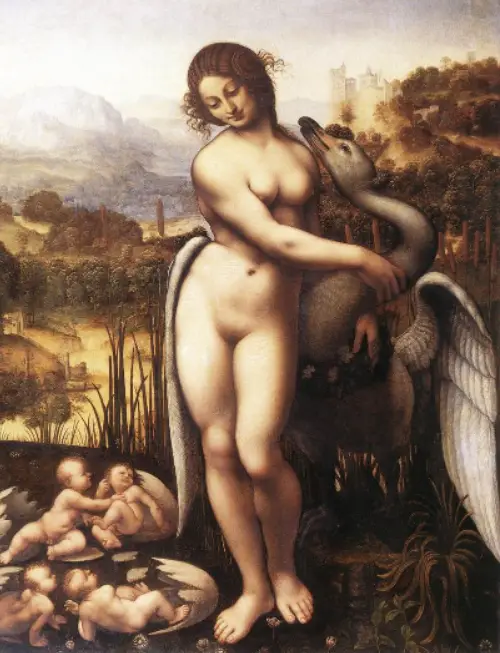
In The Leda and the Swan painting, the naked woman who is Leda looks down compassionately on her babies, while the curves of her body contrast with the sinuous lines of the swan, its head resting on her shoulder. The artwork is also metaphorical; the branch of white blossom in Leda’s hand represents purity. Her slightly awkward attitude, with the infants on one side and the swan on the other, implies that she is torn between the human world and the magical event that has just occurred to her.
The setting is naturalistic, in contrast to the mythological quality of the plot. A granite block with carvings may be seen over Leda’s left shoulder. A little medieval village can be seen above her right shoulder. The sky above and the ground below are both realistic. This realism is explained by Leonardo’s evolution as an artist. Leonardo was preoccupied with the idea of Leda while working on the Mona Lisa, and while in Milan, he drew numerous sketches of the swans in the moat around the Castello. Cassiano del Pozzo described the painting in 1625; at the time, it was in the royal collection in Fontainebleau.
Leda and Zeus
The Leda with the Swan painting by Leonardo da Vinci depicts the Greek story of Leda, the daughter of King Aetolia. When Zeus, King of the Gods, saw Leda, he was so taken with her beauty that he transformed into a swan and married her. Leda gave birth to two eggs, each of which birthed twins.
It has been suggested that Leonardo’s Chatsworth drawing for Leda and the Swan was influenced by the Laocoön Group, an antique sculpture found in 1506: The subject’s body has a similar twist; the curve of the swan’s neck recalls the snake’s lithe form in Laocoön’s palm; Zeus’ rape recalls the serpents’ aggressive attack; and The infant next to Leda’s knee resembles Laocoön’s son on the right, who likewise has a sheer break at the wrist.
Leda and the Swan analysis
Many artists have attempted to depict Leda and the Swan throughout history. Artists such as Correggio, Michelangelo, and Paul Cezanne have created interpretations of the story.
Leonardo’s original painting has been lost; it was purportedly seen in Fontainebleau in 1625 and was described as being in horrible condition, having been done on three large panels that had split and fallen apart. Some academics question whether Leonardo actually finished the picture; we only know it from many replicas made by Leonardo’s pupils and from the master’s preliminary drawings.
Leda Greek Mythology
Since the classical period, this Greek myth has influenced artists. The connection between Leda and Zeus is depicted in a variety of ways, including violent and seductive. The majority of the artwork concentrates on the story’s enticing component.
The majority of the artworks depict specific themes that depict various aspects of the myth of Leda and the Swan. The setting of the story, the facial emotions of persons depicted in the painting, and the clothing objects depicted in the painting, as well as their color.
Many painters throughout history have explored the subject of Leda and the Swan. Among the painters who have created interpretations of the story are Correggio, Michelangelo, and Paul Cezanne.
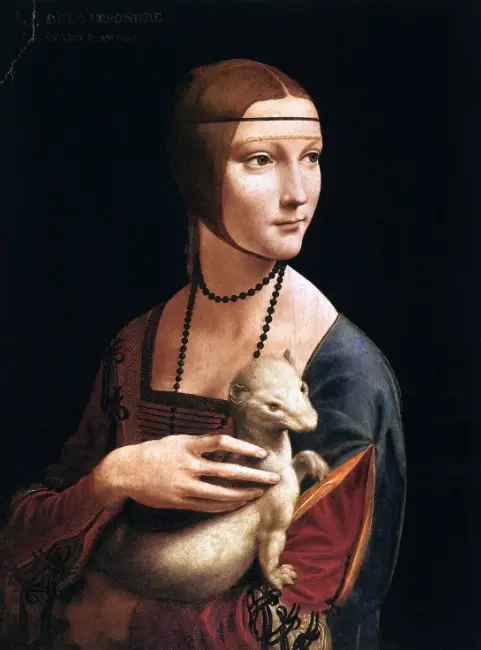
Lady with an Ermine is one of Leonardo da Vinci's most celebrated portraits and among the finest achievements of Renaissance art. Painted around 1489–1490 during Leonardo's years at the court of Milan, the work depicts Cecilia Gallerani, a brilliant young noblewoman closely connected to Ludovico Sforza, the ruler who became Leonardo's most important patron.
More than a beautiful portrait, Lady with an Ermine reveals Leonardo's growing mastery of realism, psychology, and symbolism. The mysterious ermine held by Cecilia has inspired centuries of debate, transforming the painting into one of Leonardo's most fascinating artistic puzzles. To better understand the artist behind this masterpiece, you may also enjoy exploring Leonardo da Vinci's biography and the remarkable period he spent working in Milan.
The painting belongs to a group of extraordinary works created during Leonardo's years in Milan, including The Last Supper. Together, these masterpieces illustrate how Milan became the setting for some of Leonardo's greatest artistic innovations and why it remains an essential destination for anyone interested in his life and legacy.
What is the meaning of the Lady with an Ermine Painting?
A layer of white gesso and a layer of brownish underpaint are used to prepare the painting. The paint is applied evenly overall, similar to the Mona Lisa, while certain areas of the lady's skin are more layered.
Its subject is Cecilia Gallerani, an enticing young woman from the Milanese court who was the favorite mistress of Ludovico Sforza, Duke of Milan, at the time of its execution; Leonardo was a painter to the Sforza court in Milan.
For 18 years, the duke was da Vinci's patron and champion, earning him the moniker "the white ermine." It is the second of Leonardo's only four surviving portraits of women, the others being La Belle Ferronnière, Ginevra de' Benci, and the Mona Lisa.
Leonardo's Greatest Masterpiece
See Leonardo's Greatest Masterpiece in Person
Lady with an Ermine showcases Leonardo's genius as a portrait painter, but many art historians consider The Last Supper his greatest achievement. Learn how to visit this fragile masterpiece in Milan and secure tickets before they sell out.
The Lady with an Ermine painting was purchased by the young Prince Adam Czartoryski (a hero of the war for Polish independence) during his 1800 trip to Italy. Leonardo da Vinci's Lady with an Ermine was commissioned by his mother, an avid collector and the founder of the Czartoryski Museum.
Art experts first assumed that the animal in the picture was merely a decorative element. They later discovered that the ermine is an allusion to Lodovico Sforza. Why is this so?
He was also known at times as Ermellino Bianco (white ermine). Leonardo was unable to paint a couple together due to the upcoming wedding of Ludovico and Beatrice d'Este. That is why he was portrayed allegorically as an ermine, which also covers Cecilia's pregnancy; Cesare, his son, was born soon after.
The image vanished for generations after Cecilia's death, only to resurface in Poland around 1800. For many years, it was mistakenly thought to be the likeness of the so-called "Belle Ferronière," a rumored mistress of King Francis I.
The inscription LA BELE FERONIERE / LEONARD D'AWINCI in the upper left corner alongside the artist's surname, which is spelled in Polish, attests to this. However, given Poland's twentieth-century history, it is remarkable that the Lady with an Ermine painting has survived.
What is the price of the Lady with an Ermine?
There is substantial debate over whether the Lady with an Ermine picture was created by da Vinci, Boltraffio, or da Predis. During one of his visits, Prince Adam Czartoryski purchased the picture of Lady with an Ermine in Italy.
In 1800, he added the artwork to the Czartoryski Family collection. The picture is now housed at the Czartoryski Museum in Krakow, Poland, but it is currently traveling to museums across the world because the museum is undergoing renovations that began in 2010.
On December 29, 2016, the Princes Czartoryski Foundation, represented by Adam Karol Czartoryski, the last direct descendant of Izabela Czartoryska Flemming and Adam George Czartoryski, who brought the painting to Poland from Italy in 1798, sold it to the Polish government for €100 million.
FAQs about
What is the meaning of the Lady with an Ermine painting?
Leonardo da Vinci’s Lady with an Ermine symbolizes purity, virtue, and nobility, as represented by the ermine, which was traditionally associated with moral purity. The painting also portrays Cecilia Gallerani, the mistress of Ludovico Sforza, and may subtly reflect her status, pregnancy, and connection to the duke through symbolic imagery.
How much money is the Lady with an Ermine worth?
The Lady with an Ermine is considered priceless and is not for sale, as it is part of Poland’s national cultural heritage. It was included in the Czartoryski Collection, which the Polish government acquired for about €100 million in 2016—well below its estimated market value—thereby making the painting extremely valuable.
Where is the Lady with an Ermine located today?
Today, Lady with an Ermine is housed in the Czartoryski Museum in Kraków, Poland, where it is regarded as one of the country’s most important national treasures and a highlight for visitors interested in Leonardo da Vinci’s work.
Why is Salvator Mundi so controversial?
Salvator Mundi is controversial mainly because of ongoing disputes about its authorship and authenticity, with some experts questioning whether Leonardo da Vinci painted it entirely. Its disappearance from major exhibitions and secretive ownership have further fueled debate and speculation.
What happened to Elisabeth Lederer?
Elisabeth Lederer was the subject of a portrait by Gustav Klimt. During World War II, many of her family's artworks were seized, but her portrait survived because it was not confiscated. After the war, it was returned to her family and later passed through private collections before being sold.
Why was Da Vinci's grave destroyed?
Leonardo da Vinci was buried in the Church of Saint-Florentin in Amboise, France, but his grave was disturbed and largely destroyed during the French Revolution when the church was demolished in 1802. As a result, the exact location of his remains is uncertain today.
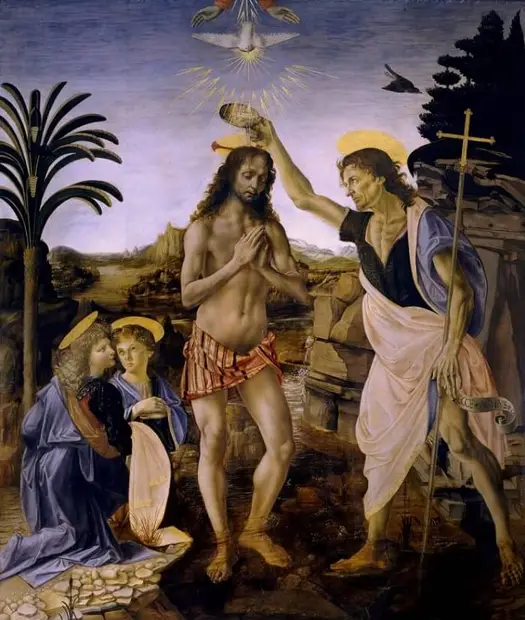
Leonardo da Vinci Baptism of Christ is a captivating masterpiece that beautifully illustrates the artistic collaboration between Leonardo and his master, Andrea del Verrocchio.
This artwork is notable for John the Baptist's graceful depiction of the Baptism of Jesus, which highlights Leonardo’s early contributions.
Verrocchio and Leonardo’s combined effort resulted in a fascinating blending of styles, particularly evident in the meticulously painted angels.
This painting is a crucial reference point for those interested in Leonardo da Vinci's career progression.
At just 18 years old, Leonardo demonstrated remarkable talent, contributing to the piece's detailed parts, especially the angel.
The painting is housed in the Uffizi Gallery, making it accessible to art enthusiasts who want to witness this historic work firsthand.
Art historians find "The Baptism of Christ" particularly intriguing as it showcases the transition from traditional techniques to innovative approaches that Leonardo would later master.
The panel's use of oil and tempera reflects the period's experimentation, setting the stage for future developments in Renaissance art.
This work exemplifies how youthful creativity and experienced guidance can produce an enduring legacy.
Historical Context of the Painting
The Baptism of Christ painting, a collaboration primarily between Leonardo da Vinci and Andrea del Verrocchio, reflects significant influences from the Early Renaissance. This artwork showcases the blend of individual innovation and traditional techniques prevalent at the time.
Early Renaissance Influence
During the Early Renaissance, artists focused on bringing realism into their works through perspective and human anatomy. The Baptism of Christ painting is an excellent example of this transition.
This period was marked by advancements in understanding light, shadow, and three-dimensionality. Artists strived to depict religious themes with more naturalism.
Leonardo's work on the Baptism of Jesus painting demonstrates these developments.
His understanding of human emotions and anatomy is evident in the angel figures he contributed to.
The softness of his facial features and the detailed depiction of drapery showcase techniques ahead of their time. This reflects the Renaissance's move towards scientific inquiry and thorough observation.
Collaboration with Verrocchio
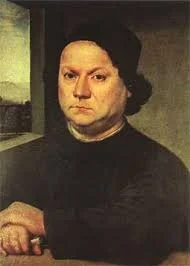
Andrea del Verrocchio (1435-1488)
The collaboration between Verrocchio and Leonardo on the Baptism of Christ marks a pivotal moment in art history. Verrocchio, a master in Florence, often worked with talented apprentices in his studio.
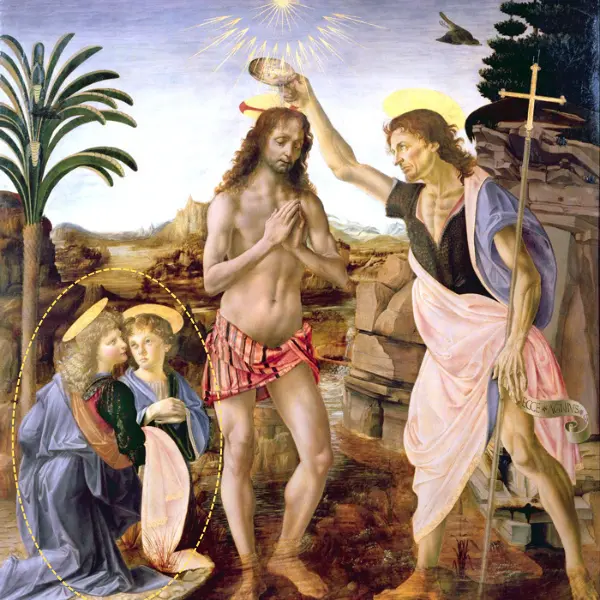
Leonardo's role was significant; he painted some figures, especially the angel on the left. His use of light and texture indicated his emerging style.
Verrocchio's mentorship allowed da Vinci to explore his talents while conforming to the studio's established techniques.
This partnership produced a unique synthesis of styles. Leonardo's soft, expressive profiles complement Verrocchio's strong outlines and careful compositions.
This partnership highlights how mentorship and collaboration were crucial to the Renaissance art community.
The Baptism of Christ Leonardo da Vinci's work remains invaluable for understanding these early collaborative efforts between a master and a protégé.
Artistic Analysis of 'Baptism of Christ'
Leonardo da Vinci's involvement in the Baptism of Christ painting, alongside Andrea del Verrocchio, exemplifies his early mastery of composition and symbolic depth. The piece beautifully combines technical skill with thematic richness.
Composition and Technique
The Baptism of Christ demonstrates remarkable composition and technique attributed to Verrocchio and Leonardo da Vinci.
The painting depicts Jesus being baptized by John the Baptist, a pivotal moment in religious art.
Da Vinci's role was primarily to paint parts of the composition, including the detailed angel on the left, showcasing his advanced grasp of human anatomy and emotion.
Leonardo's use of light and shadow adds depth, and his chiaroscuro technique gives the figures a lifelike quality.
The composition is balanced. The central figures of Jesus and John draw the viewer’s eye, while the angels add a heavenly touch.
These elements underscore the collaborative dynamic between master and apprentice present in the studio.
Symbolism and Themes
The Baptism of Christ painting is rich in symbolism, conveying themes of spiritual renewal and divine purity.
The central act of baptism symbolizes cleansing, and the figures' serene expressions suggest inner peace and acceptance.
The significant figures of water and the dove in the background represent the Holy Spirit, adding layers of symbolic meaning.
His and Verrocchio's work imbues the painting with a sense of divine intervention, highlighting the transformative power of Christ's baptism.
The meticulous attention to theme and detail makes it a significant work of the Renaissance.
Leonardo da Vinci's Contribution
Leonardo da Vinci played a significant role in the collaborative creation of The Baptism of Christ. His innovations added depth and vitality to the work, showcasing his emerging talent during his formative years as an artist. The painting is a fusion of expertise, blending Verrocchio's mastery with Leonardo's unique touch.
Innovative Use of Light
Da Vinci mastered the use of light and shadow to enhance the realism of The Baptism of Christ.
His technique, known as chiaroscuro, brought figures to life, making them appear three-dimensional against the background.
This groundbreaking approach demonstrated his deep interest in how light interacts with surfaces.
Leonardo's expertise in this area was revolutionary at the time.
By observing the play of light, he added depth that differed from the flatter depictions common in earlier paintings.
This skillful treatment of light was an early indicator of his genius and would continue to influence his later works.
Figures Painted by da Vinci
Leonardo da Vinci painted angels (yellow circle on the left) for the Baptism of Christ
Leonardo da Vinci contributed significantly to the painting of the Baptism of Christ by focusing on particular figures within the composition.
Notably, he painted an angel, infusing it with delicacy and grace.
This painting section demonstrated his ability to render detailed anatomical features with precision.
His portrayal of the angel stood out for its refined elegance, distinct from other figures in the piece.
This distinction highlights Leonardo's emerging individual style, which differed from that of other workshop artists.
His skillful depiction of the human form would become a hallmark of his later masterpieces.
Restoration and Preservation Efforts
The "Baptism of Christ" painting by Leonardo da Vinci and Andrea del Verrocchio has undergone various restoration and preservation efforts. These efforts aim to maintain the artwork's integrity and ensure its survival for future generations.
Conservation History
Leonardo da Vinci Baptism of Christ faced challenges common to many Renaissance paintings.
Initially housed in Florentine churches, it was subject to environmental factors such as humidity and dust.
Restoration efforts began early in the 19th century, focusing on cleaning and stabilizing the artwork.
In the 20th century, restorers employed techniques to remove varnish, address color degradation, and repair physical damage.
Documentation from the Uffizi Galleries highlights these interventions.
Conservators examined the paint layers and composition, revealing not just Leonardo’s hand but contributions from other artists in Verrocchio’s workshop.
These detailed analyses ensured authenticity and fidelity to the original work.
Modern Restoration Techniques
Today, advanced technology plays a crucial role in preserving Leonardo da Vinci's painting of the Baptism of Christ.
Infrared reflectography and X-ray fluorescence are commonly used to study the underdrawings and materials.
These techniques help identify pigments and map the artist’s changes during painting.
Recently, efforts have focused on controlling the painting's environment.
Humidity control and minimal light exposure in display areas are vital to prevent further deterioration.
Innovations in restorative materials also help fill cracks and stabilize faded areas without altering the original texture.
The Wikipedia entry on the Baptism of Christ notes these advancements have significantly improved the painting's condition, ensuring that this masterpiece by da Vinci and Verrocchio remains vibrant and well-preserved.
Impact and Legacy
Leonardo da Vinci's collaboration on the Baptism of Christ showcases his early artistic skills and sets a precedent for the transformative techniques for which he would become famous. This painting, completed around 1475, is significant in the art world and in da Vinci's career development.
Influence on Later Artists
The Baptism of Christ contributed significantly to Renaissance art.
Leonardo was responsible for painting the angel on the left, introducing innovative techniques such as sfumato and fine details that captured emotion and anatomy with unprecedented precision.
Other painters took notice of this blend of realism and detail.
Leonardo's methods later influenced masters such as Michelangelo and Raphael, who incorporated aspects of his approach into their artworks.
This painting is a foundational example of Leonardo's artistry, showcasing traits that would define his later works, such as The Last Supper and the Mona Lisa.
Place in da Vinci's Oeuvre
The Baptism of Christ is one of Leonardo da Vinci's earliest works.
Though primarily attributed to Andrea del Verrocchio, this project marked Leonardo's first major contribution.
It was a collaborative effort in Verrocchio's workshop, where Leonardo learned and refined his skills.
The angel's expressive features and soft form show his burgeoning talent for conveying human emotion and anatomical accuracy.
This early involvement in the Baptism of Christ painting shaped his future style, which is why this work is often highlighted in discussions of Leonardo's artistic development.
Final Thoughts
Leonardo da Vinci Baptism of Christ is a significant example of Renaissance art. The painting displays a remarkable blend of artistic skill and innovative techniques.
Leonardo's contribution to the work, especially the rendering of human anatomy and emotion, showcases his deep understanding of art and science.
Key Takeaways: Leonardo da Vinci's work on the Baptism of Christ reflects his unique artistic perspective and collaborative spirit. The harmonious combination of intricate details and expressive figures highlights his role in advancing Renaissance art.
FAQs about Leonardo da Vinci Baptism of Christ
Did Leonardo da Vinci paint the Baptism of Christ?
Leonardo da Vinci did not paint the entire scene of the Baptism of Christ. The work was mainly created by his master, Andrea del Verrocchio, around 1472–1475. However, Leonardo—then a young apprentice—contributed key elements, especially one of the angels and parts of the landscape, making it one of his earliest known works.
Did Leonardo da Vinci believe in Jesus Christ?
Leonardo da Vinci’s personal beliefs remain uncertain because he left no clear statements of faith. While he painted many Christian subjects, such as The Last Supper, some historians believe he viewed nature as a reflection of divine truth rather than strictly adhering to traditional religious doctrine.
Why is Salvator Mundi so controversial?
Salvator Mundi is controversial due to ongoing debates about its authorship, as some experts question whether Leonardo fully painted it. Its extensive restoration and damaged condition have also raised doubts, despite its record-breaking auction price.
What is the Baptism of Christ painting about?
The painting depicts the biblical moment when John the Baptist baptizes Jesus in the Jordan River. It includes symbolic elements such as angels, a dove representing the Holy Spirit, and divine light from heaven, all of which emphasize Jesus’s spiritual significance.
What was Leonardo da Vinci's most controversial painting?
One of Leonardo’s most controversial paintings is Salvator Mundi, mainly because of disputes over its authenticity and restoration. Additionally, The Last Supper has sparked centuries of speculation and debate about hidden meanings and interpretations.
What were Leonardo da Vinci's last words before he died?
Leonardo da Vinci is widely reported to have said, “I have offended God and mankind because my work did not reach the quality it should have.” While often quoted, historians note that the exact wording is based on later accounts and may not be fully verified.
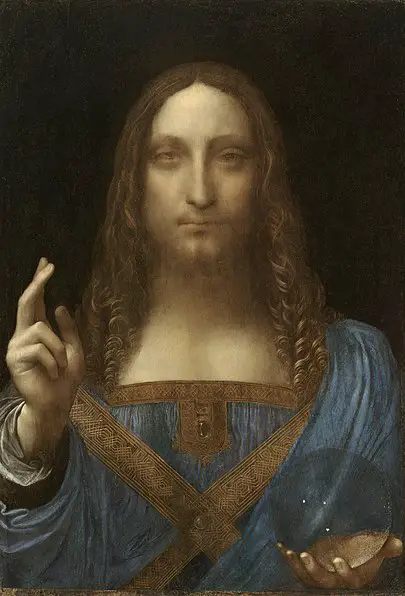
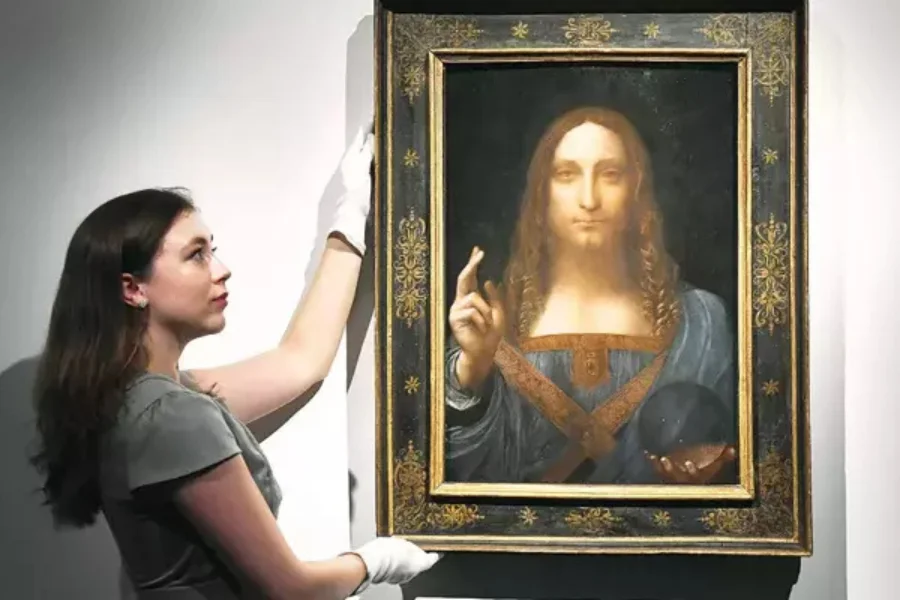
Salvator Mundi is a masterpiece that has fascinated and puzzled art enthusiasts worldwide. This painting, attributed to Leonardo da Vinci, portrays Christ with his right hand raised in blessing and a crystal orb in his left hand.
Salvator Mundi's iconic status skyrocketed when it was sold for $450.3 million at Christie’s auction in 2017, becoming the most expensive painting ever sold.
For those questioning the painting's sky-high price and authenticity, this article will unravel the mystery of its attribution and restoration.
Salvator Mundi's journey includes its rediscovery, extensive restoration, and controversial sale, which have contributed to its title as the world's most controversial painting.
You will gain insight into the controversies and history surrounding this enigmatic artwork.
Art historians and enthusiasts alike ponder the symbolism captured in Salvator Mundi. The painting’s eschatological themes and religious iconography provoke discussion on its deeper meanings.
Exploring the historical context and its secrets reveals why Salvator Mundi remains a captivating subject for debate and admiration today.
Historical Overview
Leonardo da Vinci’s Salvator Mundi painting
Leonardo da Vinci's "Salvator Mundi" is a painting with a rich and complex history. Its journey and the mysteries surrounding its creation and ownership have intrigued historians and art lovers.
Creation and Artist
"Salvator Mundi," which means "Savior of the World," is attributed to the legendary artist Leonardo da Vinci.
The painting, created around 1500, depicts Jesus holding a crystal orb, symbolizing his role as a savior. Leonardo's signature style shines through the detailed rendering of textures and Jesus's serene expression.
Though Leonardian, debates continue about whether the master himself painted it entirely or if it involved contributions from his workshop, a common practice during the Renaissance.
This painting exemplifies the artist’s talent in capturing divine serenity and depth, making it one of the most debated artworks globally. It has been a subject of extensive analysis and study, highlighting its importance in art history.
Provenance and Ownership
The painting has had a turbulent ownership history, adding to its allure and controversy.
Rediscovered in 2005, "Salvator Mundi" was initially bought at a small auction in New Orleans despite being heavily overpainted and in poor condition.
Art collectors and experts debated its authenticity until it was restored and authenticated as a da Vinci work, significantly increasing its value. In 2017, it made headlines when it sold at auction for a record Salvator Mundi price of $450.3 million, making it the most expensive painting ever sold.
The current owner is believed to be Mohammed bin Salman, the Crown Prince of Saudi Arabia, though its exact location remains uncertain. This ownership history reflects the painting's complex journey through time and the intrigue it has sparked.
Artistic Significance
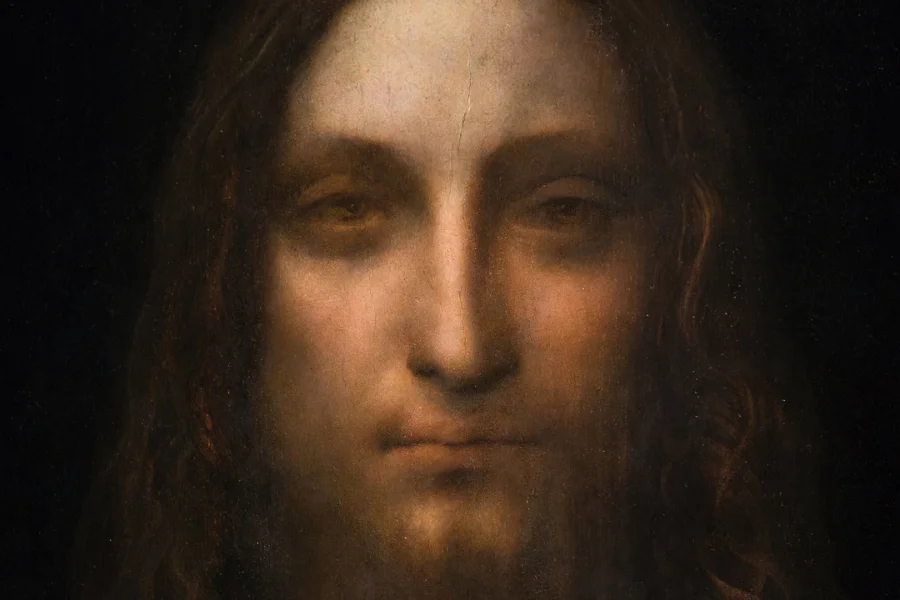
Detailed face and soft edges highlight the Salvator Mundi's artistic significance
The Salvator Mundi painting, attributed to Leonardo da Vinci, holds a unique place in art history for its intricate composition and masterful techniques. Its symbolism and style offer deep insights into the artistic vision and the period during which it was created.
Composition and Subject
The composition of the Salvator Mundi centers on a serene figure of Christ, depicted as the Savior of the World, which is what "Salvator Mundi" translates to.
Christ's right hand is raised in blessing, while his left holds a transparent orb, possibly symbolizing the cosmos. The figure's calm expression and divine gesture are typical of Leonardo da Vinci's mastery of portraying subtle human emotions.
Da Vinci's attention to detail is evident in the intricate curls of Christ's hair and the delicate rendering of his robes. The painting's symmetrical balance and light guide the viewer's eyes toward the focal point, his face and hands.
This compositional structure enhances the viewer's engagement and reflects the spiritual significance inherent in the subject matter.
Style and Techniques
Leonardo da Vinci's Salvator Mundi showcases his unparalleled techniques, such as sfumato, which softens the transitions between colors, creating a lifelike quality. The muted color palette aligns with the Renaissance ideals of harmony and balance, emphasizing the spiritual over the earthly.
The translucent quality of Christ's orb is achieved through layers of thin glazes, a hallmark of da Vinci's style. This technique adds depth and realism, underscoring his innovative approach to painting.
The contrast between the detailed rendering of Christ's face and the softer edges of the surrounding elements enhances the portrait's focal impact. This combination of style and technique highlights why the painting is considered a significant work of art today.
Controversies
The Salvator Mundi painting has sparked significant debates over its authenticity and the perplexing details surrounding its sales and auctions. These controversies have captivated the art world and the general public alike.
Authenticity Debates
The main contention is whether Leonardo da Vinci truly crafted the Salvator Mundi. Some experts assert it is a genuine work by Leonardo, while others argue it could be a product of his workshop or the work of a skilled later artist.
This disagreement arises partly because the painting's restoration efforts have been significantly retouched. The actual authorship is critical because it impacts the painting’s monetary and historical value.
Many analysts scrutinize the painting's techniques, comparing them with known Leonardo works to ascertain its authenticity. This continual debate underscores the complexity and intrigue surrounding Leonardo da Vinci's Salvator Mundi.
Sale and Auction History
The Salvator Mundi has a contentious sale history, further fueling its notoriety. Initially bought for under $10,000 in 2005, it was sold at auction in 2017 for a staggering $450 million, cementing its place as the most expensive painting ever sold.
This dramatic increase has raised eyebrows regarding the dynamics of the art market and the motivations behind its purchase. The painting's provenance has been questioned, with disputes over its ownership and legal proceedings involving prominent figures such as Russian billionaire Dmitry Rybolovlev.
Speculation about its buyer, Saudi Arabia's Mohammed bin Salman, added another layer of mystery and intrigue to its already complex tale.
Conservation and Restoration
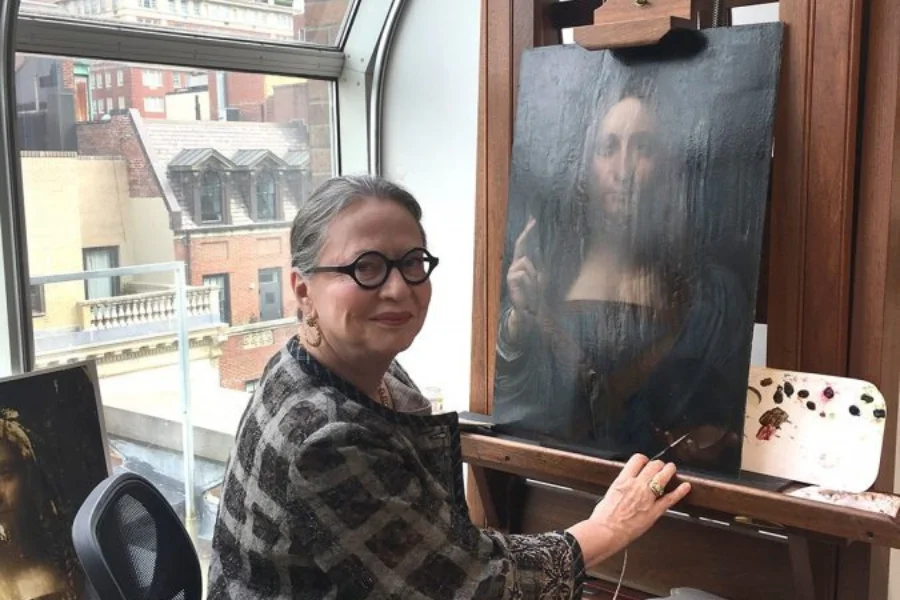
Dianne Modestini, an art conservator, restored Leonardo da Vinci’s 'Salvator Mundi
Leonardo da Vinci's masterpiece Salvator Mundi has undergone significant conservation and restoration efforts to preserve its historical and artistic value. Detailed condition reports and thoughtful restoration efforts have been crucial in maintaining the integrity of this iconic artwork.
Condition Reports
Over the years, experts have meticulously documented the condition of the Salvator Mundi painting. Condition reports provide a comprehensive understanding of the artwork's state, detailing areas of damage and previous restoration attempts.
These reports typically highlight issues such as paint loss, surface scratches, and areas where the original layers have deteriorated.
Maintaining an up-to-date record is crucial for a painting of this significance. The reports help us understand the current state and guide future conservation efforts.
Leonardo da Vinci's Salvator Mundi requires careful monitoring to preserve its historical and aesthetic qualities for future generations.
Restoration Efforts
The restoration of Leonardo da Vinci's Salvator Mundi has involved many complex processes to address areas of damage and wear. Skilled conservators like Dianne Modestini have played key roles in these efforts.
Modestini worked intensively to clean and restore the painting, which had been overpainted and was in poor condition. Restorers carefully removed varnish and non-original paint layers to reveal Leonardo da Vinci's underlying artistry.
Challenges included matching the original pigments and ensuring that any added elements did not alter the original composition. The successful restoration of the Salvator Mundi painting has secured its structural integrity and enhanced its appreciation, influencing factors like its historical significance and awe-inspiring price.
Cultural Impact
Salvator Mundi was sold at a Christie’s auction for $450.3 million in 2017
The Salvator Mundi by Leonardo da Vinci has left a profound mark on literature, media, and public exhibitions. Its mysterious history and astonishing auction price have sparked significant global interest.
In Literature and Media
Numerous books and documentaries have explored the Salvator Mundi painting. Authors often explore its mysterious provenance and the debate surrounding its attribution to Leonardo da Vinci.
This intrigue is fueled by the painting's record-breaking sale at Christie's auction house in 2017 for a staggering $450.3 million, which made headlines worldwide.
Documentaries delve into the complexities of the painting's history and authenticity, raising questions about Salvator Mundi's true origins and meaning. The painting's elusive history and the controversy over its authenticity captivate audiences, making it a frequent topic in both scholarly and popular media.
Public Exhibitions and Displays
Due to its private ownership, public exhibitions of the Salvator Mundi are rare. The painting's limited public display adds to its allure, as enthusiasts worldwide eagerly seek opportunities to see it. When it is like during the previews before the auction, the events attract significant attention.
Speculation about its future public appearances continues, especially given its acquisition by the Saudi Crown Prince Mohammed bin Salman.
The painting's significance as a portrayal of Jesus resonates deeply, drawing religious and art scholars alike. Although the Salvator Mundi is often out of view, its mystique ensures it remains a central figure in global art discussions.
Final Thoughts
Salvator Mundi holds a unique position in art history. It merges spiritual depth with artistic mastery.
The work reflects Gian Lorenzo Bernini's focus on salvation, with Christ depicted raising his hand in blessing. This sculpture can be seen at Rome's Leonardo Da Vinci-Fiumicino Airport, emphasizing its significance even in contemporary settings.
Bernini's version, distinct from the famous painting attributed to Leonardo da Vinci, showcases the diversity in artistic interpretation. The da Vinci painting sold for a record $450 million, adding to its allure by sparking debate and appreciation in the art world.
Key Takeaways: Salvator Mundi exemplifies profound religious and artistic themes. Understanding its history enriches one's appreciation of these masterpieces. Visiting exhibitions and online resources can provide valuable insights for those interested in exploring Bernini and da Vinci further.
FAQs about Salvator Mundi
Who bought Salvator Mundi for $450 million?
Salvator Mundi was sold at auction in 2017 for about $450.3 million to Saudi Prince Badr bin Abdullah Al Saud. However, reports indicate he likely acted on behalf of Saudi Crown Prince Mohammed bin Salman or Abu Dhabi’s Department of Culture and Tourism.
Why is Salvator Mundi so controversial?
The painting is controversial due to doubts about whether it was fully painted by Leonardo da Vinci, its heavy restoration, and its poor original condition. Critics also question how a damaged and debated work could achieve such a record-breaking price.
What is so special about Salvator Mundi?
Salvator Mundi is believed to be one of the very few surviving paintings by Leonardo da Vinci, making it extremely rare. It depicts Christ holding a crystal orb symbolizing the universe and became famous after being rediscovered and authenticated in the 21st century.
Is Mona Lisa worth $1 billion?
The Mona Lisa is not officially for sale, but it is considered priceless. It was insured for $100 million in 1962, which is equivalent to over $1 billion today when adjusted for inflation.
Who is the richest painter in the world?
There is no single definitive “richest painter,” but historically, modern artists like Pablo Picasso and Andy Warhol generated enormous wealth through their works. However, Leonardo da Vinci’s paintings—especially Salvator Mundi—have reached the highest prices ever at auction.
What is the #1 most expensive painting in the world?
The most expensive painting ever sold is Salvator Mundi by Leonardo da Vinci, which fetched approximately $450.3 million at a Christie’s auction in 2017.
Leonardo Bianchi is the founder of Leonardo da Vinci Inventions & Experiences, a cultural travel guide helping visitors explore Leonardo da Vinci’s art, inventions, and legacy across Italy and Paris.
Planning Milan?
See The Last Supper Without Missing the Details
Tickets are limited and visits are short. Start with the Milan guide before choosing your Last Supper experience.
If you're visiting Milan for Leonardo da Vinci, these are the experiences most travelers prioritize first — especially when tickets are limited and time is short.
This site is built for travelers who want more than surface-level sightseeing — helping you plan smarter visits around Leonardo da Vinci’s art, museums, and cities across Italy and Europe.


 Leonardo Bianchi is the founder of Leonardo da Vinci Inventions & Experiences, a cultural travel guide helping visitors explore Leonardo da Vinci’s art, inventions, and legacy across Italy and Paris.