Leonardo da Vinci life span is often discussed when people try to understand how his experiences shaped his art. Many wonder if his life events contributed to the uniqueness of his most famous paintings.
This article delves into the details, showing how his long and eventful life shaped his creative work.
Leonardo da Vinci’s life—the events he witnessed, the places he traveled, and the challenges he faced—left a mark on his art.He lived from 1452 to 1519, a period marked by significant change and discovery, known as the Renaissance.
His works reflect the growth and ideas of that time. Leonardo’s curious mind led him to study painting, science, engineering, and nature.
This curiosity is evident in pieces like The Mona Lisa and The Last Supper, making his artwork stand out among other artists of his era.
Those interested in his biography can learn more about Leonardo da Vinci’s life and achievements.
Leonardo da Vinci Life Span: Setting the Stage for Genius
Leonardo da Vinci life, which stretched from 1452 to 1519, set the foundation for his work as a painter, inventor, and scientist. Growing up in Renaissance Italy, he absorbed the energy of Florence and Milan.
This environment shaped his achievements in art, engineering, and anatomy.
The Early Years: Birth, Education, and Family in Italy
Leonardo da Vinci was born on April 15, 1452, in Vinci, a small town in Tuscany, Italy. His birth outside marriage to a local notary and a peasant woman shaped his early experiences, as he did not receive a formal classical education.
From a young age, he demonstrated a natural talent for drawing and a curious nature. He moved to Florence with his father, who soon recognized Leonardo’s abilities and arranged an apprenticeship with Andrea del Verrocchio, a respected artist.
This workshop exposed Leonardo to painting, sculpture, and technical drawing. The skills he learned here later influenced his wide-ranging works and innovations as an adult.
Early on, Leonardo was encouraged to explore many disciplines, which set him on a path to becoming a true Renaissance polymath.
Historical Context: Renaissance Florence and Milan
Leonardo’s achievements unfolded during the height of the Renaissance, a period of immense creativity in science and art. Florence was a vibrant cultural center, home to influential families like the Medici, who supported the arts and learning.
Leonardo worked on early masterpieces in this environment and developed friendships with other artists. In his late twenties, he moved to Milan and worked under Duke Ludovico Sforza.
Milan’s court valued artists, engineers, and architects, providing them opportunities for artistic experimentation and engineering projects. Here, he created important works such as The Last Supper and advanced his anatomy, mechanics, and architecture studies.
These cities played a crucial role in shaping his career. They encouraged his multidisciplinary approach and experiments, which are documented in his notebooks.
Leonardo da Vinci’s Birth and Death Dates: Years of Life (1452–1519)
Leonardo da Vinci was born in 1452 and died in 1519 at age 67 in Amboise, France. This long life span gave him decades to pursue and refine his interests in art and science.
Leonardo spent his later years in France under the patronage of King Francis I, where he continued to work on inventions and studies. Throughout his life, he filled notebooks with detailed sketches, observations, and inventions.
Some of his ideas would not be fully understood until centuries later. His legacy is recognized worldwide for its breadth and lasting impact on art and science.
How Leonardo da Vinci’s Life Span Shaped His Artistic Achievements
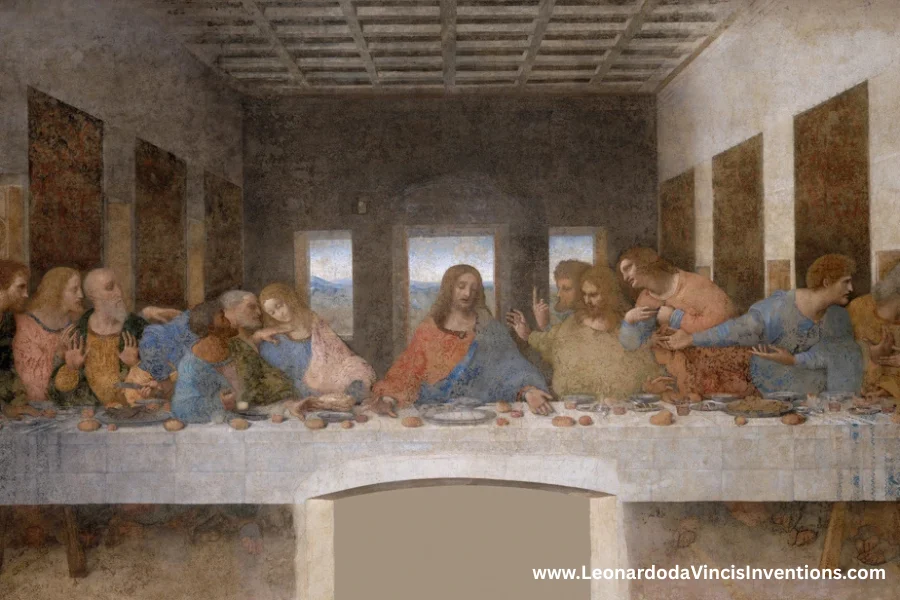
Leonardo da Vinci The Last Supper
Remarkable cultural, scientific, and artistic developments in Italy and Europe shaped Leonardo da Vinci’s life (1452–1519). His experiences in Florence, Milan, and France connected him with powerful patrons and new ideas.
He constantly found innovation in art and science.
Major Works and Masterpieces: Mona Lisa, The Last Supper, Vitruvian Man
Leonardo da Vinci created some of history’s most famous masterpieces during the Italian Renaissance. Early in his career, he painted religious works and portraits in Florence before moving to Milan, where he produced “The Last Supper.”
This mural stands out for its use of perspective and emotional storytelling. His drawing of the “Vitruvian Man” combines science and art, showcasing his interest in anatomy and the proportions of the human body.
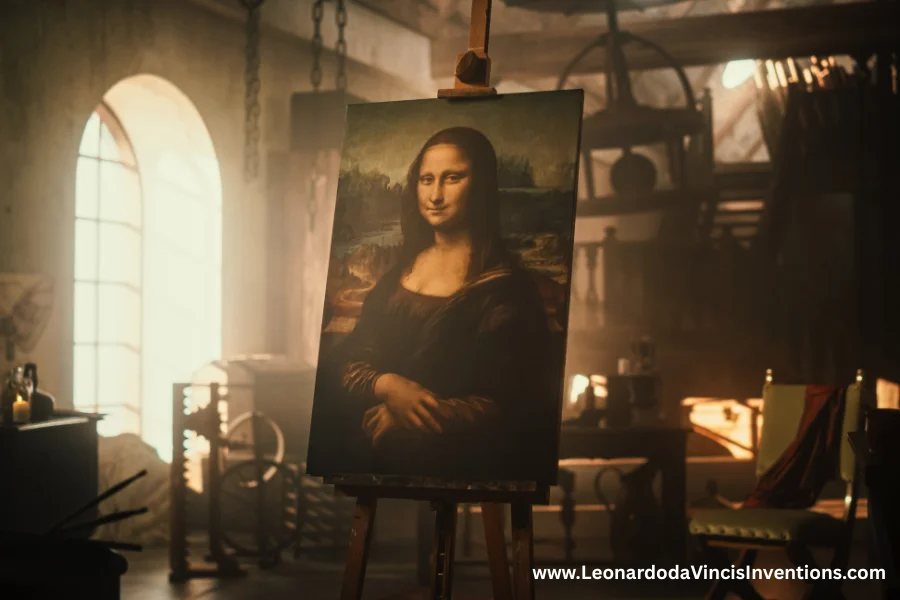
Later, he painted the “Mona Lisa,” a portrait valued for realism and detailed technique. These pieces reflect his technical skill, curiosity, and scientific observations.
Influence of Later Years in France on Leonardo’s Art
During the final years of Leonardo’s life, King Francis I of France invited him to Amboise. Here, Leonardo continued to develop his ideas and supervised important artistic projects, although he produced fewer paintings due to his advancing age and declining health.
He focused more on scientific studies, engineering projects, and anatomy. His notebooks contain detailed sketches and observations that influenced artists and scientists.
Leonardo’s exposure to the French court expanded his influence beyond Italy. His later years in France, until he died in 1519, significantly contributed to his legacy and the lasting impact of his innovations.
The Role of Patrons: Medici, Sforza, and Supporters
Leonardo da Vinci’s personal and professional life was shaped by key patrons like the Medici family in Florence and Ludovico Sforza in Milan. Early support from the Medici allowed Leonardo to learn from leading thinkers and start his career as a polymath and artist.
Under Sforza, Leonardo worked as a painter, architect, and engineer, receiving major commissions, including “The Last Supper.” Later, Francis I of France supported him in his last years, allowing him to pursue scientific discoveries and inventions.
These patrons influenced the course of his achievements. Their support helped Leonardo leave a lasting mark on Renaissance art and science.
Leonardo da Vinci as a Polymath: Impact of a Long Life
Leonardo da Vinci’s years, from 1452 to 1519, allowed him to explore various fields and make significant contributions. His long life helped him become a key figure in the Italian Renaissance.
He filled his creative career with scientific discoveries, artistic masterpieces, and innovative inventions.
Leonardo was a true polymath, known for being a painter, inventor, scientist, engineer, and architect. His accomplishments included works such as the Mona Lisa and The Last Supper, which were celebrated for their realistic detail and emotional depth.
For his art, he studied anatomy to gain a deeper understanding of the human body. Leonardo also designed machines, from flying devices to war engines, many of which were ahead of their time.
His career in Florence and Milan introduced him to powerful patrons like the Medici and Sforza families, who supported him and expanded his influence throughout Italy.
Contributions to Art and Science: Innovation and Discoveries
Leonardo’s long life allowed him to experiment with art and science for decades. He used oil paint in new ways, developing shading techniques that made his paintings more lifelike.
He studied human anatomy, plants, water, and flight in science, recording his findings in his famous notebooks. His observations led to important discoveries about the body and nature.
He created sketches for inventions such as helicopters and bicycles that would not be built for centuries. Because he lived into his late 60s, he had time to explore new ideas and complete major works.
Leonardo’s Notebooks and Sketches: Documenting Curiosity and Creativity
Leonardo filled thousands of pages with sketches, notes, and diagrams. These notebooks demonstrate his wide-ranging interests, encompassing human figures and engineering designs.
The Vitruvian Man, drawn in the 1490s, is one of his most well-known drawings and highlights the link between art and anatomy. He often wrote in reverse script, making his notes difficult to read.
His drawings reveal step-by-step studies of the world around him. Historians use these notebooks to piece together Leonardo da Vinci's life and works.
These records show the impact of his curiosity and creativity over his long lifespan.
Legacy and Influence: Did Leonardo da Vinci Life Span Matter?
Leonardo da Vinci’s life span, from 1452 to 1519, allowed him to work across several Italian cities and explore various disciplines. His long years gave him the time to shape the fields of painting, science, and engineering.
He left a substantial impact on future generations.
Influence on Future Generations and Cultural Significance
Leonardo da Vinci’s influence reaches far beyond his years in Florence, Milan, and France. As a polymath, he inspired artists, scientists, engineers, and inventors.
His notebooks are filled with sketches and written observations about nature, anatomy, mechanics, and flight. These works, comprising thousands of pages, showcased his endless curiosity and meticulous study of the world.
Artists and thinkers from later centuries studied his drawings to learn technique and method. Today, his legacy lives on in museums, books, and classrooms.
Leonardo’s impact can be seen in new inventions, art styles, and how people view discovery and learning.
Leonardo da Vinci’s Legacy in the High Renaissance and Beyond
Leonardo da Vinci’s career marked the height of the High Renaissance. His masterpieces, such as the Mona Lisa and The Last Supper, revolutionized how artists approached composition, expression, and perspective.
These works became guides for other painters. Leonardo blended science and art in his approach.
He studied anatomy to give his figures lifelike movement and realistic detail. His innovative use of light and shadow, a technique known as sfumato, set new standards for painting.
After his death, European artists drew inspiration from Leonardo’s paintings, drawings, and inventions.
Achievements and Accomplishments: Impact on Renaissance Art and Science
Leonardo made significant advances in art, design, and scientific studies. He created careful anatomical drawings and planned machines that would not be built for centuries.
He designed flying machines, bridges, and armored vehicles. His study of the human body, mathematics, and nature helped shape new scientific ideas during the Italian Renaissance.
Patrons like the Medici and Sforza families supported Leonardo. Their support allowed him to work on public projects, private commissions, and ambitious studies that combined art and engineering.
He set an example for mixing creativity with disciplined research.
The Personal and Professional Life of Leonardo da Vinci
Leonardo da Vinci lived during the High Renaissance, a period of innovation and discovery in Italy, from 1452 to 1519. This period coincided with major cultural changes.
His works continue to shape discussions about creativity and influence in art and science.
Leonardo’s Personal Life: Biography, Drawings, and Scientific Studies
Leonardo da Vinci was born in 1452 in Vinci, a small town near Florence. He grew up as the illegitimate child of a notary and received only a basic education.
His curiosity led him to study anatomy, engineering, and nature. He filled notebooks with detailed drawings and scientific observations.
He explored topics like flight, human anatomy, and machines. Leonardo kept his personal life private, but his writings reveal an endless desire to learn.
His studies bridged art and science. Leonardo provided insights into the human body, plant life, and mechanical devices.
Key Events and Turning Points in Leonardo’s Career
Leonardo began his artistic training as an apprentice to Andrea del Verrocchio in Florence, where he learned painting and sculpture. He worked in Milan for seventeen years, serving Duke Ludovico Sforza and creating The Last Supper.
After political changes in Milan, Leonardo moved between cities and completed projects for various patrons, including the Medici family. In his later years, he moved to France at the invitation of King Francis I.
He spent the rest of his life there. Leonardo’s inventions, notebooks, and artistic masterpieces showed his unique approach as a painter, engineer, and scientist.
Historical Importance and Context of Leonardo da Vinci’s Life and Works
Leonardo’s multidisciplinary talents helped define the Renaissance spirit of exploration and learning. His achievements, such as painting the Mona Lisa and drawing the Vitruvian Man, set new standards in art and science.
His notebooks reveal innovative designs and discoveries that influenced later inventors and artists. Leonardo’s legacy as a polymath continues to inspire curiosity and creativity today.
Frequently Asked Questions
Leonardo da Vinci lived during the Renaissance and made a lasting mark on art, science, and invention. His personal life, habits, and death have been the subject of curiosity and study for centuries.
What caused Da Vinci's death?
Leonardo da Vinci died on May 2, 1519, at 67. He likely died from a stroke.
Later in life, he suffered paralysis in his right hand, which may have contributed to his health problems.
What was da Vinci's IQ?
There are no official records of Leonardo da Vinci's IQ, as the concept of IQ did not exist during his time. Some experts speculate he may have had a high IQ based on his inventions, art, and wide range of talents.
Did Da Vinci have kids?
Leonardo da Vinci never married and had no known children. He dedicated most of his life to his work and studies.
What happened to Leonardo da Vinci when he was 15?
At age 15, Leonardo began an apprenticeship with Andrea del Verrocchio in Florence. This introduced him to painting, sculpture, and mechanical arts.
Where is Mona Lisa buried?
The Mona Lisa is a famous painting created by Leonardo da Vinci. The woman believed to have posed for it, Lisa Gherardini, is thought to be buried in Florence, Italy.
The painting itself is displayed in the Louvre Museum in Paris.
What did da Vinci suffer from?
In his later years, da Vinci suffered from paralysis in his right hand. Some reports suggest he also dealt with periods of depression.
Despite his physical limitations, he continued to work with his left hand.
What were da Vinci's last words?
Leonardo da Vinci reportedly expressed regret that despite his many achievements, he had not accomplished enough in life. His last words reflected his high expectations for himself.
How old is the Mona Lisa?
Leonardo da Vinci painted the Mona Lisa between 1503 and 1506, more than 500 years ago. Today, the Mona Lisa is over five centuries old.
Was da Vinci a vegetarian?
Leonardo da Vinci is believed to have been a vegetarian for much of his life. He loved animals and wrote about the ethics of eating meat, although not all historians agree on how strictly he adhered to this stance.
Did Leonardo da Vinci ever marry?
Leonardo da Vinci never married during his lifetime.
There is no historical record of romantic relationships or a spouse.
He focused mainly on his art, inventions, and studies.
Leonardo da Vinci greatest inventions have fascinated people for centuries. He combined art, science, and mechanical skill in ways that changed history.
You might find it challenging to keep track of the numerous amazing creations he imagined and designed. This article will make it easy for you.
Get ready to discover twenty of his most important and creative inventions. They are explained simply for anyone curious about da Vinci's genius.
From flying machines to early designs for tanks and bridges, da Vinci’s ideas show how far ahead he was.
This collection gives readers a clear view of his imaginative work and unique thinking, inspiring inventors worldwide.
1. Ornithopter flying machine
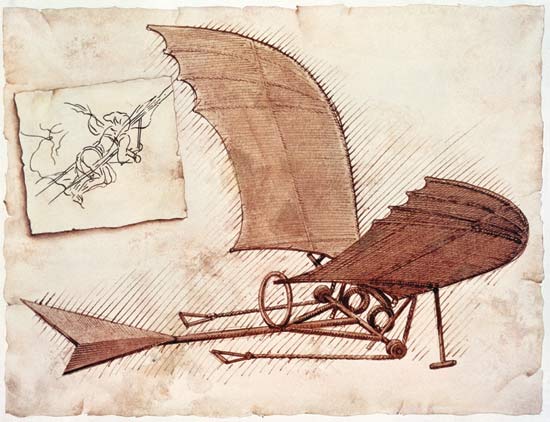
Leonardo da Vinci Glider
The Ornithopter, a flying machine, is one of Leonardo da Vinci’s most famous inventions. Inspired by birds, it shows da Vinci’s drive for discovery and interest in nature-inspired designs.
As a Renaissance genius, da Vinci created detailed sketches and prototypes. He hoped to solve the challenge of human flight with enormous wings that would flap by human power, much like a bird’s motion.
Though the flying machine never took off, it remains an engineering marvel. Many consider the ornithopter a symbol of creative exploration and technology ahead of its time.
2. Helical air screw (early helicopter)
The helical air screw shows Leonardo’s creativity and innovation. He designed this device to explore vertical flight, and its shape resembles modern helicopter blades.
Leonardo’s scientific notebooks contain detailed sketches of this flying machine. Built from linen and supported by reeds, the helical air screw compressed air to lift the machine off the ground.
Although this invention was never built or flown, it inspired later aviation designs. The Aerial Screw is now recognized as a precursor to modern helicopters. Read more about the helical air screw and Leonardo’s technology.
3. Parachute design
Leonardo da Vinci’s parachute design shows his curiosity and innovation. He sketched a pyramid-shaped parachute using a sealed linen cloth and a wooden frame.
The structure aimed to allow a person to descend safely from great heights. Unlike modern round parachutes, his drawings described a canopy held open by four poles.
Although Leonardo never built this invention, later tests have shown that it could work. In 2000, a skydiver successfully tested a replica based on Leonardo’s parachute design, proving the concept was sound.
This invention highlights da Vinci’s genius in observing nature and applying the scientific method to problem-solving.
4. Self-supporting bridge
The self-supporting bridge stands out among Leonardo da Vinci’s engineering marvels. He created this bridge design in the late 15th century, showing his skills as an innovator and engineer.
Leonardo designed the bridge so that it could be held together without nails, ropes, or fasteners. The bridge’s structure uses only the weight of the wooden beams and their placement for stability.
This idea made the bridge easy to build and take apart in military situations. Da Vinci’s self-supporting bridge showcases his expertise in mechanics and problem-solving.
His sketches and prototypes inspired later bridge designs. He studied how forces work in nature and turned simple materials into a strong and practical crossing.
5. Armored fighting vehicle (tank prototype)
Leonardo da Vinci designed an armored fighting vehicle that many consider an early prototype of the modern tank. In his sketches, the machine resembles a moving turtle shell, covered in slanted metal plates designed to deflect attacks.
This invention could hold several soldiers inside and had cannons pointing in all directions. Soldiers would turn cranks to move the vehicle forward.
Although Leonardo's armored car was never built during his lifetime, his detailed designs and ideas for it demonstrated his engineering skills. His work on this machine is another example of how his curiosity and imagination drove technological advancements in his era.
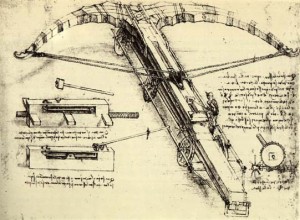
6. Giant crossbow (ballista)
Leonardo da Vinci Crossbow
The giant crossbow (ballista) is one of Leonardo da Vinci’s impressive war machines. He designed this massive weapon to intimidate and defend cities.
The crossbow, depicted in his sketches, spanned approximately 27 yards and was designed to launch large projectiles. Leonardo studied how force worked and applied mathematics to improve his designs.
He never built this giant crossbow, but the project highlights his interest in applying engineering to transform warfare and demonstrates how his curiosity led him to envision powerful new technology.
7. Mechanical knight (robotic automaton)
The mechanical knight was one of Leonardo da Vinci's most fascinating engineering marvels. Designed in the late 15th century, this robotic automaton could sit, stand, move its arms, and lift its visor using pulleys and gears.
Da Vinci’s drawings and sketches show his deep interest in mechanics and clockwork mechanisms. He wanted the robot knight to mimic real human movements.
Many historians view this creation as a testament to Leonardo's curiosity and imagination. Today, people recognize it as one of the earliest examples of robotics ideas and a highlight of Da Vinci's legacy as a genius inventor.
8. Multi-barreled machine gun
The multi-barreled machine gun is one of Leonardo da Vinci’s most striking inventions. He designed this weapon to enable soldiers to fire more shots without waiting to reload each barrel.
With a creative layout of multiple barrels, his sketches show the mind of an exceptional engineer. The invention featured a fan-shaped row of barrels, all mounted on a wheeled cart.
Soldiers could rotate and fire several barrels before stopping to reload, making it easier to keep firing during battle.
Although the gun was never fully built in his lifetime, the idea revealed Leonardo’s skills in observation and problem-solving. His machine gun design was far ahead of its time and influenced later inventions.
9. Anemometer for wind speed
The anemometer for wind speed shows Leonardo da Vinci’s drive for scientific discovery. He explored new ways to measure natural forces and designed an early version of the device.
Leonardo’s sketches reveal his focus on observation and experimentation. He took ideas from nature and developed practical inventions.
The anemometer fits well with his other weather and flight-related studies. Though he did not invent the anemometer, his improvements influenced later technology. Today, it is a standard tool in meteorology.
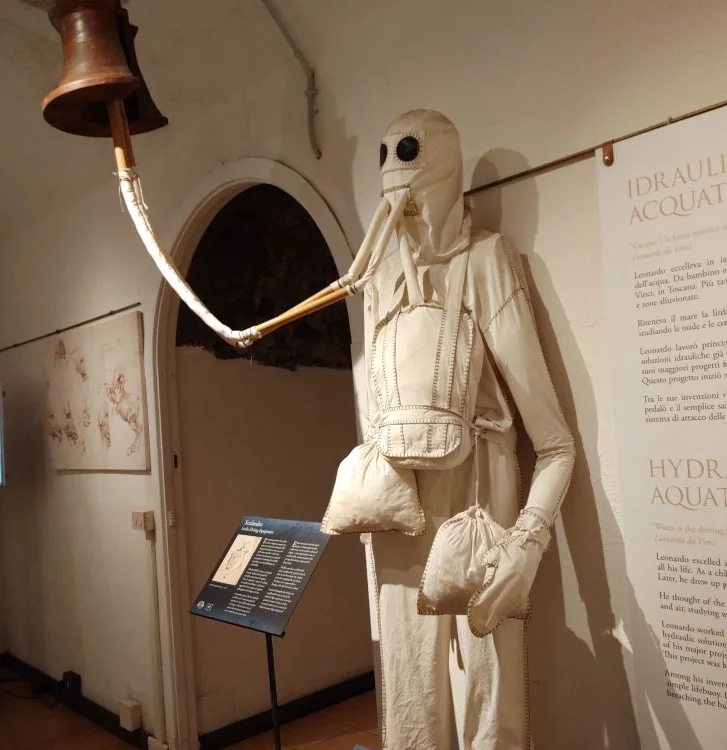
10. Diving suit with breathing tubes
Leonardo da Vinci scuba gear
The diving suit with breathing tubes is one of Leonardo da Vinci’s most interesting ideas. This design shows his curiosity for exploring underwater environments and solving real-world problems.
The suit features long tubes that connect the diver to the surface, allowing air to reach the person underwater. Da Vinci imagined this invention for military use, believing Italian soldiers could use it to approach enemy ships secretly.
The suit was never built during his lifetime, but his sketches demonstrated that he understood the basic principles of scuba gear. His detailed drawings display a mix of observation, experimentation, and creativity.
These early designs inspired later inventors. Da Vinci’s diving suit remains a testament to technology ahead of its time.
11. Water lifting device (Archimedes' screw)
The water lifting device uses a spiral-shaped screw to move water from a low place to a higher one. The concept dates back to ancient Greece, but Leonardo da Vinci created his improved designs and sketches of this machine.
Leonardo studied how the Archimedes' screw worked. He made detailed drawings in his scientific notebooks.
He explored using different materials and shapes to enhance its irrigation performance and water supply to buildings. His work with water lifting devices shows his curiosity about hydraulic machines and engineering.
These drawings demonstrate his skills as both an engineer and an inventor. Leonardo’s studies on water movement influenced later developments in hydraulic technology.
12. First gearbox design
Leonardo da Vinci created the first known sketches of a gearbox design during the Renaissance. In these detailed drawings, he demonstrated how gears could transfer and change motion, a capability that would become crucial for future machines and vehicles.
He imagined complex systems of interlocking gears long before modern engines were built. The gearbox ideas in his notebooks reveal how he combined scientific experimentation with creativity.
Leonardo’s fascination with clockwork mechanisms and problem-solving pushed him to design technology ahead of his time. Although many of these inventions stayed as prototypes or ideas, his engineering marvels influenced the development of machines for centuries.
13. Double-hull ship concept
The double-hull ship concept is a prime example of Leonardo da Vinci's innovation during the Renaissance. This design featured two layers in a ship’s hull to protect against damage from attacks or accidents.
Adding an extra layer made the vessel safer for its crew and cargo. Leonardo's scientific notebooks reveal how he applied observation and problem-solving to naval engineering.
He suggested a second hull could act as a shield, limiting damage if the outer shell was breached. This idea helped inspire safer shipbuilding in later generations.
As an inventor and engineer, his double-hull ship design shows his ability to think beyond his time. The sketches display his curiosity and understanding of mechanics, which were unusual for his era.
14. Flying parachute
The flying parachute was one of Leonardo da Vinci's most interesting inventions. His designs showed a pyramid-shaped parachute made from linen and wooden poles.
The artist and inventor Leonardo believed this device could let a person safely descend from great heights. He included careful notes and sketches for the parachute in his scientific notebooks.
The design differed from modern parachutes, but it showed his curiosity and innovation. Leonardo’s prototype had a sealed cloth to help slow the fall.
While his parachute was never built during the Renaissance, later experiments proved it could work.
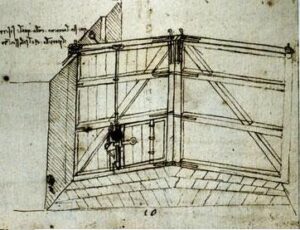
15. Improved canal lock system
Leonardo da Vinci Canal Lock
Leonardo da Vinci made significant advances in the canal system during the Renaissance. He studied old locks and noticed that boats often get damaged or stuck.
His solution was a new canal lock design with double gates and better water flow control. With his engineering skills, Leonardo designed locks that made it safer for boats to travel between areas at different water levels.
His canal lock system helped protect boats and save time moving goods in cities like Milan and Florence. These engineering marvels showed his deep understanding of hydraulics and mechanics.
16. Solar power concentration mirrors
Solar power concentration mirrors were one of Leonardo da Vinci’s lesser-known innovations during the Renaissance. He imagined using large, curved mirrors to focus sunlight and generate heat.
As an engineer and inventor, Leonardo designed a way to heat water for possible industrial uses. His sketches reveal his advanced understanding of reflection and the power of focused light.
Today, engineers recognize these designs as early concepts for solar energy systems. Some historians believe his solar concept helped inspire later developments in solar power.
17. Mechanical drum for infantry
The mechanical drum for infantry was one of Leonardo da Vinci’s fascinating war machines. Leonardo designed this device to help troops keep rhythm during marches or battles.
He incorporated gears and clockwork mechanisms into his sketches to automate the drum's operation. His mechanical drum shows Leonardo’s interest in combining music with military technology.
He believed that coordinated drumming could improve an army’s discipline and timing. Da Vinci’s notebooks contain detailed drawings of this innovative device.
The design uses wheels and levers to strike the drum. Leonardo’s curiosity and creativity led him to experiment with many inventions that were ahead of his time.
18. Cam Hammer
Leonardo da Vinci’s cam hammer is a groundbreaking invention that uses a rotating cam to lift and drop a hammer. It automates the metalworking process and significantly improves efficiency during the Renaissance.
This innovative mechanism reduced manual labor and laid the groundwork for future advancements in automated machinery, contributing to the Industrial Revolution.
Today, the cam hammer is celebrated for its blend of art, science, and engineering, and continues to inspire modern engineers and enthusiasts.
19. Ball bearing concept
The ball bearing concept is one of Leonardo da Vinci's clever engineering ideas. He tried to solve friction problems in moving machines.
His drawings and sketches demonstrate how spheres can be placed between surfaces, enabling them to move more smoothly. Leonardo used his observations of mechanics and physics to guide his designs.
Although he may not have built working prototypes, his scientific notebooks described how ball bearings could support heavy loads and reduce wear. This concept became important in later centuries.
Today, machines and vehicles often use ball bearings. His curiosity and focus on problem-solving helped shape technology hundreds of years after his time.
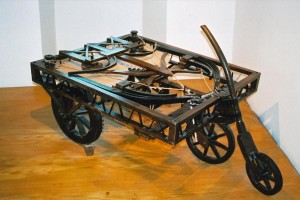
20. Self-propelled car design
Leonardo da Vinci’s self-propelled car model
Leonardo da Vinci designed a self-propelled cart in the late 15th century, which is considered a precursor to the modern automobile.
Powered by coiled springs and featuring gears, steering, and brakes, his innovative cart could move independently and showcased advanced mechanical engineering for its time.
Although never built during his lifetime, the design has been reconstructed and is recognized as a significant step toward autonomous vehicles.
Frequently Asked Questions
Leonardo da Vinci is known for inventing early flying machines, tanks, and creative devices far ahead of his time. He made significant advances in both art and engineering, creating renowned paintings, designing bridges, and exploring innovative methods to understand nature.
What was Leonardo da Vinci's biggest invention?
Many people consider Leonardo’s ornithopter flying machine to be his most ambitious invention. He studied how birds fly and designed the machine, hoping humans could fly in the same way.
He never built the machine, but his detailed sketches show his dedication to understanding flight.
What is Leonardo da Vinci's greatest achievements?
Leonardo’s greatest achievements include his paintings, such as the Mona Lisa and the Last Supper. He also made scientific discoveries in anatomy, engineering, and nature.
He created blueprints for inventions like the armored vehicle and early helicopters. Leonardo drew detailed anatomical drawings that blended art and science.
What are 4 things Leonardo da Vinci did?
Leonardo painted masterpieces, such as the Mona Lisa. He invented devices such as a self-supporting bridge and a parachute.
He studied the human body and made detailed anatomical sketches. During the Renaissance, he also designed an armored tank prototype.
What are Leonardo da Vinci's greatest works?
His most famous works are the paintings Mona Lisa and The Last Supper. His inventions include the ornithopter, the self-supporting bridge, and the armored tank.
He created scientific notebooks and anatomical drawings.
What was da Vinci's IQ?
No official record of Leonardo’s IQ exists because modern tests did not exist during his lifetime. Experts believe he was brilliant based on his art, science, and invention achievements.
Estimates sometimes suggest scores above 180, but these are only guesses.
Did Da Vinci invent the parachute?
Leonardo sketched an early parachute design. His drawing showed a pyramid-shaped frame covered in cloth.
Modern experiments have demonstrated that his parachute design is indeed effective.
What did Leonardo da Vinci do the most?
Leonardo spent much of his life drawing and painting. He filled many notebooks with sketches about anatomy, inventions, and nature.
He combined his art, science, and technology interests in almost everything he did.
Did da Vinci invent the helicopter?
Leonardo designed the "helical air screw," an early helicopter concept that looks like a spinning screw made from linen and wire.
Leonardo drew early sketches for underwater breathing tools and a submarine. He never built a working submarine and kept some of his ideas secret because he worried about their potential use in war.
What was Leonardo da Vinci's first robot?
In the late 1490s, Leonardo created sketches for a mechanical knight, sometimes referred to as "Leonardo’s robot. " The robot could perform simple movements, such as sitting or waving its arms.
Leonardo da Vinci biography for kids often feels hard to understand because of big words and confusing details.
Many students struggle to find simple facts about this famous artist and inventor. This article presents basic information in a clear and accessible way for young readers.
You can expect to learn about Leonardo da Vinci's life, his notable creations, and why he remains crucial today.
Leonardo da Vinci was an Italian artist, inventor, and scientist from the Renaissance.
He is famous for his paintings, such as the Mona Lisa, and his groundbreaking ideas about machines and the human body.
He was born near Vinci, Italy, in 1452 and began studying art at a young age.
Early Life of Leonardo da Vinci
Leonardo da Vinci’s early life shaped him into a renowned polymath, renowned for his creativity and groundbreaking discoveries.
His childhood in Italy laid the groundwork for a journey that would lead to memorable artworks and inventions.
Growing Up in Italy: Florence and Vinci
Leonardo was born on April 15, 1452, in Vinci, a small town in Italy, close to Florence.
His father, Ser Piero, worked as a notary, and his mother, Caterina, was a local peasant.
They did not marry, but Leonardo still grew up surrounded by his father's family.
The countryside around Vinci provided Leonardo with numerous opportunities to observe nature and its inhabitants.
He also spent time in Florence, a city known for art and creativity during the Renaissance.
This allowed him to see many brilliant works and meet essential artists and thinkers.
Many historians believe these places inspired his lifelong interest in art and science.
He was especially interested in animals, plants, and the human body.
He often filled his notebooks with detailed sketches of birds, flowers, and even designs for flying machines.
By observing animals and studying their bodily functions, Leonardo gained a profound understanding of anatomy before becoming a renowned scientist.
Drawing was one way he recorded his ideas and discoveries.
His passion for nature and careful observation helped him invent things and create some of the world’s most significant artworks, such as the Mona Lisa and The Last Supper.
Leonardo da Vinci – The Artist and Painter
Leonardo da Vinci was a leading artist and thinker in the Italian Renaissance.
He blended creativity, curiosity, and careful observation in his artwork.
His paintings and sketches gained worldwide fame.
His work shows a strong focus on learning and discovery.
Famous Artworks: Mona Lisa and The Last Supper
Leonardo da Vinci is best known for painting the Mona Lisa and The Last Supper.
The Mona Lisa is famous for her mysterious smile and is one of the most recognized portraits in the world.
The painting shows Leonardo’s skill in capturing human emotion and lifelike detail.
The Last Supper, created in a monastery in Milan, tells the story of Jesus' final meal with his disciples.
Leonardo used careful observation to show each person’s reaction on their face.
These two artworks are often seen as masterpieces of the Renaissance.
They demonstrate his profound understanding of anatomy and lighting.
Mastering Sketches and Drawing Techniques
Leonardo excelled at drawing and sketching before starting his paintings.
He filled notebooks with sketches of people, animals, plants, and inventions.
His drawings show his careful study of nature and anatomy.
This helped him create lifelike art.
Many of his sketches are now regarded as important works in their own right.
He often experimented with new techniques, such as drawing with both hands or trying different materials.
This exploration helped Leonardo become a master in both quick sketches and detailed art.
Children can read more about his early life and training as an artist in this guide for kids.
Creativity and Imagination in Renaissance Art
Leonardo used imagination and scientific observation to shape his art.
He drew flying machines, strange inventions, and detailed maps.
His creativity enabled him to blend science with art, making him both a renowned painter and an inventor.
During the Renaissance, artists such as Leonardo explored concepts of nature, light, and the human form.
He did not just copy what he saw; he experimented and innovated in every artwork.
Leonardo da Vinci – Inventor and Engineer
Leonardo da Vinci combined art and science in his inventions.
He utilized his curiosity about nature and the world to conceive ideas that were far ahead of their time.
Amazing Inventions and Flying Machines
Da Vinci is known for his creative inventions, many of which he sketched in his notebooks.
He imagined machines, such as an early helicopter version and a flying machine with wings shaped like birds.
He also designed bridges, water pumps, and even a type of armored vehicle.
His flying machines demonstrate how he studied birds and attempted to replicate their movements.
Although most of his inventions were never built while he was alive, the detailed drawings and ideas inspired future technology.
His work as an engineer reveals his interest in solving real-world problems through creative thinking.
Experimentation and Innovation in Science
Leonardo da Vinci employed careful observation and experimentation to comprehend the inner workings of various phenomena.
He studied anatomy by dissecting animals and even human bodies, which enabled him to create detailed drawings of bones, muscles, and organs.
These drawings led to a better understanding of human biology.
He took notes on everything he saw, from plants and water movement to machines and people.
His work as a scientist pushed learning forward during the Renaissance.
Leonardo's curiosity and commitment to study helped shape the fields of engineering, science, and art.
Observation and Discovery: The Mind of a Genius
Leonardo's mind never stopped asking questions.
He combined his artistic, inventor, and scientist skills to examine the world closely.
His notebooks, filled with sketches and diagrams, reveal his passion for learning and understanding the natural world.
He wrote backwards, which added a layer of secrecy to his thoughts and ideas.
His sharp observation skills helped him discover how things moved, changed, and worked.
This made Leonardo da Vinci one of his time's most important inventors and thinkers.
Leonardo da Vinci – Scientist and Anatomist
Leonardo da Vinci explored science and anatomy with intense curiosity and imagination.
He combined his artist, inventor, and scientist skills to study the human body and nature.
He left behind detailed sketches and ideas that changed people's thoughts about discovery and learning.
Anatomy Studies and the Human Body
Leonardo da Vinci carefully studied the human body by dissecting cadavers and observing their internal parts.
He drew hundreds of detailed sketches of bones, muscles, and organs to help people better understand anatomy.
His drawings, such as the famous Vitruvian Man, demonstrated how art and science could collaborate.
Leonardo also wrote notes explaining how the heart, lungs, and brain function.
By drawing the body from different angles, he demonstrated new ways to visualize how bones and muscles move to doctors and artists.
Today, his anatomical sketches remain crucial for science and medical research.
Exploring Nature Through Observation
Leonardo spent much of his life closely observing nature in Italy.
He believed careful observation was the key to understanding the world and improving art and science.
He filled his notebooks with countless ideas and sketches by watching how birds fly and how water moves.
He often compared the human body to nature, seeing patterns in animals, plants, and rocks.
His notes included ideas for flying machines based on animal wings and inventions inspired by rivers and trees.
Leonardo’s ability to see connections in nature helped him become a true genius of the Renaissance.
Experimentation in the Renaissance Era
During the Renaissance, most people accepted the views presented in ancient books on science. Leonardo da Vinci, however, put his ideas to the test.
He built models, mixed chemicals, and tested inventions to see how they worked. Instead of guessing, he used creativity and hands-on experimentation to solve problems.
Leonardo often challenged old beliefs and made discoveries. His experiments led to early machine designs, such as helicopters and bridges, demonstrating innovation and imagination.
He used observation and testing to set a higher standard for scientists and inventors of his time.
Leonardo da Vinci’s Legacy for Kids
Leonardo da Vinci was a true Genius from Italy who changed how people see art, science, and invention. Kids today still learn from his creativity and curiosity.
Polymath: Master of Many Talents
Leonardo was known as a Polymath, which means he possessed many talents and excelled in more than one subject. He worked as a Painter, Sculptor, Engineer, Scientist, and Inventor.
He studied topics such as anatomy, Nature, and Mathematics. He created famous Artworks like the Mona Lisa and The Last Supper.
His notebooks were full of detailed Sketches, inventions, and ideas. Leonardo da Vinci's biography for kids explains that he explored flying machines and innovative drawing techniques.
He always wanted to learn and try new things. Discovery and Experimentation were part of his daily life.
The Lasting Impact on Art and Science
Leonardo’s Artworks changed painting forever. He used light and shadow to make his images look more real.
His careful Observation helped him study human bodies and Nature. His sketches continue to aid doctors and students today.
Kids can see his ideas in science books, history lessons, and museum exhibits.
As an Engineer, Leonardo planned bridges and war machines. He even drew early designs for a flying machine.
His Inventions and imagination were ahead of his time.
Inspiring Creativity and Learning Today
Leonardo’s story inspires kids to follow their curiosity and never stop Learning. He proved that asking questions, experimenting, and observing are keys to discovery.
Students examining his sketches or paintings learn that Creativity and Innovation can emerge from studying art and science.
Many teachers use Leonardo’s life to show that imagination is essential in every subject. Schools encourage kids to draw, build inventions, and think like Leonardo.
Frequently Asked Questions
Leonardo da Vinci was a talented artist, inventor, and scientist from the Italian Renaissance. He created famous paintings, designed machines, and studied the world around him with curiosity and detail.
What is a simple biography of Leonardo da Vinci?
Leonardo da Vinci was born in 1452 in Vinci, Italy. He became known for his painting, scientific studies, and inventions.
He is celebrated for his creative genius and significant contributions to the Renaissance.
What are some facts about Leonardo da Vinci for kids?
Leonardo painted the Mona Lisa and The Last Supper. He was also an inventor and scientist who studied human bodies to learn about anatomy.
Leonardo filled notebooks with drawings of inventions, plants, and animals.
Did da Vinci have ADHD?
Some people today think Leonardo may have shown signs similar to ADHD because he started many projects but finished only a few. There is no proof or official diagnosis, and ADHD as a condition was not known in his lifetime.
What are 5 interesting facts about Leonardo da Vinci?
Leonardo wrote many of his notes in mirror writing, which is known as a form of backward writing.
He designed flying machines hundreds of years before airplanes existed.
He was interested in anatomy and studied human bodies to enhance his artistic skills.
Leonardo created detailed maps.
He was skilled in music and played several instruments.
What did Leonardo do as a kid?
As a child, Leonardo loved nature and explored the countryside around Vinci. He was talented at drawing and invented simple machines.
He became an apprentice in an artist’s workshop as a teenager.
How old is The Mona Lisa?
Leonardo started painting the Mona Lisa around 1503 in Florence, Italy. As of 2025, the painting is about 522 years old.
What was da Vinci's IQ?
There is no accurate way to test Leonardo’s IQ, as he lived before IQ tests were developed. However, based on his work and abilities, many scientists and historians believe he may have had an exceptionally high IQ.
Who painted The Last Supper?
Leonardo da Vinci painted The Last Supper, a famous mural found in a monastery in Milan, Italy.
Was da Vinci left-handed or right-handed?
Leonardo da Vinci was left-handed. He used his left hand for writing and drawing, which some people believe helped his creativity.
What caused Leonardo da Vinci's death?
Leonardo da Vinci died in 1519 at the age of 67. Most records say he died from natural causes. He likely passed away due to old age and health problems.
The Medici family tree is renowned for its profound connection to the Italian Renaissance and the artists who made that era so significant.
If you’ve ever wondered how certain artists became so well-known, you’re not alone. By exploring which artists were supported by the Medici family, you’ll get a clearer picture of their influence and discover the names connected to their powerful patronage.
The Medici family supported major artists, including Leonardo da Vinci, Michelangelo, Botticelli, Donatello, Fra Angelico, and Fra Filippo Lippi.
Their financial and personal backing of these creative minds helped shape European art for generations to come. Through their support, buildings, paintings, and sculptures flourished, making Florence a leading cultural center.
Their interest in the arts continued across generations of the Medici family tree. From Cosimo de’ Medici’s early interest in art and libraries to Lorenzo de’ Medici’s famous friendships with artists, each family member left a mark.
Key Renaissance Artists Supported by the Medici Family Tree
The Medici family, rulers of Florence and a leading Italian banking dynasty, played a decisive role in shaping the Renaissance. Their patronage of the arts elevated Florence to a center of creativity and left a lasting cultural legacy by supporting artists such as Leonardo da Vinci, Michelangelo, and Botticelli.
Medici Family Tree: How the Medici Family Connects to the World Today
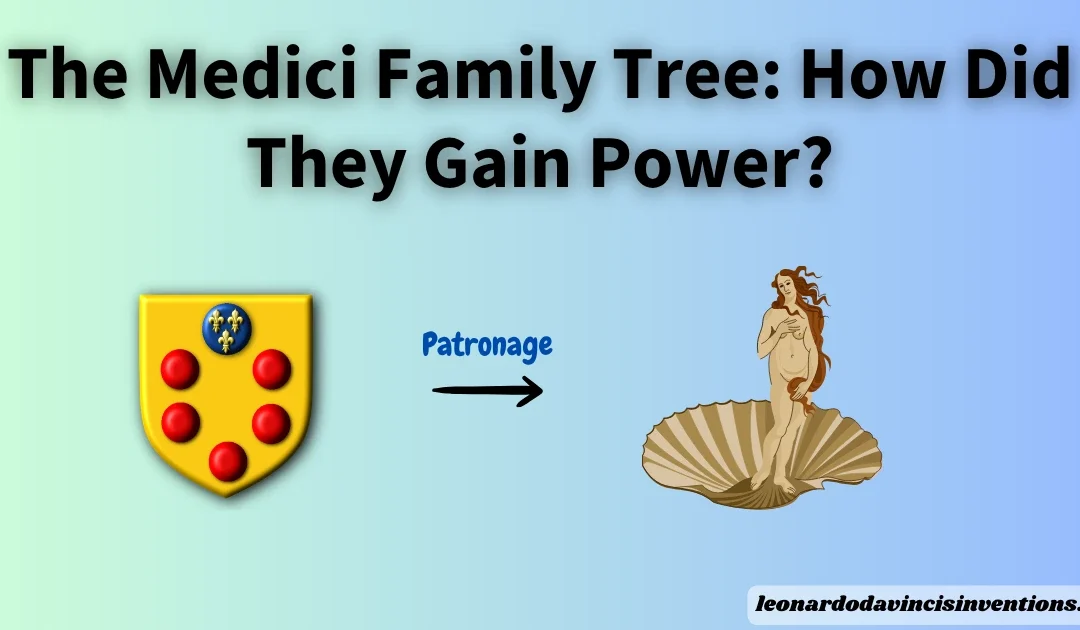
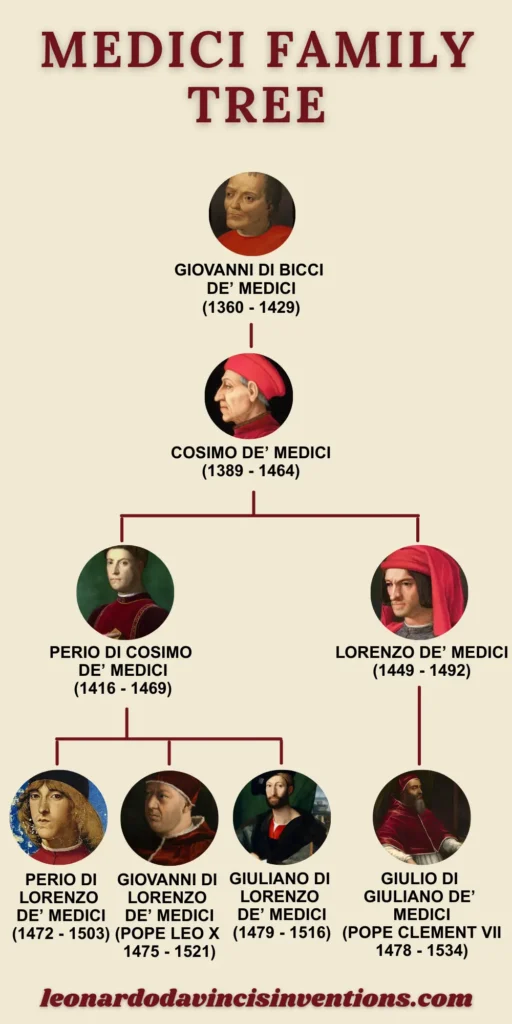
This Medici family tree infographic traces the lineage from Giovanni di Bicci de’ Medici to influential descendants like Lorenzo the Magnificent, Pope Leo X, and Pope Clement VII.
It highlights how the family’s power extended through politics, religion, and art during the Renaissance.
Leonardo da Vinci and the Patronage of the Arts
Leonardo da Vinci began his career in Florence at a time when the House of Medici held great power and influence. Lorenzo de’ Medici, sometimes called “Lorenzo the Magnificent,” recognized Leonardo’s talent early and gave him access to the Medici’s workshops and connections.
This support allowed Leonardo to grow as an artist and scientist, experimenting freely with new ideas. The Medici family’s wealth and backing enabled Leonardo to work with materials, models, and skilled assistants that few others in Italy could match at the time.
Much of his development as a Renaissance master was made possible by this unique environment of artistic freedom and innovation.
Michelangelo’s Rise to Power in Florence
Michelangelo’s early career flourished under the strong support of the Medici family. As a young man, he was invited to live at the Medici palace, where Lorenzo de’ Medici became his patron.
This relationship afforded Michelangelo access to the city's finest teachers, resources, and a close circle of artists and scholars. The environment fostered by the Medici helped Michelangelo create works that have become icons of the Renaissance.
The family’s consistent patronage helped him secure critical public commissions. Their connections later enabled him to work on major projects in both Florence and Rome.
Botticelli’s Legacy in the House of Medici
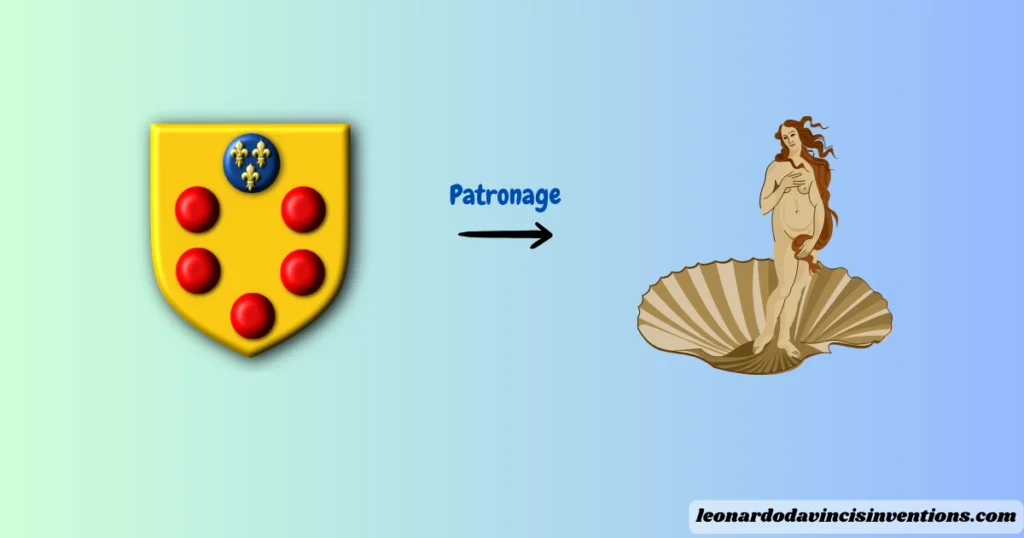
Botticelli created some of his most famous paintings, including "The Birth of Venus" and "Primavera," for members of the Medici family. The family’s enthusiasm for art and culture set the stage for Botticelli to explore mythological themes and innovative styles not seen in Florence before.
His close relationship with the Medici placed him at the heart of the family’s social and political events. Their commissions gave him lasting fame.
Because of Medici patronage, Botticelli’s works came to symbolize both the era's achievements and its taste.
How the Medici Family Tree Shaped Art and Culture in Tuscany
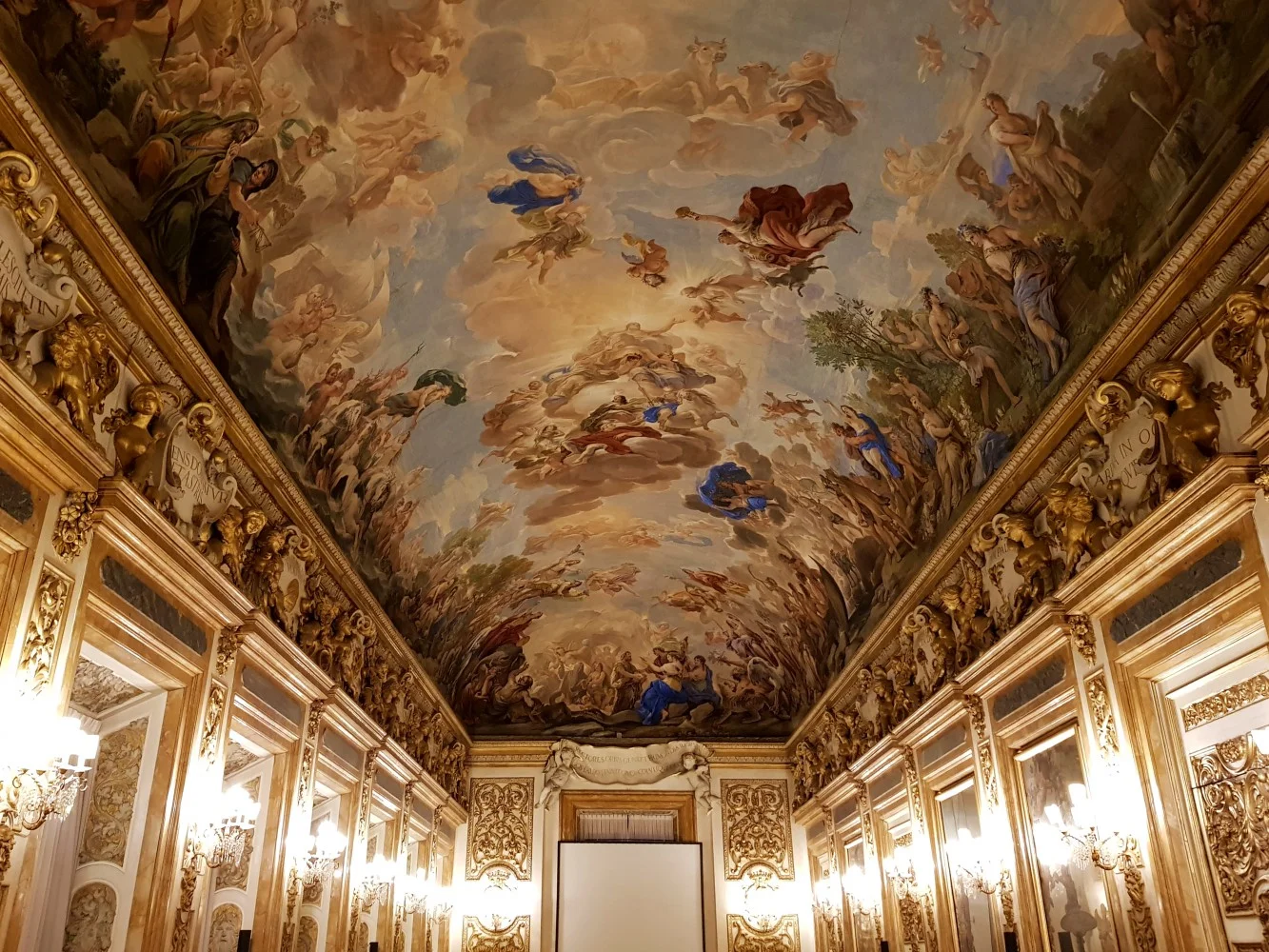
The Chapel of the Magi in Palazzo Medici Riccardi features famous frescoes by Benozzo Gozzoli depicting the Procession of the Magi
The Medici family’s rise to power sparked artistic and cultural advances across Tuscany. Through their banking empire and political leadership, the Medici dynasty left a long-lasting legacy that shaped art, architecture, and culture for centuries.
The Influence of Medici Wealth and Banking on Artists
Medici banking wealth provided the foundation for the family's artistic patronage. Their banking house, which became one of the most powerful in Europe, enabled the Medici to fund paintings, sculptures, buildings, and churches throughout Florence and Tuscany.
Artists such as Michelangelo, Leonardo da Vinci, and Sandro Botticelli received direct financial support thanks to the Medici’s substantial resources. The family’s banking success also brought new business to Florence, allowing for a flourishing of commerce, culture, and creativity.
By investing in the arts, the Medici helped transform Florence into a leading city of the Renaissance.
Patronage, Politics, and the Artistic Revolution
The Medici family used their political influence to promote art as a display of power and wisdom. As rulers of Florence and a key political dynasty, they frequently linked art projects to significant events or achievements.
Public buildings, cathedrals, and palaces became symbols of Medici strength and Florentine pride. The Medici housed creatives, provided studio space, and even helped decide artistic subjects.
The Medici’s long-standing support enabled artists to focus on their craft, resulting in works that defined the Renaissance in Italy.
The Role of Grand Dukes of Tuscany in Supporting Art
When the Medici family became Grand Dukes of Tuscany, their influence on art expanded across the entire region. The Medici line included rulers like Cosimo I, who funded large-scale projects, including gardens, fountains, and public monuments.
Key Medici rulers established:
The Uffizi Gallery
Medici Palaces in Florence and beyond
Collections of ancient and modern art
This support shaped Tuscany’s visual landscape and left landmarks that people still visit today. The Grand Dukes ensured that the Medici heritage of artistic patronage endured through shifting times and changing Italian politics.
Where the Medici Legacy Can Still Be Seen Today
Many of the places shaped by the Medici family still stand in Florence and across Tuscany. Palaces, chapels, galleries, and public squares preserve the artistic world they helped build, allowing visitors to see Renaissance masterpieces in the very spaces where they were first commissioned and celebrated.
The Lasting Impact of the Medici Family Tree on Italian Heritage
The Medici family tree profoundly shaped Italy's culture and future by connecting banking, politics, and the arts. Their support changed Florence and Tuscany, influencing not only artists but also rulers and noble families across Europe.
Succession of Rulers and Their Support of Artists and Scientists
The Medici family tree started with Giovanni di Bicci de’ Medici, whose banking success gave the House of Medici the influence to control Florence’s government. Later rulers like Cosimo de’ Medici, known as the first “Father of the Nation,” made Florence a center for scholars and artists.
Lorenzo the Magnificent continued the tradition of support, helping talents like Michelangelo and Leonardo da Vinci succeed. Several members of the Medici family became popes, including Pope Leo X and Pope Clement VII, thereby extending the dynasty’s influence within the Catholic Church.
The family’s support for thinkers and inventors encouraged innovation and scientific discoveries in the heart of Tuscany.
Medici’s Contribution to the Renaissance and Florence’s Golden Age
Patronage from the Medici played a pivotal role in shaping the Italian Renaissance, a period characterized by groundbreaking ideas in art and science. Their wealth allowed them to commission masterpieces from artists such as Botticelli, Donatello, and Brunelleschi.
Many artists were trained, housed, and protected by the dynasty, allowing them to create freely. The House of Medici also funded critical architectural works, including the Medici Chapel and the dome of Florence Cathedral.
This boom in creativity transformed Florence into a symbol of beauty and progress. The family's efforts contributed to what many historians call Florence’s golden age, characterized by notable achievements in painting, sculpture, and architecture.
The Medici Family Tree’s Legacy in Italian History and Nobility
The Medici legacy remains a vital part of Italy’s heritage. They produced several notable historical figures, including rulers, popes, and queens like Catherine de’ Medici.
Their policies helped change Florence from a medieval republic into the Grand Duchy of Tuscany. Medici palaces and landmarks still stand as reminders of their power.
The family's influence extended through marriages into other royal families, weaving their lineage into the broader network of European nobility.
Tracing the Medici Footprint Through Florence and Tuscany
The story of the Medici family is not confined to books or paintings. Across Florence and the Tuscan countryside, churches, gardens, and historic residences still reflect their influence. Exploring these locations offers a deeper understanding of how Renaissance art, politics, and daily life were woven together under Medici patronage.
Frequently Asked Questions
The Medici family tree features some of the most influential figures in European history. Their fortunes, legacy, relationships, and controversies continue to spark curiosity.
Does the Medici family still exist today?
The main Medici bloodline came to an end in the 18th century. However, descendants may exist through other families related by marriage. The family no longer holds power or wealth as it did during the Renaissance.
Who inherited the Medici fortune?
When Anna Maria Luisa de’ Medici died in 1743, the direct line of the Medici family came to an end. She left much of the family’s property, art, and treasures to the city of Florence, ensuring that the public could enjoy the Medici collection.
How is Catherine De Medici related to Cosimo De Medici?
Catherine de Medici was a descendant of Lorenzo the Magnificent, who was Cosimo de’ Medici’s grandson. This makes Catherine a member of the extended Medici family tree.
Is Netflix's Medici historically accurate?
The Netflix series “Medici: Masters of Florence” is based on real people and events. However, the show alters timelines and dramatizes stories for entertainment, so some details do not align with historical accuracy. Not all characters and events are depicted accurately.
What was the dark side of the Medici family?
The Medici family employed political influence, bribery, and occasionally violence to maintain its power. There were plots, betrayals, and scandals involving murder and corruption. These actions helped them stay at the top of Florentine society, but also made many enemies.
How did the Medicis lose their money?
The Medici bank, once the wealthiest in Europe, declined due to poor management, risky lending practices, and political turmoil. The family spent a significant portion of their fortune on art and war, and later generations mismanaged the remaining assets, ultimately leading to financial ruin.
Who was the most powerful family in Italy?
The Medici family rivaled other powerful dynasties. They stood out due to their vast wealth and significant political influence in Florence. Their influence reached the Catholic Church. Their family tree included popes and queens.u003cbr/u003eThis made them one of Italy’s most powerful families during the Renaissance.
Why did the Medici family fall?
Financial problems and weak leadership led to their decline. The political climate shifted, and other families and countries gained power. The Medici lost their influence. The dynasty ended when its direct bloodline became extinct.
Which Medici died of syphilis?
Many members of the Medici suffered from poor health. Some historians believe Alessandro de’ Medici, the first Duke of Florence, died from complications of syphilis. Health records from the time are not always clear.
Who is the most famous Medici?
Lorenzo de’ Medici, also known as Lorenzo the Magnificent, is the most famous member of the Medici family. He led as a patron of the arts and helped the Renaissance flourish. Lorenzo supported artists like Michelangelo and Botticelli.
Disclosure: This page may contain affiliate links. If you choose an experience through them, it helps support the site at no extra cost to you.
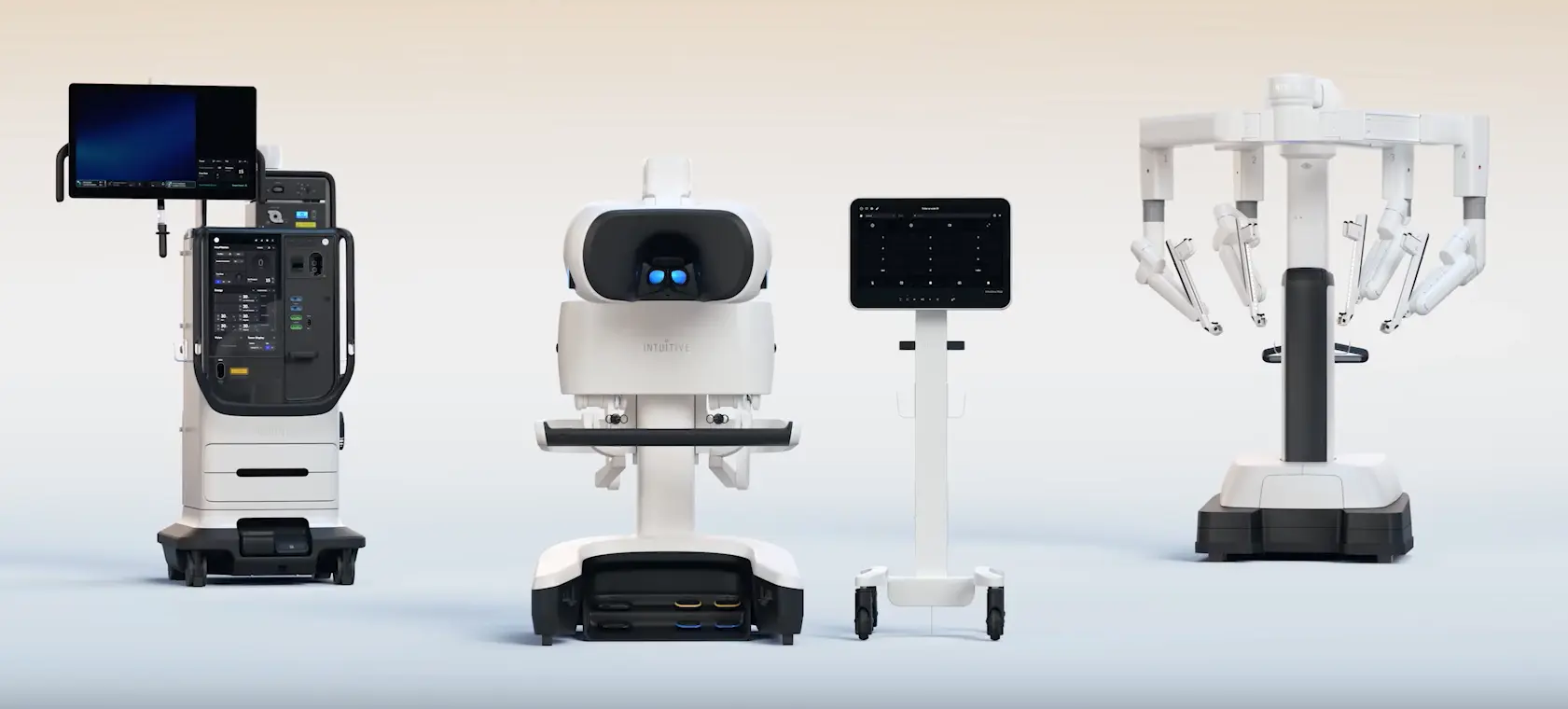
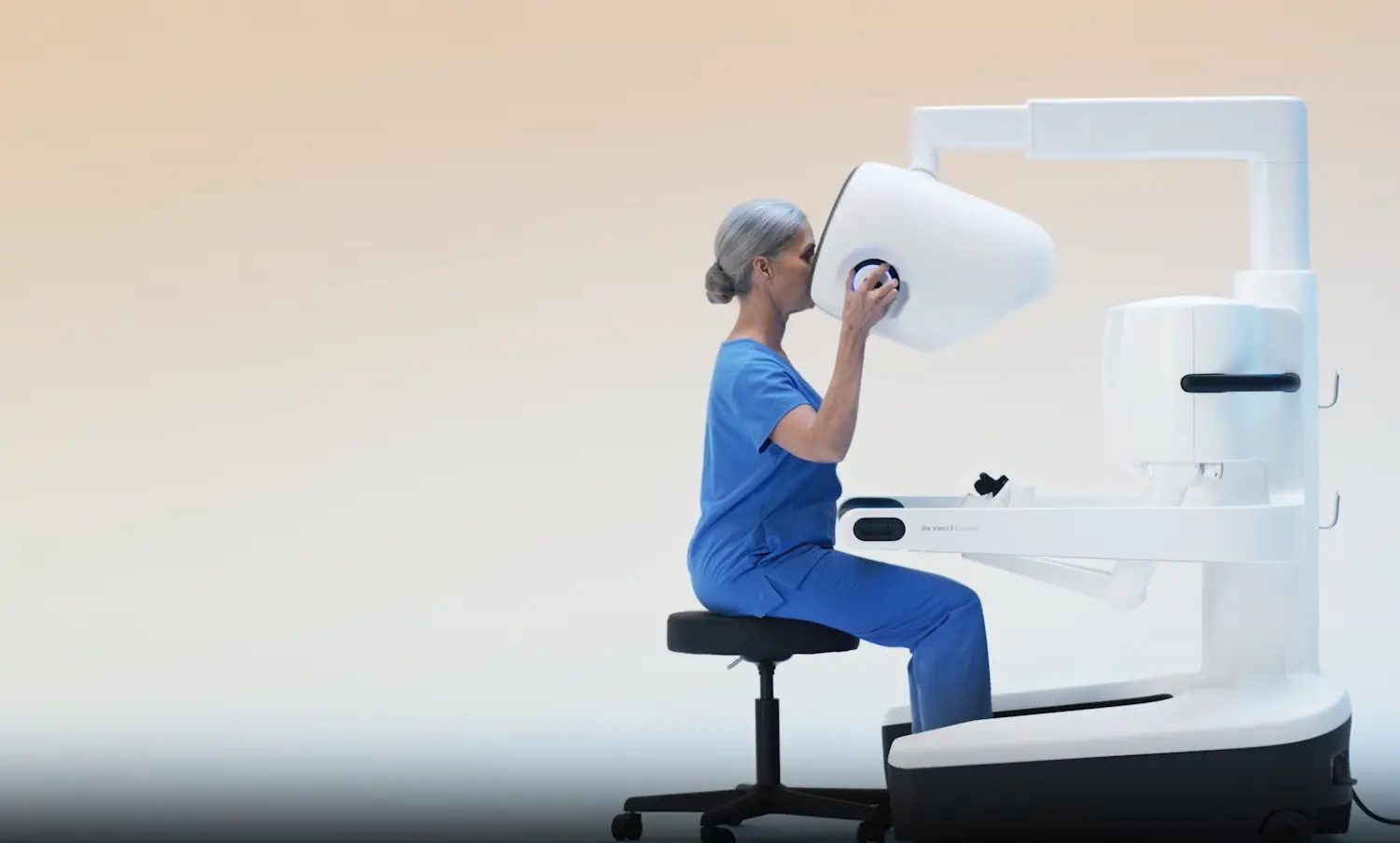
Da Vinci 5 robot surgical system, the most advanced and integrated multiport platform
Da Vinci Robot is a sophisticated surgical tool designed to assist surgeons in performing complex procedures with greater precision. This robotic system is primarily used to enable minimally invasive surgeries, enhancing surgical capabilities beyond the limitations of the human hand.
Implementing such advanced technology could ease concerns and offer a safer alternative for those unsure about undergoing traditional surgery.
Patients often worry about the long recovery times and significant scarring associated with traditional open surgeries. The da Vinci Robot significantly reduces these issues as it supports minimally invasive techniques.
The system enhances the surgeon’s abilities with robotic arms that offer greater accuracy and control, promising quicker recovery and less visible scarring for patients.
Understanding how this system works can empower individuals to make informed decisions regarding their surgical options. Through its innovative design, the da Vinci Robotic Surgical System has transformed how surgeries are performed, providing a more efficient and patient-friendly experience.
Introduction to the da Vinci Robot
The da Vinci Robot revolutionizes surgical procedures with advanced technology, enabling more precise and minimally invasive operations. This section delves into what makes this robotic system unique and explores its history and applications.
What is the da Vinci Robot?
The da Vinci Robot is a surgical system designed to enhance a surgeon’s capabilities while performing minimally invasive procedures. Operated through a console, it translates the surgeon’s movements into more minor, precise actions inside the patient’s body.
It consists of robotic arms equipped with surgical instruments and a camera, providing a high-definition, 3D view of the surgical area. This technology offers significant benefits over traditional surgery, including smaller incisions, reduced pain, and quicker recovery times.
Overview of Robotic Surgery
Robotic surgery involves using advanced robotic systems, like the da Vinci surgical system, to assist surgeons. These systems provide greater control and precision, making them ideal for complex procedures.
Surgeons manipulate the robot’s arms using a console, allowing for highly accurate movements. This approach leads to less blood loss and minimal scarring compared to open surgery.
Da Vinci robotic surgery is commonly used in urology, gynecology, and cardiothoracic surgeries, promoting shorter hospital stays and faster return to normal activities.
Initially developed with inspiration from projects funded by NASA and the military for remote surgery, it marked a significant breakthrough in medical technology.
Over the years, the system has evolved, incorporating improved imaging, ergonomics, and surgical instruments. Its history demonstrates substantial growth and innovation, increasingly making robotic-assisted surgery a standard across healthcare facilities globally.
Features of the da Vinci Surgical System
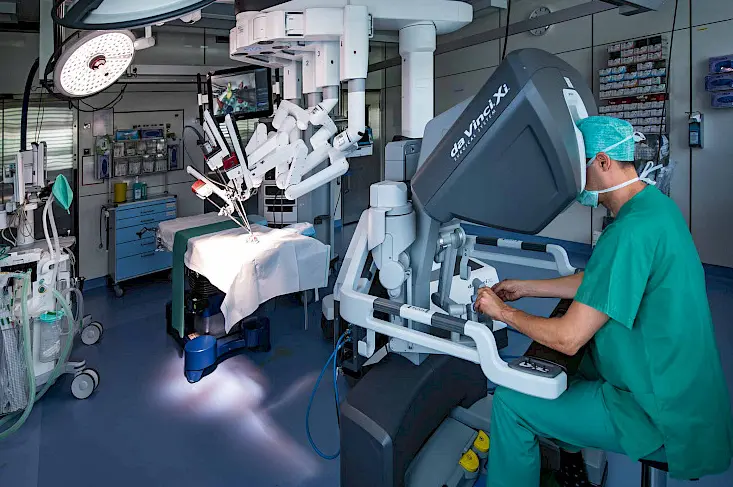
A surgeon performs surgery using the da Vinci Robot surgical system in the operating room
The da Vinci Surgical System is a robotic technology that enhances minimally invasive surgery through precision and control. It enables surgeons to perform complex procedures through smaller incisions, resulting in fewer complications and faster recovery times.
Components of the da Vinci Robot
The da Vinci surgical system comprises several key components designed to work together seamlessly. These include a patient-side cart with robotic arms that hold surgical instruments, an advanced vision system offering magnified 3D high-definition views, and a surgeon console where the surgeon operates the robot.
The robotic arms’ range of motion is wider than the human hand’s, allowing for precise manipulation of surgical tools. This intricate system ensures enhanced control and accuracy during surgical procedures.
How Does the system Work?
In real-time, the system translates the surgeon’s hand movements from the console to the robotic instruments. This is accomplished through advanced sensors and cameras that provide a detailed view of the surgical area.
With instruments that can bend and rotate more flexibly, the da Vinci robotic surgery can perform complicated tasks with traditional methods. The surgeon always maintains control, ensuring safety and precision without direct contact.
The da Vinci Console and Its Functionality
The surgeon console is the command center where critical decisions are made. It features an ergonomic design with supportive hand and foot controls for seamless operation.
Surgeons view the surgical field through a 3D high-definition monitor, which provides a clear and magnified view of the surgical area. The console allows surgeons to control the robotic arms intuitively, translating their movements into precise surgical actions. This setup enhances dexterity and reduces fatigue during lengthy procedures.
Types of Surgeries Performed with the da Vinci Robotic System
The da Vinci Robot offers precision in various surgical fields, providing enhanced visualization and control for complex procedures. Its robotic arms allow for small incisions, leading to quicker recovery and reduced patient pain.
Standard Procedures Using the da Vinci Robot
Da Vinci Robotic Surgery is widely used in prostatectomies and hysterectomies. In prostate cancer, surgeons perform precise removals of prostate tissue, which helps preserve surrounding nerves.
Similarly, for gynecological surgeries, such as hysterectomies, the technology allows for greater precision and less damage to nearby organs. The da Vinci Surgical System is also effective in colorectal surgeries, where it aids in minimizing risks and promoting faster recovery. These common uses highlight the versatility of the da Vinci technology.
Advantages of da Vinci Robotic Surgery
The da Vinci Surgical System provides several benefits. It allows surgeons to operate with enhanced accuracy, mimicking natural hand movements through robotic arms.
This precision leads to less blood loss and reduced pain during recovery. The surgeon’s console offers a 3D high-definition view, improving visibility of the surgical area.
Furthermore, minimal scarring is possible due to smaller incisions, a significant advantage over traditional open surgeries. These features make robotic surgery appealing to many patients seeking advanced medical solutions.
What Type of Surgery Does the da Vinci Robot Do?
The da Vinci Robot is used for various procedures across different specialties. It is employed in urological surgeries, including kidney and bladder operations. Gynecological applications range from fibroid removal to endometriosis treatment.
In addition, it assists in head and neck surgeries, offering surgeons control and precision even in confined spaces. As hospitals seek innovative solutions, the da Vinci Robotic System stands out for effectively tackling intricate surgical challenges.
Costs and Training for the da Vinci Robot
The da Vinci Robot offers a mix of innovation and precision in surgical procedures. Integrating this technology into a hospital setting requires significant investment in costs and training.
Da Vinci Robot Cost and Pricing
The acquisition costs of the da Vinci Surgical System range from $0.5 to $2.5 million, depending on the model and configuration. The da Vinci Xi model can sell for around $1.75 million. Hospitals must also consider ongoing maintenance, which can add up significantly.
These expenditures reflect these robots’ cutting-edge technology and capabilities in enhancing surgical precision and reducing patient recovery times.
Intuitive recognizes concerns about patient care costs and is creating cost-effective financing models. Two out of three customers use flexible financing to acquire our technology.
Da Vinci Robot Training Programs
Surgeon training for the da Vinci Robot is crucial to its successful implementation. Initial training costs, covering the first four surgeons, are included in the robot’s purchase price. Da Vinci Learning provides comprehensive training tools.
These programs enhance surgeons’ skills, ensuring they can operate the system effectively and safely. Regular updates and learning modules are available to keep up with advancements in robotic surgical procedures.
Da Vinci Robot Certification for Surgeons
Surgeons must obtain certification to perform da Vinci robotic surgeries. Certification programs involve rigorous coursework, practical skills assessments, and ongoing evaluations to ensure competency.
This certification shows a surgeon’s ability to handle the complex operations involving the da Vinci Surgical System, enhancing their reputation and patient trust. Achieving this certification is critical for those looking to specialize in robotic surgery and utilize the full potential of the da Vinci Robotic Surgical System.
Pros and Cons of Using the da Vinci Robot
The da Vinci Robot5 console provides a 3D high-definition view
The da Vinci Robot offers both promising benefits and notable risks. It enhances surgical precision and reduces recovery times, yet some potential complications still exist. Safety considerations are crucial for patients and medical professionals.
Benefits of Robotic Surgery with the da Vinci System
The da Vinci surgical system offers a less invasive option than traditional open surgeries.
Using robotic arms, surgeons achieve a higher level of precision, allowing for smaller incisions. This leads to less blood loss and quicker recovery times, making it particularly effective for complex procedures.
The Cleveland Clinic highlights that its instruments have a wider range of motion than the human hand, enhancing surgical accuracy and flexibility. Patients often experience less pain post-surgery and reduced hospital stays, resulting in a smoother recovery process.
Potential Risks and Complications
Despite its advantages, the da Vinci Robot is not without risks. Technical failures, though rare, can occur and may complicate procedures.
Surgeons must undergo extensive training to use the system effectively, and user errors can contribute to complications. Some surgeries using the da Vinci system can be expensive due to the cost of the da Vinci robot.
According to All About Women, the reduced tactile feedback compared to traditional methods can also pose challenges, potentially affecting the outcome when dealing with delicate tissues.
Da Vinci Robotic Surgery Deaths and Safety Considerations
While the da Vinci Robot is considered safe, some incidents have raised concerns about its use. Surgical complications have included injuries related to burns and cuts from instrument arms.
It’s important to note that deaths directly linked to the system are extremely rare. Safety procedures are continually updated, and hospitals prioritize surgeon training to minimize risks.
Regulatory bodies and institutions continue monitoring and evaluating the technology to ensure its safe application in surgery.
Closing Remarks
The da Vinci Robot is changing how surgeries are done. By allowing for minimally invasive techniques, this robotic system helps reduce patients’ recovery times. Such advancements mean surgeries are less taxing on the human body.
Due to the system’s advanced capabilities, doctors can conduct delicate procedures with greater precision. The robot assists with tasks like moving instruments in small, precise actions. For more detailed information, robotic-assisted surgery has become an integral part of modern medicine.
The da Vinci Robot is not just about efficiency; it’s about enhancing patient care. Surgical teams can achieve better outcomes by using this technology. Hospitals investing in the da Vinci system are positioning themselves at the cutting edge of surgical innovation.
Key Takeaways: Introducing the da Vinci Robot marks a significant shift in surgical techniques, focusing on precision and patient care. Future developments hold promise for even more advances in healthcare.
Frequently Asked Questions
The da Vinci Robot is a sophisticated tool for performing minimally invasive surgeries in healthcare. It offers precision, flexibility, and control that enhance surgical capabilities.
How much does a da Vinci robot cost?
The cost of a da Vinci robot can range between $1 million and $2.5 million. Maintenance and training add to the expenses. Hospitals consider these factors when investing in this technology.
Is the da Vinci robot still used?
Yes, the da Vinci robot is widely used in modern medicine. It performs complex surgeries with minimal incisions, leading to quicker recovery times and reduced hospital stays.
Who invented the da Vinci robot?
Intuitive Surgical, established in the late 1990s, developed the da Vinci robotic system. Their innovation was inspired by early robotic systems aimed at enhancing surgical precision.
How many da Vinci robots are there in the world?
As of recent counts, over 6,000 da Vinci robots are in use worldwide. These systems enable advanced surgical procedures in hospitals across many countries.
Is Da Vinci robotic-assisted surgery worth it?
Da Vinci robotic-assisted surgery is often considered worth it because of its benefits. Patients experience less pain and scarring and faster recovery. However, the high cost may influence the decision-making process.
How much does it cost to remove the prostate gland?
The cost for robotic prostate surgery using the da Vinci system can vary but is generally between $10,000 and $20,000. This range depends on the healthcare facility and location.
How safe is the Da Vinci robot?
The da Vinci robot is considered safe for surgical procedures. While no surgery is without risk, the system’s precision helps reduce complications. Surgeons continuously train to ensure safety and effectiveness.
What is the most expensive robot?
The da Vinci Surgical System is among the most expensive medical robots. Due to its advanced capabilities and technology, its units and associated costs are substantial.
What surgery is the Da Vinci robot used for?
The da Vinci robot is used for various surgeries, including prostatectomies, hysterectomies, heart valve repair, and bariatric procedures. Its versatility makes it suitable for many complex operations.
Is robotic prostate surgery better?
Robotic prostate surgery is often favored due to its precision, which can lead to less pain, quicker recovery, and fewer complications compared to traditional surgery. Outcomes may vary based on individual cases.
What are the key features of the Leonardo da Vinci Robotic Knight?
Leonardo Bianchi is the founder of Leonardo da Vinci Inventions & Experiences, a cultural travel guide helping visitors explore Leonardo da Vinci’s art, inventions, and legacy across Italy and Paris.
Planning Milan?
See The Last Supper Without Missing the Details
Tickets are limited and visits are short. Start with the Milan guide before choosing your Last Supper experience.
If you're visiting Milan for Leonardo da Vinci, these are the experiences most travelers prioritize first — especially when tickets are limited and time is short.
This site is built for travelers who want more than surface-level sightseeing — helping you plan smarter visits around Leonardo da Vinci’s art, museums, and cities across Italy and Europe.

 Leonardo Bianchi is the founder of Leonardo da Vinci Inventions & Experiences, a cultural travel guide helping visitors explore Leonardo da Vinci’s art, inventions, and legacy across Italy and Paris.