
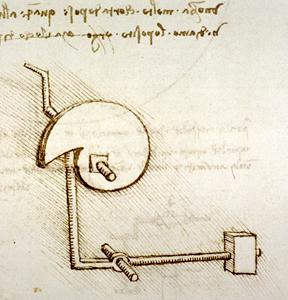
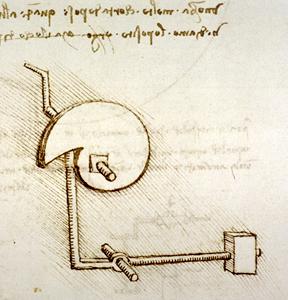
The da Vinci Cam Hammer is a fascinating machine highlighting Leonardo da Vinci's incredible foresight and ingenuity.
This invention revolutionized mechanical tools. It was used for centuries, especially during the Industrial Revolution.
By exploring the design and impact of the cam hammer, one can appreciate its lasting influence on engineering.
This article provides an in-depth look at how Leonardo’s design works and its historical significance for those intrigued by mechanical history and innovation.
You will discover how this invention showcases the connection between art, science, and technology.
Through this exploration, enthusiasts can learn about the cam hammer's notable features, including its reliance on a rotating cam to lift and drop a hammer.
Those interested in machinery's practical applications and evolution will find da Vinci Cam Hammer's story informative and engaging.
Leonardo da Vinci: The Inventor
Leonardo da Vinci was a pioneer during the Renaissance known for his incredible ingenuity. His contributions to the industrial and artistic realms are well recognized, notably the development of innovative machinery, such as the da Vinci Cam Hammer.
Renaissance Context
During the Renaissance, from the 14th to the 17th centuries, there was a surge of interest in art, science, and technology. This era encouraged creativity and sparked numerous intellectual advancements.
Da Vinci thrived in this environment, seamlessly blending art and science. He explored various fields, pushing boundaries and creating designs ahead of his time.
His dual role as an artist and engineer enabled him to conceive inventions that significantly impacted multiple industries.
Inventions and Machinery
Leonardo's fascination with machinery led to the creation of devices like the cam hammer. This invention used a rotating cam to repeatedly lift and drop a hammer, making metalworking more efficient.
His drawings showcased an advanced understanding of mechanical principles, inspiring modern engineers.
The da Vinci Power Hammer exemplifies his innovative spirit, illustrating his ability to merge artistic flair with engineering expertise.
The Cam Hammer Concept
The da Vinci Cam Hammer represents a unique blend of innovation and mechanical ingenuity. It introduces a cam-driven mechanism that has had a significant impact on fields such as metalworking and engineering.
Mechanical Design
Leonardo da Vinci's Cam Hammer features a design ahead of its time. This ingenious creation utilizes a cam to convert rotational motion into a linear pounding action.
The cam, an oblong wheel, pushes a hammerhead upwards while gravity pulls it back down, creating a rhythmic pounding effect.
This simple yet effective mechanism allows the hammer to perform work with minimal energy input.
Unlike direct contact mechanisms, the cam design reduces wear and tear, ensuring longer life and less maintenance.
Leonardo's insight into mechanical advantage laid the groundwork for future advancements and influenced designs used during the Industrial Revolution.
The cam hammer can be seen as a precursor to modern automated machinery.
Function and Efficiency
The da Vinci Cam Hammer offered significant improvements in efficiency over traditional hand tools.
During the Industrial Revolution, these hammers could deliver up to 20 strikes per second, using gravity combined with the cam's mechanical lifting action.
This level of speed was instrumental in shaping and forming metal quickly and precisely.
The increased hammering rate allowed for higher productivity in workshops and the fabrication of intricate metal components, such as sheet metal and armored machines.
Despite its historical context, the da Vinci power hammer concept highlighted the potential of mechanized labor, reducing manual effort and increasing output.
Historical Significance
The da Vinci Cam Hammer marks a pivotal moment in the development of machinery. It played a key role in the metalworking and engineering fields. Below, we explore how this invention advanced metalwork and influenced engineering practices.
Advancements in Metalworking
The da Vinci power hammer advanced metalworking by introducing automation in the forging process. This innovation allowed metalworkers to handle larger quantities of metal efficiently.
Leonardo da Vinci's design used a cam mechanism that enabled continuous hammering without manual effort.
This reduced the physical labor required in metalworking shops and improved precision in the creation of metal tools and components.
The cam hammer was a precursor to more advanced machinery, paving the way for the Industrial Revolution.
Blacksmiths could achieve consistent results, which is crucial for creating uniform metal goods.
It was a transformative step in automating tasks that had traditionally relied on human strength and skill.
Impact on Engineering
Leonardo da Vinci's cam hammer significantly impacted engineering by showcasing how mechanical systems could replace manual labor.
The design leveraged physics principles to automate repetitive tasks, demonstrating early ideas of mechanization.
This influenced future inventors and engineers to explore similar concepts in various fields.
Da Vinci’s work on the cam hammer laid the foundation for the creation of complex machines.
Engineers began to appreciate the efficiency of automated processes and incorporated them into their designs.
The cam mechanism, in particular, highlighted the potential for gears and levers in machinery, which became core elements in engineering design.
These principles are evident in modern systems, underscoring da Vinci’s enduring legacy in engineering.
Modern Interpretations
The da Vinci Cam Hammer continues to fascinate enthusiasts and historians alike. This section explores how modern technology and historical curiosity intersect in replicating and understanding the cam hammer's unique design and purpose.
Replications and Models
Enthusiasts and engineers worldwide have attempted to recreate the da Vinci Cam Hammer, testing its functionality with today's materials and technology.
These models often involve careful study of Leonardo da Vinci's original sketches and the integration of modern engineering tools for precision.
By placing the cam mechanism correctly and maintaining balance, creators aim to understand and showcase the hammer's mechanical brilliance.
Many hobbyists and professionals share their builds and experiments online, offering insights into the challenges and successes of these projects.
The availability of resources such as 3D printing and CNC machining has enabled the creation of accurate models, advancing hands-on study of da Vinci's innovative ideas.
Educational Value
The da Vinci Power Hammer serves an educational purpose beyond mere replication. It allows students and history buffs to delve into Renaissance engineering concepts.
Through these projects, learners can explore basic mechanics, such as the impact of cams and pulleys, bringing historical theories into a tangible form.
Museums and educational platforms often utilize the cam hammer design to illustrate the foundation of modern machinery.
By studying these interpretations, individuals better appreciate how past innovations inform present technologies.
Interactive demonstrations can further enrich educational experiences, making the complex concepts behind the hammer both approachable and engaging.
Technical Analysis
Da Vinci's Cam Hammer is a striking example of innovative engineering, combining mechanical ingenuity with practical applications. It employs a system where materials and construction are critical and utilizes kinetic principles to drive the hammer mechanism efficiently.
Materials and Construction
The Da Vinci Cam Hammer typically uses robust materials to withstand repetitive motion. Materials like wood and metal were chosen for their strength and durability in the original designs.
These materials ensure long-lasting functionality.
The cam mechanism was often crafted from dense wood or forged metal, allowing it to resist wear and maintain precision.
A wooden or metal frame provides stability while the moving parts are securely attached.
The hammer itself is usually a large block of metal, often made of iron or steel, that provides the necessary weight to generate impact force.
The choice of materials dramatically affects the machine's performance and longevity, and quality construction is critical to ensuring components work together seamlessly.
Kinetic Principles
The primary function of the Da Vinci Power Hammer relies on kinetic principles: a rotating cam lifts the hammer, then releases it to strike with force.
This rotational motion converts to linear motion.
The cam's design is pivotal—it must be shaped correctly to efficiently transfer energy from rotation to the hammer.
The da Vinci hammer converts potential energy into kinetic energy by elevating and suddenly dropping it.
The precision of the cam's shape and the balance of the mechanical components are essential.
These principles enable continuous, rapid striking, which is crucial for applications in metalworking and forging.
Correctly harnessing these principles enables effective use and maximizes the power of each strike.
FAQs about da Vinci Cam Hammer
There is no historical evidence that Leonardo da Vinci had a single “favorite tool.” However, his notebooks show that he frequently used drawing instruments such as pens, compasses, and measuring tools, which were essential for sketching his inventions and studying geometry and mechanics.
Leonardo da Vinci did not invent a working helicopter, but he designed the “aerial screw,” a spiral flying machine concept in the late 1400s. It is considered a precursor to the modern helicopter, although it could not fly with the materials and power available at the time.
There is no definitive historical proof of a confirmed “male lover.” However, many historians believe that Leonardo may have had close, possibly romantic relationships with his pupils, particularly Salaì (Gian Giacomo Caprotti). This interpretation is based on historical writings, but it remains debated.
No, there is no historical evidence that Leonardo da Vinci and Michelangelo were lovers. In fact, records suggest they were rivals, often competing for artistic commissions and holding differing artistic styles and personalities.
Leonardo da Vinci never married and had no known children. His legacy was carried on instead by his students and his extensive notebooks, artworks, and scientific studies.
Leonardo da Vinci’s IQ is unknown and cannot be accurately measured, as modern IQ tests did not exist in his time. Some estimates suggest he may have had an exceptionally high IQ (often speculated between 180–220), but these figures are not scientifically verified.
 Leonardo Bianchi is the founder of Leonardo da Vinci Inventions & Experiences, a cultural travel guide helping visitors explore Leonardo da Vinci’s art, inventions, and legacy across Italy and Paris.