
(Last updated: May 2026)
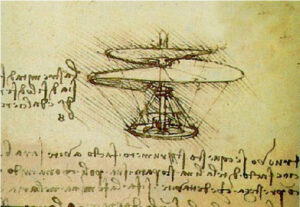
The Leonardo da Vinci helicopter — more precisely, the aerial screw — stands as one of the most astonishing conceptual leaps in the history of human invention. Sketched in Milan around 1489, this machine was not simply a curiosity. It was a bold, rational attempt to solve the problem of human flight, five centuries before the Wright brothers lifted off the ground at Kitty Hawk.
What makes this invention so fascinating is its starting point: pure observation. Leonardo watched birds, studied air currents, and analyzed the way screws worked in water. He then asked a question nobody had seriously pursued before — could the same principle that drives a screw through a solid material also drive a machine through the air? That question produced one of the most iconic drawings in the history of science.
From a historical perspective, the aerial screw matters because it demonstrates a completely new way of thinking about machines, nature, and the human body's relationship to the physical world. It reveals a Renaissance mind at full stretch — one that refused to accept the boundaries between disciplines. Leonardo was a painter, yes. But he was also an engineer, an anatomist, a naturalist, and, in this case, an early aeronaut in everything except flight itself.
For anyone visiting museums in Milan, Florence, or Paris — or exploring Leonardo's world through cultural travel — understanding this invention transforms the experience. You stop seeing a sketch on a page. You begin to see the inside of one of history's greatest minds.
This post is all about the Leonardo da Vinci helicopter — what it was, how it worked, why it still matters, and where you can encounter it today.
What Is the Leonardo da Vinci Helicopter?
The Leonardo da Vinci helicopter is a flying machine concept designed by Leonardo around 1489. It features a large helical surface made of linen or reed, intended to compress air downward and lift the craft off the ground. Although it was never built in Leonardo's lifetime, it is now regarded as the world's earliest documented conceptual ancestor of the helicopter.
The Engineering Idea Behind the Leonardo da Vinci Helicopter
Leonardo's Design Concept
Leonardo conceived the aerial screw as a direct application of Archimedes' principle — the same logic that makes a screw thread move through a material — applied to air instead of wood or metal. The machine was designed to spin rapidly about a vertical axis. As the helical surface rotated, Leonardo believed it would compress the air beneath it sufficiently to generate upward lift.
His notebook sketch, now held in the collections linked to the Codex Atlanticus, shows the machine in clean detail: a wide horizontal rotor roughly eight meters in diameter, constructed from linen stretched over a framework of iron wire and reed. A central shaft runs through the middle. A crew of four men would run on a platform below, pulling on ropes wound around the shaft to set the whole structure spinning.
The da Vinci aerial screw was not designed to carry passengers aloft as a modern helicopter does. Rather, Leonardo saw it as a demonstration of a principle. He was testing, on paper, whether the physics he observed in nature could be harnessed mechanically. That ambition was extraordinary for 1489.
Renaissance Engineering Principles
To understand the aerial screw, you have to understand Renaissance engineering as Leonardo practiced it. He believed that nature operated according to consistent mechanical laws, and that the human mind — through careful observation and rigorous drawing — could decode those laws and put them to use.
Water screws had existed since antiquity. Leonardo had studied them carefully. He also studied bird anatomy in remarkable detail, noting the relationship between wing surface area, body weight, and air resistance. The da Vinci flying machine concept drew on all of these studies simultaneously.
What distinguishes his approach from mere speculation is the precision of his geometry. The spiral of the aerial screw is not arbitrary. It follows a carefully reasoned mathematical logic based on the pitch needed to generate thrust. Whether the machine could have worked in practice is another question. But the thinking behind it was structurally sound for its era.
Leonardo also understood, at least partially, the problem of torque. Modern engineers note that without a counter-rotating mechanism, the aerial screw's platform would simply spin in the opposite direction to the rotor — a fundamental challenge that would not be fully resolved until the 20th century. But the fact that Leonardo was thinking at this level of detail is remarkable in itself.
How the Leonardo da Vinci Helicopter Works
Mechanical Design
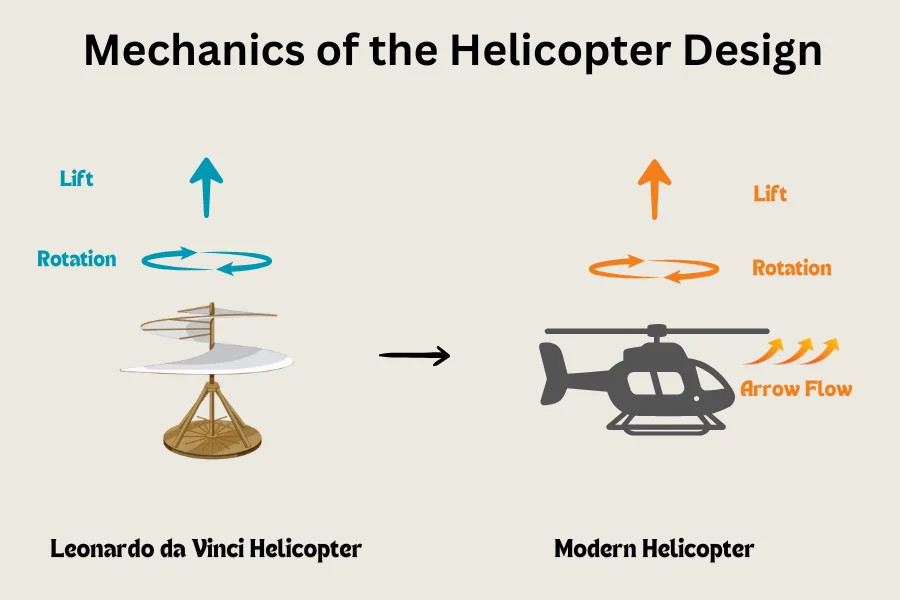
The core mechanical idea of the da Vinci helicopter sketch is elegantly simple. A large helical surface — the aerial screw — is mounted horizontally on a central vertical shaft. When the shaft is rotated rapidly, the helical surface is intended to bite into the air in the same way a drill bit bites into wood: by combining rotational motion with a forward (in this case upward) thrust vector.
The linen fabric stretched across the iron wire frame would need to be sized, Leonardo calculated, to provide enough surface area to overcome the weight of the machine and its operators. His sketch suggests a diameter of roughly eight braccia — approximately five to eight meters depending on which Florentine unit of measurement is applied.
The power source is human. Four operators on the central platform would run in a circle, pulling rope handles attached to the shaft. This would theoretically spin the rotor up to the required speed.
In modern analysis, this is perhaps the greatest practical flaw: human muscle cannot generate the sustained rotational velocity needed for a surface of this size to produce meaningful lift. But as a conceptual demonstration, the logic is sound.
Structural Principles
Leonardo's choice of materials was deliberate. Linen provided a light, semi-porous surface that could be made reasonably airtight. The iron wire provided the frame with structural rigidity without excessive weight. Reed — a material Leonardo used repeatedly in his engineering sketches — added further lightness to the supporting framework.
The overall structure was intended to be as light as possible relative to its surface area. This reflects Leonardo's deep understanding of the relationship between weight, surface, and force — a relationship he had explored extensively in his studies of bird flight and water dynamics.
Modern engineers who have studied the da Vinci screw design closely note that while a full-scale version of this machine could not achieve flight with human power alone, a smaller, motorized version of the same principle does generate lift. The underlying physics is not wrong. It is simply constrained by the power-to-weight limitations of human muscle in Leonardo's era.
Why the Idea Mattered
The significance of Leonardo da Vinci aviation thinking goes far beyond whether any individual machine could have flown. What matters is the conceptual framework he established. He identified the correct mechanical principle — a rotating helical surface compressing a fluid (air) to generate upward thrust — centuries before anyone else arrived at the same conclusion.
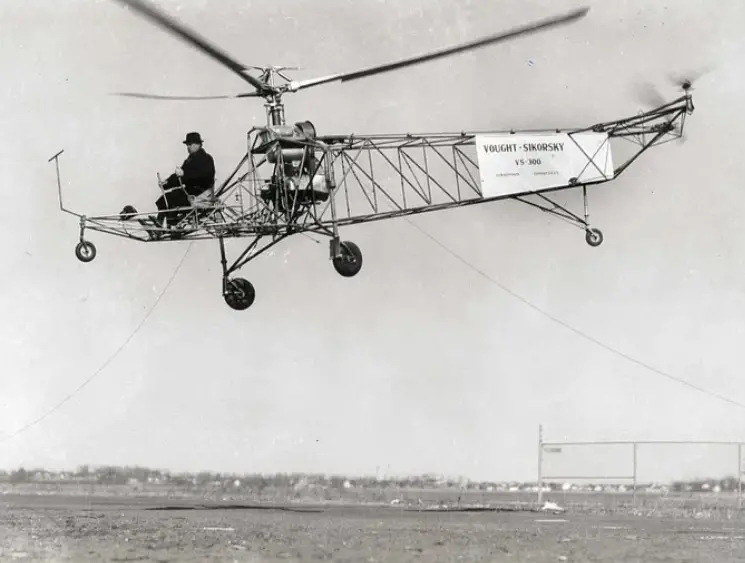
The first practical helicopter flight occurred with Igor Sikorsky in 1939, nearly 450 years after Leonardo’s sketch. When engineers in the 20th century began solving the problems of vertical flight, they were, unknowingly, working through many of the same questions Leonardo had posed. The fact that his notebooks were not widely available to those engineers makes the parallel even more striking.
Understanding the da Vinci helicopter facts in this light changes how you read the sketch. It is not a failed invention. It is a correct identification of a problem and a structurally sound first approach to solving it — produced by a man working entirely from observation and reason, with no tradition of aeronautical engineering to draw on.
Where to See the Leonardo da Vinci Helicopter Today
Museums and Exhibitions
The original notebook page containing Leonardo's sketch of an aerial screw is part of the Codex Atlanticus, the largest collection of Leonardo's drawings and writings. The Codex is held at the Biblioteca Ambrosiana in Milan, Italy. Selected folios from the Codex are occasionally displayed in temporary exhibitions, and the Ambrosiana is worth visiting for anyone seriously interested in Leonardo's engineering legacy.
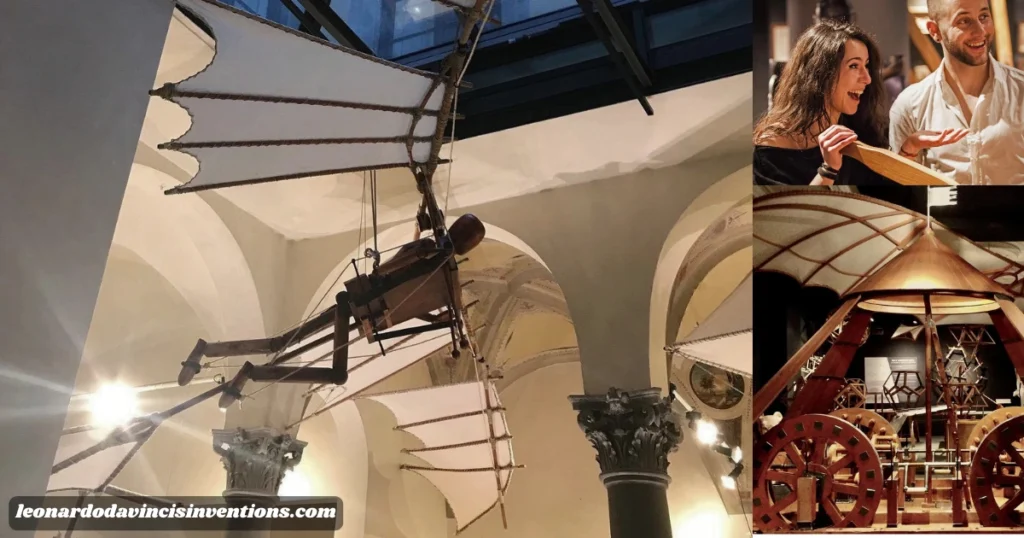
In Milan, the Museo Nazionale della Scienza e della Tecnologia Leonardo da Vinci is the single most important destination for anyone interested in Leonardo da Vinci inventions. The museum holds an extensive collection of reconstructed models based on Leonardo's engineering sketches, including large-scale models of the aerial screw and other flying machine concepts. These physical reconstructions make the Da Vinci helicopter design immediately comprehensible, unlike a flat sketch.
The Château du Clos Lucé in Amboise, France — the residence where Leonardo spent the last three years of his life as a guest of the French king Francis I — also maintains a remarkable permanent exhibition of reconstructed Leonardo machines in its gardens and interior rooms. A working-scale model of the aerial screw is among them. The setting, in the Loire Valley, combines historical atmosphere with direct engagement with Leonardo's ideas.
Plan Your Visit: Experiencing the Aerial Screw in Person
Seeing a physical reconstruction of the Leonardo da Vinci helicopter concept in person is a genuinely different experience from looking at a photograph of the original sketch. The scale becomes real. The materials become tangible. And the practical challenge of generating lift through human-powered rotation suddenly makes complete sense in a way that no written description can fully convey.
For visitors planning a trip to Milan, guided tours focused specifically on Leonardo's engineering legacy are available through several reputable operators. These tours typically combine a visit to the Museo della Scienza with additional stops at Leonardo-related sites across the city, providing historical context that deepens the experience considerably beyond what a solo visit can offer.
Some also include access to Santa Maria delle Grazie and The Last Supper, making for a remarkably comprehensive day.
Many visitors choose an entrance-only ticket for flexibility, while others prefer a guided tour for deeper historical context. If you plan to see a reconstruction of the aerial screw in person, it helps to compare ticket and tour options before your visit.
Exploring Leonardo da Vinci in Milan and Beyond
Milan was the city that most profoundly shaped Leonardo's engineering ambitions. It was here, working for Ludovico Sforza, that he filled notebook after notebook with designs for machines, anatomical studies, hydraulic engineering plans, and architectural proposals. Visiting the city with Leonardo in mind transforms it into something far richer than a fashion capital — a living laboratory of Renaissance ambition.
If you are planning a broader Leonardo-focused itinerary, there is no shortage of destinations to explore. Each city offers a different dimension of his genius — from the engineering reconstructions of Milan to the painted masterpieces of Florence, the scholarly manuscripts of Paris, and the quiet rural setting of Vinci itself. Some helpful guides to continue your journey:
- Leonardo da Vinci in Milan — the engineering city
- Leonardo da Vinci Florence Guide — art, anatomy, and early works
- Leonardo da Vinci in Paris — the Louvre and the Mona Lisa
- Leonardo Museums in Milan — the complete visitor guide
- Vinci, Tuscany — visiting Leonardo's birthplace and the Museo Leonardiano
Final Thoughts
This post was all about the Leonardo da Vinci helicopter — one of the most audacious and intellectually rigorous inventions in the long history of human attempts to fly. Leonardo did not build a flying machine. But he identified the right principle, worked through the physics with extraordinary care, and committed it all to paper with the clarity and precision that defined everything he did.
Five centuries later, engineers working on vertical flight would independently arrive at the same conclusions. That is not a coincidence. It is a testament to the quality of Leonardo's thinking.
Renaissance history, engineering, art, and cultural travel all converge at moments like this one. If you have the opportunity to follow Leonardo's ideas through the museums and cities that preserve them, take it. The journey is unlike anything else in history.
FAQs about Leonardo da Vinci Helicopter
Leonardo da Vinci did not invent a working helicopter, but he designed an early concept called the “aerial screw” in the late 1400s. This design is considered the first known concept of vertical flight and influenced later developments in aviation.
The first practical helicopter was designed by Igor Sikorsky. His VS-300 successfully flew in 1939 and introduced the modern single-main-rotor-and-tail-rotor design still used today.
Leonardo’s flying machine, including the aerial screw, was never built or tested in his lifetime. It remained a conceptual design in his notebooks, though modern reconstructions have shown the underlying principles were valid.
No, Leonardo da Vinci did not build the first airplane. He created detailed sketches of flying machines based on bird flight, but powered, controlled airplane flight was first achieved by the Wright brothers in 1903.
Leonardo contributed to aviation by studying flight scientifically and by designing early machines such as the aerial screw and gliders. His work introduced key ideas about lift, air movement, and mechanical flight centuries before modern aviation.
The first practical helicopter was developed in the United States. Igor Sikorsky’s VS-300 made its first flight in 1939 in Stratford, Connecticut, marking the beginning of modern helicopter aviation.
Related Post You May Like
Disclosure: This page may contain affiliate links. If you choose an experience through them, it helps support the site at no extra cost to you.
 Leonardo Bianchi is the founder of Leonardo da Vinci Inventions & Experiences, a cultural travel guide helping visitors explore Leonardo da Vinci’s art, inventions, and legacy across Italy and Paris.