
(Last updated: Sep 2026)
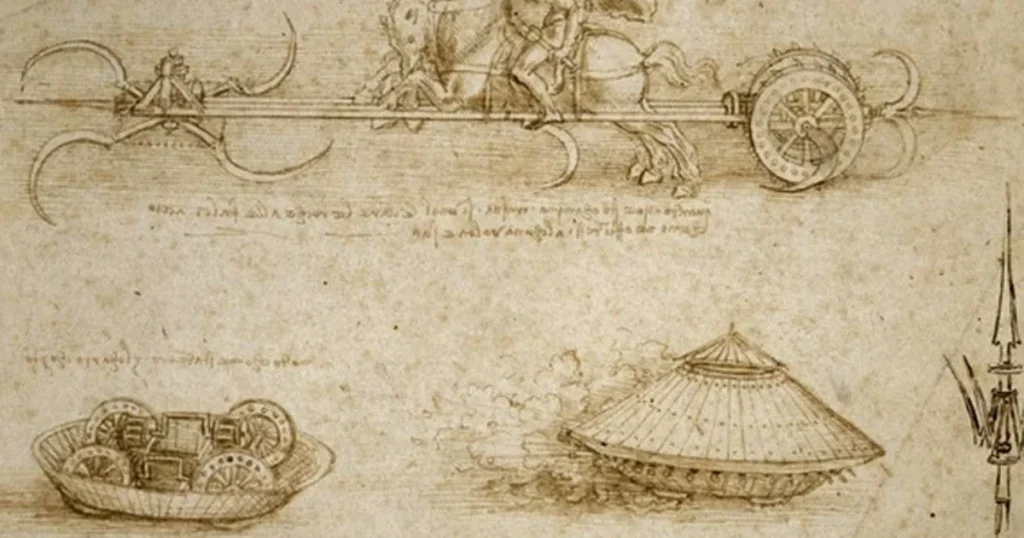
Leonardo da Vinci Tank is one of the most astonishing military concepts ever conceived — a fully armored fighting vehicle sketched in the notebooks of a 15th-century artist, engineer, and polymath. Long before modern armies fielded steel-hulled war machines across the battlefields of the 20th century, Leonardo had already imagined the essential idea with remarkable clarity and purpose.
That fact alone is extraordinary. But it becomes even more compelling when you realize this design was never built in Leonardo's lifetime — it lived for centuries as ink on paper, waiting for the world to catch up.
What makes the Leonardo da Vinci Tank fascinating is not just its appearance. It is the logic behind it. Leonardo designed it as a machine of psychological and strategic warfare, not simply brute destruction.
He thought carefully about how armor, mobility, and firepower could work together. That kind of systems thinking was deeply unusual in the Renaissance, and it reveals the same mind that painted the Mona Lisa and studied human anatomy.
Historically, the tank sketch matters because it reveals how Leonardo worked at the intersection of art, science, and military engineering. He was not designing weapons for pleasure. He was responding to the brutal realities of Italian Renaissance warfare — an era of mercenary armies, city-state rivalries, and shifting political alliances. Understanding this context helps us see the sketch not as a curiosity but as a serious document of its time.
For travelers and museum visitors, the Leonardo da Vinci Tank offers a unique entry point into the broader world of Renaissance invention. You do not need to understand engineering to appreciate it. You simply need to stand in front of a reconstruction or a page from his notebooks and ask: how did someone in the 1480s think this way? That question is the beginning of a genuinely rewarding cultural experience.
This post is all about the Leonardo da Vinci Tank — what it was, how it worked, where to see it today, and why it continues to captivate historians, engineers, and curious travelers from around the world.
What Is the Leonardo da Vinci Tank?
Leonardo da Vinci Tank is an armored fighting vehicle concept designed by Leonardo da Vinci around 1487. Drawn in his notebooks, the design features a cone-shaped hull covered in metal plates, with cannons mounted around its circumference. It was intended to intimidate enemy forces and protect soldiers inside as they advanced across a battlefield.
The Engineering Idea Behind the Leonardo da Vinci Tank
Leonardo's Design Concept
Leonardo conceived his armored car sometime around 1487, likely while working under the patronage of Ludovico Sforza, the Duke of Milan. He included the design in his notebooks alongside hundreds of other studies — anatomical drawings, hydraulic machines, musical instruments, and architectural sketches.
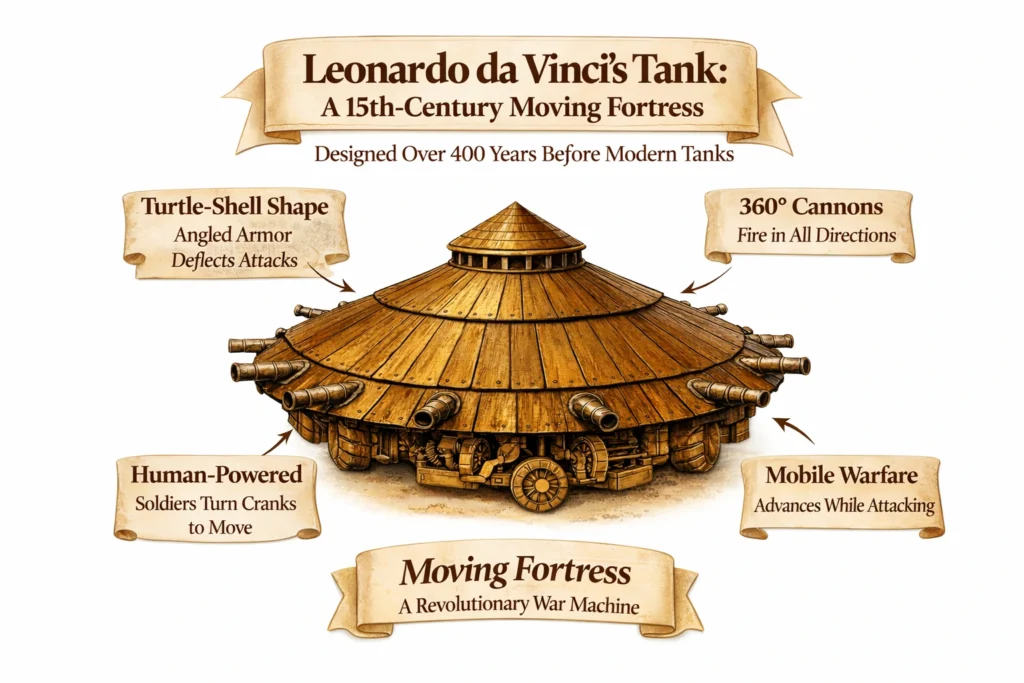
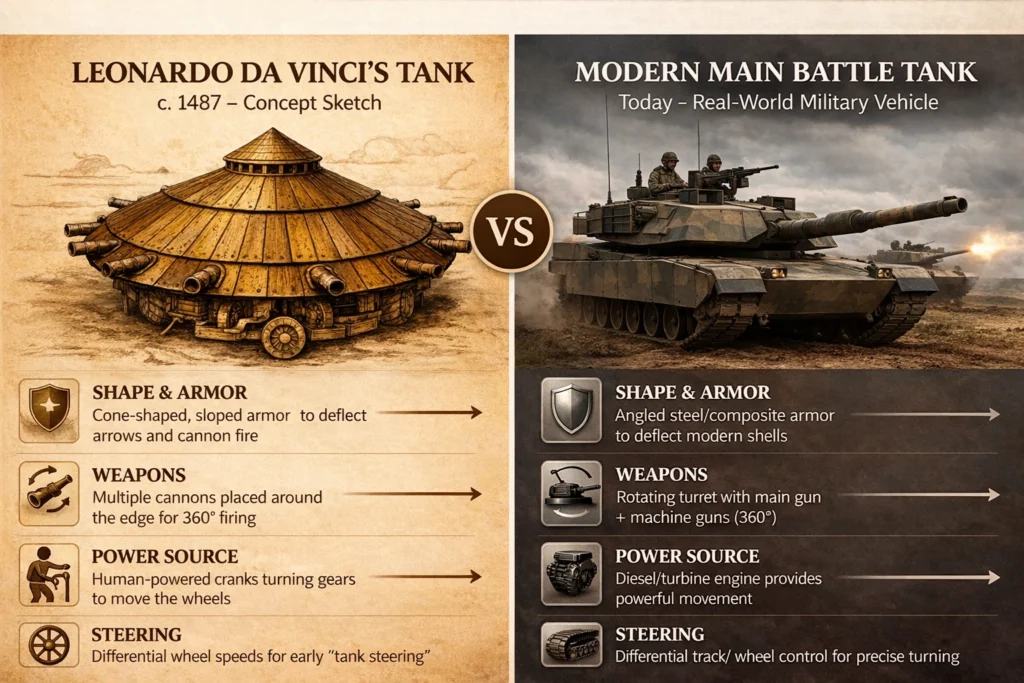
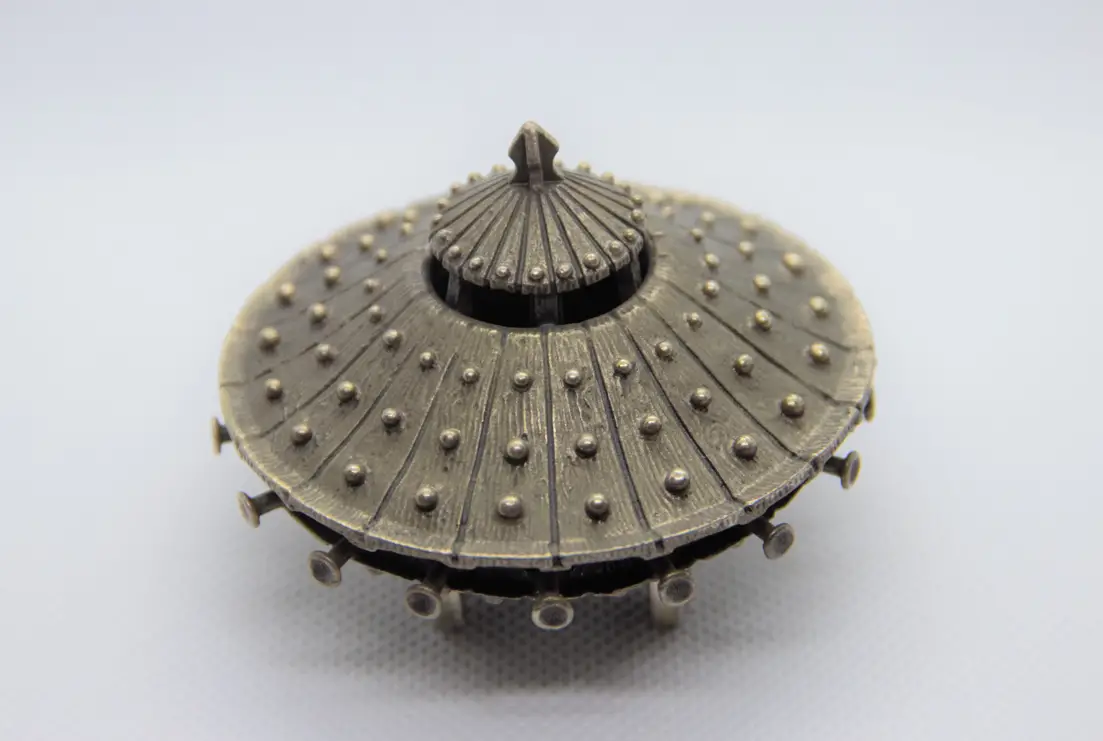
The da Vinci tank sketch shows a low, circular vehicle with a sloping outer shell resembling a turtle's carapace. Around its edges, Leonardo placed a series of light cannons, giving the vehicle a 360-degree firing capability. The hull was designed to deflect incoming projectiles by angling the armor rather than relying on sheer thickness — a principle that military engineers would not formally articulate for another four centuries.
What sets the Leonardo da Vinci armored car apart from earlier ideas about mobile fortifications is its integration of movement and firepower. It was not a static defensive structure. It was designed to advance. That shift in thinking — from defense to mobile aggression — represents a genuinely modern military concept.
Renaissance Engineering Principles
To understand the Leonardo da Vinci Tank design, you need to understand the engineering culture of the Italian Renaissance. This was an era in which a gifted individual could move fluidly between art, architecture, hydraulics, and military science. Patrons like the Sforza family in Milan actively sought out engineers who could solve practical problems — building canals, fortifying city walls, designing weapons.
Leonardo brought to this tradition his extraordinary powers of observation and his habit of thinking in systems. Where other engineers might design a cannon or a shield in isolation, Leonardo considered how components interact. The tank was a system: armor, mobility, firepower, and psychological effect.
He also thought about propulsion. The da Vinci armored car was to be driven by men inside, turning cranks connected to the wheels. This was not an ideal solution — and Leonardo almost certainly knew it — but it reflected the only available power source at the time. The concept was there. The technology of the age simply could not support it yet.
How the Leonardo da Vinci Tank Works
Mechanical Design
The Leonardo da Vinci tank drawing shows a vehicle roughly four meters in diameter. The outer hull consists of overlapping metal or reinforced wooden panels, sloped to deflect cannon fire and arrows. Around the lower edge of the hull, small cannons protrude at regular intervals, capable of firing in any direction without repositioning the entire vehicle.
Inside, a crew of men would operate the driving mechanism. Leonardo designed a system of gears and cranks that translated human effort into rotational power for the wheels. Steering would have been achieved by varying the wheel speeds on either side — a differential steering concept that, again, anticipates modern vehicle design by centuries.
It is worth noting a famous detail about Leonardo da Vinci tank invention. Researchers who have examined the original sketch closely have suggested that the gearing arrangement shown in the drawing would cause the wheels on each side to rotate in opposite directions, rendering the vehicle impossible to move.
Some scholars believe this was a deliberate flaw — a safeguard against the design being stolen and used without Leonardo's involvement. Others think it was simply an error. Either way, it adds a fascinating layer of mystery to the Leonardo da Vinci tank model as we understand it today.
Structural Principles
The genius of the Leonardo da Vinci tank sketch lies partly in its structural logic. The conical or domed upper shell serves multiple functions. It provides structural rigidity — a dome shape distributes force efficiently across its surface. It deflects projectiles — angled surfaces send incoming fire to the sides rather than absorbing it directly. And it protects the crew inside from overhead fire, which was a real threat in siege warfare.
Leonardo specified that the hull should be reinforced with iron bands, much like the cooperage technique used to bind wooden barrels. This gave flexibility alongside strength — an insight that again shows Leonardo thinking beyond the conventions of his time.
The cannons themselves were to be small and light, prioritizing rate of fire and coverage over raw destructive power. Leonardo understood that a vehicle besieged on all sides needed the ability to respond quickly in any direction. The design reflects genuine tactical thinking, not simply mechanical novelty.
Why the Idea Mattered
The importance of the Leonardo da Vinci tank invention extends well beyond military history. It demonstrates a mode of thinking — interdisciplinary, systematic, visually rigorous — that would become the foundation of modern engineering and design.
The da Vinci inventions, as a body of work, reveal a mind constantly working at the boundaries of what was possible. The helicopter concept, the da Vinci flying machine, the diving suit, the robot automaton — these are not isolated curiosities. They are expressions of the same relentless curiosity and the same willingness to imagine beyond the present moment. The armored car sits naturally among them.
When historians and engineers look at the Leonardo da Vinci tank drawing today, they see a prototype of an idea that reshaped warfare in the early 20th century. The first practical tanks appeared on the battlefields of World War I in 1916, approximately 430 years after Leonardo drew his version. That gap is humbling. It is also inspiring.
Where to See the Leonardo da Vinci Tank Today
Museums and Exhibitions
The original Leonardo da Vinci tank sketch is held in the Royal Collection at Windsor Castle, United Kingdom, as part of the extraordinary collection of Leonardo's drawings assembled there over the centuries. This collection includes some of the most important pages from Leonardo's notebooks — anatomical studies, landscape drawings, and engineering concepts, including the armored car.
For visitors who want to see a physical Leonardo da Vinci tank model, Italy offers the richest options. The Museo Nazionale della Scienza e della Tecnologia Leonardo da Vinci in Milan — commonly known as the Leonardo da Vinci Science and Technology Museum — houses an extensive collection of reconstructions built from Leonardo's notebook drawings. These include a working model of the armored vehicle, allowing visitors to see the mechanical principles brought to life in three dimensions.
Florence, where Leonardo spent his early career, also offers deep engagement with his legacy. The Museo Galileo and the Palazzo Vecchio's exhibition spaces both feature content related to Leonardo. The Uffizi Gallery holds works from Leonardo's artistic career, providing a fuller picture of the man behind the inventions.
Modern Reconstructions
Physical reconstructions of the da Vinci tank have been built by engineers and museum curators working directly from the notebook drawings. Several of these are on permanent display in Italian science museums, while others have toured international exhibitions.
The reconstruction process itself has been revealing. Engineers who attempt to build the vehicle quickly encounter the challenges Leonardo's crew would have faced — the weight of the hull, the difficulty of the steering mechanism, and the practical limits of human-powered propulsion.
Some museums also display reconstructions of related da Vinci inventions alongside the tank: the ornithopter, or da Vinci flying machine; the aerial screw that influenced the da Vinci helicopter concept; the armored diving suit; and the mechanical knight, sometimes called the da Vinci robot. Seeing these together gives a powerful sense of Leonardo's range and ambition.
Visitor Experience and City Context
Milan is the natural base for any serious exploration of Leonardo da Vinci's engineering legacy. The city was the stage for some of his most productive years — the period of the Sforza court during which he produced the armored car design, the Last Supper, and many of his most ambitious notebook studies.
Many visitors choose an entrance-only ticket for flexibility, while others prefer a guided tour for deeper historical context. A knowledgeable guide can connect The Last Supper to Leonardo's scientific thinking, helping visitors see the painting not just as a devotional image but as an exercise in geometry, perspective, and human psychology — the same qualities that appear in the tank design and all his other work.
Exploring Leonardo da Vinci in Milan
Milan is arguably the most important city in the world for understanding Leonardo da Vinci's life and work. He spent nearly two decades here, working under the patronage of Ludovico Sforza. The city shaped him, and he shaped the city — designing canals, advising on architecture, painting masterpieces, and filling notebooks with ideas that ranged from anatomy to armored vehicles.
If you are planning a trip to see the Leonardo da Vinci Tank reconstruction or The Last Supper, it is worth exploring the full range of what Milan and the surrounding region have to offer. The resources below may help you plan a deeper itinerary.
- Leonardo da Vinci in Milan — the complete guide to Leonardo-related sites
- Leonardo da Vinci Museums in Italy — Florence, Venice, and beyond
- Leonardo da Vinci in Florence — early career and artistic development
- Da Vinci Inventions Guide — the full range of Leonardo's engineering legacy
Final Thoughts
This post was all about the Leonardo da Vinci Tank — but it is really about something larger. It is about what happens when an exceptional mind refuses to accept the limits of its own era.
Leonardo did not design his armored car because he had the tools to build it. He designed it because he could see, with extraordinary clarity, what military technology was moving toward. He followed the logic wherever it led, regardless of whether the present moment could accommodate the conclusion.
That quality — the willingness to think beyond what currently exists — is what makes Leonardo's notebooks so astonishing even today. The da Vinci tank, the da Vinci flying machine, the da Vinci helicopter concept, the robotic knight, the diving suit: each of these is a document of a mind that treated the future as a legitimate subject of study.
If you have the opportunity to stand in front of a reconstruction of the Leonardo da Vinci armored car — or to see the original sketch at Windsor or a facsimile in a museum — take a moment to appreciate not just the design but the distance it had to travel.
FAQs about Leonardo da Vinci Tank
Leonardo da Vinci did not build a real tank, but he designed a concept for an armored fighting vehicle around 1487. His drawings depict a mobile, cannon-topped machine intended to protect soldiers and attack enemies, making it an early concept of a modern tank.
The da Vinci tank itself does not “spin” like a turret, but its design features cannons mounted around the vehicle, allowing it to fire in every direction without turning. Movement would come from wheels powered by internal gears and cranks.
Leonardo designed the armored car to protect soldiers as they advanced and to intimidate enemy forces on the battlefield. It combined defense and attack into a single moving machine, reflecting his understanding of both engineering and the psychology of warfare.
There is no single “greatest” invention, but Leonardo is widely known for visionary concepts like the helicopter (aerial screw), parachute, armored vehicle, and self-propelled cart. Many of these ideas were centuries ahead of their time, even if they were never built.
Leonardo da Vinci is often credited with one of the earliest recognizable tank concepts in the late 15th century, although earlier armored wagons and battle carts existed in medieval warfare. His design helped shape the idea of mobile, protected firepower.
Five famous inventions by Leonardo da Vinci include the armored tank, the helicopter (aerial screw), the parachute, the self-propelled cart, and the diving suit. These designs demonstrate his wide-ranging curiosity in engineering, flight, and human innovation.
Related Post You May Like


Disclosure: This page may contain affiliate links. If you choose an experience through them, it helps support the site at no extra cost to you.
 Leonardo Bianchi is the founder of Leonardo da Vinci Inventions & Experiences, a cultural travel guide helping visitors explore Leonardo da Vinci’s art, inventions, and legacy across Italy and Paris.