
(Last updated: April 2026)
Leonardo da Vinci is one of the most remarkable human beings who ever lived. Born in 15th-century Italy, he became a painter, engineer, anatomist, architect, musician, and philosopher — all in a single lifetime. His curiosity had no boundaries, and his notebooks still astonish scientists and artists more than five hundred years after his death.
Few historical figures continue to fascinate the world as much as Leonardo does. Historians study him to understand the Renaissance. Scientists trace modern ideas in engineering, hydrology, and anatomy back to his sketches.
Millions of travelers visit Florence, Milan, and Paris every year specifically to stand before his paintings. He was both deeply of his time and impossibly ahead of it.
Understanding Leonardo enriches far more than a history lesson. When you walk into the Uffizi Gallery in Florence or the Louvre in Paris, knowing the story behind the work changes everything.
This post is all about Leonardo da Vinci. His paintings become windows into one of history’s most original minds, and the cities he lived in still reflect his presence in their streets, churches, and museums.
Leonardo da Vinci Biography
To understand Leonardo, you first need to understand where and when he was born. He arrived in a world that was changing rapidly.
The Renaissance was reshaping European culture, reviving classical learning, and placing human experience at the center of art and science. Leonardo would become its greatest expression.
Leonardo da Vinci’s Childhood and Early Years
Leonardo was born on April 15, 1452, in the small Tuscan town of Vinci, near Florence. He was the illegitimate son of a Florentine notary, Ser Piero da Vinci, and a peasant woman, Caterina.
Growing up outside the formal structures of Florentine society actually gave him freedom. He was not destined for law or the Church, so he could follow his curiosity wherever it led.
Around the age of fourteen, Leonardo moved to Florence and entered the workshop of Andrea del Verrocchio, one of the leading artists of the day. There, he learned painting, sculpture, and mechanical arts.
His childhood curiosity — observing water, birds, rocks, and light — never left him. Those early years in the Tuscan countryside became the foundation for a lifetime of investigation.
Explore further: our detailed article on Leonardo da Vinci’s childhood and early life covers this formative period in full.
Leonardo’s Career Across Florence and Milan
By his late twenties, Leonardo had established himself as a remarkable painter in Florence. Yet he was restless.
In 1482, he moved to Milan to serve Ludovico Sforza, the city’s powerful ruler. He spent nearly twenty years there, working as a painter, military engineer, set designer for court entertainments, and architect. It was in Milan that he painted The Last Supper, one of the most famous works in the history of Western art.
After Milan fell to French forces in 1499, Leonardo traveled to Venice, back to Florence, to Rome — before finally spending his last years in France, under the protection of King Francis I. He died at Amboise on May 2, 1519, having filled more than five thousand pages of notebooks with drawings, scientific observations, and engineering designs.
Leonardo da Vinci Quotes and Philosophy
Leonardo left behind a rich record of his thinking in his notebooks. He believed that knowledge begins with the senses — with looking, measuring, and questioning. He was deeply skeptical of knowledge derived solely from books, preferring what he called saper vedere — knowing how to see.
“Learning never exhausts the mind.” — Leonardo da Vinci
This approach made him both a supreme artist and a genuine scientist, centuries before those disciplines formally separated. Our dedicated article on his most compelling quotes and philosophical ideas brings his mind to life.
Leonardo da Vinci Inventions
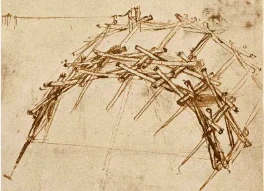
No aspect of Leonardo’s genius surprises modern readers more than his engineering imagination. His notebooks contain designs for machines that would not be built for centuries. He was not merely a dreamer — he understood mechanics, materials, and physics with astonishing precision.
Flying Machines and Aerial Studies
Leonardo was obsessed with flight. He spent years studying birds, analyzing the mechanics of their wings in hundreds of detailed drawings. From these observations, he designed ornithopters — machines with flapping wings powered by human effort — and even conceived an early version of a hang glider and a spiral-shaped aerial screw that foreshadowed the modern helicopter.
None of these machines was ever built in his lifetime. The materials of the fifteenth century could not support his visions. But his scientific reasoning was sound, and engineers who have studied his drawings confirm that several of his designs would function with modern materials.
Explore further: our article on Leonardo da Vinci’s flying machine inventions covers these concepts in full detail.
Military Engineering and Hydraulic Machines
Leonardo designed war machines for Ludovico Sforza and later for Cesare Borgia. His designs included armored vehicles resembling early tanks, a self-supporting bridge, and giant crossbows. Yet he was also deeply troubled by violence, and his notebooks contain passages questioning the morality of war.
His engineering vision extended to peaceful projects as well. He designed canals, irrigation systems, and movable dams for the city of Milan. He studied the flow of water with scientific rigor, producing drawings of currents, vortices, and waves that remain accurate enough for use in fluid dynamics research today.
Anatomy and the Science of the Human Body
Leonardo was one of the first people in history to systematically dissect the human body and record his findings. He performed over thirty dissections and produced anatomical drawings of the heart, brain, skeleton, and muscles that would not be surpassed for more than a century.
His anatomical work bridges art and science perfectly. He studied the body to paint it better, but his curiosity carried him far beyond artistic needs into genuine medical discovery. His anatomical notebooks remain among the most significant documents in the history of science.
Leonardo da Vinci Artworks
As extraordinary as his scientific work was, Leonardo is best known as a painter. He produced a relatively small number of finished works — fewer than twenty paintings are widely attributed to him — but their influence on Western art is immeasurable. Every painting is a study in light, shadow, psychology, and technical mastery.
The Mona Lisa — The Most Famous Painting in the World
The Mona Lisa is the single most visited painting on Earth. Displayed in the Louvre in Paris, it draws millions of visitors every year. Painted between approximately 1503 and 1519, the portrait is remarkable for its psychological depth and for the sfumato technique Leonardo used to blur the edges of light and shadow.
The identity of the portrait’s subject has been debated for centuries, though most scholars now agree she is Lisa Gherardini, the wife of a Florentine merchant. The painting’s enduring mystery — the ambiguous smile, the imaginary landscape behind the figure — has made it a cultural symbol far beyond the art world.
Explore further: our in-depth article on the Mona Lisa covers its history, technique, and meaning.
The Last Supper and Leonardo’s Religious Works
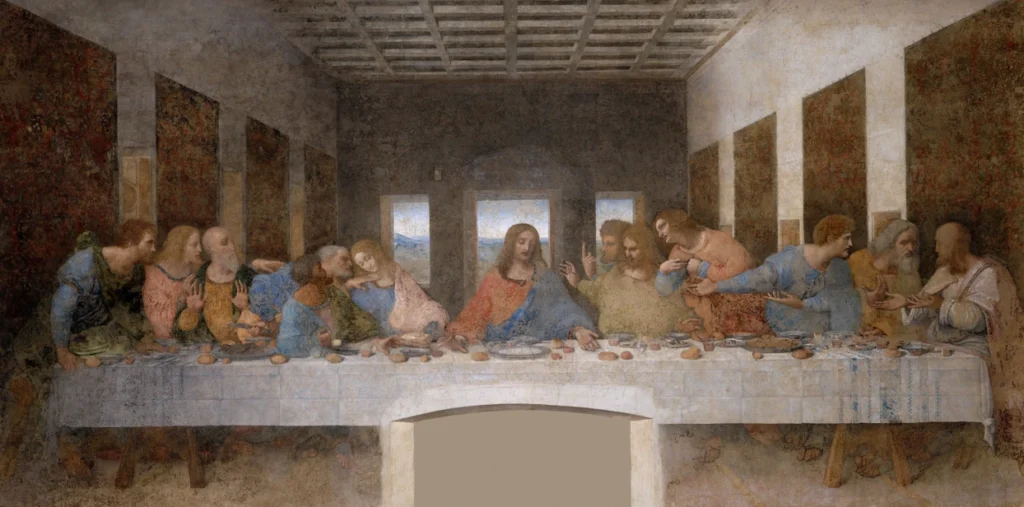
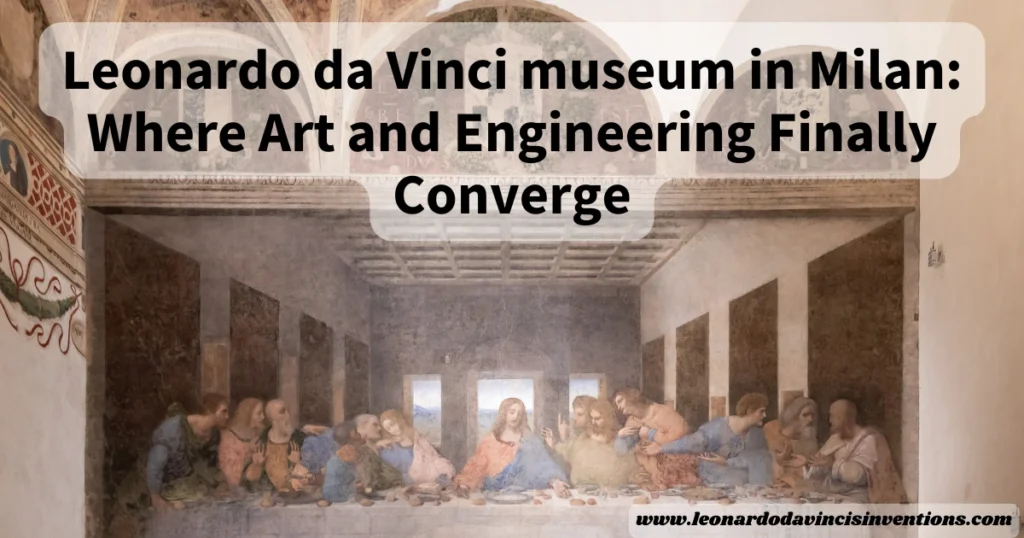
Painted between 1495 and 1498 on the wall of a refectory in Milan, The Last Supper is one of the most studied religious paintings in existence. It depicts the moment described in the Gospel of John when Jesus announces that one of his disciples will betray him. Each apostle reacts differently, and Leonardo captures twelve distinct human responses to a single devastating piece of news.
Leonardo experimented with tempera on plaster rather than traditional fresco, a choice that gave him flexibility to revise his work but led to early deterioration. It has been restored multiple times over the centuries and remains one of Europe’s great artistic pilgrimages.
Other Famous Paintings and Drawings
Beyond the two most famous works, Leonardo’s other paintings reveal the full range of his artistic vision. Lady with an Ermine, painted around 1489 in Milan, is considered one of the finest portraits of the Renaissance. Virgin of the Rocks, which exists in two versions held in Paris and London, demonstrates his mastery of atmospheric perspective and symbolic religious imagery.
His Vitruvian Man — technically a drawing rather than a painting — has become one of the most recognized images in human culture, representing the Renaissance ideal of proportion and the relationship between the human body and geometry.
Key Paintings at a Glance
| Painting | Date | Location Today |
|---|---|---|
| Mona Lisa | c. 1503–1519 | Louvre, Paris |
| The Last Supper | 1495–1498 | Santa Maria delle Grazie, Milan |
| Lady with an Ermine | c. 1489–1490 | National Museum, Kraków |
| Virgin of the Rocks | c. 1483–1486 | Louvre, Paris & National Gallery, London |
| Vitruvian Man | c. 1490 | Gallerie dell’Accademia, Venice |
Where to Experience Leonardo’s Legacy
Leonardo’s life took him across Italy and finally to France, and the places he lived still hold traces of his presence. If you want to experience his work beyond a screen, these are the cities and Leonardo museums that matter most.
| Location | Experience |
|---|---|
| Florence | The Uffizi Gallery holds early works and drawings. The town of Vinci, thirty kilometers away, houses the Museo Leonardiano and the preserved landscape of Leonardo’s childhood. |
| Milan | The refectory of Santa Maria delle Grazie contains The Last Supper. The Museo Nazionale della Scienza e della Tecnologia displays reconstructions of his inventions. |
| Paris | The Louvre houses the Mona Lisa, Virgin of the Rocks, and several other Leonardo works, making it the world’s richest collection of his paintings. |
| Vinci | The town of Leonardo’s birth is in Tuscany. The Museo Leonardiano offers an immersive look at his life, models of his inventions, and the countryside that shaped his imagination. |
| Amboise | The Château du Clos Lucé, where Leonardo spent his final years, is now a museum and park with full-scale models of his inventions set in the gardens he once walked. |
Leonardo da Vinci Museums and Permanent Collections
Several institutions worldwide hold Leonardo’s drawings and manuscripts. The Royal Collection Trust in Windsor, England, holds over six hundred of his anatomical and scientific drawings. The Biblioteca Ambrosiana in Milan houses the Codex Atlanticus — 1,119 pages of notes on science, engineering, and art — the largest collection of his writings in a single volume.
The Château du Clos Lucé in Amboise combines historical atmosphere with accessible scientific display, making it one of the most evocative Leonardo museums in the world.
Renaissance Sites and Leonardo Exhibitions
Beyond permanent collections, major Leonardo exhibitions travel internationally and frequently feature rarely seen drawings and manuscripts on loan from royal and private collections. Traveling through Renaissance Italy — visiting Florence, Siena, Pisa, and Milan — places Leonardo’s life in its full geographical context.
The landscapes he painted in the background of his portraits are not imaginary. Many of them are still visible today in Tuscany and the Lombard plain, barely changed from the fifteenth century.
Experience Leonardo’s World in Person
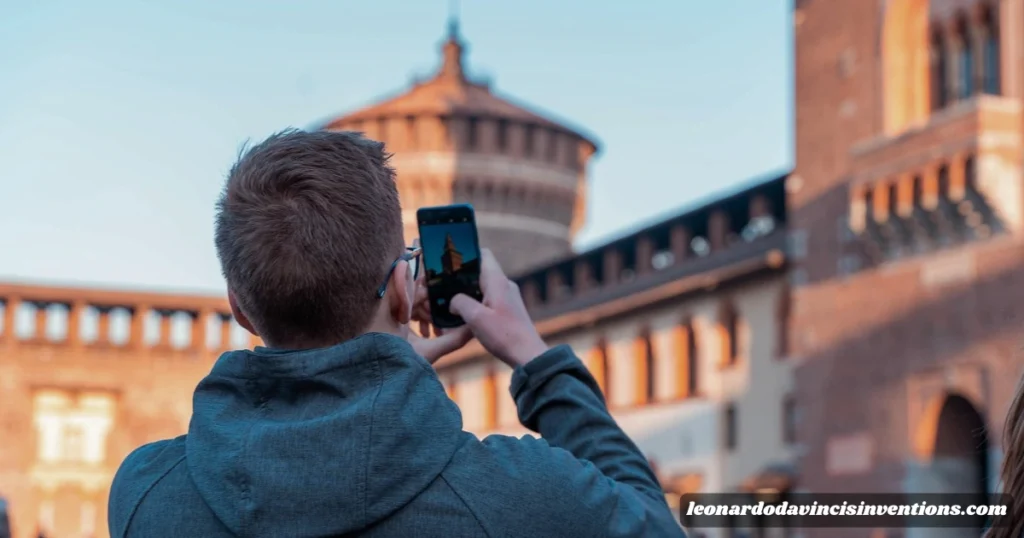
Reading about Leonardo is one thing. Standing in the spaces he inhabited is another. The cities and sites connected to his life offer some of the richest cultural travel experiences in Europe, accessible to anyone with curiosity and a willingness to look closely.
Visiting the Louvre and Milan’s Greatest Sites
The Louvre in Paris dedicates an entire wing to Italian Renaissance painting, and Leonardo’s works anchor the collection. Timed entry to the Mona Lisa room is strongly recommended, as crowds can be substantial.
Many visitors find that the lesser-known Leonardo works nearby — the Virgin of the Rocks and Saint John the Baptist — are easier to appreciate up close and no less extraordinary.
In Milan, visits to The Last Supper require advance reservations. Entry is timed and limited to small groups, creating an unusually contemplative viewing experience.
Combining this with a visit to the nearby Castello Sforzesco — where Leonardo worked for years under Ludovico Sforza — rounds out a full day in Leonardo’s Milan.
Guided Tours and Renaissance Itineraries
Guided tours focused specifically on Leonardo’s life and legacy are available in Florence, Milan, and the Amboise region of France. These tours combine art history, architectural context, and scientific biography in a way that independent visits often cannot match.
A multi-city Renaissance itinerary connecting Vinci, Florence, Milan, and Amboise creates a complete journey through Leonardo’s life — from the Tuscan hillside where he was born to the French château where he died. Few cultural travel routes in Europe offer such a concentrated encounter with a single extraordinary mind.
Interactive Science Museums and Invention Displays
For visitors traveling with families or younger audiences, science museums dedicated to Leonardo’s inventions offer a more hands-on experience.
The Museo Nazionale della Scienza e della Tecnologia in Milan and the Museo Leonardiano in Vinci both display three-dimensional reconstructions of his machines built from his original drawings.
These displays make the abstract concrete. Standing next to a full-scale model of his aerial screw or armored vehicle brings the notebook sketches to life, changing how you read the drawings afterward.
Final Thoughts
This post was all about Leonardo da Vinci as a complete human being — not just a famous painter, but a scientist, engineer, anatomist, philosopher, and tireless observer of the natural world. His life spans the full arc of the Italian Renaissance, and his notebooks represent one of the most remarkable records of human intellectual curiosity ever assembled.
What makes Leonardo endlessly fascinating is the unity of his vision. For him, art and science were not separate disciplines — they were two ways of pursuing the same goal: understanding the world exactly as it is.
His famous paintings were scientific investigations as much as aesthetic achievements. His engineering drawings were poetic in their precision. That synthesis is what makes him feel modern, even five centuries later.
Whether you come to Leonardo through the Mona Lisa, through his flying machine sketches, or through a visit to the sunlit hills of Tuscany where he was born, the encounter tends to be the same. You leave feeling that the world is more interesting, more layered, and more full of possibility than it seemed before.
That is the gift Leonardo da Vinci continues to offer anyone who takes the time to look.
FAQs about da Vinci
Leonardo da Vinci was famous as a Renaissance polymath—especially for his masterpieces like the Mona Lisa and The Last Supper, as well as his groundbreaking work in anatomy, engineering, and scientific observation. His notebooks combined art and science, making him one of history’s most influential thinkers.
Leonardo da Vinci is often said to have followed a polyphasic sleep cycle, sleeping only about 1.5 to 2 hours per day in short naps. However, this claim is debated and not historically confirmed, though it remains a popular theory about his productivity.
Leonardo da Vinci was born in 1452 in Italy, created iconic works like the Mona Lisa, filled thousands of pages with scientific notes and sketches, studied anatomy through dissection, and designed early concepts for machines such as helicopters and tanks.
There is historical evidence that Leonardo da Vinci and Niccolò Machiavelli were connected through their work with Cesare Borgia around 1502, suggesting they likely met or interacted during this period of military and political activity in Italy.
Leonardo da Vinci’s exact IQ is unknown because IQ testing did not exist in his time. Some modern estimates suggest it could have been extremely high, but these are speculative and not scientifically verifiable.
Leonardo da Vinci is often reported to have said, “I have offended God and mankind because my work did not reach the quality it should have.” However, historians note that such last words may not be fully reliable or verified.
Related Post You May Like

Disclosure: This page may contain affiliate links. If you choose an experience through them, it helps support the site at no extra cost to you.
 Leonardo Bianchi is the founder of Leonardo da Vinci Inventions & Experiences, a travel and research guide exploring where to experience Leonardo’s art, engineering, and legacy across Italy and Paris.