
(Last updated: April 2026)
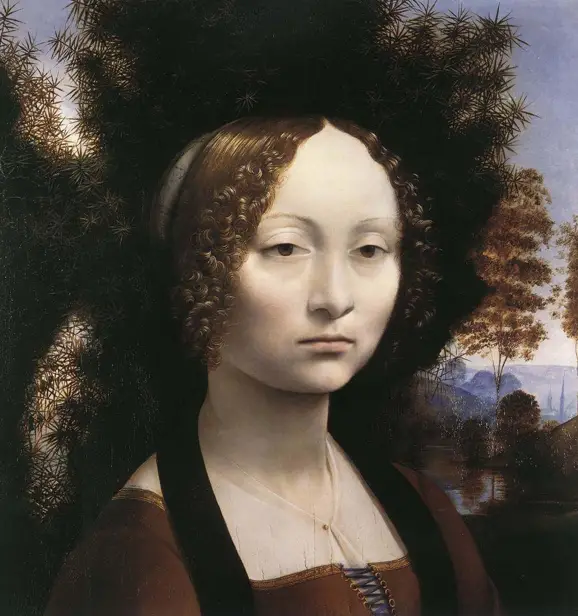
The Ginevra de' Benci is a portrait of the 15th-century Florentine aristocrat Ginevra de' Benci (born around 1458) by Leonardo da Vinci. Ginevra de' Benci, age 16 or 17, is a babysitter who is dressed in a brown dress with blue laces and gold trim, as well as a black scarf. She wears a delicate white shirt with a golden pin beneath the outfit. Her skin is flawless, and her hair is done in ringlets.
Her look is a little irritated on the one hand and proud on the other. Her eyes make this clear. Her left eye is focused on the spectator, but her right eye appears to be staring down at something. Ginevra's facial expression has been viewed by experts as an indicator that she is unhappy with the (upcoming) marriage. Take note of Ginevra's sparse brows. Shaving the brows was typical for women at the time, as shown in Leonardo da Vinci's Mona Lisa.
A juniper bush grows behind Ginevra. The halo of spikes from juniper leaves contrasts wonderfully with Ginevra's depiction. Mountains, trees, water, a tiny village, and a hazy sky are typical of Leonardo da Vinci's style in the right background. It is the only Leonardo painting on public display in the Americas, at the National Gallery of Art in Washington, D.C.
History of The Ginevra de' Benci Painting
In the leonardo da vinci Ginevra de' Benci painting, Ginevra de Benci, a well-known young Florentine woman, is largely regarded as a sitter. Leonardo created the picture in Florence between 1474 and 1478, presumably to commemorate Ginevra's 16th-year marriage to Luigi di Bernardo Niccolini. It is more than likely a commemoration of the engagement.
Contemporary portraits of females were typically commissioned for one of two reasons: betrothal or marriage. Wedding pictures were customarily done in pairs, with the woman on the right facing left and the man on the left. Because this portrait faces right, it most likely signifies betrothal.
The juniper bush that surrounds Ginevra's head and fills much of the background serves a purpose beyond decoration. The juniper was considered a symbol of female virtue in Renaissance Italy, and the Italian term for juniper, Ginepra, is also a play on Ginevra's name.
The laurel and palm on the back of the artwork represent Ginepra's intelligence and moral standards, respectively. However, the laurel and palm were also Bernardo Bembo's personal insignia, as he was considered to be having a platonic affair with Ginevra. Bernardo Bembo was the Venetian ambassador to Florence, and he most likely commissioned the rear of this painting (as well as the front, according to others, though this is unverified).
Ginevra de' Benci worth
Unlike Leonardo's previous female portraits, this lady appears sulky, unforgiving, and arrogant, highlighted by the slightly smaller cast of one eye, which makes her seem withdrawn. Her left eye appears to be looking directly at us, while her right eye appears to be looking beyond some intangible point.
Ginevra, like other Florentine ladies of the time, has shaved her brows (this is also obvious in the Mona Lisa). Perhaps her expression shows that she was not fully enthusiastic about her impending marriage.
Later in life, she would go into self-imposed exile in order to recover from a terrible illness; she was also plagued by an ill-fated love affair.
FAQs about Ginevra de' Benci painting
Several artworks have approached or exceeded $70 million, but one notable example is Pablo Picasso’s Garçon à la pipe, which sold for about $104 million in 2004 and helped push the market into that price range. Today, many major masterpieces routinely sell for tens or hundreds of millions, depending on rarity and demand.
Ginevra de’ Benci is famous as one of Leonardo da Vinci’s earliest portrait paintings and the only Leonardo work permanently displayed in the Americas, at the National Gallery of Art in Washington, D.C. It is also admired for its innovative realism and symbolic use of juniper, which represents virtue.
The $450.3 million painting Salvator Mundi was purchased in 2017 by Saudi Prince Badr bin Abdullah Al Saud, widely believed to have acted on behalf of Crown Prince Mohammed bin Salman.
Leonardo da Vinci’s most famous work is widely considered the Mona Lisa, known for its mysterious expression and global cultural significance. It is housed at the Louvre Museum in Paris and is among the most visited artworks in the world.
No painting has officially sold for $500 million. However, Leonardo da Vinci’s Salvator Mundi, sold for $450.3 million, is the closest confirmed sale and remains the most expensive painting ever sold at auction.
Recent high-value art sales have approached this level, though prices vary in private transactions. For example, works by artists like Jean-Michel Basquiat and Pablo Picasso have sold for $100–200+ million in private deals, though exact figures such as $230 million are often not publicly confirmed.
 Leonardo Bianchi is the founder of Leonardo da Vinci Inventions & Experiences, a cultural travel guide helping visitors explore Leonardo da Vinci’s art, inventions, and legacy across Italy and Paris.