
Leonardo da Vinci Rome Museum: What Makes It Unique?
(Last updated: May 2026)
Leonardo da Vinci Rome museum experience is one of the most compelling ways to connect with the genius of the Renaissance in Italy’s Eternal City.
Leonardo da Vinci remains one of the most fascinating figures in human history. He was a painter, scientist, engineer, architect, and philosopher — all at once. Historians study him to understand the Renaissance mind.
Understanding where and how Leonardo’s legacy is preserved in Rome enriches every visit to the city’s museums and streets. It places Renaissance Rome in context alongside the Vatican Museums, the city’s ancient ruins, and its living artistic tradition.
This post is all about the Leonardo da Vinci Rome museum — what it is, what it offers, and why it matters to anyone curious about the Renaissance.
What Is the Leonardo da Vinci Rome Museum?
Leonardo da Vinci Rome museum — commonly known as the Museo Leonardo da Vinci — is an interactive exhibition dedicated to the inventor’s life, scientific notebooks, and mechanical designs. Located near the Piazza del Popolo, it presents full-scale reconstructions of his machines alongside explanations of his visionary thinking. It is not a fine art gallery but a hands-on space for exploration.
Leonardo da Vinci and Renaissance Rome
To understand the Leonardo da Vinci museum in Rome, you first need to understand what Rome meant during the Renaissance. Between the late 15th and early 16th centuries, Rome was not only the seat of the Catholic Church — it was the epicenter of artistic and intellectual ambition.
Popes commissioned colossal works of art. Scholars debated ancient philosophy. Architects dreamed of rebuilding a city that could rival ancient glory. This was the world Leonardo moved through.
Leonardo’s Brief but Important Time in Rome
Leonardo da Vinci spent time in Rome between approximately 1513 and 1516, under the patronage of Giuliano de’ Medici, brother of Pope Leo X. He lived in the Belvedere Palace at the Vatican, where he pursued scientific experiments alongside his artistic projects.
His time in Rome was not his most productive by conventional standards. He struggled to complete major commissions and reportedly clashed with rivals. Yet the period reveals much about his restless curiosity. He studied anatomy, optics, and geology — quietly advancing ideas that would not find scientific equivalents for centuries.
Understanding this chapter of his life deepens the meaning of any Leonardo da Vinci experience in Rome.
Rome During the Renaissance: A City of Ambition
Rome during the Renaissance was simultaneously ancient and modern. The ruins of the Forum stood alongside newly commissioned churches. The Vatican Palaces were being decorated by the greatest artists of the age. Raphael and Michelangelo worked in competition and collaboration within the same city.
Leonardo arrived in this charged environment not primarily as a painter but as a scientist and engineer. He brought his notebooks, his mirrors, and his questions. Rome during the Renaissance was the perfect stage for someone of his scope.
The Vatican Museums and Leonardo’s World
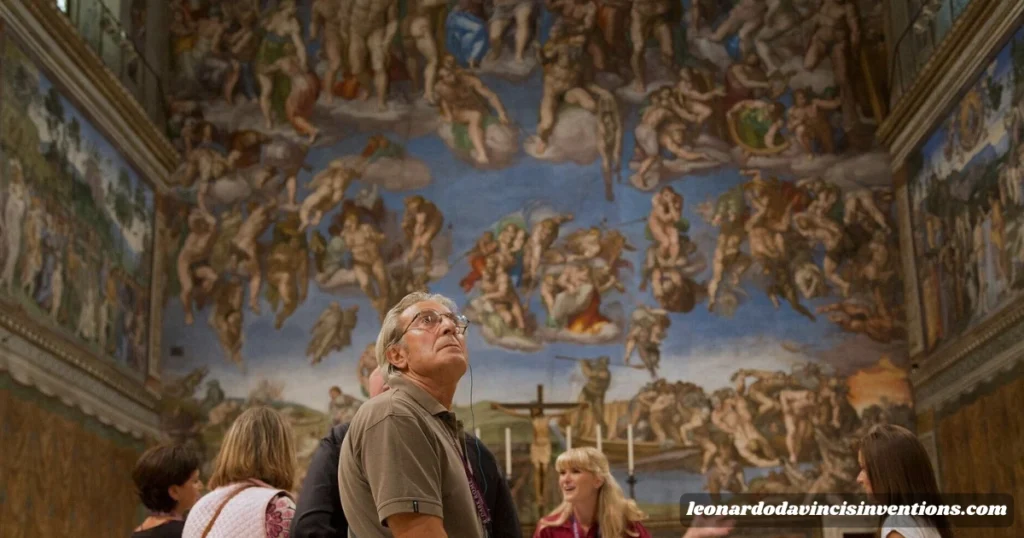
The Vatican Museums hold some of the most important Renaissance art ever created. While Leonardo’s own works are not housed there, the museums offer essential context for understanding the world he inhabited.
Raphael’s Stanze, Michelangelo‘s Sistine Chapel ceiling, and the collection of classical sculptures all speak to the Renaissance values Leonardo embodied.
If You Want to Experience Rome in Context
Planning a Leonardo-focused visit in Rome is less about seeing a single masterpiece and more about understanding the world he moved through — from the Vatican Museums to the historic center and the Museo Leonardo da Vinci near Piazza del Popolo. Seen separately, each place tells part of the story. Viewed together, they reveal how Renaissance Rome shaped his thinking.
Follow Leonardo Through Renaissance Rome
This guided experience centers on the Museo Leonardo da Vinci, using its interactive exhibits as the foundation for understanding his ideas, with selected Renaissance sites adding context to the world he lived in.
Inside the Museo Leonardo da Vinci: What to Expect
The Museo Leonardo da Vinci, located near Piazza del Popolo, is one of the best Leonardo da Vinci museums in Rome for visitors seeking an immersive, educational experience. Unlike traditional art museums, it focuses on Leonardo as an inventor and scientist rather than exclusively as a painter.
Reconstructed Machines and Inventions
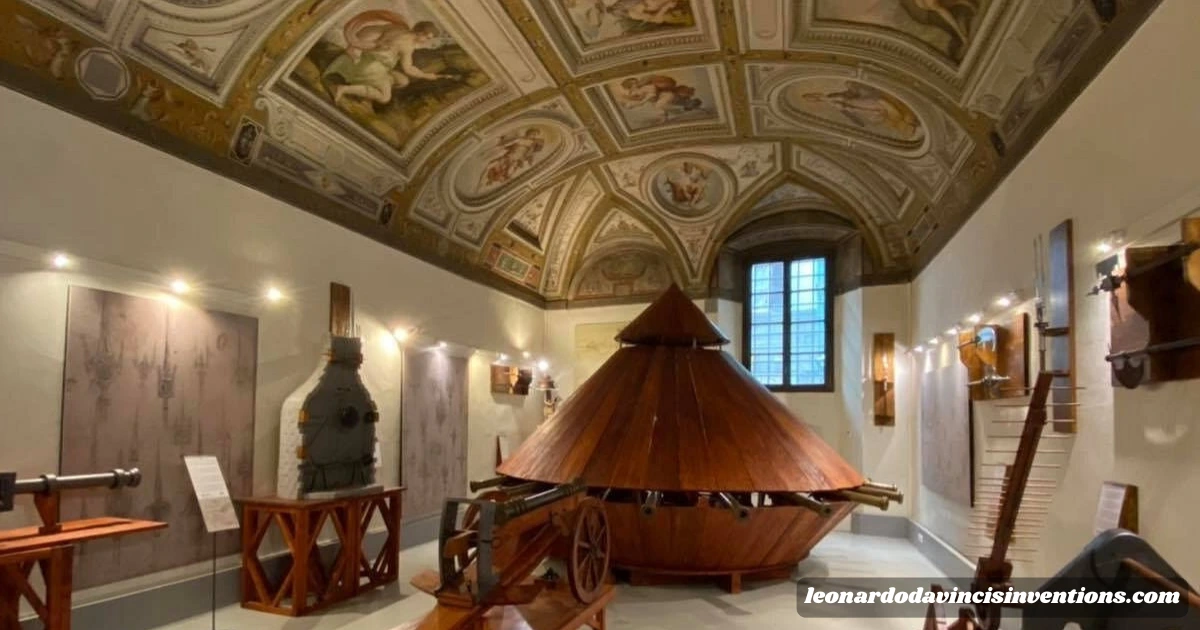
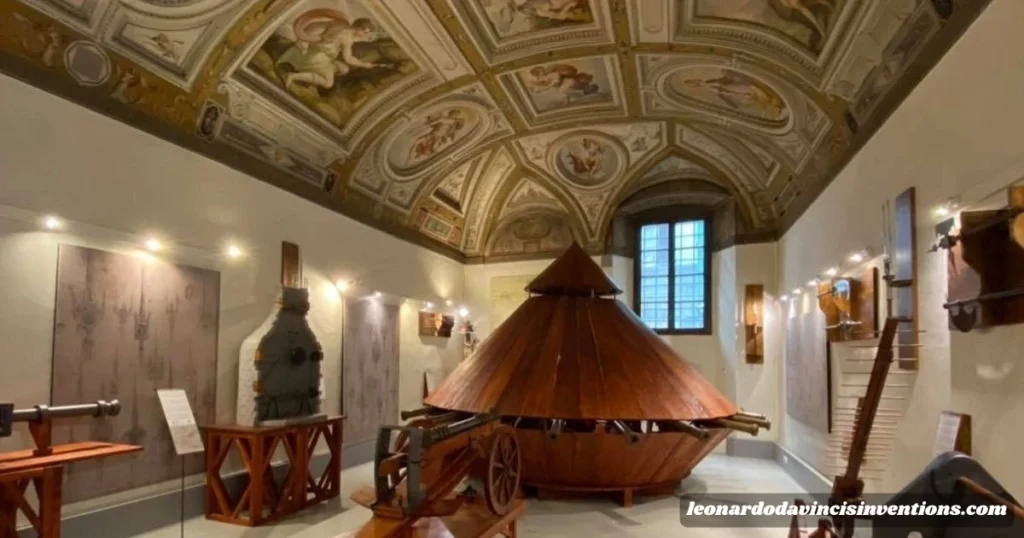
The museum’s central attraction is its collection of full-scale working models built directly from Leonardo’s drawings. These include early prototypes of flying machines, armored vehicles, a robotic knight, hydraulic devices, and architectural models.
Each reconstruction is accompanied by the original notebook sketch, allowing visitors to trace the leap from imagination to physical form. This approach makes the Leonardo da Vinci experience unusually tangible. You are not simply looking at paintings — you are watching ideas become objects.
Interactive Exhibits and Educational Programs
The museum is designed for active engagement. Visitors can handle some of the models, operate mechanisms, and test the principles Leonardo explored. This makes it particularly effective for students, families, and curious travelers who want more than a passive museum visit.
Guided tours are available in multiple languages, and the educational programs connect Leonardo’s inventions to modern science and engineering. The goal is not nostalgia but relevance—showing how Renaissance thinking shapes the world we live in today.
The Notebooks: Leonardo’s Greatest Achievement
No aspect of Leonardo’s genius is more astonishing than his notebooks. He filled more than 7,000 pages with observations, drawings, plans, and reflections across a lifetime of inquiry. The museum presents reproductions and explanations of key pages, helping visitors understand what the notebooks contain and why they still matter.
Subjects range from human anatomy to river engineering, from the mechanics of flight to the optics of light. The notebooks are not art objects — they are windows into one of the most extraordinary minds in history.
Renaissance Art in Rome and Beyond: Leonardo’s Greatest Works
Although the Museo Leonardo da Vinci in Rome focuses on inventions, no account of Leonardo is complete without his paintings. His canvases are among the most studied and reproduced works in the history of art.
The Mona Lisa and the Louvre Connection
The Mona Lisa hangs in the Louvre in Paris, where it has been since the time of the French Revolution. It remains the most visited painting in the world. Leonardo worked on it for years, possibly from around 1503 until near his death. Its subject, her expression, and the landscape behind her continue to inspire debate and wonder.
For those exploring Leonardo’s legacy across multiple cities, Paris is an essential destination alongside Rome and Florence.
The Last Supper in Milan
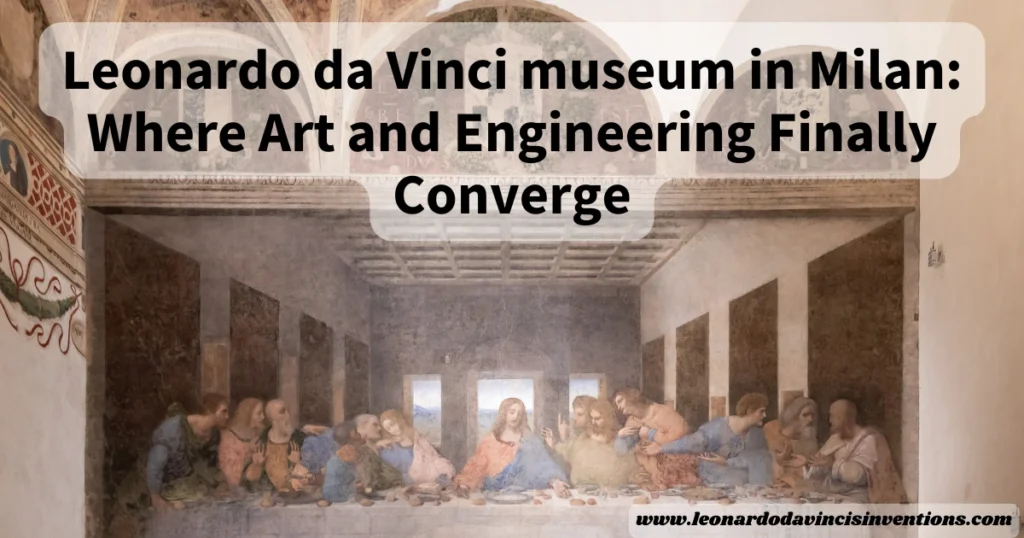
The Last Supper, painted on the refectory wall of Santa Maria delle Grazie in Milan, is considered one of the greatest narrative paintings ever created. It captures the moment Christ announces that one of his disciples will betray him. Each figure’s reaction is rendered with psychological precision that feels modern even five centuries later.
Milan is another city that rewards travelers following Leonardo’s trail. Visitors can book timed entry to see the mural and explore the Museo Nazionale della Scienza e della Tecnologia Leonardo da Vinci, which houses one of the largest collections of his machine reconstructions in the world.
Other Masterworks Worth Knowing
Lady with an Ermine, held in Krakow, and the Virgin of the Rocks, which exists in two versions — one in the Louvre and one in London’s National Gallery — demonstrate the extraordinary range of Leonardo’s painting. Each work rewards close attention and rewards even more when placed in its historical context.
Understanding these works enriches any visit to a Leonardo da Vinci museum, because the paintings and the inventions are products of the same relentless intelligence.
Where to Experience Leonardo’s Legacy
Leonardo’s works and reconstructed ideas are spread across several European cities. Each location offers a different angle on his genius.
Florence: The City That Made Him
Leonardo was born near Florence in 1452 and trained in the city under the painter Verrocchio. Florence shaped his early vision of art and science as inseparable. The Uffizi Gallery houses important works from his early career, and the surrounding Tuscan landscape appears in several of his paintings.
Florence remains one of the most rewarding cities for anyone interested in Renaissance art. Walking its streets gives a visceral sense of the culture that produced Leonardo, Michelangelo, Brunelleschi, and Botticelli within a single generation.
Milan: Leonardo’s Most Productive Years
Leonardo spent nearly two decades in Milan, working for Ludovico Sforza. This was his most creative and prolific period. Beyond The Last Supper, he designed canals, planned festivals, built stage machinery, and filled notebook after notebook with observations and inventions.
The Museo Nazionale della Scienza e della Tecnologia in Milan is the largest science and technology museum in Italy and houses a major permanent collection of Leonardo works. It is essential for anyone pursuing a deeper understanding of the da Vinci museum Italy experience.
Paris: Home of the Mona Lisa
After leaving Italy for the last time in 1516, Leonardo spent the final years of his life in France at the invitation of King Francis I. He died at the Chateau du Clos Luce in 1519. Today, the chateau is a museum dedicated to his final years and houses further reconstructions of his machines.
The Louvre, meanwhile, holds not only the Mona Lisa but also the Virgin of the Rocks and several other works attributed to Leonardo and his circle.
Rome: The Museo Leonardo da Vinci
Rome offers the dedicated traveler an experience distinct from Florence, Milan, or Paris. The Museo Leonardo da Vinci near Piazza del Popolo is the primary destination for Leonardo-focused visitors in the city. Its emphasis on hands-on learning makes it particularly accessible for first-time visitors to Renaissance history.
Combined with visits to the Vatican Museums, the Capitoline Museums, and a walk through the historic center, a Leonardo-focused day in Rome connects the Renaissance to the ancient past and the modern present in a way few other cities can match.
Experience Leonardo’s World in Person: Planning Your Visit
The museum Leonardo da Vinci experience in Rome is most rewarding when planned thoughtfully. A few practical considerations help visitors make the most of their time.
Visiting the Museo Leonardo da Vinci at Piazza del Popolo
The museum is centrally located and easily reached by public transport or on foot from the historic center. It is open to general visitors and welcomes school groups, tourists, and independent travelers alike. Timed entry is recommended during peak tourist season to avoid long waits.
Most visitors spend between one and two hours in the museum. Pairing it with a walk through the surrounding Piazza del Popolo area, which itself is a remarkable example of Renaissance and Baroque urban planning, naturally extends the experience.
Guided Tours and Curated Experiences
Several cultural tour operators in Rome offer guided experiences that combine the Museo Leonardo da Vinci with other Renaissance-era sites. These tours often include the Vatican Museums, the Castel Sant’Angelo, or the historic churches of the city center.
A good guided tour adds historical depth that self-guided visits sometimes lack. An expert guide can explain the relationship between Leonardo’s ideas and the broader context of Renaissance Rome — connecting the scientific notebooks to the paintings on church walls and the architecture in the streets outside.
Beyond the Museum: Exploring Renaissance Rome
Rome is not typically described as a city of Leonardo in the way Florence or Milan are. But the city offers extraordinary Renaissance art and architecture for those willing to look. The Villa Farnesina, the Palazzo Farnese, and the churches of the historic center contain frescoes and paintings by Leonardo’s contemporaries.
Understanding Renaissance art in Rome means seeing Leonardo’s work as part of a larger conversation — a moment in history when artists, scientists, and patrons all believed the world could be understood and improved through careful observation and bold imagination.
Final Thoughts
This post was all about the Leonardo da Vinci Rome museum — what it offers, why it matters, and how it connects to a broader story of Renaissance genius that still resonates today.
Leonardo da Vinci was not simply a great painter or a clever inventor. He was a thinker who refused to accept disciplinary boundaries. He studied rivers and faces with the same intensity. He drew flying machines and anatomical cross-sections with the same pen. His curiosity was his method, and his notebooks are its permanent record.
Visiting a dedicated Leonardo museum — whether in Rome at the Piazza del Popolo, in Milan’s science museum, or at the Chateau du Clos Luce in France — brings that curiosity to life. It transforms history from a list of names and dates into a living encounter with ideas that were five centuries ahead of their time.
The Museo Leonardo da Vinci experience in Rome is a remarkable starting point for anyone beginning that journey. It does not demand prior knowledge. It asks only for the same thing Leonardo himself always brought to every question: an open and curious mind.
FAQs about the Leonardo da Vinci Rome museum
Yes — the Leonardo da Vinci museums in Rome are generally considered worth visiting for their interactive experience, especially if you’re interested in his inventions rather than original artworks. Visitors highlight the working models and hands-on exhibits as engaging, though the museums are relatively small and better suited as a short cultural stop rather than a major highlight.
You cannot see the original Leonardo da Vinci paintings in Rome. His major works are located elsewhere — for example, the Mona Lisa is in the Louvre Museum and The Last Supper is in Santa Maria delle Grazie. In Rome, museums only display reproductions and models, not original masterpieces.
There are about three Leonardo da Vinci museums or experiences in Rome, operated by different organizations. These include interactive exhibitions focused on his inventions and life rather than original works.
Most visitors spend around 1 to 2 hours exploring the museum, depending on how deeply they engage with the exhibits. Some smaller exhibitions can be completed in 45–60 minutes, while more interactive visits may take longer.
The most widely regarded “best” Leonardo museum in Italy is the Museo Leonardiano di Vinci, located in his birthplace. It offers a deeper, more authentic experience with extensive collections and typically requires 1.5 to 3 hours to visit, making it more comprehensive than the smaller, more tourist-oriented museums in Rome.
If you’re visiting Rome for Leonardo da Vinci, it’s important to know that Rome is not a major Leonardo city — there are no original masterpieces, only interactive museums. Plan your visit accordingly: treat these museums as short, educational stops, and prioritize cities like Florence or Milan if you want to see Leonardo’s most important works.
Related Post You May Like


Disclosure: This page may contain affiliate links. If you choose an experience through them, it helps support the site at no extra cost to you.
 Leonardo Bianchi is the founder of Leonardo da Vinci Inventions & Experiences, a travel and research guide exploring where to experience Leonardo’s art, engineering, and legacy across Italy and Paris.