
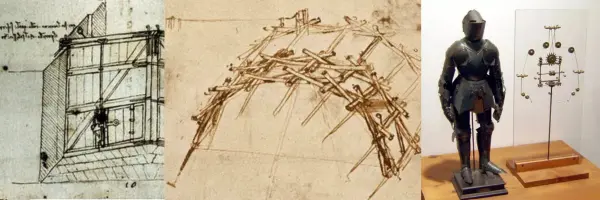
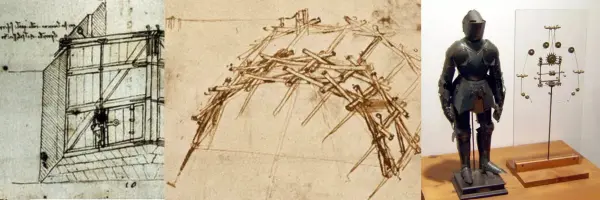
Leonardo da Vinci Civil Inventions showcase the genius mind of one of history’s greatest thinkers. His civil engineering innovations were theoretical and practical solutions to real-world challenges.
His designs, such as the canal lock and swing bridge, demonstrate his ability to blend artistry with engineering.
If you want to understand the breadth of da Vinci’s contributions, you will appreciate his groundbreaking work in hydraulic engineering.
You will explore da Vinci’s vision, which was centuries ahead of its time.
His concepts, including those for a self supporting bridge and water pump, reveal his keen eye for efficiency and functionality.
Learning about inventions like the Robotic Knight reveals his brilliance and how his ideas continue to influence modern engineering.
Overview of Leonardo da Vinci’s Civil Engineering Contributions
Leonardo da Vinci civil engineering inventions were ahead of their time and continue to inspire modern designs.
His innovative ideas, like the da Vinci bridge and water management systems, paved the way for future breakthroughs.
What Was Leonardo da Vinci Famous For?
Leonardo da Vinci was renowned not only as an artist but also as a pioneering engineer.
His civil engineering contributions included designing a canal lock system to manage water levels and a swing bridge for strategic military use.
Da Vinci’s approach to engineering blended art and science, reflecting his belief in harmonizing functionality with aesthetics.
His sketches reveal plans for a water pump and rudimentary crane, tools that he hoped would increase efficiency in construction and agriculture.
Leonardo also conceptualized urban planning ideas, envisioning cities with better sanitation and transport systems. His relentless curiosity led him to imagine machines that seemed futuristic to his contemporaries.
Impact on Modern Engineering and Design
Leonardo da Vinci’s inventions and ideas laid the groundwork for various engineering advancements.
His designs for movable bridges influenced modern movable bridge technology.
Leonardo’s vision for a more efficient waterway management system laid the foundation for current water infrastructure engineering.
His plans highlighted the importance of effective resource management in urban development.
Today’s engineers continue to draw inspiration from his blend of art and functionality, which remains relevant in designing sustainable and innovative solutions.
Detailed Exploration of Key Civil Inventions
Leonardo da Vinci is renowned for his vast array of inventions, many of which demonstrate creativity and technical skill. Many of these designs remained visionary concepts during his lifetime and continue to inspire engineers today.
Leonardo da Vinci Canal Lock
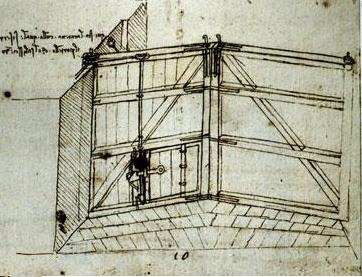
Leonardo da Vinci created an innovative canal lock system, contributing significantly to the development of waterways.
His design included a mitered lock gate to control water flow and enable ships to navigate varying water levels. This concept is seen in modern lock systems, showing his far-reaching impact.
His work in civil engineering, such as this lock system, allowed for more efficient trade routes and improved regional connectivity.
Leonardo Self-Supporting Bridge
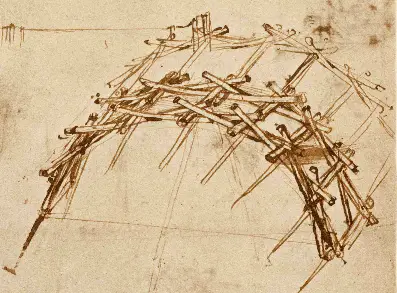
The self-supporting bridge designed by Leonardo was unique due to its simplicity and strength.
Construction materials are interlocked through clever geometry and do not require fasteners. This is an example of Leonardo’s inventions that still mesmerizes engineers.
These bridges were practical for military campaigns or temporary crossings, reflecting his understanding of practical engineering and architecture.
Leonardo da Vinci Robotic Knight
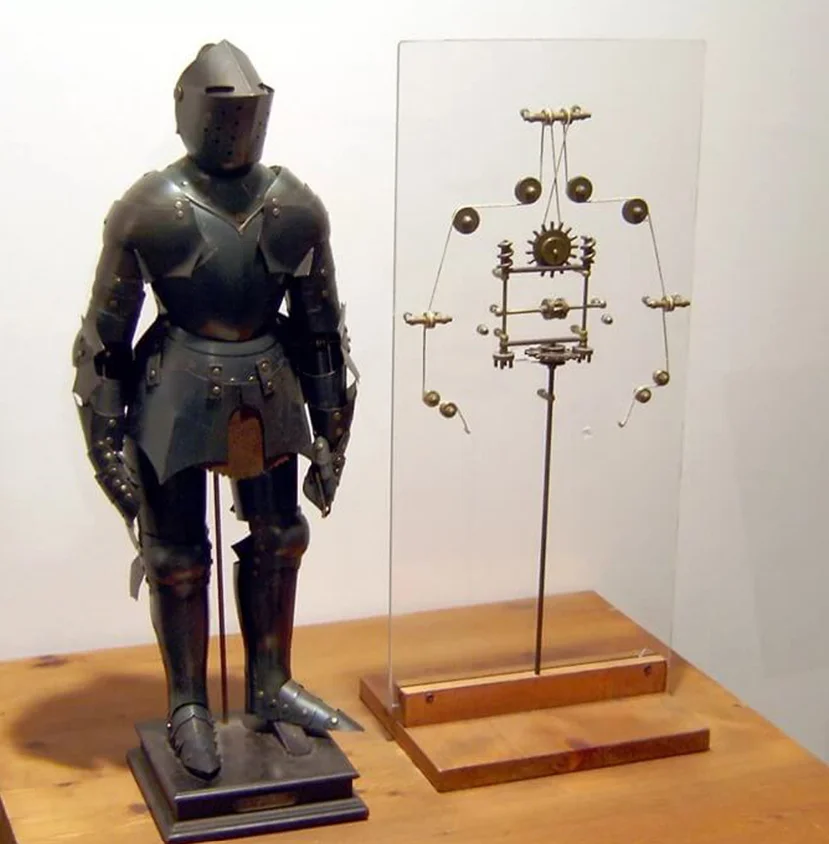
Leonardo da Vinci imagined a robotic knight, a marvel of mechanical design for his era.
This automaton could sit, wave, and move its head and arms, highlighting Leonardo’s talent in mechanical engineering.
Although not directly related to civil structures, it shows his interest in human-machine interfaces and early steps in robotics.
Leonardo da Vinci Diving Suit
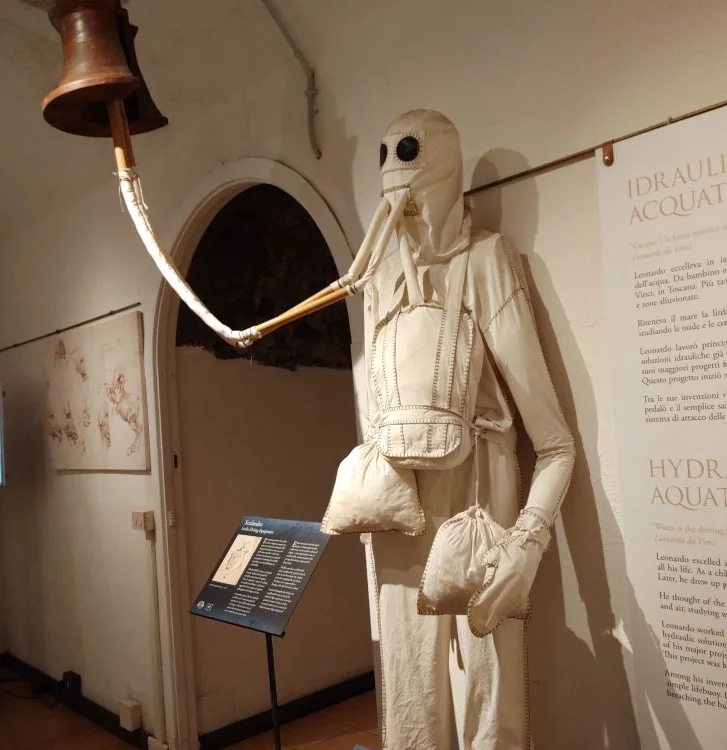
Leonardo’s diving suit was intended for underwater warfare.
Made from leather, it featured breathing tubes to the surface, allowing stealthy naval maneuvers.
While it was never constructed in his time, his idea prefigured modern diving technology and illustrates how his inventive mind sought novel solutions across varied fields.
Da Vinci Mechanical Drum
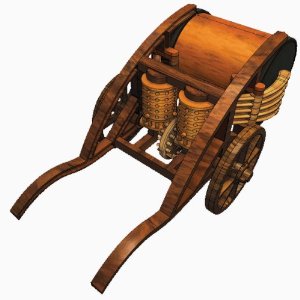
The mechanical drum, another of da Vinci’s inventions, was designed as a self-playing instrument.
The drum used gears and levers to create music without human intervention. This design displays his mechanics and automation skills, precursors to modern automated machinery.
Leonardo da Vinci Swing Bridge
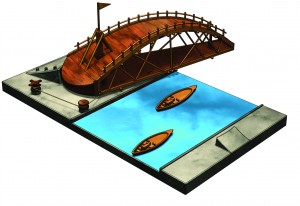
Leonardo’s swing bridge concept was elegant in its simplicity and functionality.
Controlled by a central pivot, the structure could open to allow the passage of larger ships.
His ideas on such movable designs show an understanding of transportation needs and highlight why he is famous for combining practicality with innovation in his civil projects.
Da Vinci Paddle Boat
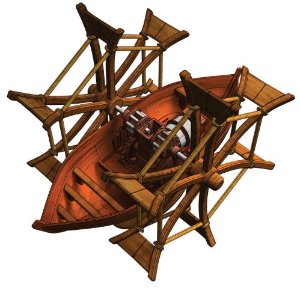
Leonardo envisioned a paddle boat powered by hand cranks, facilitating smooth navigation in calm waters.
This invention showcases his interest in human-powered vehicles and fits well within his exploration of efficient transportation methods that anticipated future watercraft.
Da Vinci Printing Press
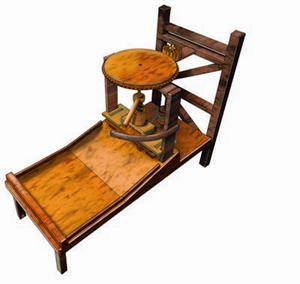
Leonardo da Vinci designed a printing press that improved upon existing models, aiming for greater efficiency.
While its impact was less dramatic than that of Leonardo da Vinci’s other inventions, it reflected his desire to enhance tools for spreading knowledge.
This aligns with his broader pursuit of advancing technology across different disciplines.
The Influence of Leonardo’s Civil Inventions Today
Leonardo da Vinci’s civil inventions continue to shape today’s engineering and architectural fields. His imaginative designs have inspired modern innovations and paved the way for scientific exploration.
Modern Applications of Da Vinci’s Concepts
Leonardo da Vinci’s inventions list includes remarkable designs that continue to influence contemporary engineering.
His idea for a 240-meter single-span bridge for the Ottoman Empire showcases his foresight in civil engineering.
While the original bridge was not built, modern engineers have drawn inspiration from its design principles, influencing bridges worldwide.
Da Vinci’s inventions, such as water systems and mechanical devices, have been adapted and advanced in today’s technology.
With a focus on functionality and innovation, these concepts have driven advancements in machinery and infrastructure.
His work on canal designs also reflects principles used in modern hydraulic engineering today.
Leonardo da Vinci’s Scientific Discoveries
Leonardo da Vinci’s scientific discoveries went beyond art and engineering, impacting multiple fields.
His detailed studies of mechanics and motion have served as a basis for further exploration in physics and engineering disciplines.
Leonardo’s keen observations and sketchbooks reveal a deep interest in mechanical devices, such as the helicopter, which have evolved into real-world applications.
While Leonardo da Vinci did not invent every modern device, his innovations laid the foundation for many modern devices.
For instance, his exploration of flying machines provided conceptual groundwork that fascinates aeronautical engineers today.
His endeavors in civil inventions reflect a blend of art and science that continues to captivate experts and drive scientific advancements.
Final Thoughts
Leonardo da Vinci Civil Inventions are a testament to his incredible vision and creativity.
His designs, like the self-supporting bridge and canal systems, showcase innovative solutions ahead of their time.
Leonardo’s work in civil engineering illustrates his deep understanding of mechanics and materials.
Notable Achievements:
- Self-Supporting Bridge: This showcased his skills in creating structures without additional support.
- Canal and Locks System: Designed to control water flow and improve transportation, exemplifying his integration of engineering and practicality.
His inventions often combined art and science, pushing the boundaries of what was possible during the Renaissance.
Leonardo’s ability to conceptualize and draw detailed plans marks him as a pioneer in the field.
His forward-thinking approach to engineering problems continues to inspire modern-day engineers and architects.
Key Takeaways: Leonardo da Vinci’s civil inventions demonstrate his genius, blending technical skill with artistic insight.
His legacy in this area remains influential, as engineers and inventors still draw upon his pioneering work today.
FAQs about Leonardo da Vinci Civil Inventions
Leonardo da Vinci designed a wide range of inventions across engineering, military, and civil fields, including flying machines, bridges, hydraulic pumps, canals, parachutes, and early armored vehicles. His notebooks contain thousands of sketches of ideas for water-powered machines, systems for lifting heavy loads, and designs to improve transportation and urban infrastructure.
There is no definitive proof of Leonardo da Vinci’s sexuality, but historical records show he was accused of sodomy in 1476; the charges were dismissed due to lack of evidence. Because he never married and left few personal writings about his private life, historians continue to debate the subject.
Leonardo da Vinci was not formally trained as a civil engineer, but he worked extensively in engineering roles and applied many civil engineering principles. He designed bridges, canals, and urban water systems, and was employed by rulers to solve infrastructure and military engineering problems, effectively acting as an early civil engineer.
Leonardo designed bridges, canal systems, and large-scale water management projects, including a plan to divert the Arno River in Italy. He also developed ideas for harbor cleaning systems, flood control, and machines to excavate tunnels and transport materials—key concepts in modern civil engineering.
Leonardo da Vinci did not invent the gun, as firearms already existed before his time. However, he improved and reimagined weapons, designing advanced concepts such as multi-barrel cannons, rapid-fire devices, and early versions of firearms that aimed to increase efficiency and firepower.
Leonardo da Vinci is widely credited with conceptualizing more than 100 inventions through his detailed notebooks. While many were never built during his lifetime, his designs—ranging from engineering machines to flight concepts—demonstrate his extraordinary creativity and influence on future technological development.
 Leonardo Bianchi is the founder of Leonardo da Vinci Inventions & Experiences, a travel and research guide exploring where to experience Leonardo’s art, engineering, and legacy across Italy and Paris.