Leonardo da Vinci Paintings are not just masterpieces but also windows into the mind of one of history’s greatest thinkers.
If you’re wondering which da Vinci’s paintings are a must-see, this article will guide you through his famous works.
Leonardo’s paintings, such as the Mona Lisa and The Last Supper, continue to fascinate art lovers worldwide. They are recognized for their innovative techniques and lifelike details.
His mastery of techniques such as sfumato and chiaroscuro set a new standard for artists of his time.
The Mona Lisa is perhaps best known for her enigmatic expression.
The Last Supper, another pivotal work, captures the emotional intensity of the apostles at a critical moment.
Each painting offers a glimpse not only into his artistic skill but also his scientific curiosity.
The Vitruvian Man perfectly showcases his interest in human anatomy, blending art and science.
Discover how these creations have solidified Leonardo’s reputation as a master of the Renaissance and have influenced countless artists across the centuries.
The Life of Leonardo da Vinci
Leonardo da Vinci was a true Renaissance man, possessing talents in art, science, and engineering. His remarkable journey from a small town in Italy to becoming an iconic historical figure is both fascinating and inspirational.
Early Years and Training
Leonardo was born in 1452 in the small village of Vinci, near Florence, Italy. He was the illegitimate son of a Florentine notary, Ser Piero, and a young peasant woman named Caterina.
Growing up in rural Tuscany, Leonardo was fascinated with nature and art.
At age 14, he began an apprenticeship under the renowned artist Andrea del Verrocchio in Florence.
Under Verrocchio, Leonardo learned many skills, including painting, sculpting, and mechanical arts.
His natural talent quickly emerged, and he contributed to various projects in Verrocchio’s workshop, refining his techniques and gaining valuable insights into the art of creation.
Leonardo’s early works demonstrated his unique ability to capture movement and emotion, laying the foundation for his famous paintings, including those attributed to him.
Professional Life and Patrons
Leonardo worked for influential patrons throughout his career, which significantly shaped his work.
He moved to Milan around 1482 to work for Ludovico Sforza, the Duke of Milan, where he flourished as a painter and engineer.
During this time, he created iconic works, such as The Last Supper, which showcased his innovative use of perspective and detail.
Leonardo also worked as a military engineer, designing weapons and fortifications for the Duke.
After the fall of the Sforza dynasty, Leonardo returned to Florence and painted the Mona Lisa, one of his most renowned masterpieces.
His time in Florence and later in Rome further established his reputation, and he attracted commissions from wealthy patrons across Italy.
Final Years and Legacy
Leonardo spent his final years in France, having been invited by King Francis I.
Living at the Château du Clos Lucé near Amboise, he continued his studies and artistic pursuits until he died in 1519.
Although he left few finished works, his contributions to art and science were profound.
His ability to blend art with scientific inquiry set him apart from his contemporaries.
Works like the Mona Lisa and The Last Supper remain celebrated and inspire artists and scholars worldwide.
His influence extends beyond his paintings, as his notebooks reveal inventive concepts far ahead of their time.
Leonardo’s legacy lives on, embodying the spirit of innovation and creativity.
Leonardo da Vinci Famous Paintings
Mona Lisa
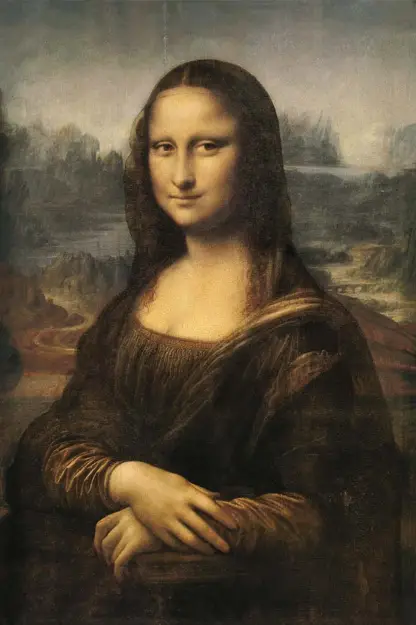
The Mona Lisa, one of Leonardo da Vinci’s most famous paintings, depicts a seated woman believed to be Lisa Gherardini, the wife of Francesco del Giocondo, a wealthy merchant.
The painting is a half-length portrait, considered one of the world’s most famous and iconic paintings.
Leonardo da Vinci Mona Lisa painting is notable for its mastery of composition, use of light and shadow, and the psychological intensity of the figures.
The Mona Lisa’s fame is partly due to the painting’s enigmatic expression, which is often the subject of speculation and interpretation.
Mona Lisa
The Last Supper
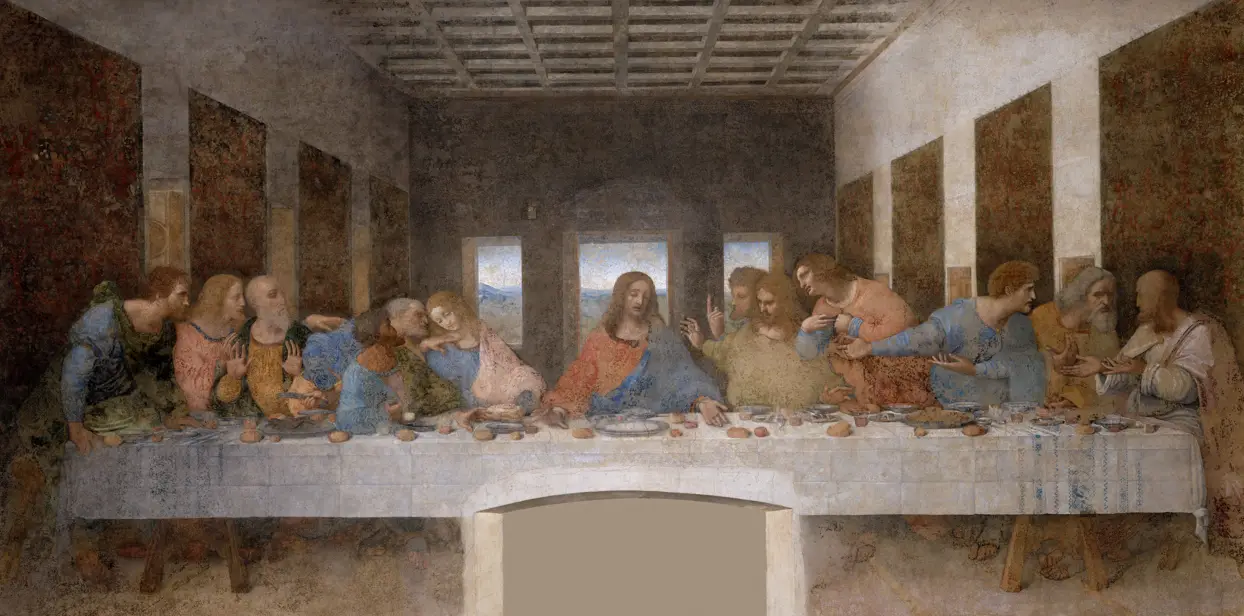
The Last Supper, one of Leonardo da Vinci most famous paintings, depicts the scene from the Bible in which Jesus and his disciples are gathered for the Last Supper, the final meal Jesus shared with his disciples before his arrest and crucifixion.
Leonardo da Vinci’s Last Supper is a large mural commissioned by Ludovico Sforza, Duke of Milan, to be painted on the wall of the Dominican monastery Santa Maria delle Grazie in Milan, Italy.
The painting is regarded as one of the greatest masterpieces of the High Renaissance and one of the most renowned paintings in the world. It is notable for its mastery of composition, use of light and shadow, and psychological intensity of the figures.
The Last Supper
Salvator Mundi
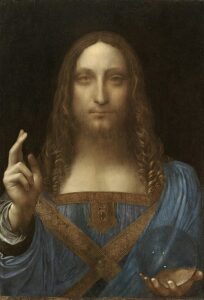
The Salvator Mundi, also known as the “Savior of the World,” depicts Jesus Christ as the Salvator Mundi, holding an orb in his left hand and making the sign of the cross with his right hand.
Leonardo da Vinci’s painting of Jesus is considered an important masterpiece of the High Renaissance. It is notable for its mastery of composition, use of light and shadow, and the psychological intensity of the Christ figure.
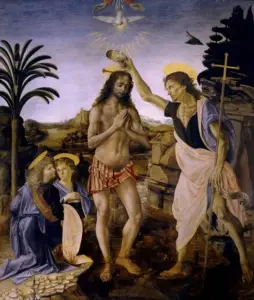
The Baptism of Christ, considered Leonardo da Vinci’s first painting, depicts a biblical scene in which Jesus is baptized by John the Baptist in the River Jordan.
The painting is considered one of Leonardo’s earliest known works. It is notable for its mastery of composition, use of light and shadow, and psychological intensity of the figures.
The Baptism of Christ
Lady with an Ermine
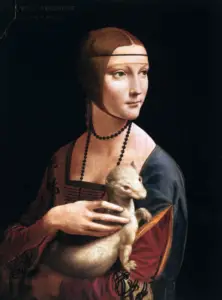
Lady with an Ermine is a portrait of Cecilia Gallerani holding an ermine, a small mammal that symbolized purity and nobility in the Renaissance era.
The painting is renowned for its realism, meticulous attention to detail, and the use of sfumato, a technique that blends colors to create a soft, hazy effect.
Lady with an Ermine
Leda and the Swan
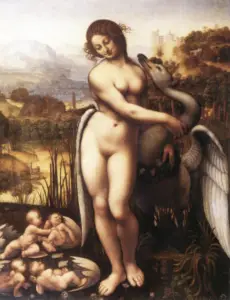
Leda and the Swan depicts the story from Greek mythology of Leda, a queen of Sparta, who was seduced and impregnated by Zeus in the form of a swan.
The painting is considered a lost work, known only from copies, as no original has been found.
Leda and the Swan
Madonna Litta
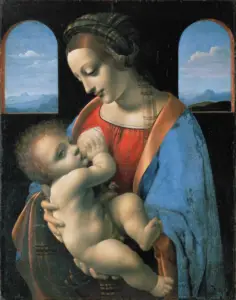
Madonna Litta is a painting by Leonardo da Vinci, created between 1490 and 1491. It depicts the Virgin Mary breastfeeding the baby Jesus, with a tiny angel playing with a curl of Mary’s hair.
The painting is a small devotional work considered one of the finest examples of Leonardo’s skill in painting the human figure.
Madonna Litta
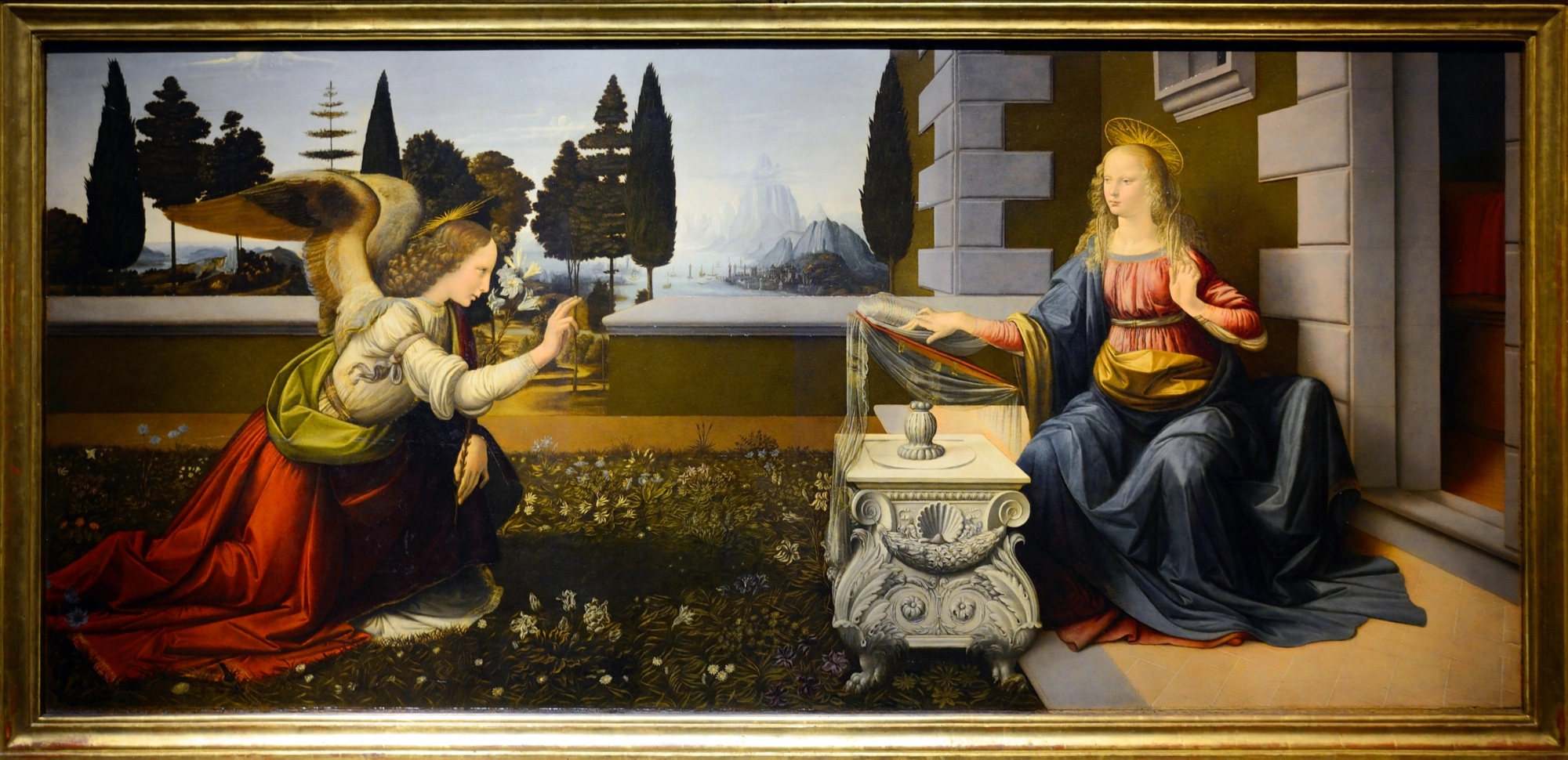
The Annunciation
The Annunciation depicts the biblical scene in which the angel Gabriel visits the Virgin Mary to inform her that she will conceive and bear Jesus Christ.
The painting is a small devotional, probably painted for a private patron. It is considered one of Leonardo’s earliest known works, notable for its mastery of composition, use of light and shadow, and the psychological intensity of the figures.
Annunciation
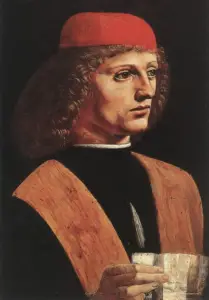
Portrait of a Musician
Portrait of a Musician depicts an unknown musician playing the lute against a landscape background.
The painting is notable for its effective use of light and shadow, which create a sense of depth and motion, as well as its meticulous attention to detail. It has been the subject of much speculation and has been widely studied by art historians and critics.
Portrait of a Musician
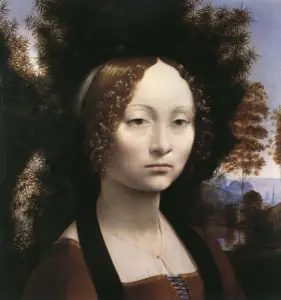
Ginevra de’ Benci
Ginevra de’ Benci depicts a young woman from a wealthy Florentine family, married to Luigi Niccolini.
It’s notable for its sfumato, a technique that blends colors to create a soft, hazy effect, and for its use of light and shadow, which give the figures a sense of depth and volume.
Ginevra de’ Benci
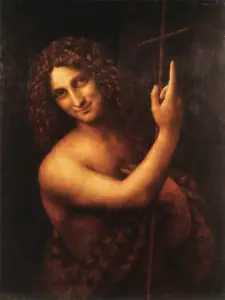
Saint John the Baptist
Saint John the Baptist, Leonardo da Vinci’s last painting, depicts the biblical figure as a young man in the wilderness, dressed in animal skins and holding a reed cross.
The painting is considered one of the greatest masterpieces of the High Renaissance. It is known for its mastery of composition, use of light and shadow, and psychological intensity of the figure of John the Baptist.
Saint John the Baptist
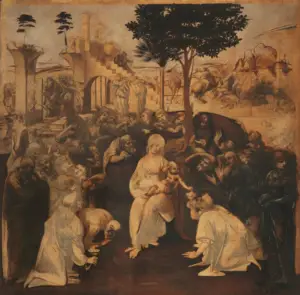
The Adoration of the Magi
The Adoration of the Magi depicts the biblical scene in which the three wise men, or Magi, come to pay homage to the baby Jesus, who the Virgin Mary is holding.
The painting is considered one of Leonardo’s earliest known works. It is notable for its mastery of composition, use of light and shadow, and psychological intensity of the figures.
The painting was never completed, left in a crude state, and is now lost. It is known through copies, some drawings, and sketches.
The Adoration of the Magi
Techniques and Artistic Innovations
Leonardo da Vinci’s paintings are renowned for their groundbreaking techniques and artistic innovations. His mastery of light handling, anatomical precision, and inventive compositions revolutionized the art world.
Chiaroscuro and Sfumato
Leonardo da Vinci’s paintings, such as the Mona Lisa, showcase his expertise in chiaroscuro and sfumato.
Chiaroscuro contrasts light and dark to give paintings a sense of depth and volume.
The technique is evident in works like The Last Supper, where the play of shadows enhances the three-dimensional effect.
Sfumato, another signature technique, involves the delicate blending of colors and tones to produce soft, seamless transitions.
This creates a hazy effect, most famously seen in the Mona Lisa’s enigmatic smile. Unlike sharp lines, sfumato creates the illusion of movement and life, distinguishing da Vinci’s work from that of his contemporaries.
Anatomical Studies and Proportions
Leonardo’s fascination with anatomy profoundly influenced his paintings.
He conducted detailed studies of the human body, which he intricately incorporated into his art.
These anatomical observations helped him achieve realistic proportions and lifelike representations.
A famous Leonardo da Vinci painting, the Vitruvian Man, exemplifies his dedication to proportions and symmetry.
His keen observation of muscle, bone structure, and bodily dimensions informs works like Saint John the Baptist, where realistic anatomy is paired with his artistic vision.
By integrating these studies into his art, Leonardo ensured that each figure was scientifically accurate and artistically compelling.
Engineering and Inventions in Art
Leonardo’s inventive mind extended beyond traditional art techniques.
He often combined engineering and art, turning his paintings into visual marvels.
His knowledge of mechanics and structures influenced both his designs and artistic execution.
Leonardo employed linear perspective and geometry to construct intricate compositions in works such as The Last Supper.
This made his scenes more dynamic and spatially complex. His unique approach allowed him to depict mechanical and architectural innovations in art, leaving a lasting impact on the field.
5 Leonardo da Vinci Unfinished Paintings
Several paintings by Leonardo da Vinci are considered unfinished. These include:
The Adoration of the Magi was commissioned by the Monks of San Donato a Scopeto in Florence, Italy, in 1481. Although the painting was never completed, it is now housed in the Uffizi Gallery in Florence.
The St. Jerome, a painting depicting Saint Jerome in the Wilderness, is housed in the Vatican Museums in Rome, Italy.
The Battle of Anghiari is a painting commissioned by the Signoria of Florence, Italy, in 1503. The painting was never completed, and the surviving fragment is housed in the Palazzo Vecchio in Florence.
The Virgin and Child with St. Anne is a painting depicting the Virgin Mary, Jesus, and St. Anne housed in the Louvre Museum in Paris, France.
The Leda and the Swan, a painting depicting the mythological story of Leda and the Swan, which is housed in the Galleria Borghese in Rome, Italy
These Leonardo paintings are considered unfinished because Leonardo did not complete them. His students and followers have finished some of them; however, they may not have the same mastery and accuracy as the original artist’s works.
Frequently Asked Questions
Leonardo da Vinci is known for creating some of the most iconic paintings in art history. Thanks to their beauty and mystery, his works continue to intrigue art lovers worldwide.
What are the three famous paintings of Leonardo da Vinci?
Leonardo da Vinci’s three most famous paintings are the Mona Lisa, The Last Supper, and the Vitruvian Man. These works showcase his mastery of art and an extraordinary understanding of human anatomy and perspective.
What is the #1 most famous painting in the world?
The “Mona Lisa” is regarded as one of the most famous paintings in the world. This celebrated work of art is renowned for its enigmatic smile and mysterious background.
How many Leonardo da Vinci paintings are left?
About 15 to 20 paintings are widely attributed to Leonardo da Vinci. These paintings are distributed across various museums and collections worldwide.
Why is Mona Lisa’s painting so famous?
The “Mona Lisa” is famous for its captivating depiction of the subject’s expression, which appears to change depending on the angle from which it is viewed. Leonardo employed innovative techniques, such as sfumato, which added to the painting’s allure and mystery.
Where is the Mona Lisa buried?
The actual burial place of the woman depicted in the Mona Lisa, believed to be Lisa Gherardini, is said to be at the convent of Saint Orsola in Italy.
How much is the Mona Lisa worth?
The Mona Lisa has an estimated value of billions, although it is considered priceless and not for sale. This high valuation reflects its profound cultural and historical significance.
Where is the Mona Lisa kept?
The Mona Lisa is kept in the Louvre Museum in Paris, France. It is displayed in a climate-controlled glass case to ensure its preservation.
What are Leonardo’s two most famous surviving paintings?
Leonardo’s two most famous surviving paintings are the Mona Lisa and The Last Supper. Both works are celebrated for their artistic innovation and impact on the art world.
How long did it take to paint the Mona Lisa?
Leonardo da Vinci worked on the Mona Lisa between 1503 and 1506, though some believe he continued to make adjustments until 1517. This long duration highlights his dedication to perfecting the piece.
What is Leonardo’s greatest masterpiece?
Although opinions may vary, many consider the Mona Lisa Leonardo da Vinci’s greatest masterpiece. Its influence and fame have endured over the centuries.
Mona Lisa captures the imagination of millions, leaving many curious about the mystery behind her smile.
Painted by Leonardo da Vinci, this masterpiece is among the world’s most famous works of art, intriguing art enthusiasts and experts alike.
You will delve into the painting’s fascinating history, learn how her smile captivates audiences, and discover why her allure has endured.
Leonardo da Vinci’s Mona Lisa is more than just a painting; it has become an icon, fascinating people across different cultures and generations. Beyond its artistic significance, questions about who the Mona Lisa was and her life circumstances linger.
Understanding why the Mona Lisa remains a subject of immense fascination requires examining its influence on art and popular culture. Her enigmatic presence inspires creative minds, whether through movies like “Mona Lisa Smile” or various reinterpretations in modern media.
Mona Lisa: Historical Context
The Mona Lisa, painted by Leonardo da Vinci during the Renaissance, is renowned for its subject’s mysterious smile and historical significance. Understanding the period and the artist’s influences helps to appreciate why this artwork has remained a cultural icon.
The Renaissance Period
The Renaissance was a European cultural movement that began in Italy in the 14th century and lasted until the 17th century.
This period marks a revival of interest in classical art, literature, and learning. It was an era of great creativity and innovation, as evident in the works of artists, scientists, and thinkers.
During this era, the development of techniques such as perspective and chiaroscuro brought depth and realism to art.
These advancements allowed paintings like the Mona Lisa to achieve remarkable lifelike qualities.
The Renaissance’s emphasis on humanism shifted art’s focus toward the human figure and expression, contributing to the enduring intrigue of the Mona Lisa’s smile.
This painting, now displayed at the Louvre, is celebrated for reflecting these emerging ideas and techniques.
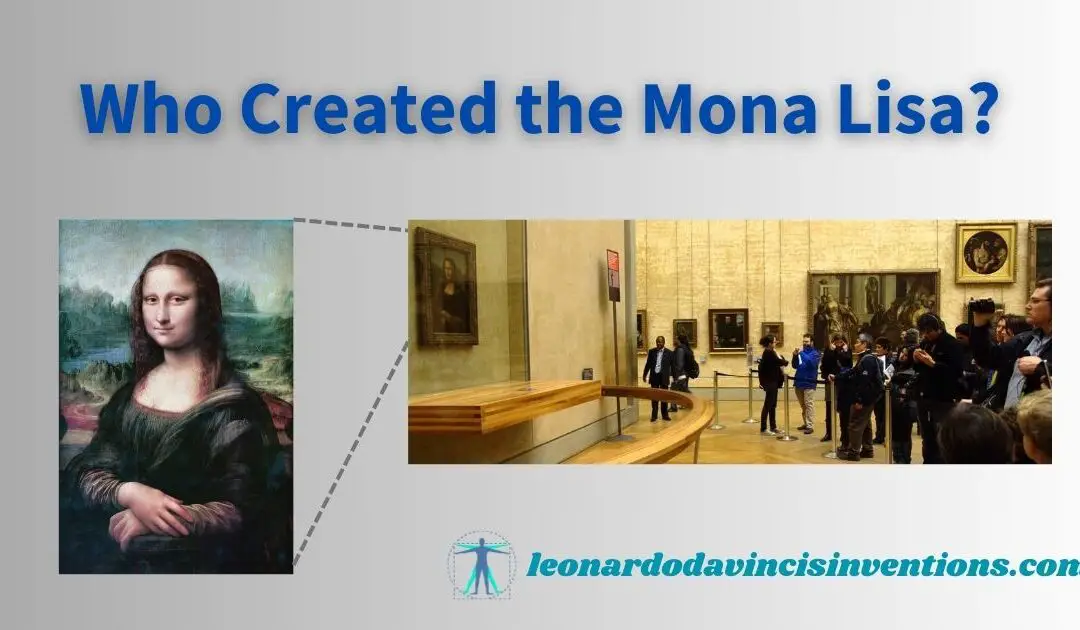
Who Created the Mona Lisa?
Leonardo da Vinci, who painted the Mona Lisa, was a quintessential Renaissance man who made significant contributions to art, science, engineering, and anatomy.
Born in 1452 in Italy, he was the illegitimate son of a notary and a peasant woman. His talents were evident from a young age, and he apprenticed under the artist Verrocchio in Florence.
Da Vinci’s diverse knowledge significantly influenced his artwork.
His skill in anatomy allowed him to depict the human form with precision, as seen in the Mona Lisa‘s lifelike features.
His interest in optics and the study of light contributed to the painting’s enigmatic quality.
Leonardo’s sfumato technique, characterized by soft transitions between colors and tones, is prominent in this piece, enhancing the subject’s mysterious smile.
His innovative approaches have cemented his legacy as one of history’s greatest artists.
Where Was the Mona Lisa Painted?
The Mona Lisa, an iconic painting by Leonardo da Vinci, remains mysterious not only because of its enigmatic subject but also because of its origins. Most art historians believe it was completed between 1503 and 1517 in Florence, Italy, while recent studies suggest that the background landscape may offer clues about its actual location.
A geologist named Ann Pizzorusso has proposed that the recognizable features in the background of the Mona Lisa correspond to the area around Lecco, a town situated on the shores of Lake Como.
This theory adds a fascinating layer to the painting’s history, suggesting that the natural beauty of the Italian landscape influenced Leonardo’s work.
While the exact location remains a topic of debate, it is widely accepted that the Mona Lisa was painted in Florence, a hub of Renaissance art and culture. Today, the Mona Lisa is housed in the Louvre Museum in Paris, where it continues to captivate millions of visitors each year.
From the Louvre Back to Leonardo’s Italy
Although the Mona Lisa is closely associated with the Louvre today, its story begins in Italy—shaped by Florence and the world Leonardo moved through. Tracing his life across places like Florence, Milan, and Vinci can add context to the portrait, linking it to the wider Renaissance networks that influenced his art and ideas.
Description of the Painting
Mona Lisa artwork, Louvre Museum, Paris
The Mona Lisa, painted by Leonardo da Vinci, is often recognized for its serene beauty and enigmatic smile. This artwork depicts a woman in a harmonious setting, showcasing Da Vinci’s masterful techniques.
Visual Analysis of the Artwork
The painting is a portrait of Lisa del Gherardini. She is seated against an imaginary landscape, which adds depth to the background.
Her gaze captures the viewer’s attention, creating a direct connection. Her smile, the most famous feature, has intrigued many for centuries due to its mysterious nature.
Her relaxed pose and delicately folded hands add to the portrait’s elegance.
Behind her, a winding path and serene bodies of water are visible, creating a dreamlike atmosphere.
Details like her veil and curls reflect Leonardo’s attention to realism. The harmonious color palette and soft transitions between light and shadow enhance the portrait’s lifelike appearance, making the Mona Lisa painting a masterpiece of its time.
Sfumato, Composition, and Chiaroscuro Techniques
Leonardo da Vinci employed several innovative techniques in creating the Mona Lisa.
One such technique, sfumato, involves subtly blending colors and tones to create a smoky effect without harsh lines.
This is evident in the transitions on her face, particularly around the eyes and mouth. This technique contributed to the mysterious allure of the Mona Lisa smile.
The composition is meticulously balanced. The figure of the Mona Lisa is positioned in the foreground, framed by a rustic background.
Using geometric shapes, like the triangle formed by her arms and head, adds stability to the composition.
Leonardo also used chiaroscuro, a technique that employs strong contrasts between light and dark, to give the Mona Lisa a three-dimensional quality.
Together, these methods produce a harmonious, natural portrayal, demonstrating Leonardo’s skill in capturing the complexities of human expression.
Theories and Interpretations of Mona Lisa
Leonardo da Vinci’s Mona Lisa remains a subject of fascination and mystery. Two critical areas of interest are the subject’s enigmatic expression and the symbolism within the painting. Each aspect offers a glimpse into the genius behind this famous masterpiece.
Various interpretations of the subject’s expression
The Mona Lisa’s smile is one of art’s greatest enigmas.
Some believe this expression conveys contentment or inner serenity, while others view it as ambiguous, with its meaning changing when viewed from different angles.
This ambiguity contributes to the painting’s allure, leading many to ponder its true meaning.
Leonardo’s skillful use of sfumato, a technique blending tones and colors, adds to the complexity of her smile.
This technique creates a soft transition between colors and the edging, enhancing the painting’s mysterious nature.
The Mona Lisa continues to captivate audiences drawn to its ever-changing expression.
Symbolism in the painting
The Mona Lisa, Lisa Gherardini’s painting, holds numerous symbolic elements.
The distant landscape behind her represents the connection between humanity and nature. Her clothing and serene posture suggest Leonardo’s interest in balancing human emotion and intellect.
Experts also examine the symbolism in her gaze. She appears to follow viewers, suggesting an eternal presence that surpasses time.
This aspect of the painting highlights Leonardo’s aim to capture more than just a physical likeness.
Cultural Impact
The Mona Lisa has had a profound influence on popular culture and various media forms, including literature and film. Her mysterious smile and iconic gaze have made her an enduring symbol throughout global history.
The Mona Lisa in Popular Culture
Throughout the 20th and 21st centuries, the Leonardo Mona Lisa has transcended her original status as a masterpiece to become a cultural icon.
This transformation is evident in how she has inspired and appeared in various forms of entertainment. Notable examples include her appearances in music videos, such as Beyoncé and Jay-Z’s 2018 release, which prominently featured her in a Louvre setting.
The Mona Lisa has also been interpreted across various art movements and media, showcasing her enduring relevance.
Her influence extends beyond the art world. She has appeared in marketing campaigns, parodies, and memes, often used to evoke humor or critique societal norms.
These diverse portrayals highlight her ability to connect with modern audiences while maintaining her classic allure.
References in Literature, Film, and Media
Literature and films have frequently referenced the Mona Lisa, underlining her enigmatic quality.
Her 1911 theft and subsequent recovery heightened her fame, inspiring stories and documentaries. During the French Revolution and World War II, the safety of La Joconde was prioritized, emphasizing her cultural significance.
Napoleon’s admiration for the painting, which led him to hang it in his bedroom, demonstrates its enduring allure.
In contemporary times, books and films often incorporate her as a symbol of mystery and intrigue, further solidifying her role as a figure of fascination across different media.
Notable Exhibitions and Tours
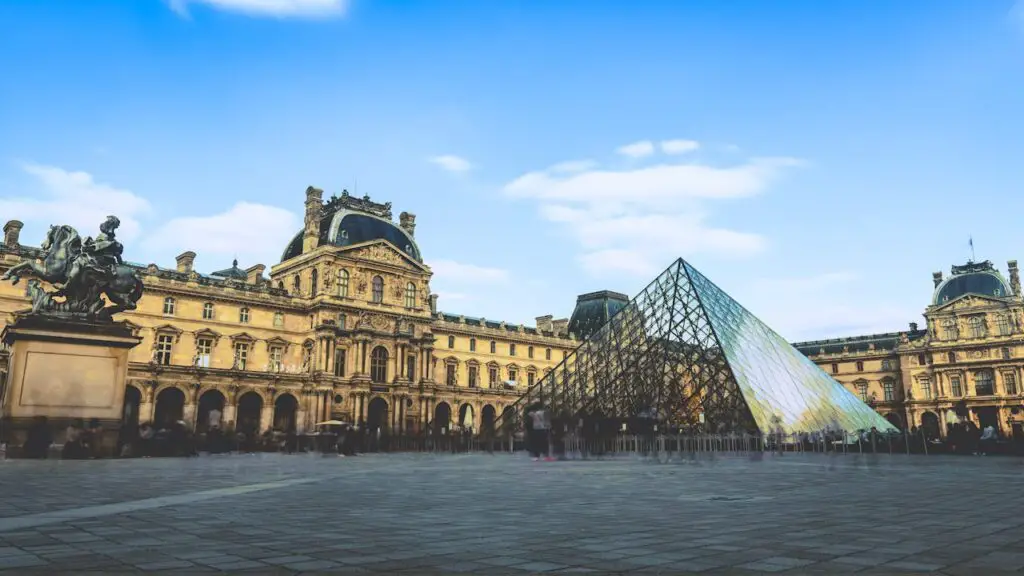
Louvre Museum, Paris
The Mona Lisa is perhaps the most famous painting in history. It has been displayed in various exhibitions worldwide and is housed in the Louvre Museum in Paris, which draws thousands of visitors daily.
History of the Painting’s Exhibitions
The Mona Lisa has traveled globally, captivating audiences far beyond France.
One of its most notable early exhibitions was in 1963 when it visited the Metropolitan Museum of Art in New York. In just two months, the event attracted over a million visitors.
In 1974, the painting was showcased in Tokyo and Moscow, solidifying its status as a global cultural icon.
Each exhibition required meticulous planning to ensure the artwork’s safety, involving advanced protective measures.
In Paris, the Mona Lisa became the centerpiece of various exhibitions, consistently drawing millions of admirers. This remarkable journey through time and place highlights its enduring significance in art history.
Current Location and Accessibility
Today, the Mona Lisa resides in the Louvre Museum in Paris.
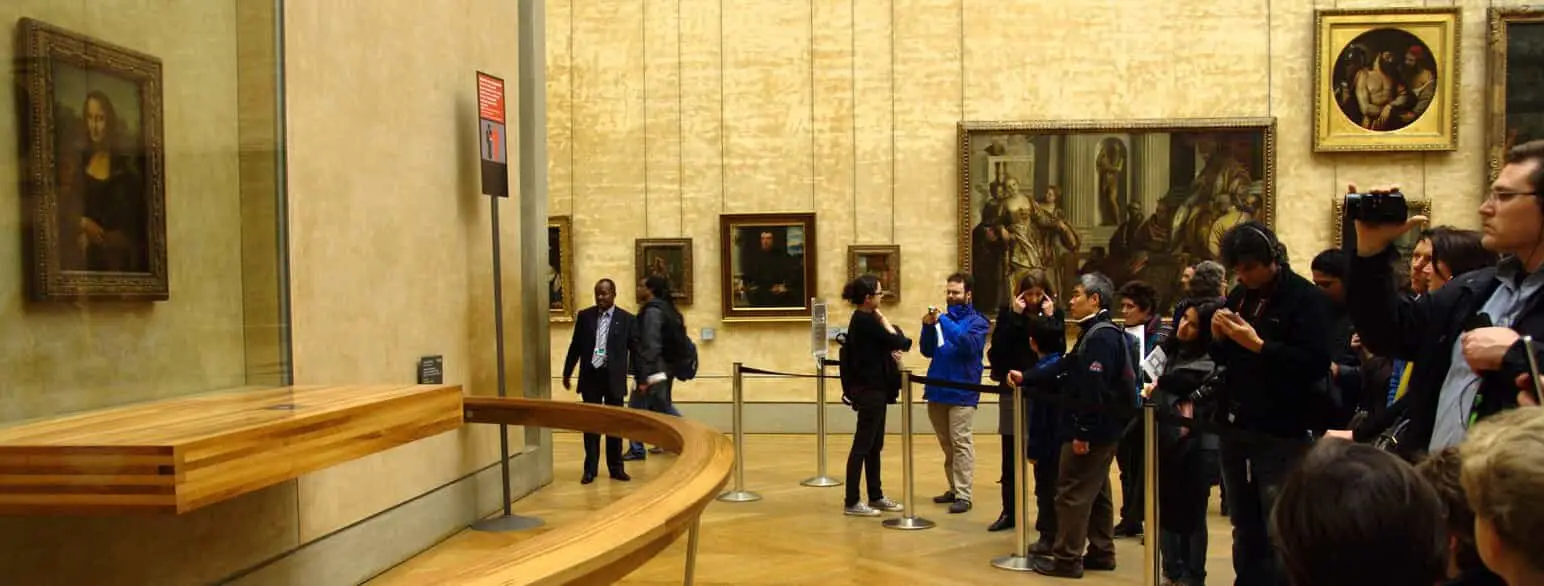
It is housed in the Salle des États, a room designed to accommodate large crowds. The painting is safeguarded behind protective glass, a measure necessary to preserve this masterpiece.
Visitors looking to see the Mona Lisa can expect to navigate through the bustling halls of the Louvre. Skip-the-line tickets are advisable for a more streamlined experience and to avoid the long queues.
The museum utilizes modern technologies, such as infrared imaging, to study and preserve the painting, ensuring it remains in excellent condition for future generations.
This combination of innovative preservation and accessibility allows art enthusiasts to appreciate the Mona Lisa up close while protecting its legacy.
Seeing One Masterpiece in a Larger Landscape
The Louvre offers one way to encounter Leonardo’s work, but the Mona Lisa is only one part of his longer Italian story. Exploring Leonardo-linked places in Florence, Milan, and Vinci can help art lovers connect the portrait to his studies of anatomy, light, and observation—threads that run through his drawings, notebooks, and other works.
Explore Leonardo’s Legacy by City
If the Mona Lisa sparked questions about Leonardo’s methods and influences, exploring his story through place can add clarity. The Leonardo Travel Hub connects key cities—Florence, Milan, and Vinci—so you can see how his art, studies, and Renaissance world fit together across Italy.
Optional experiences • No extra cost • Supports this site
Restoration and Conservation of Mona Lisa
One of the world’s most iconic paintings, the Mona Lisa, is the subject of ongoing efforts to preserve its condition. Due to its age and the materials used to create the masterpiece, these efforts face several challenges.
Overview of restoration efforts
Restoration efforts for the Mona Lisa focus on the painting and its frame. Specialists clean the surface to remove dirt and grime without damaging the original image. Techniques include chemical and mechanical cleaning. These cautiously address layers of dirt accumulated over centuries.
The frame is equally important. The original poplar wood frame has experienced warping over time. Conservators have taken measures to stabilize the frame, ensuring it continues to support the painting. Efforts also involve applying protective layers to shield the artwork from environmental factors.
Challenges in preserving the artwork
Professionals face numerous challenges in preserving the Mona Lisa.
The aged materials pose significant concerns, as they are susceptible to deterioration. Environmental conditions such as humidity and light exposure also threaten the painting’s longevity. Acid attacks and other intentional acts of violence have heightened security and intervention measures.
Balancing preservation with maintaining the artwork’s authenticity is crucial.
Restorers aim to minimize interventions to retain the original appearance while preventing further damage. This delicate balance demands a deep understanding of Leonardo da Vinci’s materials and techniques.
Famous Forgeries and Replicas
The Leonardo Mona Lisa is one of art history’s most replicated and forged paintings. These replicas and forgeries have fascinated art enthusiasts and impacted people’s views of this iconic artwork.
Overview of Notable Forgeries
One of the most infamous episodes in art history is the 1911 theft of the Mona Lisa from the Louvre.
During this period, Yves Chaudron forged several replicas. These replicas were allegedly part of a scheme by Eduardo de Valfierno, who aimed to sell them as the original painting while the honest Mona Lisa remained hidden.
Replicas similar to the original were made even during Leonardo’s time. This trend continues today, with replicas created for various purposes, from study to decoration.
Some replicas are crafted with such meticulous attention to detail that they require expert examination to distinguish them from the originals. The Mona Lisa Hekking is a well-known replica, highlighting the challenges in identifying authentic works.
They have made the artwork more accessible worldwide, allowing those who may never visit the Louvre to experience it in some form. This widespread reproduction has led some to question the original’s uniqueness and value.
While some replicas are crafted with artistic integrity, others are forgeries intended to deceive.
These forgeries can undermine trust in art authentication and spark debates about art authenticity. Viewing a replica can influence how people appreciate the artwork, sometimes enhancing admiration for the original’s mastery.
Where is the Mona Lisa to Explore?
Visitors to the Louvre can enjoy a range of experiences, from viewing Leonardo da Vinci’s famous painting, the Mona Lisa, to exploring other museum highlights. It’s essential to plan your visit effectively and stay up to date with current trends.
Tips for Visiting the Mona Lisa
To enhance their experience of viewing the Mona Lisa, visitors should plan to arrive early or late in the day when the museum is less crowded. To save time, they should purchase tickets online in advance.
The painting is displayed in the Salle des États, which can get crowded. Positioning oneself in front of the artwork can be challenging, so consider using a camera with a zoom lens to capture details without needing to be close to the painting. Moments of quiet can occur when large tour groups move on, so patience is essential.
Visitor Statistics and Trends
The Louvre regularly attracts millions of visitors annually, making it one of the most famous museums in the world.
Large crowds can be expected during peak tourist seasons, especially around the Mona Lisa. Due to its popularity, wait times can be significant.
Recent trends indicate increased interest in interactive museum experiences, such as virtual reality offerings like “Mona Lisa Beyond the Glass,” which give visitors unique insights into the painting.
The museum continues to explore ways to improve the viewing experience, including the possibility of relocating the Mona Lisa to a subterranean space.
The Psychology of the Mona Lisa’s Smile
The Mona Lisa’s smile is renowned for its enigmatic charm. This expression, often melancholy and content, has intrigued art lovers for centuries. It’s not just a smile; it’s an enigma.
Leonardo da Vinci’s technique plays a significant role. He used sfumato, which creates soft transitions between colors and tones. This technique adds depth and subtlety to Mona Lisa’s expression. The smile seems to change when viewed from different angles or distances.
Researchers have explored various theories to explain the phenomenon of smiling.
One explanation is based on perceptual organization, suggesting that the viewer’s perception can shift, affecting how they interpret her smile. This idea posits that psychological factors might influence how people perceive the expression.
Another aspect of the smile’s allure is its ambiguity. The blend of shadow and light makes it hard to discern her genuine emotion. It’s a delicate balance that invites endless interpretation and speculation.
The environment surrounding her adds to the mystery. The background, with its winding roads and gentle hills, may contribute to the overall perception of Mona Lisa’s mood.
The painting’s enduring fascination is a testament to da Vinci’s genius. Artists, scientists, and psychologists continue to study this masterpiece to uncover new insights.
The Mona Lisa Artwork in Modern Art
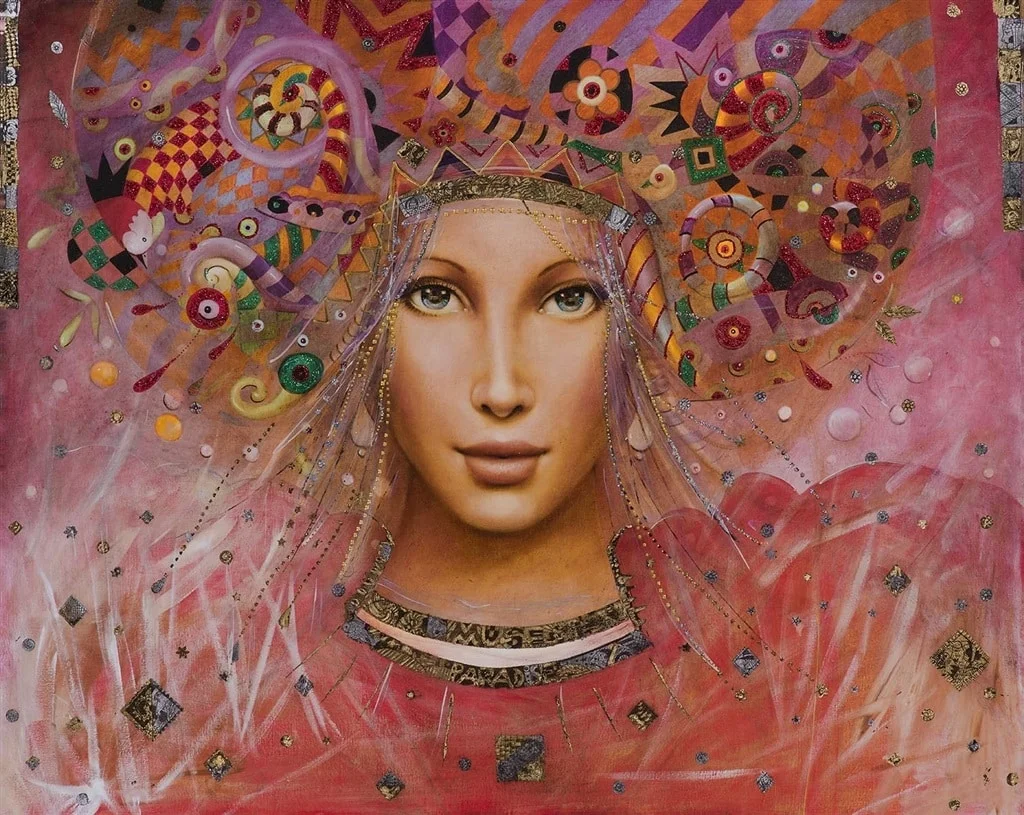
Muse of Paradise by Csaba Markus (2020), Park West Gallery
The Leonardo da Vinci Mona Lisa continues to inspire and influence contemporary artists.
Many have reimagined this iconic painting through different styles and media. Leonardo da Vinci’s iconic work is often used as a template for exploring new artistic expressions.
Several modern artists have created unique versions of the Mona Lisa. For example, Csaba Markus combines elements of Renaissance art with contemporary techniques to craft what he calls Modern Mona Lisas. These artworks blend traditional elegance with modern flair through ethereal and confident portraits.
The Mona Lisa’s enigmatic smile and captivating aura are frequently highlighted in modern adaptations.
Artists utilize this aspect to evoke curiosity, enabling viewers to delve deeper into the meanings beyond the canvas. This adaptability makes the Mona Lisa a timeless subject in art, bridging the past and present.
Contemporary galleries often revisit the Mona Lisa theme. Artists challenge traditional perspectives by experimenting with colors, forms, and textures, encouraging audiences to engage with classic art in new ways.
Modern artists appreciate the Mona Lisa for its cultural significance and artistic potential. As a result, the painting’s legacy endures, continually inspiring fresh and innovative perspectives in the art world.
Final Thoughts
The Mona Lisa remains an enduring icon of art history. Her enigmatic smile has captured the intrigue of millions.
This masterpiece continues to inspire fascination and scholarship, inviting audiences to delve deeper into the world of art and Renaissance culture.
Summary of the Mona Lisa’s Significance
The Mona Lisa is a pivotal work by Leonardo da Vinci. It showcases his mastery of art and innovative techniques.
Painted in the early 16th century, this portrait has become one of the most famous pieces in the world. Her mysterious smile and gaze have sparked endless discussions and interpretations, drawing viewers to the Louvre in Paris, where she is displayed.
This painting exemplifies Renaissance portraiture, blending realism with a delicate sfumato technique. The Mona Lisa’s fame is partly due to its tragic history, including theft and vandalism, which have heightened public curiosity and admiration.
How much is the Mona Lisa worth? The painting is nearly priceless, and its insurance value was once listed at $100 million in 1962, equivalent to over $1 billion in today’s dollars.
Invitation to Explore Further Resources
Several resources can deepen the appreciation and understanding of those intrigued by the Mona Lisa, Leonardo da Vinci, and the mysteries surrounding her.
Books and scholarly articles offer insights into Leonardo’s technique and the identity of the Mona Lisa. Some believe she is Lisa Gherardini.
Meanwhile, numerous documentaries explore her legacy. They look at her presence in popular culture and how she persists in modern interpretations.
Engaging articles also discuss her appearance in modern media. For example, the cast of the film Mona Lisa Smile showcases her ongoing cultural influence.
Exploration does not end with historical insights. Contemporary adaptations, ranging from music to film, reflect the Mona Lisa’s enduring relevance.
Her enigmatic presence invites everyone to explore the rich tapestry of symbolism and meaning enveloping this timeless creation.
Frequently Asked Questions
The Mona Lisa is surrounded by intrigue and mystery. It has captivated viewers for centuries, prompting numerous questions about its origins, significance, and value.
Why is the Mona Lisa so special?
The Mona Lisa stands out due to its detailed attention to anatomical proportions and Leonardo da Vinci’s innovative sfumato technique.
This technique creates a lifelike representation, making the painting a prime example of Renaissance art.
How old was Mona Lisa when he died?
The subject of the painting, Lisa Gherardini, was around 63 years old when she died. It is worth noting that she was a noblewoman in Florence, Italy.
What is the real story behind the Mona Lisa?
The painting portrays Lisa Gherardini, the wife of a wealthy Florentine merchant. Her husband commissioned it, but the reasons behind her mysterious smile and expression have been the subject of much debate and speculation.
Why is the Mona Lisa so mysterious?
The ambiguous expression and the subtle, seemingly lifelike quality of her smile create an air of mystery that has inspired endless interpretations and fascination over the centuries.
How much is Mona Lisa worth?
The painting is considered priceless but is insured for hundreds of millions of dollars due to its cultural and historical value. It is considered irreplaceable and among the most valuable artworks in the world.
What does the Mona Lisa symbolize?
The Mona Lisa is often seen as a symbol of the Renaissance’s exploration of human emotion and beauty. It reflects the era’s fascination with realism and the human psyche.
Why is The Starry Night so famous?
“Starry Night” by Vincent van Gogh is celebrated for its vibrant swirling patterns and emotional depth. The painting embodies Van Gogh’s imaginative vision and distinctive style, capturing the night sky in a way that resonates with viewers worldwide.
Why is Mona Lisa always smiling?
The Mona Lisa’s smile changes because of Leonardo da Vinci’s use of sfumato, a technique that uses shadow and light. This technique creates an illusion that gives different impressions depending on the viewer’s perspective.
Where is the Mona Lisa buried?
Lisa Gherardini is believed to be buried in the Convent of Saint Ursula in Florence. Archaeological research supports this location as her final resting place.
What is unusual about the Mona Lisa?
The Mona Lisa’s sitting position and background are distinctive for their time. The subject’s pose and the landscape backdrop offer a unique depth and realism.
Disclosure: This page may contain affiliate links. If you choose an experience through them, it helps support the site at no extra cost to you.
There have been numerous books written about Leonardo da Vinci, including several where you can get your hands on his original notebooks with translations of his writings beside them. Others range from studies of his artwork, to his mechanical engineering, books like the Da Vinci Code and even books along the same vein as the famous “How to think like Leonardo da Vinci”.
Below we will arrange the books about Leonardo da Vinci into several categories –
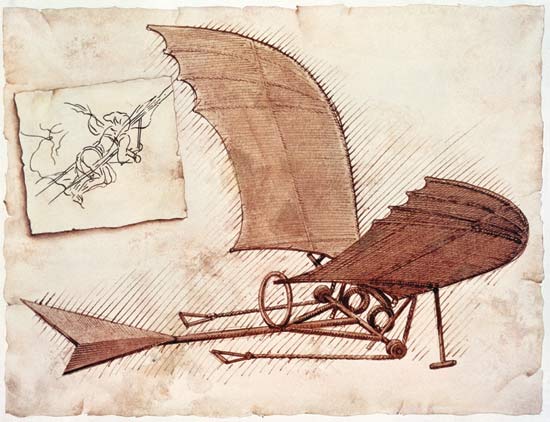
Leonardo da Vinci flying machine has captivated the imagination of historians and aviation enthusiasts. Despite his drawings and designs, the machine was never capable of flight.
Da Vinci created several designs that showed his deep interest in human flight. His most notable idea was the ornithopter, which aimed to mimic the flapping of bird wings. Still, these designs required materials and technologies not available in his time, ultimately preventing their realization.
The mystery of the flying machine continues to intrigue people today. By examining historical records and expert analyses, you can gain a clearer insight into da Vinci’s unfulfilled dream of flight.
His innovative spirit and vision paved the way for future inventors, leaving a lasting impact on aviation.
The Concept of Leonardo da Vinci Flying Machine
Leonardo da Vinci Glider
Leonardo da Vinci was a visionary thinker known for his inventive genius.
His flying machines, especially the ornithopter, highlighted his understanding of animal flight and his determination to mimic it. Though unsuccessful, these inventions paved the way for future aviation developments.
Understanding the Ornithopter Design
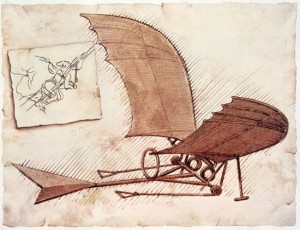
The ornithopter is one of Leonardo da Vinci’s most intriguing designs. It was inspired by birds’ flight and involved wings that flap like birds’.
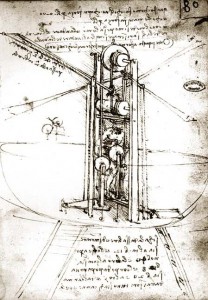
Da Vinci’s sketches showed a meticulous design that harnesses human power and aerodynamic principles. The wings were to be controlled by a system of pulleys and levers, allowing the pilot to simulate the flapping motion.
This design illustrated his profound interest in human flight and his desire to replicate nature’s efficiency in flying. His notes reflect a deep understanding of motion and mechanics, although the machine was ultimately non-functional due to the limitations of human strength.
Early Flying Machines: Da Vinci’s Inventions
Leonardo da Vinci’s contributions to early flying machines showcased his remarkable creativity and insight. Among his numerous designs, the ornithopter stands out, but he also explored other concepts.
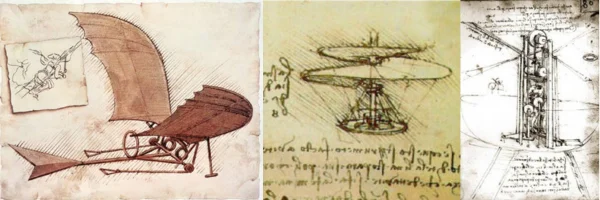
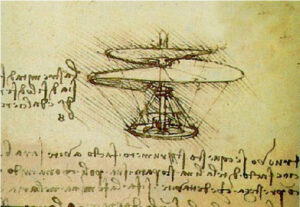
These included a helicopter-like device with a helical rotor intended to lift off through rotational force. Although visionary, Leonardo da Vinci’s flying machine was not feasible at the time due to the lack of suitable materials and propulsion technologies.
Despite their impracticality, his designs are celebrated for their imaginative engineering and lasting impact on aviation.
The Evolution of Da Vinci Flying Machines
Over time, Da Vinci’s flying machines evolved with increasingly complex designs. He went from simple sketches to more advanced concepts, hoping to achieve sustained human flight.
Each design iteration incorporated feedback from previous models and experiments. Leonardo da Vinci’s flying machine reflected observations of nature and mechanical innovation.
Da Vinci’s machines never took to the skies, but they laid the foundation for subsequent inventors. His work inspired others to continue exploring the dream of flight and made significant contributions to the history of aviation technology.
Leonardo da Vinci’s Approach to Aviation
Leonardo da Vinci Helicopter
Leonardo da Vinci’s approach to aviation was groundbreaking. He blended art and science in a way that set the foundation for future innovators.
His sketches and observations on bird flight translated into detailed designs for mechanical flight.
Leonardo da Vinci and Flight: A Visionary’s Perspective
Leonardo da Vinci viewed flight as a symbol of freedom and limitless human potential. His fascination with birds and their ability to soar inspired him to study their anatomy in great detail.
Leonardo created detailed drawings to capture the mechanics of wing motion. This meticulous research was both artistic and scientific, aimed at replicating avian flight through mechanical means.
His vision extended beyond sketches, reflecting a deep understanding of how nature can guide technological advances.
The Role of Leonardo da Vinci’s Flying Machine Sketches
Leonardo da Vinci’s flying machine sketches, often referred to as ornithopters, featured large wings designed to flap like a bird’s.
These sketches explored various forms, including a helicopter-like device with a screw-shaped rotor. Though they were never built or tested during Leonardo’s lifetime, these designs illustrated his forward-thinking approach to human flight.
Leonardo’s sketches demonstrated his ability to envision machines centuries ahead of his time, influencing later aviation concepts.
Analyzing the Leonardo da Vinci Plane Design
The Leonardo da Vinci plane design showcased his engineering brilliance by attempting to mimic the complex dynamics of bird flight. His designs featured a lightweight frame combined with firm, yet flexible, wing surfaces.
Despite advances in understanding aerodynamics, the technology of the era couldn’t materialize such sophisticated designs. While the machine was theoretical, it represented a crucial step in the history of aviation.
His work demonstrated an early understanding of the principles underlying lift and propulsion, which are fundamental to modern aviation engineering.
The Mechanics Behind the Flying Machine
Leonardo da Vinci’s flying machine, an ornithopter, is one of his most famous inventions. This impressive design uses human muscle power to mimic the flapping of bird wings, showcasing Leonardo’s innovative approach to aerodynamics and mechanics.
How to Make a Leonardo da Vinci Flying Machine Model
Building a model of the da Vinci flying machine provides insight into the mechanics Leonardo envisioned. The model often requires lightweight materials, such as wood or plastic, to simulate the rod-and-pulley system that powered the original design.
Simplified versions focus on the large wings essential to its operation. These wings are connected via cranks and levers, allowing flapping motion. Enthusiasts can find kits online or at hobby stores that include detailed assembly instructions, enabling a hands-on experience with one of history’s earliest flying machines.
The Science of the Da Vinci Airplane
The science behind Leonardo da Vinci’s airplane centers on the principles of lift and propulsion.
Leonardo’s sketches detail ornithopters that aim to achieve flight by flapping their wings, much like birds. His designs, such as the flying machine, explored methods to harness human power to create lift.
By translating muscle movement into mechanical action through a series of gears and pulleys, Leonardo sought to replicate birds’ flight. Although his machines never took flight, they laid the foundation for future aviation developments.
Insights from Leonardo da Vinci’s Flying Machine Drawings
Leonardo da Vinci’s drawings of flying machines show his remarkable understanding of flight. His sketches often included detailed annotations on wing shape and movement.
These plans reveal Leonardo’s belief in human flight and his desire to emulate the natural grace of birds. The drawings depict keen observation of bird anatomy, focusing on elements such as adjustable, contorted wings adapted to different phases of flight.
His meticulous attention to detail is a testament to his genius and inspires artists and engineers.
Leonardo da Vinci’s Innovative Landing Gear Design
Leonardo da Vinci Landing Gear
Leonardo da Vinci’s landing gear design, part of his broader exploration of flight, introduced the concept of retractable landing gear for aircraft.
This remarkable invention demonstrated his forward-thinking approach to aviation safety, enabling a more controlled landing by allowing the mechanism to be retracted or deployed as needed.
Historical Context and Impact of da Vinci Flying Machine
Leonardo da Vinci’s flying machine was a groundbreaking concept for its time, showcasing his deep interest in human flight and mechanical innovation. This section examines the invention of the flying machine, its feasibility, and its impact on modern aviation.
When Was the Flying Machine Invented by Leonardo da Vinci?
Leonardo da Vinci began exploring the idea of flight during his stay in Milan in the late 15th century. His fascination with aviation is evident in his collection of sketches and notes.
The most notable of these is the ornithopter, a concept that attempted to mimic the flapping of bird wings. The da Vinci flying machine inventions included around 500 sketches, demonstrating his dedication to understanding the mechanics of flight.
His designs featured intricate systems of pulleys, gears, and wings that reflect his innovative approach to human flight. Though these machines did not achieve liftoff, they inspired future generations of inventors to pursue the dream of air travel.
Did Leonardo da Vinci’s Flying Machine Work?
Despite Leonardo’s ingenious designs, the flying machine never achieved flight. The materials available at the time were unsuitable for building a functional aircraft.
Da Vinci’s models required a strong yet lightweight frame, which technology couldn’t provide at the time. His interest in bird anatomy and aerodynamics was crucial in guiding his ideas; however, the practical limitations of his era were insurmountable.
Though his machines remained grounded, Leonardo da Vinci’s concepts of flying machines laid the foundation for future innovations in aerodynamics and engineering.
The Legacy of Leonardo da Vinci’s Inventions in Aviation
Leonardo’s work had a profound impact on aviation history. His sketches and theories inspired countless inventors and engineers in the following centuries.
The aerial screw, regarded as an early form of the helicopter, showcases his forward-thinking approach. Many believe his ideas influenced later aviation pioneers, including those who developed the first successful aircraft.
Da Vinci’s work on flying machines emphasized creativity and scientific inquiry, underlining the importance of innovation in technological development. Today, his contributions are celebrated as pivotal steps toward realizing human flight, a testament to his enduring influence on aviation.
Where Leonardo’s Dream of Flight Took Shape
Leonardo’s aviation studies were not isolated ideas but part of the vibrant scientific culture of Renaissance Italy. Today, his flying machine models, notebooks, and engineering experiments can be explored in museums and historic cities where his fascination with flight first unfolded.
Explore Leonardo’s Aviation Legacy in Italy
Leonardo’s flying machine designs were shaped by the Renaissance cities where he observed nature and refined his mechanical studies. Discover the places where his notebooks, flight experiments, and reconstructed models can still be experienced today.
Optional experiences • No extra cost • Supports this site
Modern Interpretations of Leonardo da Vinci Flying Machine
Leonardo da Vinci was ahead of his time with his visionary ideas on flight. Although his flying machines never took off during his lifetime, they have influenced modern aviation technologies and inspired countless innovations.
The Influence of Leonardo da Vinci’s Flying Machine on Contemporary Aviation
Leonardo da Vinci’s designs for flying machines, such as the ornithopter, have inspired imagination and innovation in aviation.
His meticulous studies of bird movement informed his sketches, which demonstrate a profound understanding of aerodynamics —a fundamental concept in modern flight.
Though his designs were not practical during his time, they laid the groundwork for future developments.
Today, scientists and engineers look to his work for inspiration in developing new flying technologies. Some projects, such as modern flying cars, draw inspiration from da Vinci’s ideas.
His influence is evident in various experimental aircraft that mimic birds’ flapping motion to achieve flight.
What Was Leonardo da Vinci’s Flying Machine Called?
The ornithopter is Leonardo da Vinci’s most famous design for a flying machine. This device was meant to be powered by human strength.
Leonardo envisioned a machine that could imitate the flight of birds through flapping wings. While his ornithopter did not become a working model, it captured his curiosity about flight.
Leonardo da Vinci created approximately 500 drawings and sketches that detailed his theories on aviation. These designs played a critical role in the early stages of aerodynamics.
The ornithopter, in particular, left a lasting legacy symbolizing human ambition to conquer the skies.
The Ingenious Design of Leonardo da Vinci’s Parachute
Leonardo da Vinci Parachute
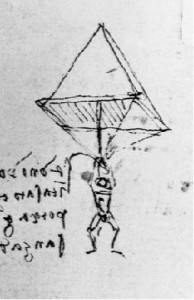
Leonardo da Vinci’s parachute design, created around 1485, featured a pyramid shape that allowed a person to descend safely from great heights. Although it was never tested during his lifetime, modern experiments have demonstrated that his concept was remarkably effective, underscoring his visionary understanding of aerodynamics.
Final Thoughts
Leonardo da Vinci Flying Machine holds a unique place in aviation history. His inventive designs and curious sketches reveal a mind dedicated to understanding flight, even though the technology of his time was not advanced enough to bring his concepts to life.
Many of Leonardo’s ideas were not practically feasible, but his work has inspired countless inventors and engineers. His flying machine, mainly the Grande Nibbio, showcased an imaginative approach to mimicking bird flight through mechanical means.
There have been debates on whether Leonardo’s designs could ever work. Some believe that with modern materials, his concepts might take flight. However, experts often argue that his machines were more akin to art than to practical engineering.
Key Takeaways:
Leonardo’s flying machine was too advanced for his time.
His visionary ideas paved the way for future innovations in aviation.
Leonardo da Vinci’s legacy continues to inspire exploration in various fields.
Although his flying machine never left the ground, the ideas behind it still live on in Renaissance workshops, museums, and reconstructed models across Italy. Exploring these spaces offers a deeper context into how Leonardo studied motion, mechanics, and the natural world.
Frequently Asked Questions
Leonardo da Vinci’s flying machine remains a topic of interest. People often wonder whether flying machines could fly, who first invented them, and what impact they had.
Did Leonardo da Vinci’s flying machine work?
Leonardo da Vinci’s flying machine, known as the ornithopter, was never tested by him, so it did not work during his time. The concept involved flapping wings like a bird, but technological limitations and human strength made it impractical.
Who invented the first flying machine?
Leonardo da Vinci designed some of the earliest concepts for a flying machine. However, the Wright brothers achieved the first successful powered flight centuries later, in 1903.
Was Leonardo da Vinci capable of flight?
Leonardo da Vinci himself did not fly. Although he had ideas about human flight, his designs were never tested to achieve actual flight during his lifetime.
Did the ornithopter ever fly?
With its flapping wings, the ornithopter faced challenges in practicality and human strength requirements. While fascinating, it did not achieve successful flight in Leonardo’s or any later iterations.
How did the flying machine impact the world?
Leonardo’s flying machine concepts inspired future generations in aviation. His ideas demonstrated an early interest in human flight and significantly contributed to the history of aeronautical engineering.
What does Leonardo’s sketch of a flying machine mostly reveal?
Leonardo’s sketches reveal his keen interest in observing nature and understanding the mechanics of flight. They highlight his skill in blending art with engineering to explore new ideas.
Did Leonardo’s aerial screw work?
Leonardo’s aerial screw is an early design similar to a helicopter’s rotor. Like many of his inventions, it was never built during his time, and it likely wouldn’t have flown due to material and structural limitations.
What was Leonardo da Vinci’s best invention?
Determining Leonardo da Vinci’s best invention is subjective, but his designs ranged from the Vitruvian Man to military engineering. The Vitruvian Man remains one of his most iconic drawings.
Did Leonardo da Vinci’s parachute work?
Leonardo da Vinci conceived a parachute design distinct from the traditional canopy design. It has been successfully tested in recent years and has proven effective.
What was Leonardo da Vinci’s misconception about flight?
Leonardo’s main misconception was the reliance on mimicking bird flight using human muscle power. This approach overlooked the need for powered flight mechanisms. These were only realized centuries later.
Disclosure: This page may contain affiliate links. If you choose an experience through them, it helps support the site at no extra cost to you.
Leonardo da Vinci toy models are replicas of his inventions that you can assemble yourself. With these models, you could build your collection of inventions from possibly the smartest human that has ever lived.
Leonardo Bianchi is the founder of Leonardo da Vinci Inventions & Experiences, a travel and research guide exploring where to experience Leonardo’s art, engineering, and legacy across Italy and Paris.


 Leonardo Bianchi is the founder of Leonardo da Vinci Inventions & Experiences, a travel and research guide exploring where to experience Leonardo’s art, engineering, and legacy across Italy and Paris.