
(Last updated: April 2026)
Da Vinci Codex Atlanticus is the largest surviving collection of drawings and writings by Leonardo da Vinci, a breathtaking archive spanning more than 40 years of one man's relentless curiosity. Assembled across 1,119 folios, this extraordinary codex touches on everything from flying machines and hydraulics to anatomy, botany, and mathematics.
What makes the Codex Atlanticus so fascinating is not just what it contains — it is what it reveals. Here you see Leonardo not as a finished genius posing for posterity, but as a working mind in motion. Pages of the Leonardo Codex Atlanticus show calculations crossed out and restarted, sketches layered over sketches, and ideas pursued, then abandoned, then revisited years later.
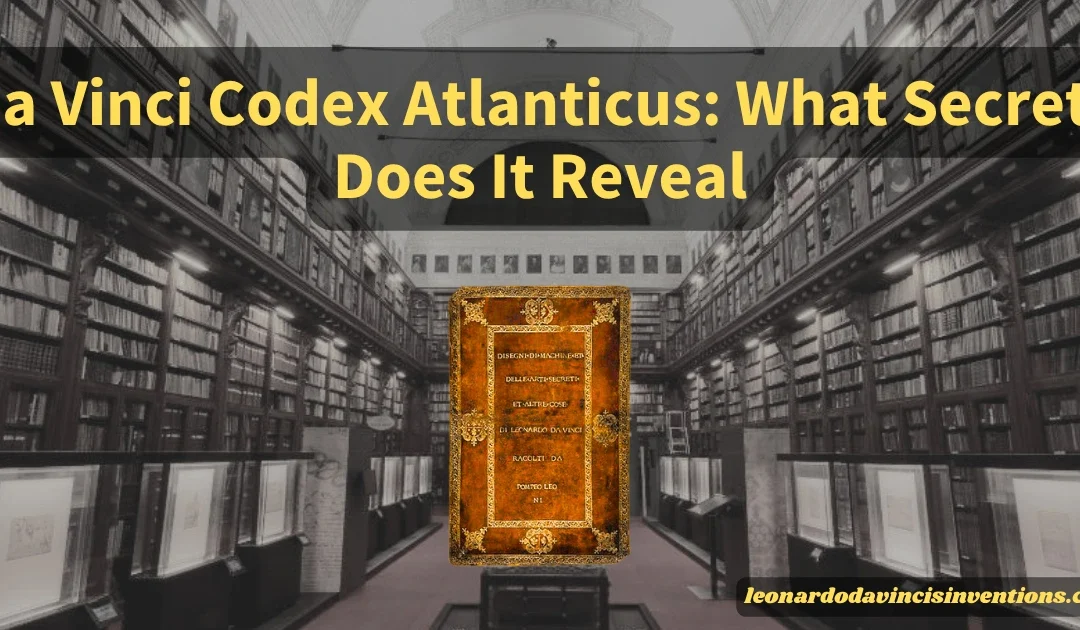
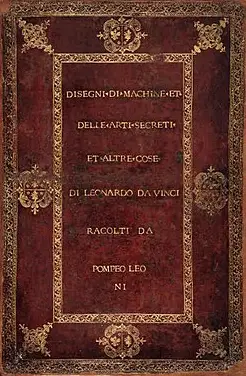
Historically, the da Vinci Codex matters because it survived at all. After Leonardo's death in 1519, his notebooks were scattered across Europe. The artist and sculptor Pompeo Leoni painstakingly gathered hundreds of loose sheets during the late 16th century and mounted them onto large folios — that act of preservation gave us the Codex Atlanticus as we know it today.
For anyone planning a cultural trip to Milan, understanding the Codex Atlanticus makes a museum visit much richer. You are not simply looking at old paper. You are standing before the most complete record of a Renaissance mind that history has preserved.
This post is all about the da Vinci Codex Atlanticus — where it came from, what it contains, and where you can see it in person today.
What Is the Da Vinci Codex Atlanticus?
Da Vinci Codex Atlanticus is a 12-volume collection of 1,119 sheets containing drawings, diagrams, and writings by Leonardo da Vinci, compiled between roughly 1478 and 1519. It is housed at the Biblioteca Ambrosiana in Milan and is the largest single collection of Leonardo's manuscripts. The name refers to the large atlas-sized format of the folios.
The Engineering Idea Behind the Da Vinci Codex Atlanticus
Leonardo's Design Concept
Leonardo da Vinci never intended the Codex Atlanticus to be a book. He was not writing for readers. He was thinking on paper, and the codex is the closest we will ever get to watching that happen in real time.
The sheets of the Leonardo da Vinci Codex Atlanticus span an enormous range of subjects. On one page, you might find a detailed sketch of a canal lock mechanism. Turn the folio, and there is a study of light refraction, or a note about water currents, or a drawing of a mechanical wing. Leonardo worked across disciplines the way most people change subjects in conversation — naturally, fluidly, and with relentless energy.
What unified all of this was a single engineering philosophy: observe nature, extract its principles, and apply them through design. Leonardo believed that flight was possible because birds existed. He believed machines could replicate the motion of water because he had studied currents for years. The codex is the record of that belief system made visible.
Renaissance Engineering Principles
To understand the Codex Atlanticus, it helps to understand the Renaissance world it came from. In Leonardo's lifetime, the boundaries between art, science, and engineering did not exist. A painter was expected to understand geometry. An architect was expected to understand hydraulics. A court engineer was expected to design weapons, festivals, and aqueducts with equal skill.
Leonardo worked within this tradition — and pushed far beyond it. The Codex Atlanticus, in the Ambrosiana Collection, contains his studies of gear mechanisms, water-lifting devices, and fortification designs commissioned by patrons such as Ludovico Sforza in Milan and later by Cesare Borgia. These were real engineering projects, not theoretical exercises.
But it also contains pages that had no immediate patron and no practical deadline. Pages where Leonardo simply wondered. His studies of bird flight, wave motion, and the proportions of the human skull appear alongside military commission sketches, with no clear sense of priority. Everything interested him equally.
Why the Idea Mattered
The pages of the Codex da Vinci challenged the boundaries of what a Renaissance mind was supposed to think about. Leonardo was not simply cataloguing inventions. He was building a private scientific method decades before Francis Bacon formalized one.
Many of his ideas — including a rudimentary helicopter concept, a solar energy concentrator, and studies of plate tectonics — would not be revisited by science for centuries. The Codex Hammer and Codex Leicester, two other famous Leonardo manuscripts, share this quality of radical foresight. But the Codex Atlanticus is the largest and most varied, making it the most complete portrait of Leonardo's restless mind.
How the Codex Atlanticus Works as a Document
Mechanical Design and Structure
The physical structure of the Codex Atlanticus book is worth understanding before you visit. What Pompeo Leoni assembled in the late 1500s was not a conventional manuscript. He took hundreds of loose Leonardo sheets — some tiny, some large — and mounted or pasted them onto 65 enormous folios, each the size of an atlas page. This is where the name comes from: Atlanticus, meaning atlas-sized.
For centuries, the collection remained in this bound form. In the 1960s and 1970s, the Biblioteca Ambrosiana undertook a careful restoration that separated the original Leonardo sheets from Leoni's mounts, allowing scholars to study each page independently for the first time. The result was the 12-volume arrangement that visitors can research today.
If you want to explore the collection without traveling to Milan, the Codex Atlanticus is partially available online through digital archives, including the Biblioteca Ambrosiana's digitization projects. But seeing a reproduction, however high quality, is genuinely different from encountering the originals.
Structural Principles of the Collection
One of the most striking things about the codex is the sheer variety of its contents. Scholars have identified studies related to at least forty separate subjects across the 1,119 sheets. These include urban planning designs for a new city that Leonardo proposed to Ludovico Sforza, mechanical clock components, studies of the flight of swallows, calculations for casting a giant equestrian statue, and notes on the behaviour of water in motion.
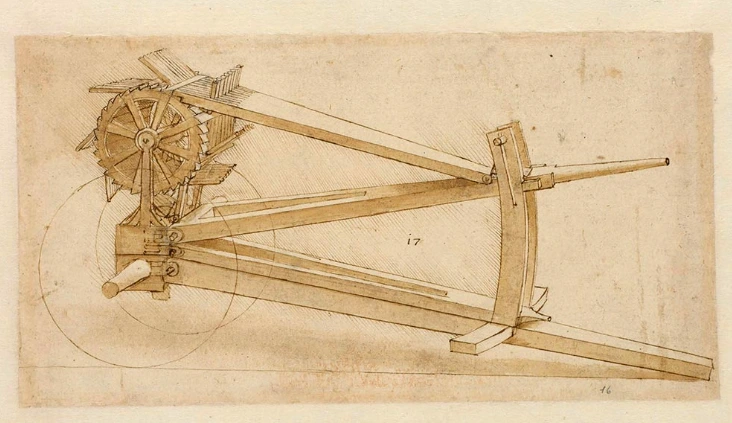
Codex atlanticus, page 132, for example, contains one of Leonardo's famous studies of a flying machine—a design for an ornithopter, or flapping-wing aircraft, based on his observations of birds. The drawing is precise, annotated in Leonardo's characteristic mirror writing, and reveals a mind working through an engineering problem with genuine seriousness.
The Codex Arundel, held at the British Library in London, is a related manuscript containing similar hydraulic and mechanical studies. Comparing the two gives scholars a fuller picture of how Leonardo's ideas evolved across different periods and locations of his career.
Why the Idea Still Matters Today
The Leonardo da Vinci and the Secrets of the Codex Atlanticus is a phrase researchers and documentary makers return to repeatedly — and for good reason. The codex is not simply a historical document. It is a mirror held up to the gap between imagination and execution.
Many of Leonardo's designs were not built in his lifetime because the materials and manufacturing precision required did not yet exist. His concepts for ball bearings, for instance, anticipated the industrial age by three hundred years. His hydraulic studies influenced engineers working on Milanese canals for generations after his death.
The Codex Atlanticus Salai — a reference sometimes used for pages associated with Leonardo's pupil and companion, Gian Giacomo Caprotti — reminds us that these ideas circulated within Leonardo's workshop and influenced the next generation of Renaissance artists and craftspeople.
The Codex Leicester, now owned by Bill Gates and occasionally displayed publicly, covers Leonardo's water studies in detail. But the Codex Atlanticus casts a far wider net, making it the essential document for anyone serious about understanding Leonardo as an engineer rather than simply as a painter.
Where to See the Da Vinci Codex Atlanticus Today
The Biblioteca Ambrosiana in Milan
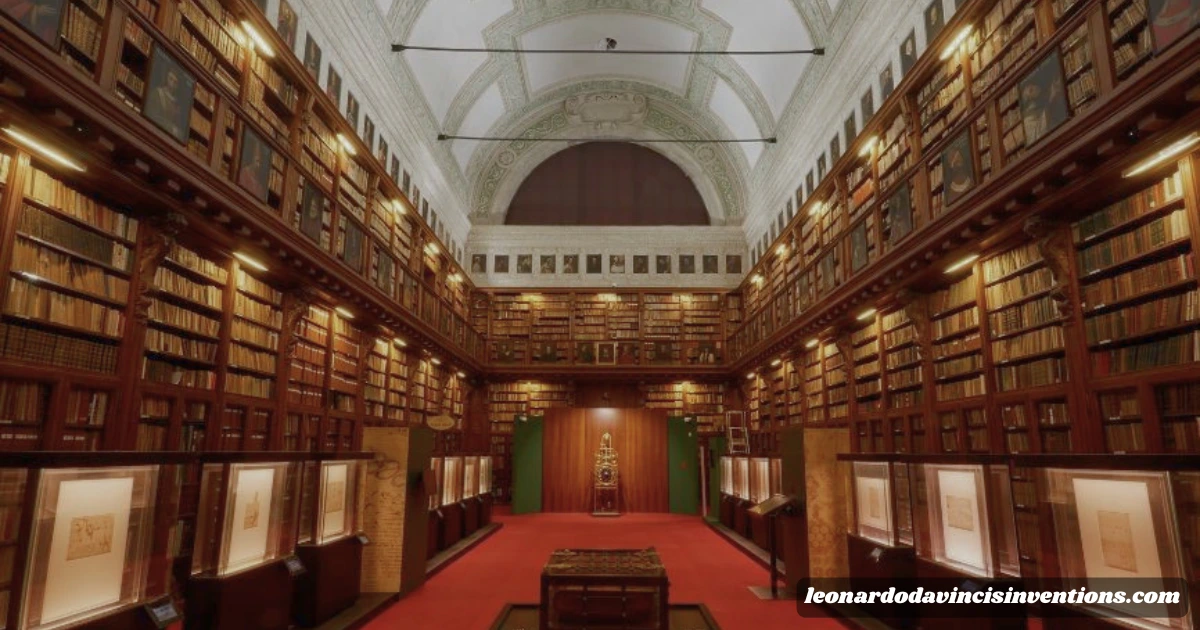
The permanent home of the Codex Atlanticus is the Biblioteca Ambrosiana in central Milan — one of the oldest libraries in Europe, founded in 1609 by Cardinal Federico Borromeo. The library is located on Piazza Pio XI, a short walk from the Piazza del Duomo and the famous Galleria Vittorio Emanuele II shopping arcade.
The Ambrosiana houses the codex in its Pinacoteca, the art gallery attached to the library. A selection of the most significant pages is rotated for public display, so visitors can see original Leonardo sheets in an intimate rather than overwhelming setting. The Codex Atlanticus Ambrosiana display is one of the most quietly astonishing experiences available to anyone interested in the Renaissance.
Unlike some of the more crowded Leonardo attractions in Italy, the Ambrosiana rewards those who take their time. The gallery also holds Raphael's famous cartoon for the School of Athens and other Renaissance masterpieces, making it a destination worthy of a dedicated half-day visit.
Modern Reconstructions and Exhibitions
For visitors who want to see Leonardo's engineering ideas brought to life, Milan offers several complementary experiences. The Museo Nazionale della Scienza e della Tecnologia Leonardo da Vinci — the National Museum of Science and Technology — holds one of the world's largest collections of models based on Leonardo's drawings. Many of these reconstructions draw directly from Codex Atlanticus sketches.
The museum's Leonardo galleries allow visitors to move from the two-dimensional sketches of the codex to three-dimensional wooden and metal models of the machines Leonardo envisioned. It is an enormously effective way to understand what Leonardo was actually trying to build — and how remarkably close some of his concepts came to working.
Visitor Experience and City Context
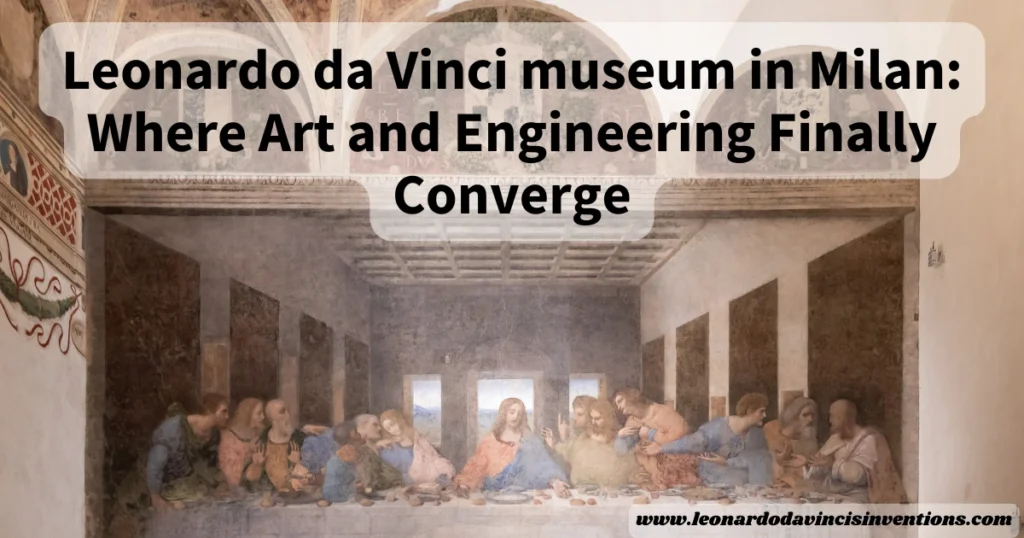
Milan is one of the great cities of Leonardo. Beyond the Ambrosiana and the Science Museum, the city holds The Last Supper — Leonardo's monumental mural at Santa Maria delle Grazie — as well as the Castello Sforzesco, where Leonardo worked for Ludovico Sforza, and which now houses several collections related to Leonardo.
Planning a visit to see the Codex Atlanticus alongside The Last Supper and the Science Museum makes for one of the most complete Leonardo experiences available anywhere in the world. Each site reveals a different dimension of the same extraordinary mind.
Many visitors choose an entrance-only ticket to the Ambrosiana for flexibility, while others prefer a guided tour that places the Codex Atlanticus in its full historical and artistic context. If you are planning to see Leonardo's work in Milan, comparing ticket and tour options before your visit can make a significant difference to how much you take away from the experience.
Exploring Leonardo da Vinci in Milan
Milan is where Leonardo spent some of the most productive years of his life — roughly from 1482 to 1499, and again from 1506 to 1513. The city shaped his engineering career, secured his patronage from Ludovico Sforza, and provided the setting for The Last Supper. It also became the permanent home of the Codex Atlanticus. For anyone serious about tracing Leonardo's life through place, Milan is the essential starting point.
Beyond the Codex Atlanticus and the sites mentioned above, Milan rewards deeper exploration. The Castello Sforzesco and its collections, the church of Santa Maria delle Grazie, and the lesser-known Vineyard of Leonardo in the Casa degli Atellani all offer connections to Leonardo that most tourists miss entirely.
Planning a few days around these sites, with the Ambrosiana as an anchor, creates one of the most rewarding cultural travel experiences Italy has to offer.
For more on Leonardo's world across Italy and Europe, explore these related guides on leonardodavincisinventions.com:
- Leonardo da Vinci in Milan — A Complete Cultural Guide
- Leonardo da Vinci in Florence — Where It All Began
- Leonardo Museums in Milan — The Essential Visitor Guide
- Leonardo da Vinci in France — Amboise and the Final Years
Final Thoughts
This post was all about the Da Vinci Codex Atlanticus — and what it reveals is something that no biography of Leonardo can quite capture. Biographies tell you what he did and when he did it. The codex shows you how he thought. That difference is enormous.
What strikes most visitors to the Ambrosiana is not the grandeur of the collection but its intimacy. These are working pages. The ink is faded, but the urgency is still there — in the density of the annotations, the overlapping sketches, the corrections and revisions. Leonardo was not performing a genius for posterity. He was chasing ideas because he could not help himself.
The Renaissance produced extraordinary art and thought, but the Codex Atlanticus stands slightly apart from the rest of that inheritance. It is not a finished work. It is a mind in motion, preserved by accident and held together by the determination of people who recognised its value across five centuries.
To stand before its pages in Milan is to understand, in a way that no reproduction can fully convey, why Leonardo da Vinci remains the most fascinating figure the Renaissance produced — and perhaps the most fascinating the Western world has ever known.
FAQs about da Vinci Codex Atlanticus
The Codex Atlanticus was named after its large paper format, which resembled that of atlases. The term “Atlanticus” refers to these oversized sheets rather than any connection to the Atlantic Ocean.
Yes, parts of the Codex Atlanticus can be seen at the Biblioteca Ambrosiana in Milan, where selected pages are displayed in rotating exhibitions. Additionally, the entire codex has been digitized and is available online for public viewing.
No, the Codex Atlanticus is not owned by Bill Gates. It is preserved at the Biblioteca Ambrosiana in Milan. Bill Gates owns a different Leonardo manuscript called the Codex Leicester, which he purchased in 1994.
Several countries restricted or banned The Da Vinci Code, including Lebanon, where it was officially banned for its religious content, which was considered offensive to Christianity.
The Da Vinci Code is controversial because it presents fictional claims about Jesus Christ, including ideas about his marriage and hidden bloodline, which contradict traditional Christian beliefs. Many religious groups criticized it for blurring fiction with historical and theological claims.
In The Da Vinci Code, the character Sophie Neveu is revealed to be a descendant of Jesus Christ and Mary Magdalene, forming a central element of the novel’s fictional storyline.
Related Post You May Like


Disclosure: This page may contain affiliate links. If you choose an experience through them, it helps support the site at no extra cost to you.
 Leonardo Bianchi is the founder of Leonardo da Vinci Inventions & Experiences, a cultural travel guide helping visitors explore Leonardo da Vinci’s art, inventions, and legacy across Italy and Paris.